> ## Documentation Index
> Fetch the complete documentation index at: https://conveo.ai/docs/llms.txt
> Use this file to discover all available pages before exploring further.
# Randomization
> Learn how to randomize the order of sections or research objectives to reduce order bias in your studies
Randomization reduces order bias by shuffling the order in which questions appear for each participant. Different participants see content in different orders, so position in the interview doesn't skew your results.
Randomization applies to **sections** — groups of questions you want to treat as a unit. The same flow applies to **research objectives** on older studies that still use the research-objective-only model; only the label differs.
### How It Works
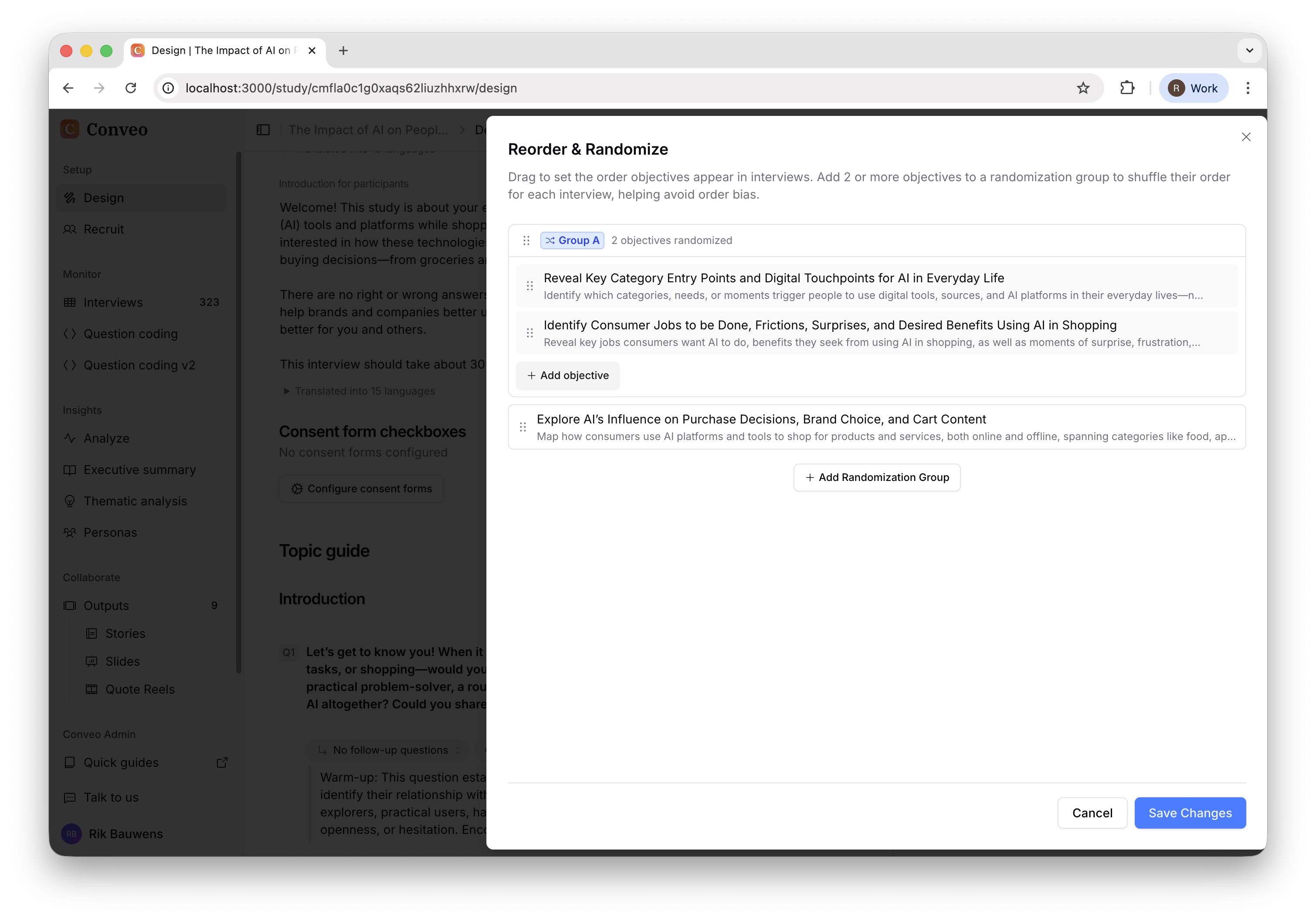
* Sections in the same **randomization group** appear in a random order for each interview
* Each interview gets a unique shuffle, but the same interview always sees the same order (deterministic)
* Sections outside any randomization group keep their fixed position — use this for icebreaker or closing questions that should always come first or last
### Setting Up Randomization Groups
1. Click **Reorder & Randomize** on your topic guide
2. Click **Add Randomization Group** to create a new group
3. Use the dropdown to add sections to the group
4. Sections in the same colored group will be shuffled together
5. Click **Save Changes**
 ### Distribution & Balancing
Randomization groups control the **order** of sections, not which sections a participant sees. Every participant goes through every section in the group — just in a different order. The order is a purely random shuffle with no balancing algorithm applied.
For example, with 3 sections in a group:
* Participant 1 might see: A → B → C
* Participant 2 might see: C → A → B
* Participant 3 might see: B → C → A
All participants answer the same content, just in a different order.
This is different from **stimulus randomization** (randomized images/videos), which controls *which* content a participant sees and uses a balanced algorithm to ensure an equal split across participants.
### Tips
* Groups with only 1 section won't be randomized (you need at least 2)
* You can create multiple independent groups that shuffle separately
* Sections not in any group maintain their fixed position
* Use this to reduce primacy/recency bias in your research
***
**Need help?** Contact us at [support@conveo.ai](mailto:support@conveo.ai)
### Distribution & Balancing
Randomization groups control the **order** of sections, not which sections a participant sees. Every participant goes through every section in the group — just in a different order. The order is a purely random shuffle with no balancing algorithm applied.
For example, with 3 sections in a group:
* Participant 1 might see: A → B → C
* Participant 2 might see: C → A → B
* Participant 3 might see: B → C → A
All participants answer the same content, just in a different order.
This is different from **stimulus randomization** (randomized images/videos), which controls *which* content a participant sees and uses a balanced algorithm to ensure an equal split across participants.
### Tips
* Groups with only 1 section won't be randomized (you need at least 2)
* You can create multiple independent groups that shuffle separately
* Sections not in any group maintain their fixed position
* Use this to reduce primacy/recency bias in your research
***
**Need help?** Contact us at [support@conveo.ai](mailto:support@conveo.ai)