


Chat with personas built from your study's interviews
Conveo turns your interviews into personas with a profile, linked quotes and the participants behind them. Chat with any persona to explore ideas.
 Florian Hendrickx
At a glance
- Personas are generated from the interviews in your study, with the participant count shown
- Each persona has a profile, an About summary and quotes linked to their source
- See exactly which participants make up each persona
- Chat with a persona to try out copy, concepts or follow-up questions
- Labeled beta: use personas for ideation and confirm big decisions with real participants
A persona deck from last year sits in a shared drive, and the people in it no longer sound like the customers in your latest interviews. Then a marketer asks how one segment would take a new line of copy, and the honest answer is that nobody asked. The next study is weeks away. Personas in Conveo are built from the interviews you just ran, so the profile and the evidence behind it sit in the same place.
AI personas, how they work and what they change, no sound needed.
How it works
Conveo builds the personas. Once interviews are in, the Personas tab groups participants into a few personas and shows how many participants they were derived from.
Each persona gets a profile. A name, a one-line description, profile tags such as age, location or job, an About summary and quotes from the interviews, each linked to its source.
You see who is behind it. The participant list under each persona shows the people it is based on, so you can go back to their interviews.
You can chat with it. Open a chat and ask how the persona would react to a message, a concept or a question your guide did not cover. It answers in character, based on its profile.
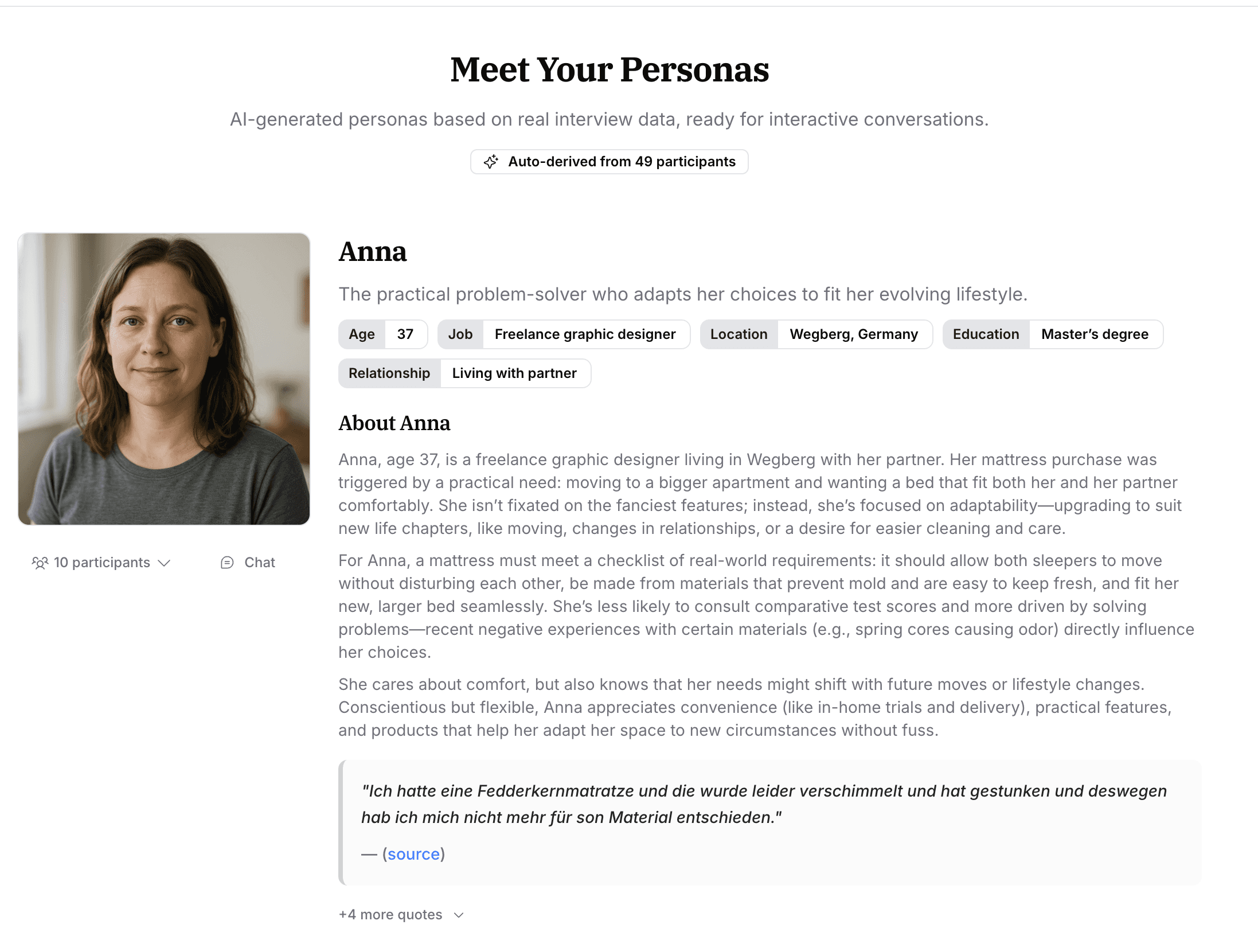
Every persona starts from your own participants
Teams often ask whether this is synthetic data. Each persona summarizes real people who took part in your study, the quotes come from their interviews, and the participant list shows exactly who they are.
Research teams asked for it in four situations
These come from teams we work with in food and drink, retail, financial services and creative agencies. We kept them anonymous.
Questions that come up after fieldwork. A stakeholder asks something the guide did not cover, and the team wants a first read before deciding whether it needs a new study.
Checking copy and messaging drafts. Writers run a new line past the personas to see which segment it speaks to and where it might fall flat.
Early reactions to concepts and creative. Ideas still in development get a first round of sparring before they go in front of real consumers.
Sharing who the customer is with other teams. Product, marketing and sales get a profile they can read in a minute, with quotes and interviews one click away.
See how a persona keeps the evidence attached
Follow a persona from interview evidence to profile, participant list and source-linked chat.
What this means for your research
The people you interviewed stay within reach after the report is out. Anyone on the team can put a question to a persona, then check the quotes and interviews it rests on.
Some limits to know. Personas are labeled beta in the app and work best for ideation. A persona drawn from a small sample can blur real differences, so check its participant count before you lean on it. Treat chat answers as hypotheses: for answers grounded in the interview data, use Talk to your data, and confirm high-stakes decisions with real participants in a follow-up study.