


Ask single and multi-select questions during interviews
Participants pick from a list you define, the AI research assistant asks why, and the answers come back as charts you can filter and compare.
 Hendrik Van Hove
At a glance
- Add Single-select and Multiselect questions anywhere in your topic guide
- Shuffle or fix the option order, pin "None of these" and set exclusive answers
- The AI research assistant follows up on each answer to get the reason
- Selected answers become direct-count charts you can filter, crosstab and export
- Use the answers to route later questions and compare groups
Release details
- Shipped
- Area
- Study design
- Kind
- New
- Author
- Hendrik Van Hove
Ask twenty people why they buy a brand and you get twenty good stories, but no clean count of who chose it. The usual fix is a separate survey, often with different people, and an afternoon spent lining the answers up. Quantitative questions put the count and the reason in the same video conversation, from the same participant.
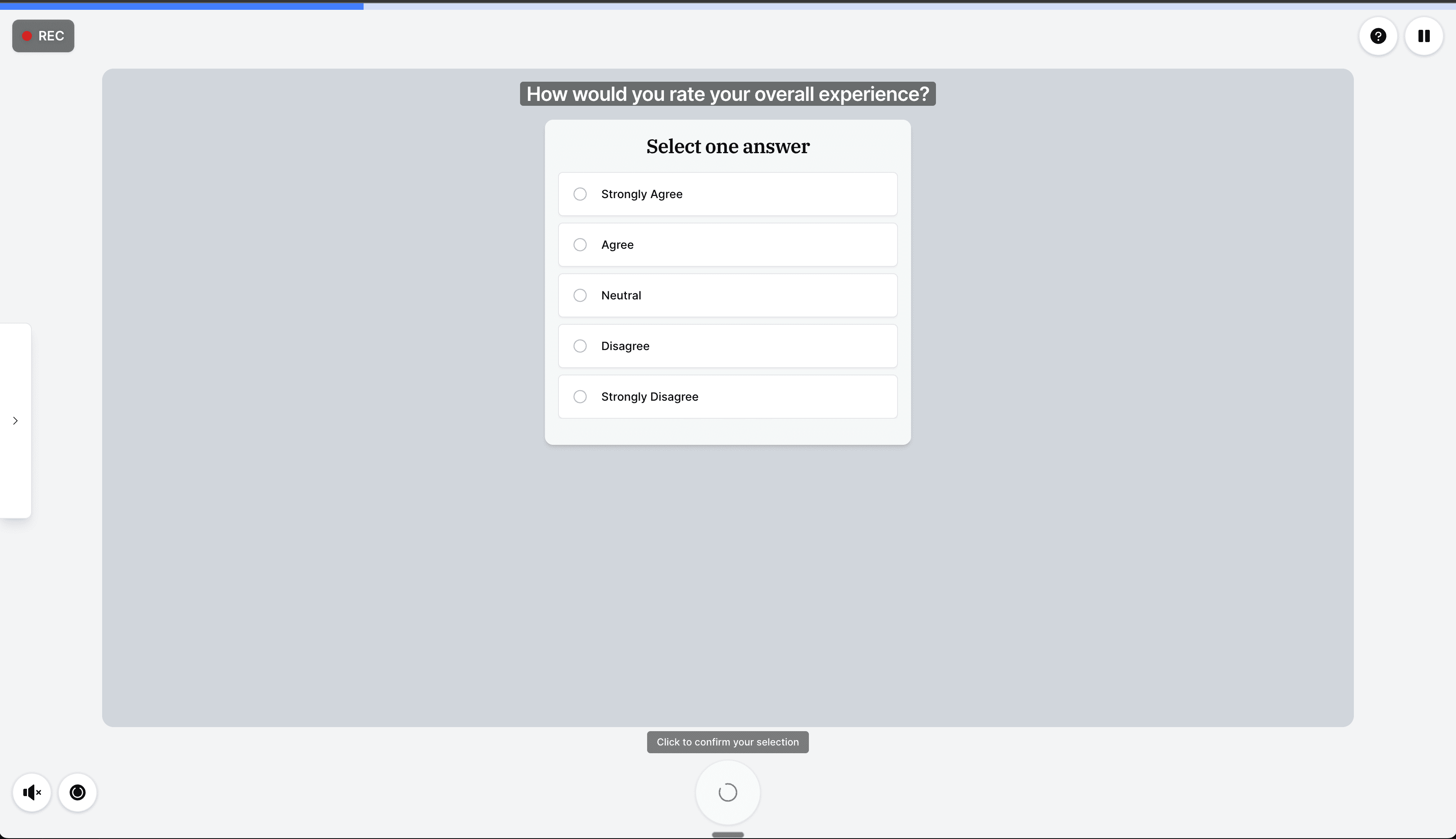
Quantitative questions, how they work and what they change, no sound needed.
How it works
Pick the question type. In your topic guide, choose Single-select for one answer from a list, or Multiselect when participants can pick several.
Write the answer options. Keep them in a fixed order or shuffle them, and pin an option such as "None of these" to its place. In a multiselect, mark an option as mutually exclusive when it has to be picked on its own.
Participants choose, then talk. The options appear on screen during the interview and participants confirm their pick. The AI research assistant then asks about the answer, with the follow-up depth you set for the question.
Answers are counted for you. Selected answers show up in question coding as direct-count charts, separate from AI-coded categories.
Use the answers to filter, compare and route
Structured answers work as filters. Select everyone who picked one option to see how their summaries differ, or crosstab against another question. The same answers can drive question routing, so later questions only reach the people they apply to. Answer options are translated with the rest of the guide.
Research teams asked for it in five situations
These come from teams we work with in consumer goods, food and drink, consulting, travel and market research agencies. We kept them anonymous.
Scales with a follow-up. Purchase intent, satisfaction or expected use on a numbered scale, then a question about why someone chose that number.
Brand and product choice. Which brand, pack or option people prefer, followed by the reasons behind the pick.
Numbers for stakeholders. A few closed questions so the qualitative story comes with counts the business can quote.
Profiling at the start. Usage frequency, current product or role, asked as fixed answers before the conversation opens up.
One study instead of a survey plus interviews. The same participants give both kinds of data, so nothing has to be matched across studies.
What this means for your research
You get the count and the reason from the same person in the same session, with no second study to field or merge. The choice questions also give you clean groups to cut the rest of the interview by.
Some limits to know. Percentages from a few dozen interviews show direction; sizing a market still calls for a representative survey. Routing can skip a question for some participants, so check each chart's base before you share it.
See one choice stay connected from guide to chart
See how one participant's selection stays attached to the follow-up, direct-count chart, filter, routing rule and source video conversation.
Read the topic guide setup guide for question types and options, and the question coding guide for the charts.