In this article
TL;DR
Qualitative research is no longer constrained by time, headcount, or geography. AI now enables research teams to run hundreds of real conversations in parallel, analyze voice, video, and text simultaneously, and surface findings in hours instead of weeks. This guide explains how AI is changing qualitative research at each stage of the methodology, design, fieldwork, analysis, and knowledge compounding, and what rigorous AI-powered qual looks like in practice.
Why qualitative research is having its moment
For decades, qualitative research carried a reputation problem it did not deserve. The insights were irreplaceable: no survey captures the hesitation in a customer’s voice, or the contradiction between what someone says and what their face does. But the operational reality was hard to defend. A six-to-twelve week agency cycle. Analysis bottlenecks that stretched long after fieldwork closed. Findings locked in reports that nobody revisited.
That operating model shaped how organizations funded qual. If you could not get a finding in time to influence the decision it was meant to inform, you stopped commissioning qual for fast-moving decisions. Product launches went ahead without the customer understanding that might have changed them. Positioning decisions were made based solely on survey data. Segments that deserved exploration got a slide deck instead.
The depth that made qualitative research valuable (real conversation, emotional nuance, unexpected directions) is no longer in tension with the speed and scale organizations demand. Research teams running AI-augmented qualitative programs today report 70-90% reductions in time from fieldwork to findings, without sacrificing the rigor that made the investment worthwhile.
This is not about replacing qualitative research with something cheaper and faster. It is about removing the operational constraints that were misread as inherent limitations of the method.
How AI changes the qualitative research methodology
AI does not intervene at a single point in the research process. It changes what is possible at every stage: how interviews are designed, how conversations are conducted at scale, how analysis is performed, and how organizations retain and build on what they learn. Understanding each stage matters because the workflows and platforms that serve one stage well do not all serve the others.
Stage 1: Research design and adaptive question architecture
Traditional qualitative interview guides are fixed documents. A researcher writes a topic guide, it gets signed off on, and every participant gets roughly the same questions in roughly the same order. Good moderators probe and adapt, but their bandwidth is finite. In a group, the guide is even more constrained.
AI-augmented qualitative research changes the structure of the guide itself. Rather than a static sequence, the interview becomes a branching system: a core framework with AI-generated follow-up logic that responds to what each participant actually says. When a participant introduces a concept that the guide did not anticipate, the AI can probe it. When a response is thin, it can be asked again differently. When a theme emerges across multiple participants, the system can deepen coverage in real time.
Conveo’s research across enterprise deployments shows that more than 50% of breakthrough insights emerge from AI-generated follow-up questions rather than the original guide questions, conversations going somewhere the researcher’s document could not have predicted. As one Senior Insights Manager at Orange put it: “Conveo spotted patterns our team missed overnight, revealing customer pain points that transformed our product roadmap.”
This is not a convenience feature. It is a shift in what qualitative interview design means: from writing a script to building a responsive inquiry framework.
Stage 2: Fieldwork at scale
The practical ceiling on traditional qualitative fieldwork is human moderator capacity. One researcher moderating live can conduct a limited number of interviews per week. A focus group runs eight to ten participants and takes two hours. Scaling qualitative means adding headcount, adding time, or accepting shallower methods.
Conveo’s asynchronous video interview architecture changes this ceiling entirely. Participants complete video or voice interviews on their own schedule, in their own language, and Conveo’s AI moderator adapts and probes throughout, applying the same branching follow-up logic as a trained researcher, at any volume. A research program that would have taken six weeks of fieldwork can run in days, with participants across multiple markets contributing simultaneously.
This has practical implications for research design:
Sample depth
Teams that previously ran twelve interviews because logistics prevented more now routinely run sixty or eighty, with richer follow-up per participant than a human moderator could sustain across that volume.
Global reach without translation lag: Real-time AI translation across 50-plus languages means cross-market studies no longer require separate fieldwork phases or separate analysis pipelines. Markets that were routinely excluded for cost reasons become standard inclusions.
Participant honesty
A consistent finding across AI-moderated research programs is increased disclosure. Participants discussing sensitive topics (health decisions, financial behavior, relationship dynamics) often share more candidly with an AI interviewer than with a human moderator. Conveo’s own usage data shows 83% of participants report openness comparable to or greater than their experience with human interviewers.
Respondent accessibility
Hard-to-reach participants (shift workers, caregivers, participants across time zones) can engage asynchronously without coordinating schedules with a moderator.
Stage 3: Analysis and synthesis
Traditional qualitative analysis is where the time goes. Transcription takes days. Manual coding takes weeks. Researchers read, re-read, mark up, build code frames, refine them, and debate themes with colleagues before anything close to a finding emerges. In practice, analysis is often compressed because the deadline does not move when the transcripts arrive late.
Conveo’s analysis engine operates across three dimensions simultaneously:
Multimodal processing
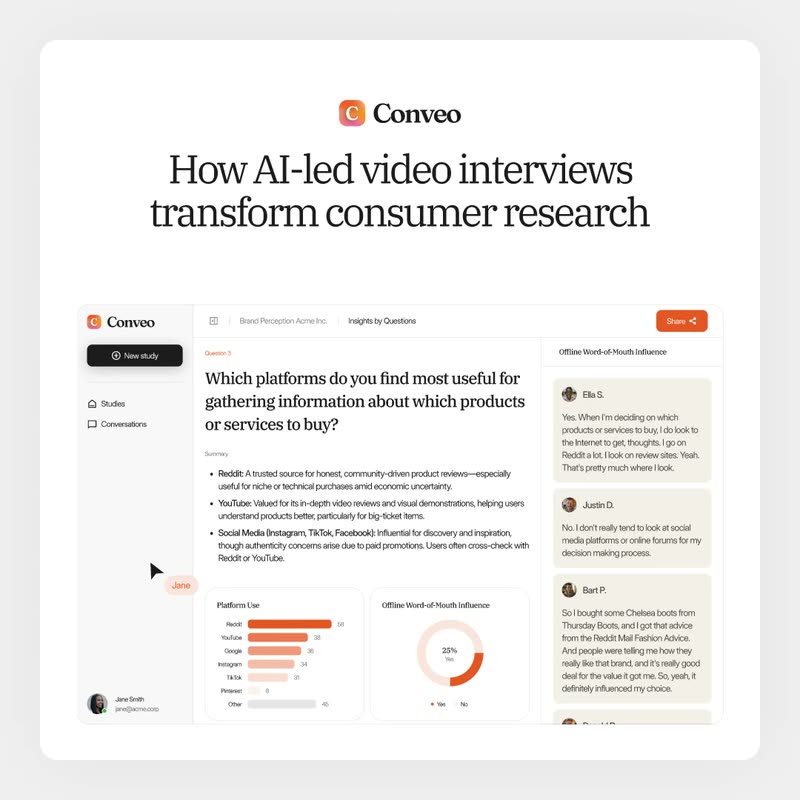
Text-only analysis misses most of what is happening in a qualitative interview. Voice (pitch, pace, hesitation, emphasis) carries emotional information that transcript text cannot represent. Facial expression adds another layer: what someone says and how their face responds to saying it are often different. Conveo processes audio, video, and text simultaneously, extracting sentiment across all three channels rather than collapsing the interview to its words.
Automated coding and theme generation
Conveo generates a preliminary code frame from completed interviews within minutes, grouping responses by theme, flagging outliers, and attaching confidence scores to each cluster. This does not replace researcher judgment; the preliminary structure requires review, challenge, and interpretation, but it changes what researchers spend their time on. Rather than building the initial structure from scratch, they are interrogating, refining, and challenging a draft.
Traceability from insight to source
The practical risk of AI analysis is opacity: a finding that cannot be traced back to a participant response is not a finding; it is a confabulation. Conveo’s analysis architecture keeps every theme, quote, and sentiment score connected to its source video or transcript segment so that researchers can challenge any output, and stakeholders can see the evidence behind any claim.
Insights teams running on Conveo consistently report analysis timelines of hours rather than weeks, with findings ready to present the day after fieldwork closes.
Stage 4: Knowledge compounding
Traditional qualitative programs produce findings relevant to a single decision cycle. The next project starts from scratch: a new screener, a new guide, new recruitment, and a new analysis. Institutional knowledge accumulates slowly and sits in documents nobody searches.
AI-powered qualitative research creates a different possibility. When each study is captured with consistent tagging, structured analysis, and searchable video evidence, the findings compound. A study conducted this quarter connects to a study from eighteen months ago on a related topic. A new product team can search an insight library for prior customer language around a category before commissioning fresh research.
Conveo’s insight library uses semantic search across historical research, meaning teams can query past studies in plain language and surface relevant participant responses, themes, and video evidence without knowing which project they came from. Research stops being a series of isolated projects and becomes a growing organizational asset that grows more valuable with each study added.
This changes how research is funded and valued. A program that might once have been justified on a single-use basis can now be justified as a contribution to a permanent knowledge infrastructure, one that returns value across every team that commissions research in the same category.
"Powerful if you can just look back and just ask AI about the past."
Insights Manager, ASICS
What rigorous AI qualitative research looks like in practice
Not all AI-augmented qualitative research is equal. The shift to AI raises a legitimate question: What does quality control look like when AI is moderating, coding, and synthesizing? The answer is not that quality is irrelevant. It is that the signals of rigor differ and are worth knowing before evaluating any platform or workflow.
Real participants, not synthetic respondents
This is the most important distinction in the market right now. A growing number of platforms use AI-generated respondents (profiles built from training data) to simulate what real people might say. It is faster and cheaper than recruiting real participants, but it is not qualitative research. Synthetic respondents cannot produce the unexpected direction a real person takes, the emotional disclosure that changes the interpretation of a finding, or the behavior that contradicts a stated preference. Conveo only runs research with real participants. AI augments those conversations, probing, coding, and analyzing, but the humans in the research are real people.
Researcher-in-the-loop design
AI should augment researcher expertise, not replace it. Research programs that produce trustworthy findings keep experienced researchers in control of the inquiry framework, the analysis review, and the interpretive layer. The AI handles scale and surface-level pattern detection; the researcher handles meaning, context, and the questions worth asking in the first place.
Full insight traceability
Every theme, sentiment score, and key finding should link directly to its source material. If a platform cannot show you the participant video behind an insight, the insight cannot be trusted. Traceability is not a premium feature. It is the minimum condition for research that can be defended to stakeholders.
Transparent AI logic
AI-generated follow-up questions and coding outputs should be explainable. Black-box analysis that produces findings without a visible methodology is difficult to peer-review and impossible to challenge. Look for platforms that surface their question-generation logic and allow researchers to audit coded themes against raw transcripts.
Security and compliance fit for enterprise data
Qualitative research often captures sensitive participant disclosures. Enterprise-grade data handling is not optional: it is the condition under which research can be done at all in regulated industries or with sensitive populations. SOC 2 Type II certification, GDPR compliance, EU data residency options, and role-based access controls are standard requirements for any research program handling personal data.
Applying the methodology: use cases and workflow principles
Concept and positioning research across markets
A consumer goods team testing three positioning concepts across four European markets would traditionally run twelve focus groups over six weeks, with separate recruitment, moderation, and analysis per market. With Conveo, the same programme runs as asynchronous video interviews across all markets simultaneously. Real-time translation means a German participant’s hesitation about a brand claim and a French participant’s enthusiasm for the same message are coded and compared in the same analysis run, without waiting for separate agency outputs.
The workflow: build a responsive interview guide with branching follow-up logic for each concept, recruit participants through integrated panels, run asynchronous interviews over five to seven days, review multimodal analysis with linked video evidence, and present findings with video highlight reels by market and concept within 48 hours of fieldwork closing. For organisations used to six-week cycles, this is a different kind of research capability.
Customer experience diagnosis
When qualitative research is fast enough to run continuously rather than periodically, it changes what it can diagnose. Teams using Conveo for rolling CX qual run short interview programmes tied to specific touchpoints (post-purchase, post-support, post-onboarding) rather than annual deep dives. Findings inform product and service decisions on the same cycle as the decisions being made.
A theme that appears weakly in one study and strongly in another six months later gets surfaced automatically through Conveo’s insight library, rather than relying on a researcher with a good memory. Patterns that would previously have required a retrospective analysis project emerge as a natural output of the ongoing programme.
Stakeholder-ready synthesis
One of the persistent gaps between qualitative research and decision-making is the translation problem: findings that live in a researcher’s head, or in a 60-page report, do not easily travel to product teams, finance, or leadership.
Video evidence changes this. Exporting themed highlight reels (short clips of participants speaking in their own words, organised by insight) turns qualitative findings into content that does not require a researcher to be in the room. Stakeholders who would not read a transcript will watch a 90-second compilation of customers describing the same problem in different ways. Conveo’s video export and highlight reel tools package qualitative evidence in formats that build cross-team alignment without requiring the researcher to re-present their work to every stakeholder group.
How Conveo delivers this methodology at enterprise scale
The four stages described in this guide (adaptive interview design, scaled asynchronous fieldwork, multimodal analysis, and compounding knowledge) are the architecture on which Conveo is built. Each stage is integrated with the others: the same platform that designs the interview guide runs the asynchronous fieldwork, generates the analysis, and stores findings in the searchable insight library.
Conveo is built for enterprise research teams running recurring, high-stakes qualitative programmes across CPG, pharma, financial services, and tech. Clients, including Google, Reddit, FOX, and Bosch, run programmes across 50-plus languages with EU-hosted infrastructure and SOC 2 Type II certification. Findings go from fieldwork to presentation in hours, not weeks.
If your team runs occasional ad hoc qual projects or primarily needs survey analysis, Conveo may not be the right fit. If you run recurring qualitative programmes and need findings that can actually influence decisions in progress, the methodology described here is what Conveo delivers in practice.
Frequently Asked Questions
What is AI qualitative research methodology?
AI qualitative research methodology refers to the application of artificial intelligence across each stage of the qualitative research process: designing adaptive interview guides, conducting asynchronous video or voice interviews at scale, performing multimodal analysis of audio, video, and text simultaneously, and building compounding knowledge libraries from accumulated study outputs. The core principles remain those of rigorous qualitative research (real participants, genuine conversation, interpretive analysis), with AI augmenting what researchers can do rather than replacing their judgment.
How reliable are AI-moderated qualitative interviews?
Reliability in AI-moderated research depends on three things: the quality of the interview framework (built by experienced researchers, not generated from scratch), the traceability of findings to source material (every insight should link to a specific participant response), and the use of real participants (not synthetic respondents). Conveo validates every AI-generated follow-up question against the original research framework and links every insight directly to the raw video transcript, achieving over 90% theme accuracy in Conveo's internal benchmark studies.
Can AI replace human judgment in qualitative research?
No. AI handles the tasks that constrain scale: transcription, initial coding, pattern detection, and follow-up question generation at volume. Human researchers handle the work that gives those patterns meaning: hypotheses, contextual interpretation, the decision about which findings matter, and why. Conveo is designed as a research partner that takes operational load off expert researchers, so they can focus their time on the questions that require human judgment.
How fast can AI qualitative research deliver results?
Programs using Conveo routinely deliver complete interview analysis within hours of fieldwork closing, compared to a four-to-six week timeline for equivalent traditional agency research. This comes from automated transcription, real-time AI moderation, instant theme generation, and multimodal analysis running in parallel rather than sequentially. The more significant shift is that research can now run on the same cycle as the decisions it is meant to inform.
What data privacy standards apply to AI qualitative research?
Enterprise qualitative research involves sensitive participant data and often operates under GDPR, sector-specific regulations, or internal data governance requirements. Key standards to verify: SOC 2 Type II certification (independent security audits), GDPR compliance with explicit data processing agreements, EU data residency options, role-based access controls, and a policy of not training AI models on client research data without explicit permission.
What is the difference between AI qualitative research and synthetic research?
Synthetic research uses AI-generated respondents (profiles built from training data) to simulate what real people might say. It is faster and cheaper than recruiting real participants, but it is not qualitative research. It cannot capture the unexpected direction a real person takes, the emotional disclosure that changes the interpretation of a finding, or the behavior that contradicts a stated preference. Rigorous AI qualitative research uses real participants and real conversations. AI augments those conversations (probing, coding, analyzing), but the humans in the research are real people.

About the author
Niels Schillewaert
Head of Research and Methodologies
Twenty-nine years in consumer research. Niels co-founded Human8 (formerly InSites Consulting), served as president of ESOMAR and teaches marketing at Vlerick Business School. At Conveo he sets the methodology and pressure-tests every feature against real-world research practice.
Meet Niels on film →Qualitative insights at the speed of your business.
Conveo runs AI-moderated video interviews and structures everything they say.