In this article
TL;DR
Focus groups cost enterprise teams $8,000–$15,000 per study and 6–12 weeks of logistics for a single round of findings. This article covers five credible alternatives to focus groups, comparing costs, timelines, and trade-offs across all major qualitative research methods. Asynchronous video interviews deliver actionable consumer insights without the logistical constraints that make traditional focus groups impractical to run continuously.
By the time the focus group report comes back, the decision is usually already made. A product launch brief gets finalized. A campaign concept gets approved. A pricing model gets locked. The research that was supposed to inform those decisions arrives afterward, confirming what the team already chose or, worse, surfacing something that would have changed the outcome.
The economics of traditional focus groups make this problem structural rather than accidental. Venue rental, professional moderator fees, participant incentives, and the logistical requirement that six to ten people show up in the same room at the same time add up to a cost and timeline most companies cannot sustain on a recurring basis.
The result: market research gets rationed. Teams run two or three studies a year instead of the 20 or 30 their stakeholders actually need, and qualitative understanding becomes a periodic event rather than a continuous practice.
This article examines five categories of alternatives to focus groups, compares their tradeoffs, and shows how teams choose among them based on research objectives and operational constraints.
Comparison table: Focus group alternatives
| Method | Cost per Study | Timeline | Depth | Scalability | Best For |
|---|---|---|---|---|---|
| Traditional focus groups | $8,000–$15,000 | 6–12 weeks | High (group dynamics) | Low | Co-creation and stakeholder observation |
| Online focus groups | $5,000–$10,000 | 4–8 weeks | High (group dynamics) | Low (live moderator) | Remote group interaction without venue costs |
| 1:1 interviews | $3,000–$8,000 | 4–8 weeks | Very high (no group bias) | Low (sequential) | Sensitive topics and behavioral depth |
| Asynchronous video interviews | $1,000–$3,000 | Days to 2 weeks | Very high (adaptive probing) | Very high (parallel) | Continuous research at scale across markets |
| Ethnography | $10,000–$25,000 | 8–16 weeks | Very high (contextual) | Very low (8–15 participants) | Understanding product usage in natural environments |
| Online communities | $8,000–$20,000 setup + ongoing | Ongoing | Medium | Medium (recurring panel) | Longitudinal tracking and co-creation |
Cost ranges reflect typical agency-commissioned studies in North America. Timelines include recruitment, fieldwork, and analysis.
Why teams look for focus group alternatives
Focus groups carry a cost structure that makes them impractical as a recurring research method. Venue rental, professional moderator fees, participant incentives, and travel expenses create a $5,000–$15,000 per-session baseline before a single insight is captured. At that price point, most teams can afford two or three studies a year, not the continuous cadence that modern product and brand decisions actually require. Running them at that frequency simply is not cost-effective.
Timeline pressure compounds the problem. Coordinating venue availability, moderator scheduling, and participant recruitment stretches the process to 6–12 weeks from brief to debrief. The process is time-consuming by design: every stage depends on lining up the same people in the same place at the same time. By the time findings land, the campaign has shipped, or the product decision has already been made.
Multi-market research adds another layer. Each geography requires a separate session, separate recruitment, and separate moderation, multiplying both cost and elapsed time without proportional gains in data accuracy or insight quality.
Group dynamics impose a methodological constraint that cost alone cannot capture. Dominant voices pull conversations. Social desirability effects push participants toward consensus rather than candor. When qual budgets stay flat while deadlines compress, teams need qualitative research alternatives that preserve depth without the venue and moderator dependencies.
5 alternatives to focus groups
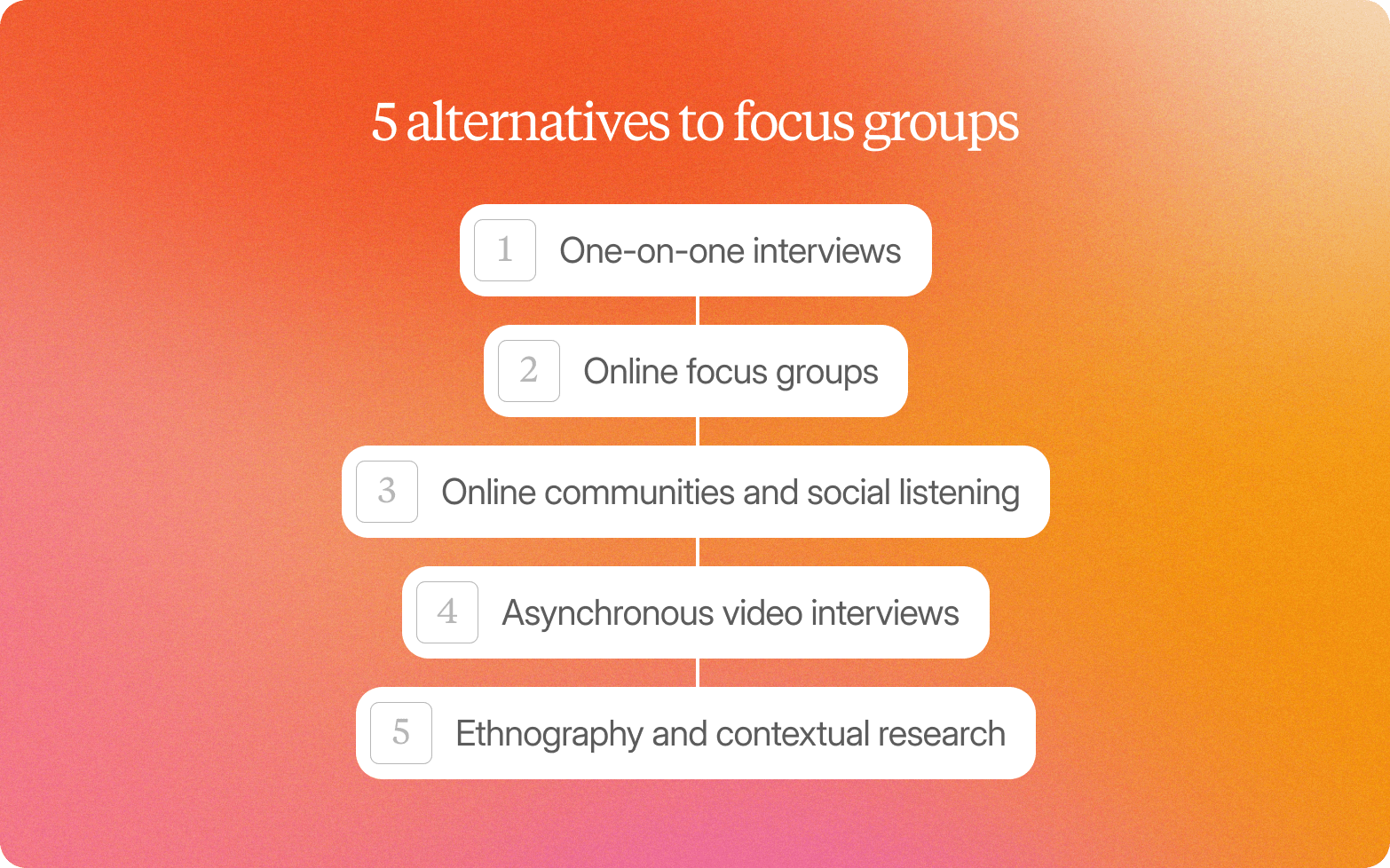
The five main group alternatives to focus groups each represent distinct qualitative research methods with different trade-offs among depth, speed, cost, and scalability: one-on-one interviews; group-based alternatives, including online focus groups and research communities; asynchronous video interviews; ethnography and contextual research; and social listening. The sections below break down where each performs well and where it falls short.
One-on-one interviews
Individual interviews strip out the group dynamics that distort focus group data. Without a dominant voice steering the room or social pressure shaping responses, participants share more candid opinions, particularly on sensitive topics like pricing reactions, competitive preferences, or experiences with product failures. This capacity for deep exploration is why in-depth interviews remain a trusted alternative to focus groups for behavioral and attitudinal research. User interviews in this format produce unfiltered perspectives that a group setting rarely surfaces.
The traditional format incurs real logistics costs. Sequential moderation means 10 interviews take as long as 10 separate sessions, and scheduling adds weeks before synthesis can begin.
AI-moderated interviews change that equation. Sessions run in parallel, so a team can conduct 10 or 1,000 one-to-one interviews in the same window rather than queuing them one at a time. Removing live moderator dependency reduces per-interview costs and eliminates the scheduling bottleneck that makes traditional IDIs impractical at scale.
Online focus groups
When teams ask for an alternative to focus groups in a digital context, online focus groups are the first method that comes to mind: they replicate the traditional group setting via video conferencing, removing venue costs and expanding access for geographically dispersed participants. A live moderator is still required; all participants must be available at the same time, and group dynamics bias persists as dominant voices shape the group discussion. Per-session costs drop modestly, but recruitment and synthesis keep the overall timeline in the two-to-four-week range.
Online communities and social listening
Communities engage target consumers in ongoing dialogue and longitudinal tracking, in which participants provide feedback through structured discussions over weeks or months. Social listening captures unsolicited consumer language at scale. Neither can probe for the "why" behind a signal or produce the traceable evidence chain that high-stakes decisions require. Choose these for passive sentiment monitoring, not when you need decision-ready findings with a traceable chain of evidence.
Asynchronous video interviews
Asynchronous video interviews work differently from every other format on this list. Participants receive a link, open it on their own schedule, and provide responses to interview questions on video: no venue booking, no calendar coordination, no live moderator.
Watch: How AI moderation adapts in a real shopper interview
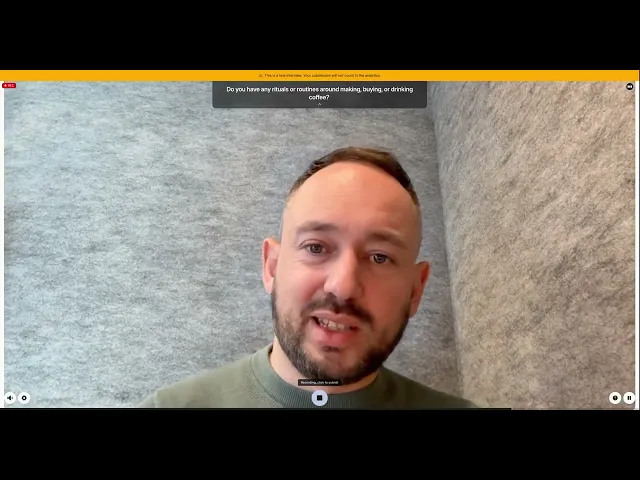
A traditional focus group requires eight participants, one moderator, and a shared time window. A single AI-moderated interview study can conduct a large sample of conversations in parallel, across time zones and markets. For multi-market research programs, this removes the calendar bottleneck that would otherwise turn a three-market study into a three-month project.
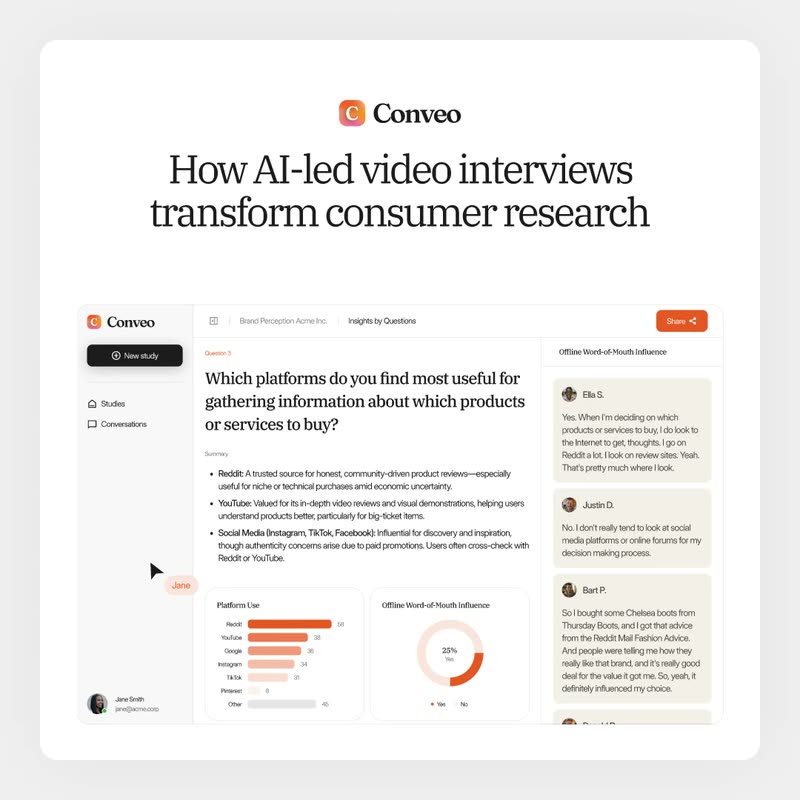
Online surveys and open-ended responses capture what people say. Video captures how they say it: the hesitation before answering a price question, the shift in tone when a brand name comes up, the facial expression that contradicts the words. Quantitative data tells you what happened; AI-moderated interviews explore the why. Probing questions that adapt in real time to what each person actually says produce the behavioral depth that surveys cannot reach.
Every finding links back to a timestamped clip and verbatim quote, actionable insights that stakeholders can inspect rather than accept on trust. Teams report cutting research timelines from 6–8 weeks to days, with research spend coming in at up to 75% lower than comparable agency-delivered qualitative work.
"Within days, we had insights that would've taken a traditional agency a month."
Head of Customer Insights, JDE Peet’s
Among the best alternatives to focus groups for enterprise research programs, asynchronous video interviews present the strongest case when depth, scale, and speed must all be achieved simultaneously.
Ethnography and contextual research
Ethnography places researchers inside the customer's world, observing how a product is used in a real kitchen, a shared office, or on a morning commute, rather than asking users to reconstruct the experience. That observational proximity gathers rich contextual detail, usage patterns, and environmental factors that no interview guide would think to probe.
The tradeoff is significant: researcher travel, extended observation, and manual synthesis stretch timelines to eight weeks or more, typically across eight to 15 participants. Diary studies and remote video diaries have emerged as cost-effective alternatives to traditional focus groups for global teams seeking contextual depth without travel overhead. Choose ethnography when you need to understand how customers actually use a product in their natural environment.
How to choose the right alternative: 5 dimensions
Planning the right research project means working through five dimensions.
Research objective
In any focus groups vs. AI qualitative research comparison, the objective is the first filter. For example, concept testing and packaging validation require depth and traceability: favor one-on-one interviews or asynchronous video. UX discovery that depends on observing users in their actual environment calls for video diaries or ethnographic methods.
Timeline
Decisions requiring answers in days need alternative approaches that do not depend on scheduling coordination or live moderation. Asynchronous video interviews can be fielded and closed within 48–72 hours. Decisions with a four- to six-week window can accommodate online focus groups or structured ethnography.
Budget
Studies costing $5,000–$10,000 can support live, moderated formats with a human researcher. Studies at $1,000–$3,000 favor asynchronous or AI-moderated formats. Companies running 10 or more studies per year need per-study costs low enough that commissioning a study is a routine decision, not a budget conversation.
Geographic scope
Single-market studies can use any method. Multi-market research compounds quickly with live moderation: separate sessions, separate moderators, separate timelines. Asynchronous video interviews support 50+ languages and run in parallel across markets.
Depth vs. continuity
Periodic research, even excellent research, produces findings that age. Continuous approaches build a compounding picture of your target audience that becomes more accurate and more valuable with every study added.
The right alternative to focus groups depends on whether you need depth, speed, scale, or all three, and whether your organization supports periodic research bursts or continuous customer understanding.
What focus group alternatives cannot replace, and how to compensate
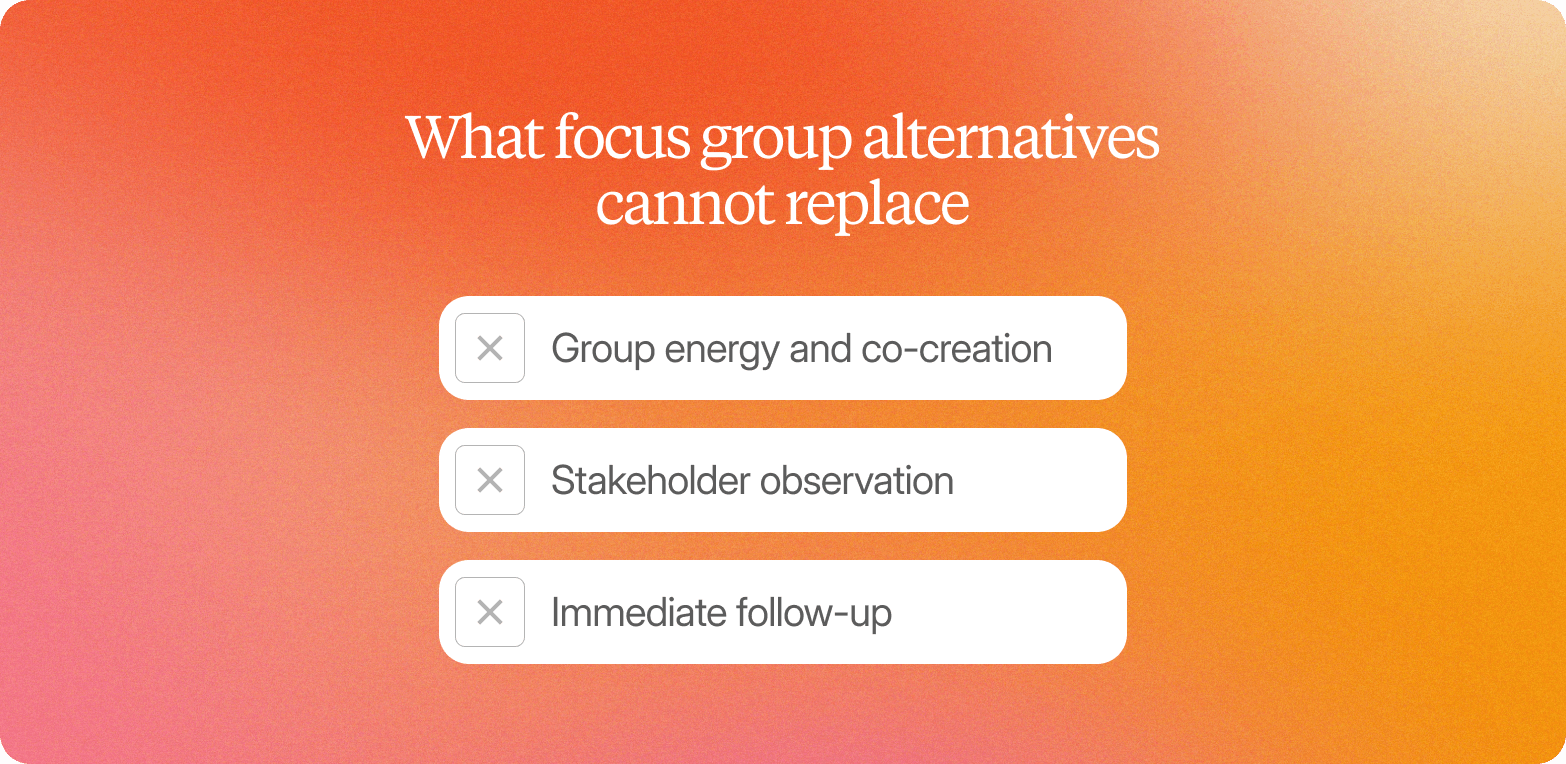
Any honest answer to the question of what an alternative to focus group research is has to start with what you give up. There are three genuine losses worth naming.
Group energy and co-creation
Focus groups enable real-time idea building in a group setting, where one participant's reaction sparks a direction no other participants anticipated. Modern alternatives do not replicate that dynamic. What they offer instead is individual depth synthesized into curated evidence reels: clips that are tagged, searchable, and replayable.
Stakeholder observation
Live sessions let observers form their own interpretations in real time. Video-first interviews produce shareable clips that stakeholders can review at their own pace, filter by theme, and cite directly in presentations.
Immediate follow-up
A skilled live moderator catches an unexpected response and probes it in the moment. AI-moderated interviews with adaptive probing adjust follow-up questions based on what a participant actually says, rather than on a rigid script, producing consistent depth across every session and avoiding reliance on moderator judgment or timing.
The question is not whether alternatives to focus groups replicate the format exactly. It is whether they deliver the depth, credibility, and speed your stakeholders require.
Trust and governance for enterprise research teams
For enterprise research teams, the question of which platform to use is never purely about workflow speed. It is about whether outputs will hold up when a CMI director presents findings to the C-suite, when procurement reviews a vendor contract, or when legal asks where participant data is stored.
Three concerns surface consistently at this evaluation stage.
Participant authenticity
Enterprise organizations need confidence that responses come from real, verified people, not bots, incentive farmers, or synthetic AI personas. Platforms vary significantly in how rigorously they screen for them. Video-first interviews provide an inherent layer of authenticity that text-based methods and chat-based research services cannot: a recorded face and voice are verifiable evidence that a real person participated.
Data governance
Not all research platforms publish compliance certifications. For teams handling EU data or operating in regulated industries, this is a disqualifying concern before a contract is signed, not a checkbox afterward. Conveo is SOC 2-certified and GDPR-compliant, with EU regional data hosting, which meets the procurement requirements that quietly stall vendors who have not invested in governance infrastructure.
Output traceability
Outputs that link directly to video clips and verbatim quotes give stakeholders the ability to analyze the evidence themselves, which makes findings defensible rather than merely persuasive.
How Conveo supports modern qualitative research
The fundamental constraints of focus groups are structural, not incidental: venue dependency, synchronized scheduling, and group dynamics that suppress honest responses are baked into the format itself. Conveo's video-first AI research platform is built around removing exactly those constraints while preserving the depth that made qualitative research valuable.
The AI interviewer adapts in real time to what each participant says, following up on hesitations and probing beneath surface-level answers to uncover actionable consumer insights that stakeholders can stand behind. Each finding links to a timestamped clip, so stakeholders can analyze the evidence rather than rely on a summary. Enterprise teams at Google, Reddit, FOX, and Bosch use Conveo to conduct qualitative research at a pace and scale that traditional focus group logistics cannot match.
Frequently Asked Questions
What is the best alternative to a focus group for large-scale qualitative research?
Asynchronous video interviews are the strongest alternative for large-scale qualitative research. They conduct a large sample of conversations in parallel, remove the need for live moderators and venue logistics, and produce traceable, stakeholder-ready consumer insights.
How do asynchronous video interviews compare to traditional focus groups in terms of cost?
Asynchronous video interviews typically cost $1,000–$3,000 per study compared to $8,000–$15,000 for traditional focus groups. The savings come from removing venue rental, moderator fees, and participant travel. For teams running multiple studies per year, the economics shift qualitative research from a periodic event to a continuous program.
Are focus group alternatives reliable enough for high-stakes enterprise research?
Yes, provided the alternative produces traceable, verifiable outputs. Enterprise stakeholders require actionable insights they can interrogate, not a summary they are asked to accept. Video-first platforms that link every insight to a timestamped clip and verbatim quote meet that standard.
How do online focus groups differ from asynchronous video interviews?
Online focus groups replicate the traditional group setting via video conferencing; they remove venue costs but retain live moderator dependence, synchronized scheduling, and group-dynamics bias. Asynchronous video interviews remove all three constraints: participants respond on their own schedule, AI moderation runs in parallel, and there is no minimum group size or shared group discussion to coordinate.
Can AI-moderated interviews replace focus groups for concept testing?
Yes, in most concept testing scenarios. AI-moderated interviews with adaptive probing can surface the same depth of consumer reactions as focus groups, without group bias. Each person responds independently, which tends to produce more diverse opinions. The tradeoff is that AI-moderated interviews do not replicate the real-time co-creation dynamic of group discussion, which some research objectives require.

About the author
Meg Gerli
Research Impact Lead
Meg is a Research Impact Lead at Conveo, working with insights and research teams on the studies they run with Conveo.
Meet Meg on film →Qualitative insights at the speed of your business.
Conveo runs AI-moderated video interviews and structures everything they say.