In this article
TL;DR
Healthcare qualitative market research uses in-depth interviews, focus groups, and observational studies with patients, clinicians, and caregivers to surface the motivations, behaviors, and decision-making processes that survey data cannot reveal.
Traditional qualitative research in healthcare takes 8–12 weeks from study design to final report, with recruitment alone accounting for a substantial share of that timeline
Conveo delivers the same depth in 5–7 days using asynchronous AI-led video interviews, automated transcription, and AI synthesis tied directly to video evidence
Every finding links back to its source: timestamped video, verbatim quotes, and emotion signals that stakeholders can inspect rather than take on faith
Conveo is SOC 2 certified, GDPR compliant, and offers EU data hosting, meeting the compliance requirements common in enterprise healthcare procurement
Best for: Insights, CMI, and research teams at healthcare and pharma enterprises that need continuous qualitative understanding at a pace that matches clinical and commercial decision cycles
Healthcare qualitative market research is at an inflection point. For decades, the discipline operated under a false tradeoff: you could have depth, or you could have speed, but rarely both. You could run rigorous, participant-grounded studies, or you could move fast enough to inform decisions before the window closed. That tradeoff is dissolving, and nowhere is this shift more consequential than in the healthcare industry.
The operational tension hasn’t disappeared, though. Healthcare teams, whether they sit inside pharmaceutical companies, health systems, or medical device manufacturers, need a deeper understanding of patients, caregivers, and providers to inform clinical development, product positioning, and care delivery models. That understanding has historically been slow to arrive. Decision windows close in days. Most traditional research programs take six to twelve weeks to deliver findings, leaving healthcare companies without the consumer insights needed to inform product development, shape marketing strategies, or respond to emerging trends. For pharmaceutical companies and medical device manufacturers developing new medical devices and treatments, the cost of that delay is measured in decisions made without real patient input.
This article covers the core qualitative methods used in healthcare market research, concrete examples of how those methods generate actionable insights across patient and provider contexts, and how modern platforms like Conveo have compressed the healthcare research cycle without sacrificing the methodological rigor or evidence traceability that healthcare contexts demand.
What is healthcare qualitative market research?
Healthcare qualitative market research is the practice of conducting in-depth interviews, focus groups, and observational studies with patients, caregivers, clinicians, and other healthcare stakeholders to understand the behaviors, motivations, and decision-making processes that quantitative methods cannot capture. Qualitative healthcare market research fills the gap between what people report doing and why they actually do it, surfacing the human behavior and patient preferences that shape real-world healthcare decisions.
That distinction matters in healthcare more than almost any other sector. An online survey can tell you that 40% of patients stop taking a prescribed medication within 90 days. It cannot tell you whether that dropout is driven by side effect anxiety, cost pressure, a caregiver’s skepticism, or a clinician who never explained the long-term benefit. Qualitative methods surface those reasons: the emotional reasoning, cultural context, and practical friction that shape health behaviors and care decisions. For insights teams, brand managers, and product leads, that comprehensive understanding is what makes research actionable rather than merely descriptive, and what turns qualitative data into a genuine competitive advantage over teams relying solely on numerical data.
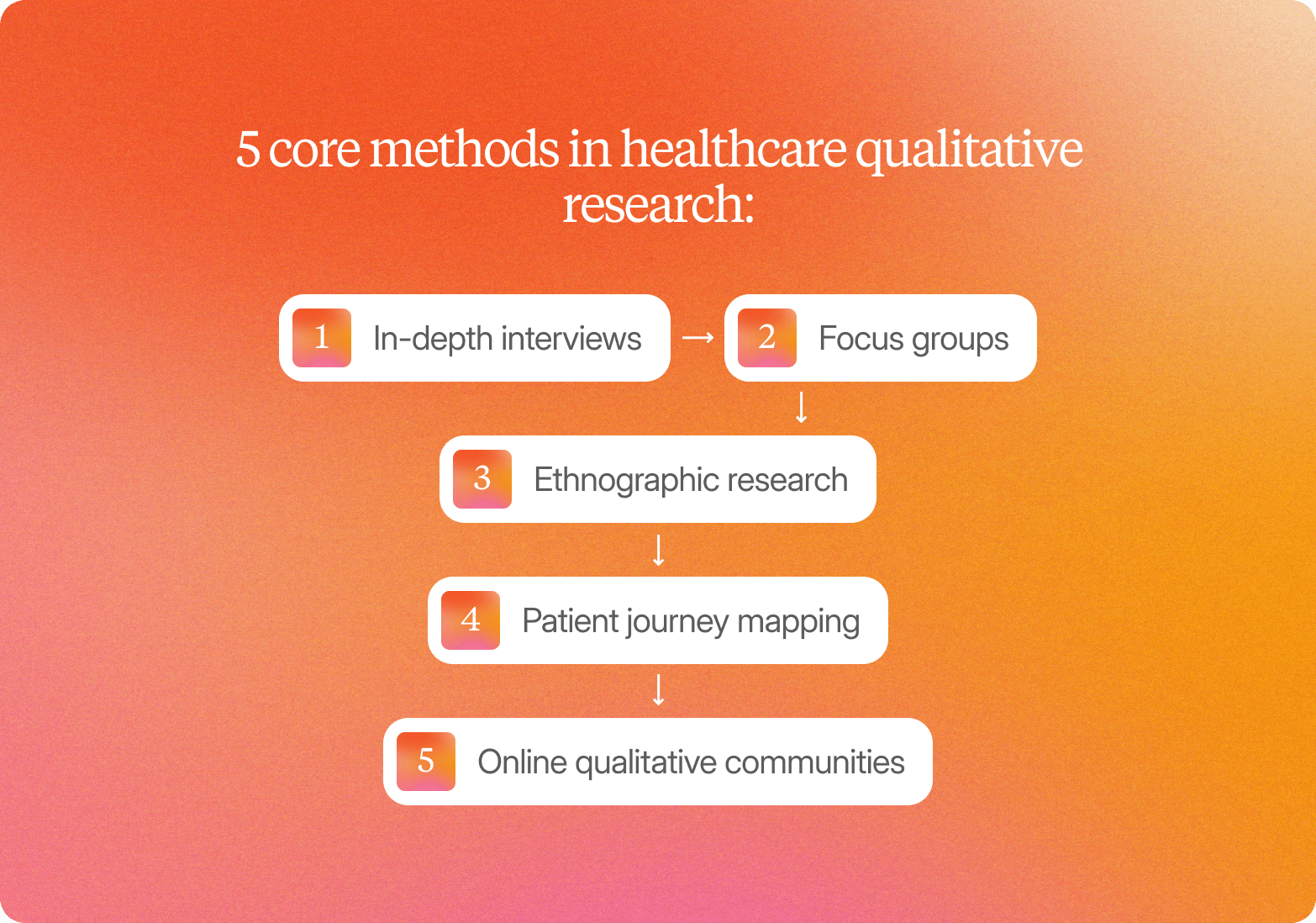
5 core methods in healthcare qualitative research
Healthcare qualitative research spans multiple methods, each suited to different research objectives and target audiences. Choosing the right approach depends on what you need to know, who you need to hear from, and how you plan to collect data from research participants.
In-depth interviews (IDIs)
One-on-one conversations with patients, caregivers, or healthcare professionals to explore individual experiences, treatment journeys, or decision-making processes. In-depth interviews are best for sensitive topics or when individual variation matters more than group consensus. When you need to gain a deep understanding of patient preferences or identify barriers to care adoption, this format allows research participants to speak candidly in ways that group settings rarely permit. Conveo’s AI interviewer conducts asynchronous video depth interviews at scale, removing the scheduling constraints that typically make IDIs the slowest method to field.
Focus groups
Moderated group discussions with six to ten research participants to surface shared attitudes, perceptions, and social dynamics around healthcare topics. Useful for concept testing, messaging validation, or understanding community norms around treatment. Focus groups are particularly effective when the research objective is to understand how healthcare professionals discuss a topic with peers, not just how they respond to it individually. Conveo’s format is optimized for individual video interviews rather than synchronous group sessions, so teams running focus groups will typically use a separate moderation setup for that method specifically.
Ethnographic research
Observing research participants, patients, or clinicians in real-world settings, including clinics, homes, and hospitals, to identify unspoken behaviors, workflow inefficiencies, or environmental factors that influence care delivery and health behaviors. Ethnographic research surfaces what participants cannot articulate in an interview because they have normalized it. This data collection method is particularly valuable for understanding how healthcare providers actually deliver care, rather than how they describe it, a distinction that is especially relevant in contexts where behavior and self-report diverge significantly.
Patient journey mapping
Structured interviews or workshops that trace a patient’s experience across touchpoints: diagnosis, treatment, follow-up, and discharge. Patient journey mapping identifies patient needs at each stage, pain points, emotional inflection moments, and gaps between what care teams intend and what patients actually experience. The qualitative data collected through this method directly informs product development, care pathway redesign, and patient-centric solutions that improve patient outcomes across the healthcare ecosystem.
Online qualitative communities
Asynchronous discussion boards or video diaries, where research participants share experiences over days or weeks. This approach is well-suited to longitudinal conditions or post-treatment recovery, where health behaviors evolve, and a single interview captures only a snapshot. Some healthcare teams also layer in social media listening and digital tools to complement the insights gained from these community studies, though these supplementary sources lack the depth and traceability of direct participant interviews.
Across healthcare market research examples, qualitative in nature, the method matters less than the mechanism: how quickly can the research be designed, fielded, the qualitative data collected, and delivered in a form stakeholders can act on?
Healthcare qualitative market research examples
Healthcare qualitative market research examples span a wide range of decision contexts: from understanding why patients stop taking medications to how clinicians actually use the platforms built for them. Each example below is framed as a representative scenario that reflects the kinds of studies healthcare organizations and pharmaceutical companies conduct when online surveys alone cannot capture the full picture.
Patient adherence research for chronic disease management
Consider a team researching medication adherence among diabetes patients. In-depth interviews conducted at the 90-day mark reveal that non-adherence is not driven by forgetfulness or cost, but by pill burden and the absence of visible progress. Patients cannot feel the medication working, so they quietly stop. That distinction, between logistical friction and psychological disengagement, leads the team to identify barriers to adherence, redesign the dosing regimen, and revamp patient education materials to support patient-centered care. The insights gained improve patient outcomes and, ultimately, market success for the treatment. An online survey tracking refill rates would have confirmed the drop-off. It would not have explained the underlying health behaviors driving it.
Physician perception study for a new treatment protocol
In a representative example from oncology, focus groups with practicing physicians exploring attitudes toward a new immunotherapy protocol surface concerns not captured in prescribing data: uncertainty about patient selection criteria and anxiety about reimbursement pathways. These concerns directly shape how healthcare professionals discuss the treatment with their target market. The research informs marketing strategies, sales training, and payer engagement strategy ahead of market entry, delivering a competitive advantage by surfacing physician decision-making processes before launch. Structured questionnaires would have measured awareness. They would have missed the hesitation underneath it.
Caregiver experience research for home health services
Consider a team using video diaries with family caregivers managing elderly relatives at home. The research reveals that burnout stems primarily from two sources: the absence of respite options and confusion about care coordination responsibilities, not the physical demands of daily care. That reframes the service design problem entirely and points toward patient-centric solutions that address the real drivers of caregiver stress and improve patient satisfaction. Satisfaction scores would have shown stress. They would not have shown where the healthcare ecosystem was failing caregivers, or what patient-centered care interventions were needed.
Clinician workflow research for EHR optimization
In a representative ethnographic study conducted in primary care clinics, researchers observe how healthcare providers interact with electronic health records during live patient visits. This is an increasingly common healthcare qualitative market research project for digital health companies looking to improve clinical tools and support patient-centered care at scale. The key finding: documentation requirements force physicians to look away from patients at critical moments, eroding rapport and trust. Interface redesign priorities shift accordingly. Usage analytics would have shown where clinicians clicked. They would not have shown what that behavior cost the patient experience.
Each of these healthcare qualitative market research examples required deeper insights and emotional context that online surveys cannot capture. Traditional moderated research would have taken 6 to 12 weeks to deliver findings. Conveo’s video-first AI-led interviews compress the research execution cycle, from fielding through synthesis, to as few as five to seven days, with every finding tied to the video clip and verbatim quote that produced it.
"Conveo's video-first approach is a real differentiating methodological advantage. The ability to distill insights from reactions and not just hear answers adds context you simply can't get from transcript-only tools, or any other tool in the market for that matter."
Senior Marketing Research & Insights Manager, Google
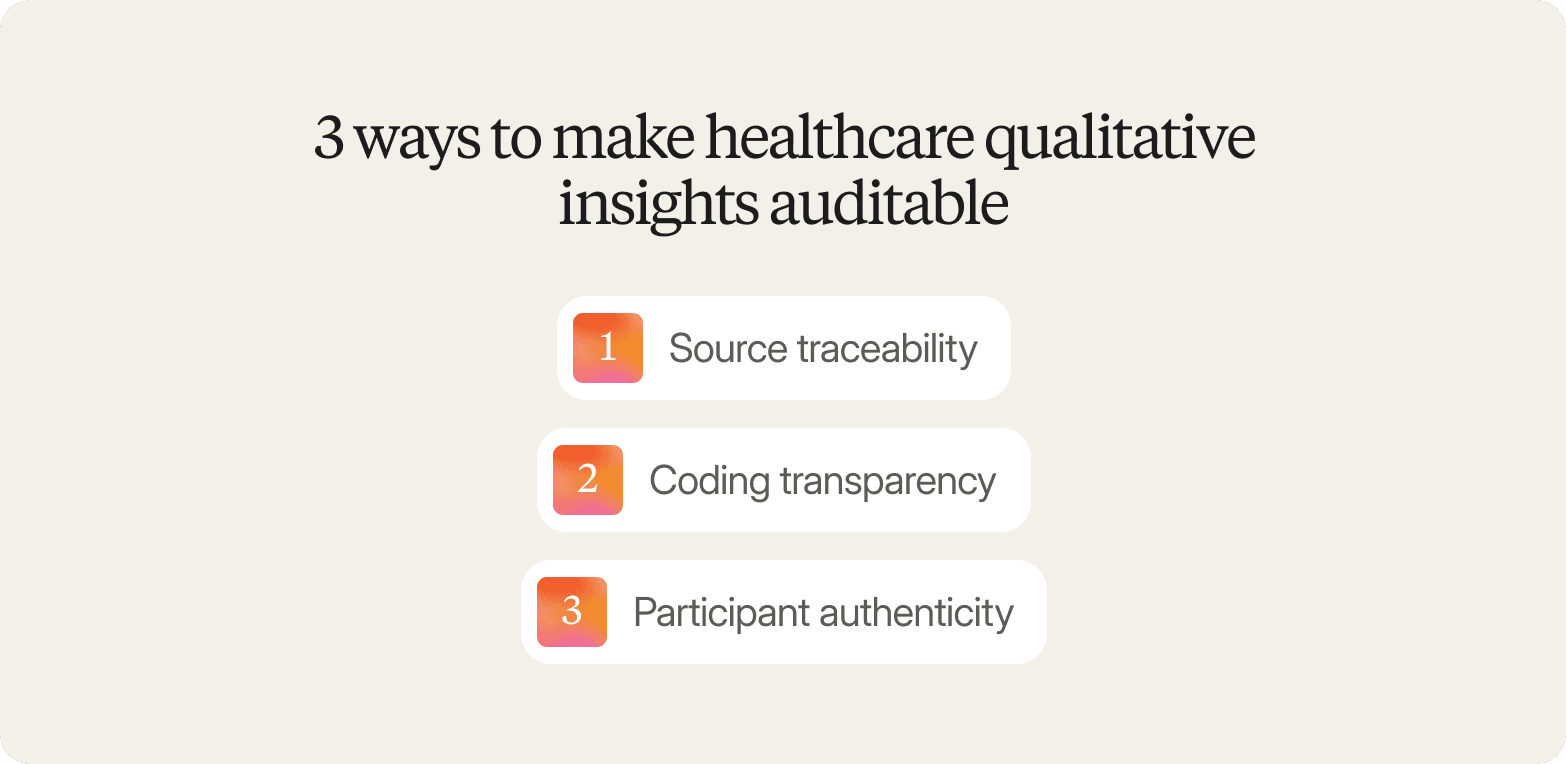
Evidence and trust: 3 ways to make healthcare qualitative insights auditable
Clinical leaders, compliance teams, and regulatory affairs reviewers hold qualitative findings to a different standard than a marketing deck. When research informs a clinical protocol, shapes patient education materials, or supports a regulatory submission, the question is not just “what did research participants say?” It is “how do we know, and can we show our work?” That credibility gap is where most AI-generated qualitative outputs fail in healthcare contexts, and where the data collected must be both comprehensive and traceable to provide valuable insights that stakeholders will actually act on.
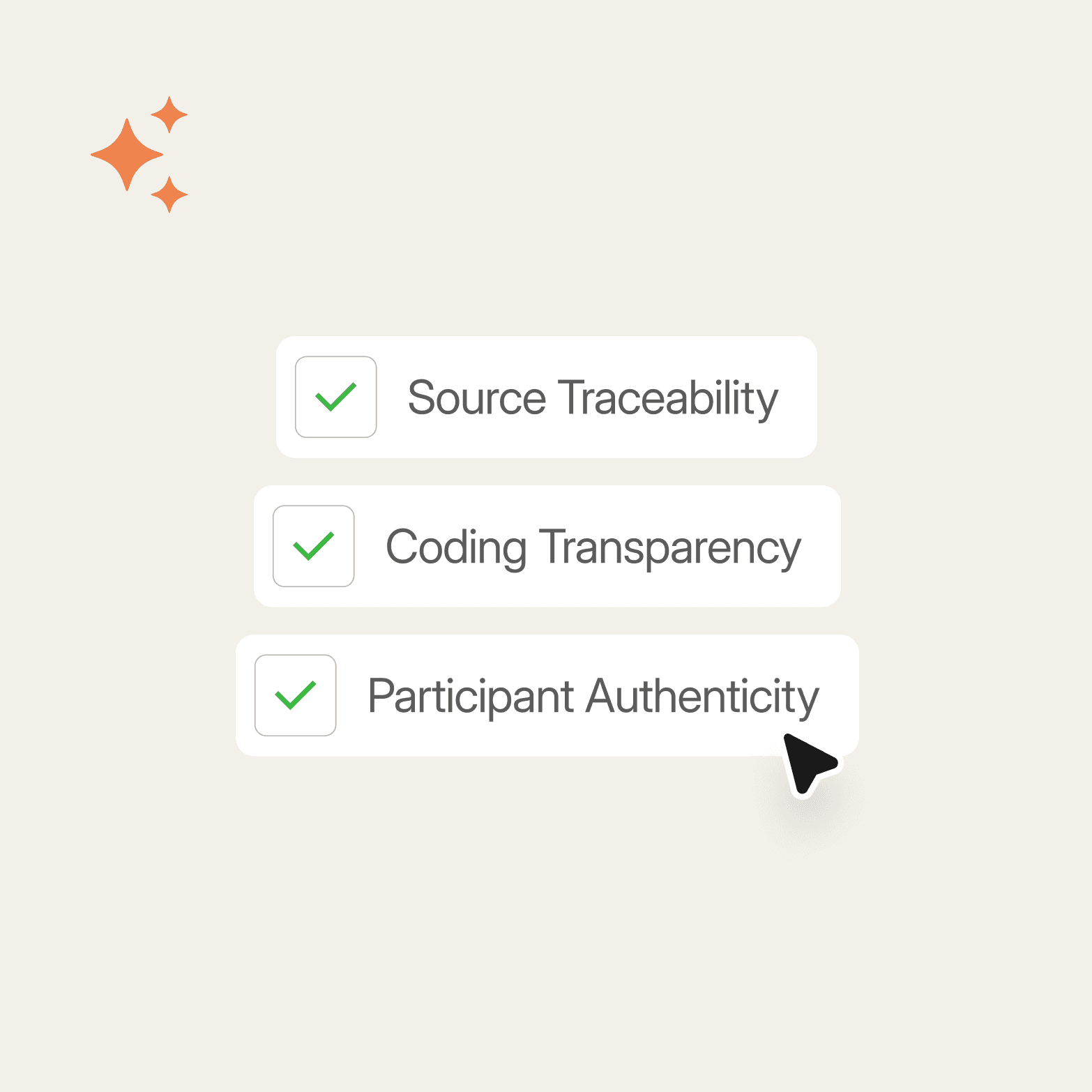
Three layers of evidence make qualitative research defensible in regulated healthcare contexts:
Source traceability
Every theme, insight, or recommendation should link directly to the participant quotes and video clips that produced it. Stakeholders should not have to take the researcher’s word for it. They should be able to click through to the source. Conveo ties every finding to verbatim quotes and video timestamps, so a clinical reviewer or compliance officer can inspect the evidence behind each conclusion rather than accepting a summary, building the deeper understanding that regulated healthcare environments demand.
Coding transparency
“The AI identified three themes” is not a methodology. Defensible research shows the grouping logic: here are the 12 quotes coded under “medication adherence barriers,” here is the reasoning for that cluster, and here is what was excluded and why. Transparency at the coding level is what separates a credible thematic analysis from a black-box output, and what turns raw qualitative data into insights gained through a rigorous research process.
Participant authenticity
Qualitative methods allow in-depth exploration of patient experiences and can provide context for healthcare decision-making and healthcare interventions. That value depends entirely on participants being real. Synthetic or avatar-based responses carry no evidentiary weight in clinical or regulatory settings. Video-based interviews with verified human participants are the only format that holds up to scrutiny from compliance and clinical governance teams.
If your research will inform clinical decisions, regulatory filings, or patient-facing materials, auditability is not optional. It is a procurement gatekeeper. Research platforms that cannot demonstrate source traceability, coding transparency, and participant authenticity should not be in scope for healthcare applications, regardless of how fast they deliver a report.
Healthcare data governance and compliance: What to ask vendors
Healthcare qualitative research involves a category of participant data that sits outside the usual research stack. Health conditions, treatment histories, medication experiences, and personal identifiers are all in scope the moment a research participant opens an interview link. That exposure triggers privacy regulations and, in most enterprise healthcare organizations, a procurement review process that will stop a vendor relationship before it starts if the compliance documentation is not in order.
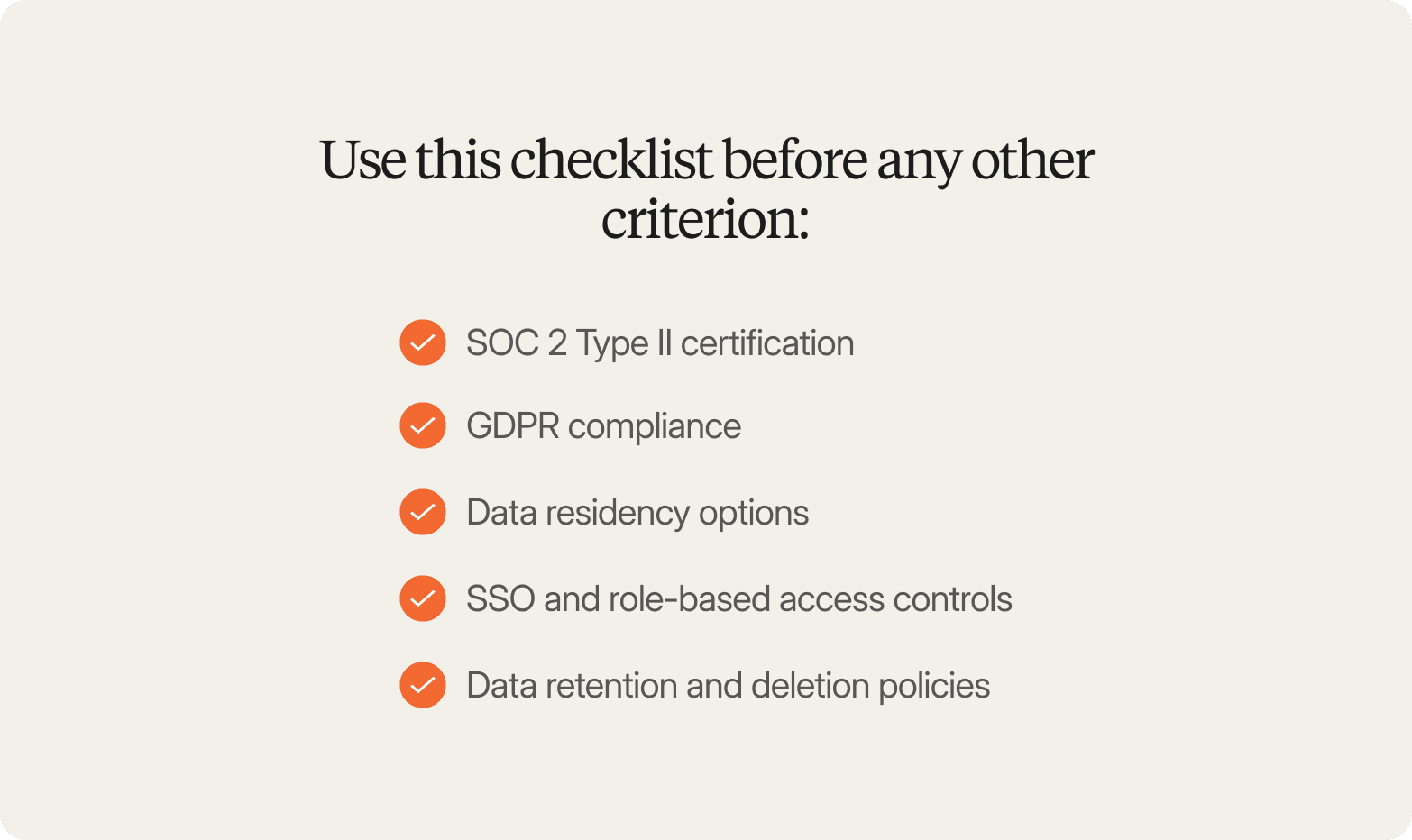
When evaluating research platforms for use in the healthcare space, use this checklist before any other criterion:
SOC 2 Type II certification
A SOC 2 Type II report confirms that an independent auditor has examined the vendor’s security controls over a sustained period, covering data handling, access management, and incident response. A self-attestation is not equivalent.
GDPR compliance
Any research process involving EU research participants or EU-based healthcare organizations requires documented GDPR compliance, including data subject rights, consent management, and cross-border data transfer safeguards. This is not optional for European markets.
Data residency options
European healthcare companies routinely require that participant data be hosted within the EU. Vendors without regional hosting options create cross-border transfer complications that can block approval entirely.
SSO and role-based access controls
Enterprise healthcare organizations need single sign-on integration and the ability to restrict who can view sensitive participant video recordings and transcripts. Broad access to data collected during the research process is a liability in regulated environments.
Data retention and deletion policies
Vendors should provide clear, documented policies for how long participant data is stored and how it is securely deleted when the research process concludes.
Conveo is SOC 2 certified, GDPR compliant, and offers EU data hosting to meet common healthcare enterprise procurement requirements.
One hard recommendation before moving forward with any vendor: if they cannot provide documented evidence of SOC 2 certification or GDPR compliance, do not proceed. The procurement risk is too high for regulated healthcare contexts.
Conveo vs. traditional healthcare qual agencies
Traditional qualitative research agencies and market research firms deliver genuinely strong work. Firms with specialized knowledge of healthcare sector dynamics, experienced moderators, and polished deliverables have earned their place in healthcare research. The tradeoff is not quality: it is cadence.
Six- to twelve-week turnarounds make recurring qualitative market research impractical for most healthcare insights teams. By the time a patient journey study comes back, the product team has already made the decision it was meant to inform. That is a structural constraint built into full-service research delivery, one that leaves healthcare companies unable to track market trends or respond to shifting patient needs in time to act.
"Within days, we had insights that would've taken a traditional agency a month."
Head of Customer Insights, JDE Peet’s
Conveo delivers research depth comparable to specialist agencies in days, not 6–12 weeks. Conveo’s AI interviewer handles moderation and adaptive probing; automated transcription removes the one- to two-week vendor dependency that follows fieldwork; and AI synthesis with human review compresses analysis from weeks to days. Teams report savings of up to 75% compared to traditional agency research costs. For healthcare companies that need continuous consumer insights, this cadence is a genuine competitive advantage, enabling teams to conduct research continuously and gain a deeper understanding of emerging trends and patient preferences in the healthcare space than those constrained to one or two agency cycles per year.
If you run one or two high-stakes studies per year with a budget for full-service support, agencies remain a strong choice. If you need monthly concept tests, quarterly patient journey updates, and ongoing clinician feedback loops, Conveo is built for that cadence.
Frequently Asked Questions
What are examples of qualitative research in healthcare?
Qualitative healthcare market research includes patient adherence studies, physician perception research, caregiver experience interviews, patient journey mapping, and clinician workflow ethnography. A patient adherence study might reveal that side effect anxiety, not forgetfulness, is the real barrier, directly informing healthcare interventions designed to improve patient outcomes. A caregiver burnout study might uncover where caregivers disengage from support systems, providing valuable insights that inform both product development and clinical outreach. Each requires the contextual nuance that online surveys cannot capture. Conveo's AI-led video interviews deliver these actionable insights in days, not weeks.
How long does healthcare qualitative research take?
Traditional qualitative research in healthcare takes 6–12 weeks from study design to the final report. Study design and ethics review account for 1–2 weeks; participant recruitment and scheduling, 2–4 weeks; moderated interviewing, 1–2 weeks; transcription and translation, 1–2 weeks; and thematic analysis and synthesis, 2–3 weeks. Each handoff compounds quickly. Conveo compresses this significantly. What traditionally takes 8–12 weeks can be completed in five to seven days because recruitment, interviewing, transcription, and thematic analysis occur in parallel rather than sequentially.
What is the difference between qualitative and quantitative healthcare research?
Quantitative healthcare research measures how many: survey response rates, treatment adoption figures, and statistical data from large populations. Qualitative research explains why: patient motivations, clinician reasoning, and the emotional factors that drive decisions. A survey might show 40% of patients prefer Treatment A. Qualitative research explains what sits behind that number: cost concerns, fear of side effects, or a prior treatment experience that shaped patient preferences. Quantitative data and statistical analysis can validate hypotheses and predict trends at scale. Qualitative methods surface the human behavior and contextual meaning that numerical data cannot reach.
How do you recruit patients for healthcare qualitative research?
Recruiting patients is slower and more expensive than general consumer research because of privacy regulations, the prevalence of the condition, and the need for informed consent. Three methods are most commonly used: panel providers with specialized knowledge of healthcare recruitment; healthcare organization partnerships (which typically require IRB approval); and digital recruitment through patient forums and condition-specific communities (which require rigorous eligibility screening). Conveo supports recruitment through built-in participant sourcing, fraud filtering, and incentive management. Teams can source participants through Conveo's global panel network or upload proprietary lists where a consented pool already exists.
What compliance certifications should healthcare research platforms have?
Healthcare research platforms should have SOC 2 Type II certification, GDPR compliance, and regional data residency options. SOC 2 Type II provides third-party verification of security controls over data collected during the research process. GDPR compliance covers data subject rights and consent management. EU data hosting removes cross-border transfer complications that frequently stall procurement in European healthcare organizations. Conveo holds all three, meeting the combination required to clear security reviews in most regulated European healthcare environments.

About the author
Emmie Yurchuk
Research Impact Lead
Emmie is from Toronto and has lived in Antwerp for seven years. She came from research and agency consulting and was in client calls from day one, in a room of clients in Switzerland by day seven, and giving analysis training by day twelve. Relationships are the part of the job she cares about most.
Meet Emmie on film →Qualitative insights at the speed of your business.
Conveo runs AI-moderated video interviews and structures everything they say.