
TL;DR
AI-assisted qualitative research works best as a three-tier model: AI handles interviewing and initial analysis; AI assists with synthesis and pattern recognition; human researchers handle interpretation, judgment, and stakeholder communication.
Credibility requires traceability: every AI-generated finding must link back to the source video, verbatim quotes, and participant context, not just a summary.
Time compression is real: conducting market research that previously took six weeks can now run in three days without sacrificing methodological rigor.
Governance is non-negotiable: enterprise teams need SOC 2 certification, GDPR compliance, and EU data hosting before any platform clears procurement.
The outcome is actionable insights at scale, not headcount reduction: teams using AI-assisted research run more studies with the same budget, serving more of the organization without adding researchers.
Learning how to use AI for market research is no longer a question of whether it belongs in the workflow. The real question is where it belongs, and what standards make AI-assisted findings credible enough to act on.
Something structural has shifted. Generative AI in market research is moving well beyond faster transcription: AI-moderated video interviews can now run hundreds of conversations in parallel, compress what once took six weeks into three days, and produce outputs traceable from the synthesized findings back to the original participant footage. The methodological constraints that made the market research process periodic, expensive, and hard to defend in front of a CFO are no longer fixed. They are design choices.
That shift creates an immediate operational tension for market researchers. Stakeholder timelines have not waited for research workflows to catch up. Decisions on campaign direction, product positioning, and market entry are moving on two-week cycles. Qualitative insights that land a month later do not influence those decisions. They document them.
This article answers the question most experienced researchers are actually asking when they consider using AI in market research: which tasks should AI own, which require human judgment, and what governance standards make AI-assisted insights credible enough for a board deck. It covers a three-tier workflow framework, a task-by-task adoption guide, a real three-day workflow example, and the failure modes that quietly undermine otherwise sound AI adoption in research.
The AI-Human Workflow Decision Framework
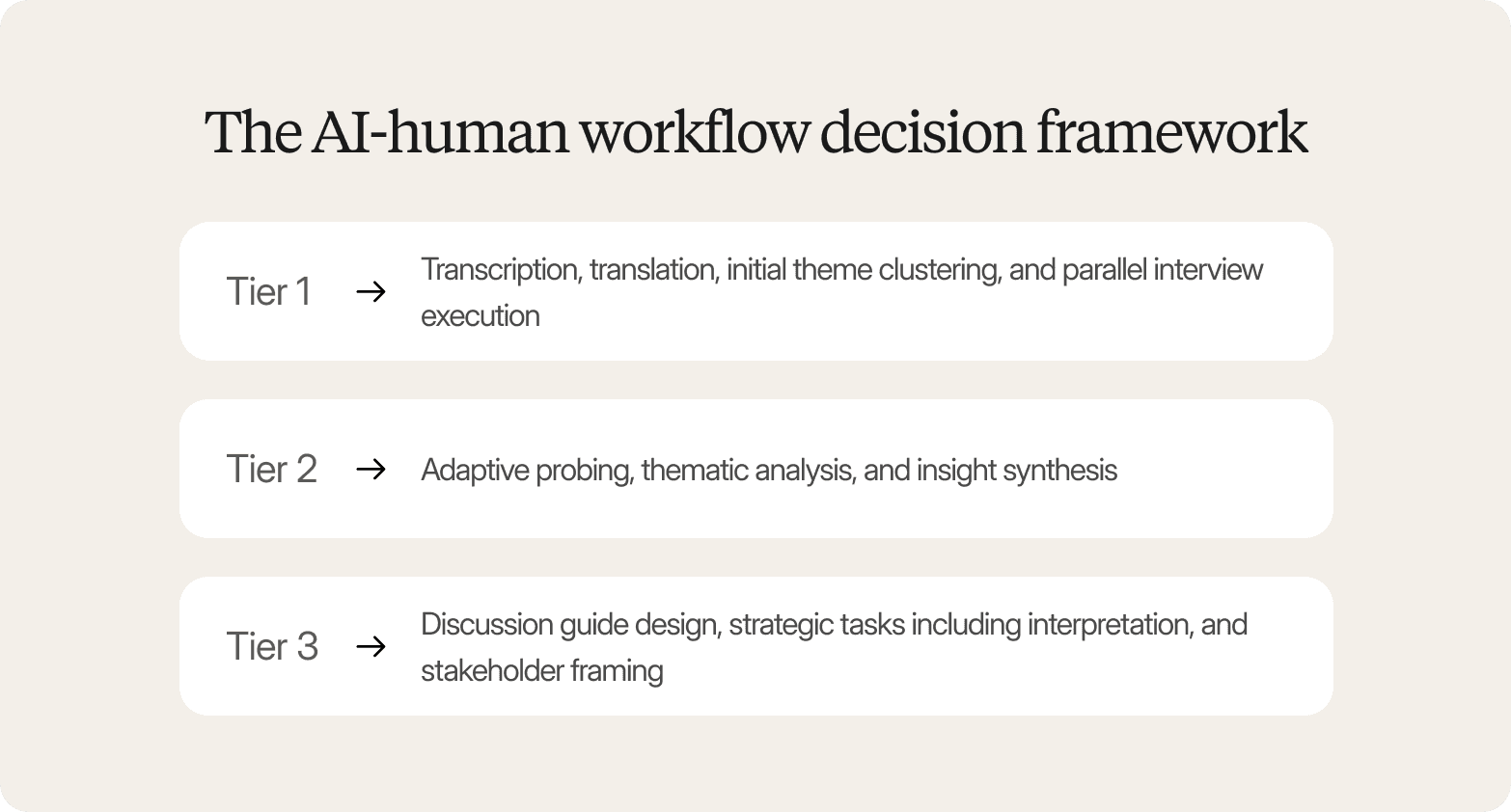
Research teams evaluating an AI-driven approach to market research are making a workflow governance decision, not a technology purchase. The question is not "what can the AI do?" It is "which parts of our workflow should AI systems own, and which parts require a researcher's judgment?"
The framework below organizes the answer into three tiers:
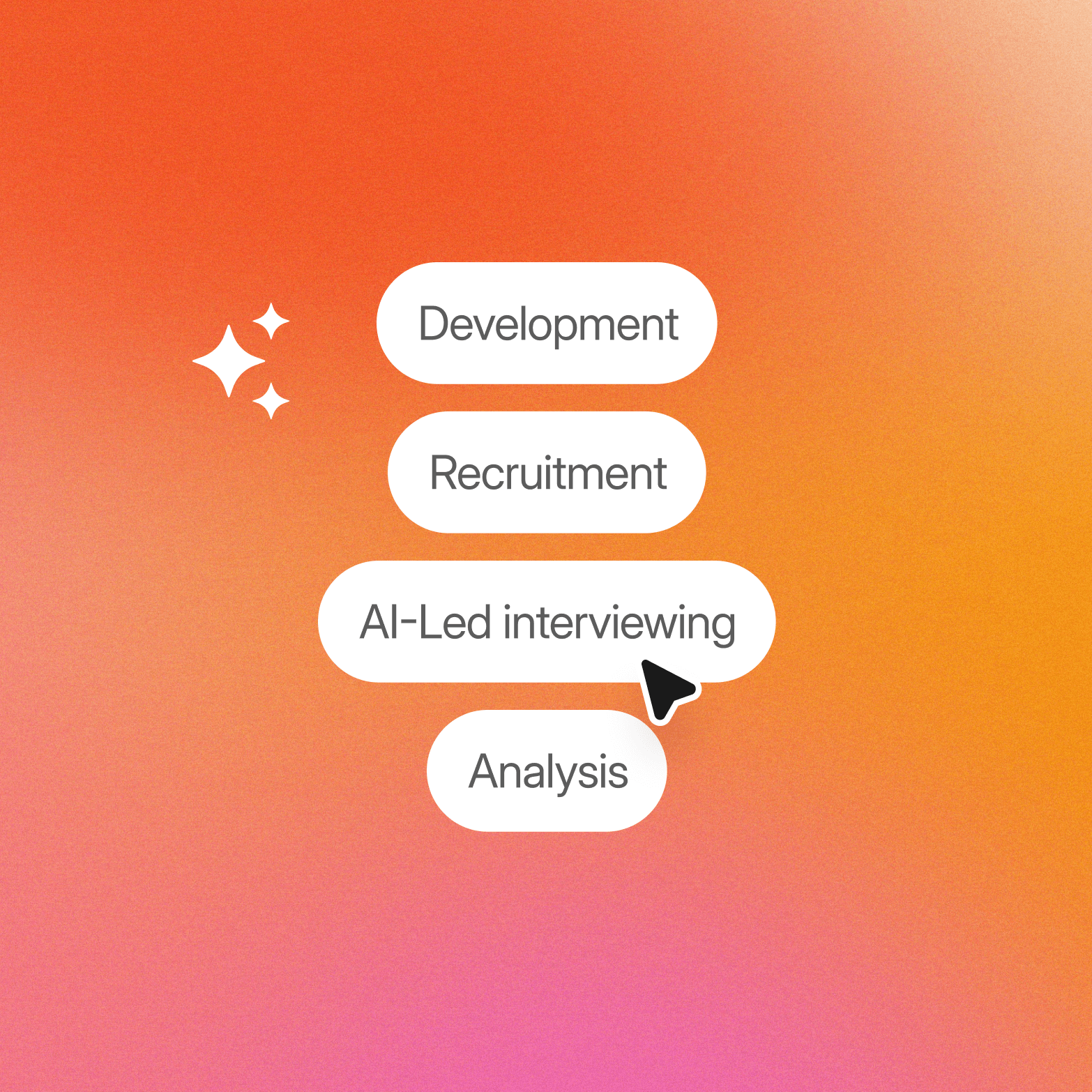
Tier 1 (AI-owned): Transcription, translation, initial theme clustering, and parallel interview execution
Tier 2 (AI-assisted, human-reviewed): Adaptive probing, thematic analysis, and insight synthesis
Tier 3 (Human-owned): Discussion guide design, strategic tasks including interpretation, and stakeholder framing
The practical rationale: manual coding and synthesis alone consume roughly 30% of project budgets and push timelines to a minimum of two to three weeks. The tiers identify where AI generates the highest return without introducing methodological risk for market researchers. The AI-human approach to market research that this framework describes is not a compromise between speed and rigor. It is what makes both possible at the same time.
"We ran a concept test for a new product line, in one night we had 200 interviews analyzed."
CMI Manager, Edgard & Cooper
Conveo is built around these boundaries. The platform handles Tier 1 and Tier 2 tasks by design, with human review gates embedded at every stage where strategic judgment matters.
Task-by-Task AI Adoption Guide
The sections below map the core AI applications in market research, from study design to reporting, showing where AI generates the highest return and where human judgment remains non-negotiable.
Study Design and Discussion Guide Development
Defining research objectives and aligning stakeholders on what a study needs to answer are tasks that require business context, organizational history, and judgment that AI does not possess. That work stays with the researcher.
Where AI earns its place in this phase: generating question variations, surfacing probing opportunities a first draft misses, and translating guides accurately across languages for multi-market studies. Whether the design calls for depth interviews, focus groups, or asynchronous video sessions, the discussion guide shapes everything that follows in the data-gathering phase, and the quality of research objectives set here determines the value of every output downstream.
On Conveo, the discussion guide does something a traditional script never does. It sets the parameters for the AI moderator's adaptive probing logic, which means teams are not writing a static sequence of questions. They are defining the boundaries of a dynamic conversation that responds to what each participant actually says. The best guides built for Conveo are structured with that responsiveness in mind from the start.
Participant Recruitment and Screening
Recruitment is where data quality is won or lost before a single question gets asked. Bring in the wrong participants and no analysis layer, however sophisticated, can recover the signal. If the wrong consumer data enters the study, no AI can correct for it.
AI contributes meaningfully here: automated screening logic filters submissions against inclusion criteria at intake, fraud-detection patterns flag duplicate or incentive-farming submissions, and data cleaning verification confirms participant profiles before they reach the interview stage. Conveo's recruitment infrastructure runs these checks by default, keeping real participant panels clean at scale.
The human role is to set the criteria that automation enforces: defining who qualifies, reviewing edge cases, and approving the final panel before fieldwork opens.
AI-Led Interviewing and Adaptive Probing
Among the AI tools for market research, the quality of probing separates platforms that surface responses from those that reach the real "why." Conveo's AI interviewer does not follow a fixed question sequence. It listens to what each participant actually says and probes based on that response, in real time, across every session simultaneously. Over 70% of final insights emerge from those AI-driven follow-up questions, not from the scripted guide.
AI agents conducting interviews capture customer feedback with a consistency and depth that human moderation at scale cannot guarantee. AI moderation removes human error and moderator bias, ensuring consistent probing depth across all participants regardless of session number or fatigue. Unlike approaches that rely on synthetic data or simulated respondents, Conveo interviews real human participants with video verification, producing research findings grounded in authentic consumer behavior rather than modeled proxies.
Every theme the analysis surfaces links directly to the source: the verbatim quote, the video timestamp, and the participant record. Stakeholders are not reading assertions. They are reading evidence trails they can inspect, share, and challenge. That traceability is what makes AI-assisted qual credible inside organizations that demand it.
The honest tradeoff: AI's ability to probe dynamically does not extend to reading a room or pivoting research strategy mid-field the way an experienced human moderator can. For sensitive or complex studies, human oversight remains essential.
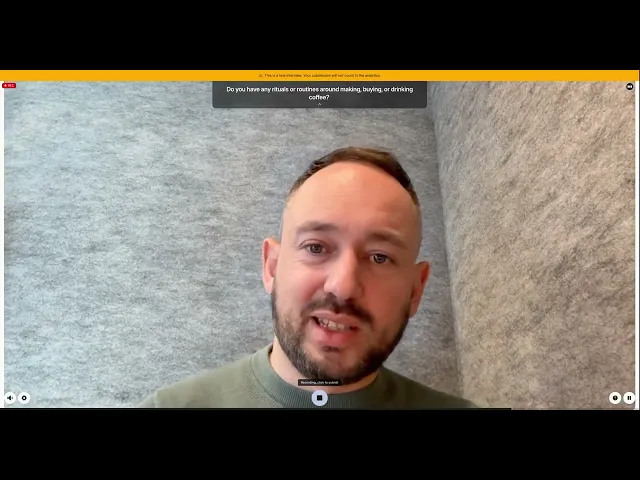
See it in action: How Conveo's AI moderator probes contextually in a live session:
Transcription, Translation, and Multimodal Analysis
Transcript-only analysis has always been the weakest link in qualitative synthesis. Natural language processing and machine learning algorithms can now process raw data from multiple data sources simultaneously: speech, tone, facial cues, and on-screen behavior, identifying patterns humans would take days to uncover manually. Sentiment analysis runs alongside thematic clustering, capturing not just what participants said but the emotional register in which they said it.
Conveo's multimodal analysis layer addresses this directly. Advanced algorithms automatically transcribe, translate, and code every session as recordings land, surfacing richer insights than any text-based analysis delivers alone. For market researchers overseeing high study volumes, automating repetitive tasks like initial coding and transcription compresses analysis from days or weeks to hours.
With support for 50+ languages, transcription and translation happen automatically within the same workflow, removing the coordination overhead that typically slows cross-market studies when gathering data from global participant panels.
The human researcher's role sharpens at this stage. A researcher reviews AI-generated themes, validates interpretations against source clips, and connects findings to business strategy before any output reaches a stakeholder. That review gate is what separates AI-assisted synthesis from unchecked AI output, and what makes findings defensible when procurement teams, compliance reviewers, or senior leadership ask to see the evidence behind the conclusions.
End-to-End Workflow Example: Concept Testing in 3 Days
Day 1
The research brief is finalized, and a human researcher designs the discussion guide. Participants are recruited and screened against the target profile using AI-assisted panel matching. Once approved, interviews launch immediately through Conveo's AI moderator. Sessions run asynchronously, so participants complete them on their own schedule.
Day 2
50 video interviews run in parallel overnight. Transcription, translation, and multimodal data analysis begin as recordings land. Conveo reads speech, tone, and facial cues together, not just the transcript text. A human researcher reviews the AI-generated thematic clusters, validates the findings, and flags any responses that warrant a closer look.
Day 3
A stakeholder-ready report is generated with video clips, verbatim quotes, and a structured thematic summary covering market trends and participant patterns across the full set. Decision-makers receive actionable insights with full traceability from conclusion to source: every claim linked back to the original conversation.
In a traditional qualitative program, those three days become six weeks: one to two weeks for participant recruitment using traditional market research methods, another for scheduling and moderation, then transcription, manual coding, and reporting stacked one after another.
Conveo compresses the end-to-end qualitative cycle from six weeks to three days by running AI-led interviewing across all participants simultaneously, analyzing multimodal signals in real time, and generating stakeholder-ready outputs with traceability from findings to sources. Teams running on Conveo report compressing six-week research cycles to under 72 hours, with cost reductions of up to 75% compared to agency-delivered qualitative programs.
When AI Research Fails: Common Pitfalls and How to Avoid Them
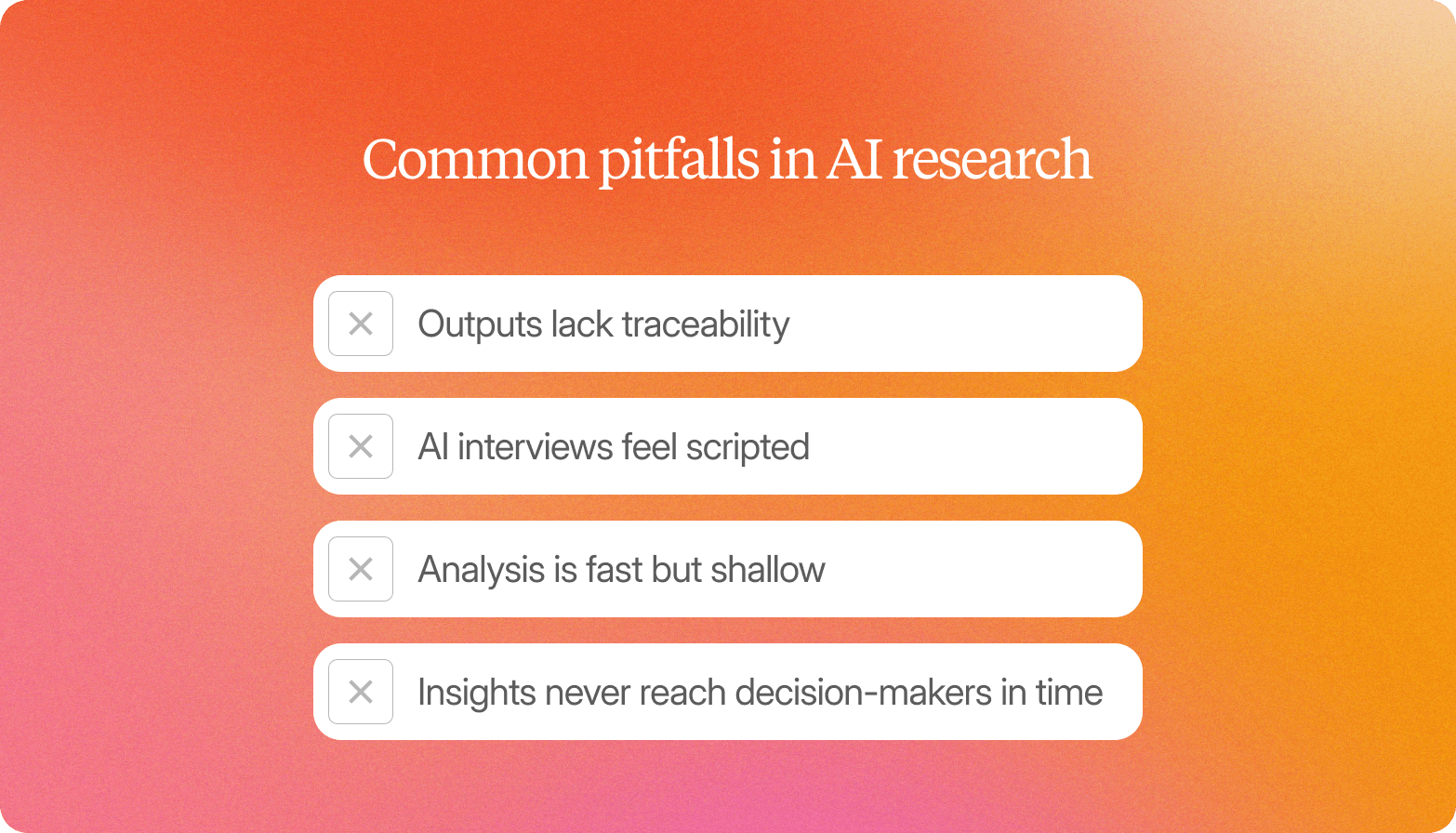
Most AI research failures are not technology failures. They are workflow failures: teams adopt an AI market research tool, get faster outputs, and discover the outputs are unusable.
Outputs lack traceability, so stakeholders reject the findings
A theme cluster without a source is an opinion. Before any finding reaches a stakeholder deck, it needs to include a video clip and a verbatim quote. Conveo links every AI-generated theme back to the original session recording, so "consumers feel confused by the pricing" is not a claim. It is a documented pattern with faces and voices behind it.
AI interviews feel scripted, so participants disengage early
Rigid question trees produce rigid answers. When the AI follows a fixed sequence regardless of what the participant says, the conversation stops feeling like a conversation. Adaptive probing, where the next question responds to what was just said, is what separates a real interview from a glorified form. On Conveo, the AI moderator responds dynamically to each participant's answers rather than following a predetermined path, which keeps sessions engaging and generates unexpected responses that yield the most valuable findings.
Analysis is fast but shallow, missing the "why."
Speed without interpretation is noise. AI theme clustering is a starting point, not a conclusion. The teams that get the most from AI-assisted research treat automated pattern detection as the first step, not the final one. On Conveo, every AI-generated theme links to the source video, so human researchers can interrogate the evidence rather than accept a summary.
Insights live in decks and never reach decision-makers in time
A finding buried in a slide deck from last quarter does not inform this week's product decision. A searchable insight library changes that. Instead of restarting research from scratch, teams query historical data from past studies in plain language and get sourced answers in seconds. Conveo's insight library compounds across every study the organization runs: the more market research data that flows in, the more the platform surfaces connections between emerging trends that no one thought to look for. One-off studies cannot replicate that.
How Conveo Powers AI-Assisted Market Research at Enterprise Scale
Teams using AI for market research need more than a collection of disconnected tools. The three-tier framework described in this article only delivers on its promise when the underlying platform can hold the full workflow together. Piecemeal stacks, where one AI solution handles recruitment, another handles interviews, and a third handles data analysis, introduce handoff gaps that break traceability and slow generating insights at exactly the moments when speed matters most.
Conveo is built to cover that entire workflow in one place: study design and screener setup, AI-led video interviewing, multimodal analysis, and stakeholder-ready reporting. Unlike top AI tools that address a single step in the market research process, Conveo's AI capabilities span the end-to-end qualitative cycle. Every AI-generated theme links back to the source video, verbatim transcript, and participant metadata, so actionable consumer insights are traceable rather than asserted.
For enterprise procurement teams, Conveo is SOC 2 certified, GDPR-compliant, and offers EU-region data hosting. Purpose-built qualitative platforms differ from survey tools or standalone interview products: they cover the full workflow from guide design to stakeholder-ready report, with evidence traceability throughout, which AI-powered tools built for a single task cannot provide.
Google, Reddit, FOX, and Bosch run qualitative research on Conveo. Marketing teams, insights leaders, and brand researchers at these organizationsuse the platform to understand customer behavior, identify future trends, and shape marketing strategies without adding headcount. The goal is more research, better research, not fewer researchers.
Frequently Asked Questions
How do enterprise research teams evaluate AI market research tools?
Are there free AI tools for market research?
What are the best AI tools for market research?
How do I use AI prompts for market research?
Can AI replace market research?