
TL;DR
Finding good study participants helps ensure research cycles stay on track and that your findings hold up to stakeholder scrutiny.
Recruiting participants for research on social media often means a high volume of applicants, but self-reported demographics are unverified, and manual screening overhead delays research cycles before you’ve booked a single interview.
This guide provides Research Ops teams with a decision framework and a step-by-step playbook to reduce recruitment cycles from weeks to days.
A research study lives or dies on the quality of its participants. When participants are a poor fit, the problems may not appear straight away. They surface later, when stakeholders question whether the findings reflect real customers and whether the research can be trusted.
In this article, we cover the best options for participant recruitment in the market research sector, ways to reduce screening overhead, and how to run research cycles that yield rock-solid findings.
Why Social Recruiting Fails for Enterprise Research
On the face of it, recruiting study participants on social media seems like a smart approach. You get access to a large pool of potential participants at a low cost. But the time you save in recruitment gets eaten up by manually coordinating dozens of unqualified applicants. A wave of 200 social media responses that yields 8 qualified participants creates an overhead problem that far outweighs the volume advantage.
Self-reported demographics are also unverified, so screening falls on the research team before interviews begin. When you're running multiple studies at the same time, that problem only compounds. Each wave requires the same manual triage, and the workload accumulates across all concurrent projects.
Compliance requirements add another layer of complexity. Social channels weren't designed for research workflows, which means data handling, consent documentation, and participant data storage must all be managed.
Recruitment Method Decision Framework
The right participant recruitment method depends on your study type, timeline, and compliance requirements. Use the table below for an overview of your options for how to recruit participants for a qualitative study.
How are participants recruited for research? | Audience specificity | Timeline | Compliance requirements | Fraud/quality risk | Cost range | Vendor complexity |
Social media ads | Low. Self-reported demographics are unverified. | 1 to 3 weeks due to screening overhead. | High. Consent and data handling sit outside the platform and require manual management. | High. Professional respondents are common, and accountability is limited. | Low per applicant, but total cost rises once screening overhead is included. | High. Ad platform, screening tool, scheduling, and analysis are separate vendors. |
Panel providers | Medium to high. Participants are pre-screened with demographic data. | 3 to 7 days. | Managed by the provider. Check terms for compliance coverage. | Medium. Panel fatigue and professional respondents are possible. | 2 to 4x per completed participant versus social recruiting, but no manual screening is required. | Medium. Panel provider plus separate research and analysis tools. |
Integrated research platforms | High. Participants are matched and verified against study criteria. | Days. Recruitment, screening, and scheduling are handled in a single workflow. | Built-in. Consent, data handling, and audit trail are managed in one place. | Low. Verified participants with quality controls built in. | Higher platform cost, lower total research cost at volume. | Low. Recruitment, screening, interviewing, and analysis in one workflow. |
Customer/CRM lists | High. Known customers with verified data. | Variable. Depends on list quality and internal coordination. | Internal. Requires coordination with legal and CRM teams. | Low. Known customers with verified identity. | Low direct cost, but internal coordination adds overhead. | Medium. Requires internal team coordination plus separate research tools. |
Social Media Recruiting
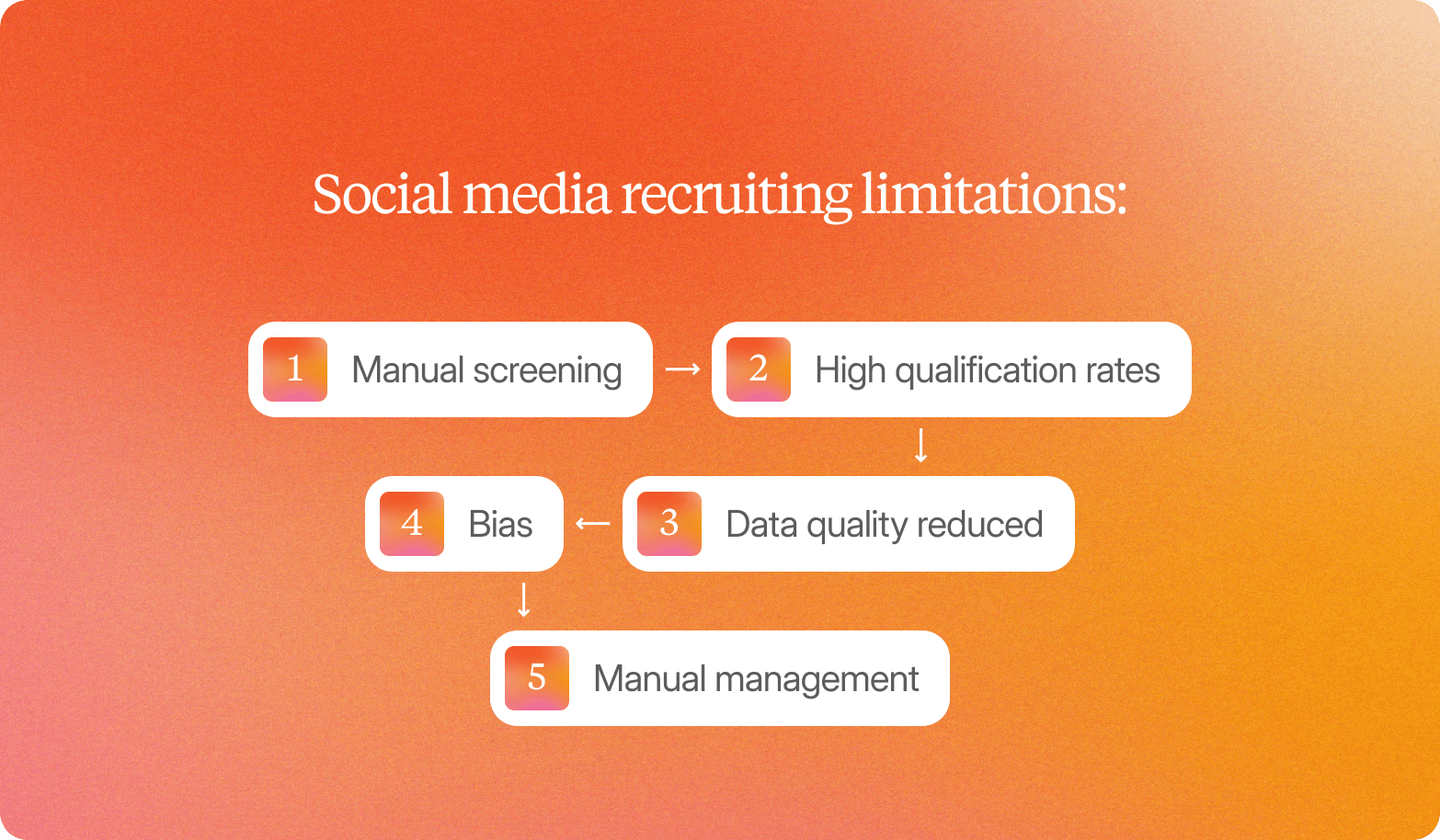
Social media platforms have the lowest barrier to entry for recruiting research participants. This method offers a good fit when reach and speed are your top priorities, as long as you’re aware of several limitations:
Your team has to manually screen applicants because self-reported demographics aren’t verified against your eligibility criteria.
You’ll likely see high disqualification rates, with many responses but relatively few qualified participants.
Professional participants and incentive-driven applicants are common in social media groups, which can reduce data quality and introduce bias.
Social platforms don’t include built-in research workflows, so teams must manage consent, data handling, and participant storage manually.
These trade-offs don’t tend to be a problem for studies like exploratory research, general population studies, or fast-turnaround pulse checks, where you don’t need responses from a specific group.
For example, if a SaaS team wanted to understand general sentiment toward a new product category before committing to deeper research, social media recruiting could fill a small-group study of 20 people within days at low cost.
Panel Providers
If your study requires specific demographics, panel providers are often a good starting point for finding participants. They work well for niche segments that are difficult to reach through social channels, including B2B research targeting specific job titles, company sizes, or industries.
A key advantage is that the provider's database removes the manual screening burden, but it’s reflected in the price. Panel recruitment costs around 2 to 4x as much as social recruiting.
A limitation is that most panels offer strong demographic filtering but limited filtering for consumer behavior or product usage. When that happens, the efficiency gains from panel recruitment start to drop.
For example, a SaaS team could use a panel provider to quickly identify IT decision-makers at mid-market companies for user research. But if participants also needed to have evaluated new software within the last six months, the team would still need additional screening to confirm they meet the eligibility criteria.
Integrated Research Platforms
When your Research Ops team manages 50 or more studies a year or faces pressure to consolidate vendors, integrated research platforms like Conveo are a strong fit.
Integrated platforms combine recruitment, screening, interviewing, and analysis in a single workflow. When studies run at a high volume, reducing back-and-forth between tools and maintaining compliance throughout the process are what keep research cycles on track.
Conveo's integrated panel and AI-assisted screening criteria mean research participants are qualified against study requirements before interviews run, inside the same platform where findings are produced. SOC 2 certification and EU data hosting are also built in, giving procurement teams the compliance layer they require without a separate vendor review process.
Customer Lists and CRM Data
Customer lists and CRM data give Research Ops teams direct access to known users, making them well-suited to product feedback, lifecycle research, and follow-up studies with existing customers.
The limitation is that participants from your customer list tend to be biased towards satisfied or highly engaged users, which can skew your results. This familiarity also makes customer lists less helpful when you need a more diverse group or a wider range of perspectives for your research topic.
A team researching a new market segment, for example, would only hear from users who already found the product useful. The team would miss the objections and barriers that might prevent wider adoption.
5 Step Social Recruiting Playbook: How To Recruit Participants For a Research Study
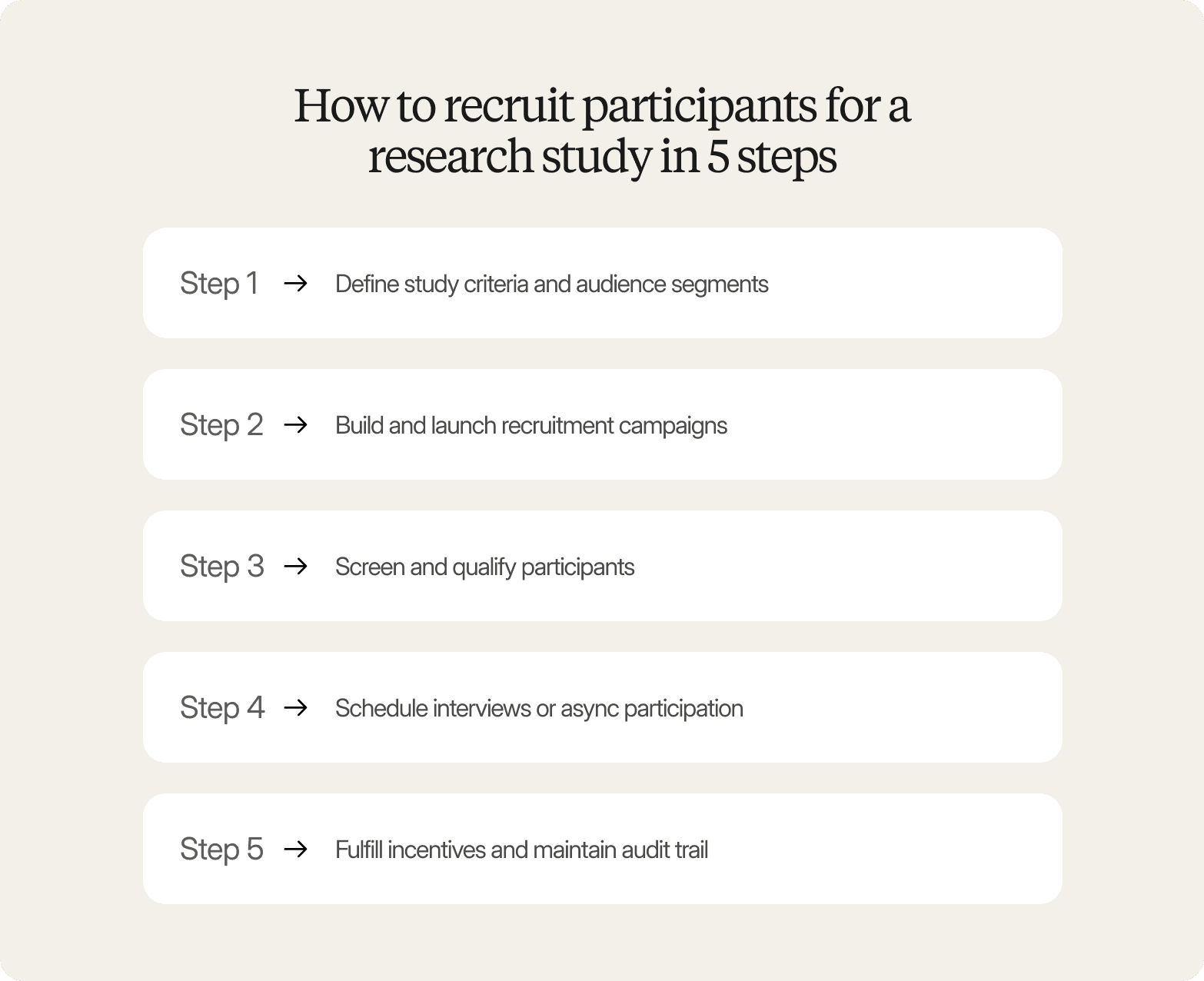
If you want to recruit participants directly for interviews, surveys, or focus groups, these steps cover the full process from defining study criteria to sending incentives.
Step 1: Define Study Criteria and Audience Segments
Your criteria should cover these three categories:
Demographic. Age, location, job title, company size, and seniority.
Behavioral. Recent actions, purchase decisions, switching events, and frequency of use.
Product usage. Current tools or platforms, usage frequency, and specific features used.
Making your eligibility criteria as specific as possible helps reduce manual work filtering participants further down the line.
For example, "adults aged 25–45 who use financial apps" will generate a high volume of applicants who don't fit your study. "Adults aged 25–45 who have opened a new bank account in the past six months and currently use a mobile-first bank as their primary account" gives you a qualified pool to work with.
Step 2: Build and Launch Recruitment Campaigns
Paid social media posts are a relatively low-cost research recruitment strategy when executed properly. Start by deciding which social media platform you’ll use. This will determine the word count and image or video size for your ad and the audience who’ll see it:
Facebook/Meta. Best for general consumer studies where age, location, and interest-based targeting are sufficient.
LinkedIn. Best for B2B, online services, and professional roles targeting. Job title, seniority, company size, and industry filters make it the strongest option for reaching specific professional profiles.
Reddit. Best for community-specific or tech-adjacent audiences that you can target by subreddit.
Whichever platform you choose for your recruitment efforts, all ads should include the same information to make sure you attract the best-fit participants:
Study purpose. One or two plain-language sentences explaining what the research is about, written so potential participants can self-identify as relevant without needing to understand research terminology.
Time commitment. Be specific: "45-minute video interview" or "20-minute survey."
Incentive amount. State it clearly to encourage participation from the right applicants.
Eligibility criteria. The key criteria from Step 1, written in plain language.
Informed consent. A brief note on how participant data will be handled, stored, and used.
Clear, straightforward copy in your recruitment materials will result in more successful recruitment than overly polished or marketing-heavy language. Participants need to understand what you’re looking for straight away or they’ll likely scroll past. An example ad for finding UX research participants might read:
"We're looking for freelancers who use project management tools daily to take part in a 45-minute video interview about how they plan and track their work. Participants will receive a $75 gift card. You must be a freelancer who has used at least two different project management tools in the last 12 months. Your responses will be kept confidential, and your data will not be shared with third parties."
It might be tempting to use broad targeting so your ad reaches a broader population, but a smaller, well-targeted audience yields higher-quality applicants and keeps screening manageable.
Step 3: Screen and Qualify Participants
Structured screening questionnaires with disqualification logic reduce manual work for your team by routing out poor-fit participants at the point of application.
Without automated disqualification logic, a researcher manually reviewing 150 free-text applications one by one becomes a bottleneck, delaying every study they touch. For teams running multiple concurrent studies, the workload adds up fast.
Screener questionnaires can be built in survey tools with branching logic, where an incorrect answer automatically ends the application, or handled within an integrated research platform that combines screening with recruitment. Either way, the goal is the same: participants who don't meet your criteria never reach your shortlist.
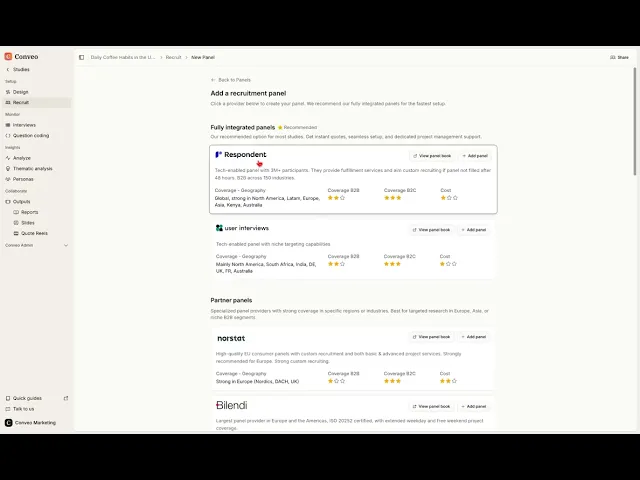
Conveo's screening criteria and quota controls let research teams define exactly who qualifies before recruitment launches. The study assistant auto-generates the study setup (including screener criteria) based on the research objectives, thereby reducing the time between the brief and live recruitment.
Step 4: Schedule Interviews or Async Participation
Once participants are qualified, the next decision for your research plan is whether to run synchronous or asynchronous interviews.
Synchronous scheduling means one-on-one calendar coordination for every participant: finding times, sending invites, managing rescheduling, and accepting that no-shows will happen.
Asynchronous video interviews eliminate the need for a calendar entirely. Participants record responses on their own schedule, and the research team reviews completed responses rather than managing a live interview calendar.
Here’s an overview of the pros and cons of each type, and what kind of studies they work best for:
Synchronous | Asynchronous | |
Scheduling | Every participant needs individual calendar coordination. | No scheduling is required. |
No-show risk | Participants can drop out or reschedule at any point. | Participants record on their own schedule, so there is no no-show risk. |
Scale | Scale is limited by the number of sessions a coordinator can manage. | Interviews run in parallel for all participants. |
Depth of questioning | The moderator can probe and follow up based on what participants say. | Questions are fixed in advance with no live follow-up. |
Best for | In-depth interviews where live probing is important to the quality. | Concept testing, initial screening, and high-volume studies. |
Step 5: Fulfill Incentives and Maintain Audit Trail
Monetary compensation is standard practice in commercial research, with one study showing that monetary incentives increase survey response rates by 25%.
Common incentive methods for recruiting research participants include gift card platforms such as Tremendous or Rybbon, direct digital payments, and panel points for panel participants. In the US, UX research rates typically range from $50 to $150 per hour, depending on participant type and seniority. Rates vary by region, so if you’re conducting research in other regions, you should check local norms before you offer incentives.
A couple of practical decisions to make before you recruit participants for a research study:
When to send payment. Sending incentives immediately after a session improves participant experience and reduces the chance of disputes.
Whether to pay participants who don't qualify. Give clear communication about whether initial participants receive payment if they're screened out mid-session. Unconditional incentives tend to improve goodwill and show rates.
Enterprise teams need an audit trail for incentives for finance and compliance. Platforms that manage fulfillment inside the research workflow reduce the manual work of tracking payments across multiple tools.
Quality and Integrity Layer
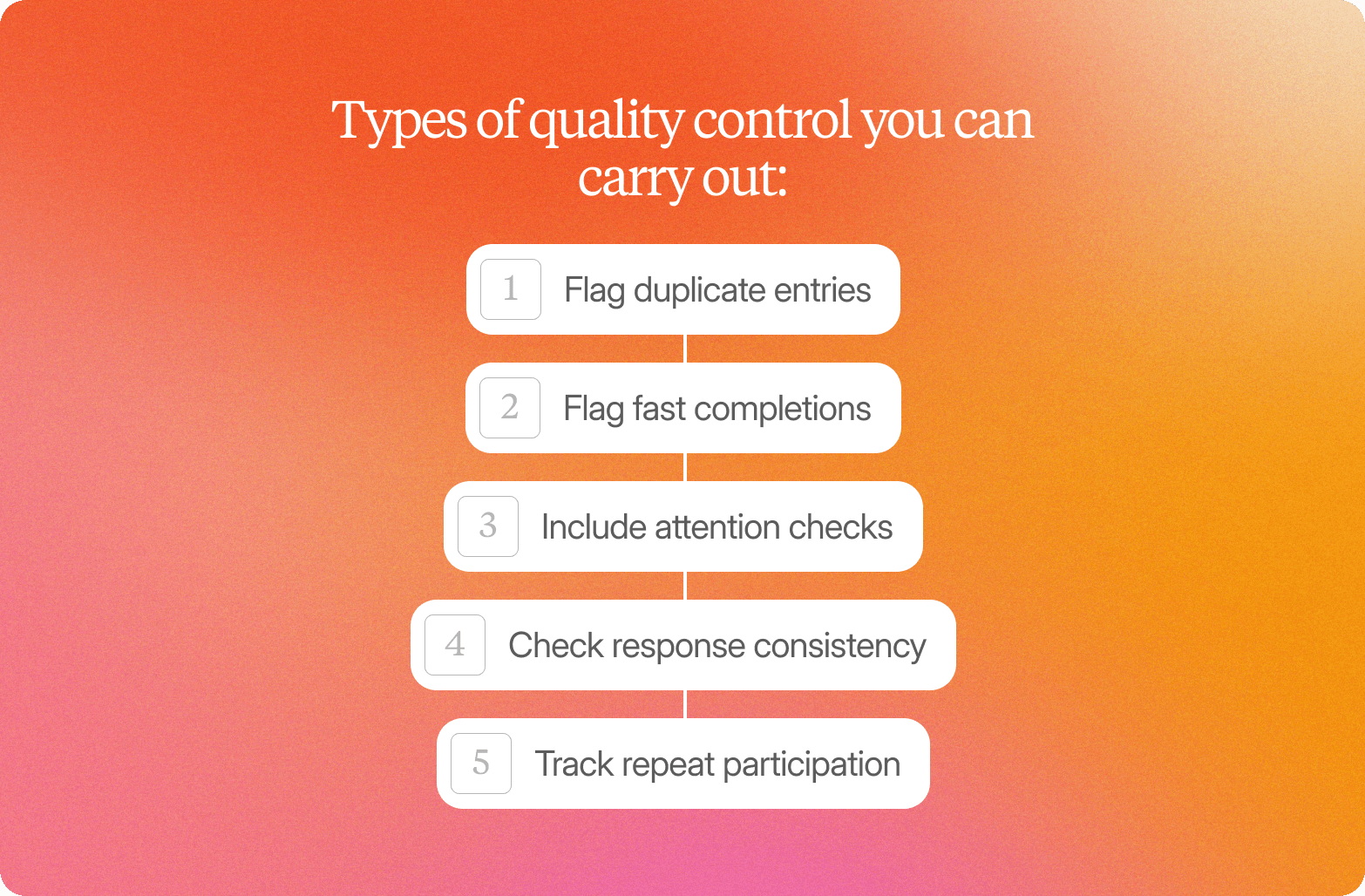
The quality of your findings depends on whether participants are who they claim to be. Without quality checks, purely incentive-driven participants, duplicate entries, and low-effort responses can distort your sample and introduce bias before analysis even starts.
There are a few different types of quality control you can carry out:
Flag duplicate entries. Flag entries that use the same email address, IP address, or device to prevent one person from completing the study multiple times.
Flag fast completions. Flag responses completed too quickly to have been read carefully, which often signals low effort or automation.
Include attention checks. Include one or two simple verification questions in the screener to confirm that participants have read and responded carefully.
Check response consistency. Compare answers to the same question asked in different ways, and flag contradictions as unreliable responses.
Track repeat participation. Track participants who appear across multiple studies in a short period as a potential quality risk.
Video-based participation provides a stronger verification layer than text-based screening alone. A recorded video response is harder to fabricate than a survey form, and tone, expression, and spontaneity all contribute to authenticity signals that text responses don’t surface.
Conveo takes this approach even further. Every theme Conveo surfaces links to the specific video clips that generated it, so stakeholders can verify participant authenticity alongside credibility.
"Conveo's video-first approach is a real differentiating methodological advantage. The ability to distill insights from reactions and not just hear answers adds context you simply can't get from transcript-only tools, or any other tool in the market for that matter."
Senior Marketing Research & Insights Manager, Google
Participant Quality Controls
There are several signals that indicate a low-quality participant in commercial research contexts. They generally fall into two categories, behavioral and technical. Here’s what to look out for during participant recruitment for research:
Signal | Type | What it may indicate |
The participant gives inconsistent answers across screener questions. | Behavioral | The participant may not be reading carefully or may be making up responses. |
The participant gives generic answers that don’t reflect real product experience. | Behavioral | The participant may not actually use the product. |
The participant completes the screener much faster than expected. | Behavioral | The response may be low effort or automated. |
The participant joins many studies and uses broad self-descriptions. | Behavioral | The participant may join studies purely for the incentive and isn’t a real target user. |
The system detects a duplicate IP address or device. | Technical | The same person may have submitted multiple applications. |
The email address uses a disposable domain. | Technical | The participant may be trying to avoid duplicate detection. |
The system detects VPN usage. | Technical | The participant may be hiding their real location or identity. |
Where possible, you should look for these signs at the intake stage of finding research participants to avoid compromised data or a wasted research session.
Duplicate Prevention and Panel Integrity
Duplicate participants skew the results and unnecessarily fill interview slots. The standard prevention layer covers three mechanisms that answer the question: how do you recruit participants for a research study without the same person appearing twice?:
Unique participation links that expire after one submission.
Email deduplication that flags addresses already in your participant pool.
IP-level flagging that catches multiple submissions from the same session or device.
Panel providers typically handle deduplication within their own panel, so participants can't apply twice through the same source. The gap appears when teams run social media and panel recruitment simultaneously. A participant who applies through both channels won't be caught by either provider's deduplication logic, because each only checks against its own records.
Integrated platforms that manage all recruitment within a single workflow reduce this risk by maintaining a unified participant record across every channel. When recruitment, screening, and participant history sit in one place, duplicates are caught before they reach your shortlist.
Choosing the Right Recruitment Stack for Your Research Program
For Research Ops, CMI, and CX teams running occasional studies with flexible timelines and no compliance requirements, panel providers are usually sufficient for recruiting research participants.
But for Research Ops teams running 20+ studies a year, dealing with vendor consolidation, or working under enterprise compliance requirements, integrated research platforms offer significant time and cost savings.
Conveo is a video-first AI research platform that manages the full research workflow, from recruitment through analysis. Here’s what that looks like in practice.
Qualified participants before the interviews run.
Conveo's AI-assisted screening criteria filter applicants against study requirements within the platform, so interview slots go to relevant participants who meet your criteria rather than to applicants who need a second-round review.
See how Conveo handles participant recruitment:
Global panel access without a separate vendor.
Integrated panel access means teams can recruit verified participants across markets without managing a panel provider relationship alongside the research platform.
Recruitment through analysis in one workflow.
The full research process, including recruitment, screening, interviewing, and analysis, runs inside one platform, removing handoffs between tools and keeping participant records connected to the findings they generated.
Enterprise compliance built in.
SOC 2 certification, GDPR compliance, and EU regional data hosting are standard, so procurement requirements are met without the need for a separate vendor security review.
Evidence stakeholders can trace.
Every finding links back to the specific participant video clips that generated it, so stakeholders can verify the evidence behind a recommendation rather than taking the conclusion on trust.
Findings that compound over time.
Each study adds to a searchable insight library, so research teams can surface what participants said six months ago, compare it against current findings, and build institutional memory across projects.