In this article
TL;DR
Qualitative market research explains why customers think, behave, and decide the way they do by collecting non-numerical data through interviews, observation, and open-ended exploration.
Different qualitative market research methods reveal different signals, from customer motivations in in-depth interviews to real-world behavior through ethnographic and observational research.
Teams use qualitative market research to clarify messaging, improve product adoption, diagnose journey friction, and identify unmet customer needs that quantitative data alone cannot explain.
AI now allows teams to run one-on-one interviews at scale, automate qualitative data analysis, and identify patterns across datasets in hours instead of weeks.
Continuous qualitative market research programs help organizations generate actionable insights earlier in product, CX, and strategy decisions instead of relying on periodic studies.
AI-powered platforms make it practical for insights teams to conduct qualitative market research in-house while preserving the depth and rigor that make qualitative research valuable.
By the time qualitative market research findings arrive, the decision they were meant to inform has often already been made. Many research teams still depend on agency timelines, limited interview slots, and slow synthesis cycles that make it difficult to keep pace with product launches, shifting customer behavior, and fast-moving market trends.
What’s changing now isn’t the value of qualitative research. It’s how often teams can actually use it. As research workflows become augmented by AI, qualitative market research is moving from a periodic validation step to a continuous source of decision support across product, CX, and marketing. Instead of explaining what happened after the fact, it’s increasingly shaping what teams do next.
This guide explains what qualitative market research is, which methods teams rely on most, where it delivers the strongest impact, and how AI is redefining what qualitative research makes possible for modern research teams.
What is qualitative market research?
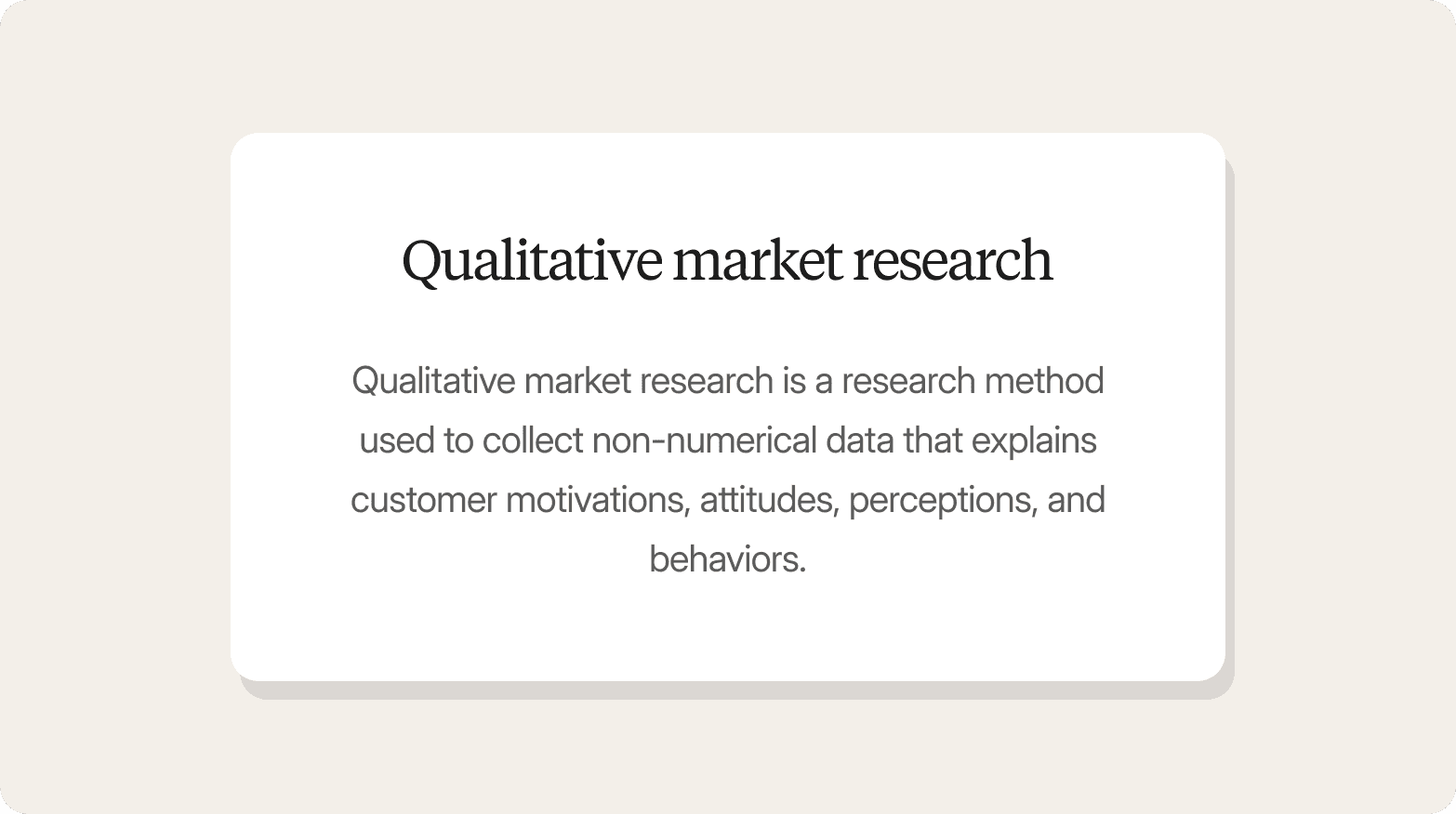
Qualitative market research is a research method used to collect non-numeric data that explains customer motivations, attitudes, perceptions, and behaviors.
Instead of measuring how many people think something, qualitative market research focuses on understanding why they think it, using conversations, observations, and open-ended exploration to generate meaningful qualitative insights.
This type of market research helps you answer questions that quantitative data can’t, like:
Why do customers behave this way?
How do they describe their needs in their own words?
What shapes their reactions to a product, message, or experience?
Qualitative research is exploratory and interpretive by design. Its findings are not meant to be statistically representative, but they are meant to reveal patterns, context, and a deeper understanding you can act on.
The value of qualitative market research becomes clearer once you see how teams actually run it in practice. Each method reveals a different kind of customer truth, depending on what you need to learn and how quickly you need to learn it.
7 types of qualitative market research methods
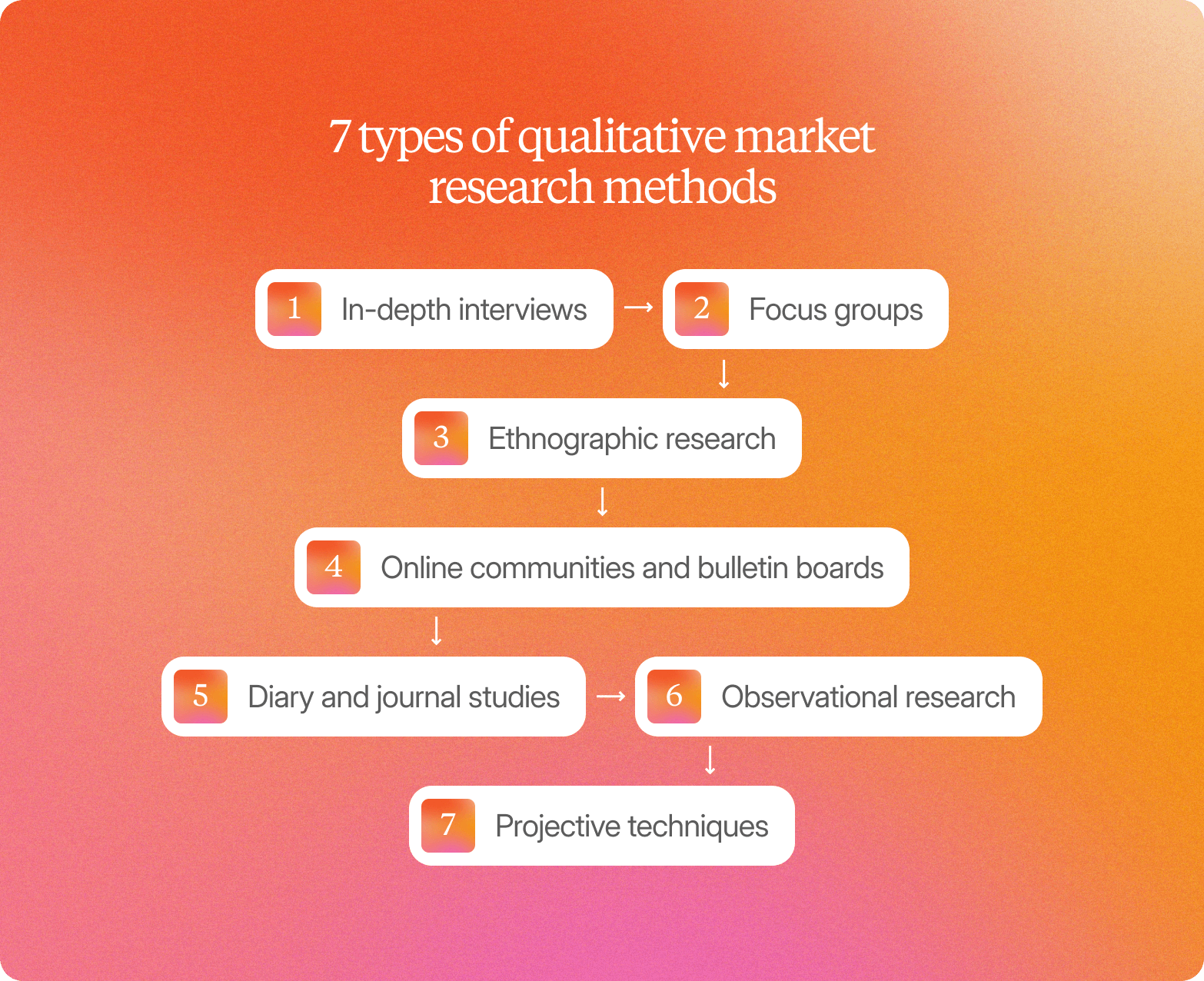
Different qualitative market research methods answer different questions about customer behavior, customer needs, and decision-making context. Choosing the right research method depends on what your team needs to learn and how quickly you need actionable insights.
In-depth interviews (IDIs)
One-on-one conversations that explore individual experiences, beliefs, and customer motivations in depth.
Best for
Complex B2B journeys
Sensitive topics
Early concept exploration
Understanding the target audience’s language
In-depth interviews generate high-quality qualitative data and deeper insights per participant. Traditionally hard to scale, they can now run asynchronously using video interviews, which is one reason teams are already transforming qualitative market research with AI.
Focus groups
Moderated discussions with a small group (typically 6–10 people) exploring shared reactions to ideas, products, or marketing messages.
Best for
Concept reactions
Shared vocabulary
Testing marketing strategies
Identifying customer preferences
Focus groups help market researchers collect qualitative insights quickly, but groupthink and dominant voices can affect results. They’re less suitable for sensitive research topics.
Ethnographic research
Observation of participants in their natural environment to understand real behavior instead of reported behavior.
Best for
Shopper journeys
Usage research
Identifying patterns in consumer behavior
Understanding customer needs in context
Ethnographic research produces detailed information and valuable insights that support enhancing product development and tailored marketing strategies.
Digital variants now include diary capture and screen recordings across distributed market segments.
Online communities and bulletin boards
Asynchronous research spaces where participants respond over days or weeks instead of a single session.
Best for
Tracking emerging trends
Geographically distributed audiences
Evolving customer preferences
Online communities help collect data continuously and support strategic decisions based on changing customer behavior over time. They’re widely used in qualitative research in market research programs across retail, healthcare, and CPG.
Diary and journal studies
Participants document behaviors, experiences, or emotions as they happen rather than relying on recall.
Best for
Habit research
Product usage tracking
Capturing in-the-moment reactions
Studying existing customers over time
Diary studies capture non-numerical insights that interviews often miss. Mobile formats make qualitative data collection easier during everyday interactions with products or services.
Observational research
Researchers watch behavior directly instead of asking participants to describe it.
Best for
UX research
Retail environments
Session recordings
Identifying hidden pain points
Observational qualitative methods help identify patterns between stated intent and actual behavior. This research method supports a deeper understanding of customer behavior in real decision contexts.
Projective techniques
Indirect prompts, such as word association or brand personification, are used to surface unconscious attitudes.
Best for
Brand perception
Advertising research
Emotional reactions to marketing campaigns
Exploring customer motivations
Projective techniques are usually combined with in-depth interviews or focus groups rather than used alone in qualitative market research techniques.
Qualitative research methods compared
| Method | Best for | Sample size | Relative cost | Scalability |
|---|---|---|---|---|
| In-depth interviews | Customer motivations, B2B journeys, sensitive topics | 8–20 | Medium–High | Low (traditional) / High (async video) |
| Focus groups | Concept reactions, shared language | 6–10 per small group | Medium | Low |
| Ethnographic research | Natural behavior, in-home usage | 5–15 | High | Low |
| Online communities | Longitudinal insight, geographic spread | 20–50+ | Medium | Medium |
| Diary or journal studies | In-moment behavior, habit research | 10–30 | Medium | Medium |
| Observational research | UX, retail, in-context behavior | Varies | Medium | Low–Medium |
| Projective techniques | Brand perception, unconscious attitudes | Used within IDIs | Low | Medium |
Each of these qualitative market research methods helps teams collect data that explains customer needs, supports marketing strategies, and produces actionable insights that quantitative market research alone can’t provide.
These qualitative market research methods give you different ways to explore customer behavior. Running them well depends on a clear process from study design to qualitative data analysis.
5 real-world examples of qualitative market research
These examples show how qualitative market research works when a team has a real decision to make.
1. A brand team testing why a campaign message felt flat
Situation: A CPG brand team had two campaign directions for a new product line, but neither was landing well in early creative reviews. They needed to understand how the target audience actually interpreted the language, not just which version they preferred.
Research approach: The team ran a series of in-depth interviews with customers in two market segments, using open-ended discussion prompts to explore first impressions, emotional reactions, and the language people used on their own.
What was learned: The issue wasn’t the concept. It was the wording. Participants connected more strongly to practical outcomes than to the aspirational message the brand had prioritized, which gave the team clearer marketing messages and more grounded marketing strategies.
2. A product team trying to understand low feature adoption
Situation: A SaaS product team had launched a new workflow feature, but adoption stayed low even though quantitative data suggested users were reaching the feature successfully. The team needed to understand what happened after the first use.
Research approach: They used one-on-one interviews with recent users and asked them to walk through their actual experience step by step. This gave the team qualitative context around customer behavior that product analytics alone could not provide.
What was learned: Users understood the feature, but they didn’t trust the setup choices they had to make early on. That insight shifted the roadmap from adding more functionality to reducing decision friction, which was more useful for enhancing product development than the team’s original plan.
3. A UX team comparing stated needs with real behavior
Situation: A retail UX team believed customers wanted more filtering options on mobile, but they weren’t sure whether that reflected real usage or just survey frustration. They needed a deeper understanding of how people actually browsed products in context.
Research approach: The team used observational research and short diary entries to study browsing behavior in a natural environment over several days. This combined direct observation with participant reflection, which gave them richer qualitative data than open-ended survey responses alone.
What was learned: Customers were not asking for more filters because they loved filtering. They were asking for them because navigation and category labels felt unclear. That distinction helped the team solve the real problem instead of adding complexity.
4. A CX team investigating drop-off in a financial services journey
Situation: A financial services team saw a sharp drop during a digital onboarding process. Quantitative market research showed where people left, but not why they stopped.
Research approach: They conducted moderated qualitative research sessions with recent applicants, asking participants to complete the flow while explaining what they were thinking and where trust started to break down.
What was learned: The biggest barrier was not the number of steps. There was uncertainty around document upload and data security. That gave the team actionable insights they could use immediately, including better reassurance copy, clearer sequencing, and a stronger handoff between screens.
5. An insights team exploring shifting customer preferences over time
Situation: A consumer insights team wanted to understand how existing customers used a category differently across the week, especially as routines changed between weekdays and weekends. A one-time interview would not have captured those shifts well.
Research approach: They used an online community with mobile prompts, short video responses, and follow-up questions over a two-week period. This helped the team collect data over time and gather detailed feedback from customers in their everyday lives.
What was learned: The team found two different usage patterns inside the same target market, with different customer needs, decision triggers, and moments of frustration. That gave them a more complete view of customer behavior and helped shape tailored marketing strategies for each segment.
These examples show why qualitative market research helps teams move past surface reactions and gain insight they can actually use.
The question isn’t whether qualitative research offers value. It’s when that value outweighs the speed and scale advantages of quantitative approaches alone.
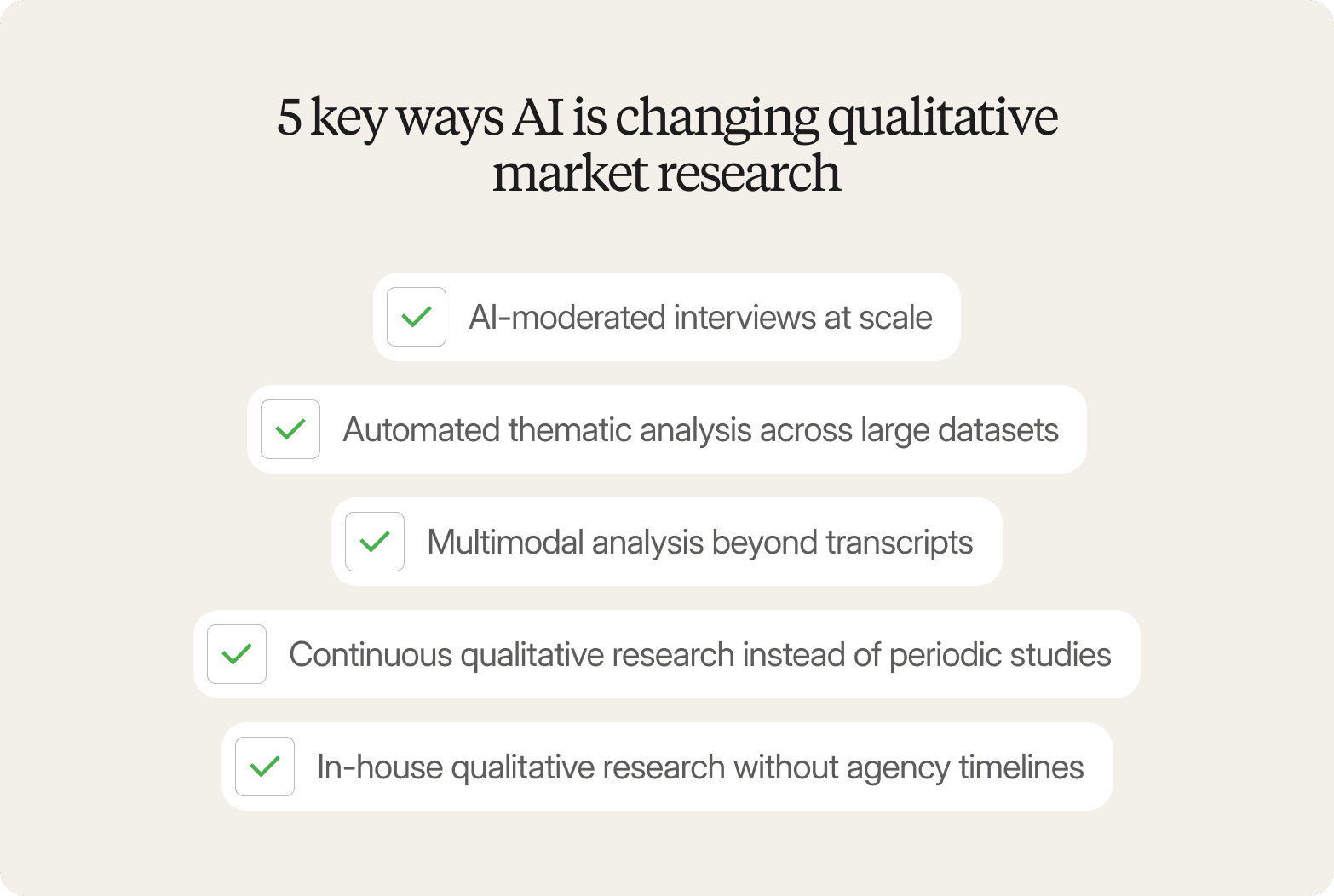
5 key ways AI is changing qualitative market research
For years, the constraint in qualitative market research wasn’t depth. It was whether insights arrived early enough to change decisions.
Traditional qualitative research delivered valuable insights, but recruiting participants, moderating interviews, and completing qualitative data analysis meant most teams ran studies only a few times per quarter. That made qualitative insight powerful but slow and often disconnected from day-to-day product, CX, and marketing strategies.
Research augmented by AI is changing that operating model. Teams can now conduct qualitative market research continuously, across larger target markets, and close to real decision points instead of after them.
Organizations adopting platforms like Conveo are treating qualitative research less as a project and more as infrastructure for ongoing customer understanding.
1. AI-moderated interviews at scale
See Conveo’s AI moderation in action:

One of the biggest changes in market research qualitative methods is the ability to run large numbers of in-depth interviews without adding moderators.
AI interviewers can now conduct one-on-one interviews asynchronously using video, allowing teams to collect qualitative data from dozens or hundreds of participants in parallel while preserving conversational depth.
Teams already transforming qualitative market research with AI are using this approach to replace milestone-based interview waves with continuous discovery programs that stay aligned with real product and customer experience decisions.
What this changes
Qualitative market research shifts from a milestone activity to an always-available decision input.
"Really useful for creative testing. I don't think I've ever turned around a project in a week. So this is really, really helpful."
Insights Manager, Google
2. Automated thematic analysis across large datasets
Qualitative data analysis has historically been the biggest bottleneck in qualitative research in market research workflows.
Research augmented by AI can now identify patterns across transcripts in minutes, helping market researchers surface customer motivations, emerging trends, and qualitative insights immediately after data collection.
Instead of waiting for synthesis cycles to finish, teams can move directly from interviews to decisions while the context is still fresh.
What this changes
Insights become available while decisions are still forming, not after they’ve already been made.
3. Multimodal analysis beyond transcripts
Traditional qualitative methods relied heavily on written transcripts as the primary evidence layer.
Today, research augmented by AI can interpret tone, pauses, facial expressions, and on-screen behavior alongside spoken responses, strengthening the qualitative context behind customer preferences and customer behavior.
This allows teams to identify signals that previously depended entirely on moderator interpretation and manual review.
What this changes
Teams gain a more in-depth understanding of reactions, not just responses.
4. Continuous qualitative research instead of periodic studies
Historically, qualitative market research focused on milestone projects such as quarterly studies or concept validation initiatives.
Infrastructure augmented by AI now supports always-on research programs where teams gather detailed feedback continuously from existing customers and target audiences across market segments.
What this changes
Market research becomes a continuous source of consumer behavior insight rather than a periodic snapshot.
5. In-house qualitative research without agency timelines
For many organizations, qualitative research historically depended on external vendors because recruiting, moderation, and synthesis required specialist capacity.
Platforms augmented by AI are changing that expectation. Internal teams can now collect data directly, analyze qualitative data quickly, and generate actionable insights within days instead of waiting for agency timelines.
This shift is redefining market qualitative research from an occasional outsourced study into a standing internal capability that supports product development, marketing efforts, and customer experience design continuously.
What this changes
The advantages of qualitative research become accessible earlier and more often across the organization.
What AI does not replace in qualitative research
Despite these changes, qualitative research still depends on strong research judgment.
Study design determines whether qualitative insights are meaningful, and interpreting findings requires context that automation alone cannot provide, especially when balancing quantitative and qualitative research evidence.
Understanding the advantages and disadvantages of qualitative research remains essential when comparing quantitative vs. qualitative market research approaches. Understanding the disadvantages and advantages of qualitative research helps teams decide when depth matters more than statistical scale.
Research augmented by AI improves the speed and scalability of qualitative market research methods, but it does not replace careful participant selection, thoughtful research questions, or objective analysis of results.
How Conveo brings AI-moderated qualitative research to enterprise teams
Many insights teams understand the benefits of qualitative market research, but running studies often enough to support decisions is still difficult without agency support. Conveo helps CMI insights teams and CX insights teams shift from periodic projects to continuous in-house qualitative research.
Teams can run AI-moderated asynchronous video interviews with real participants across markets without scheduling bottlenecks. Automated thematic analysis and multimodal synthesis reduce qualitative data analysis timelines from weeks to hours, helping teams identify patterns earlier.
Findings accumulate in a shared insight library, so each study builds on the last instead of sitting in separate decks. This makes market qualitative research practical as an ongoing decision support capability rather than a one-time effort.
Frequently Asked Questions
What is qualitative market research?
Qualitative market research is a method used to understand customer motivations, perceptions, and behavior through interviews, observation, and open-ended responses rather than numerical measurement. It provides a deeper context that explains why customers think and act the way they do.
What is the difference between qualitative and quantitative market research?
Qualitative and quantitative market research answer different questions. Qualitative research explains why customers behave a certain way, while quantitative research measures how many customers behave that way using statistical data.
How many participants do you need for qualitative research?
Most qualitative market research studies involve 8–20 participants per segment. Smaller samples are appropriate because the goal is to identify patterns and motivations rather than produce statistically representative results.
How long does qualitative market research take?
Traditional qualitative market research typically takes several weeks because recruitment, interviews, and analysis happen sequentially. AI-supported workflows now allow teams to conduct qualitative market research and generate insights within days.
How do you analyze qualitative research data?
Researchers analyze qualitative data using thematic coding, clustering responses, and identifying patterns across interviews or observations. These market research qualitative methods turn raw feedback into structured insights that support decisions.
How do you ensure qualitative research is reliable and unbiased?
Reliable market qualitative research depends on a strong research design, careful participant selection, and transparent interpretation of findings. Understanding the advantages and disadvantages of qualitative research helps teams apply results appropriately.

About the author
Alex de Hemptinne
Business Impact Lead
Alex is a Business Impact Lead at Conveo, partnering with enterprise teams to embed AI-led research into their workflows. From the first study to full-scale rollout, she helps customers shift from project-based research to continuous customer intelligence.
Meet Alex on film →Qualitative insights at the speed of your business.
Conveo runs AI-moderated video interviews and structures everything they say.