In this article
TL;DR
AI is rapidly transforming the entire shopping journey—from discovery to purchase—by enabling consumers to search, compare, and even check out within a single conversational interface. Based on Conveo’s study, tools like ChatGPT are becoming primary touchpoints for product decisions, reducing reliance on traditional search and websites. For brands, this shift creates both a major opportunity to influence buyers earlier and a risk of losing visibility if they don’t adapt.
With the 2025 holiday season approaching, AI’s influence on shopping decisions is set to reach new heights. During last year’s festive period alone, Salesforce reported that AI influenced $229 billion in global online sales - that’s nearly one in five online orders. Now, with leading AI platforms like ChatGPT introducing in-app “instant checkout” capabilities, AI is moving beyond inspiration to transaction, reshaping every stage of the shopping and purchasing journey.
At Conveo, we wanted to see just how far AI’s influence reaches. So we ran our own study, going straight to consumers to hear their experiences. Using our AI-moderated interview platform, we conducted 330 in-depth conversations across eight markets: the UK, France, Germany, the US, Mexico, Brazil, South Africa, and India.
What we found is clear: from awareness through to conversion and loyalty, AI tools are influencing how people discover, compare, and choose products. For brand and marketing professionals, these platforms are a new frontline - offering significant opportunities for those who learn to leverage them (and a real risk for those who don’t).
Let’s dive into the data…
Discovery in the Age of AI
It’s no surprise that the most used tool amongst participants is ChatGPT (22%). However, Google Gemini was hot on its heels at 18%, outpacing Microsoft's Copilot (11%) and Amazon’s Alexa (9%).
When asked what they’re using these tools for, the top everyday use cases were learning and discovery (12%), searching for information (12%), and shopping and buying products (11%).
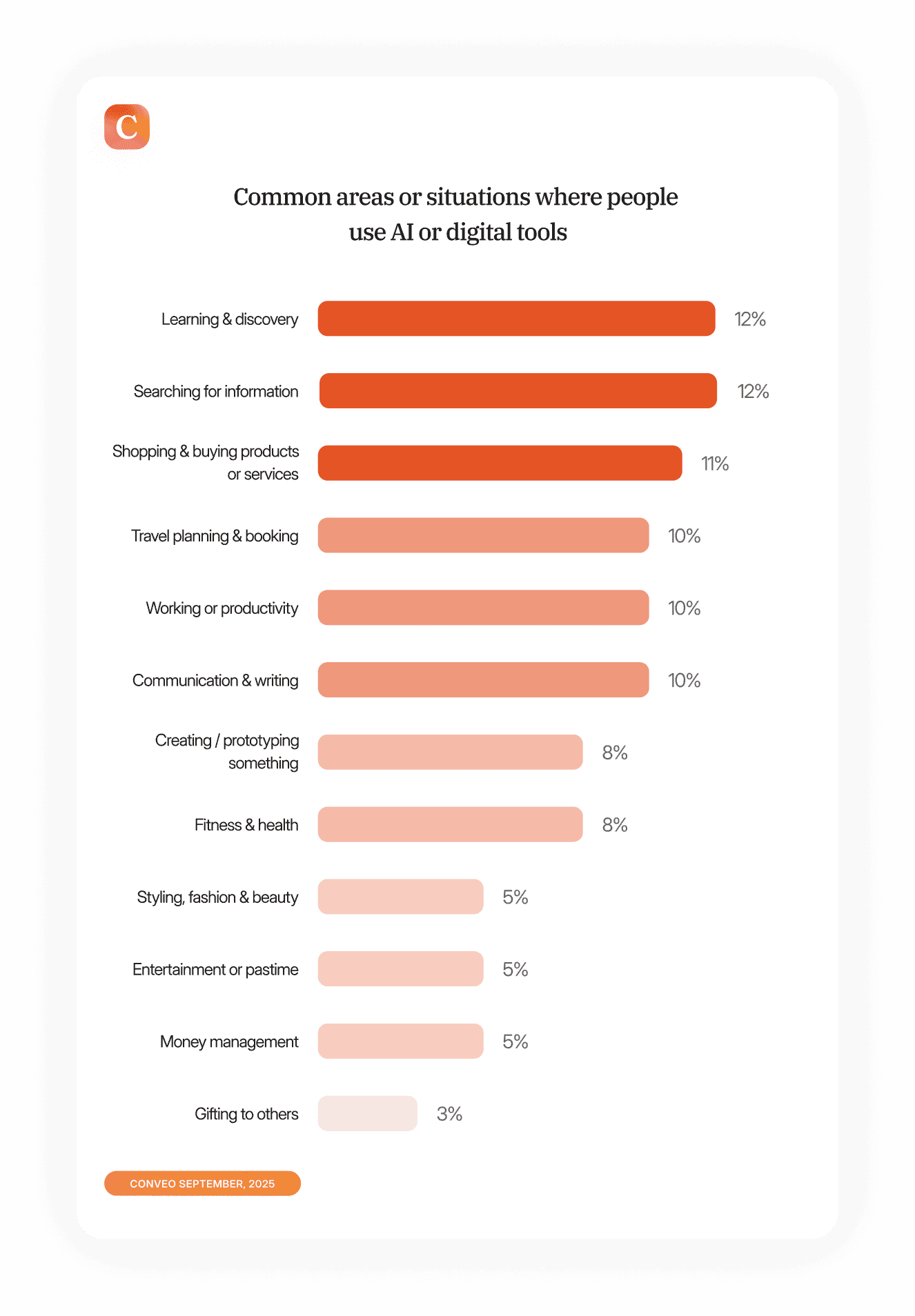
The implication is clear: traditional search is evolving. With Google’s AI summaries appearing at the top of search results, many users stop their search journey there. In fact, it’s been reported that 60% of searches now end without progressing to a destination. SEO and big ad budgets no longer equal discovery, with many consumers bypassing search engines entirely, heading straight to platforms like ChatGPT for fast, direct answers.
“I use ChatGPT because I have more experience with it. And based on my experiences it has proven that it provides valuable information. So, instead of Googling and taking time to actually scroll through every single site that has solutions, I rather prefer using ChatGPT, which would give me the straight answer directly without having to waste my time going through each and every single website that I find on the Internet.”
Male, 24, South Africa
Niels Schillewaert, Conveo’s Head of Research & Methodologies notes - “What really stood out to me from the interviews is just how widespread AI’s influence already is — it’s touching almost every shopping category. You would expect it to have an impact on high planning or costly categories like travel or electronics, but it is often about very personal items and categories. Instances in which people feel more comfortable engaging with AI to treat hair loss or bed bugs for example."
From Milk to MacBooks, AI is a Mainstream Shopping Companion
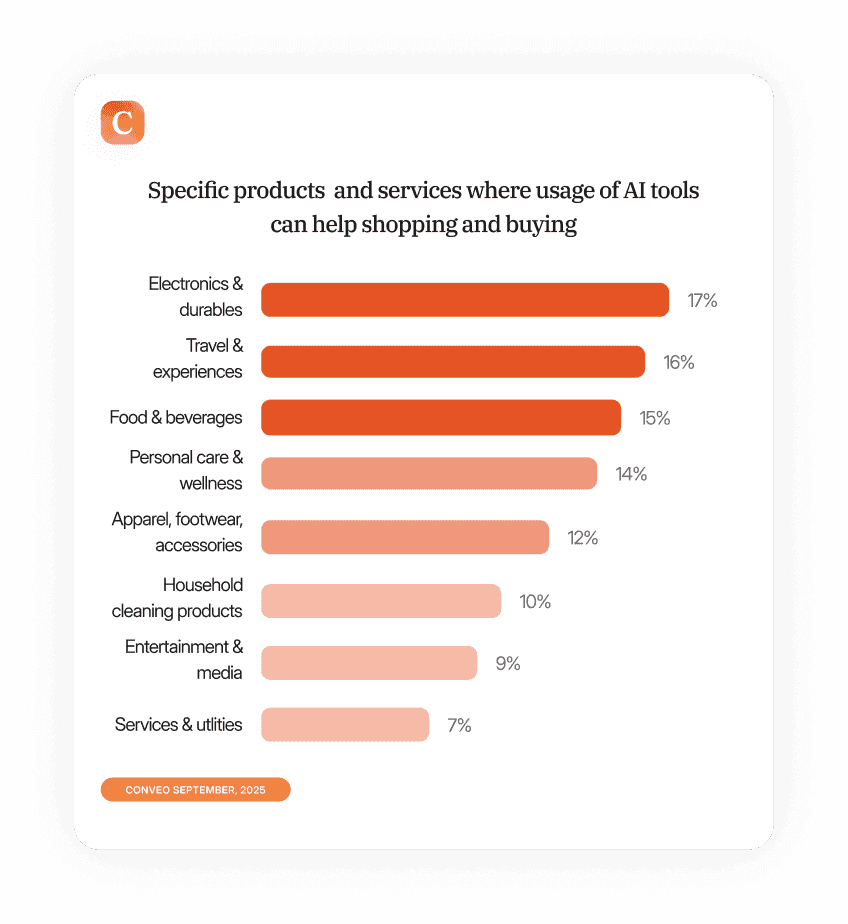
A resounding 97% said AI has at least a slight influence on their shopping behaviors, with 39% reporting strong influence. This spans complex purchases (33%) to everyday essentials (13%), with particular impact in consumer electronics (17%), travel & experiences (16%), food & beverage (15%), and personal care (14%).
“I was looking for an iPad to purchase for entertainment and a bit of light work… I gave [AI] all my requirements… it suggested one of the older iPads, 6th generation from 2022, which met all my needs and was at my price point… a product I wasn’t really thinking [about]… I went ahead and bought it.” (Male, 27, United Kingdom)
“When I was looking for this carpet cleaner, I wanted something practical for me, within my budget, and suited to my everyday needs. I’d actually put a product in my cart that was on sale, but it didn’t have the features I really needed. I’d made that choice based on customer reviews, but AI helped me understand its features, its advantages, and especially its drawbacks. I was won over — AI encouraged me and, above all, suggested exactly the product that matched what I wanted and needed.” (Female, 58, France)
“I downloaded an app… I uploaded my pictures of my hair and it suggested particular types of medicines… It worked really well. My hair growth is now much much much better.” (Male, 28, New Delhi)
Niels Schillewaert, Conveo’s Head of Research & Methodologies notes - “What really stood out to me from the interviews is just how widespread AI’s influence already is — it’s touching almost every shopping category. You would expect it to have an impact on high planning or costly categories like travel or electronics, but it is often about very personal items and categories. Instances in which people feel more comfortable engaging with AI to treat hair loss or bed bugs for example."
Shoppers want a Personal Advisor, Not Generic Answers
Consumers aren’t just after efficiency - they want expertise. Providing knowledgeable guidance (40%) ranked as its top benefit, far ahead of time-saving which followed (15%). There’s a clear demand for that guidance to be tailored to the individual, with personalized recommendations (11%) seen as the top ‘job’ for AI.
“I definitely know that AI helps me choose books by using information about what I’ve read, the genres and authors I like, and which books I’ve really enjoyed and why. That led me to this author [Will White] and I’ve really loved his books and have flown through them this last year.”
Male, 48, US
Consumers want AI to act like a personal shopping assistant, understanding their individual preferences, needs, and circumstances. Across numerous interviews, participants highlighted a desire for AI to ‘remember’ past choices or learn from their behavior - with frustrations mounting when tools ignore feedback or offer generic/pointless suggestions.
“I think for me, the biggest bug at the moment and most annoying thing is on Amazon when you purchase something, and then you get a recommendation the next day for exactly the item that you've already purchased… That is not helpful. It's really annoying.” (Female, 48, UK)
“[Desire] that it can be customized to my needs and tastes… if it's tailored to me and I could train it to get to know me better… it would help its answers be more focused on me." (Female, 41, Mexico)
Has Word-Of-Mouth Met Its Match?
The study reveals that it’s certainly under pressure, as AI increasingly leads the conversation. Recommendations from AI (51%) were roughly twice as popular as family and friends (26%), and five times more than in-store staff (10%) or online reviews (10%). AI is also perceived as highly credible, with 71% rating it most trustworthy.
“I trust more in AI than friends/family or store staff… It's data and statistics based. Friends and family base things on personal experience and their thoughts” (Female, 43, Germany)
“I think I would trust AI more… Humans individually are very subjective… whereas the entirety of the collection of the Internet that AI is pulling from really has a lot of power and a lot of leverage.” (Male, 35, US)
However, nine in ten do still follow a multi-channel verification process to confirm AI credibility, double-checking recommendations via social media, reviews, forums, or friends and family.
“When it comes to more important decisions, I never rely on one source. I never want to rely solely on AI. Of course, I still accept recommendations from friends, acquaintances, family, or salespeople. But I always form my own opinion from multiple sources.” (Male, 37, Germany)
AI is Breaking B(r)a(n)d Loyalty
The power of ‘brand’ and ‘brand loyalty’ is also feeling the heat. It’s no longer enough to be well-known, or placed front-and-centre by a retailer, brands now need to be recognised and validated as the right choice by consumers’ digital shopping advisors too. Over half (53%) said they try new brands based on AI guidance and 39% said that AI has altered their cart contents.
“In the case of my running shoes, [AI] presented me with a brand I’d not heard of… AI gives me much more detail to help me make an informed decision.” (Male, 58, UK)
“I asked AI to recommend headphones… I bought the Marshalls which I'd only heard of as a speaker brand… instead of the Sonys I wanted.” (Female, 27, Mexico)
Loyalty shifts are happening in-store too, with nearly eight in ten changing what they bought at the shelf due to AI suggestions.
From Chat to Checkout: AI as a One-Stop Shop
Beyond influencing choice, AI is already streamlining the act of buying itself - directing consumers to where they can purchase, check out, or complete transactions most efficiently.
“I did use it for gifting choices… it presented me with a set of suggestions … along with the various Amazon links… I was able to click and then look at various varieties and go forward with my buying process.” (Female, 31, India)
“[AI] directed me to the pre‑loved version on the Canada Goose website where I saw some options were half the price… I appreciated AI introducing that to me. I put the item in my cart.” (Male, 44, US)
AI’s influence on purchasing decisions is only set to grow. With ChatGPT’s recent partnerships with Etsy and Shopify, we’re moving toward full discovery-to-transaction functionality on the platform. Think of it like TikTok Shop or Instagram Shopping, but powered by chat recommendations. As with any major shift, opportunity follows: challengers and early adopters who embrace LLM-centric strategies have a real chance to gain ground in spaces traditional paid and performance marketing can’t fully reach.
Closing Remarks
We’re entering a new era of agentic commerce. Understanding and adapting to this evolution gives brands a powerful opportunity to engage shoppers in entirely new ways. For those eager to get involved, here are a few takeaways to consider:
Enable brand discoverability - Don’t just pay for placement — make your brand findable. Ensure your product data is structured and easy for AI tools to parse, and clearly highlight your unique differentiators. Include high-quality images and reviews that AI can ingest to maximise your chances of appearing in recommendations and search results. The goal: to ensure your brand and products show up naturally when consumers use AI-style search or conversational queries.
Be transparent first - Prepare for customers testing your marketing copy more frequently. AI spots misleading claims so avoid them to preserve trust and loyalty.
Maintain credibility - While many consider AI guidance highly credible, consumers still frequently validate recommendations with additional research (e.g., YouTube, friends, forums). To build deeper trust and increase conversion brands should ensure consistency across all touchpoints.
Test, track and explore - Conduct research to understand how AI is reshaping behaviours in your category and guide your next moves.
“The findings from our AI Shopper Study reveal that the AI-powered shopping revolution is happening now, rapidly. People put more trust in AI for recommendation because it is perceived as more complete, objective and convivial. Brands need to act today. Those that don’t risk being left behind” - concludes Niels Schillewaert.
Keen to hear the wider findings from this study? Conveo will be hosting an online expert session ‘From chat to checkout: The rise of the AI-powered shopper’ on 3rd December at 4 PM GMT | 11 AM EST. Catch up on the session here.
This article was originally published on Greenbook's The Prompt column on Nov 11, 2025. Visit the original article here.
Frequently Asked Questions
How fast can I get insights with Conveo?
Conveo is an AI-powered qualitative research platform that helps enterprise teams gather deep customer insights fast. It uses voice and video interviews, not avatars, to capture authentic, human responses. Conveo’s AI then analyzes these multimodal inputs to extract themes, quotes, and actionable insights. Ideal for marketing, product, CX, and innovation teams who want real qualitative data without slow, manual analysis.
How is Conveo different from other qualitative research tools?
Conveo is an AI-powered qualitative research platform that helps enterprise teams gather deep customer insights fast. It uses voice and video interviews, not avatars, to capture authentic, human responses. Conveo’s AI then analyzes these multimodal inputs to extract themes, quotes, and actionable insights. Ideal for marketing, product, CX, and innovation teams who want real qualitative data without slow, manual analysis.
Who uses Conveo and what are the main use cases?
Conveo is an AI-powered qualitative research platform that helps enterprise teams gather deep customer insights fast. It uses voice and video interviews, not avatars, to capture authentic, human responses. Conveo’s AI then analyzes these multimodal inputs to extract themes, quotes, and actionable insights. Ideal for marketing, product, CX, and innovation teams who want real qualitative data without slow, manual analysis.
Can Conveo replace traditional focus groups or interviews?
Conveo is an AI-powered qualitative research platform that helps enterprise teams gather deep customer insights fast. It uses voice and video interviews, not avatars, to capture authentic, human responses. Conveo’s AI then analyzes these multimodal inputs to extract themes, quotes, and actionable insights. Ideal for marketing, product, CX, and innovation teams who want real qualitative data without slow, manual analysis.
Is Conveo compliant with data privacy and security regulations?
Conveo is an AI-powered qualitative research platform that helps enterprise teams gather deep customer insights fast. It uses voice and video interviews, not avatars, to capture authentic, human responses. Conveo’s AI then analyzes these multimodal inputs to extract themes, quotes, and actionable insights. Ideal for marketing, product, CX, and innovation teams who want real qualitative data without slow, manual analysis.
How fast can I get insights with Conveo?
Conveo is an AI-powered qualitative research platform that helps enterprise teams gather deep customer insights fast. It uses voice and video interviews, not avatars, to capture authentic, human responses. Conveo’s AI then analyzes these multimodal inputs to extract themes, quotes, and actionable insights. Ideal for marketing, product, CX, and innovation teams who want real qualitative data without slow, manual analysis.

About the author
Hendrik Van Hove
Founder & CPO
Hendrik is Conveo’s Chief Product Officer and co-founder. He's extremely passionate about technology and the real positive impact it can bring. Before Conveo, he ran AI strategy projects at McKinsey for the Fortune 2000, working with boards and every function from marketing, to sales to insights.
More by Hendrik →Qualitative insights at the speed of your business.
Conveo runs AI-moderated video interviews and structures everything they say.