In this article
TL;DR
The core tension: qualitative consumer research delivers the motivational depth that surveys cannot match, but traditional agency timelines (six to twelve weeks from brief to report) mean insights arrive after decisions are made. Enterprise teams default to three imperfect alternatives: agencies, which provide depth but move slowly and are costly; quantitative surveys, which are fast but produce numerical data without explaining the reasoning behind them; and generic AI tools, which are fast but not grounded in real human conversations.
Conveo exists for teams that need qualitative depth at survey speed. It is a video-first qualitative research platform that compresses study cycles from weeks to days while preserving conversational depth and stakeholder traceability. Insights teams move from interviews to stakeholder-ready understanding without losing context, auditability, or institutional memory.
Your NPS score dropped three points. Your brand tracker shows awareness holding steady. Your campaign just underperformed by 18%. The dashboards tell you something has changed. They cannot tell you why.
That is the persistent gap at the center of enterprise consumer research. Quantitative methods are fast, scalable, and statistically confident. They produce measurable data about what happened. Qualitative consumer research is what you turn to when you need to understand what was actually going on in the consumer’s head at the time. The two disciplines are not in competition. They answer different questions. The problem most enterprise teams face is not choosing between them. It is running enough qualitative consumer research, often enough, to keep pace with the decisions being made.
This guide covers the core research methods, where they break down operationally, and how the workflow for qualitative consumer research has materially changed with AI-assisted platforms. This is the decision framework for teams considering whether to run more qual in-house, reduce agency dependency, or move to continuous consumer understanding.
What Qualitative Consumer Research Actually Is
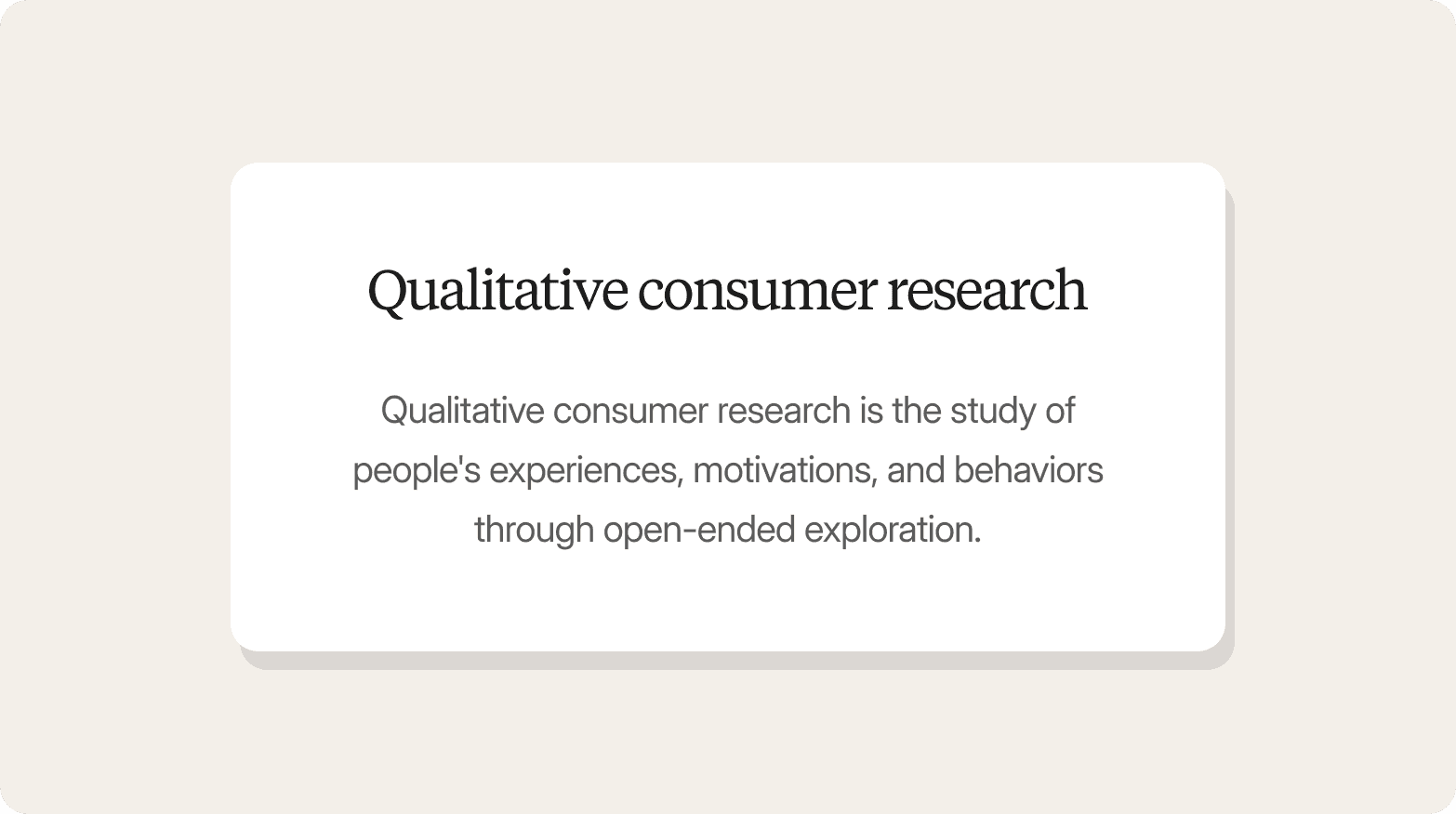
Qualitative consumer research is the study of people’s experiences, motivations, and behaviors through open-ended exploration. Where quantitative research asks how many and how much, qualitative consumer research asks how and why; it focuses on understanding the reasoning and emotion behind consumer behavior, not just counting it.
The distinction matters for how you design studies and act on findings. Quantitative data points to the problem. Qualitative insights explain it. A brand tracker might show that purchase intent declined among 25- to 34-year-olds in Q2. A well-run set of qualitative consumer interviews will tell you whether that decline reflects a pricing perception shift, a competitor’s positioning move, a packaging change that landed wrong, or a cultural moment your team missed entirely.
Most enterprise teams underinvest in qual, defaulting to surveys for speed and reserving qualitative studies for major annual programs. The result is a research function that is fast but shallow: a lot of measurable data, not enough understanding. Successful businesses that consistently produce sharper positioning and more effective creative are the ones that run qualitative consumer research as an ongoing discipline, not a periodic event. The operational constraints that once made qualitative depth inaccessible (manual moderation, transcript review, weeks of synthesis) are now dissolving. Understanding the fundamentals of qualitative consumer research today means understanding both what the methodology delivers and what has changed about the infrastructure required to run it at scale.
4 Core Methods of Qualitative Consumer Research
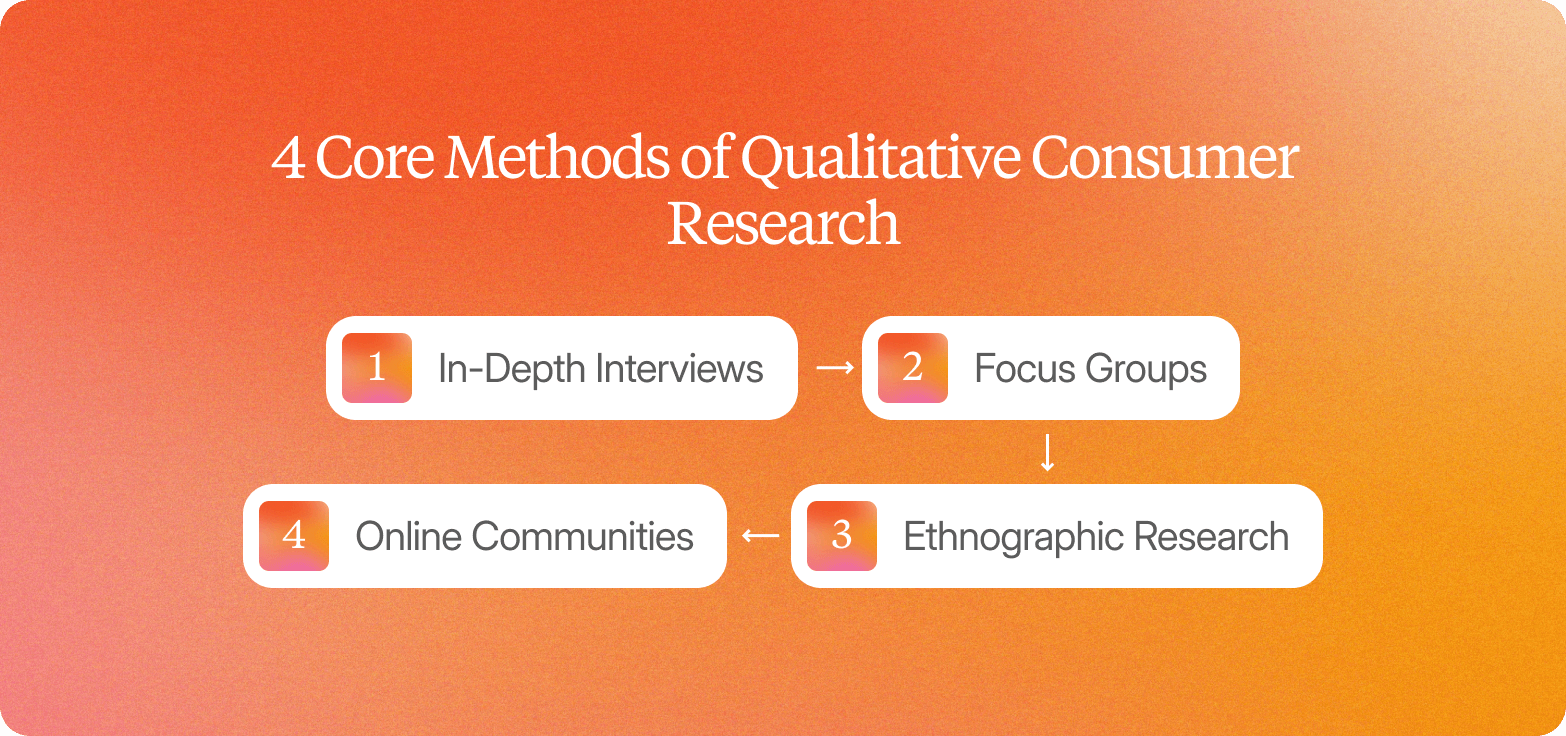
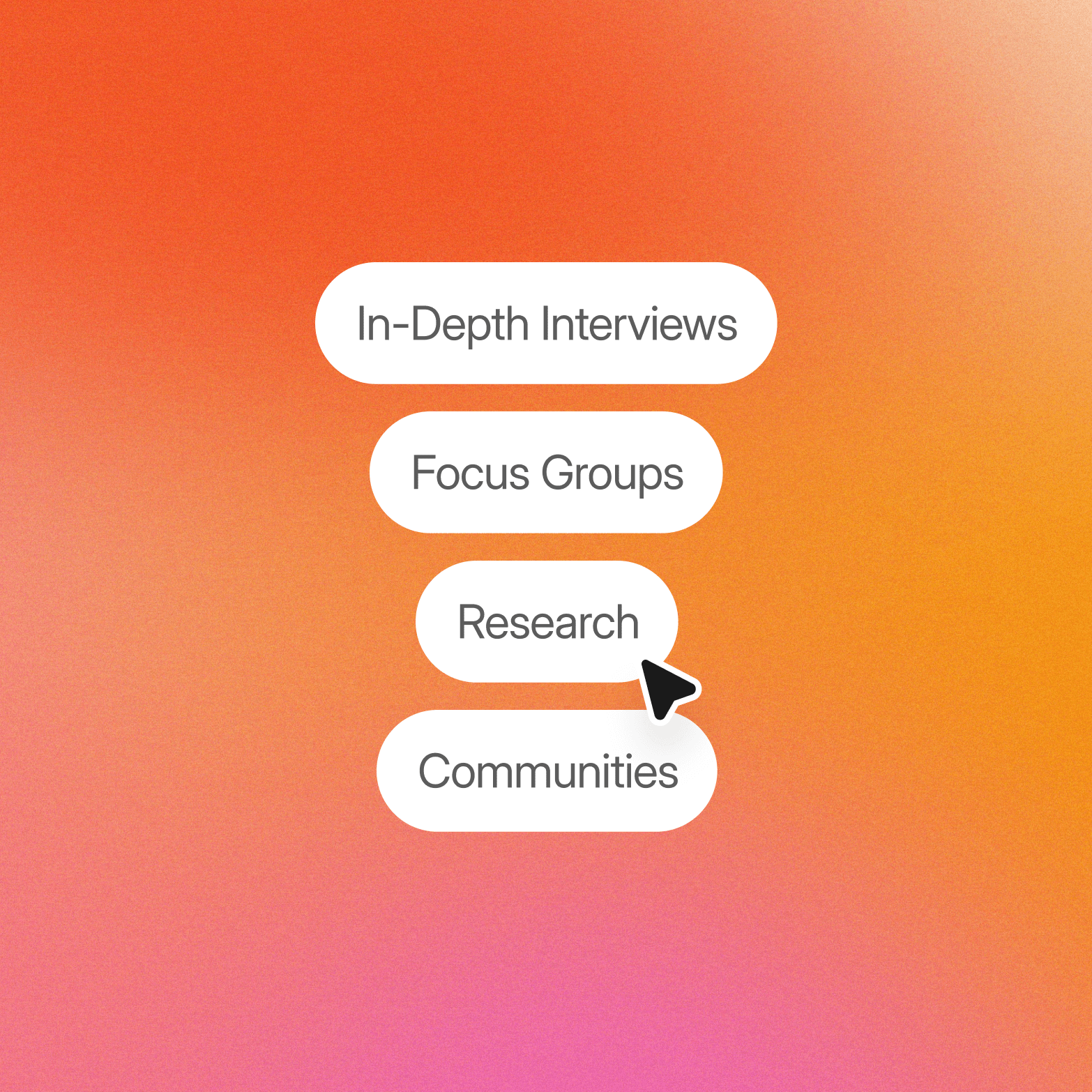
Understanding which method fits which research objective is the first operational decision every research team makes. Here is how the primary qualitative consumer research methods work in practice, and where each creates friction at enterprise scale. These are consumer market research qualitative examples in their most common forms, each qualitative research method suited to different research questions, timelines, and operational realities.
In-Depth Interviews (IDIs)
Qualitative research in consumer behavior most often begins here: a single participant, a skilled line of questioning, and the space to follow wherever the response leads. One-on-one interviews, also called in-depth interviews, are the most widely used qualitative method in consumer and market research. The researcher follows a discussion guide but adapts based on what the participant says, probing to explore the underlying reasons consumers make the choices they do.
That depth is what makes IDIs the preferred method when the research question involves emotional drivers, purchase decision journeys, or context-specific pain points that neither group settings nor structured surveys can reliably surface. A participant who hedges in a focus group will often speak plainly when there is no audience.
The operational constraint is throughput. Manual scheduling, live moderation, and post-session transcription cap most studies at 10 to 20 interviews. That sample size is workable for exploratory work, but it limits confidence when findings need to hold across segments or broader populations. Asynchronous video interviews with adaptive probing change that equation: participants complete sessions on their own schedule, the AI moderator follows up based on what each person actually says, and hundreds of conversations can run in parallel without sacrificing the deeper insights that make one-on-one interviews valuable.
Focus Groups
Focus groups typically bring six to ten participants together to react to a concept, message, or product in real time. This qualitative research method surfaces group dynamics: where consensus forms naturally, where outlier perspectives push back, and where one stimulus triggers ideas no individual would have generated alone. Skilled moderators use focus groups to identify patterns in how a small group of consumers interprets and responds to the same stimulus.
Running a focus group means coordinating a physical or virtual venue, securing a skilled moderator who can prevent dominant voices from flattening the room, and asking participants to commit 90 minutes or more. This is why focus groups tend to be reserved for high-stakes decisions rather than continuous discovery.
Ethnographic Research (Field Studies)
Ethnographic studies place researchers inside the environments where consumer behavior actually happens: homes, retail aisles, workplaces, and kitchens. Rather than asking consumers to recall their behavior, ethnography observes it directly, surfacing the unstated habits, environmental triggers, and contextual influences that no survey or interview room can replicate. It is one of the most powerful qualitative methods for understanding how consumers interact with products and spaces in their natural context, closing the gap between what people say and what they do.
Full ethnographic fieldwork requires trained moderators, travel logistics, and synthesis timelines that routinely stretch to weeks or months. For one-off foundational studies, that investment can be justified. For recurring research needs, it rarely is. Teams increasingly use ethnographic-style video interviews, where participants capture their own environments on camera, to approximate behavioral depth at a fraction of the cost and time.
Online Communities
Private digital forums bring participants together over days or weeks to share reactions, document experiences, and respond to each other’s perspectives in real time. Unlike a single interview session, a multi-day community captures how opinions shift, how peer influence shapes consumer preferences, and how sentiment evolves as participants process a concept more deeply.
The operational cost is significant: prompts need refreshing, threads need monitoring, disengaged participants need reactivating, and the resulting volume of unstructured discussion requires manual synthesis before any findings are usable. For a small team managing concurrent programs, a live community can consume more bandwidth than the insight it produces justifies.
All four methods share the same underlying bottleneck: findings depend on manual moderation and synthesis. It is the reason small insights teams struggle to run more than a handful of studies per quarter, and the part of the qualitative consumer research workflow that has changed most significantly with AI-augmented platforms.
Qualitative vs. Quantitative Research in Consumer Behavior
Most enterprise research programs use both qualitative and quantitative research in consumer behavior, but teams default to quantitative. Quantitative surveys are fast to field, straightforward to report, and easy to defend in a stakeholder meeting. Qual has traditionally been the method you commission when you have six weeks and a budget to match. That default is worth re-examining.
| Dimension | Qualitative | Quantitative |
|---|---|---|
| Research question type | Why do people behave this way? What are the underlying reasons? | How many? How often? Which option performs better? |
| Data format | Qualitative data: video, voice, narrative, emotional cues, observed behavior | Numerical data: scaled, categorical, statistical |
| Sample size | Small to mid-size (typically 10–60 participants) | Large sample sizes (hundreds to thousands of respondents) |
| Analysis approach | Qualitative analysis: thematic coding, sentiment analysis, pattern interpretation | Quantitative analysis: statistical analysis, cross-tabulation, regression |
| Timeline (traditional) | 6–12 weeks for agency-led qual | Days to weeks for survey fielding |
| Best use cases | Concept exploration, messaging development, understanding friction, unpacking behavioral drivers | Market sizing, preference ranking, tracking, and segmentation validation |
Note: AI-moderated qual significantly compresses the traditional timeline. That shift is covered in detail in the following section.
The key differences between qualitative and quantitative approaches come down to what each method is built to answer. Quantitative methods rely on numerical data and statistical significance to produce results that hold across broader populations. Qualitative and quantitative research serve complementary purposes: quant measures the “what,” qual explains the “why.” Treating quantitative vs. qualitative as a binary choice typically means the organization is optimizing for the easiest method to run, not the one that best fits the question at hand.
Qualitative Consumer Research in Practice: 4 Scenarios
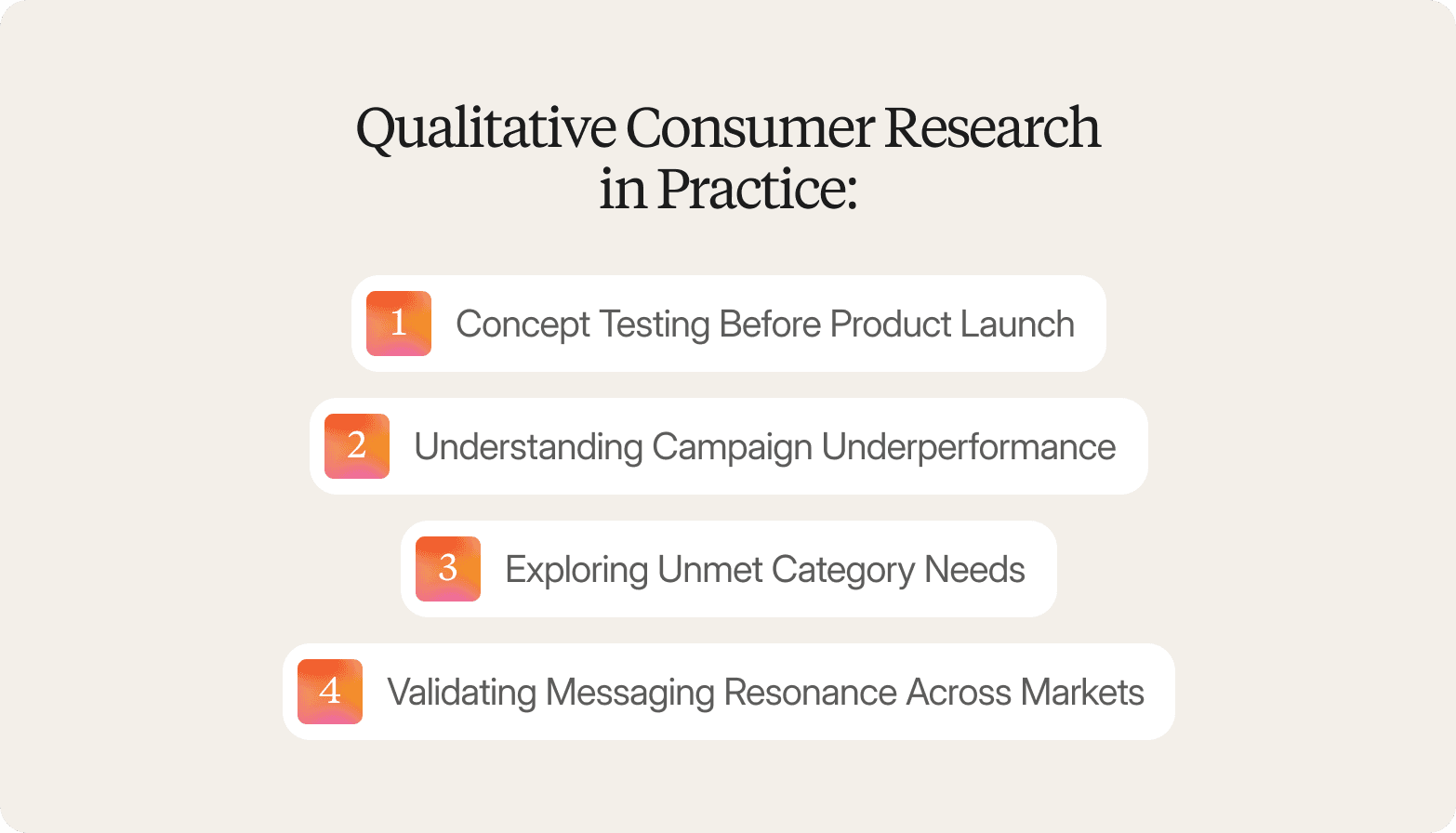
Concept Testing Before Product Launch
A quantitative concept test had already pointed the team toward a winner. Three concepts, one clear frontrunner by score. The decision had been made.
Then the qualitative work began.
Pieter Vanpaemel, Head of Insights at Edgard & Cooper, ran a follow-up qualitative study using Conveo’s AI-moderated video interviews after the quant. What came back changed the outcome entirely.
“We used Conveo after a quant study with 3 concepts and chose an entirely different version. We’re glad we did, and our customers too.”
The quant scores had ranked preference. They had not captured why participants hesitated, what language felt off, or which concept they would actually recommend to someone they trusted. Those signals only surfaced when people were asked to explain themselves on video, in their own words, with an interviewer who probed when they paused. This is where conducting interviews goes beyond collecting responses and starts gathering rich insights into consumer behavior.
A concept can win on appeal and still fail on believability, relevance, or fit with how consumers already think about the category. Quantitative data alone cannot tell you which of those is the problem. Over 70% of final insights are generated during AI-driven follow-up probes in Conveo-moderated sessions, precisely because the most revealing insights come after the scripted question, not during it.
Understanding Campaign Underperformance
Engagement metrics were soft across three markets, but the quant data offered no clear explanation. Asynchronous AI-moderated video interviews, conducted in local languages with automated transcription and translation, surfaced within days. Participants in one market consistently paused or showed visible discomfort when describing the campaign’s lead visual. The AI interviewer probed each hesitation, and a pattern emerged: the imagery carried a cultural association the creative team had not anticipated and survey responses had not flagged, because participants had not volunteered it unprompted.
Conducting interviews via video captured the moment of hesitation, the language participants reached for when pressed, and the underlying association driving it. The creative was adjusted before the next media burst. The regional performance gap closed. This is the kind of meaningful insight that qualitative research helps uncover: the causal relationships between consumer perception and business outcomes that numerical data alone cannot surface.
Exploring Unmet Category Needs
Unmet needs are rarely where product teams think they are. Consumers can tell you what they currently use. They struggle to articulate what they wish existed, because that gap is not something they can describe in the abstract. They can only show it.
Ethnographic-style video interviews change what becomes visible. When participants walk through their actual routines on camera, demonstrating how they currently solve a problem rather than describing it, the research process captures what transcripts alone would miss: the makeshift fix, the hesitation before a step, the moment a participant reaches for one product and then instinctively grabs another. These are the signals that point toward genuine unmet needs and provide deeper insights into customer behavior, the kind that give market researchers and product teams a real competitive advantage.
Validating Messaging Resonance Across Markets
A tagline that signals confidence to US consumers can read as arrogance to German ones. The same benefit claim that resonates in the UK as practical and grounded can feel flat in a market where emotional storytelling carries more weight. These are complex phenomena rooted in cultural interpretation, and they only surface when real consumers in each market are asked to respond in their own words.
Conveo runs all three markets simultaneously. A single study is configured once and then deployed in parallel across US, UK, and German participants, with the AI interviewer conducting sessions natively in each language. Automated transcription and translation surface responses in a unified analysis workspace, so researchers can compare how the same message lands across markets without waiting for sequential fieldwork or reconciling outputs from separate vendors. Qualitative research helps teams gather feedback on messaging at a pace that quantitative approaches alone cannot match. Reaching localization decisions in three to five days rather than six to eight weeks means they can happen before the campaign ships, not after it underperforms.
How AI Is Changing Qualitative Consumer Research Workflows
Hundreds of real consumer conversations can now run in parallel, across markets and languages, while findings are coded, translated, and structured within hours of the first response. The old constraint: qualitative depth required sequential scheduling, live moderation, and weeks of manual analysis. That constraint no longer holds.
The workflow transformation happens across three data collection methods. First, AI-moderated video interviews replace manual scheduling and moderation entirely: teams publish a link, participants complete sessions on their own schedules, and 10 interviews or 1,000 can run in the same window. Second, the analysis and interpretation of qualitative data in consumer research no longer wait for a human analyst; automated transcription, translation, and thematic coding surface patterns within hours of fieldwork closing. Third, findings flow into a searchable insight library rather than a slide deck that gets archived after the presentation, so institutional knowledge compounds across programs instead of getting stranded in exports.
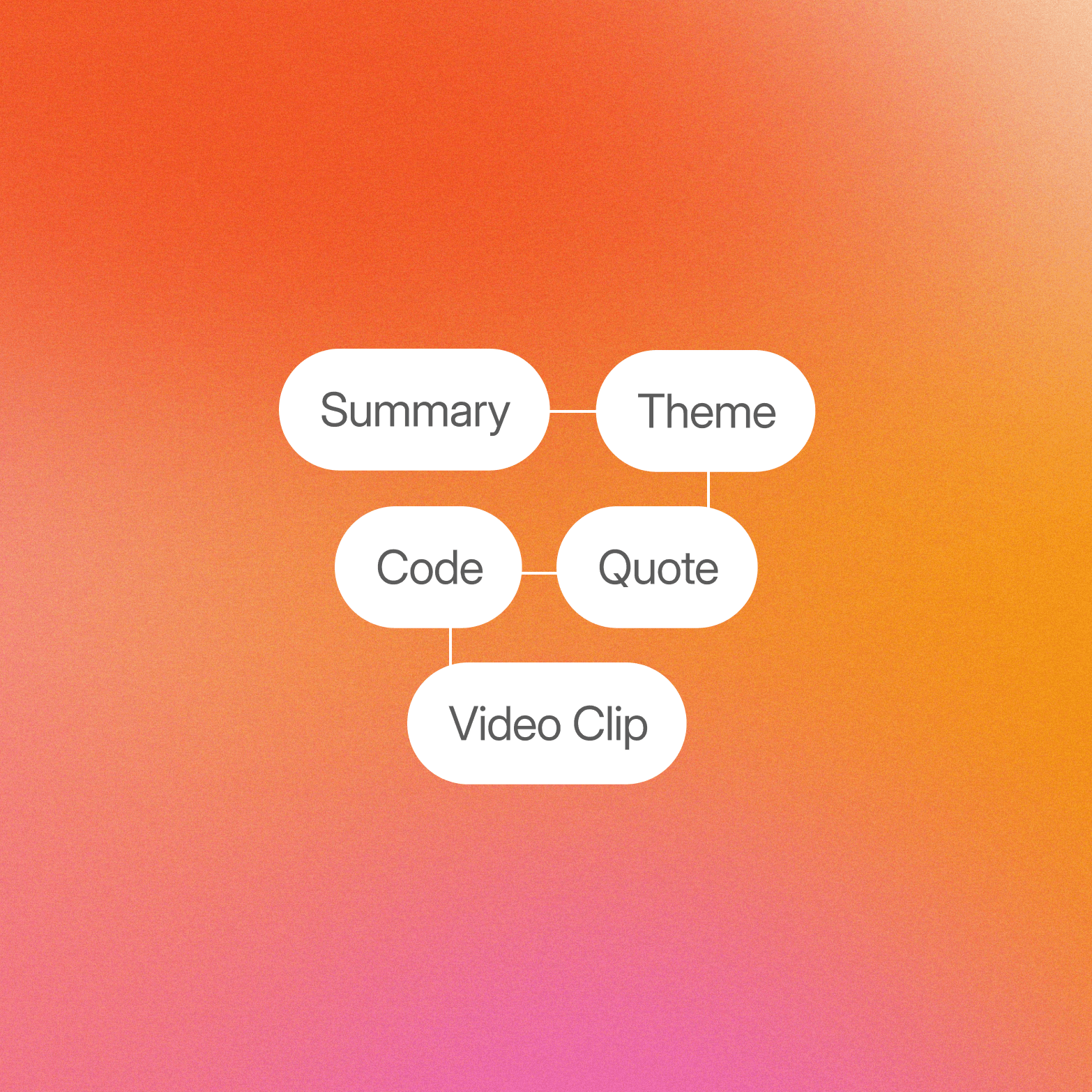
The credibility concern is a genuine blocker to the adoption of qualitative consumer and marketing research. When stakeholders cannot trace a finding back to a real consumer conversation, they discount it. Conveo addresses this directly: every theme ties to video clips and verbatim quotes, so stakeholders can inspect the evidence rather than trust a summary. It is also what makes it possible to uncover rich insights that are credible to CMOs, CFOs, and procurement teams, not just the research function.
Discover how to unlock insights using Conveo:
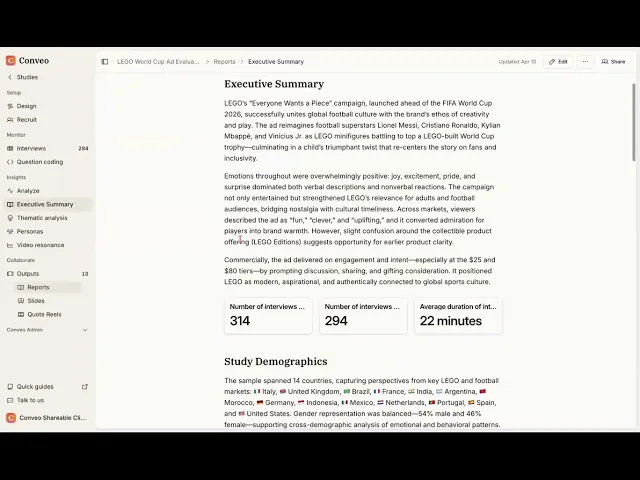
Participant authenticity is not a default. It is a design choice. Real human participants, captured on video with no avatars or synthetic responses, provide the verifiable evidence enterprise buyers now require. Over 400 enterprise teams, including Google, Unilever, and Bosch, rely on real human participants for this reason. The platform is SOC 2-certified, GDPR-compliant, and supports research in 50+ languages. AI removes operational friction; human researchers remain in review for quality control and the strategic judgment that turns findings into recommendations.
How to Choose the Right Research Method for Your Team
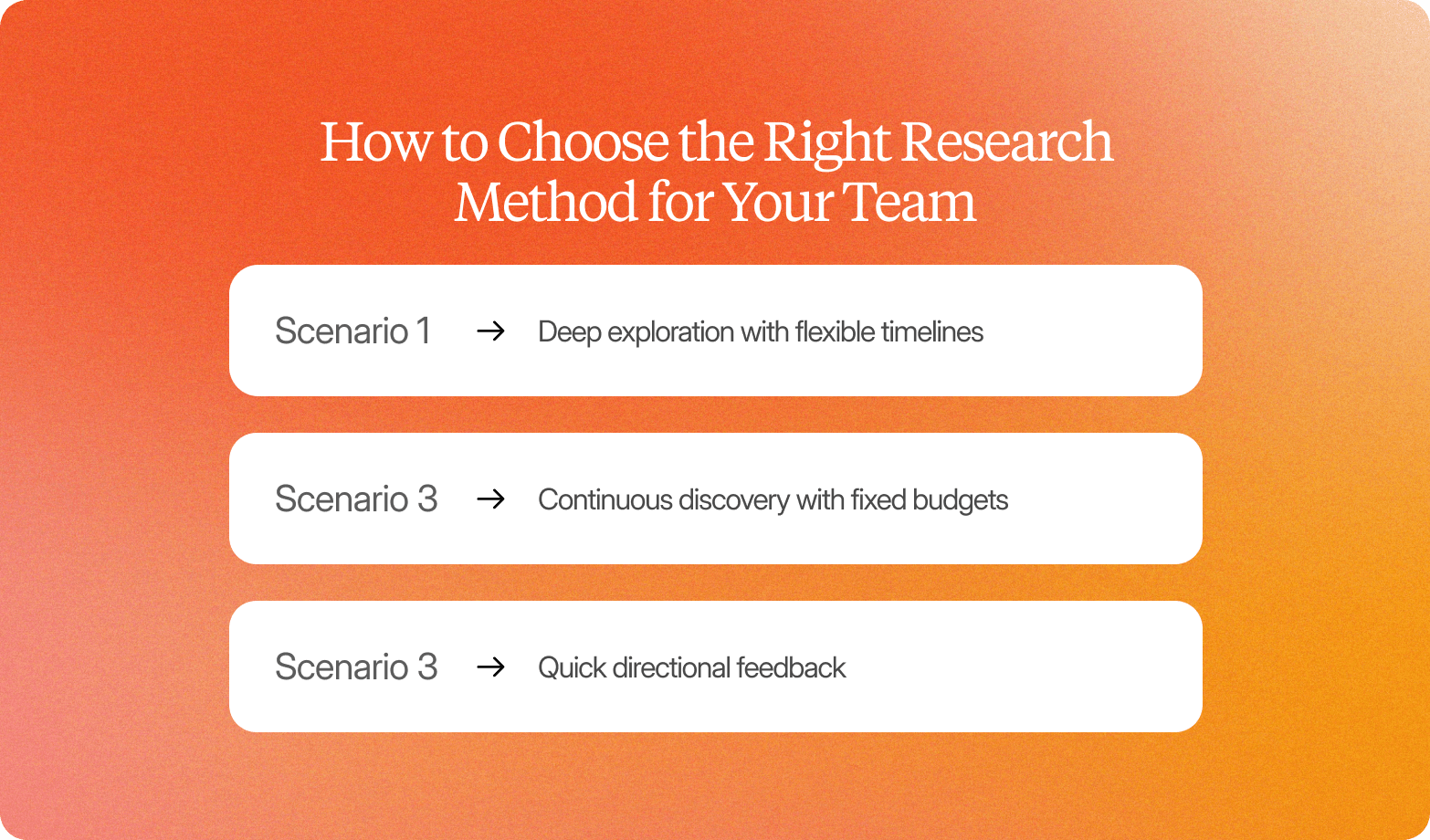
The right qualitative consumer research approach depends on three factors: the depth your research question requires, the timeline your decision can accommodate, and the budget your team controls.
Scenario 1: Deep exploration with flexible timelines
When the research question is genuinely open-ended (brand positioning, cultural context, or category entry) and the stakes justify a 6–12 week investment, agency-led qualitative methods remain the right choice. Skilled human moderation, ethnographic studies, and multi-week synthesis produce interpretive depth that is difficult to replicate at speed.
Scenario 2: Continuous discovery with fixed budgets
When teams need to conduct qualitative research across multiple studies per quarter without adding headcount or agency spend, AI-moderated video interviews compress timelines to days while preserving conversational depth and stakeholder-traceable outputs. This is the right model for teams building a recurring qualitative consumer research practice rather than commissioning one-off projects.
Scenario 3: Quick directional feedback
When the question is narrow, and speed matters more than motivational depth, quantitative surveys with open-ended questions are practical and sufficient. The distinction between quantitative and qualitative consumer research matters here: quantitative methods rely on measurable data to tell you what customers said, while qualitative research focuses on why they said it.
Most enterprise research programs use qualitative and quantitative approaches together, depending on the decision stakes. Conveo is built for teams running Scenario 2. It is not designed for teams that run a single annual study or whose primary need is in-person ethnography or live human moderation.
How Conveo Delivers Qualitative Consumer Research at Enterprise Scale
Enterprise insights teams face a structural problem: the research methods that produce credible, stakeholder-ready findings are the same ones that take six to ten weeks to deliver. By the time the report lands, the decision window has closed.
Conveo is built to resolve that tension without trading depth for speed. Three structural capabilities separate it from generic AI interview platforms and point solutions.
Compliance and traceability
Every study produces audit-ready outputs: themes tied directly to video clips and verbatim participant quotes. Stakeholders can inspect the evidence behind any finding rather than accepting a summarized conclusion on faith. Conveo is SOC 2 certified, GDPR-compliant, and supports EU regional data hosting, clearing the procurement hurdles that quietly stall enterprise vendor evaluations. For market researchers operating in regulated industries, this is table stakes.
Real participants, not synthetic responses
Conveo conducts qualitative consumer research interviews with real human participants across 50+ languages. No avatars, no AI-generated respondents. The target audience for enterprise research programs demands verifiable human data, and Conveo is built around that requirement.
A knowledge library that compounds
Every study feeds a searchable insight repository. Teams stop rebuilding context from scratch each quarter and start connecting new findings to prior research across brands, markets, and programs. This is how qualitative insights become a compounding organizational asset rather than a series of one-off reports.
Over 400 enterprise teams, including Google, FOX, and Bosch, rely on Conveo to run this workflow continuously.
Frequently Asked Questions
What are common qualitative consumer research topics?
Common qualitative consumer research topics span the full range of behavioral and attitudinal questions that numbers alone cannot answer: purchase motivations and decision drivers, brand perception and emotional associations, product experience pain points and workarounds, messaging resonance and comprehension, unmet needs and category frustrations, and customer journey friction points. Each requires understanding the "why" behind customer behavior, context, and causation that numerical data and closed-ended surveys cannot surface. Video-first interviews with adaptive probing go further still: when a participant's tone shifts describing a competitor or their expression changes at a price point, those signals carry valuable insights that open-ended survey responses typically miss entirely.
How long does qualitative consumer research take?
Agency-led qualitative consumer research typically takes 6–12 weeks from brief to final report: 2–3 weeks for study design and recruitment, 1–2 weeks for interviewing, and 2–4 weeks for analysis, synthesis, and reporting. AI-moderated workflows compress each stage of the data collection and analysis process. Asynchronous video interviews run in parallel, so fielding that once took weeks can close in days. Automated transcription and thematic coding reduce qualitative analysis from weeks to hours. Teams report moving from brief to stakeholder-ready findings in 3–7 days on studies that previously took months. Actual timelines depend on sample size, analysis complexity, and the level of human review required.
What's the difference between qualitative and quantitative consumer research?
Qualitative research in consumer behavior explores the "why" and "how" behind decisions through open-ended conversations, interviews, and observation. Quantitative research measures "how many" and "how much" through structured surveys and statistical analysis. The key differences in consumer market research come down to intent: qualitative consumer research uncovers motivations, emotions, and unmet needs; quantitative research methods validate findings, measure prevalence, and track market trends at scale. Most enterprise programs use both in sequence, qual to open the question, quant to confirm how widely the findings hold.
Can qualitative consumer research be done at scale?
Yes. AI-moderated video interviews make large-scale qualitative consumer research operationally viable in a way that manual moderation cannot. Traditional qual is constrained by scheduling and moderator capacity: most teams run 10 to 30 interviews per study because managing more becomes impractical. Asynchronous AI-led interviewing removes that ceiling; teams can collect data from 10 or 1,000 conversations in parallel, across 50+ languages, with automated transcription and thematic coding surfacing patterns within hours of fieldwork closing. The depth of real conversational interviews is preserved. The operational constraints that made scale impractical are not.

About the author
Alex de Hemptinne
Business Impact Lead
Alex is a Business Impact Lead at Conveo, partnering with enterprise teams to embed AI-led research into their workflows. From the first study to full-scale rollout, she helps customers shift from project-based research to continuous customer intelligence.
Meet Alex on film →Qualitative insights at the speed of your business.
Conveo runs AI-moderated video interviews and structures everything they say.