In this article
TL;DR
Brand equity research measures how consumers perceive your brand over time, tracking awareness, emotional associations, and loyalty to inform strategic decisions. Most brand equity programs fall short because the operational model forces research into periodic, agency-dependent cycles that miss the emotional and contextual signals that drive real brand strength and preference. When those constraints are removed, continuous management of brand equity becomes possible. This article offers insights for CMI professionals running brand equity programs or weighing how to build that capability without ongoing agency dependency.
Brand equity is one of the most strategically important things a brand can measure, and one of the most consistently mismanaged. Most programs track metrics without explaining what drives them, run annually when markets shift quarterly, and deliver findings after the decisions they were meant to inform have already been made.
This article covers the frameworks, methods, and question banks that separate brand equity research programs that actually drive decisions from those that just produce slides.
What is brand equity research, and why traditional methods fall short
Brand equity programs deliver findings six to twelve weeks after the decisions they were meant to inform have been made. By the time a research report lands, the campaign has shipped, the pricing change has gone live, or the product has launched in a new market.
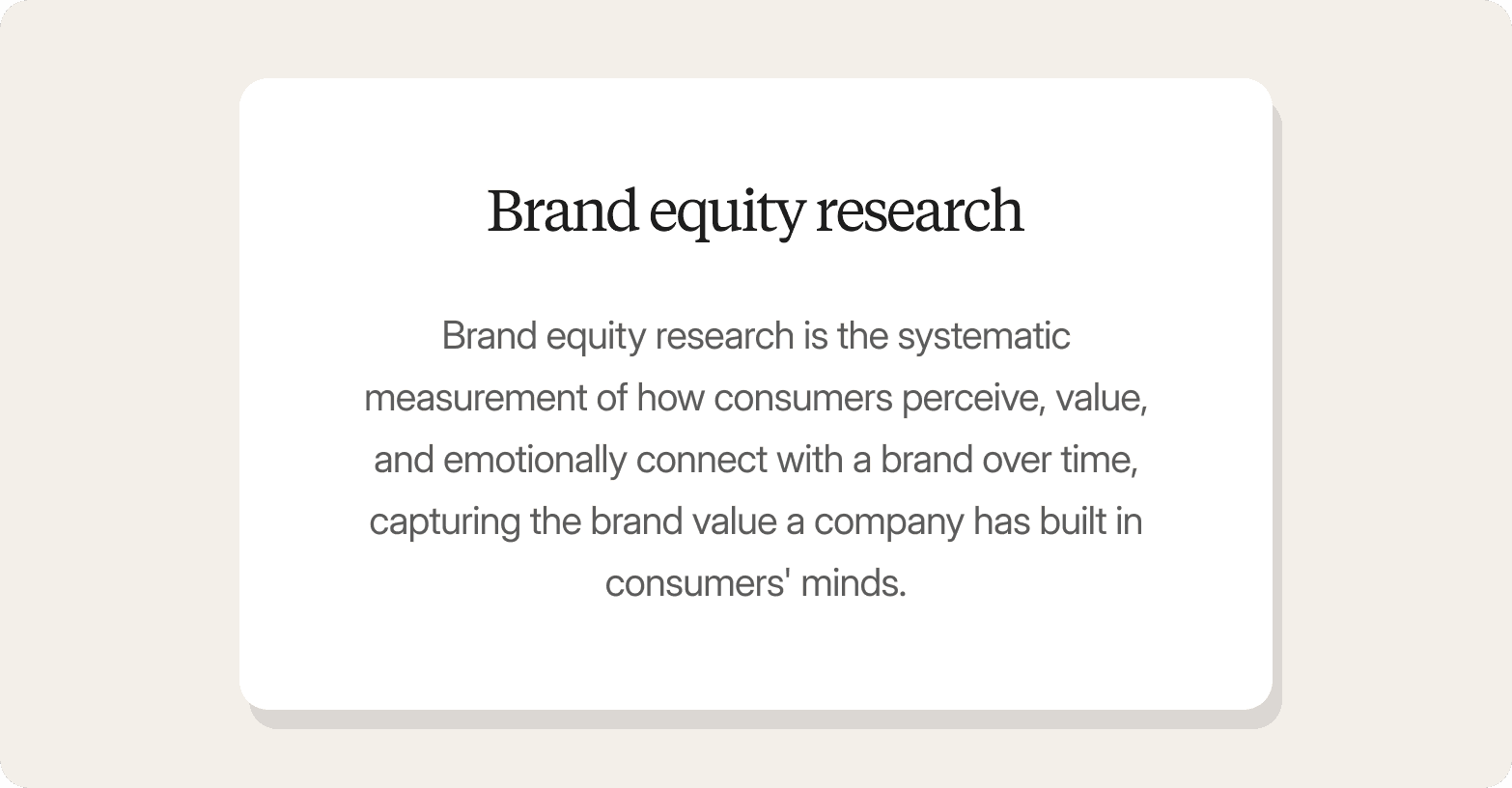
Brand equity research is the systematic measurement of how consumers perceive, value, and emotionally connect with a brand over time, capturing the brand value a company has built in consumers' minds. Understanding brand equity means going beyond what awareness scores and NPS can tell you. The "why" behind a brand equity shift lives in conversation, not in a number: why trust eroded, why a competitor gained ground, why a new segment started paying attention.
Capturing that depth has traditionally required focus groups, in-depth interviews, and agency timelines that made continuous tracking impractical. That constraint is dissolving. Qualitative research is entering a new era of capability: AI-moderated interviews now deliver the emotional richness of real human conversations at a pace and scale that traditional methods cannot match.
This piece explains how to measure brand equity and build brand value using methods that surface the reasoning behind the numbers, without waiting months for findings or rebuilding your approach from scratch with every new wave.
Why brand equity research matters for business decisions
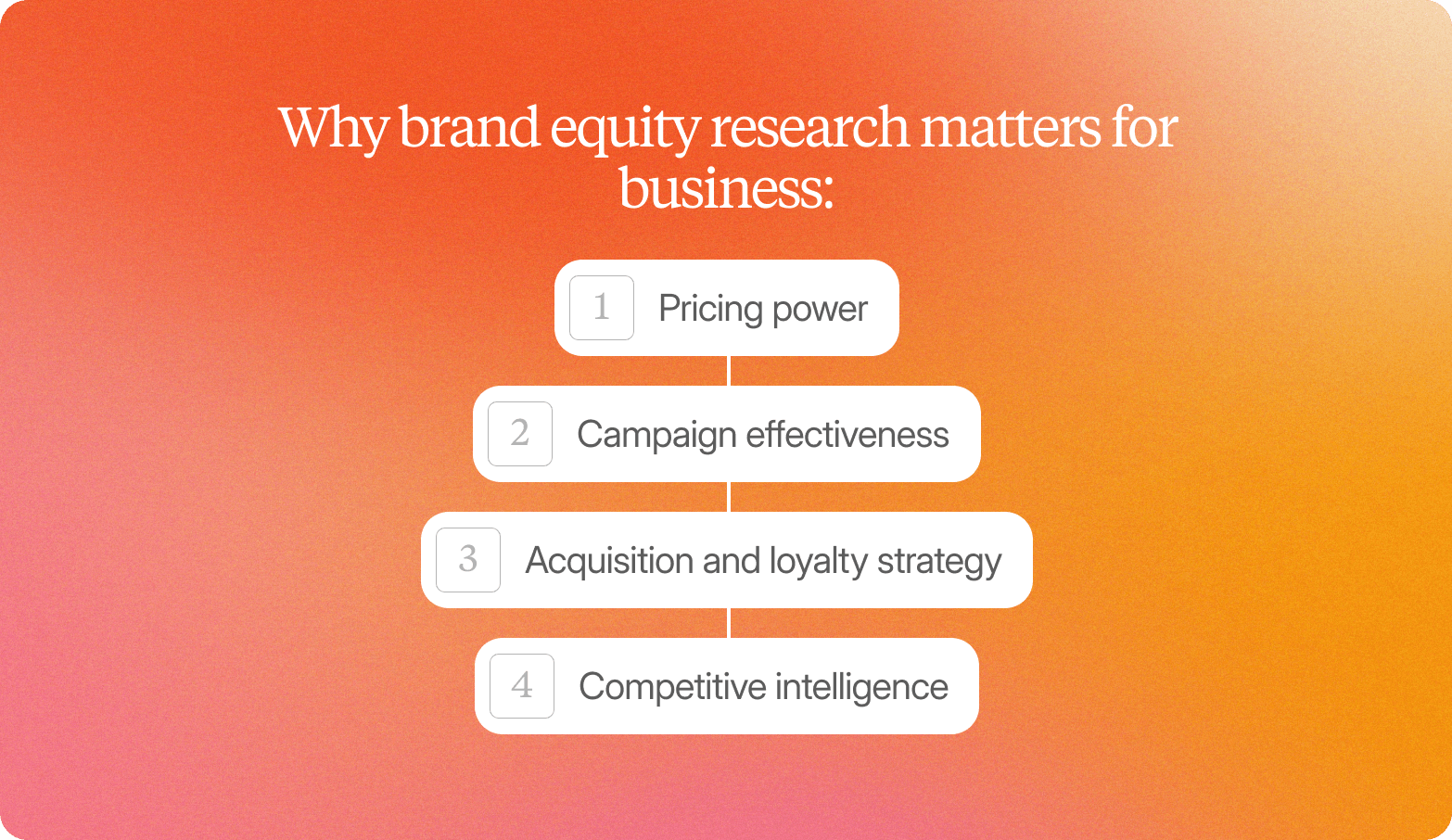
Brands that skip continuous brand equity research make pricing, campaign, and positioning decisions without knowing whether consumer perception has shifted since the last study. By the time the evidence surfaces in revenue data, the window to respond has already closed. Strong brand equity research objectives address four concrete business outcomes that no other data source can fully replace.
Pricing power
Brands with positive brand equity can justify a price premium with evidence, not internal conviction. High brand equity signals to consumers that this brand's products and experiences are worth paying more for, and that signal directly translates into a willingness to pay more.
Campaign effectiveness
Pre- and post-campaign equity tracking reveals which marketing campaigns shifted perception and which had no measurable effect. This is where brand equity in marketing research earns its place at the budget table: it connects brand strategy and marketing strategies to attitude change, not just reach or recall.
Acquisition and loyalty strategy
Understanding the specific drivers of brand loyalty and the triggers that cause lapse gives retention and acquisition teams something to act on: retaining existing customers while building brand equity with new audiences.
Competitive intelligence
Tracking brand performance across a competitive set reveals where a brand is gaining or losing ground before it shows up in share data. Teams that run brand equity research continuously catch competitive threats at the perception stage, when positioning adjustments are still affordable and negative brand equity can still be prevented.
The 6 components every brand equity research program must measure
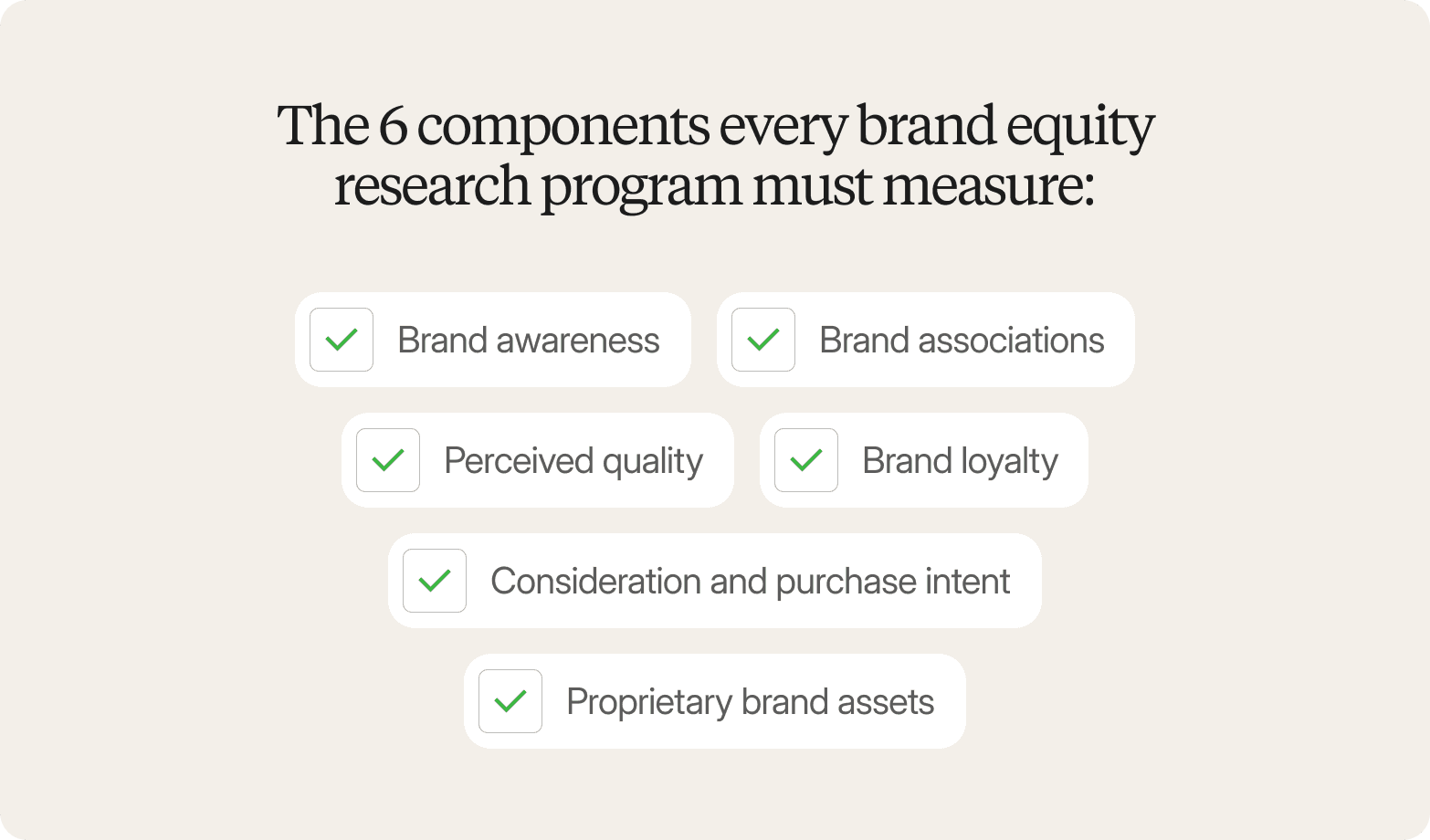
The key components of brand equity that every research program must track span awareness, associations, quality, loyalty, consideration, and proprietary assets. Understanding how each connects to consumer behavior is key to moving teams from tracking brand health to actively growing it.
Brand awareness
Specifically, brand recall and brand recognition measure how familiar consumers are with your brand within a category. Brand awareness measures set the ceiling for every other component: a brand consumers cannot recall cannot be chosen.
Brand associations
Capture the brand image consumers hold about your brand: the attributes, emotions, and meanings they connect to it across every brand experience, from advertising to product use to interactions on social media platforms. When positive brand associations shift to neutral or negative, positioning decisions follow; yet a tracker score alone cannot tell you which associations are changing or why.
Perceived quality
Measures how consumers rate the brand's products and brand experience relative to category alternatives, closely tied to brand reputation. Survey ratings inform pricing and extension decisions, yet they routinely mask the specific triggers behind a quality or reputation gap.
Brand loyalty
Tracks customer loyalty, specifically whether brands are creating loyal customers who make repeat purchases and resist switching. Understanding whether loyalty is driven by genuine brand preference or inertia is one of the core objectives of brand equity research.
Consideration and purchase intent
Capture brand relevance: whether your brand is seen as a viable option for the consumer's current need state. Consumers prefer some brands over others for reasons that go beyond awareness; only qualitative depth reveals the barrier between high awareness and low consideration.
Proprietary brand assets
Cover the trademarks, visual identities, sonic cues, and distinctive elements that drive brand recognition independent of the brand name. These erode quietly, often before awareness scores register any change.
The two frameworks that shape how brand equity is defined and measured
Two frameworks define how practitioners approach brand equity research methodology.
David Aaker's Brand Equity Model (1991) organizes equity around five dimensions: brand loyalty, brand awareness, perceived quality, brand associations, and other proprietary assets. It provides research teams with a diagnostic framework for assessing brand strength that can be tracked independently across markets and linked to commercial outcomes such as price realization and market share.
Kevin Lane Keller's Customer-Based Brand Equity (CBBE) model (1993) defines brand equity as the differential effect of brand knowledge on consumer response to marketing, organized as a four-level pyramid: brand identity, brand meaning, brand response, and brand resonance at the peak.
Both models converge on the same truth: brand equity lives in consumers' minds. Surveys track whether components shift; only real consumer conversations reveal the associations, feelings, and reasoning behind those shifts. That is precisely why rigorous brand equity research methodology requires qualitative depth alongside quantitative tracking.
Brand equity research methods: Qualitative vs. quantitative approaches
Brand equity research methodology typically combines quantitative tracking with qualitative exploration, but most programs strike the wrong balance. Surveys, brand trackers, and NPS scores dominate research calendars because they are fast to field and easy to report. Qualitative depth gets scheduled once or twice a year, if budget allows. The result is a program that can assess brand equity at the metric level but rarely explains why those metrics are moving.
| Quantitative methods | Qualitative methods | |
|---|---|---|
| Common techniques | Brand equity surveys, brand perception surveys, and NPS | In-depth interviews, focus groups, and observation-based research |
| Core strength | Scale and wave-on-wave trend data | Emotional and contextual depth |
| Primary limitation | Tells you what consumers think, not why | Traditionally slow and expensive, limiting research frequency |
| Best used when | You need comparable data across time periods and markets | You need to understand the drivers behind a shift in metrics |
Most teams run annual or biannual qualitative studies because agency timelines make higher frequency impractical; brand equity surveys and brand perception surveys fill the gap, which works for trend reporting but not when a brand perception shift appears mid-quarter and stakeholders need to understand what changed.
Consumer sentiment captured through real voice and video interviews carries evidential weight that text-based or simulated methods cannot replicate.
6 brand equity research questions that uncover emotional drivers
Effective brand equity research questions do more than confirm recognition. The real diagnostic value comes from questions that uncover consumer preferences, emotional associations, and how a particular brand sits relative to competitors in the consumer's mind, revealing insights that inform brand messaging and positioning.
Awareness
"When you think of [category], which brands come to mind first?"
Associations
"What words or feelings come to mind when you see this brand?" Open-ended association questions surface the emotional vocabulary consumers use, which rarely matches the language a marketing team would choose.
Perceived quality
"How does this brand compare to competitor brands in terms of quality? Why?"
Loyalty
"What would make you switch to a competitor?"
Consideration
"If you were choosing a brand in this category today, how likely are you to consider this one? What would change that?"
Emotional connection
"Describe a time this brand made you feel something. What happened?"
The limitation of static brand equity market research questions is that they cannot follow a thread. When a participant says, "I trust this brand, but not the way I used to," a fixed survey moves to the next item. That hesitation is exactly where the brand equity story lives.
Conveo's AI interviewer catches those moments, probing further when a participant's response reveals something unexpected, rather than advancing through a predetermined script, enabling teams to gain valuable insights into the purchasing decisions that follow.
See it in action: How AI-Moderated Interviews Work
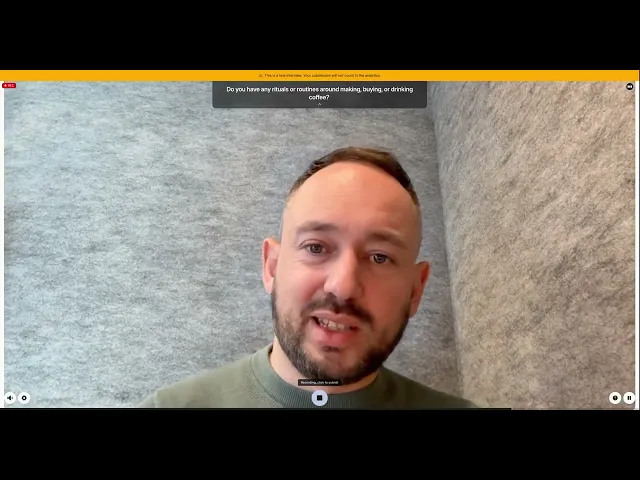
5 steps to measure brand equity: From periodic projects to continuous tracking
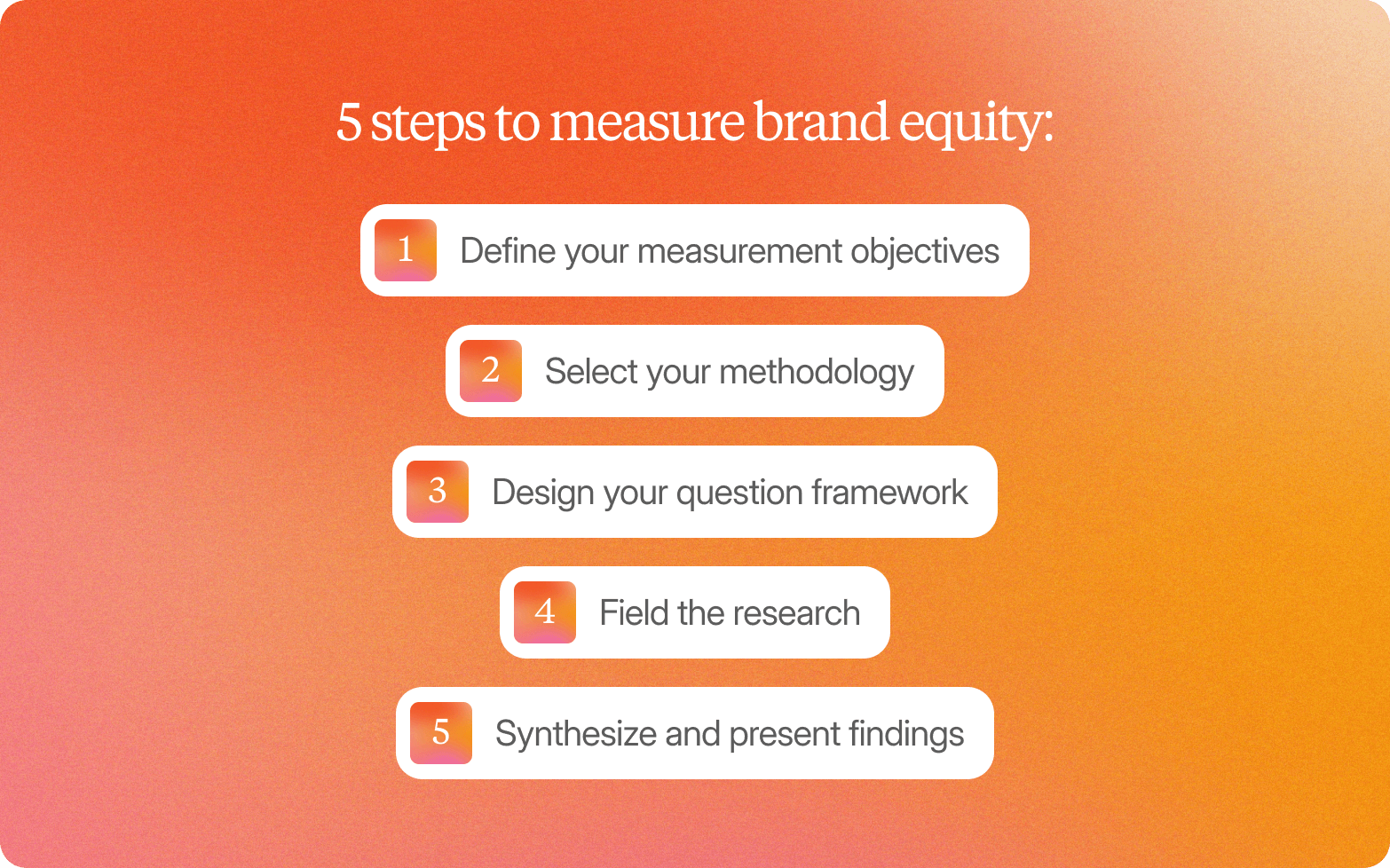
The five-stage process below reflects the key success factors for teams that run brand equity measurement well.
1. Define your measurement objectives
Anchor the program to a specific business decision: competitive benchmarking, post-campaign perception shift, or longitudinal equity tracking. Identify which key metrics and brand equity metrics matter most based on the business question at hand.
2. Select your methodology
Most programs need both quantitative and qualitative methods. Quantitative tracking delivers scale and trend data. Qualitative interviews deliver the emotional depth and causal understanding that explain why brand equity metrics are moving.
3. Design your question framework
Map brand equity research questions to each equity component. Use consistent closed-ended questions across all quantitative waves; changing question wording mid-program breaks longitudinal comparability.
4. Field the research
Qualitative brand equity research requires real human participants in real voice or video conversations. For quantitative waves, maintain a consistent sample definition: even subtle shifts in composition introduce variance that appears to reflect perceptual change but is a methodological artifact.
5. Synthesize and present findings
Link every reported claim back to the participant, the question, and the verbatim response: evidence of whether the brand is meeting, missing, or exceeding its brand promises. Findings with traceable evidence and clear brand-strategy implications are the ones that actually drive decisions.
Most brand equity programs run once or twice per year, not because quarterly tracking is not valuable, but because agency-delivered qualitative programs take six to twelve weeks to complete and carry a commensurate cost.
Continuous brand equity market research requires three things: consistent methodology across waves, faster turnaround, and a compounding insight library that accumulates themes over time. Conveo's insight library addresses all three, feeding every study into a searchable repository that tracks recurring themes across waves and enables longitudinal brand perception tracking without manual reconciliation. AI-assisted thematic synthesis converts raw interviews into actionable insights and removes the manual bottleneck without removing the researcher's judgment.
Conveo supports brand equity research in 50+ languages with parallel execution across markets, making consistent multi-market tracking viable without the coordination overhead of separate agencies.
Teams report spending up to 50-80% less on research than on agency-delivered qualitative programs, making continuous tracking financially viable for programs that previously ran once per year by necessity.
"Within days, we had insights that would've taken a traditional agency a month."
Head of Customer Insights, JDE Peet’s
Evidence and trust: How to make brand equity research credible to stakeholders
A researcher can walk into a strategy review with a well-constructed thematic analysis and leave with their findings parked indefinitely, because one skeptical CMO asked: "Can you show me where that actually came from?" Building traceability into the research from the start is not a formatting preference; it is a survival requirement for findings that need to move strategy.
Traceability means every reported insight links to the actual video clip, the verbatim quote, and the specific participant, so a stakeholder can inspect the evidence themselves.
Transparency means showing the participant the question and the response. A claim without a visible source is an opinion; a claim linked to a participant recording is a finding.
Consistency means using the same framework across research waves, so stakeholders can tell whether sentiment moved because consumers changed or because the questions did.
Conveo is SOC 2-certified, GDPR-compliant, and offers EU-region data hosting. For teams presenting to legal, procurement, or a global leadership team, these are prerequisites, not footnotes. The consumer sentiment captured through real conversations, not synthetic profiles, is what turns brand performance data into evidence that leadership teams will act on.
Why video-first qualitative delivers better brand equity insight than surveys or agencies
The three dominant approaches to brand equity research each solve one part of the problem while leaving the rest unaddressed. Agency-led qualitative delivers emotional depth but runs on timelines that make continuous tracking financially impractical. Survey-heavy platforms track metrics at scale but cannot explain the brand differentiation gaps, associations, or emotional textures behind a score. Point platforms for transcription or analysis add value during synthesis but create fragmented workflows in which context gets lost between handoffs.
Conveo is a video-first AI research platform that is one of the most complete end-to-end platforms for continuous brand equity tracking, combining video-first qualitative depth, AI-assisted synthesis, and a compounding insight library built for longitudinal research programs.
Real conversations, not surveys
Video-first interviews capture the emotional responses, unprompted associations, and consumer sentiment that brand equity metrics alone cannot explain. Real human participants, not synthetic respondents, produce findings that enterprise stakeholders can trace and trust.
Speed without sacrificing rigor
AI-assisted transcription, coding, and thematic synthesis remove the bottleneck that makes continuous qual impractical. Teams at organizations like Google, FOX, and Bosch report moving from interview to structured findings in days, not weeks.
Compounding knowledge across waves
The insight library tracks recurring themes, sentiment shifts, and brand associations across studies, enabling longitudinal tracking of brand perception with a consistent methodology from wave to wave. Each study deepens the team's understanding of where brand growth opportunities lie and how to direct brand-building efforts.
Frequently Asked Questions
What is brand equity research?
Brand equity refers to the value consumers associate with a brand name. Brand equity research is the systematic measurement of how that value is formed, perceived, and sustained over time. The definition spans two layers: quantitative tracking (awareness, preference, net promoter scores) and qualitative exploration (emotional associations, purchase motivations, competitive positioning). Effective brand equity research captures both the "what" and the "why." Metrics tell you where you stand; the qualitative layer explains why consumers feel the way they do, which informs brand positioning, brand messaging, and marketing strategies.
What are the main brand equity models?
Brand equity research is most commonly structured around two dominant frameworks. Aaker's Brand Equity Model (1991) defines equity across five dimensions: brand loyalty, brand awareness, perceived quality, brand associations, and proprietary brand assets. Keller's Customer-Based Brand Equity (CBBE) model (1993) organizes equity as a four-stage pyramid built on brand knowledge: brand identity, brand meaning, brand response, and brand resonance. Both confirm that equity is built on consumer knowledge and emotional connection. Surveys track whether these components shift, but only real consumer conversations reveal the reasoning behind those shifts.
What are brand equity research methods?
Brand equity research methods fall into three broad categories. Brand equity surveys and brand tracking studies measure awareness, brand perception, and loyalty at scale. In-depth interviews and focus groups surface the emotional associations and behavioral drivers that survey data cannot explain. Observational and ethnographic approaches capture how people interact with a brand in context. Quantitative methods scale but stay shallow; qualitative methods deliver depth but traditionally take weeks to execute. Video-first qualitative interviews with AI moderation change that calculus, giving teams the richness of real conversations at a pace that fits actual decision timelines.
What are good brand equity research questions?
Good brand equity research questions are open-ended, emotionally probing, and built to follow where participants lead, revealing the consumer preferences and emotional texture that explain how consumers perceive a particular brand. Strong examples include: "What comes to mind when you think of [brand]?", "How does this brand make you feel compared to competitors?" "Describe a time you chose this brand over another: what influenced your decision?", and "If this brand were a person, how would you describe them?" A scripted list yields surface-level answers; adaptive questions elicit the insights that explain behavior.
What are brand equity research examples?
Brand equity research examples span industries and decision types. A food brand testing new packaging uses brand equity research to confirm whether perceived quality and brand image carry over to the new design. A SaaS company monitoring brand perception after an acquisition surfaces gaps in brand reputation in new markets, informing brand strategy before a perception problem becomes a commercial one. A fashion retailer exploring loyalty and lapse uses emotional association interviews to understand what kept loyal customers and what quietly pushed others away, producing answers no exit survey could generate.
How long does brand equity research take?
Brand equity research through a traditional agency typically runs 6 to 12 weeks from brief to final report, and brand decisions rarely wait that long. AI-moderated qualitative interviews change that dynamic: because sessions run asynchronously, hundreds of participants complete interviews in parallel, and analysis begins as recordings land. Teams report collecting and analyzing brand equity input, from key brand equity metrics to emotional association themes, in days rather than weeks, without sacrificing the depth that stakeholder-ready findings require.

About the author
Alex de Hemptinne
Business Impact Lead
Alex is a Business Impact Lead at Conveo, partnering with enterprise teams to embed AI-led research into their workflows. From the first study to full-scale rollout, she helps customers shift from project-based research to continuous customer intelligence.
Meet Alex on film →Qualitative insights at the speed of your business.
Conveo runs AI-moderated video interviews and structures everything they say.