In this article
TL;DR
Qualitative customer research is the right method when you need to understand why a metric is moving, not just measure that it is.
AI-moderated video interviews now compress what once took six to twelve weeks through an agency into a matter of days, without reducing the depth of participant responses.
Stakeholder trust depends on source traceability: customer research insights backed by real video, verbatim quotes, and coded themes are far more defensible than summary decks.
Choosing a customer research method is not a question of speed versus rigor. A strong customer research strategy is supported by running real conversations at scale and surfacing analysis that experienced researchers can stand behind.
Insights that compound across studies, rather than dying in individual decks, give enterprise research functions a structural advantage: each new study builds toward a growing base of actionable insights rather than starting from scratch.
Qualitative research is no longer constrained by the limits that defined it for decades. Teams that understand how to conduct customer research with today’s AI-augmented platforms can run hundreds of real video conversations simultaneously, capture tone shifts and facial cues that transcripts miss entirely, and deliver stakeholder-ready findings in days rather than the six to twelve weeks a traditional agency engagement typically requires. Insight libraries compound across studies, so each new project builds on what came before rather than starting from zero.
Most insights and CMI teams are not yet running research this way. Research requests arrive faster than teams can respond, critical decisions get made without real customer input, and the primary research that would inform them hasn’t landed yet. The root cause runs deeper than bandwidth. Teams lack a consistent framework for method selection, data collection, and study execution, so every project becomes a custom design effort built from scratch. Without a customer research strategy that standardizes these steps, findings live in slide decks rather than searchable libraries. Each new study restarts from zero. Emerging trends in market dynamics shift faster than six-week agency cycles can accommodate, and the organization keeps paying to rediscover what it has already learned.
"Within days, we had insights that would've taken a traditional agency a month."
Head of Customer Insights, JDE Peet’s
This guide is the operational playbook for building a customer research strategy that runs at the pace decisions demand: choosing the right method, executing studies with rigor, analyzing findings efficiently, and scaling without adding headcount.
What is customer research? (And why terminology matters)
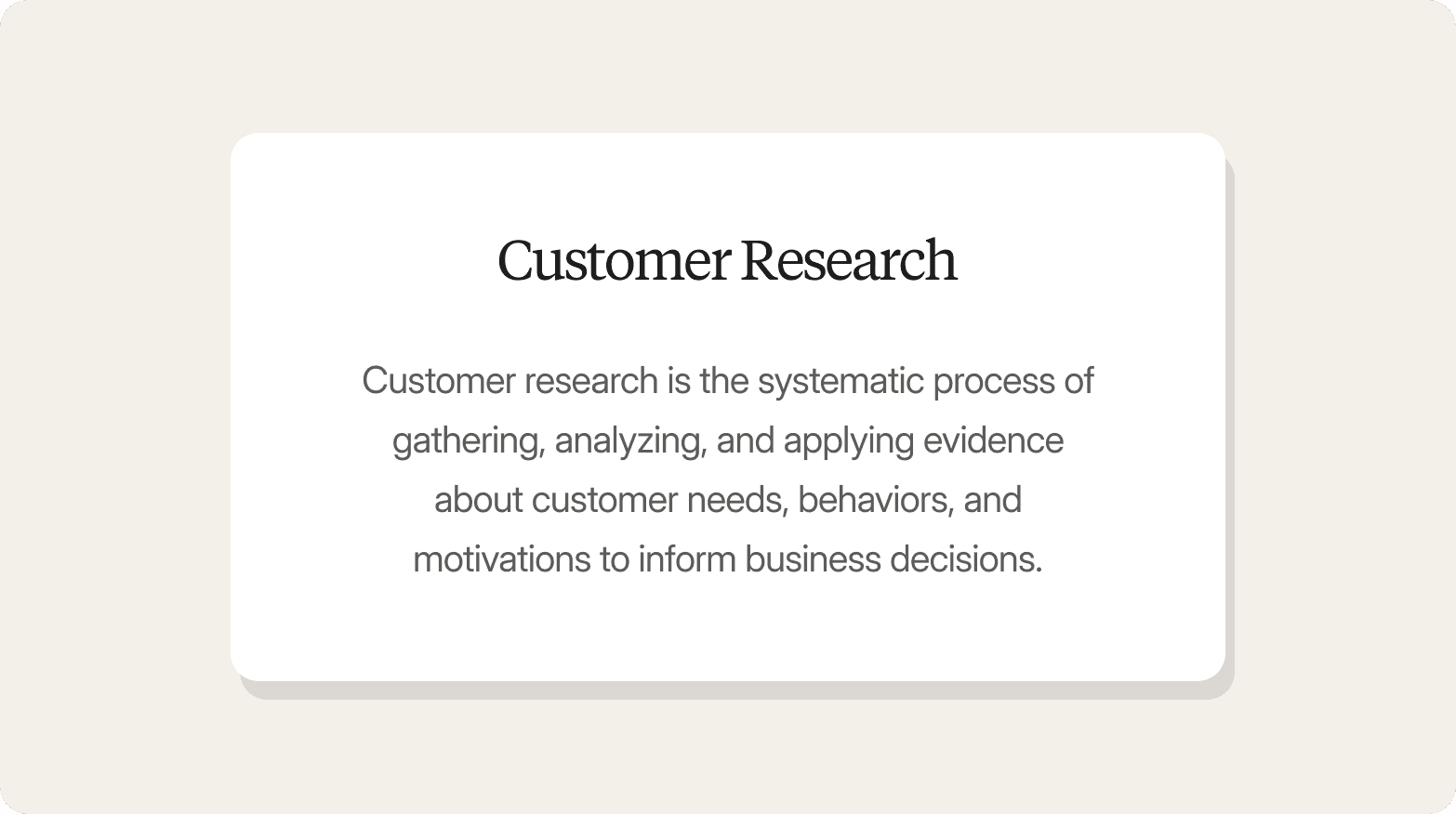
Customer research is the systematic process of gathering, analyzing, and applying evidence about customer needs, behaviors, and motivations to inform business decisions. Sometimes called consumer research in marketing and brand contexts, it encompasses the full range of methods for understanding who customers are, what they need, and why they behave as they do.
The terminology matters more than it seems. Market research examines broader market dynamics: category size, market segment trends, and competitive positioning. User research centers on product interaction and usability. Customer research focuses on existing or potential customers as people: their motivations, decisions, and experience with a product or category. Customer experience research is a narrower subset, focused on touchpoint satisfaction and friction across the customer journey.
When teams conflate these categories, they commission the wrong study. A product team trying to reduce churn maps the journey rather than interviewing churned customers. A brand team trying to understand why a product isn’t resonating runs a survey that measures awareness. The method doesn’t fit the question, and the budget is spent without answering what stakeholders actually need to know.
Customer research broadly divides into primary and secondary research. Primary research generates new data directly from customers through interviews, focus groups, and surveys. Secondary research draws on existing sources, including industry reports and syndicated datasets, to scope a category before commissioning primary fieldwork. Effective customer research programs use both, with secondary research informing the primary research design and primary research generating the customer insights that drive decisions.
Conveo’s structured study templates start from the question type rather than the method. They also address a distinction most teams overlook: the difference between platforms that generate new primary data through moderated interviews and platforms that analyze data already collected elsewhere. When the question requires new qualitative insights from real customers, teams need a platform that conducts the research, not one that processes what has already been gathered.
Customer research methods: The framework for choosing the right approach
Effective customer research starts before anyone opens a survey tool or schedules an interview. Before choosing how to gather data, a team needs clarity on three variables: question type, audience size, and decision timeline.
Question type: Exploratory vs. confirmatory
Exploratory questions require qualitative customer research methods. If a team is trying to understand why a metric shifted unexpectedly, how a new concept lands, or what friction exists in a customer journey, the question is open. The answer is a pattern, a tension, a language that only emerges through real conversation. Qualitative research is also the right call when the audience is too niche to survey meaningfully.
Confirmatory questions belong to quantitative methods. When a team needs to measure prevalence, validate a hypothesis at scale, track customer satisfaction across market segments, or establish statistical confidence before a major investment, quantitative research is the instrument.
Audience size and accessibility
The distinction between how to do customer research and how to conduct market research often comes down to this variable. Customer-focused research involves accessible, definable audiences where qualitative depth is achievable. When teams conduct market research at a broader scale, including competitive landscape analysis, market insights across segments, and industry trends, they typically require larger samples. Teams tracking market size, future trends, and category dynamics will find that quantitative research serves them better for sizing. Teams trying to understand consumer behavior and the motivations behind it need qualitative depth first.
Timeline: days vs. Weeks vs. months
The timeline determines which customer research methods are actually available in practice. A two-week decision cannot wait for a six-week agency qual study. Ethnographic observation adds value for understanding consumer behavior in context, but requires longer timelines and higher budgets.
The strongest research programs treat qualitative and quantitative as sequential: qual to explore and generate hypotheses, quant to validate at scale. Teams without a clear framework default to the method they know best, not the method the question requires. Conveo’s study templates encode this decision logic: teams select their research objective, and the platform surfaces the appropriate methodology, discussion guide structure, and analysis framework. The research process stays grounded in the question rather than in habit.
Step-by-step: How to do customer research (Qualitative Focus)
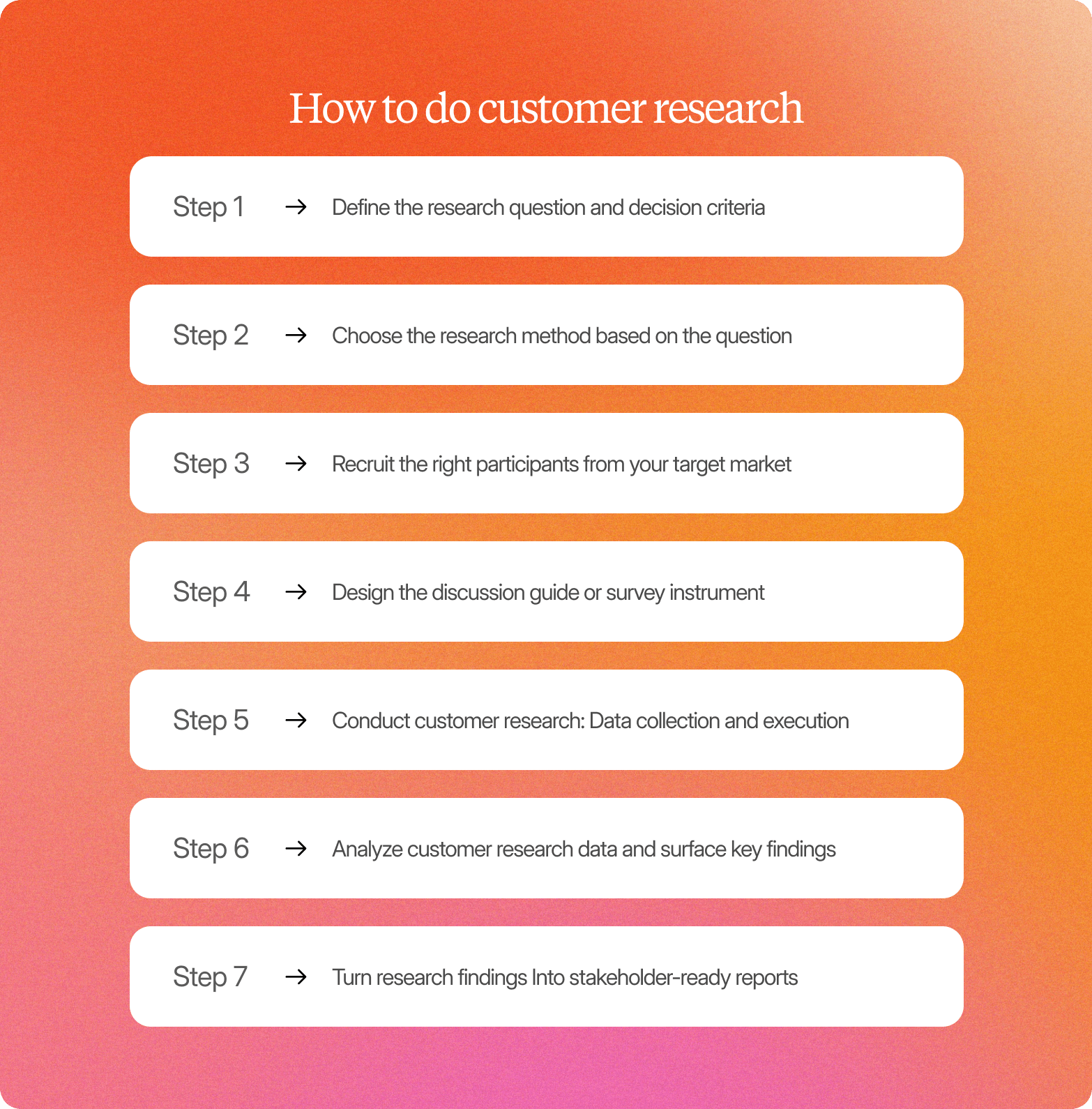
Step 1: Define the research question and decision criteria
Every research project that ends in a shrug started with a question too broad to answer usefully. “Understand our customers better” is not a research question. “Why are customers churning after the first purchase?” is the question. A well-formed research question names the decision it informs and the evidence that would shift that decision.
Before any study launches, teams should answer three things: what decision does this research inform, when does that decision need to be made, and what would we need to hear from customers to change course? Map the research objectives to a specific decision before designing anything. When research objectives align with business strategy, findings have a direct path to action. This step is the foundation of any customer research strategy worth building on.
Conveo’s structured study templates operationalize this step: rather than writing a research brief from scratch, teams begin from a question-to-decision framework that surfaces the appropriate method, guide structure, and analysis approach for their objective.
Step 2: Choose the research method based on the question
Does this question need depth or scale? The answer determines everything: the method, the sample, the timeline, and the kind of output stakeholders can use.
Choose qualitative when the question involves unknowns, motivations, or reactions that can’t be pre-coded. This includes exploring a problem space you don’t fully understand, testing a concept or message before committing to production, surfacing pain points and friction in consumer behavior, or building market understanding before designing a survey. Qualitative insights surface through real conversation. Conveo’s AI-led interviews run this kind of consumer research at scale, with the AI probing based on what participants actually say rather than following a rigid script.
Choose quantitative when the question requires measurement or tracking: how many customers hold a particular view, whether customer satisfaction is shifting across market segments, or whether a qualitative hypothesis holds at scale.
Most teams benefit from running qualitative first. Real conversations generate the hypotheses, surface the language customers use, and reveal the dimensions worth measuring. Quantitative studies then validate at scale.
Step 3: Recruit the right participants from your target market
Recruiting is where more customer research studies fail than most teams want to admit. Write screeners that reflect your actual target market, not broad demographic profiles. Screeners filtering on demographics alone routinely let in people who look right on paper but have no relevant experience. A screener filtering on your target audience’s actual behaviors and experiences produces far more reliable customer data.
If studying how procurement managers evaluate vendors, confirm the participant has personally led a vendor evaluation in the past twelve months. Where possible, use customer data from your CRM: behavioral signals like purchase frequency and product usage depth tell you far more about whether someone can speak to the pain points you’re investigating than age and location alone.
Incentives matter. For a thirty-minute video interview with a general consumer audience, $50 to $75 is a reasonable starting point; niche B2B audiences require considerably more. Conveo’s integrated panel access removes the need for a separate vendor relationship, reducing one of the most common sources of recruiting failure.
Step 4: Design the discussion guide or survey instrument
The discussion guide shapes the customer feedback you receive. A well-designed instrument is not a checklist of things you want to know. It is a structured invitation for participants to tell you things you did not know to ask.
Every question should open a door, not close one. Start with “walk me through,” “describe,” or “what happened when” rather than anything that invites yes or no. Unlike focus groups, where group dynamics can suppress dissenting views, one-on-one interviews allow each participant to respond without social pressure. This is the stage in the research process where depth is either built in or lost entirely. Conveo’s AI interviewer is built around adaptive probing: it reads what participants actually say and follows up accordingly, rather than marching through a fixed script.
For quantitative instruments, use validated scales, test every question for neutrality, and pilot before fielding. Double-barreled questions are the most common source of corrupted survey data.
Step 5: Conduct customer research: Data collection and execution
How you conduct customer research determines whether your data is usable or merely collected. The data collection phase is where methodology choices made earlier either pay off or create problems that no amount of analysis can fix.
Live moderated interviews remain the gold standard for probing complex emotional territory, but they cap throughput. A team of two researchers running live interviews can realistically complete fifteen to twenty sessions in a week. AI-moderated asynchronous video interviews remove that ceiling entirely. Participants open a link on their own schedule and speak directly to an AI interviewer that probes based on what they actually say. Because sessions run independently of each other and independently of your team’s calendar, gathering data from ten or one thousand participants requires the same setup effort. For insights teams fielding backlogs of deferred studies, parallel execution capacity is what makes continuous customer research operationally viable.
Conveo’s AI interviewer operates across more than fifty languages, enabling multi-market studies to run simultaneously across geographies. For quantitative research, monitor response rates, straight-lining, and demographic quota drift in real time to catch data quality problems before they compound.
Step 6: Analyze customer research data and surface key findings
What you do with customer research data after collection determines whether it produces insight or just volume.
For qualitative analysis: code transcripts against your research objectives, cluster codes into themes, and anchor every theme to verbatim quotes and video moments. Customer research insights are only as strong as their evidence trail. A finding that cannot be traced back to a participant’s actual words is a finding a stakeholder can dismiss.
Where Conveo changes this step materially is in the time it takes to get from raw recordings to structured findings. As sessions complete, the platform transcribes, translates, and codes every conversation automatically. Multimodal analysis designed to uncover insights runs alongside: facial cues, tone shifts, and on-screen objects are captured and flagged, surfacing qualitative insights that text-only transcripts miss. What typically takes a researcher days of manual transcript review can be completed in hours. Teams distill key insights from coded themes and move directly to reporting without an intermediate synthesis stage.
"The AI doesn't just summarize, it surfaces patterns I wouldn't have spotted reading transcripts."
CMI Manager, Edgard & Cooper
The Insight Library is where analysis stops being a one-time exercise. Every study’s coded themes, clips, and key findings flow into a searchable repository. When the next project begins, analysts can query across prior studies: what did consumers say about this category six months ago? Has sentiment on this claim shifted since the last concept test? Each project builds institutional knowledge rather than starting from scratch.
Step 7: Turn research findings Into stakeholder-ready reports
The most common structural mistake in customer research reporting is leading with the method instead of the answer. A CMI director presenting to brand leadership does not need to open with sample size and fieldwork dates. They need to open with: here are the key findings, here is what they mean for the decision, and here is the evidence.
Every Conveo output is traceable to its source: the specific video moment, the verbatim quote, the participant who said it. A stakeholder can move from the top-line recommendation to the individual session recording in seconds, which transforms the report from a document to be accepted or rejected into a body of evidence to be explored. Research findings that connect to a specific point in the customer journey, including touchpoints where customer satisfaction broke down or purchase intent shifted, carry particular weight with product and brand stakeholders.
Format should match the decision context. For a fast-moving campaign review, a highlight reel and a one-page summary may be sufficient. For a major investment tied to business strategy or marketing efforts, a full structured report with traceable evidence and cross-study context is appropriate.
How to evaluate a qualitative research platform against your decision timeline
The choice most research teams face is not between speed and depth. It is between a process that forces them to sacrifice one for the other and a platform that removes that constraint. Customer research becomes a competitive advantage only when it runs continuously, at the pace decisions actually get made.
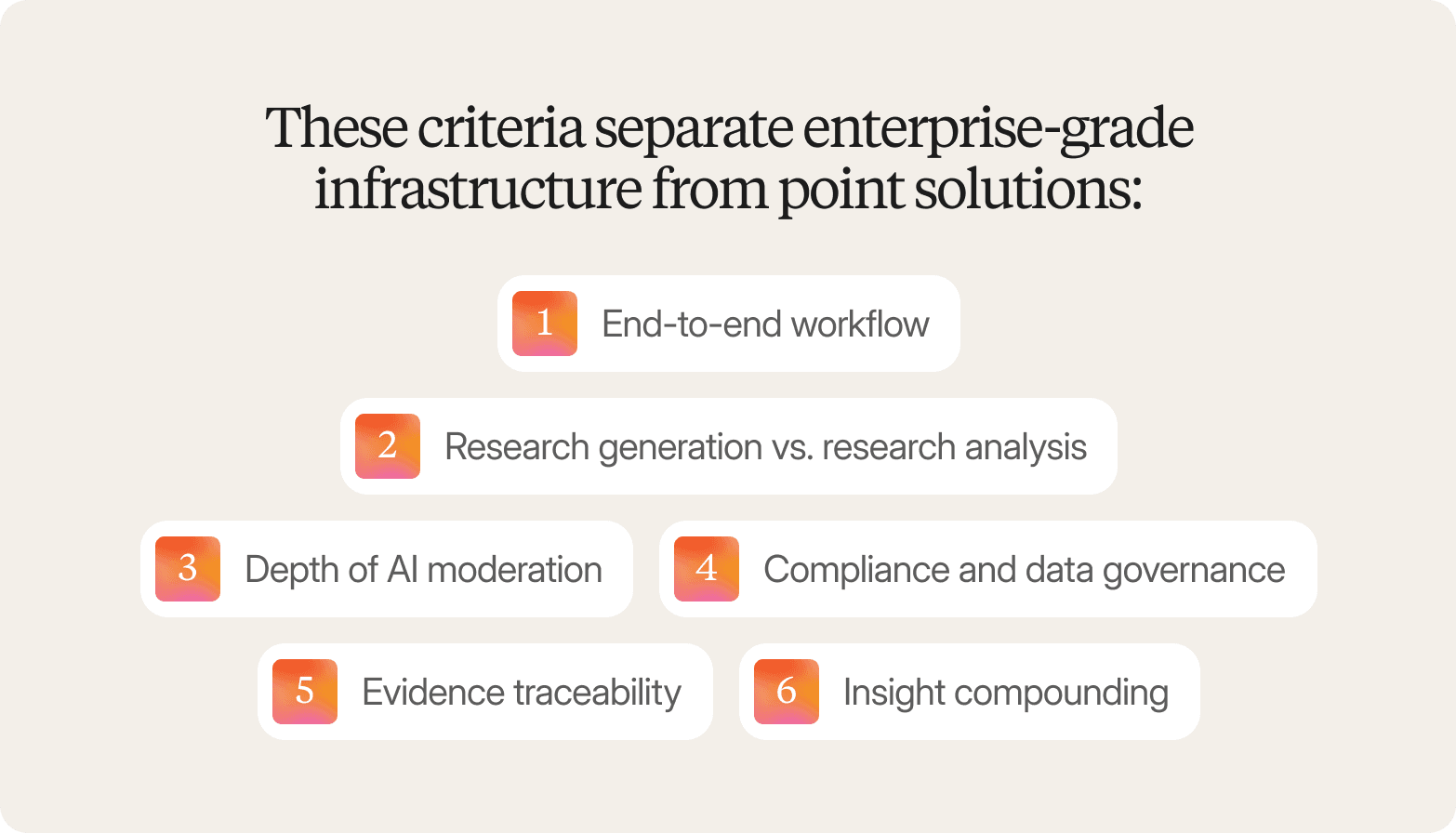
These criteria separate enterprise-grade infrastructure from point solutions:
End-to-end workflow
Does the platform cover recruitment, AI-led interviewing, transcription, analysis, and reporting in one place? Every handoff between tools is a place where context gets lost, and timelines stretch.
Research generation vs. research analysis
Does the platform generate new primary data through moderated interviews with real participants, or does it analyze data already collected elsewhere? Teams that need new qualitative insight need a platform that conducts the research, not one that stores what already exists. This is the most commonly overlooked distinction when evaluating platforms.
Depth of AI moderation
Can the AI probe in context based on what a participant actually says, or does it deliver a fixed script? Survey-style tools cannot replicate the depth that adaptive probing produces.
Compliance and data governance
Is the platform SOC 2 certified, GDPR-compliant, and with EU regional data hosting? Enterprise procurement teams evaluate governance before turnaround time. Platforms that cannot answer these questions clearly are not enterprise-ready.
Evidence traceability
Can stakeholders follow the evidence path from insight back to the original video clip and verbatim quote? Research findings that cannot be audited will not hold up in the boardroom.
Insight compounding
Does the platform store findings in a searchable library? Teams conducting competitor analysis, tracking brand perception shifts, or monitoring market insights across product categories need customer research data to accumulate, not expire.
Teams that gain insights through one-off projects and store them in slide decks are leaving compounding value on the table. Hundreds of enterprise teams, including teams at Google, Reddit, FOX, and Bosch, use Conveo to run their entire qualitative research workflow, from study setup to stakeholder-ready reporting, without the agency dependency or the six-week wait.
Frequently Asked Questions
How long does customer research take?
Customer research timelines depend on the chosen method and the extent to which the process remains manual. Traditionally run qualitative research takes six to eight weeks: one to two weeks for recruiting, one to two weeks for live moderation, and two to four weeks for transcription, coding, and synthesis. Quantitative research runs three to five weeks from survey design through analysis and reporting. AI-moderated asynchronous video interviews compress the qualitative cycle from six to eight weeks to three to five days. Recruitment and screening happen within the platform. Interviews run in parallel. Transcription, translation, coding, and thematic synthesis happen automatically as sessions land, removing the manual analysis phase entirely. When evaluating research platforms, ask specifically which steps each handles end-to-end and which still require manual intervention. That is where timeline estimates diverge most sharply between vendors.
How do I get started with customer research as a beginner?
Learning how to do customer research for beginners is most effective when you start with qualitative research rather than large-scale surveys. Before recruiting a single participant, define a specific research question tied to a real business decision. Eight to twelve participants are enough for a first qualitative study: pain points and patterns surface faster than most beginners expect. Use structured research templates rather than designing a discussion guide from scratch. They standardize question flow and prevent the most common beginner mistake: asking leading questions that confirm what you already believe. AI-moderated asynchronous interviews eliminate the most operationally complex part of early research: scheduling live moderation. Participants complete interviews in their own time; the platform automatically transcribes and codes every session; and the team receives a structured analysis without manual synthesis.
How do businesses conduct customer research effectively?
Knowing how to conduct customer research in business starts with matching the research method to the specific decision at hand, rather than defaulting to the same format for every question. Effective customer research programs operate on a consistent methodology framework: qualitative for exploring unknowns, diagnosing why a metric has shifted, or understanding consumer behavior behind a decision; quantitative for measuring how widespread a behavior or attitude is across each market segment or tracking change over time. Programs break down when teams lack a consistent framework for selecting methods, so studies become ad hoc and incomparable. Building a searchable insight library ensures that each project compounds organizational learning and helps identify future trends before they appear in sales data.
What are some examples of customer research in practice?
The best way to understand how to do customer research examples in practice is through concrete scenarios where method selection follows the question. Concept test. A CPG brand validates two packaging concepts before launch. AI-moderated video interviews with fifteen to twenty target consumers, using adaptive probing to capture emotional and functional reactions. Quantitative validation is performed if statistical confidence is required across markets. Churn diagnosis. A SaaS company sees first-month churn rising. Structured video interviews with recently churned users, probing on their experience in the first two weeks. Goal: hypothesis generation. The customer feedback gathered in this phase is far more diagnostic than a satisfaction score. New market entry. A retailer entering an unfamiliar market. Qualitative interviews first to identify cultural nuances and generate hypotheses, then a representative quantitative survey to validate at scale before committing to market entry.
What is the difference between customer research and market research?
Customer research and market research answer different questions. Choosing the wrong one wastes budget on findings that do not inform the decision. Customer research studies existing or potential customers: their needs, motivations, consumer behavior, and experience with a product or category. It is the right approach when the question is about why customers behave as they do, what pain points drive their decisions, or how they respond to a concept. Market research studies market dynamics: category size, competitive landscape, competitive analysis, demand trends, and pricing expectations. Teams use primary research methods (surveys, competitive interviews) and secondary research methods (industry reports, syndicated data) when the question is about market-level sizing or tracking industry trends. The method decision should always begin with the question. Qualitative customer research, conducted through video interviews with real participants, is the right starting point when the question concerns motivation, behavior, or unmet needs.

About the author
Dieter De Mesmaeker
Co-Founder & CEO
Dieter is CEO and co-founder of Conveo. Before starting the company, he founded DataCamp and scaled it into one of the leading edtech platforms in the world.
More by Dieter →Qualitative insights at the speed of your business.
Conveo runs AI-moderated video interviews and structures everything they say.