In this article
TL;DR
The best customer insights platforms for enterprise insights teams cover the work from study design to reporting, and link research findings back to what a participant said on video.
"Customer insights platform" is also used for customer relationship management systems and customer feedback surveys. Insights and CMI teams at consumer brands need the type that runs primary qualitative research.
A team that buys the wrong type ends up with dashboards and survey data rather than actionable insights.
This guide compares seven platforms on workflow coverage, AI-moderated interviews, participant sourcing, and how findings carry across studies.
Conveo fits teams that run AI-moderated video interviews in 50+ languages and want every study kept in a searchable insight library.
Customer insights platforms that support qualitative research differ in how they collect and analyze data. Some use AI to conduct interviews, while others analyze recordings from interviews you've already run. They also differ in how they recruit participants and what you can do with the findings after a study ends.
These differences affect what your team can do with the platform and whether you'll need other tools or external providers to fill the gaps. This guide compares seven platforms across these areas, explains how they gather customer insights, which research needs each one suits, and outlines the questions to ask vendors before choosing a platform.
Side-by-side comparison: Customer insights platforms at a glance
| Platform | Workflow coverage | AI-moderated interviews | Participant sourcing | Findings across studies | Best fit |
|---|---|---|---|---|---|
| Conveo | Study design through reporting | Yes, video and voice, in 50+ languages | Third-party panels (8 providers) + your own contact lists | Searchable insight library | Insights and CMI teams at consumer brands bringing agency-led qualitative research in-house |
| Listen Labs | Study design through reporting | Yes, video | Listen Labs' participant pool + participants you bring | Cross-study queries | Consumer insights and market research teams that need a large number of interviews and don't have research ops staff |
| Outset | Study design through analysis | Yes, video, voice or text | Integrated third-party panels + participants you bring | Cross-study search | Product, UX and market research teams shaping features or concepts |
| Marvin | Interviewing through repository | Yes, including inside your own website or product | No native recruitment; participants you bring + third-party panels | Repository of interviews, survey data and support tickets | Product and UX research teams that want to interview users inside their own product |
| Dovetail | Analysis and repository | No | None | Repository with AI search | Research operations teams centralizing feedback from sales, support and research |
| GetWhy | Recruitment through synthesis, self-serve or full-service | Yes, video | Multiple panel vendors + participants you bring | Cross-study queries | Brand and CMI teams in CPG and FMCG that want researchers to run some studies for them |
| Voxpopme | Video surveys, plus AI-moderated voice interviews | Yes, voice (a newer product alongside its core video surveys) | Voxpopme's panel + participants you bring | Cross-project repository | Insights teams at consumer brands running ongoing video feedback programs |
1. Conveo: Best for insights teams bringing qualitative research in-house
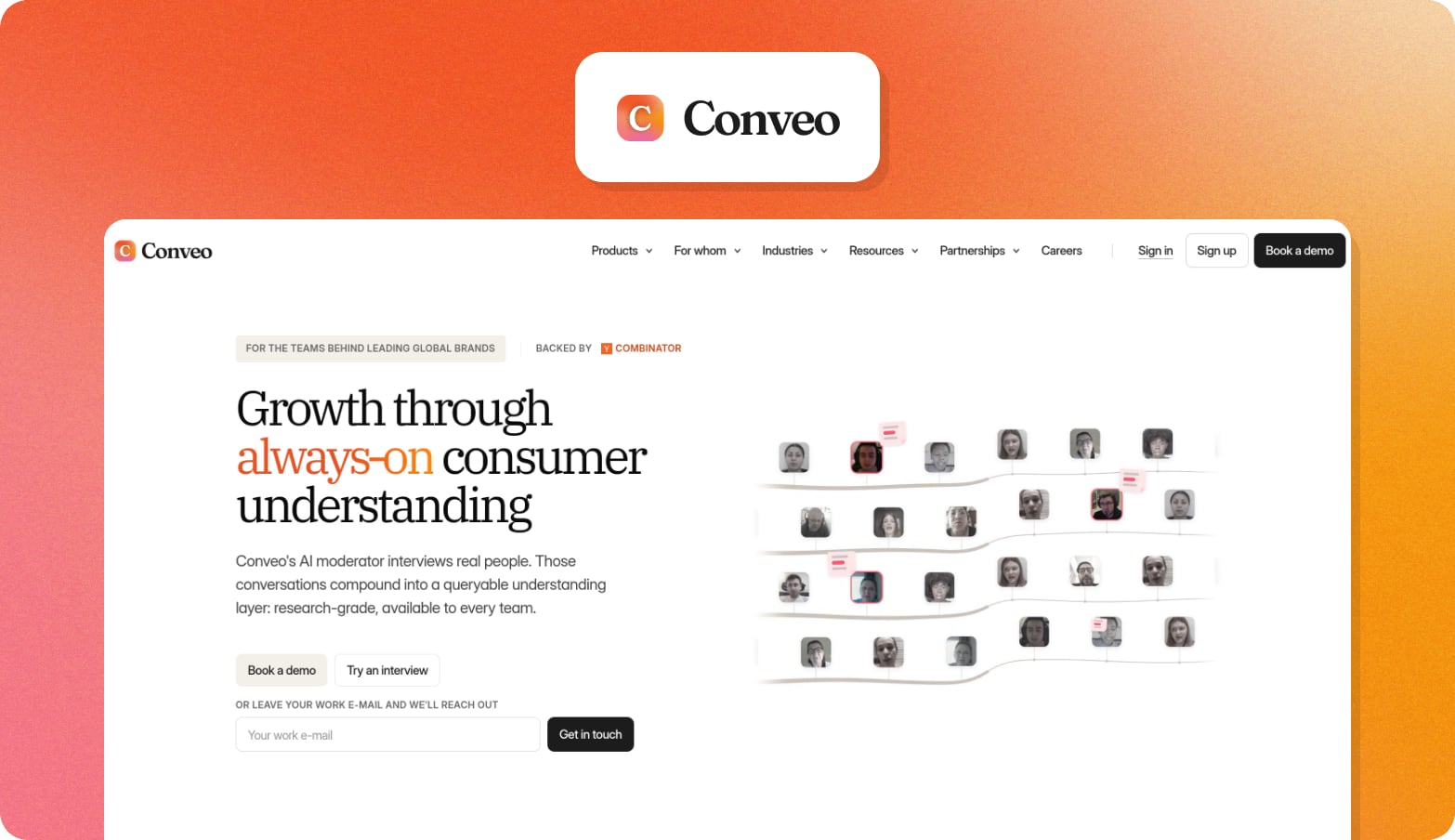
Conveo is Consumer Understanding Infrastructure: it runs AI-moderated video interviews with real participants and keeps every study in a searchable insight library, so each new study adds to what the team already knows.
It's built for CMI insights teams at consumer brands that test concepts and messaging in several markets and want to run that research themselves. CX insights teams use it the same way for customer experience research.
More than 400 enterprises, including Google, Unilever and Canva, use Conveo. For enterprise security reviews, it is SOC 2 Type II certified, GDPR compliant, with EU hosting in Belgium.
A study in Conveo moves through four stages, from recruiting participants to storing the findings, and the same team can run all four.
Stage 1: Study design and recruitment
You define the audience, add a screener, and launch the study from Conveo. Participants come from eight integrated third-party panel providers or from your own contact lists, so a study doesn't need a separate recruitment vendor.
A small follow-up question becomes worth testing, because it no longer needs its own recruitment project.
Stage 2: AI-moderated interviews with real participants
Participants open a link when it suits them and answer on video or voice. Conveo's AI research assistant asks follow-up questions when an answer is vague or leaves a gap, building on what the consumer said earlier.
Interviews run in 50+ languages, so consumers in each market answer in their own language.
Learn how to build a study from scratch on Conveo:
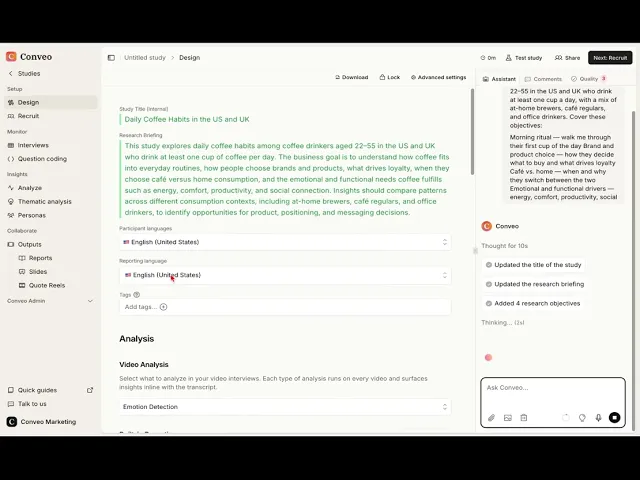
Stage 3: Analysis that stakeholders can check
Conveo transcribes and translates each interview, then groups the answers into themes. Its multimodal analysis covers what participants show on camera, how they say things, and what they say.
Every theme links back to the participants behind it, with the video clip and quote, so anyone reviewing the results can check where a finding came from. Marketing teams and other stakeholders who weren't part of the study can watch the clips behind the key insights, and they get them while the decision is still open: Conveo can complete 100 interviews in 3 days.
Stage 4: An insight library that builds with every study
Every study lands in Conveo's searchable insight library, so when the next concept goes into testing, the team can pull up what earlier tests found.
Conveo runs both single studies and continuous programs. With Conveo StoryLines, research runs in waves on a set cadence, for example every two weeks or monthly. After each wave closes, Conveo compares the new results against earlier waves and surfaces shifts in existing views and emerging themes.
Where insights and brand teams use Conveo:
Product and concept testing before a launch decision
Ad and messaging tests with the target audience before media spend
Brand research that follows how views shift from wave to wave
Segmentation research into what different consumer groups need
2. Listen Labs: Best for high-volume interview studies without a research ops team
What it is:
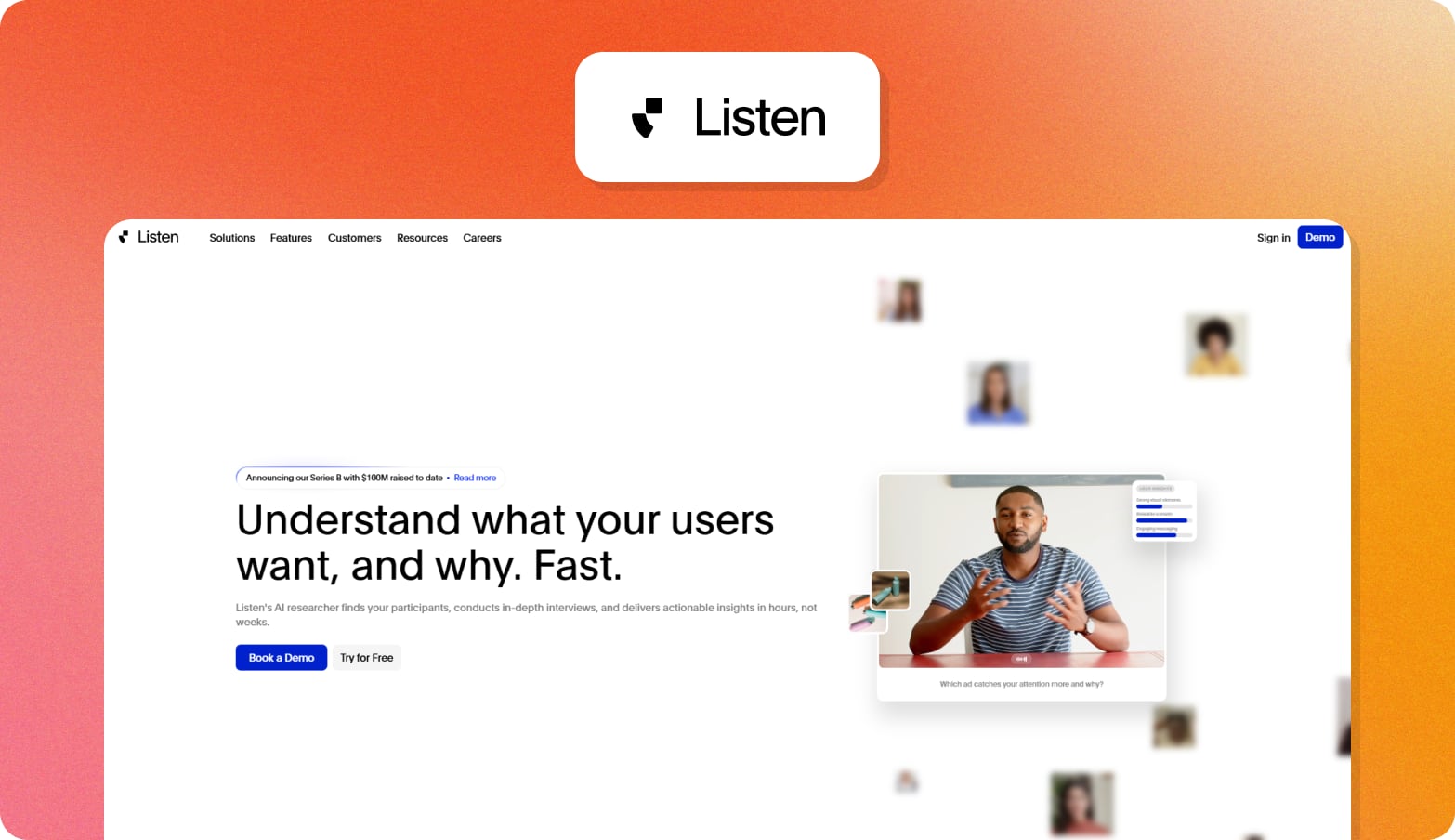
Listen Labs runs AI-moderated video interviews for consumer research, with participant sourcing, interviewing, and analysis in one workflow.
What makes it distinct:
Listen Labs is built for volume. Studies draw on its own participant pool, and one session can combine rating questions such as NPS or MaxDiff with open-ended interview questions.
Its Research Agent turns results into slide decks and highlight reels, and links each insight to quotes and timestamped clips. Teams can also query findings across all their studies.
Best for:
Consumer insights and market research teams that need a large number of interviews and don't have research ops staff to manage recruitment and analysis.
Tradeoff:
Listen Labs is being acquired by Salesforce, the customer relationship management vendor, which plans to use it alongside Marketing Cloud and Service Cloud. Future development may center on those Salesforce products, so teams that don't use Salesforce could see fewer improvements to the research tool itself. Pricing and standalone access may also change once the deal closes, and Salesforce hasn't confirmed either.
3. Outset: Best for teams that want control over how the AI interviews
What it is:
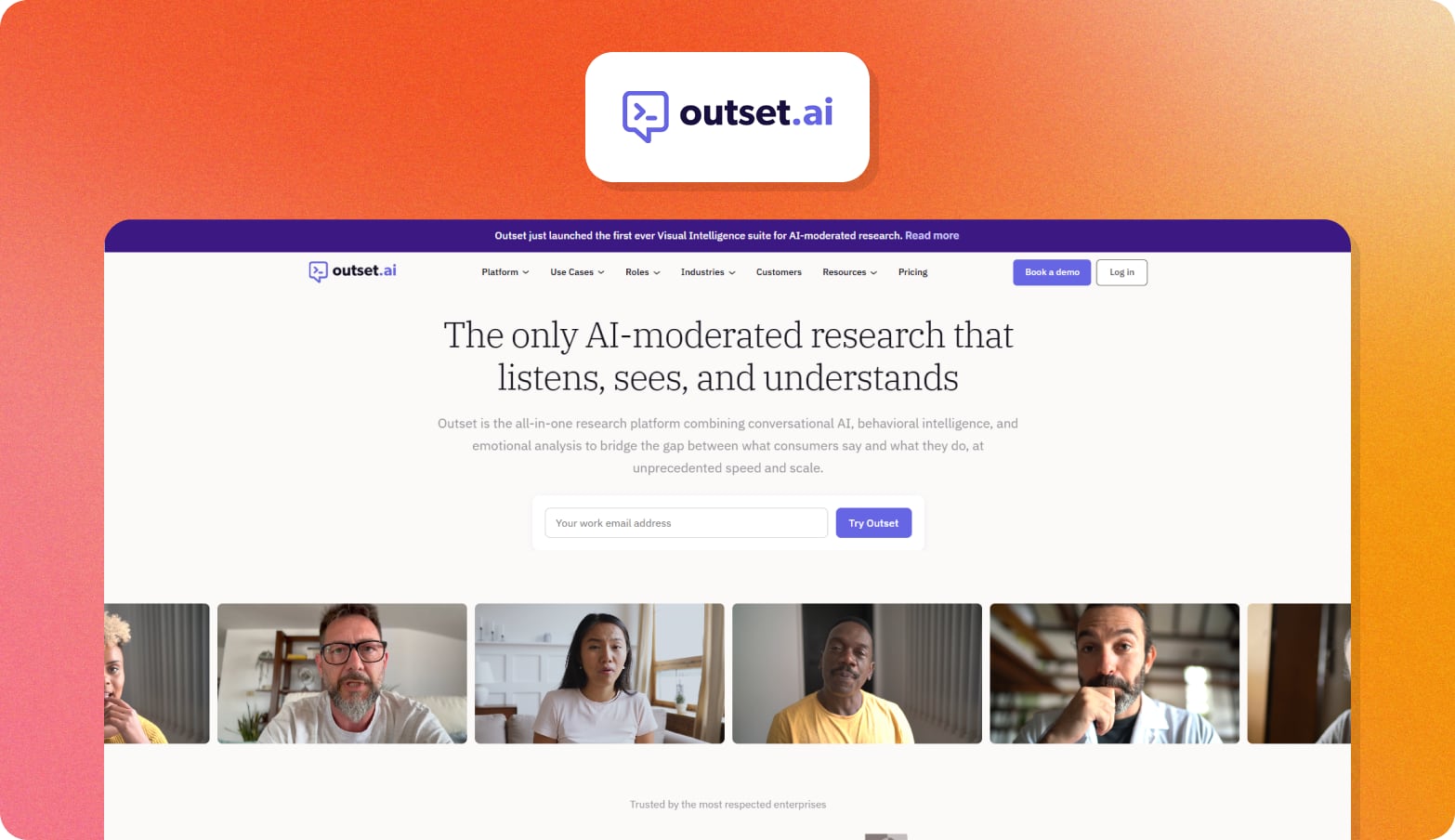
Outset is an AI interview platform designed to help teams launch conversational studies and collect user feedback through moderated dialogue.
What makes it distinct:
Outset lets researchers decide how the AI interviews. They set its style and how far it follows up on each answer, which suits teams that want a usability test to run differently from an open discovery interview. Findings from every study can then be searched together.
Best for:
Product, UX and market research teams studying customer behavior and user interactions while features or concepts are still being shaped.
Tradeoff:
Outset's security page lists SOC 2 Type II and GDPR compliance but doesn't state where data is hosted or offer an EU data residency option, at the time of writing. Teams with EU hosting requirements should confirm this directly.
4. Marvin: Best for interviewing users inside your own website or product
What it is:
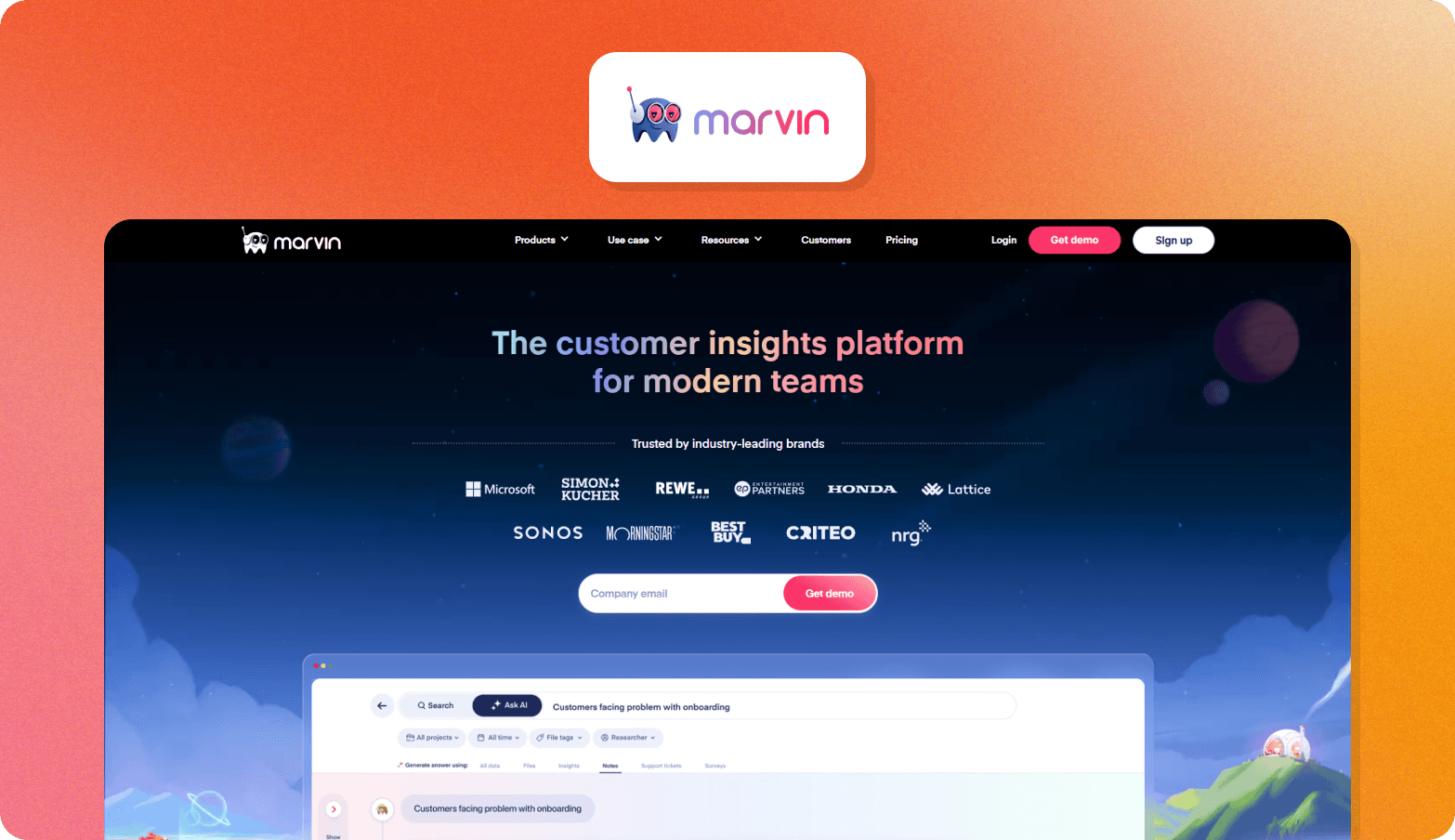
Marvin is a research platform and customer feedback repository. Teams run interviews in it, live or with an AI interviewer, and analyze them alongside feedback from other sources, such as survey data and support conversations.
What makes it distinct:
Marvin's Live Intercept places a voice AI interviewer inside a website or digital product, so teams can collect real-time feedback from users when they reach a pricing page or an onboarding step.
Those interviews land in the same repository as the team's past research and support tickets, where tagging and search make it easier to connect insights across multiple data sources.
Best for:
Product and UX research teams that want to interview users inside their own product, and research operations managers with large archives who want to extract valuable customer insights without repeating fieldwork.
Tradeoff:
Marvin has no native participant recruitment. Live Intercept only reaches people already on your website or product, so reaching a wider target audience means bringing your own participant list or a third-party panel.
5. Dovetail: Best for centralizing customer feedback from every team
What it is:
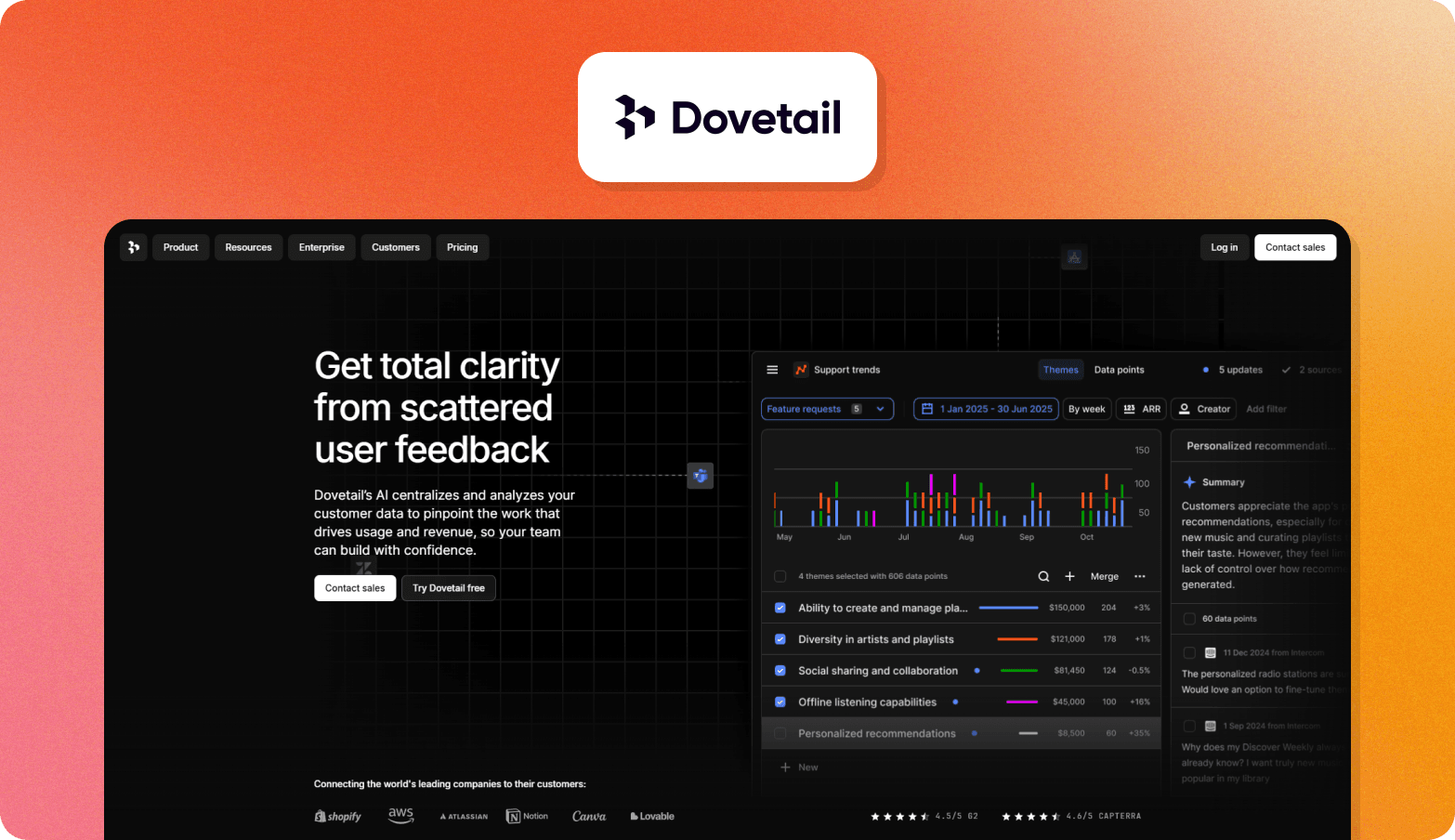
Dovetail is a repository and analysis platform that centralizes customer feedback from sources such as sales calls and support tickets alongside research findings.
What makes it distinct:
Dovetail pulls feedback in from the tools a company already uses, including customer support interactions and recorded calls, and its AI search answers questions across all of it. Every AI-generated insight links back to its source.
Its newer Digital Twins feature builds a model of a customer segment from that feedback. Teams can ask the twin questions or test a message on it, and each answer cites the conversation it came from.
Best for:
Research operations teams that need a single source of truth for the feedback that sales teams and customer support collect alongside research.
Tradeoff:
Dovetail has no interview moderation or participant recruitment. A Digital Twin answers from feedback the company already holds, so a question customers haven't been asked before still needs new research in a separate tool.
6. GetWhy: Best for video-based consumer insights in CPG and brand research
What it is:
GetWhy is an AI-moderated video research platform designed for brand and CMI teams running concept testing and packaging research.
What makes it distinct:
GetWhy can be run self-serve or handed to its in-house research team, which designs and delivers the study as a full service. Teams can start with one and move to the other without changing vendor.
Best for:
Brand and CMI teams in CPG and FMCG running repeatable concept validation across markets, particularly those that want researchers to run some studies for them.
Tradeoff:
On GetWhy's full-service route, its researchers design and deliver the study, so ownership of the research sits with the vendor. That suits teams that want a research partner and is a weaker fit for teams bringing qualitative research in-house.
7. Voxpopme: Best for video survey research at scale
What it is:
Voxpopme is a video survey platform that collects short recorded responses from its own participant panel and applies automated tagging to help teams analyze feedback at scale.
What makes it distinct:
Voxpopme sits between survey tools and interview platforms. It allows teams to gather customer feedback quickly across large audiences while still capturing facial reactions and spoken responses.
Alongside video surveys, Voxpopme offers a newer AI Moderator product that runs voice interviews with follow-up questions. Every study is stored in one repository.
Best for:
Insights teams at consumer brands running ongoing video feedback programs connected to brand tracking and campaign evaluation.
Tradeoff:
In a video survey, participants record answers to set questions, and nobody follows up, so the format suits structured feedback better than exploratory research. Follow-up questions are only available through the AI Moderator, which interviews by voice.
These seven solutions all handle qualitative research, but "customer insights platform" is also used for analytics and survey tools that answer different questions.
What is a customer insights platform, and why is the category confusing?
A customer insights platform can describe several very different systems. Knowing which category you’re evaluating helps you avoid choosing a platform that answers the wrong research question.
| Platform type | What it does | Best for | Example tools |
|---|---|---|---|
| Digital and behavioral analytics | Tracks what users do across websites, apps, and digital customer journeys using behavioral data and interaction signals | Product, UX, and CRO teams analyzing user behavior and customer interactions | Contentsquare, Hotjar, Mixpanel |
| Panel and audience data | Provides structured access to large-scale survey responses and consumer intelligence datasets | Brand tracking, segmentation, media planning, and market trends analysis | GWI, YouGov, Kantar |
| Insights repository and management | Organizes collected customer data, transcripts, and research outputs into searchable knowledge systems | Research operations, knowledge management, and cross-team collaboration | Dovetail, Stravito, Notion |
| Qualitative research platforms | Designs and runs primary research including interviews, thematic analysis, and stakeholder-ready reporting | Insights, CMI, brand, UX, and product teams building a deeper understanding of customer needs | Conveo, Listen Labs, Outset, Marvin, GetWhy |
If a research platform is the right fit, being clear on your starting point will make shortlisting easier.
How to choose the right customer insights platform
Most teams evaluating a customer insights platform are trying to remove a specific bottleneck in how they collect customer insights, analyze customer data, or deliver findings to stakeholders.
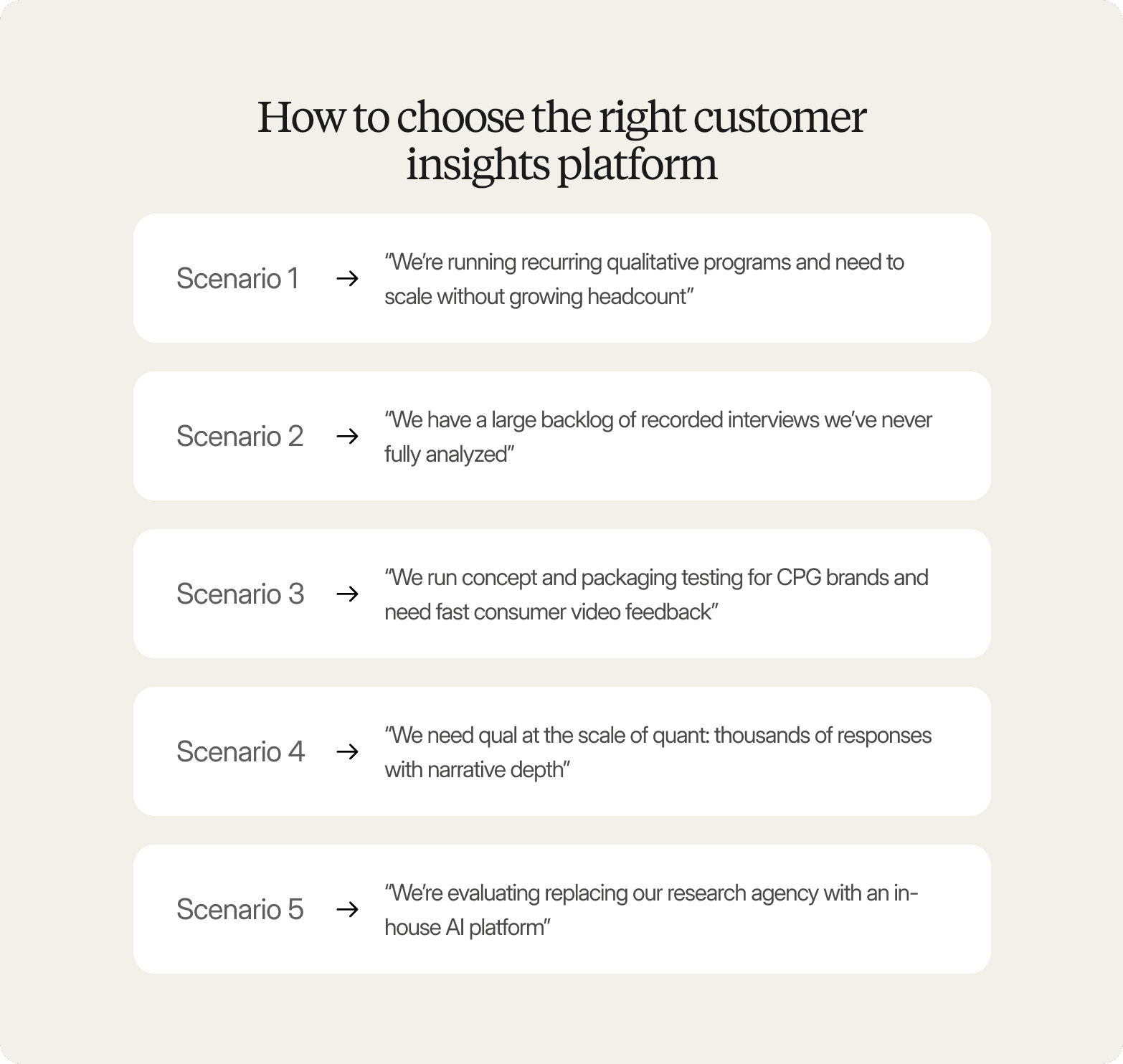
These scenarios reflect the most common decision paths enterprise insights and CMI teams face.
Scenario 1: “We’re running recurring qualitative programs and need to scale without growing headcount.”
If your team already runs recurring customer research, the constraint is usually the manual work of setting up, running, and comparing each round.
In this case, the right customer insights platform runs the program for you. With Conveo StoryLines, each round is a wave in one continuous program. When a wave closes, Conveo analyzes it against the ones before, flags what's changed, and delivers the report, so your team keeps collecting customer insights without adding headcount.
Scenario 2: “We have a large backlog of recorded interviews we’ve never fully analyzed.”
Some teams already have strong data collection but limited time to extract value from past work. The challenge is turning existing material into usable customer intelligence.
Tools like Marvin or Dovetail help analyze data across archives, organize structured and unstructured data, and surface valuable customer insights from research that would otherwise remain unused.
Scenario 3: “We run concept and packaging testing for CPG brands and need fast consumer video feedback.”
Brand and CMI teams often need validation before a launch. Here, the decision usually depends on who you want running the research.
GetWhy is a strong fit when you'd like its researchers to design and deliver some studies for you. Conveo is the better choice when your team wants to run the studies itself and keep each concept test in a searchable insight library for the next one.
Scenario 4: “We need qual at the scale of quant: thousands of responses with narrative depth.”
Some programs sit between survey tools and moderated interviews. Teams want scale without losing context from customer interactions.
Voxpopme works well for large volumes of recorded video responses tied to brand tracking and campaign feedback, where set questions are enough. If you want follow-up questions, it offers them through its newer AI Moderator, which interviews by voice. Conveo is better suited when you need AI-moderated video interviews that still scale across markets.
Scenario 5: “We’re evaluating replacing our research agency with an in-house AI platform.”
This usually means the team wants to own its research: who gets interviewed, what they're asked, and where the findings are kept. Conveo supports this by running recruitment, interviews, and analysis in one place, with every study kept in a searchable insight library. Listen Labs covers the same stages, though its acquisition by Salesforce is worth raising before you commit.
If your team runs qualitative research and is evaluating platforms, Conveo’s team offers a working demo of the full research workflow.
8 questions to ask when evaluating a customer insights platform
Use this checklist to pressure-test whether a customer insights platform will support real customer research at enterprise scale.
1. Does the platform cover the whole study or one step of it?
Each handoff between an interview tool, analytics tools, and a repository adds a vendor and a place for findings to get lost. Ask which stages happen in the platform and which ones you'd need another product for.
2. Does it interview real participants or rely on synthetic ones?
Your stakeholders will ask where a finding came from. Check whether it's from an interview with a real person or a modeled response, and whether there's a recording behind it.
3. What does the AI do?
"AI-powered" doesn't tell you much on its own. Some platforms use natural language processing for data analysis after the interviews, tagging and summarizing what's been said. Others run the interview and ask the follow-up questions. Ask to see a recorded example.
4. What do stakeholders receive?
Ask to see a finished report, and check whether someone who wasn't part of the study, such as customer success teams or brand managers, could understand it without a researcher explaining it. If a vendor promises real-time insights, ask whether you'll see results as interviews are completed or only once fieldwork closes.
5. How does it handle research in several markets and languages?
Enterprise teams need findings they can compare across regions. If each market needs its own workflow, data collection slows down, and the results aren't easy to compare.
6. Where do participants come from?
Clarify whether the platform recruits from panels, accepts your own participant lists, or both, and whether it can reach the target audience you're after in each market.
7. Does it fit your existing tools and pass a security review?
Seamless integration is a common claim, so ask which tools connect natively, including the marketing tools your teams already use, and which you'll need technical expertise to set up. Evaluate each platform on scalability and security too: how it copes as data volume grows, which certifications it holds, and where your data's hosted.
8. What do onboarding and pricing look like?
Look for a platform that's easy to use from day one, because a steep learning curve delays your first study. Ask how long new users take to launch one, how custom pricing is calculated, and whether advanced reporting and advanced analytics are included or cost extra.
Why enterprise insights teams choose Conveo to collect customer insights
Enterprise insights teams choose Conveo as their customer insights platform when they want to run qualitative research in-house and need findings that stakeholders can use for data-driven decisions. Here are the key features behind that:
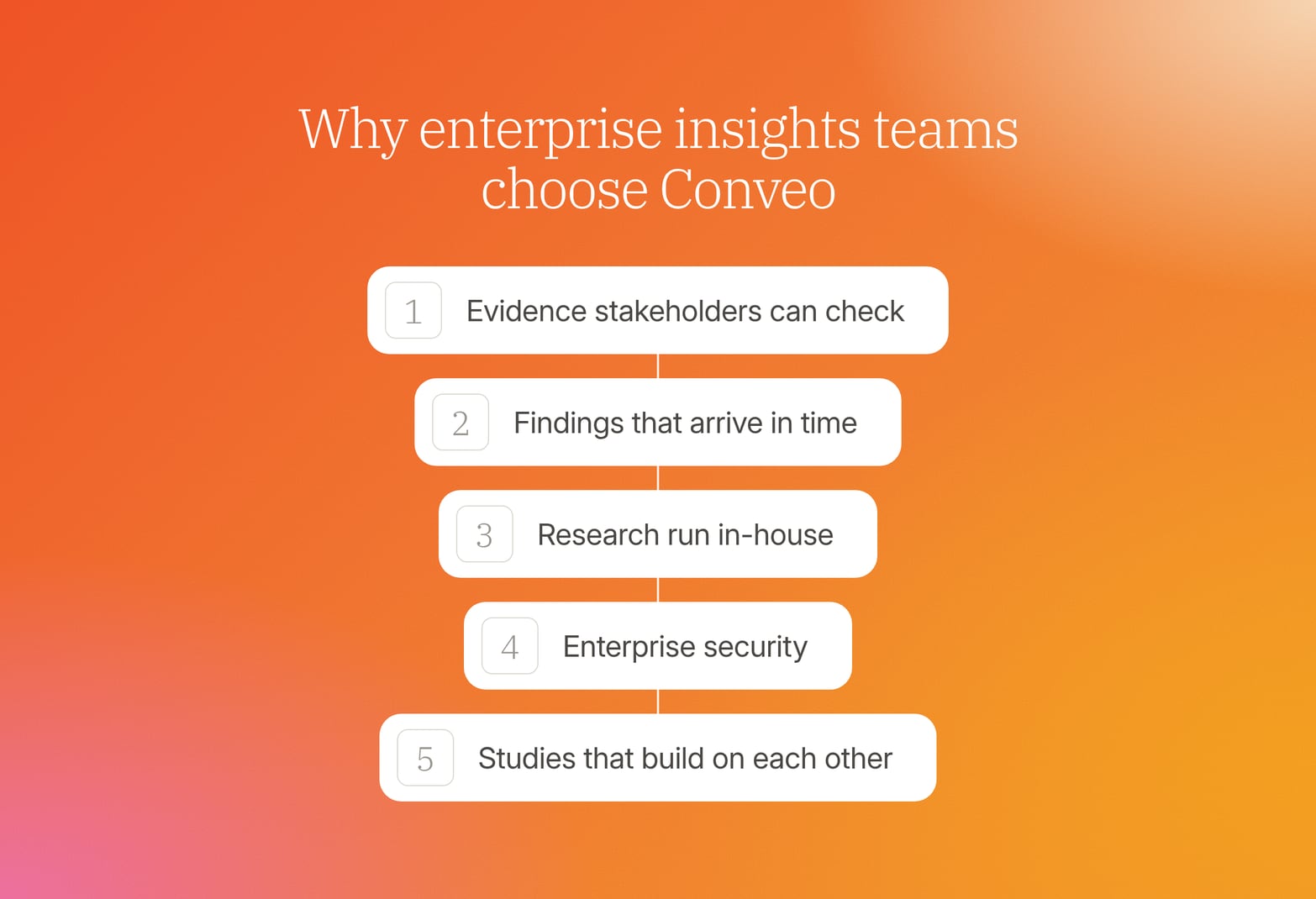
Evidence stakeholders can check. Each theme comes with the quotes and video clips of the participants who raised it, so stakeholders can watch the evidence for themselves before they act on a finding.
Findings that arrive in time. Researchers can investigate questions as they arise, rather than waiting for a new project to be commissioned, so findings arrive while the decision is still open. Conveo can complete 100 interviews in 3 days, so research can keep up with decisions on product launches and marketing campaigns.
Research run in-house. Recruitment, interviews, and analysis all happen in Conveo. Participants come from eight third-party panel providers or your own contact lists, and interviews run in 50+ languages.
Enterprise security. Conveo is SOC 2 Type II certified, GDPR compliant, with EU hosting in Belgium.
Studies that build on each other. Each finished study is added to the searchable insight library, where the team can look up what earlier research found. A one-off study analyzes a picture. Conveo StoryLines analyzes a video, where each wave is a frame, so a change in customer sentiment after a relaunch shows up in the next wave.
Teams whose main need is NPS or CSAT monitoring to track customer loyalty will be better served by a survey-based tool.
If you're choosing a customer insights platform for qualitative research, the quickest way to judge fit is to see a full study run from start to finish.
"The pace, responsiveness, and research expertise of the Conveo team, on top of the top AI-moderated qual platform, have been invaluable to us in scaling brand advertising internationally."
Matt Harris, Research & Insights Lead, EMEA, Canva
Frequently Asked Questions
What’s the difference between a customer insights platform and a consumer intelligence platform?
"Customer insights platform" is a broad label that includes tools for running primary customer research, such as interviews and video studies. A consumer intelligence platform aggregates external signals like social media, panel data, and behavioral data to track market trends. Many enterprise teams use both: a customer insights platform to ask customers why their behavior changes, and a consumer intelligence platform to monitor the wider market.
Will participants engage openly in AI-moderated interviews?
It depends on how the interview is run. Participants answer in their own time and in their own language, and an AI-moderated interview that follows up on what they've said gives them room to explain. Consistent follow-up across interviews also helps teams collect customer insights that stay comparable across markets and user segments. Ask any vendor for sample recordings so you can judge the openness of the answers yourself.
How do I know if AI-generated qualitative insights are credible enough for stakeholder decisions?
Credibility depends on whether insights come from real customer conversations or synthetic responses. Platforms that interview real participants and provide traceable clips, transcripts, and supporting evidence produce outputs that stakeholders can review directly and trust in product, brand, and customer experience decisions.
How many interviews does a platform need to run before the insights are statistically meaningful?
Qualitative research identifies patterns in customer needs, motivations, and reactions, so statistical significance isn't the measure. Enterprise teams typically run interviews until themes repeat across segments. Many platforms support scaling interviews across markets to strengthen confidence in findings.
What should enterprise teams look for when evaluating AI-moderated interviews?
Strong AI-moderated interviews adapt questions based on participant responses, probe for detail, and maintain conversational flow across interviews. Teams should confirm whether the platform runs interviews in several languages, handles open-ended responses effectively, and produces consistent outputs across large studies.
Can a customer insights platform replace a research agency?
Often, yes. A customer insights platform can support recruitment, interviewing, analysis, and reporting within one workflow. Enterprise teams often adopt platforms to run continuous customer research internally while using agencies for specialized studies or complex market research programs.

About the author
Dieter De Mesmaeker
Co-Founder & CEO
Dieter is CEO and co-founder of Conveo. Before starting the company, he founded DataCamp and scaled it into one of the leading edtech platforms in the world.
More by Dieter →Qualitative insights at the speed of your business.
Conveo runs AI-moderated video interviews and structures everything they say.