In this article
TL;DR
B2B quantitative research uses structured surveys and statistical analysis to measure stakeholders' opinions at scale, but it cannot capture how multi-stakeholder buying groups negotiate competing priorities.
Fixed-question instruments flatten role-specific priorities into aggregate scores, hiding the disagreements that actually determine deal outcomes.
Quant earns its place for hypothesis validation, tracking market trends, and turning quantitative data into valuable insights, but breaks down when the research question involves committee negotiation or unstructured problems.
Adaptive qualitative probing surfaces decision tensions between stakeholders, explaining the "why" behind the numbers.
B2B quantitative research is the workhorse of the enterprise insights stack. Surveys go out, numbers come back, and teams get the statistical confidence they need to validate a hypothesis, size a market, or track how brand perception is shifting across a segment. For many research questions, that is exactly what the job requires.
The problem surfaces when the research question is not “what do stakeholders think?” but “how will they decide?” B2B purchases involve committees, and committees negotiate. A CFO, an IT director, and a procurement lead can each earn strong scores on different criteria, and none of those scores indicate how the three will reach consensus in a procurement review. Quantitative instruments measure individual preferences. They have no mechanism for capturing the dynamics between them.
This article covers what B2B quantitative research does well, where it structurally breaks down, and how a mixed-methods approach that combines quant with adaptive qualitative probing closes the gaps that surveys cannot.
What Is B2B Quantitative Research? (And Why It Misses the Buying Group Dynamic)
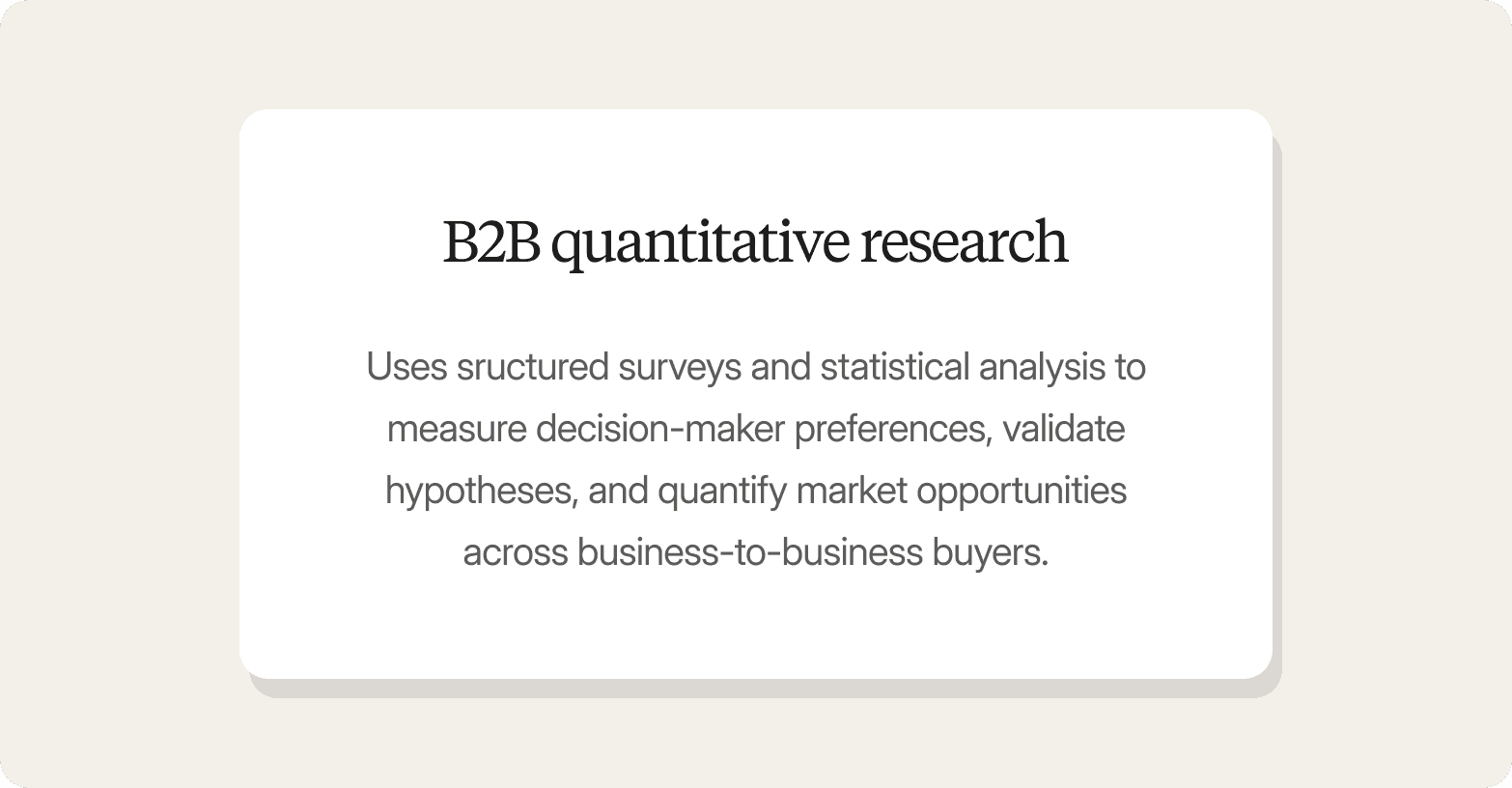
B2B quantitative research uses structured surveys and statistical analysis to measure decision-maker preferences, validate hypotheses, and quantify market opportunities across business-to-business buyers. It is a reliable instrument for generating numerical data that establishes what a target audience believes, how often, and with what level of confidence.
The limitation appears with buying groups. Fixed-question instruments force every stakeholder through the same answer paths, flattening role-specific priorities into aggregate scores. A CFO’s concern about total cost of ownership and an end-user’s priority for ease of integration can both score highly in the same study, masking a genuine conflict between the two groups. Market researchers designing these instruments often underestimate how much signal is lost when stakeholder priorities are averaged.
Consider a product team that surveys IT directors and procurement leads separately. Both cohorts return strong scores on different criteria. The quantitative B2B research reads as a green light; then the deal stalls, because the two groups cannot agree on implementation scope, a disagreement that the survey never surfaced.
Quant delivers statistical confidence. What it does not deliver is visibility into how competing priorities inside a buying group interact, negotiate, and ultimately determine whether a decision moves forward.
5 Common B2B Quantitative Research Methods (And Where Each Breaks Down)
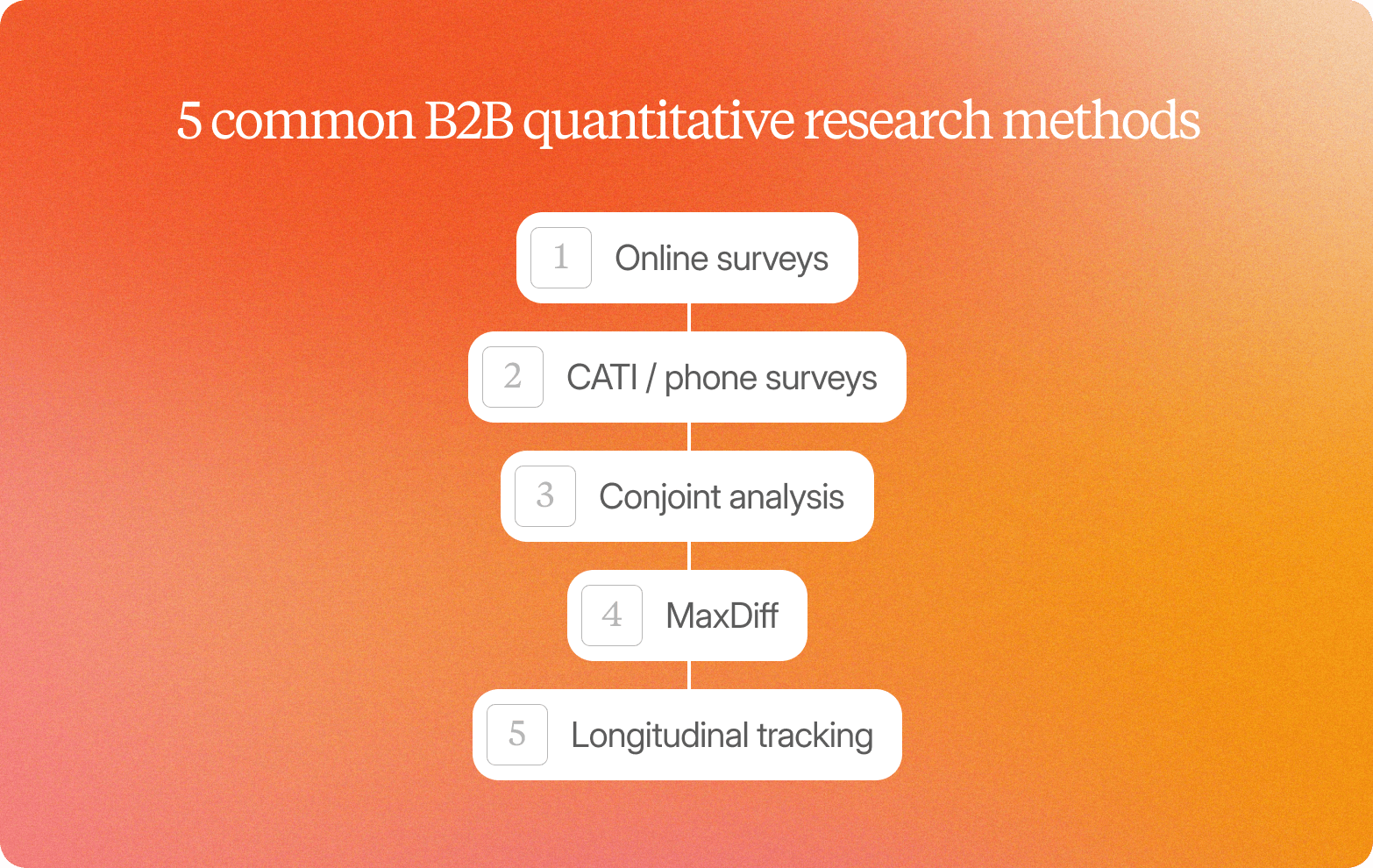
Most teams running B2B quantitative research methods reach for the same short list of approaches. These typically include consumer surveys and online questionnaires built around multiple-choice and rating-scale questions, statistical models such as conjoint analysis, and longitudinal trackers. Each is legitimate. Each also has a structural ceiling when applied to buying groups where multiple stakeholders hold competing priorities.
| Method | Best for | B2B limitation |
|---|---|---|
| Online surveys | Pricing sensitivity, feature importance, and customer satisfaction tracking | Fixed question logic prevents adaptive follow-up; can’t probe when responses conflict |
| CATI / phone surveys | Senior executives have higher completion rates than self-administered surveys | Recruiting 200 qualified respondents is time-consuming: 4-6 weeks, and a significant budget |
| Conjoint analysis | Quantifying trade-offs across price, features, and service terms | Assumes rational individual choice; breaks down when stakeholder groups must reach group consensus |
| MaxDiff | Ranking competing priorities across a respondent set | Quantifies disagreements between stakeholder groups, but can’t explain how they’ll resolve them |
| Longitudinal tracking | Measuring perception and loyalty shifts over time | Shows that a metric moved; it rarely surfaces the organizational dynamics that caused the shift |
All five methods answer “what” and “how much” with precision. They struggle with “why” and “how do stakeholders negotiate conflicting priorities” (the questions that most directly determine whether a deal closes).
"It picks up on the nuances a survey never could."
CMI Manager, Edgard & Cooper
One distinction worth making: The MaxDiff limitation above applies to MaxDiff run as a standalone quant instrument. Conveo’s MaxDiff pairs preference ranking with AI-moderated qualitative probing in the same study session, so research teams get ranked utility scores alongside the reasoning behind stakeholder disagreements rather than ranked scores without explanation.
Why B2B Quantitative Research Struggles with Multi-Stakeholder Buying Groups
For B2B tech purchases, six to ten stakeholders spanning IT, finance, operations, and executive leadership are typically involved in the decision-making process. Each brings a different success metric, a different risk tolerance, and a different set of pain points around what makes or breaks vendor adoption in their specific function. That structural reality is precisely where B2B quantitative research starts to break down.
Fixed-question surveys face a binary trap: when teams send surveys to multiple stakeholders within the same account, they must choose between them. Survey everyone with the same instrument, and you flatten the differences that explain how decisions get made. Survey each role separately, and you generate parallel datasets with no mechanism for understanding how those groups will reconcile their disagreements. Gartner research found that buying groups that reach consensus are 2.5 times more likely to report a high-quality deal, which means the negotiation between stakeholder perspectives is the research question that surveys cannot ask.
Consider a concrete example: a cybersecurity vendor surveys CISOs, IT managers, and CFOs separately. CISOs prioritize threat detection speed. IT managers prioritize ease of deployment. CFOs prioritize contract flexibility. The vendor gets three statistically significant datasets but no insight into how these groups will negotiate the final decision. Surveys capture what each job title cares about; they cannot explore perceptions across roles or reveal how those perceptions interact under procurement pressure. The disagreements are not noise to be filtered out. They are the signal.
The missing layer is adaptive probing. 74% of B2B buyer teams exhibit unhealthy conflict during the decision-making process, which means these dynamics are the norm, not an edge case. Fixed-question instruments have no mechanism to surface the tensions between stakeholder positions, let alone explore how each party weighs them.
Quant tells you what the buying group thinks. It rarely tells you how they’ll decide.
When to Use Quantitative Research in B2B (And When Not To)
When B2B quant fits
Quant earns its place when you need to validate a hypothesis across a large enough sample to segment by role, seniority, or company size. B2B quantitative research is reliable for tracking market trends, giving marketing strategies a defensible evidentiary foundation, and measuring how audience attitudes shift over time. It performs best when the decision is individual rather than committee-driven, the question is closed-ended rather than exploratory, and the target audience is broad enough for meaningful segmentation.
A martech vendor that uses quant to test messaging assumptions and measure feature adoption among 500 marketing directors is a good fit. The question is closed, the sample is large, and the output directly strengthens marketing efforts (so a number of stakeholders can act on it).
When it doesn’t fit
The same vendor runs into trouble the moment the research question shifts to why deals stall during procurement review. That question involves multiple stakeholders, conflicting priorities, and organizational dynamics that a survey cannot capture.
Avoid quant when the buying process involves complex committee negotiation, when you’re exploring an unstructured problem in a new category, when niche verticals make meaningful segmentation impossible, or when you need to understand the pain points driving competing stakeholder positions. When the goal is brand positioning in a contested category, or when you need to explore perceptions across distinct buyer segments, quant can tell you what people think but not why.
If your research question is “how many” or “which option,” quant fits. If it’s “why do stakeholders disagree” or “how do they negotiate trade-offs,” qualitative depth belongs first.
How Adaptive Qualitative Probing Complements B2B Quantitative Research
Qualitative and quantitative research in B2B are not competing methods; they answer different questions.
B2B quantitative research tells you what stakeholders prioritize at scale. A survey might show that 70% of IT directors rank ease of integration as their top vendor criterion, while 65% of CFOs rank contract flexibility as their top criterion. Both findings are real quantitative data. Neither tells you how those two groups resolve the tension when they have to agree on a vendor.
That negotiation dynamic is what adaptive qualitative research methods are designed to surface. Researchers increasingly frame this as a mixed-methods approach: use quantitative methods to measure at scale, then conduct qualitative research to explain the dynamics behind the numbers. When an IT director says integration ease is non-negotiable, Conveo’s AI moderator follows up: “Your CFO flagged contract flexibility as the priority. How does your team typically navigate that difference?” The question is adaptive, not templated. It probes the actual decision tension at a deeper level, building a deep understanding of how competing stakeholder priorities shape the buying process and delivering qualitative data that explains where the numbers come from.
Two operational advantages matter here. First, async participation: busy professionals (particularly senior decision-makers) rarely clear calendar time for a 60-minute in-depth interview, and Conveo sessions run on participants’ own schedules, solving the recruitment bottleneck that makes traditional qual impractical at a buying-group scale. Second, traceability: every finding links to verbatim video clips, providing the kind of evidence that lends real credibility to marketing communications and brand positioning decisions with internal stakeholders.
Use quant to validate priorities at scale. Use adaptive qual to understand whether those priorities translate to a deal, or quietly collapse under stakeholder negotiation.
Examples of B2B Quantitative Research in Practice
The following examples of B2B qualitative and quantitative research cover the B2B marketing research topics that quantitative teams most commonly address, with the method, business question, and output for each.
| Study type | Method | Business question | Output |
|---|---|---|---|
| Feature prioritization | MaxDiff | Which roadmap priorities do 300 PMs rank highest? | Ranked utility scores by capability |
| Pricing sensitivity | Conjoint analysis | What are SMB vs. enterprise willingness-to-pay thresholds? | Price points where purchase intent drops by segment |
| Brand perception tracking | Quarterly survey | Is brand awareness shifting among HR directors at 500+ employee companies? | Longitudinal awareness and consideration data |
| Win/loss analysis | Post-decision survey | Why did closed deals convert or churn? | Customer feedback ranked by deal size and competitive scenario |
These study types are common across industries, and many teams use them as case studies when communicating findings to clients, other businesses, and internal stakeholders. The numerical data each method generates are valuable: they tell leaders and customers what the market thinks. What it rarely provides is the qualitative feedback that explains how those beliefs drive actual buying behavior.
Designing B2B Quantitative Studies That Account for Buying Group Complexity
The core design problem is that standard survey instruments are built around individual respondents. They assume one person, one opinion, one set of priorities. B2B purchasing doesn’t work that way. When a CFO, compliance lead, and IT director evaluate the same vendor, a single instrument averages their responses into a number that accurately represents none of them.
Three best practice approaches make quant more structurally honest for buying group research:
Segment by role from the outset. Compare results across stakeholder types (by job title, function, and seniority) rather than collapsing them into aggregate scores. This makes disagreement visible rather than burying it.
Use account-level analysis. When a CFO rates vendor risk tolerance differently from the IT director at the same company, that gap is the finding, not noise to be smoothed over.
Pair quant with adaptive qual. Segmentation quantifies disagreement; it doesn’t explain how groups resolve it. Qualitative depth closes that gap.
The practical workflow: run qual first to discover the language each stakeholder type uses and map decision dynamics between roles. Identifying the right respondents (with accurate job title targeting and role-level screeners) is critical to grounding quant instruments in clear research objectives. Use that foundation to design surveys that measure the right variables. Then use video evidence from the qual phase to socialize findings internally, because a clip of a CFO explaining their veto criteria lands differently than a bar chart.
Conveo’s AI-moderated video interviews probe each stakeholder adaptively, then synthesize across roles to surface decision tensions rather than averaging them away. A fintech company interviews CFOs, compliance leads, and IT directors separately. The AI probes each on their top concern, follows up when responses conflict, and produces a decision map that is especially valuable during the data analysis phase, helping teams connect qualitative findings to quant survey strategy before measuring patterns at scale across 200 accounts.
How Conveo Maps Buying Group Dynamics That B2B Quantitative Research Misses
The gap between what quant measures and how buying groups actually decide cannot be closed by designing better surveys. It requires an instrument that adapts to each stakeholder’s priorities in real time, probes contradictions between roles, and produces traceable evidence that internal stakeholders trust.
Conveo is built for that workflow. As a video-first AI research platform built for modern research technology, it runs AI-moderated interviews across an entire buying group, with each participant responding on their own schedule. Unlike traditional focus groups or in-depth interviews that require real-time moderation and calendar coordination, Conveo sessions are async and scalable, making them far more practical for busy professionals across B2B industries. The AI moderator follows up when an IT director’s integration concerns conflict with a CFO’s cost priorities, producing a decision map that shows where consensus exists, where it breaks down, and which objections carry veto weight.
Three structural advantages make this possible: multimodal signal capture (tone, hesitation, and emphasis that transcripts and surveys miss); verbatim video evidence that gives marketing communications teams the proof they need in stakeholder review; and a knowledge library where findings compound across studies, making every subsequent study faster and more grounded. SOC 2-certified workflows meet enterprise procurement requirements, and the platform gives internal research teams access to studies they could not run before at an agency scale, without sacrificing depth.
For market researchers running B2B quantitative research today, the practical next step is not to abandon quant: it’s to combine it with adaptive qualitative depth and adopt a mixed method approach that delivers valuable insights at the speed modern research strategy demands.
Frequently Asked Questions
How do you design a B2B quantitative study that accounts for multiple stakeholders in the same buying decision?
Segment your survey instrument by role and run account-level analysis to identify where procurement, end users, and economic buyers systematically disagree. Identifying the right respondents (with accurate job-title screening) is a best practice that's easy to overlook but critical to achieving meaningful results. That segmentation makes disagreement visible; it doesn't explain how stakeholders resolve it. Pair quant with adaptive AI-moderated video interviews to probe each role in their own words. The practical workflow: first conduct qualitative research to discover decision dynamics, then validate patterns at scale with quantitative instruments.
When contacts disagree inside an account, what's the best way to model that in quant data without averaging the signal away?
Preserve role-level data and treat intra-account variance as a signal, not noise. AI-moderated video interviews surface the qualitative feedback behind disagreements, giving researchers sharper segmentation variables and cleaner inputs for the data analysis phase. In practice, a vendor interviews three stakeholders per account; the moderator follows up when responses conflict; and the output is a decision map. Quantitative B2B research then measures how common each pattern is across 100 accounts, turning qualitative insight into scalable validation.
What sample size do you need for B2B quantitative research to be statistically valid?
Standard thresholds: 100-200 respondents for directional insights, 300-400 for reliable segmentation, 500+ for advanced statistical modeling. The challenge is that B2B samples are constrained by population size; smaller sample sizes are the norm in niche verticals and enterprise-only segments, not an edge case. If your target audience is 500 companies, an underpowered quant study won't become valid by wishing for more respondents. In those situations, well-screened qualitative interviews often produce more actionable findings.
How long does B2B quantitative research typically take from design to results?
Agency-led B2B quantitative research typically runs four to eight weeks from questionnaire design through programming, fielding, analysis, and reporting (a timeline that can be time-consuming and costly for teams under delivery pressure). Recruitment is the primary bottleneck: reaching qualified decision-makers takes significantly longer than B2C, and premium panels can require four to six weeks for hard-to-reach senior buyers. AI-moderated video interviews compress the timeline from weeks to days, with participants completing sessions on their own schedule and eliminating the need for calendar coordination entirely.
What's the difference between B2B and B2C quantitative research?
B2B quantitative research involves smaller, harder-to-reach samples and complex organizational buying groups. B2C works with larger samples and individual customers who are straightforward to source via consumer panels. B2B respondents are senior professionals at other businesses, with low participation rates, which makes recruitment slower and more expensive. B2B decisions also involve multiple stakeholders with conflicting priorities (a complexity that surveys frequently obscure and that increasingly drives market researchers to adopt a mixed method approach to explain what aggregate trends cannot).
Can you run B2B quantitative research without an agency?
Yes, but it requires internal expertise in survey design, sampling methodology, and statistical analysis. In-house teams save on agency fees and avoid the coordination overhead of traditional methods such as focus groups or moderated in-depth interviews, but they still need high-quality B2B panels, a capable survey platform, and the analytical skills to interpret results confidently. A hybrid approach works well for most enterprise teams: platforms that support end-to-end research workflows allow researchers to focus their strategy on insights rather than operations, and to test, iterate, and validate findings without agency dependency.

About the author
Meg Gerli
Research Impact Lead
Meg studied at Stanford and spent six and a half years on the insights and research team at Nike before joining Conveo. She scopes studies with US enterprise teams: sample sizes, panel feasibility, and the trade-off between depth and speed, with the reasoning behind every recommendation.
Meet Meg on film →Qualitative insights at the speed of your business.
Conveo runs AI-moderated video interviews and structures everything they say.