In this article
TL;DR
Is survey research qualitative or quantitative? Most survey research is quantitative: it generates numerical data that can be analyzed statistically to measure what people think, how often, and in what proportion.
Open-ended survey fields are not the same as qualitative research. In practice, participants type compressed answers that strip out the context, hesitation, and reasoning that reveal the real "why."
When you need to understand why customers behave a certain way, not just how many do, qualitative interviews consistently yield more actionable findings than open-ended survey fields.
The right method depends on the question. Surveys excel at measuring what happened. Qualitative interviews explain why.
Is survey research qualitative or quantitative? For most teams running surveys, the answer is quantitative: fixed-response scales, multiple-choice grids, and rating questions measure how many customers think something or how strongly they feel it. That structure is what makes surveys fast to field and straightforward to analyze.
The confusion starts when surveys include open-ended questions. Is a survey quantitative or qualitative research when participants can type a free-text answer? Technically, those fields introduce qualitative elements. In practice, they rarely deliver the depth of qualitative research required, because participants won’t type what they would say in a conversation.
This matters because teams default to surveys for speed, only to discover that the results can’t explain the behavior they were trying to understand. The data shows what happened. It doesn’t show why.
Understanding whether survey research is qualitative or quantitative
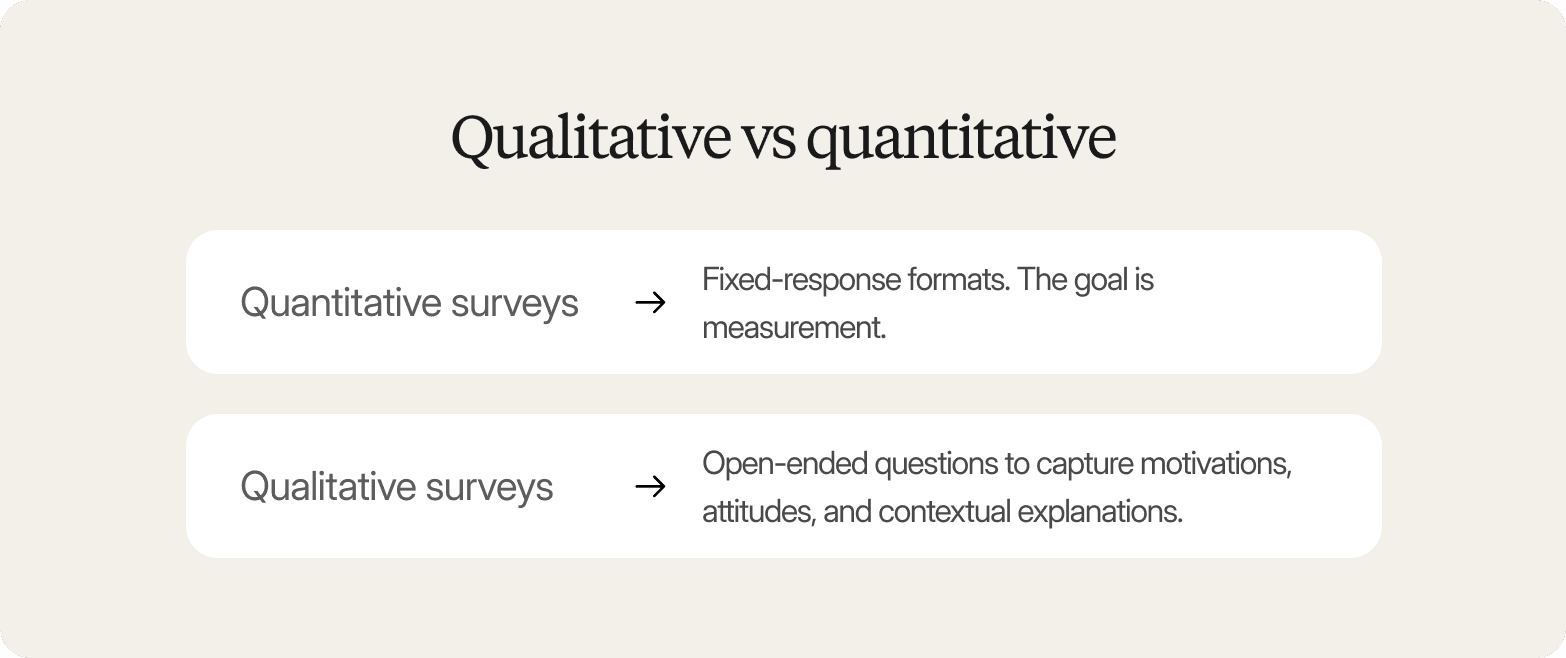
Question format determines data type. That single distinction resolves most of the confusion about whether survey research is qualitative or quantitative: closed-ended questions produce numerical data; open-ended questions produce qualitative data.
Quantitative surveys
Use fixed-response formats: Likert scales with options ranging from “strongly agree” to “strongly disagree,” multiple-choice options, yes/no questions, and rating scales. The goal is measurement. How many people prefer Option A? What percentage are satisfied? How does sentiment shift across age groups? Quantitative survey questions generate data you can aggregate, compare, and analyze statistically. When researchers ask whether surveys are qualitative or quantitative research, this is the model most people have in mind.
Qualitative surveys
Use open-ended questions designed to capture motivations, attitudes, and contextual explanations in the respondent’s own words. The goal is meaning, not measurement. Why do customers prefer one product over another? What’s missing from their current experience? What language do they use to describe a problem they haven’t fully articulated yet? Qualitative survey questions are designed to generate language, not numeric data.
The hybrid reality is that most surveys are predominantly quantitative, with a few open-ended fields added at the end for texture. A brand-tracking survey might include closed quantitative questions, such as “How satisfied are you with our product?” on a five-point scale, alongside one qualitative question: “Why?” in a free-text box. The first produces a score. The second produces a sentence fragment.
That fragment is the limitation. Open-ended fields consistently yield thin, low-context answers because participants won’t type what they would say aloud. The effort of writing discourages depth. Without a moderator to probe, the “why” behind a 3-out-of-5 satisfaction rating stays buried. Teams end up with numeric data they can chart and a comment field full of one-liners that don’t explain anything.
This is where the distinction between qualitative survey research and genuine qualitative research matters most. Quantitative surveys measure what people think. Qualitative research methods, when designed and executed with rigor, reveal why they think as they do.
Comparison Table
| Method Type | Question Format | Data Output | Best Used For | Output Credibility | Typical Turnaround |
|---|---|---|---|---|---|
| Closed-Ended Surveys (Quantitative) | Fixed-choice, scales, rankings | Numerical, aggregated | Measuring frequency, preference, and scale | Statistical results, charts | Days to weeks |
| Open-Ended Survey Fields (Qualitative Attempt) | Free-text within a survey | Unstructured text | Capturing surface reactions | Sentence fragments, difficult to synthesize | Days to weeks, but thin results |
| Video-Based Qualitative Interviews | Conversational, adaptive probing | Video, transcript, themes | Understanding motivation, context, and the “why.” | Video clips, verbatim quotes, and traceable findings that stakeholders can interrogate | 3–5 days with Conveo |
Is survey research qualitative or quantitative? The answer depends on the question format and data output, and the table above shows where each approach breaks down.
When to use qualitative research (And why surveys often fall short)
Qualitative research earns its place when the question you’re trying to answer can’t be resolved by counting. The decision-first principle applies here: if you need to explore an unknown problem, surface motivations, or build a more holistic understanding of emotional and attitudinal drivers, qualitative research methods are the right starting point. If you need to measure prevalence or validate a hypothesis across a large sample, quantitative methods take over. The mistake most teams make is choosing the method before defining their research goals.
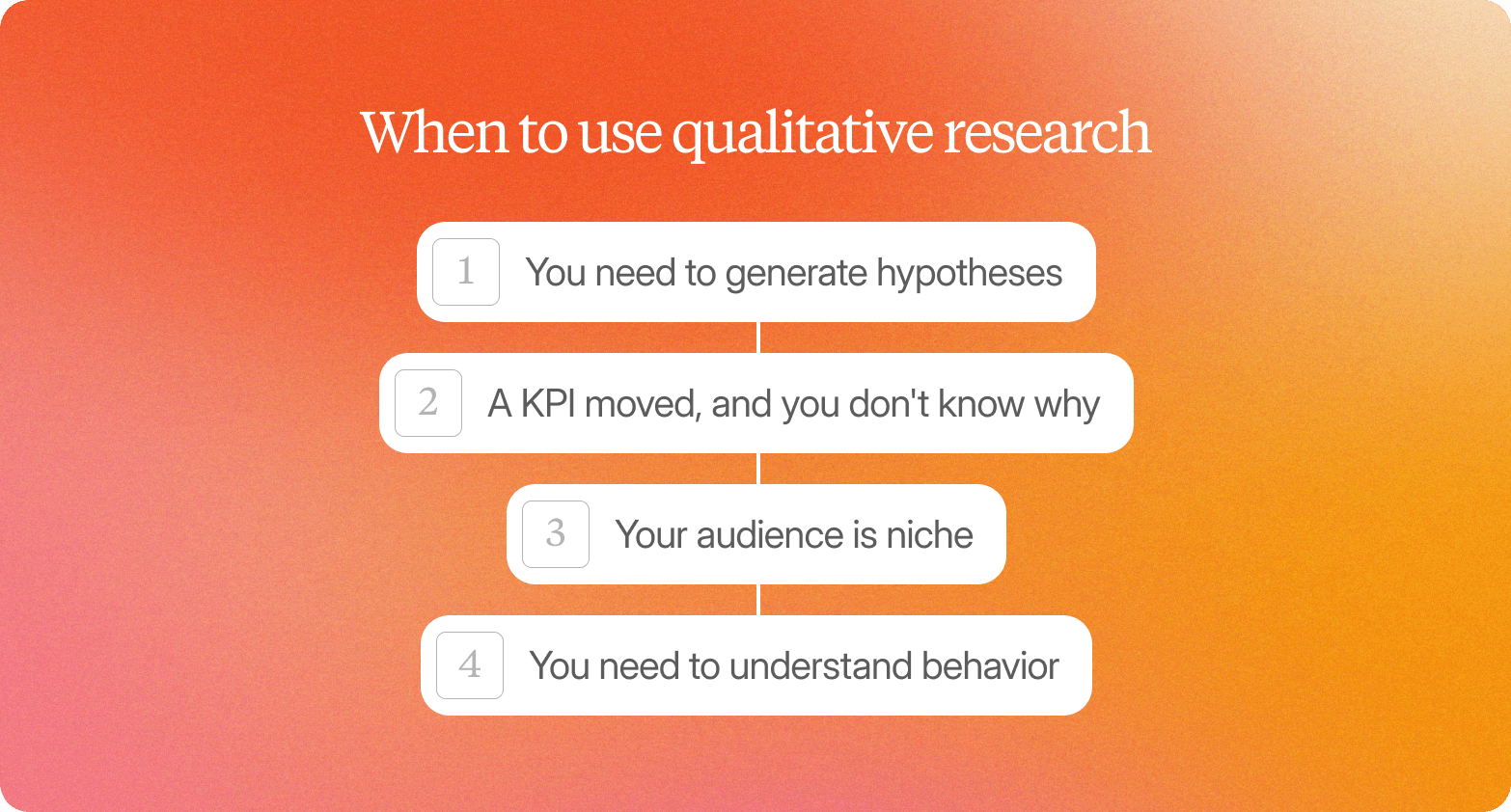
Four situations consistently call for qualitative research over a survey:
You need to generate hypotheses before you can measure anything
Surveys require you to know what to ask. Qualitative interviews surface the language, concerns, and mental models you didn’t know to look for, giving you the raw material to write a survey that actually measures something meaningful.
A KPI moved, and you don’t know why
Quantitative data shows you the change. It doesn’t explain the cause. When NPS drops, conversion falls, or churn spikes, the right first move is to engage participants in a real conversation, not send them a rating scale.
Your audience is niche, hard to recruit, or unlikely to complete a standard survey
Smaller, specialist populations respond better to conversation than to checkbox questions. Surveys in these contexts often produce low completion rates and surface-level open-ended responses that don’t reflect how the audience actually thinks.
You need to understand behavior, not just record it
Quantitative data shows what happened. Qualitative research explains why it happened by capturing opinions, beliefs, and motivations that numbers alone cannot reveal, and that distinction is where most product, brand, and CX decisions are actually made.
Surveys can include open-ended fields, but they capture only surface-level responses. They miss the depth that comes from probing and conversational context. A written answer to “Why did you stop using this feature?” produces one sentence: “It’s confusing.” A qualitative interview asks: “Walk me through the last time you tried to use it. What happened? What were you trying to accomplish?” The difference in output quality is not marginal.
Traditional qualitative research methods, including focus groups and in-depth interviews, were designed to provide exactly this kind of holistic understanding. The assumption that accessing this depth requires weeks of scheduling and a significant agency budget is now outdated. AI-moderated asynchronous interviews have made it practical to run qualitative research at the scale and turnaround that surveys have historically monopolized. The tradeoff between depth and speed no longer holds as it once did.
When to use quantitative research (And why surveys excel here)
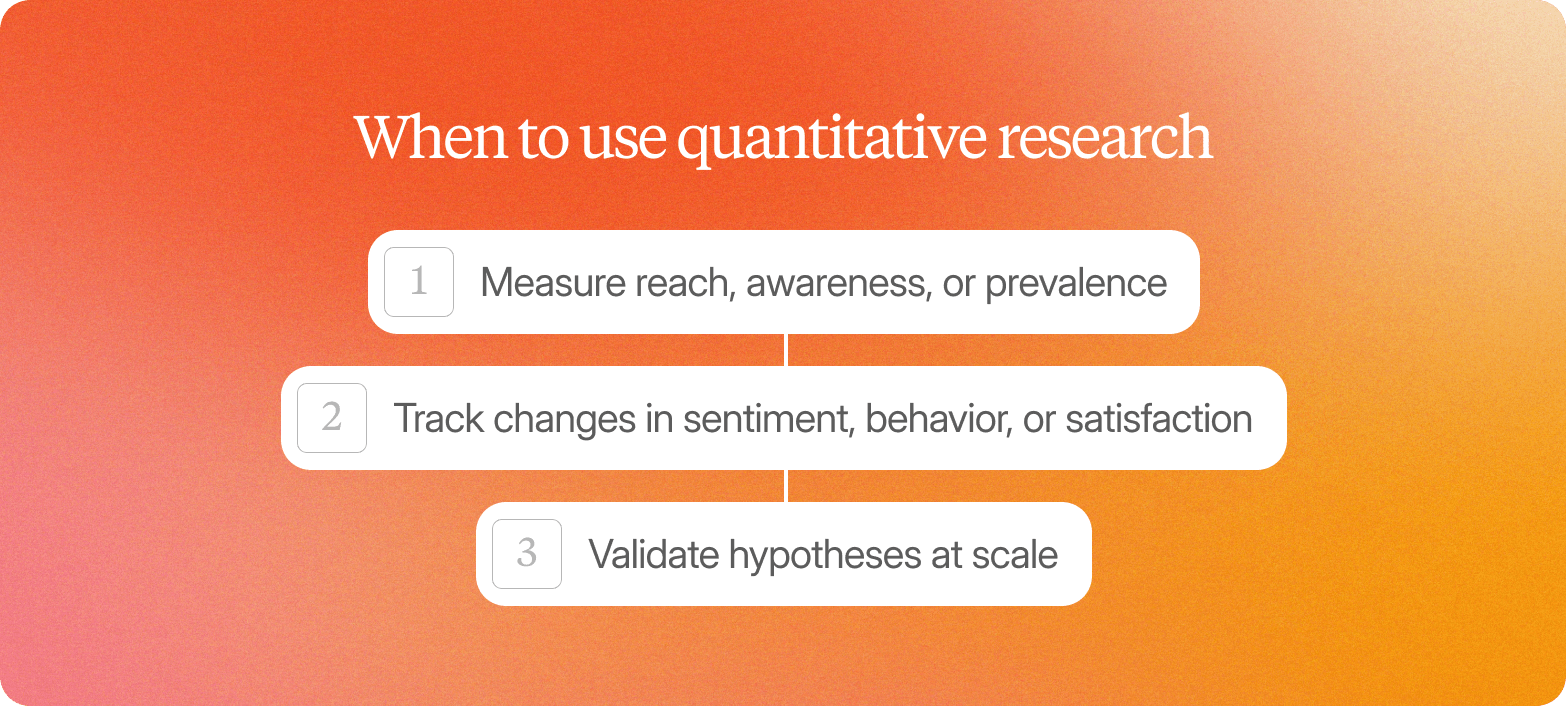
Quantitative research is the right choice when your question requires statistical confidence, representative measurement, or the ability to track trends over time. Quantitative research methods are designed to collect numeric data that can be analyzed at scale, compared across segments, and repeated at intervals to detect shifts.
Three situations call for quantitative surveys specifically:
Measure reach, awareness, or prevalence
When you need to know what proportion of your target audience holds a belief, recognizes a brand, or has taken an action, a survey with a representative sample gives you defensible statistical data. Collecting numeric data across demographic segments is where surveys excel.
Track changes in sentiment, behavior, or satisfaction over time
Consistent survey instruments run at regular intervals produce trend data that qualitative studies cannot replicate. Brand trackers, NPS programs, and satisfaction benchmarks all depend on this structure.
Validate hypotheses at scale
Qualitative research generates hypotheses. Quantitative research verifies them. Once interviews reveal a pattern, a survey can confirm whether that pattern holds across a larger, statistically representative group.
Fixed-response formats eliminate ambiguity in responses, enabling aggregation and comparison. A brand team that needs to know whether a new campaign lifted awareness among 25- to 34-year-olds can run a survey with 1,000 representative participants and get a statistically confident answer. A qualitative study cannot produce that number, nor is it designed to.
Surveys are fast and scalable, but they produce thin answers. When a brand tracker shows satisfaction dropping by 3 points quarter-over-quarter, the survey tells you something has changed. It does not tell you why customers feel differently, what specifically broke down, or what they would need to feel confident again. That context requires a different kind of conversation.
The most effective market research programs use both methods together: quantitative surveys to measure what is happening, qualitative interviews to explain why.
The problem with open-ended survey questions
Many teams add open-ended questions to surveys, expecting qualitative depth. The results are almost always the same: short, text-based responses that confirm a sentiment without explaining it.
Survey participants won’t type what they would say in a conversation. Without probing, follow-up, or nonverbal cues, a survey captures what people think but consistently misses the why behind behavior. This is the core limitation teams run into when asking whether surveys can be used in qualitative research: the format itself works against depth.
Watch it now: Conveo’s AI moderation in action

The pattern shows up across every research project. A survey asks, “What do you like most about our product?” The open-ended responses come back: “Easy to use.” “Fast.” “Reliable.” These answers feel like a signal. They are not. They don’t explain what makes the product easy to use, what the respondent is comparing it to, or what would happen to their workflow if those qualities changed. Leadership reads the summary, nods, and makes a decision based on two words that could mean almost anything.
The contrast with a real qualitative interview is immediate. A researcher probes: “You said it’s easy to use. Can you walk me through a recent time you used it? What made that experience easy compared to other platforms you’ve tried?” That follow-up surfaces the specific workflow, the comparison point, and the emotional context that the survey response never touched.
This is the problem Conveo is built to solve. Researchers get the depth of a real conversation with the operational efficiency of a survey program. Conveo runs AI-moderated video interviews that surface the motivations behind quantitative trends, delivering traceable findings, including video clips and verbatim quotes, within three to five days.
If your survey results leave you with more questions than answers, qualitative depth is what closes that gap. More survey responses will not.
4 ways to choose between qualitative and quantitative methods
Start with the decision you need to make. Then choose the method that produces the evidence required to make it with confidence, given your research goals.
Four questions clarify the choice:
1. Do you need to measure prevalence, distribution, or statistical relationships?
Use quantitative surveys. They’re built for scale and produce findings you can generalize across a population.
2. Do you need to explore motivations, diagnose unexpected behavior, or generate hypotheses?
Use qualitative interviews. When you’re asking why customers behave a certain way, or trying to understand what’s driving a pattern you’ve already observed, surveys will tell you what’s happening, but not what’s behind it. This is where the question “Is survey research qualitative?” has a clear answer: surveys produce quantitative findings, even when they include open-ended questions. Open-text responses give you a signal, not an explanation.
3. Do you need both measurement and explanation?
Use mixed methods research. When researchers combine quantitative surveys with qualitative interviews, they produce qualitative and quantitative data that is both statistically grounded and contextually rich. The data analysis draws on both sources: statistical data to identify patterns and measure their scale, and qualitative data to explain what those patterns mean.
4. Is your audience niche or hard to reach at scale?
Use qualitative research methods. The sample sizes required for reliable quantitative results are often unachievable with specialist or hard-to-recruit segments. Interviews with 15–20 carefully selected participants will produce more actionable findings than a survey with a 40% response rate from the wrong sample.
How Conveo Complements Your Survey Data
Surveys are built to measure. They capture what happened across a large sample, quickly and at low cost. What they cannot do is follow up. When a respondent selects “somewhat dissatisfied” or types three words into an open-ended field, the survey moves on. The reason stays buried.
Conveo is built for the conversation that happens after the number surfaces.
The AI moderator does not work from a rigid script. It listens to what participants actually say and probes based on their specific responses, the way a skilled moderator would. When a participant hesitates, shifts tone, or gives an answer that raises a new question, Conveo follows that thread. No open-ended survey field can do that.
Because sessions run asynchronously, participants respond in their own time and on their own devices, without coordinating schedules. Interviews run in parallel across hundreds of participants simultaneously. Teams report cutting qualitative research timelines from six to eight weeks down to three to five days.
The findings are traceable by design. Every theme, every insight, and every AI-generated summary links back to the video clip and verbatim quote that generated it. Stakeholders at organizations including Google, Bosch, Reddit, and FOX can watch the moment and interrogate the evidence, rather than reading a synthesized summary and taking it on faith. That traceability is what makes qualitative findings credible enough to act on, not just interesting enough to read.
"Conveo's video-first approach is a real differentiating methodological advantage. The ability to distill insights from reactions and not just hear answers adds context you simply can't get from transcript-only tools, or any other tool in the market for that matter."
Senior Marketing Research & Insights Manager, Google
For Research Operations Managers, this matters beyond research quality. One platform covering the full workflow from screener to stakeholder-ready findings means fewer vendor contracts, one security review, and consistent findings across every team running studies.
Frequently Asked Questions
Is a cross-sectional survey qualitative or quantitative?
Cross-sectional surveys are quantitative by design. They capture a snapshot of a population at a single point in time, using fixed-response questions to generate statistical data that measures "how many" or "how much" across demographic groups. So the question of whether survey research is qualitative or quantitative is most often settled by question structure and intent. Adding open-ended fields introduces a qualitative element, but does not change the primary method if the goal is statistical measurement. Open-ended survey fields produce thin, low-context answers; participants rarely type what they would say in a conversation. Cross-sectional surveys are quantitative unless the design explicitly prioritizes thematic analysis over statistical measurement.
Is survey research qualitative or quantitative in scholarly articles?
In scholarly literature, the classification depends on research design, not the survey format. For each research subject, the methodology determines the label: most peer-reviewed survey studies are classified as quantitative because statistical analysis is the primary method, even when the instrument includes open-ended questions. A survey, in academic contexts, classified as qualitative uses primarily open-ended questions, a small purposive sample, and thematic analysis as the core method, rather than frequency counts or regression. A study of 500 participants that uses Likert scales and one open-ended question is quantitative. A study of 30 participants, using primarily open-ended questions and analyzed thematically, is qualitative. The practical failure mode, in academic and practitioner contexts alike, is to choose a method first and force the question to fit it.
How do you know if research is qualitative or quantitative?
The simplest heuristic: if the primary data output is numerical data, it's quantitative. If the primary data output is words, themes, or narratives, it's qualitative. Three checkpoints clarify ambiguous cases: question format (closed-ended indicates quantitative; open-ended indicates qualitative), sample size (large and representative indicates quantitative; small and purposive indicates qualitative), and data analysis approach (statistical indicates quantitative; thematic indicates qualitative). A survey with 500 participants and one open-ended question is still quantitative. The primary analysis is statistical, even if the open-ended responses are coded thematically as a secondary layer.
Can you use surveys for qualitative research?
Yes, but only when the survey is designed specifically for qualitative depth: primarily open-ended questions, a small purposive sample, and thematic analysis rather than statistical aggregation. This is rare. Most market research surveys prioritize scale and closed responses over the detailed, unprompted language qualitative analysis that it depends, and designing a genuinely qualitative survey is time-consuming. When a survey does include open-ended fields, they typically appear at the end of a long questionnaire and elicit a sentence or two of thin answers with almost no context to analyze. When qualitative depth is the objective, video interviews are almost always more effective: they allow for probing, follow-up, and conversational context that written responses cannot replicate.
What is the difference between qualitative and quantitative survey questions?
Quantitative questions use fixed-response formats, including Likert scales, multiple choice, and yes/no options, designed to produce numerical data for statistical analysis. Qualitative questions use open-ended formats designed to capture motivations, attitudes, and contextual explanations in the respondent's own words. When a survey includes both quantitative and qualitative questions, the classification depends on which type dominates. The difference in practice: "On a scale of 1–5, how satisfied are you with our product?" tells you where sentiment sits. "What factors influenced your satisfaction?" tells you why. Quantitative questions scale cleanly; qualitative open-ended questions are harder to analyze and tend to yield thin responses in survey formats.
Are online surveys qualitative or quantitative?
Online surveys are quantitative in almost every case that matters. Whether hosted on a website, sent via email, or distributed to a research panel, they use fixed-response formats, including rating scales, multiple choice, and ranking, to measure how many people think or behave a certain way across a large sample. Open-ended questions create space for qualitative-style responses, but the format works against depth: participants typing into a text field produce a sentence, sometimes two, and rarely more. An online survey asks, "Why did you choose our product?" and gets back, "It was cheaper." A video interview probes the same moment differently: "Cheaper than what? What were you comparing it to? What would have made you choose the more expensive option?" A survey field cannot ask them; a well-designed AI-moderated interview asks them based on what the participant actually said. If you need qualitative depth from an online format, asynchronous video interviews produce richer, more usable findings than open-ended survey fields.

About the author
Alex de Hemptinne
Business Impact Lead
Alex is a Business Impact Lead at Conveo, partnering with enterprise teams to embed AI-led research into their workflows. From the first study to full-scale rollout, she helps customers shift from project-based research to continuous customer intelligence.
Meet Alex on film →Qualitative insights at the speed of your business.
Conveo runs AI-moderated video interviews and structures everything they say.