

TL;DR
The right brand equity survey questions detect a perception problem; they rarely explain it. Trackers show what changed, not why.
Six core areas anchor any tracker: awareness, associations, perceived quality, loyalty, consideration, and emotional connection. Each carries a distinct measurement error that can create false movement.
Keep tracker wording identical across waves, rotate qualitative probes to diagnose movement, and segment by behavior rather than demographics alone.
Pair consistent closed-ended trackers with adaptive qualitative follow-ups to convert unexplained metric shifts into traceable, decision-ready explanations.
Conveo, a video-first AI research platform, runs those follow-ups asynchronously with real participants, so the "why" arrives in days, not weeks.
The right brand equity survey questions can detect a perception problem. They cannot explain it.
When a tracker shows a 10-point drop in brand trust over two quarters, the data is precise, and the cause is invisible. Something changed: a competitive move, a service failure, a shift in what the category now promises. The survey score surfaces the outcome. It cannot tell you which experience or market dynamic drove it.
That is the core tension in measuring brand equity. Static survey formats push respondents through rating scales and predefined paths. When someone signals nuance, "I trust the brand, but not like I used to," the script has nowhere to go. The hesitation goes unprobed, and the story behind the number stays buried.
The solution is not to abandon tracker questions. Consistent, wave-over-wave brand equity survey questions are the only way to build trendable data that stakeholders can act on. The solution is to pair them with adaptive qualitative follow-ups that convert unexplained metric movement into traceable, decision-ready explanations.
This article covers the six core brand equity question areas every tracker should address, the design principles for building questions that hold up across waves, and when to layer qualitative depth to get at the why behind the numbers.
The 6 core brand equity question areas
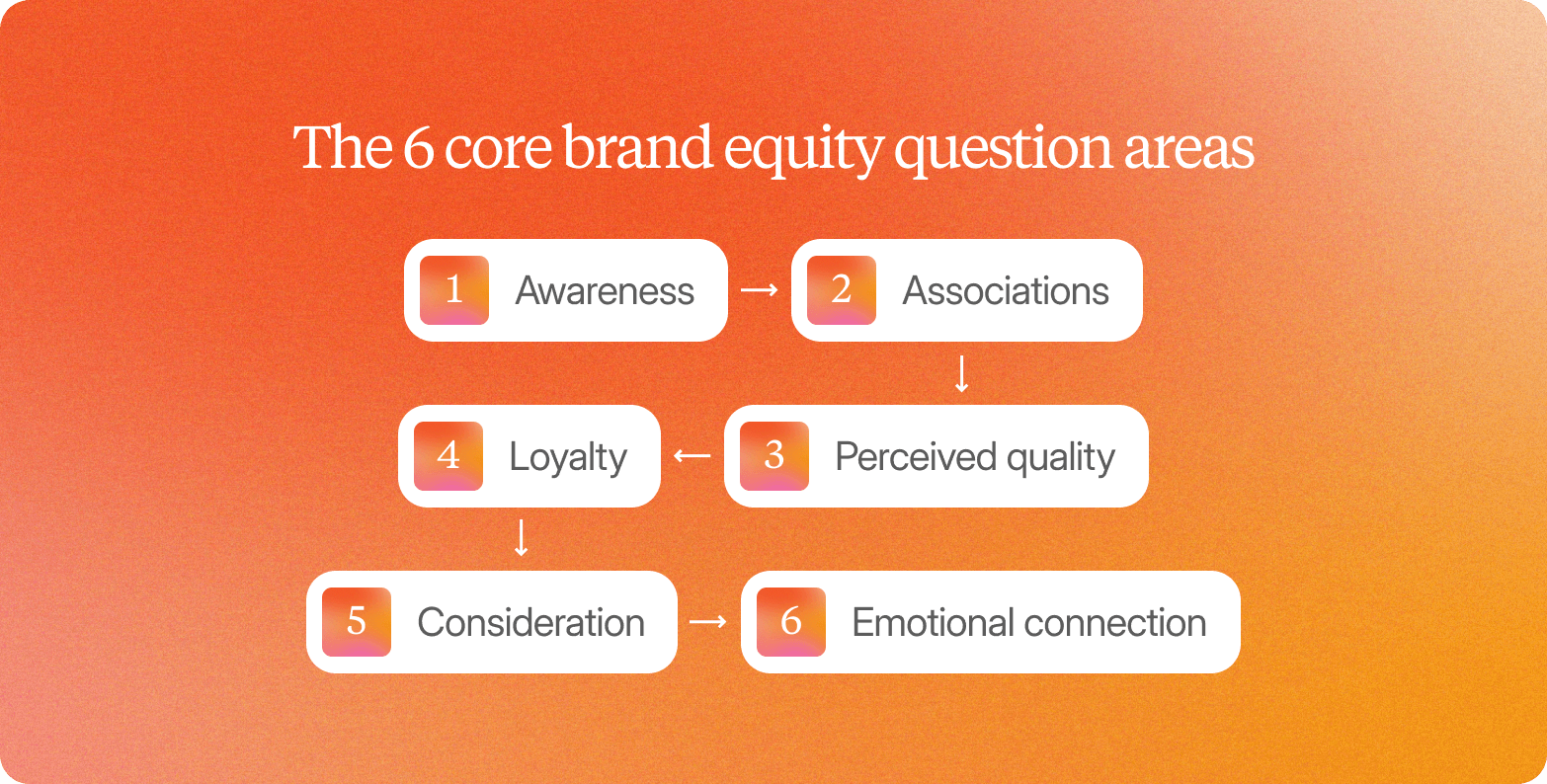
A well-designed set of brand equity survey questions does more than capture a snapshot. It creates a trendable record of how consumer perception shifts across waves, markets, and competitive contexts. The six dimensions below form the structural backbone of any brand equity questionnaire. Each targets a distinct layer of the equity construct, and each is vulnerable to a specific measurement error that can create false movement in your tracker if left uncorrected.
1. Awareness: establishing mental availability without priming
Core question: "When you think of [category], which brands come to mind first?"
Why it matters: Unaided awareness is the clearest proxy for mental availability, the degree to which a brand surfaces spontaneously when a purchase occasion arises. For teams managing brand architecture decisions or entering new markets, this metric establishes the baseline before any other equity dimension can be interpreted. A brand cannot be considered, preferred, or emotionally connected to if it is not recalled. This top-of-mind awareness, whether a brand is the first brand a consumer names unprompted, is the foundation the other five dimensions build on.
Common mistake: Asking aided recognition before unaided recall. Showing respondents a brand list before asking what they remember primes them with names they might not have generated independently, inflating awareness scores by 20 to 30 percentage points in some tracking programs. Unaided awareness must always precede aided recognition in the questionnaire sequence, with no exceptions across waves.
2. Associations: capturing consumer vocabulary, not internal messaging
Core question: "What words or feelings come to mind when you see this brand?"
Why it matters: Brand associations reveal whether the positioning a team has invested in is actually landing with consumers, or whether consumers have constructed a different meaning entirely. For teams navigating repositioning or portfolio rationalization, the gap between intended associations and actual consumer vocabulary is where strategic risk lives. This question also surfaces brand personality, the human traits and tone consumers project onto a brand, which is often invisible in closed-ended attribute lists.
Common mistake: Replacing open-ended prompts with closed-ended lists of attributes. When researchers hand respondents a pre-written list of attributes to rate, they are testing whether consumers recognize the brand's own language, not whether they generate it spontaneously. Open-ended association questions surface the words consumers actually use, which often differ substantially from internal messaging frameworks. That gap is the insight, and it's where valuable insights about how familiar consumers actually think and talk about a brand tend to surface.
3. Perceived quality: surfacing competitive drivers, not abstract ratings
Core question: "How does this brand compare to competitor brands in terms of quality, and why?"
Why it matters: Perceived quality is one of the strongest predictors of tolerance for price premiums and resistance to switching. Brands with high brand equity on this dimension can typically charge premium prices without triggering defection, because consumers perceive the premium as justified rather than opportunistic. But quality means different things in different categories:
Financial services: reliability and accuracy
CPG: ingredient integrity
Subscription or support-heavy businesses: service quality
Comparative framing forces respondents to articulate the specific dimensions on which they judge quality, giving brand teams actionable direction rather than a single score to report.
Common mistake: Using a single-item rating scale ("Rate this brand's quality from 1 to 10") without a follow-up probe. Aggregate scores mask the drivers. A brand can score 7.2 on quality across a 1,000-person sample while holding fundamentally different quality associations across age groups, usage occasions, or regional markets. The number tells you where you stand; the follow-up tells you why.
4. Loyalty: identifying defection conditions, not abstract commitment
Core question: "What would make you switch to a competitor?"
Why it matters: Abstract loyalty ratings ("How loyal are you to this brand?") consistently overstate behavioral commitment. Asking respondents to name the specific conditions under which they would defect surfaces the concrete triggers that actually drive churn: a price threshold crossed, a product failure repeated, a competitor innovation that closes a perceived gap. For teams managing brand health across a portfolio, this framing identifies which equity vulnerabilities are latent versus active. It's also where the gap between existing customers and satisfied customers becomes visible: satisfaction and true brand loyalty are not the same thing, and treating them as interchangeable is how tracking programs miss early churn signals.
Common mistake: Measuring loyalty solely by repurchase intent. Repurchase intent is a lagging indicator that reflects past behavior as much as future commitment. Teams that rely on it miss the early signals of erosion, the conditional loyalists who stay until a specific trigger is met. The switch-trigger question converts loyalty from a sentiment measure into a risk assessment, and gives brand teams a genuine way to retain customers before a competitor's offer closes the gap.
5. Consideration: revealing the barriers between awareness and choice
Core question: "How likely are you to consider this brand today, and what would change that?"
Why it matters: Consideration is the gap between being known and being chosen, and it's a useful lens for understanding brand preference among a defined target audience. A brand can hold strong unaided awareness while losing ground in consideration due to price perception, distribution gaps, or competitive alternatives that have closed the quality gap. Tracking consideration alongside awareness shows where a brand is leaking demand between recall and purchase, both among existing customers weighing a repeat purchase and non-customers evaluating the category for the first time. Consideration questions also help teams identify potential customers who know the brand but haven't yet been given a reason to choose it.
Common mistake: Treating consideration as a single yes/no measure without capturing the barrier. Knowing that consideration dropped four points is not actionable; knowing that it dropped because a competitor is now perceived as better value is. The paired "what would change that" probe turns a flat metric into a map of the specific obstacles standing between awareness and choice.
6. Emotional connection: measuring the bond that ratings scales miss
Core question: "If this brand were a person, how would you describe them, and how do you feel about them?"
Why it matters: Emotional connection predicts resilience. Brands that hold a genuine emotional bond retain consideration and loyalty through price increases, service lapses, and competitive pressure that would erode a purely functional relationship. It is also the dimension most often underweighted in trackers because it resists a clean numeric scale, even though it's often what a brand stands for in a consumer's mind more than any functional attribute does.
Common mistake: Reducing emotional connection to a Likert agreement statement ("I feel connected to this brand"). Consumers rarely hold their emotional associations in the language of a rating scale, so the score captures compliance with the statement rather than the feeling itself. Open-ended and projective probing surfaces the associations consumers hold but rarely articulate directly, which is where emotional equity actually lives, and where a brand's positive equity with a customer base is built or eroded over time.
Together, these six dimensions- awareness, associations, perceived quality, loyalty, consideration, and emotional connection- are the key components of any brand equity measurement program. They're also key metrics marketing teams can track over time to gauge overall brand performance, not just at a single point but across an entire tracking program.
3 design principles for trendable brand equity trackers
How you structure a brand equity questions survey matters as much as which questions you include. The design choices made at program launch determine whether you can trust the trend line three years later or are comparing numbers that were never truly comparable.
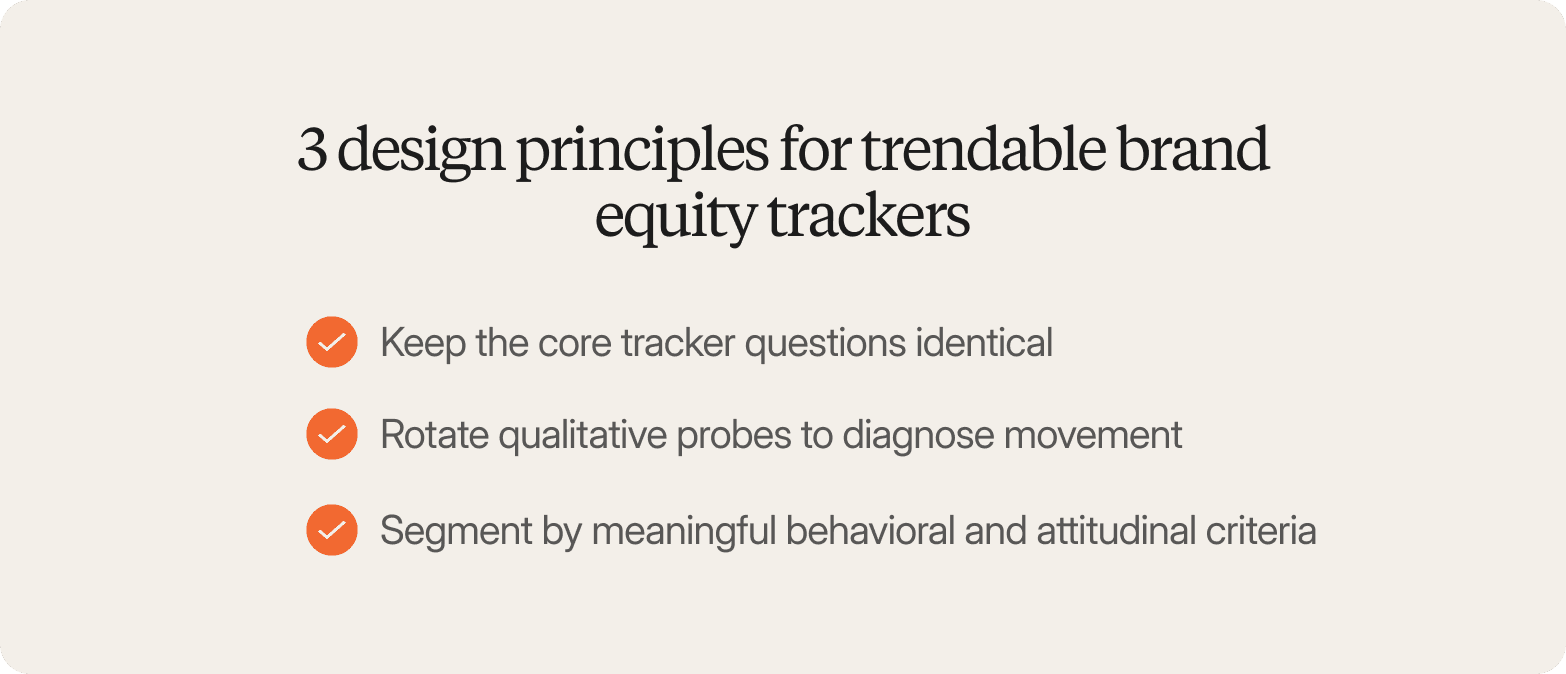
Three design rules are worth holding firm on, regardless of program maturity.
Keep the core tracker questions identical across all waves.
Not similar. Identical. Wording, scale anchors, and response options must be locked from the start. Changing a question mid-program breaks the trend line for that item entirely. Teams that have made this mistake report spending months debating whether a score shift reflects a real change in perception or an artifact of revised wording. That ambiguity is expensive and avoidable, and it undermines the marketing team's ability to track progress against branding efforts with any confidence.
Rotate qualitative probes to diagnose movement without touching the quantitative instrument.
When brand trust drops eight points between waves, the tracker tells you it happened; it cannot tell you why. Adaptive qualitative follow-ups, run alongside or shortly after each wave, provide the explanatory layer without contaminating trend data. The key is keeping probes modular so they can be swapped in response to what the tracker surfaces. Static survey formats that lock participants into fixed paths miss this entirely. When a participant signals hesitation or nuance, a rigid question sequence cannot follow. Platforms built for adaptive research, such as Conveo, can follow it in the moment.
Segment by meaningful behavioral and attitudinal criteria, not demographics alone.
Age and gender are easy to report but often poor predictors of perception movement. Category involvement, purchase recency, and brand relationship stage typically explain more variance than a target demographic defined solely by age bracket. The tradeoff is operational: behavioral segmentation requires richer participant profiling upfront, which adds complexity to recruitment and screener design.
The governance layer is where many programs lose credibility. Aggregated survey data without traceable participant responses creates a different kind of risk: stakeholders who distrust the findings or cannot defend them when challenged. Auditable brand equity claims require that every score can be linked back to real participant responses, with fraud filtering applied at intake and data-quality checks built into the analysis workflow. This traceability- every claim tied to a real, reviewable conversation- is a core part of how Conveo approaches brand equity research. Without that infrastructure, a favorable brand equity number is a number without a foundation.
Some brand teams also track net promoter score and market share alongside the six core dimensions (awareness, associations, perceived quality, loyalty, consideration, emotional connection). That's reasonable as a business-level backdrop, but neither metric substitutes for the diagnostic layer above: a brand can hold strong market share while brand equity erodes underneath it, and the switch-trigger and emotional-connection questions are often the first signal that a share number is about to move.
When survey questions aren't enough: The diagnostic gap
Brand equity trackers are built to detect change. When you are selecting survey questions for a brand equity project, the priority is consistency: the same wording, the same scale, the same cadence, so that a 10-point drop in trust registers cleanly against last quarter. That design strength is also the diagnostic ceiling. A tracker tells you something shifted. It cannot tell you why.
The failure point shows up in the response itself. A participant rates brand trust at 6 out of 10, then adds in an open-ended field: "I trust them, but not like I used to." That hedge carries real signal. It suggests an experience, a competitive encounter, or a shift in category that changed the relationship. But the survey script cannot follow up. The next question is already written, and the nuance disappears into a data point that looks like a six.
The timing problem compounds the gap. Agency-led qualitative brand equity work typically runs six to twelve weeks from brief to findings. Most teams absorb that cost by scheduling depth annually or biannually. When perception shifts mid-quarter, as it does during a competitor campaign, a pricing change, or a supply issue, the organization often makes decisions before any diagnostic research returns.
The resolution is not to abandon trackers, nor to run more focus groups; the timeline problem is the same either way. It is to pair trackers with faster qualitative methods that convert metric movement into explanation. Three question types do this reliably:
Behavioral questions ("What made you choose that brand over the others you considered?") reduce fabricated rationale and surface real decision criteria: just what actually drove the choice, not the tidied-up version a respondent offers on reflection.
Laddering questions ("What would it take for you to switch?") reach the underlying motivations that rating scales cannot access.
Projective questions ("If this brand were a person, how would you describe them?") draw out emotional associations consumers hold but rarely articulate directly, getting closer to what's actually in consumers' minds than a rating scale ever can.
Together, these question types create a diagnostic layer that sits alongside the tracker without disrupting its longitudinal structure, providing brand and marketing teams with deeper insights than a tracker wave can produce on its own.
4 common brand equity survey mistakes and how to avoid them
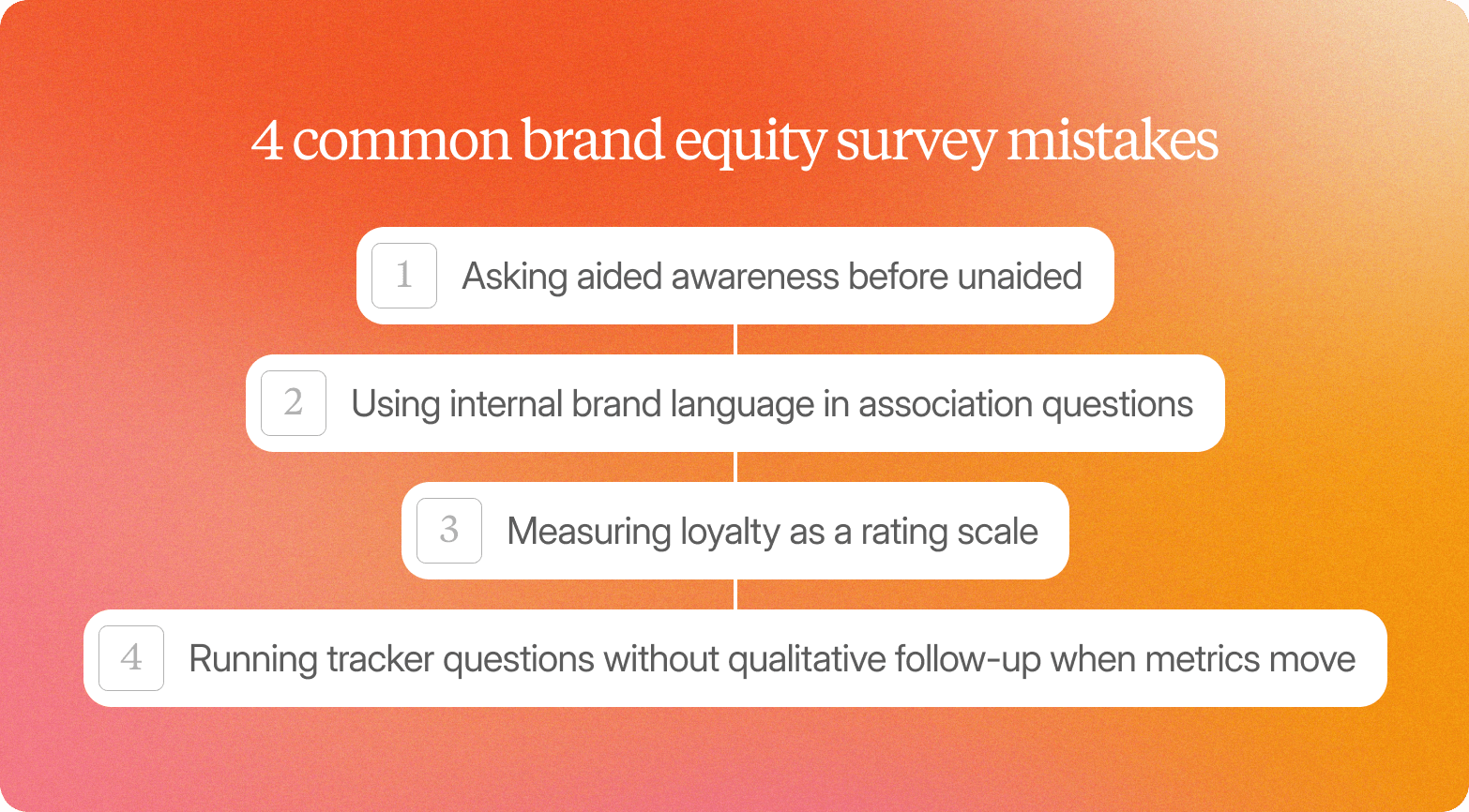
The difference between a brand equity tracker that drives decisions and one that produces noise often comes down to question design. Poorly worded or sequenced brand equity survey questions don't just introduce measurement error: they create false movement across tracking waves, leading teams to act on shifts that were never real. The four failure modes below are well established in research methodology.
Failure mode 1: Asking aided awareness before unaided
When respondents see a brand name on a list before being asked which brands they recall spontaneously, the list primes their memory. Unaided recall scores inflate, and what appears to be growing mental availability may reflect the order of questions. The diagnostic signal: if unaided scores rise sharply without a corresponding shift in media spend or market presence, check whether question sequencing changed between waves. The correction is structural: unaided questions always run first, aided questions always follow.
Failure mode 2: Using internal brand language in association questions
When association prompts include the brand's own positioning language ("innovative," "trusted partner," "category leader"), responses mirror the brand's messaging rather than consumers' actual mental models. The distortion is subtle: scores look healthy because the language was chosen to resonate, not because it reflects unprompted consumer perception. The correction is to use open-ended association questions before any prompted list, and to build prompted lists from consumer language gathered in prior qualitative work rather than from brand strategy decks.
Failure mode 3: Measuring loyalty as a rating scale
A five-point loyalty scale produces high scores in categories where switching is low-effort but infrequent. Respondents rate themselves as committed because they haven't switched, not because they are genuinely anchored to the brand. The more predictive approach asks what would cause them to switch: a price threshold, a competitor offer, a service failure. That question surfaces latent vulnerability that a rating scale consistently masks, and it's a more honest read on customer loyalty than a five-point scale can offer.
Failure mode 4: Running tracker questions without qualitative follow-up when metrics move
A tracker can show that consideration dropped by 4 points between Q2 and Q3. It cannot tell you why. Teams that treat the metric shift as the finding and brief against it, without qualitative investigation, risk responding to the wrong cause and mistaking noise for meaningful differentiation from a competitor. The correction is to treat unexpected metric movement as a trigger for a focused qualitative study rather than as a standalone signal.
Failure mode | Distortion created | Correction required |
Aided before unaided | Inflated unaided recall scores | Always sequence unaided first |
Internal language in association prompts | Responses reflect brand messaging, not consumer perception | Build prompts from consumer language, not strategy docs |
Loyalty as a rating scale | Overestimates commitment, masks switching risk | Ask switch triggers, not satisfaction ratings |
No qualitative follow-up on metric movement | Cause of shift remains unknown | Use metric change as a trigger for qualitative investigation |
Poorly worded or unbalanced survey questions can distort brand perception results and create false movement in tracking waves.
Closing the explanation gap with Conveo
Brand equity survey questions give you the numbers. They tell you that familiarity dropped four points in Q3, that purchase intent is softer among 35- to 44-year-olds, or that your quality perception score trails a competitor by a meaningful margin. What they cannot tell you is why any of that happened, or what to do about it.
Conveo, a video-first AI research platform, closes that gap by following the participant rather than the script. When someone hesitates before rating your brand on trustworthiness, Conveo's AI moderator notices and probes. When a participant uses an unexpected word to describe a competitor, it follows that thread. The result is diagnostic depth a fixed survey path cannot produce, delivered at a pace traditional moderation and traditional focus groups cannot match.
"It picks up on the nuances a survey never could"
— CMI Lead, Edgard & Cooper
Because sessions run asynchronously, teams can run conversations in parallel, with analysis beginning as recordings land rather than after a moderator has finished a two-week field schedule. Multilingual studies across 20+ languages add no scheduling overhead: transcription and translation happen automatically, making cross-market brand perception work tractable for a small insights team. And because every finding is a real conversation with a real participant, traceable back to video, the diagnosis holds up when a stakeholder challenges it, whether that stakeholder sits on the marketing team, in the C-suite, or on the board.
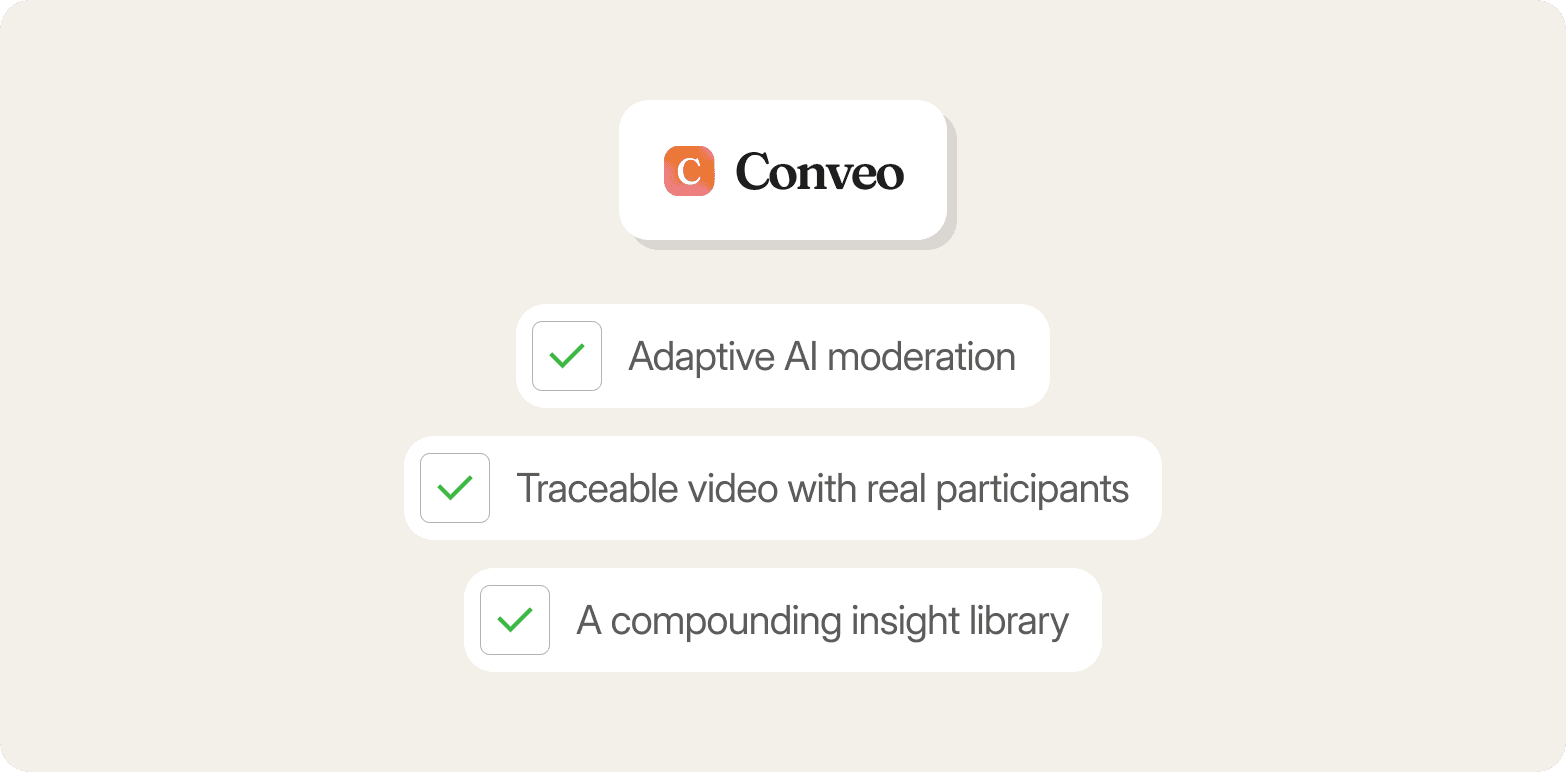
Three capabilities matter most for brand-equity diagnostics:
Adaptive AI moderation that probes hesitation and unexpected language in the moment, along dimensions that trackers leave unexplained.
Traceable video with real participants recruited through Conveo's integrated panel network or your own list, so no score is a number without a foundation.
A compounding insight library where each wave's qualitative findings inform the next, building brand understanding that deepens over time rather than resetting each quarter, and helping teams build brand equity deliberately instead of just measuring it after the fact.
See it in action: How AI-Moderated Interviews Work →
This is not a replacement for your tracker. It is the diagnostic layer that makes tracker data actionable in 3 to 5 days, rather than the 6 to 12 weeks a traditional qualitative study takes, and it's how brand teams turn survey data into strategic partnerships with the rest of the business, rather than a quarterly reporting exercise.
Frequently Asked Questions
What are the best brand equity survey questions?
How do you measure brand equity with survey questions?
Are brand equity survey questions PDF templates reliable for research design?
How should I use a brand perception survey questionnaire?
How often should brand equity surveys be run?
What's the difference between brand awareness and brand equity survey questions?