
TL;DR
Scripted questions often lead to shallow answers because they can’t explore unexpected responses or ask why someone feels a certain way.
This guide includes more than 15 examples of qualitative research questions across five common use cases. It also shows how to improve weak questions with practical before-and-after examples.
You'll see how Conveo's AI moderator follows up on participant responses in real time and turns interviews into evidence that teams can review and share, without waiting weeks for agency-led research.
The quality of any qualitative market research study traces back to one place: question design. Example research questions for qualitative research are easy to find online. But most of them were written for academic studies or general consumer surveys, which makes them a poor fit for enterprise teams.
The examples below will help you write stronger interview guides and get more useful answers from participants. You'll also see how AI moderation can build on good question design by exploring responses in more depth and uncovering insights that scripted interviews often miss.
What Are Qualitative Research Questions?
Qualitative research questions are open-ended questions that help you understand why people think, feel, and behave the way they do. They encourage participants to describe experiences in their own words, unlike quantitative research questions, which usually involve selecting from multiple-choice answers or assigning a score to a statement.
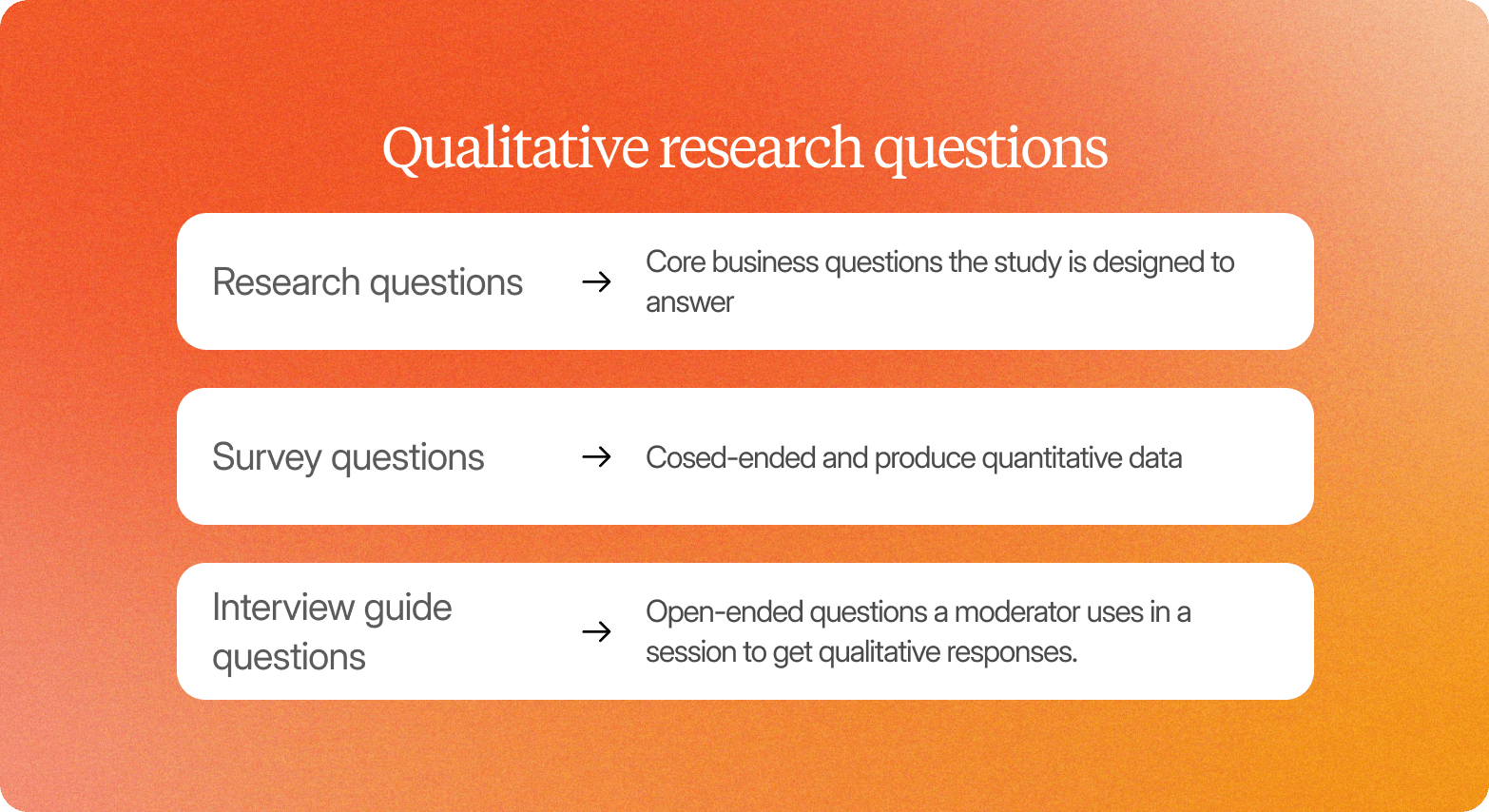
Before looking at examples of qualitative survey questions, it's important to separate three terms that are often used interchangeably:
Research questions are the core business questions the study is designed to answer. They operate at the strategy level, for example, "Why did brand consideration drop among 25-34s?" or "What's driving churn in the enterprise segment?"
Survey questions are closed-ended and produce quantitative data, for example, “How likely are you to recommend our product to a colleague?” rated on a scale from 0 to 10.
Interview guide questions are open-ended questions a moderator uses in a session to get qualitative responses. These are the questions this guide focuses on.
Confusing these question types in your survey, interview, or focus group results in respondents answering the wrong question or generating findings no one can act on.
When to Use Qualitative Research Questions vs. Quantitative
Qualitative questions aren’t better or worse than quantitative questions. The best method depends on your research objectives and the research topic. Here are four scenarios where qualitative questions are the right choice.
Scenario | What quantitative research gives you | What qualitative research adds |
Concept testing before a product launch | Quantitative survey questions give you a score or rating for the concept. | A conversation shows how people react to the idea, what it reminds them of, and what would need to change for them to trust it. Ratings alone don’t explain why someone gave a specific score. |
Understanding why a brand metric dropped | A tracking study shows that the metric has gone down. | Interviews help explain what personal experiences or changes in perception caused the drop. |
Exploring unintended competitor associations | A survey can only measure what it asks about directly. | Open conversations reveal unexpected brand associations that wouldn’t appear in fixed answer choices or numerical data. |
Mapping the emotional arc of a purchasing decision | A survey can capture a decision or preference. | A discussion shows the emotions behind the decision, such as hesitation or confidence, and how those shift over time. |
The next step is turning your research objectives into descriptive questions that encourage respondents to share meaningful, detailed responses.
How to Write Effective Qualitative Research Questions That Produce Stakeholder-Ready Evidence
There are six core principles to writing good qualitative research questions:
Principle | Explanation | Weak question | Strong question |
Avoid leading language | Questions shouldn’t suggest the “right” answer, because this can shape what participants say. | “What did you find most innovative about this concept?” | “What’s your first reaction to this concept?” |
Avoid double-barreled questions | Each question should focus on one idea only. Asking two things at once leads to unclear answers. | “How clear was the messaging, and did it make you more likely to purchase?” | Split into two questions: one on clarity and one on purchase likelihood. |
Keep questions within a realistic scope | Questions should be specific enough to answer in a single session. Broad questions produce vague responses. | “Tell me about your relationship with this brand.” | “Tell me about the last time you used this brand.” |
Design for traceable evidence | Questions should make it easy to connect answers to specific moments or feelings, leading to more meaningful responses. | “Why do you feel this way about the product?” | “Can you walk me through what led you to feel that way?” |
Align each question to a business decision | Each question should connect clearly to a decision the business needs to make. If it doesn’t, it won’t be useful. | “What do you think of this feature?” | “Would this feature make you more likely to choose this product over alternatives?” |
Leave room for unexpected answers | Guides should allow space for participants to raise topics you didn’t anticipate. | “Which of these issues matters most to you?” | “What stood out to you in this experience?” |
Applied together, these principles shape clearer, more focused answers to qualitative research questions. This makes the findings easier to interpret and present to stakeholders when making business decisions.
15 Enterprise Qualitative Research Question Examples by Use Case
This section provides practical examples of qualitative research survey questions across common enterprise use cases. Each can serve as a starting point for building interview guides for real research projects.
1. Concept Testing Questions
Concept testing is used before launch to understand early reactions to a new idea. The central research questions are: what does this concept mean to participants, and what kind of emotional or functional response does it create?
Here are some follow-up qualitative survey questions you might use to dive deeper into customer responses:
Walk me through your first reaction to this concept. What did you notice first?"
Reactions give you more specific insights into early confusion or interest in a concept than asking if someone liked it.
"What, if anything, does this remind you of? A product you already use, a brand, an experience?"
This shows what mental “bucket” the concept lands in. If it maps to the wrong competitor or category, positioning problems usually show up here first.
"What would need to be different for you to trust this?"
This surfaces blockers to adoption. The answers often translate directly into product or pricing changes.
Compare these examples of qualitative research questions for interviews to a static scripted question. A static question might ask participants to rate the concept on a scale of 1 to 5. That tells you a score, but not whether a low rating reflects confusion or a pricing concern, which is exactly what the questions above are designed to surface.
"The AI doesn't just summarize, it surfaces patterns I wouldn't have spotted reading transcripts."
- CMI Lead, Edgard & Cooper
2. Brand Positioning Questions
Brand positioning research is run to understand how people perceive a brand when they're not in buying mode. The key questions are: how do people describe and think about our brand, and does that match what we want to communicate?
These follow-up qualitative survey question examples help you understand how consumers see you:
"If this brand were a person, how would you describe them to a friend?"
People find it easier to describe personalities than abstract brand attributes and may give you more specific answers.
"When did you last think about this brand outside of a purchase moment? What prompted it?"
This is a good way to gauge your brand's strength and whether you need to invest in awareness campaigns or rethink your branding.
"What do you think this brand would never do?"
If the limits participants offer are too narrow or wrong, it can signal a need to expand or correct your positioning in the market.
3. UX Discovery Questions
UX discovery research helps teams understand how people currently complete tasks and what they’d expect from a product. The central questions are: what are users trying to achieve, and what's getting in their way?
Sample questions for qualitative research worth asking are:
"Walk me through how you currently handle this. What does that process look like from start to finish?"
This maps the existing workflow before and prevents wasted time from assuming what users need.
"Where does your current process break down, and what impact does that have on your work?"
This helps you identify the highest friction points for feature prioritization and product messaging.
"What would a significantly better version of this process look like to you?"
Allowing participants to talk freely helps uncover unmet needs without leading them towards a specific solution.
You can see how the qualitative survey questions sample here could impact high-stakes product decisions. For UX discovery, the static version would typically be something like: "Which tools do you currently use for X?" with a fixed list of options. It tells you what tools exist in the market, but nothing about how people really use them or why they fall short.
4. Ad Testing Questions
Ad testing research helps you understand how audiences interpret and respond to marketing creative before you commit significant budget. The research questions are: what message are people taking away from this ad, and is it the message we intended?
Here are some examples of open-ended questions for qualitative research to explore audience reactions:
"What do you think this ad is trying to tell you?"
If participants consistently interpret the message differently, it suggests you may need to revise the creative before launch.
"Which part of the ad stood out most to you, and why?"
Teams can use what people notice most to strengthen other creative assets and remove distractions.
"After seeing this ad, what would you expect from the product or brand?"
The answers can help prevent messaging that attracts attention but leads to disappointment later in the customer journey.
5. Packaging Research Questions
Packaging research tests whether a design is sending the right signals at the point of purchase. The questions at the center are: what signals does the packaging send, and are they the right ones?
Examples of qualitative questions for research include:
"What kind of product would you expect to find inside this package?"
When expectations don't match what's inside, shoppers feel misled and may not repurchase.
"What does this packaging suggest about the quality of the product?"
This is how you find out whether the design supports or undermines a higher price.
"If you saw this on a shelf next to competitors, what would make you pick it up or pass it by?"
What draws attention on the shelf can be different from what designers expected, and helps make more informed decisions about the aesthetic.
How to Spot Weak Qualitative Questions (and How to Fix Them)
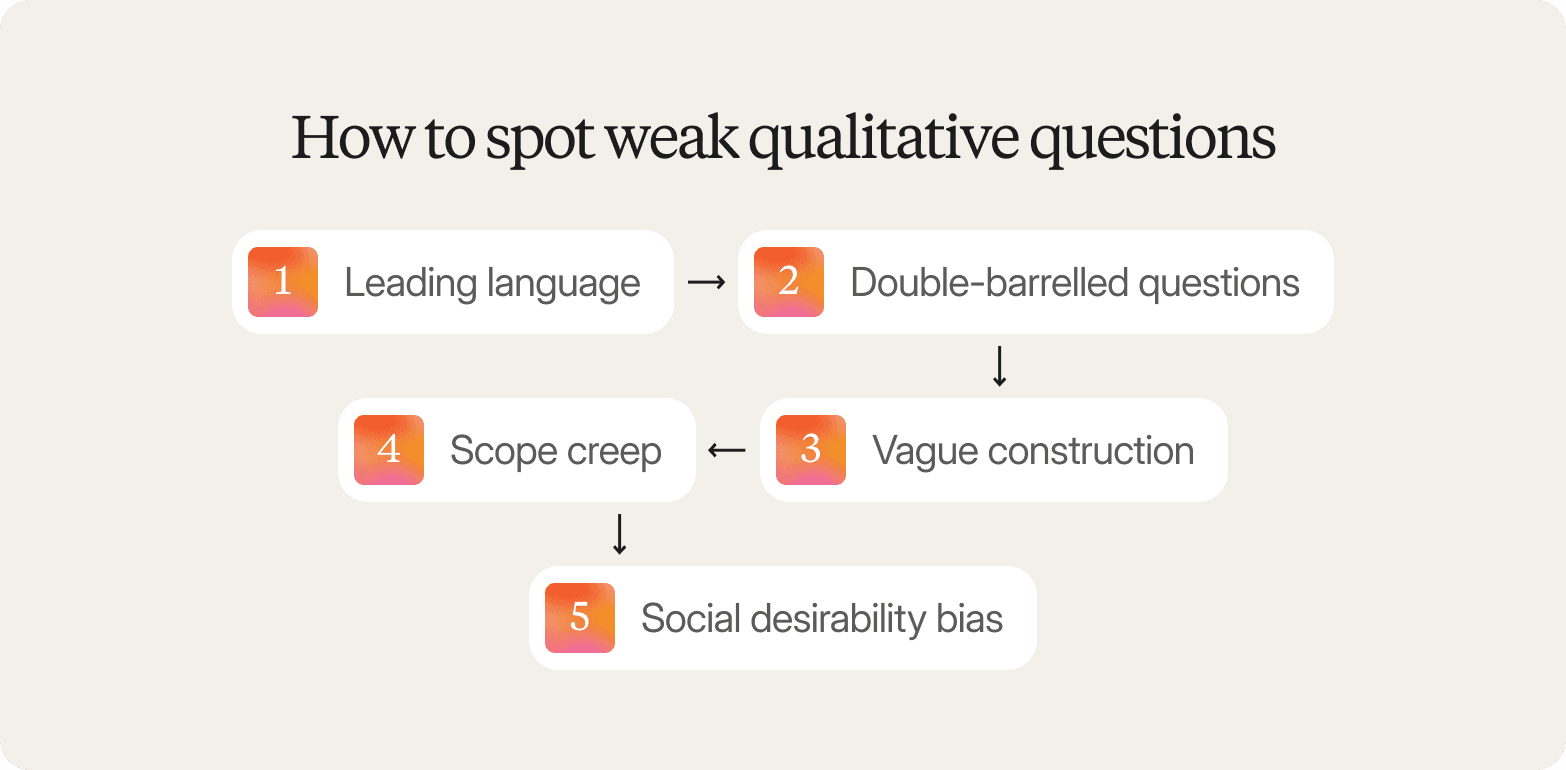
If you’re not getting the deeper insights you expected from your qualitative research survey questions, they’re likely falling into one of the following traps.
1. Leading Language
A leading question suggests the answer before the participant gives it. The response is unreliable because you don’t know whether the answer genuinely reflects the participant's feelings or if the question’s wording influenced their answer.
╳ "What did you find most useful about this specific feature?"
This assumes the feature was useful, even if the participant didn't think it was.
✓ "How did you use this feature, if at all?"
The phrase "if at all" makes it clear that not using the feature is also a valid answer.
2. Double-Barrelled Questions
A double-barreled question asks two things at once. Participants will often answer only one question, so you don’t get as detailed insights as you could have.
╳ "Was the messaging clear, and did it change how you feel about the brand?"
A "yes" answer doesn't tell you whether they're talking about the messaging, the brand, or both.
✓ Ask about message clarity first, then ask about brand impact separately.
This gives you a clear answer to each question.
3. Vague Construction
A vague question doesn't give participants a clear point of reference. Without a specific situation to focus on, people tend to answer in general terms that are hard to turn into findings.
╳ "Tell me about your experience with this product."
Participants often give a general overview without discussing specific events or behaviors.
✓ "Walk me through the last time you used this product. What were you trying to do?"
Focusing on a specific moment usually leads to more detailed answers.
4. Scope Creep
Broad questions ask participants to cover more than they can reasonably explain in a single answer. Even when they understand the question, they often skip over details or jump between topics.
╳ "Tell me about your relationship with this category."
This could cover years of experience and purchases.
✓ "Think about the last purchase you made in this category. What drove that decision?"
The participant has a specific event to talk about, which makes the answer easier to analyze.
5. Social Desirability Bias
Some questions invite participants to give the answer that makes them look good rather than the one that reflects reality. Questions about recommending something or trying something new are especially prone to this.
╳ "Would you be comfortable sharing this product with your team?"
Many people will say yes because it feels like the socially acceptable answer.
✓ "Imagine a colleague asks about this product. What would you tell them?"
This focuses on a realistic situation and often produces a more honest response.
From Research Questions to Interview Guides to Stakeholder Outputs
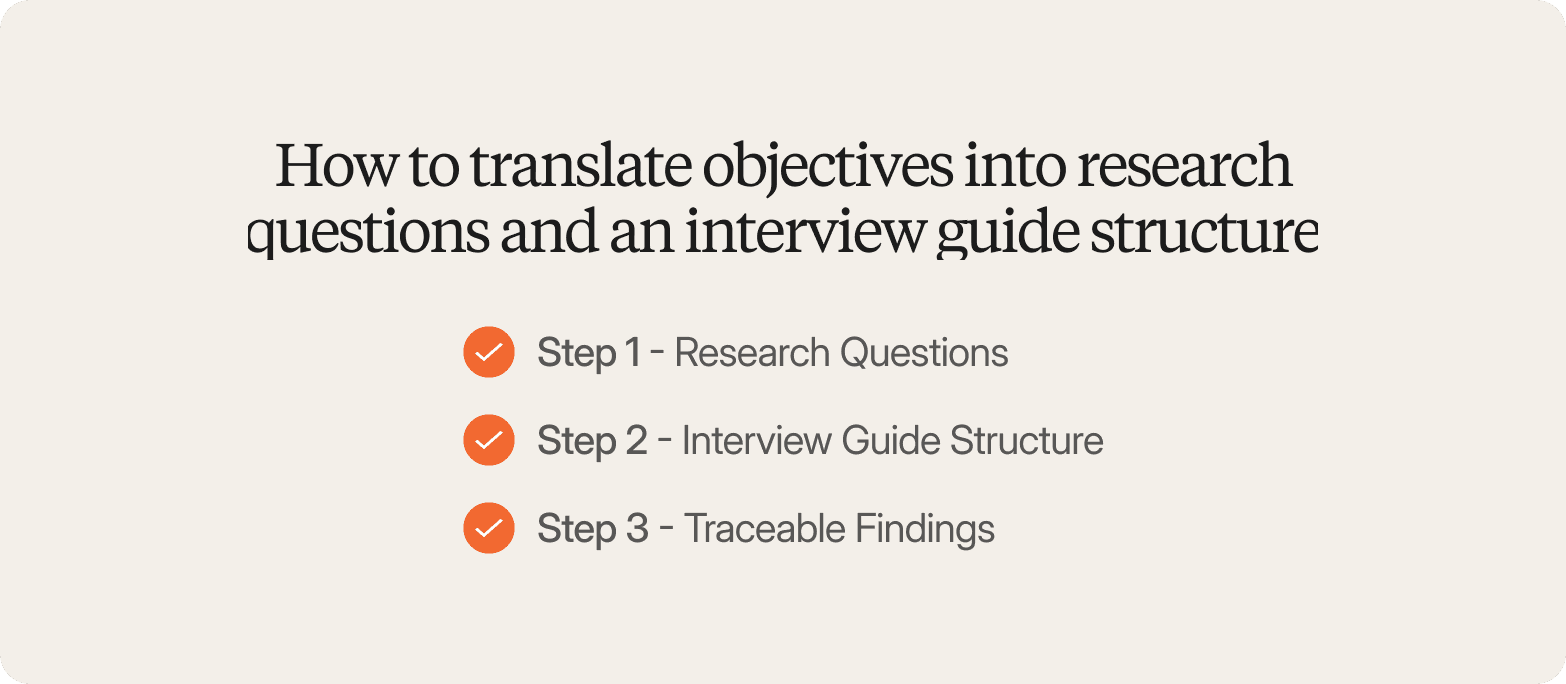
Say your current business objective is to understand why brand consideration among decision-makers aged 25 to 35 dropped 8 percentage points in Q1. Here's how you could translate that business objective into research questions and an interview guide structure into findings a CMO can act on.
Step 1: Research Questions
A research question for a qualitative study translates the business objective into what you need to find out. They’re for internal use, not to ask participants. In this instance, example questions might be:
What changed in how this segment perceives the brand's relevance to their work?
What competitive alternatives are they now considering, and why?
These questions point to two separate causes worth investigating: an internal cause related to the brand and an external cause related to competitors.
Step 2: Interview Guide Structure
The interview guide turns the research questions into a structured conversation to run with participants. It’s not a script of exact questions, but rather a suggested flow that ensures each particular topic gets covered. This guide might be organized into sections like:
Context setting and recent decision-making. Start by getting a clear understanding of when and how participants last considered solutions in this category.
Brand perception and relevance. Explore how participants currently see the brand, what it means to them, and whether it still fits their needs or expectations.
Competitive set and alternatives. Understand what other options come to mind first and what is driving those choices. This helps surface shifts in the consideration set.
Drivers of change. Focus on what has changed since they last engaged with the category. This is where you connect back to the drop in consideration and uncover possible causes.
Within each section, the moderator uses open-ended questions to conduct qualitative research and follows up on participants' responses. If someone mentions switching attention to a competitor, the interviewer might ask additional questions about the competitor’s perceived benefits rather than move straight to the next question.
Step 3: Traceable Findings
Traceable findings connect every insight back to the exact participant moment it came from. In this example, the output wouldn't be a generic summary that "brand perception has declined." It would be specific information backed by evidence from the qualitative survey responses or interviews. This might look like:
A small number of themes explain the drop in consideration, such as "competitors now feel more relevant to current needs" or "pricing no longer matches perceived value."
For each theme, direct links to video clips show the exact moments where participants expressed that view.
Supporting quotes from the interview transcript capture the language customers used rather than paraphrased interpretations.
A CMO can open the source clips and hear the reasoning in participants' own words to assess how strong each finding is, without having to read a 40-slide deck.
Why Good Question Design Isn’t Enough at Scale
Strong research questions are the foundation of all good qualitative data, but once you're running dozens of studies across multiple markets, human-moderated research hits practical limits.
Recruiting participants across time zones and manually arranging hundreds of session places a ceiling on how much research a team can run. AI-moderated qualitative research using a platform like Conveo removes that ceiling. Here's how the two research methods compare in practice:
Criteria | Human-moderated interviews | Conveo |
Stakeholder trust | Findings are based on a moderator's notes and interpretation of what participants said. Stakeholders usually have to trust the summary rather than review the original response themselves. | Every finding links back to the original video. Stakeholders can watch the exact moment that supports a finding and judge the evidence for themselves. |
Depth of response | Moderators usually work from a discussion guide. When participants raise an unexpected point, there is not always time to explore it in detail. | The AI follows up based on what each participant says, allowing it to explore unexpected topics and gather more details. |
Scale and reach | Running studies across multiple countries often requires different moderators, translators, and schedules for each market. | Teams can run hundreds of interviews simultaneously across more than 50 languages without coordinating separate moderator teams. |
Turnaround time | Studies often take several weeks to complete, including recruitment, conducting qualitative research, qualitative analysis, and reporting. | Findings are available in days, with themes linked directly to supporting participant responses and video clips. |
How Conveo Turns Research Questions Into Stakeholder-Ready Evidence
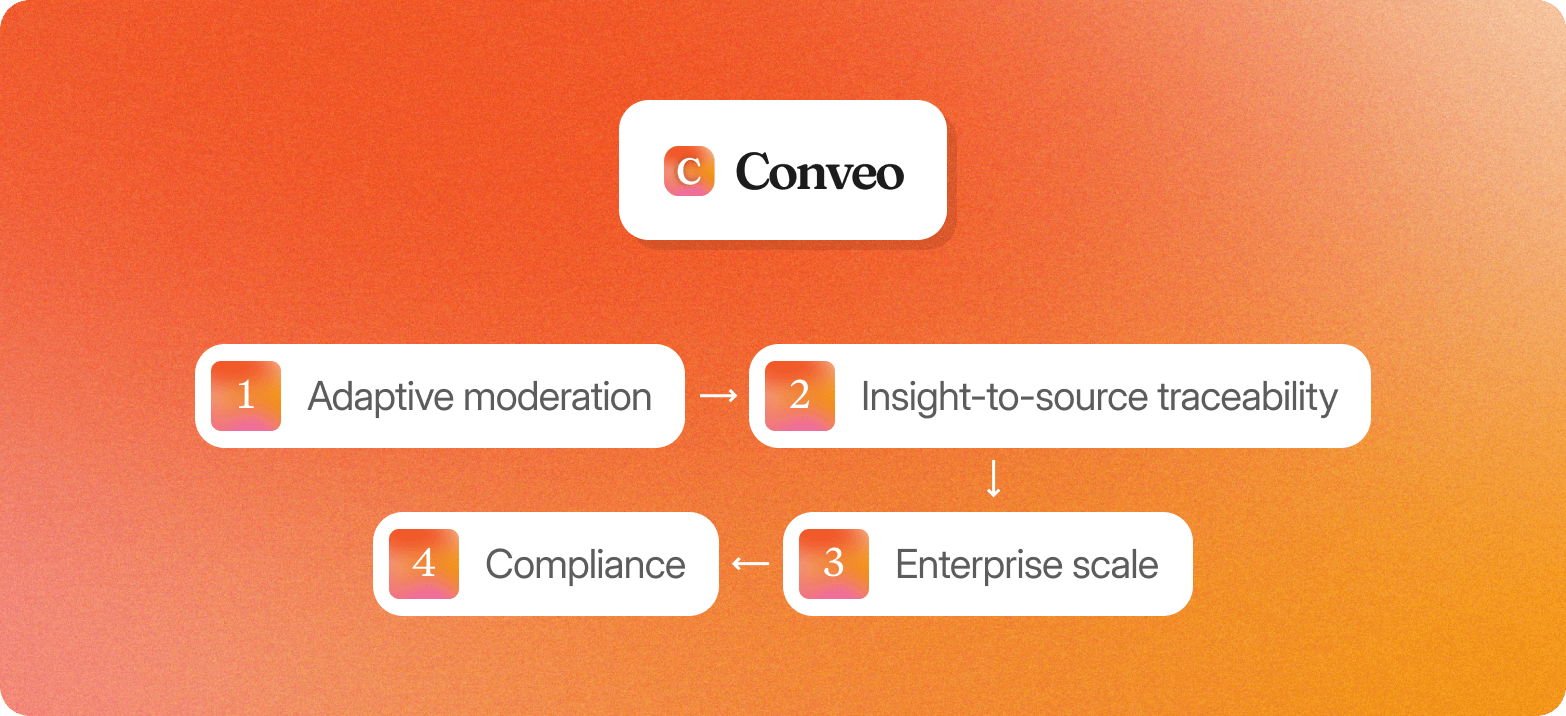
Everything in this article starts with one idea: the quality of qualitative research depends on the quality of the questions being asked. But question design alone is not enough. What matters just as much is how those questions are explored in live conversations and turned into evidence that stakeholders can trust.
This is where Conveo changes the workflow.
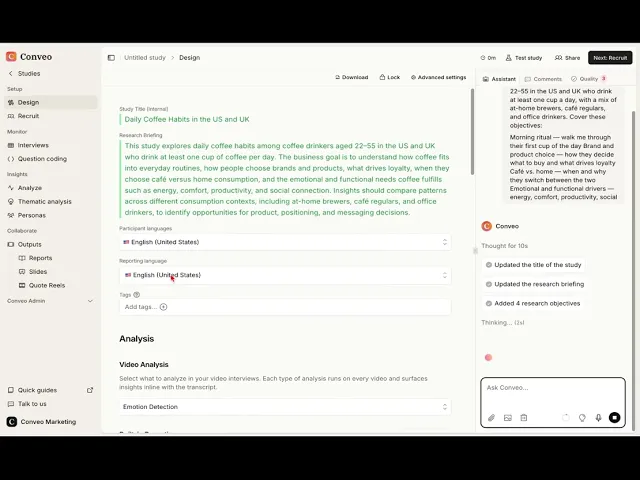
Discover how to build study from scratch on Conveo:
Adaptive Moderation
Conveo's AI moderator doesn't follow a static script. It adapts its questions based on what each participant actually says, adjusting depth and direction in real time. A participant who hesitates before answering receives a follow-up that addresses the hesitation, not the next item in the script. That's how a well-designed research question converts into evidence rather than just a response.
Insight-to-Source Traceability
Every finding in Conveo links back to the exact moment in the original video. Stakeholders can see the response, not just read a summary of it. This creates a direct line from the research question to the participant's answer to the final insight, which increases trust in the findings.
Enterprise Scale
Teams at hundreds of organizations, including Google and Bosch, use Conveo to run this kind of adaptive research across more than 50 languages. This allows research that starts with carefully designed questions to scale across markets without losing depth or consistency.
Compliance
For enterprise procurement teams, Conveo is SOC 2-certified, GDPR-compliant, and offers a choice of data hosting locations. This ensures research can move from question design to execution without extra security friction.
Frequently Asked Questions
What is the difference between qualitative and quantitative research questions?
What are some examples of qualitative survey questions for enterprise research?
How do you write a qualitative research question that produces actionable findings?
What is a sample questionnaire for qualitative research?
How do you design qualitative research questions for multilingual studies?
What is the difference between a research question and a discussion guide question in qualitative research?