In this article
TL;DR
Most competitive intelligence programs track what competitors do but cannot explain why customers choose them. Closing that gap is the point of this guide to competitive intelligence: qualitative depth that arrives while decisions are still open.
Pair scale methods with depth interviews to capture decision reasoning. Surveys show what customers prefer; interviews show why.
Build behavioral segment criteria before recruiting. Demographic filters miss how buyers actually decide, and direct and indirect competitors get evaluated on different logic.
Probe for institutional blockers (legal, IT, procurement friction), not just feature gaps.
Use adaptive probing to follow contradictions as they surface. Fixed-question methods smooth over the moments that reveal competitive perception.
Triangulate interview findings with behavioral data so competitive claims carry evidentiary weight.
Build a searchable, compounding insight library so findings do not die in a one-time deck. Conveo's searchable insight library connects findings across projects and ensures nothing gets researched twice.
Run an always-on competitive program with continuous waves rather than ad hoc research or quarterly commissions. Conveo StoryLines supports a bi-weekly or monthly cadence with themes tracked across waves.
Competitive intelligence refers to the operational frameworks teams use to monitor, analyze, and act on competitor activity, and competitive intelligence best practices are what separate programs that inform business strategy from programs that just generate reports. Most programs do exactly the latter: they track pricing changes, catalog feature releases, and flag when a rival launches into a new segment. What they cannot tell you is why a customer who considered your product chose a competitor instead, or what hesitation surfaced in the final stages of that decision.
The core problem is decision-lag. Research that arrives six weeks after the decision has closed might as well never have happened. The common response is to commission qualitative market research: a round of depth interviews or focus groups designed to get at the reasoning behind competitive perceptions. That instinct is right. The execution problem is timing. Get the timing right, and the payoff is a real competitive advantage and a genuine competitive edge in decision making. Get it wrong, and even accurate market trends data arrives too late to change anything.
When traditional agency-led research takes weeks to deliver, the positioning decision has been made, and the competitive insight is useful only for the next cycle. Teams report findings arriving in days rather than months when shifting to AI-moderated video interviews, while the competitive context was still live.
"The pace, responsiveness, and research expertise of the Conveo team, on top of the top AI-moderated qual platform, has been invaluable to us in scaling brand advertising internationally."
Matt Harris, Research & Insights Lead, EMEA, Canva
The best competitive intelligence practices close the distance between what competitors claim and what customers actually experience in a real purchase decision. That requires qualitative depth: the ability to follow a hesitation, surface a contradiction, and understand the reasoning behind a stated preference, while strategic decisions are still open.
Why traditional competitive intelligence methods miss the customer perspective
Monitoring across social media platforms can show that sentiment shifted after a competitor's product launch. A survey can confirm that brand awareness dropped three points. Neither can tell you why a customer who considered your product chose someone else instead, or how they actually interpreted your competitor's positioning claims in practice.
Desk research compounds the problem. Analyst reports, press releases, and competitor websites tell you what competitors say about themselves, and most competitive analysis stops right there, at the claim rather than the customer's reaction to it. This is standard competitive intelligence software territory: dashboards that collect data on competitors' moves without ever explaining how customers respond.
Social media monitoring captures sentiment at scale, but sentiment without reasoning is directional at best. A spike in negative mentions tells you something went wrong. It leaves open what a customer tried first, or what specific claim made them trust a competitor over you. That reasoning lives in the moment of deliberation, and accessing it requires depth interviews that probe for decision logic rather than another dashboard of competitive data.
The operational challenge is that traditional qualitative research often takes weeks to months from brief to findings. Competitive and industry dynamics do not remain still for long. A competitor launches a new campaign, announces a pricing change, and by the time the research comes back, the strategic decisions it was meant to inform are already locked in.
That gap is what forces the operational shift. Competitive intelligence efforts cannot rely on annual persona refreshes or quarterly ad hoc research. Continuous qualitative loops, running close to real decision points, are what keep competitive understanding current and industry trends visible as they emerge across a fast-moving competitive landscape. This is a strategic management problem: shifting market dynamics and a shifting business environment punish any team still working from a snapshot taken months ago.
8 competitive intelligence best practices for research-led teams
Most competitive intelligence programs stop at the competitor. They track pricing changes, monitor feature releases, and flag new messaging. What they rarely do is explain why customers are making the choices they are, which is the only form of competitive understanding that actually changes a roadmap or positioning decision.
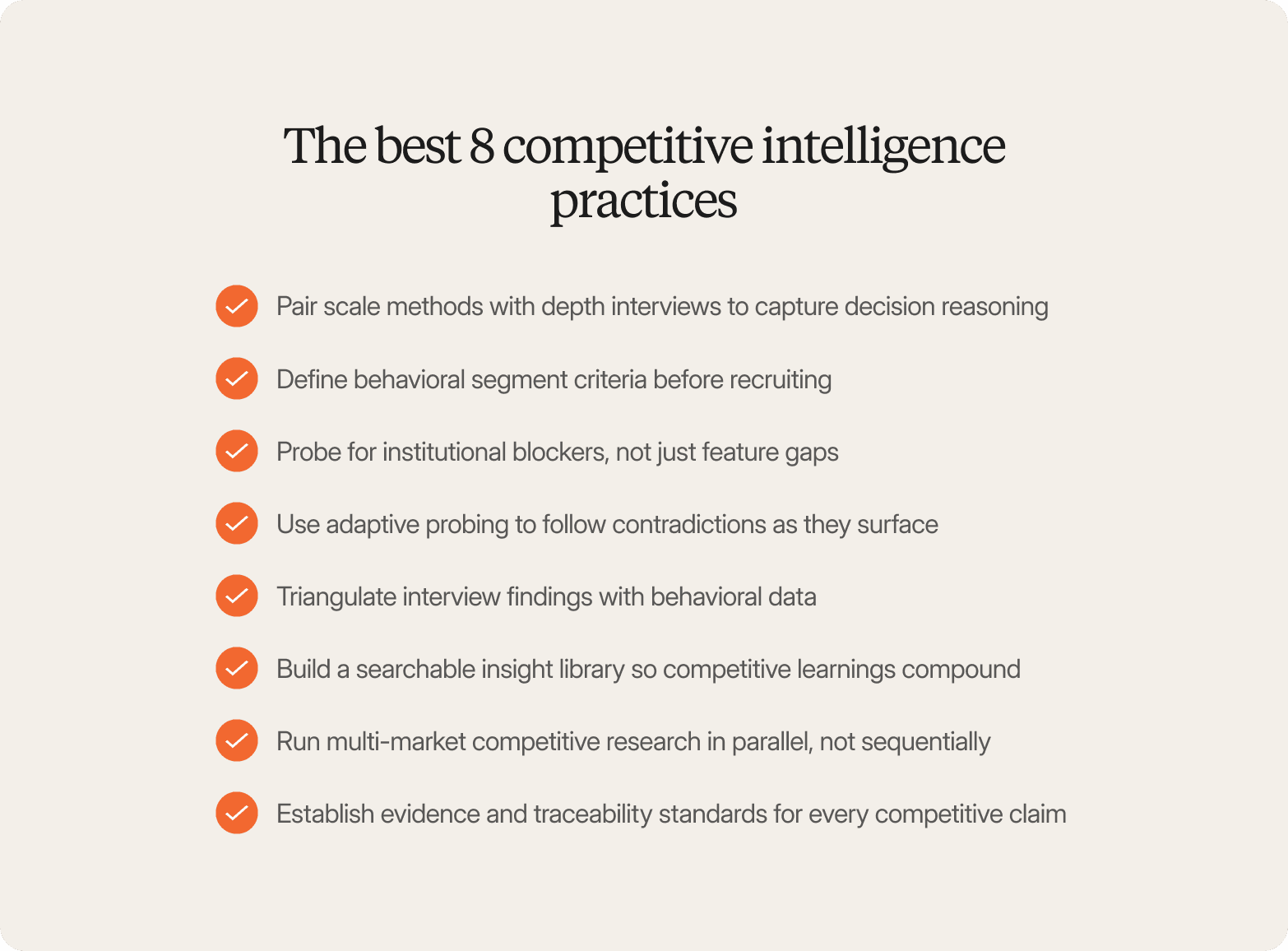
The eight practices below serve as a guide to competitive intelligence for teams that want to move beyond monitoring and generic competitive intelligence tools. Each one shows how competitive intelligence connects competitor activity to the customer reasoning behind it, and each includes a specific deliverable so teams know what they're building toward. Together they form a working set of intelligence tools, not a single dashboard of market intelligence. This is an operational playbook for insights professionals, CMI leads, and consumer researchers who conduct competitive intelligence research as part of their day-to-day mandate, because competitive dynamics play out in customer minds before they show up in market share numbers.
1. Pair scale methods with depth interviews to capture decision reasoning
Behavioral data tells you that a customer churned. Win/loss records tell you which competitor they moved to. Both stop short of what was actually happening in their heads: the hesitation they felt, the workaround they had already built, or the moment a competitor's product crossed the line from "not quite right" to "close enough." Reading customer behavior this closely is what customer feedback at scale still misses.
Scale methods and depth interviews answer different questions, and competitive intelligence research that relies on only one of them is operating with incomplete evidence. Surveys efficiently quantify preferences: they can tell you that 62% of your target market rates a competitor's onboarding favorably. What they leave unanswered is why those participants weighted onboarding the way they did, or what vocabulary they use when describing the tradeoff to a colleague. Depth interviews recover that reasoning, surfacing the exact language customers use about competitors, and the moment a competitor's offer crossed a threshold.
Go qualitative-first when your positioning language is still exploratory or emotional resonance drives choice more than feature checklists. Triangulate when you already have behavioral signal, such as churn data or NPS movement, and need interviews to explain what happened and why.
The traceability requirement matters here. Competitive narratives built on synthesized themes without supporting evidence collapse under stakeholder scrutiny. Every claim in a competitive perception report should link back to verbatim quotes and timestamped video clips that colleagues in product, marketing, and strategy can inspect directly, feeding the same business intelligence teams use for strategic decision-making elsewhere. "Customers find the competitor's pricing model confusing" is a hypothesis; a clip of a participant explaining exactly where their confidence broke down is evidence of real customer preferences, and that evidence shifts market positioning decisions.
The deliverable is a competitive perception report that pairs survey data showing what customers prefer with interview clips explaining why they prefer it, one of the clearest examples of competitive intelligence where qualitative and quantitative data work together.
Competitive intelligence techniques like this one feed directly into marketing strategy as well as the research function that produced them.
2. Define behavioral segment criteria before recruiting
Demographic segmentation identifies who the buyer is. Decision logic lives somewhere else entirely. Two procurement managers at similar companies can evaluate competing platforms through completely different lenses: one anchors on total cost of ownership, the other on time to deploy. Treat them as interchangeable and your competitive perception data gets averaged into meaninglessness.
Instead, define recruitment criteria around decision logic: what did buyers prioritize, what did they try first, and what knocked competitors off the shortlist? That data collection effort is what separates core competitors from the marginal ones that only occasionally make a shortlist. Recruit 5 to 15 participants per segment, enough to identify patterns without over-investing before you have signal. Behavioral screening at recruitment supports this, filtering based on decision logic before the conversation begins.
In B2B research, resist interviewing only the primary contact. The decision-maker, end user, IT gatekeeper, and procurement lead each weigh direct and indirect competitors differently and stall deals for different reasons, especially when their business models differ. Missing that layer leaves a gap that surfaces later as lost renewals.
The deliverable is a segment-specific competitive perception map showing how each buyer type evaluates your product against primary competitors, and where your positioning is working versus where it isn't.
3. Probe for institutional blockers, not just feature gaps
When a buyer takes three months to decide, the instinct is to call them slow. The more accurate read is that friction inside their own company's operations is the real obstacle.
Feature comparisons and standard competitor analysis miss this entirely. A buyer may prefer your product on every capability and still choose a competitor because that competitor's security documentation is already in their approved vendor registry. Legal review, IT approval workflows, and data residency requirements are often the actual decision criteria, sitting closer to risk mitigation than to product preference.
The probing question that surfaces this is direct: "What would need to be true for you to choose us over [competitor]?" Buyers who are ready to engage will describe organizational constraints rather than product preferences. For enterprise programs, compliance infrastructure is rarely optional: Conveo is SOC 2- and GDPR-compliant, with European hosting (Belgium), SSO, and on-demand PII deletion, so competitive research clears procurement without a separate security review.
The deliverable is a competitive blockers inventory naming the friction points that determine win or loss against specific competitors.
4. Use adaptive probing to follow contradictions as they surface
Fixed-question methods have a ceiling: when every participant follows the same script, the moments that actually reveal competitive perception get smoothed over. A well-designed survey can tell you 60% of participants prefer a competitor on ease of use. It cannot follow the participant who pauses and says, "I liked them at first, but then we ran into something." That pause is where the real competitive signal lives.
Conveo's AI moderator, built on artificial intelligence rather than a fixed script, follows exactly that kind of unexpected statement. It probes the reasoning behind competitive preferences and surfaces the conditions under which a participant's perception shifted in every conversation, including those a skilled human moderator might pass over.
See it in action: How AI-Moderated Video Interviews Actually Work
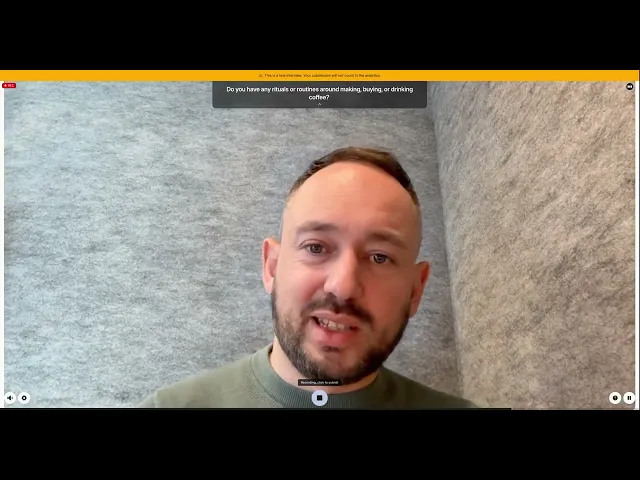
Every competitive perception finding should link to a verbatim quote and a timestamped video clip stakeholders can inspect themselves. Platforms relying on synthetic or avatar-based inputs cannot provide that link, because there is no real person behind the finding. The deliverable is a competitive perception report where every claim is traceable: the theme, the quote, and the clip that proves it.
5. Triangulate interview findings with behavioral data
Competitive intelligence built solely on interviews has a credibility problem: a single participant's comment about pricing confusion is a data point, and a validated pattern requires more. Triangulation fixes this: interviews surface the reasoning, behavioral data confirms the scale. Pull support ticket themes and sales call transcripts to check how often an interview finding actually surfaces in deals.
When those signals align, the finding moves from "a participant told us" to "interviews, support data, and win/loss records all point the same direction," which matters to every stakeholder who wasn't in the room. Conveo's traceable outputs support this directly: every interview finding links to its data sources, so support ticket volume, financial statements, and churn rates give the brief its weight alongside the texture the interview clips provide, supporting real data-driven decision-making rather than a gut call based on real-time data alone.
The deliverable is a competitive intelligence brief that pairs qualitative depth with behavioral evidence.
6. Build a searchable insight library so competitive learnings compound
Most competitive research follows the same arc: a study gets commissioned, findings land in a deck, the deck gets presented once, and it's never opened again. Six months later, a different stakeholder asks a nearly identical question, and the team commissions new research rather than searching what it already knows. The research itself holds up. The failure is organizational: findings sit unstructured and unindexed, so valuable data ends up buried rather than turned into actionable insights.
A searchable insight library fixes this by tagging every session by competitor, feature, objection, and decision stage. Conveo's searchable insight library connects findings across projects, so nothing gets researched twice, turning what used to be raw data into key insights the whole organization can reuse.
"Super valuable... ahead of where most of your competitors are... quite a special way to analyze this data"
Matt Harris, Research & Insights Lead, EMEA, Canva
Competitive positioning does not stay stable long enough for annual persona refreshes to remain useful. Continuous loops, in which each new study feeds back into the library, keep intelligence current without requiring a full research cycle every time a question arises. The deliverable is a competitive insights library in which every claim links to a source, and each new study adds to the repository rather than starting from scratch.
7. Run multi-market competitive research in parallel, not sequentially
Sequential market-by-market fieldwork is a persistent source of delay: recruit in the US, field, synthesize, then start over in the UK, then Germany, then France. By the time the final market wraps, the first market's data is weeks old. That constraint comes from the method itself, and it holds regardless of how capable the team running it is.
Conveo's AI moderator conducts interviews across 50+ languages, so a team can field simultaneously in North America, Western Europe, and APAC without waiting for one market to close before opening the next. Automated transcription and translation mean synthesis doesn't wait for fieldwork to finish, so analysts can track trends across the whole market landscape while later markets are still in the field, keeping an eye on opportunities to gain market share that the immediate future would otherwise hide.
The deliverable that used to take months, a global competitive perception report, becomes available in days, keeping market opportunities visible that would otherwise go stale.
8. Establish evidence and traceability standards for every competitive claim
Competitive narratives break down the moment a stakeholder asks, "Where does this come from?" and the answer is a slide with no source. Every claim should link to a verbatim quote, a timestamped video clip, or a behavioral data point a skeptical stakeholder can inspect directly. The standard is the source itself.
This matters most to legal, product, and executive reviewers, and to the leadership team weighing a strategic shift in direction in light of it. Build source-quality scoring into the synthesis, tag every insight by source type, and surface contradictions explicitly rather than smoothing them over. The deliverable is a competitive intelligence brief in which every claim is audit-ready: sources are inspectable, contradictions are named, and confidence levels are stated.
What an always-on competitive intelligence program actually looks like
Most competitive intelligence programs run on a cadence that made sense when research was expensive and slow: commission a study, present it, then wait six months for the next refresh. Competitors move faster than that. By the time the next wave launches, the research is already outdated relative to the strategic business decisions it was meant to inform.
Conveo StoryLines replaces that quarterly, ad hoc research commission with a continuous, wave-based program tracking themes across waves at a bi-weekly or monthly cadence, calibrated to competitive dynamics rather than research calendars.
Intake: Establish a bi-weekly intake form where product, marketing, and sales submit competitive questions.
Triage: prioritize by urgency and existing evidence, since resource allocation only works if the most time-sensitive gaps get filled first.
Wave cadence: run interviews in bi-weekly or monthly waves and deliver a short competitive digest, five to seven bullets with timestamped clips, so stakeholders gain insight without a lengthy readout.
Escalation: when a signal requires immediate action, escalate to a decision memo pairing interview clips with response options.
Teams report up to 75% lower research spend versus agency-delivered qualitative programs when shifting this work to AI-moderated video, which changes the resource allocation math for teams that previously had to ration ad hoc research.
How to connect competitive intelligence to customer understanding
Most competitive intelligence programs are built around monitoring: tracking feature launches, pricing changes, and messaging pivots, while the question of whether any of it matters to the customers you're trying to win goes unasked.
The fix is a validation loop connecting competitor moves to direct customer conversations. When a competitor announces a new feature, run five to ten interviews with customers who evaluated both products to understand whether it changes their preference and why. The probing question that opens this up: "What would need to be true for you to choose [competitor] over us?" Follow the answer into feature gaps, institutional constraints, and emotional drivers that quantitative tracking never surfaces.
Every claim from this process needs to be traceable to a verbatim quote or timestamped clip. That's what separates decision-grade competitive intelligence from market noise.
How Conveo delivers competitive intelligence while decisions are still open
Competitive intelligence that changes decisions requires continuous understanding, research rigor stakeholders trust, and a compounding system so nothing gets researched twice. Conveo delivers all three: StoryLines runs continuous research in a bi-weekly or monthly cadence, every finding traces back to a real participant, and its searchable insight library connects findings across projects so recurring questions get answered in seconds rather than weeks.
Compliance infrastructure is built in: SOC 2 compliant, GDPR compliant, European hosting (Belgium), SSO, and on-demand PII deletion, so competitive intelligence work clears procurement without a separate security review. Teams report going from weeks to days on competitive perception studies at up to 75% lower spend than agency-delivered programs, with an AI moderator running interviews across 50+ languages so multi-market research runs in parallel rather than sequentially, a strategic advantage over teams still waiting on sequential fieldwork.
Frequently Asked Questions
What is the difference between competitive intelligence and competitive monitoring?
Competitive monitoring tracks what competitors do: pricing changes, feature releases, messaging shifts. Competitive intelligence explains why customers respond to those moves. Monitoring tells you a competitor launched a new feature; intelligence tells you whether that feature changes how customers evaluate you against them, and why.
How often should a competitive intelligence program run qualitative research?
The cadence depends on how fast competitive dynamics shift in your market. For most enterprise teams, bi-weekly or monthly waves provide enough signal to stay current without overinvesting, since a competitor can ship a capability or shift pricing between quarterly cycles, locking in a strategic decision before the next wave launches.
How do you ensure competitive findings are credible enough for executive decisions?
Traceability is the mechanism. Every claim should link to a verbatim quote and a timestamped video clip from the participant who said it. Triangulating interview findings with behavioral data (CRM records, support tickets, win/loss analysis) adds evidentiary weight, which is the difference between competitive intelligence and a guess dressed up as strategic intelligence.
What is the difference between demographic and behavioral segmentation for competitive research?
Demographic segmentation filters by who the buyer is: industry, company size, geography. Behavioral segmentation filters by how they decide: what they prioritized, which competitors they evaluated, what knocked options off their shortlist. Behavioral segmentation surfaces the decision logic that actually drives competitive choice.
How do you handle competitive research across multiple markets without delaying findings?
Run interviews in parallel rather than sequentially. Traditional agency models field one market at a time because human moderation requires scheduling and translation requires a separate vendor. AI-moderated interviews remove that constraint, so teams can field interviews simultaneously across North America, Western Europe, and APAC, with synthesis beginning as interviews close in each market.

About the author
Dieter De Mesmaeker
Co-Founder & CEO
Dieter is CEO and co-founder of Conveo. Before starting the company, he founded DataCamp and scaled it into one of the leading edtech platforms in the world.
More by Dieter →Qualitative insights at the speed of your business.
Conveo runs AI-moderated video interviews and structures everything they say.