
TL;DR
Asynchronous, AI-moderated video interviews solve B2B user research's core failure: traditional methods can't get busy, senior, multi-stakeholder participants into a scheduled interview fast enough to inform a decision before it's made.
Recruiting is the bottleneck, not the research. Scheduling busy product managers, procurement leads, or IT directors for a 60-minute call can take two to three weeks before a single interview runs.
Sequential interviewing caps what small teams can deliver. Running interviews one at a time creates a ceiling. Throughput stays low regardless of how good the methodology is.
Insights arrive after decisions are already locked. Qual cycles that run six to 12 weeks return findings to teams that have already finalized roadmaps, approved campaigns, or committed to positioning.
Best for: Research ops managers and CMI teams at enterprise organizations running B2B studies who need compliant, scalable qual without having to rebuild their vendor stack.
The fix: Asynchronous video interviews remove scheduling friction by letting participants respond on their own time, in parallel. Hundreds of conversations can run simultaneously without adding moderators or extending timelines. Conveo, the video-first AI research platform, is built for exactly this use case.
Why it's credible: Every finding in Conveo traces back to timestamped video clips and verbatim quotes. Stakeholders can inspect the source, not just read the summary.
B2B user research stalls for a reason unrelated to methodology: the people you most need to speak with won't take a scheduled 60-minute call. Senior buyers, technical evaluators, procurement leads, and end users are already overcommitted. Getting five of them on a call, at the same time, in the same buying group, within a two-week window, is not a recruiting challenge. It is a structural one that compounds with every layer of seniority you add.
The throughput problem runs deeper than scheduling. Traditional qualitative approaches interview research participants sequentially, which means the pace of your B2B user research is capped by the slowest calendar in the room. A research project that requires 20 conversations across four stakeholder roles can take six to eight weeks to complete, even with a skilled recruiter and a clear screener. By the time synthesis is done and a deck is ready, the roadmap decision it was meant to inform has already been made.
Fixed-question interview guides also flatten the differences between roles. A finance team evaluating total cost of ownership and a day-to-day user don't share the same friction points or vocabulary. Ask them the same questions, and you get comparable data but lose the disagreements between them, which is often exactly what determines whether a deal moves forward. The key players in a buying group rarely see a purchase the same way, and averaging their answers erases that tension.
Asynchronous, AI-moderated video interviews resolve both constraints. Professionals participate on their own schedule, hundreds of conversations run in parallel, and adaptive follow-up probes dig deeper where a fixed script would move on.
This article covers why B2B research is structurally different from consumer research, how the recruiting bottleneck forms, which B2B user research methods hold up for busy audiences, and how to build outputs that earn stakeholder trust, enabling teams to achieve better outcomes without adding headcount.
Why B2B User Research Is Structurally Different from B2C
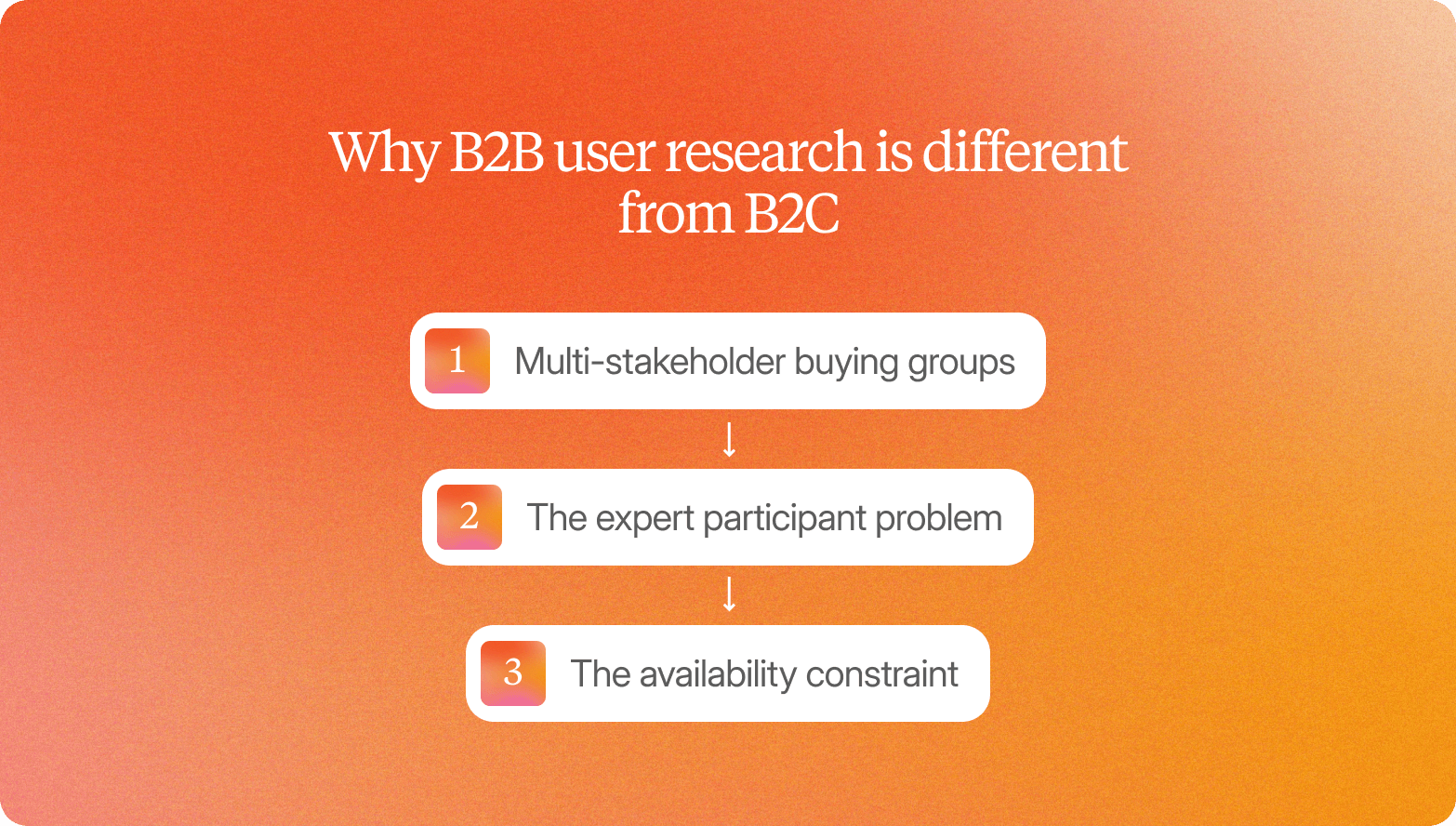
Three structural realities make B2B user research harder than consumer research, and they compound each other. Unlike consumer-facing UX research, where one person discovers, buys, and uses a product, B2B research must account for many challenges that arise when those roles are split across an organization.
Multi-Stakeholder Buying Groups
B2B purchases rarely belong to one person. A single evaluation might involve:
A procurement lead controlling budget
A security team owning vendor approval
End users focused on daily workflow
A department head setting strategic requirements
Each of these different users has different success criteria and definitions of value.
Fixed-question surveys collapse these distinctions into aggregate responses that make disagreements invisible, and disagreements are what determine whether a deal progresses. Research that averages across stakeholder groups produces findings that actively mislead the teams relying on them and makes it harder to manage expectations once the real picture surfaces later.
The Expert Participant Problem
B2B users are often domain experts who know their workflows better than researchers do. A procurement manager or DevOps engineer speaks in domain-specific language, assumes a shared business context, and immediately notices when a question reflects a shallow understanding of their work.
Poorly designed questions signal that the research isn't worth the participant's time. Domain knowledge on the researcher's side reduces the cognitive load a participant carries in explaining basic context before reaching the interesting answer. Probing needs to follow the participant's actual workflow, not a generic guide, or participants give polished, surface-level answers that protect their time.
The Availability Constraint
Business-to-consumer research can draw on panels of participants who are available and motivated. Business-to-business professionals are not; they're managing full calendars, navigating internal approval processes to participate, and often requiring cross-departmental coordination before a researcher can even reach them.
Scheduling 10 one-hour interviews with relevant B2B participants can take three to four weeks, by which point the decision the research was meant to inform has often already moved forward.
These constraints interact: multi-stakeholder studies need more participants, expert participants need better questions, and availability constraints make scheduling at scale nearly impossible with traditional methods. Effective B2B research methods need to remove scheduling friction, adapt in real time to expert responses, and capture role-specific perspectives separately rather than merging them, or they miss the business problems actually driving B2B decisions.
The Recruiting Bottleneck: Access Is the Real Constraint
Recruiting determines whether B2B user research happens at all, not study design or analysis. Access to the right users is the constraint.
Busy professionals aren't going to block 60 minutes for a vendor they don't know. Calendar coordination among five or six participants, accounting for time zones and cancellations, routinely takes two to three weeks before a single conversation can happen. Internal processes add further delay:
Customer success teams protecting their accounts
Legal reviewing consent language
Each common B2B recruiting channel carries its own friction.
Channel | Strength | Limitation |
LinkedIn outreach | Reaches specific titles and companies directly | Low response rates; significant effort per contact |
CRM and customer lists | Direct contact with people already in your ecosystem | Slowed by internal approvals; customer fatigue; limited to existing customers |
Professional communities and Slack groups | Reaches self-selected, engaged niche roles | Small sample sizes; the same people tend to participate repeatedly, skewing findings |
B2B research panels | Fast, with ICP matching | Cost premium; participants are often professional respondents whose answers reflect that familiarity rather than genuine experience |
Sequential interviewing (running interviews one at a time rather than in parallel) compounds the recruiting bottleneck. If recruiting takes two weeks per wave and each interview runs an hour, a team of three researchers can realistically complete 15 to 20 interviews a month, less once they're also handling analysis and reporting. The constraint isn't effort or expertise; it's the sequential structure, which makes it nearly impossible to recruit participants fast enough to keep pace with the business.
Asynchronous video interviews break that structure. A researcher can send 200 invitations on a Monday and receive responses throughout the week without coordinating a single calendar slot. Instead of interviewing participants one at a time, teams can run hundreds of conversations in parallel, each session captured in full video and ready for analysis as it arrives. The bottleneck becomes structurally irrelevant, and teams can recruit users at the pace the business needs.
4 B2B User Research Methods That Work for Busy Professionals
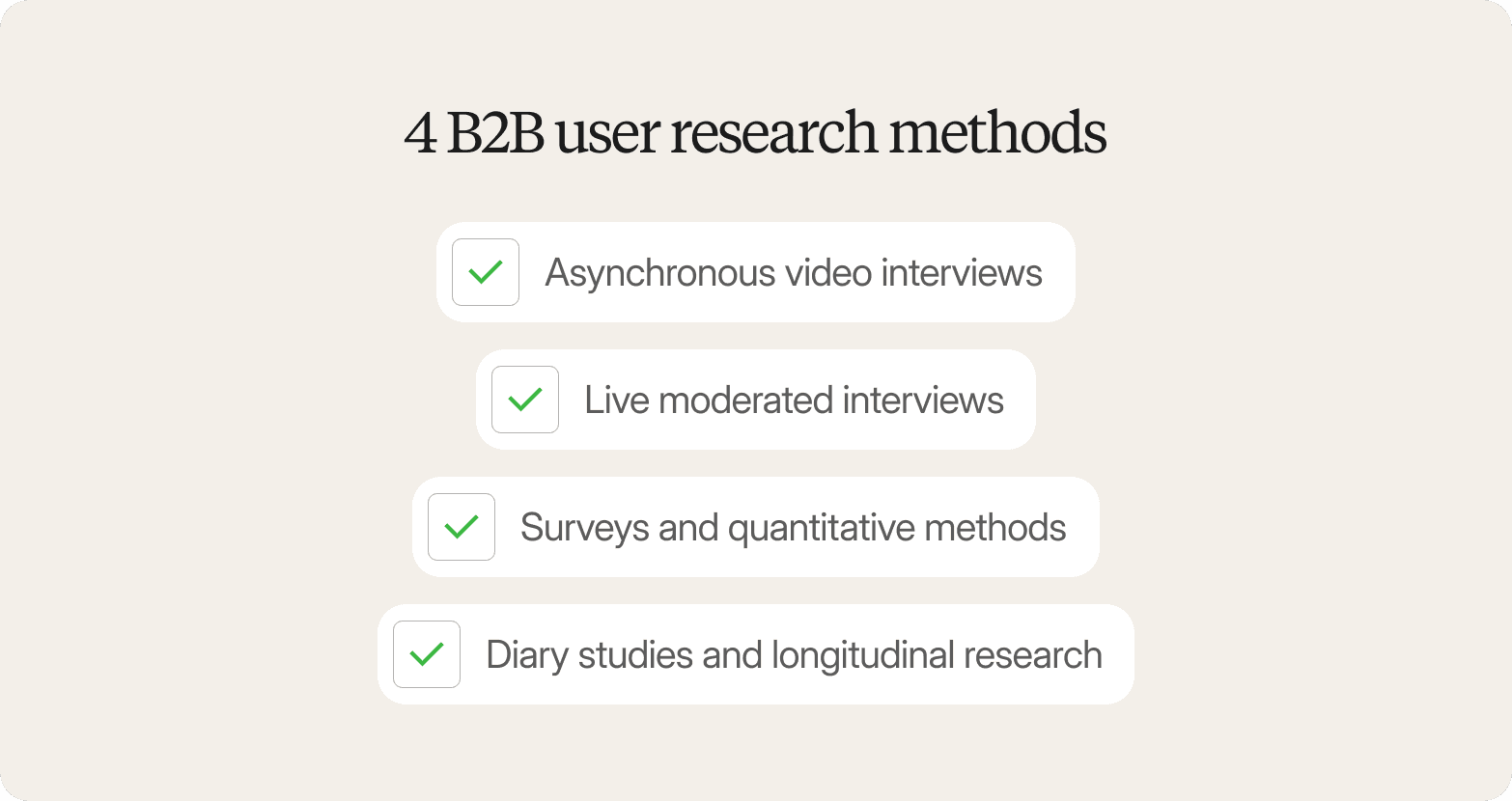
Asynchronous Video Interviews
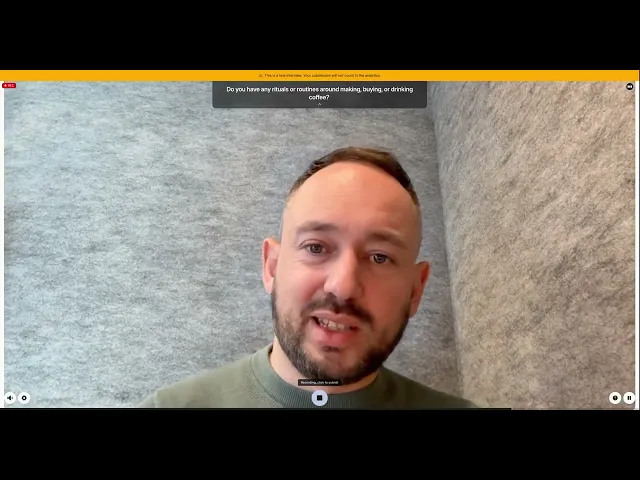
Scheduling one-on-one user interviews with B2B professionals is often the hardest part of the process. Async video interviews remove the scheduling dependency: participants receive a link and record responses when it fits their day. The AI moderator adapts in real time, following up based on what each person says rather than advancing through a fixed script. If a participant hesitates on a pricing question, it digs deeper; if they mention an unexpected pain point, it follows that thread.
See it in action: How AI-Moderated Video Interviews Actually Work →
The throughput advantage is significant: teams can run hundreds of conversations in parallel rather than sequentially, reducing a three-week study to days. The credibility advantage is equally practical. Every finding traces to timestamped video clips and verbatim quotes, so stakeholders can watch the moment a participant's tone shifted rather than take a researcher's word for it.
Live Moderated Interviews (Traditional Qual)
Live moderated interviews remain the gold standard for depth, but a full agency cycle from recruitment through synthesis typically takes 6 to 10 weeks, versus 3 to 5 days for asynchronous video interviews. An experienced moderator reads the room, pivots when a participant says something unexpected, and builds empathy with a senior director in a way that gets them to say what they actually think. That depth is hard to replicate.
The trade-off is structural: scheduling 10 busy professionals can take two to three weeks, and, when run through an agency, the full cycle from recruitment through synthesis often stretches to six to 12 weeks at six-figure fees. Use live interviews when the stakes justify the timeline: executive decision mapping, sensitive topics that require trust, or exploratory research where following an unexpected thread is the point. For faster-cycle questions or larger samples across markets, the throughput ceiling becomes the binding constraint.
"Within days we had insights that would've taken a traditional agency a month"
— Head of Customer Insights, JDE Peet’s
Surveys and Quantitative Methods
Surveys scale. When you need to measure how widespread a problem is or confirm that a pattern holds across your customer base, surveys do so efficiently, reaching hundreds of participants in days with statistical confidence.
The limitation is structural: surveys tell you what percentage of buyers experience a problem, not why it persists or how different members of a buying group weigh it against competing priorities. In B2B contexts, a survey score flattens the disagreements that determine whether a deal moves forward. Open-ended fields rarely close that gap, since typed responses tend to be brief without a moderator to probe further.
The right sequence is qualitative first, to validate assumptions and identify what matters, then surveys to measure how broadly a finding applies. Reversing the sequence produces fast data with no framework for interpreting it.
Diary Studies and Longitudinal Research
Diary studies ask participants to document behavior as it happens rather than recalling it after the fact. For understanding how a workflow evolves over a two-week onboarding period for new users, or how a buying committee's priorities shift across a procurement cycle, that temporal dimension is irreplaceable. Rather than relying on isolated interactions, diary studies allow a team to observe users as behavior unfolds.
The trade-off is participant burden: logging entries daily over weeks results in meaningful dropout, and the resulting behavioral data requires to synthesize. Use these methods when the research question only makes sense over time, such as adoption patterns or decision journeys where sequence matters as much as outcome.
Most B2B programs need a mix of these B2B user research methods. The constraint isn't which method is best; it's which methods busy professionals will actually complete before the decision window closes.
How to Build Credible B2B User Research Outputs
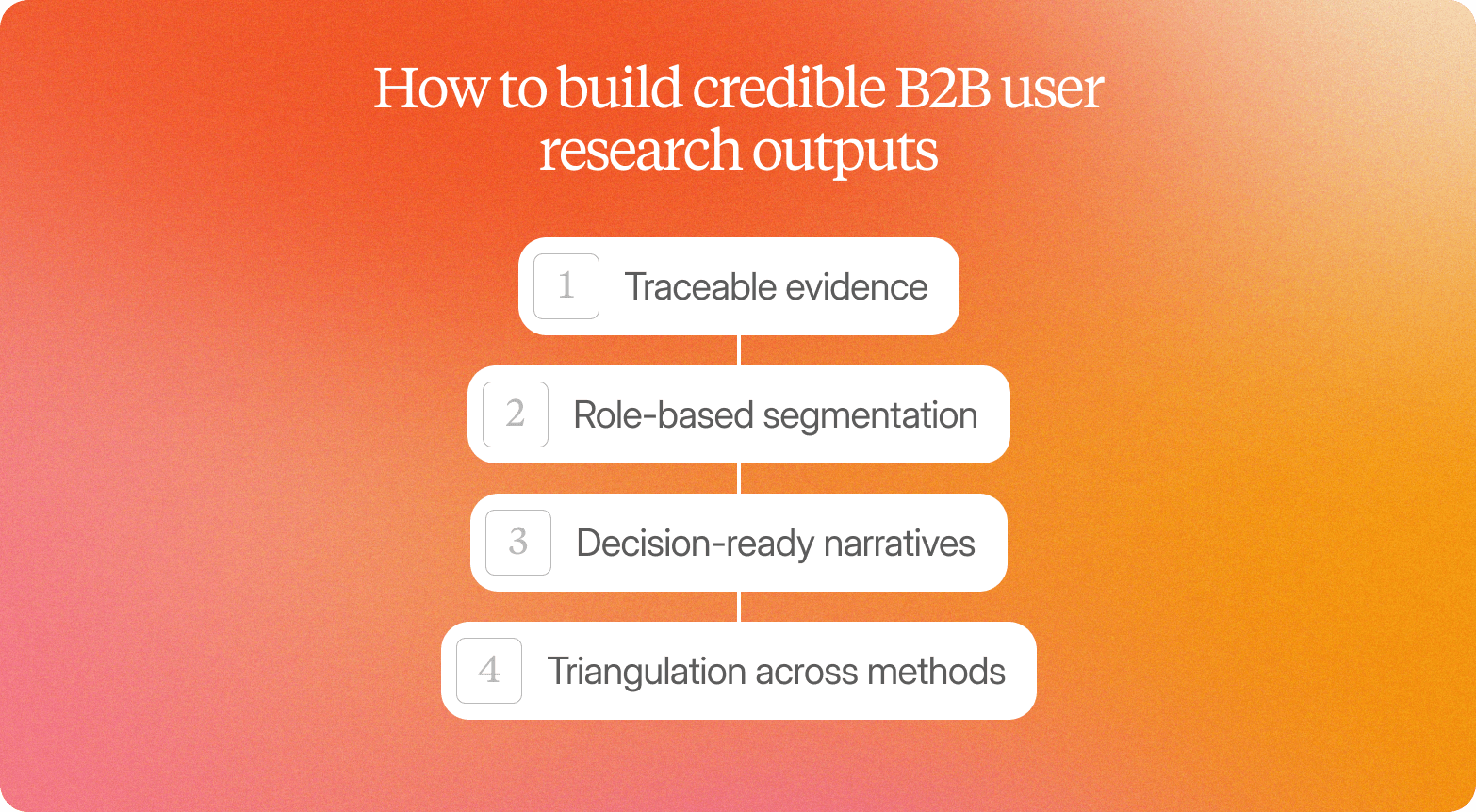
B2B user research fails when stakeholders don't trust the findings, usually because the evidence isn't traceable.
Traceable Evidence
A bullet point that reads "users find onboarding confusing" carries no weight on its own; it reads like an interpretation, not evidence. The fix is source-linked outputs: every theme tied to the timestamped video moment or verbatim quote that produced it. When a stakeholder can watch a participant pause and say "I don't know what this is asking me to do," the finding becomes undeniable. A typed answer tells you what someone said; a recorded conversation shows you what they meant.
Role-Based Segmentation
Different stakeholders in the same buying group weigh the same decision differently:
A procurement lead weighs security certifications
An end user cares whether the workflow fits how they run research studies
An IT gatekeeper wants data residency details
Ask all three the same scripted question, and you get answers that look compatible until the deal stalls because nobody surfaced the real disagreement.
Fixed-question methods flatten these differences by design. Adaptive probing changes that: when a procurement lead hesitates on compliance, the moderator follows the hesitation; when an end user describes a workaround, it asks why. Those divergences, captured on video and traceable to their sources, are where real buying-group dynamics live.
Decision-Ready Narratives
Stakeholders act on conclusions they can trace back to something real. Decision-ready outputs answer in sequence: What did we learn? Why does it matter? What should we do? Each key insight should pair with the video moment or quote that produced it. A searchable insight library prevents findings from dying in an unopened deck and saves researchers time spent interpreting findings from scratch on every new request.
Triangulation Across Methods
A pattern that appears in video interviews, support ticket language, and product usage data carries more weight than one that appears only in interviews. When direct access is limited, pull from what's available: sales call recordings surface objection language, CRM notes reveal where deals stall, and behavioral data from product usage shows where actions diverge from stated intent. Layering these against qualitative findings turns isolated observations into a defensible evidence base. A searchable insight library that connects findings across studies makes this cumulative rather than one-off. Conveo's knowledge library, for example, links video clips, themes, and quotes across studies so that a pattern spotted in Q1 can be validated or challenged by evidence from Q3 without re-fielding the original research.
B2B User Persona Research: Building Role-Based Personas
B2B persona research fails when personas describe job roles instead of decision-making contexts. A persona describing "a 42-year-old VP of Marketing" tells you almost nothing about how that person evaluates vendors or where they lose authority in the buying process.
There are three persona types enterprise teams need to build separately.
Persona type | Focus |
Buyer personas | Procurement criteria and budget authority: who signs off, what triggers formal review, what "good enough" looks like to the finance team holding the budget |
User personas | Day-to-day workflows, user needs, and which features would actually change how someone works |
Organizational personas | Company size, tech stack, and buying-group composition, the structural factors determining whether a deal is even possible |
The common mistake is treating all three as a single, static document, without success metrics to tell you whether it still holds up. Rigorous B2B persona research follows a different process:
Interview 8-12 people per role, including the decision-maker, end user, gatekeeper, and admin. Each of these user roles has a different definition of success.
Map the decision journey: who gets involved at each stage, where priorities conflict.
Identify role-based priorities explicitly, rather than in a single list with different formatting.
Link every claim to evidence, a quote or timestamped clip, since personas built on memory drift toward assumption.
Update quarterly, since roles and markets shift.
Async video interviews make this process more practical. Instead of scheduling stakeholder interviews sequentially across roles over three weeks, teams can run parallel tracks with decision-makers, end users, and IT gatekeepers simultaneously using a platform like Conveo. The AI moderator adapts its probing to each role's domain, and reviewing sessions as they land builds empathy for each stakeholder's world faster than a single round-up meeting.
The output should be a one-page template per role, including the decision criteria, key pain points, and a direct link to the evidence for each claim. Quotes and timestamps separate a persona a stakeholder will trust from one they'll ignore.
A Pragmatic B2B User Research Strategy for Small Teams
Small insights teams (often 1 to 5 people) are expected to support entire organizations, but sequential interviewing caps throughput.
Intake and Prioritization
Before committing researcher time, ask three questions: Has this been studied before? Can existing data answer it? Does the decision require new evidence, and what does the requesting product team actually need to achieve? Prioritize by decision urgency and business impact, not who submitted the request; teams that prioritize by seniority end up doing the loudest work, not the most consequential. A simple intake form, reviewed weekly, keeps the queue defensible.
Study Cadence and Batching
Batch related questions into a single study run on a predictable two-week cycle rather than treating every question as a standalone research project. One round of recruitment, one screener, one synthesis pass: fixed costs stay flat while learning compounds. Because participants complete sessions on their own schedules, a team of two can conduct a concept test, a usability testing round, and a user satisfaction check simultaneously in the field, without scheduling conflicts.
Insight Library and Knowledge Reuse
Every interview should feed a shared, searchable repository organized by theme and participant type. When a new question surfaces, check what prior research already covers before recruiting the same people twice. A structured library turns past work into infrastructure: prior themes become reference points, and patterns across studies become visible in ways single-project synthesis never reveals. Conveo's knowledge library connects clips, themes, and quotes across studies so evidence accumulates and real value compounds with every study added.
Self-Service Research for Non-Researchers
Product, marketing, and UX teams spend more time waiting for research capacity than making decisions. For low-stakes questions, non-researchers can run their own studies: concept tests, message validation, and basic usability testing don't require expert moderation, just a clear objective and an async interview format. A brand manager can field 20 conversations in two days without touching a researcher's calendar.
Reserve researcher time for complex B2B journeys, sensitive topics, and studies shaping major decisions. That distinction protects research quality where it matters while delivering better outcomes across every team. Findings from both tracks should flow into a shared library so nothing gets siloed.
How Conveo Solves the Core B2B Research Challenges
Every approach forces a tradeoff:
Agencies deliver rigor, but six-figure fees and 6- to 12-week timelines mean findings arrive after roadmaps are locked in.
Surveys move quickly but stay shallow, unable to explain why an economic buyer and end user disagree.
Generic AI and synthetic-avatar platforms offer speed, but when stakeholders can't trace a finding to a real human voice, trust erodes fast, and enterprise procurement teams increasingly require video evidence and source traceability as baseline requirements.
Conveo is the video-first AI research platform built for B2B teams needing qualitative depth without the scheduling bottleneck. Here is how it maps to the specific challenges this article covers.
Multi-stakeholder mapping. Run parallel interview tracks for every role in the buying group simultaneously, with the AI moderator surfacing disagreements that fixed-question methods flatten out.
Expert participant probing. The AI moderator listens to what participants actually say, senses hesitation, and probes the reasoning behind answers the way a skilled human moderator would.
Traceability. Every insight traces to a timestamped video clip and verbatim quote, so the answer to "where did this come from?" is one click away.
Full workflow consolidation. Study design, recruitment through integrated panel partners and BYO lists, AI-moderated interviewing, thematic synthesis, and reporting all run within a single platform, covering the entire process end-to-end instead of stitching together separate tools.
Enterprise-grade compliance. SOC 2 certified, GDPR-compliant, with optional EU data hosting and SSO support. Over 400 enterprises, including Google, Reddit, and FOX, rely on Conveo for qualitative research at scale, giving Research Operations Managers a credible starting point for solving business problems a generic tool can't touch.
Frequently Asked Questions
What Is B2B User Research?
How Does B2B User Research Differ from UX Research and B2C Research?
How Do You Recruit Hard-to-Reach B2B Participants?
How Do You Make B2B Research Outputs Credible to Skeptical Stakeholders?
How Can a Small Insights Team Run B2B User Research at Scale?
How Do Async Video Interviews Work in B2B Research Contexts?