In this article
TL;DR
An AI moderator conducts asynchronous voice and video interviews with real participants, removing scheduling bottlenecks and enabling 10 or 1,000 interviews in parallel.
Adaptive probing, not scripted questions, drives 70-90% of final insights from AI-moderated studies.
83% of participants report being as open or more open with an AI moderator than with a human one, reducing social desirability bias.
Conveo, a video-first AI research platform, covers the full workflow from study design to stakeholder-ready reporting, with every finding traceable to time-stamped video clips.
AI moderation does not replace human researchers. It removes the operational overhead that prevents teams from running research as often as they should.
Qualitative research is entering a new era. The old perception that qual is inherently slow, expensive, and hard to synthesize is dissolving. Artificial intelligence (and in particular large language models and machine learning) has made it possible to run deep, conversational interviews at a pace and scale that would have been unthinkable five years ago, capturing voice, video, and behavioral signals from real participants across markets in days rather than months.
Yet for most teams, the day-to-day reality has not caught up with the possibility. Every sprint, the plan is the same: talk to users before the decision gets made. The reality is that scheduling five interviews takes longer than the sprint itself. Recruiting participants, aligning moderator availability, sending reminders, and chasing no-shows can consume days of researcher time before a single session runs.
An AI moderator removes the constraint at its source. Instead of matching moderator and participant calendars, participants receive a link and complete a voice-and-video interview on their own schedule. Sessions run asynchronously, meaning hundreds of conversations can happen in parallel, 24/7, without adding headcount or extending timelines. The moderation itself adapts in real time, probing based on what participants actually say rather than following a rigid script.
The result is research that fits the cadence of product development: lightweight, repeatable, and weekly rather than quarterly.
What is an AI moderator?
The term "AI moderator" carries two distinct meanings, and the distinction matters when evaluating research technology.
AI moderation for content: filtering user-generated content at scale
In one context, an AI moderator refers to AI systems used by social media platforms, online communities, and large platforms to monitor and act on user-generated content. Content moderation work at this scale (billions of user posts across platforms) is impossible without automation. The job of AI content moderation is to identify and remove inappropriate content, including hate speech, explicit imagery, and anything that violates community standards or platform guidelines. Most tools rely on keyword filters, machine learning models, and natural language processing to flag such content for immediate action, either automatically removing it or routing it for human review.
Large platforms typically handle AI content moderation using a mix of reactive and proactive approaches. Reactive moderation responds after content has already been posted: a human review queue flags and removes violating material once it has gone live. A proactive approach, including post-moderation queues and pre-publication filtering, catches most content before it reaches more users. This hybrid moderation model, sometimes called distributed moderation, is now standard moderation work for platforms managing user engagement at scale. Accurate moderation is the goal: filtering inappropriate content and upholding community guidelines while preserving the platform's integrity. Continuous learning keeps machine learning models up to date as new content types emerge and community standards evolve.
AI moderation for research: conducting qualitative interviews
Qualitative research AI moderation is an entirely different category. An AI moderator in this context is software that conducts interviews with real participants: asking questions, listening to responses, and probing adaptively based on what the participant actually says. It does not moderate content. It runs conversations. The two categories share a name and some underlying technology, but their purpose, method, and output are entirely distinct.
A moderator AI runs asynchronous voice and video interviews that participants complete on their own schedule via a secure interview site, without needing to coordinate calendars with a human researcher. Because sessions run independently, a team can field 10 or 1,000 interviews simultaneously. The number of concurrent conversations is no longer constrained by moderator availability or working hours.
The participant experience holds up under scrutiny. Conveo's data show:
83% of participants report being as open or more open with an AI moderator than with a human one
93% rate the experience 4 out of 5 or higher
For practitioners evaluating fit, that combination of operational scale and participant openness is the practical case for AI moderation: more conversations, more honest responses, and findings that reach stakeholders in days rather than weeks.
How AI moderators work
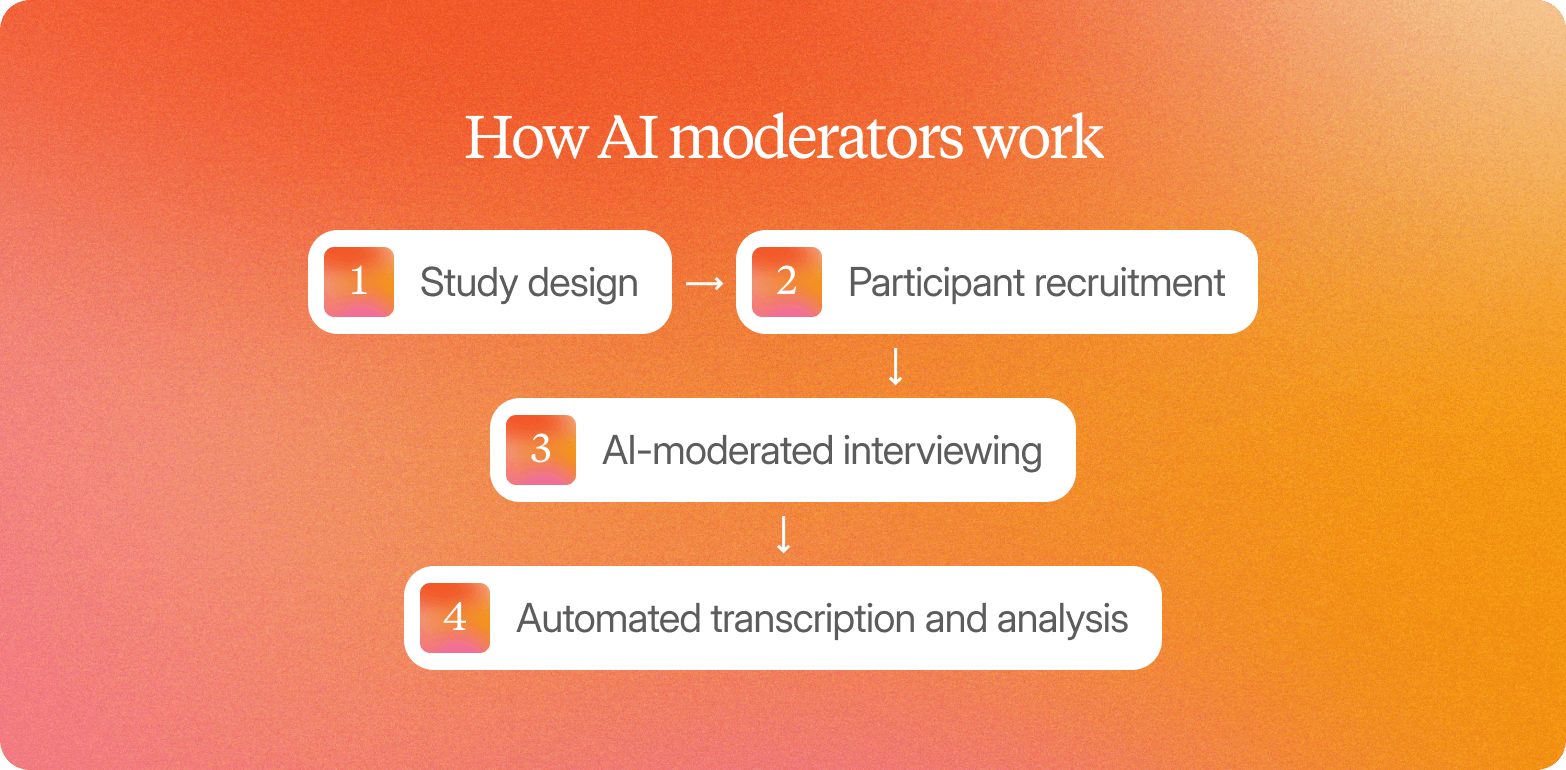
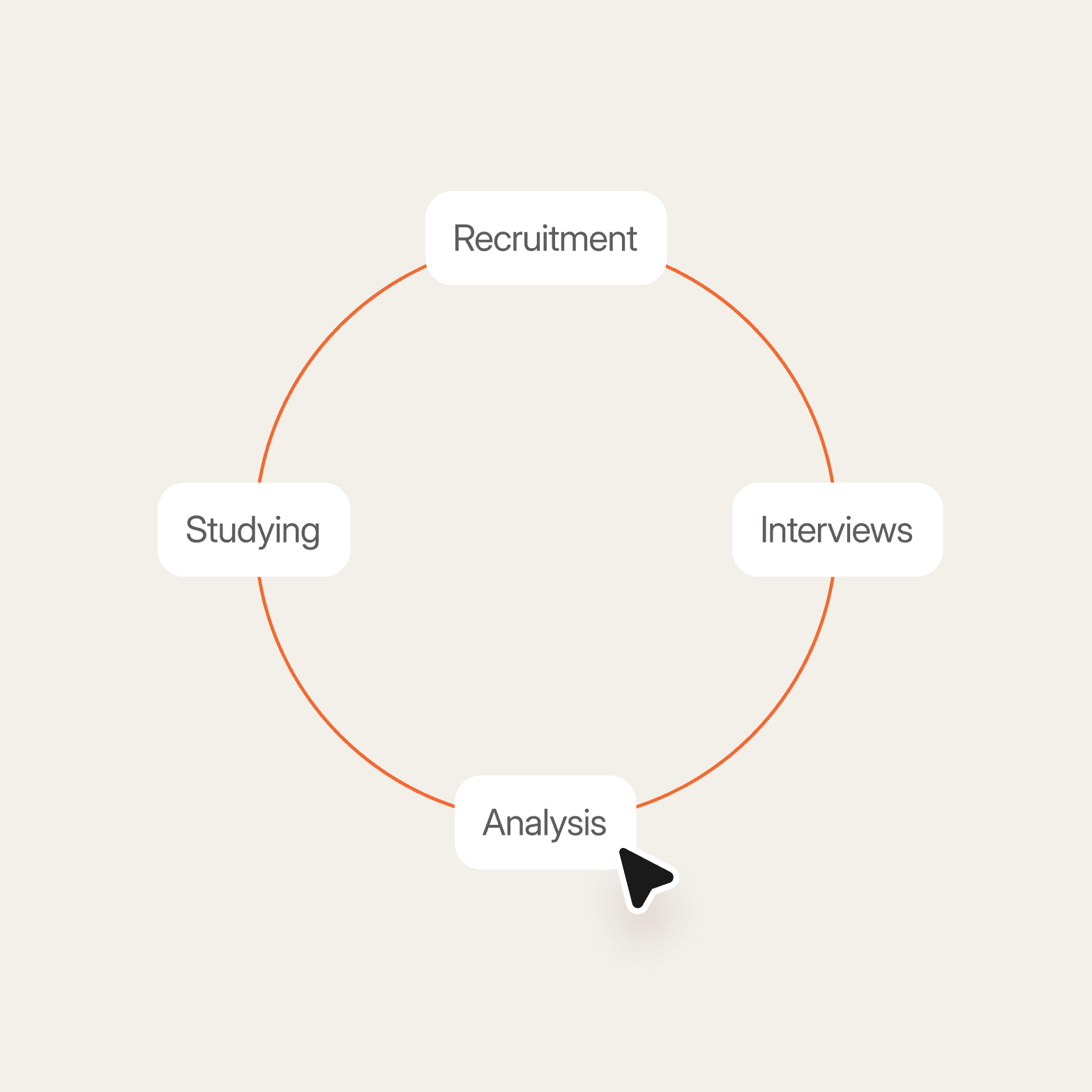
The workflow follows 4 connected stages:
Study design: Define objectives, structure the discussion guide around your research topic, and configure participant screeners.
Participant recruitment: Source participants via integrated panel partners or your own list. Fraud filtering and incentives are handled within the platform.
AI-moderated interviewing: Participants access their interview via a secure session site and complete voice and video responses on their own schedule, 24/7.
Automated transcription and analysis: Every session is transcribed, translated, and thematically coded. Findings link back to time-stamped clips.
What separates genuine AI moderation from scripted survey logic is contextual understanding
Modern AI moderator tools are built on large language models and AI models trained on conversational data, which means the AI reads each participant's response in real time and formulates follow-ups based on what was actually said. Natural language processing allows the AI to parse intent, detect hesitation, and identify threads worth probing deeper. If a participant mentions price hesitation, the AI probes the source of that hesitation. If they reference a competitor, the AI follows that thread. This is what makes AI-led interviews feel like a genuine conversation rather than a structured survey.
The numbers reflect this:
Over 70% of final insights typically emerge from AI-driven follow-up probes, not the original guide questions
3-4x longer responses compared to static surveys, because the conversational format creates space for explanation
The asynchronous execution model is what makes scale possible
AI systems run multiple interviews simultaneously across time zones, without any scheduling coordination. A study that would take a human moderation team four to six weeks to complete can close in days.
Conveo, a video-first AI research platform, orchestrates all of this as a single connected workflow. Critically, its video-first approach captures signals that text-only or audio-only platforms miss: tone, facial expression, and behavioral cues that change what the data can tell you.
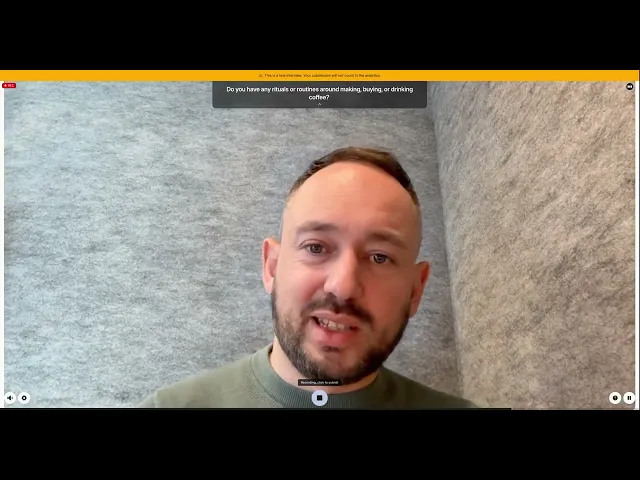
See it in action: How a real AI-moderated interview unfolds →
Why teams use AI moderators
The case for an AI moderator starts with a straightforward operational problem: when a UX or product research team needs to run 15-20 interviews across multiple projects in a single sprint cycle, manual moderation does not scale.
The key benefits of AI-led research are primarily operational. AI moderation removes three specific constraints:
| Constraint | What AI moderation changes |
|---|---|
| Scheduling overhead | Participants open a link on their own schedule; sessions run in parallel, not sequentially |
| Sample size limits | A study requiring four weeks of fieldwork at 20 interviews can reach the same sample in days |
| Time zone restrictions | Asynchronous sessions run globally without coordinating a single calendar |
Conveo compresses a typical six-week qual cycle into days by running recruitment, interviewing, transcription, and analysis concurrently. First-coded themes can appear within hours of fieldwork opening, creating immediate impact: research shifts from a post-mortem activity to something that informs decisions as they are still being made.
A proactive approach to research (running AI-led interviews continuously rather than in quarterly bursts) changes what research teams can offer the business. For multi-market work, AI moderation across 50+ languages, with automated transcription and translation, reduces both costs and cycle time. The practical result: a shift from reactive, project-by-project research to continuous discovery.
AI moderator vs. human moderator: When to use each
The choice between an AI and a skilled moderator comes down to constraints, not quality.
| Factor | Human moderator | AI moderator |
|---|---|---|
| Best for | High-stakes strategic research, sensitive topics, and exploratory research without a structured guide | Continuous discovery, concept testing at 50-100+ interviews, multi-market research |
| Sample size | 4-6 interviews per day, narrow scheduling window | Hundreds in parallel, no scheduling coordination |
| Time zones | Constrained by moderator availability | Runs 24/7 across markets |
| Languages | Requires separate moderators per market | Automated transcription and translation in 50+ languages |
| Participant comfort | Variable: social desirability bias can flatten responses | 83% of participants report being as open or more open with an AI moderator |
One assumption worth challenging:
The idea that participants always prefer human moderators. Conveo's research shows that 83% of participants report being as open or more open with an AI moderator than with a human one, particularly on topics where social desirability bias would otherwise shape their answers.
The most effective research programs use a hybrid model
In specific scenarios (concept testing, continuous discovery, multi-market studies), AI-led interviews handle execution at scale. A human review layer handles interpretation, stakeholder communication, and judgment calls that require domain expertise. Conveo's platform preserves the researcher's role (discussion guide design, analysis, and stakeholder storytelling) while removing the operational overhead from fieldwork.
Evaluating AI moderator platforms: What to look for
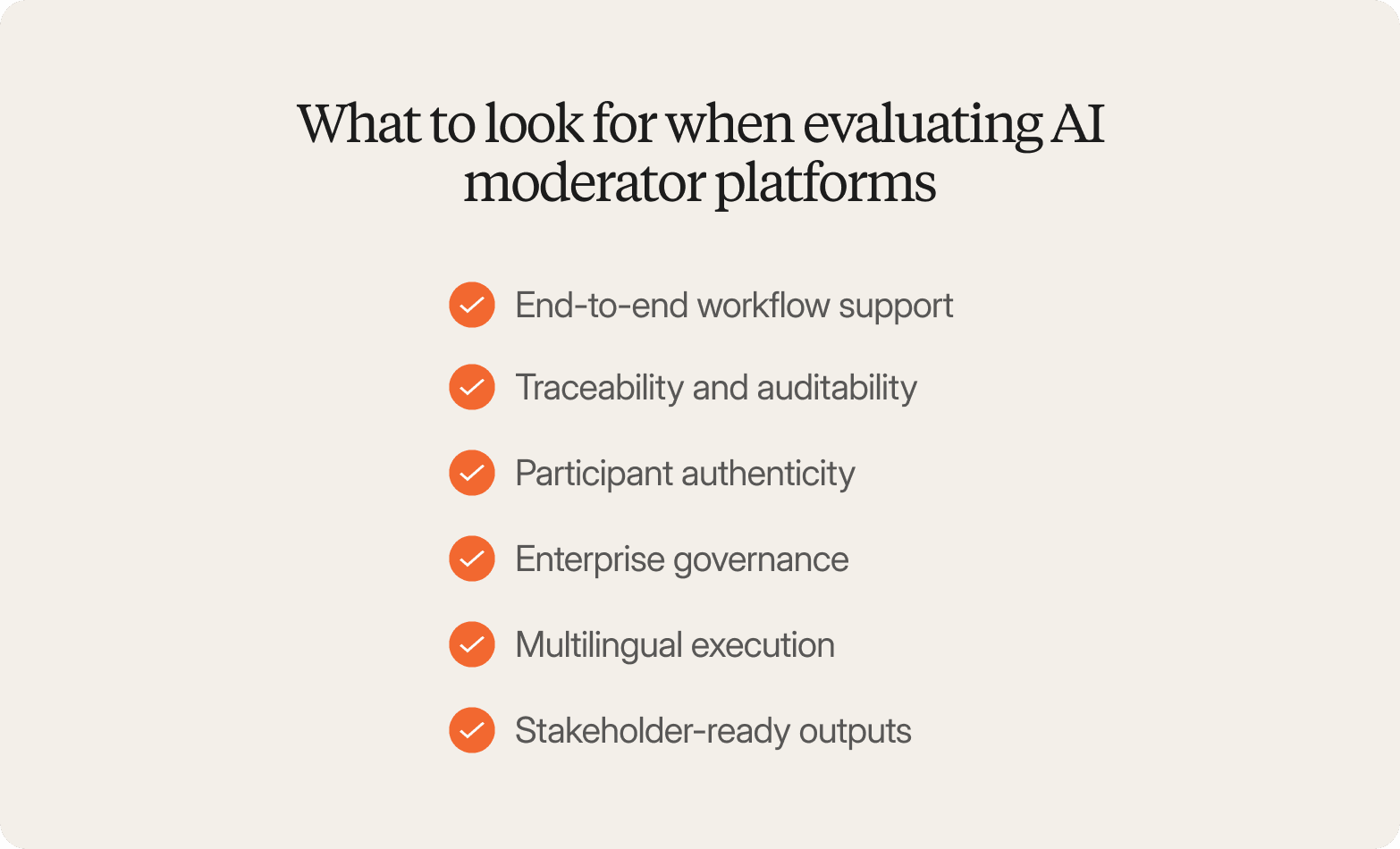
The AI moderator tool category is maturing fast, and not all platforms are built with research rigor in mind. Some handle the interview layer and stop there. Others generate summaries using artificial intelligence, but cannot trace a finding back to the participant who said it.
When evaluating platforms, treat each criterion below as a pass/fail question rather than a feature preference.
1. End-to-end workflow support
Study design, participant recruitment, fraud filtering, incentive handling, AI moderation, thematic analysis, and exportable deliverables should all live in one place. The research teams that struggle most with AI moderation are the ones stitching together point solutions across different content types and research workflows.
2. Traceability and auditability
Every theme should link directly to time-stamped transcripts, video clips, and verbatim quotes, giving teams full control over data lineage. If a stakeholder asks, "Where does this come from?", the answer should be one click, not a manual search. AI moderation without traceability creates a credibility problem, not a shortcut.
3. Participant authenticity
Voice and video capture make participant authenticity verifiable. Text-only chat interfaces and synthetic respondent platforms cannot provide the same level of evidence. The biggest credibility risk in scaled research is fake participants (a problem that natural language processing alone cannot detect without video).
4. Enterprise governance
SOC 2 certification, GDPR compliance, and EU regional data hosting are procurement gatekeepers for European buyers and large enterprise teams. Most AI moderation platforms do not publish their compliance posture.
5. Multilingual execution
Running multi-market research should not require separate moderators per market. Automated transcription and translation across 50+ languages make global research operationally viable for small teams.
6. Stakeholder-ready outputs
Video highlight reels, thematic reports, and exportable clips should require no manual reformatting before sharing. The last-mile problem in qualitative research is turning raw data into something stakeholders will act on, identifying broader patterns across multiple interviews, not just cataloging individual responses.
Conveo meets all six criteria. It moderates real video interviews, generates source-linked insights, and covers the full workflow from study design to stakeholder-ready reporting in a single platform.
3 common concerns about AI moderation, and what the data shows
"Does an AI moderator produce the same depth of insight as a human moderator?"
Yes, and in some respects, the data suggests it goes further. Over 70% of final insights emerge from follow-up probes the AI generates in response to what participants actually say, not from scripted questions. Contextual understanding (the platform's ability to identify broader patterns across multiple interviews and probe each one in real time) is what drives this depth. Voice and video responses also tend to run 3-4x longer than answers collected through static surveys.
"The AI doesn't just summarize, it surfaces patterns I wouldn't have spotted reading transcripts."
CMI Lead, Edgard & Cooper
"Do participants feel comfortable being interviewed by AI?"
Research consistently shows they do. 83% report being as open or more open with an AI moderator than with a human one. 93% rate the experience 4 or higher out of 5. Participants are less likely to soften critical feedback when they are not performing for a person, which produces more honest responses.
"Will stakeholders trust findings generated through AI moderation?"
Stakeholder trust depends on traceability, not the method. Every theme Conveo surfaces links directly to time-stamped transcripts and video clips, so findings can be inspected at source rather than taken on faith.
How Conveo's AI moderator platform fits your research workflow
From brief to findings, the workflow runs in one place:
Study setup: Share a research brief or business objective. Conveo drafts an interview guide, defines a participant profile, and sources participants through its integrated panel partner network. Screeners, fraud filters, and incentives are handled within the platform.
Fieldwork: Once participants access their session link, Conveo's AI moderator greets them naturally, mirrors their language, senses hesitation, and probes based on what they actually say. AI-led interviews run asynchronously in 50+ languages across markets and time zones.
Analysis: As recordings land, the platform transcribes, translates, and codes every session. Multimodal analysis layers in tone and facial expressions to surface signals that transcripts alone miss. Every theme links back to time-stamped video clips, verbatim quotes, and original session context. Continuous learning from each study sharpens the platform's contextual understanding over time, compounding the value of the knowledge base.
Delivery: Coded, stakeholder-ready output in days, not weeks. Teams gain full control over how findings are shared: thematic reports, video highlight reels, and exportable clips, all traceable to the source.
Hundreds of enterprise teams, including Google, Bosch, Reddit, and FOX, rely on this hybrid model for continuous customer understanding: AI-led research handles the scale and execution; human researchers handle the strategy and storytelling. The future of qualitative research is one in which insights are gathered continuously, not in quarterly bursts. The platform is SOC 2-certified, GDPR-compliant, and supports EU regional data hosting.
Frequently Asked Questions
How do AI moderators ensure data quality?
A well-designed AI moderator platform protects data quality at every stage. Platforms like Conveo verify participant authenticity through voice and video capture, filtering out bots and synthetic respondents before their responses contaminate the dataset. Because every session is recorded on a dedicated study site, each theme links directly to time-stamped transcripts and video clips, allowing stakeholders to inspect the evidence behind a finding rather than trusting a summary. Participants in conversational video interviews tend to give responses 3-4x longer than those collected through static surveys, because adaptive follow-up questions create space for explanation rather than a single-click answer.
What is the difference between an AI moderator and a chatbot?
An AI moderator conducts research-grade qualitative interviews, adapting its questions based on what participants actually say about the research topic. When someone hesitates, contradicts themselves, or raises an unexpected thread, the AI probes further, using natural language processing to identify the most meaningful direction for the conversation. A chatbot routes users through predefined flows. It cannot sense when an answer warrants a follow-up, nor can it deviate from its script based on a participant's language or tone. The output difference is equally significant: AI-moderated interviews generate structured, traceable findings linked to video recordings, transcripts, and thematic clusters. Chatbot sessions produce conversation logs. One is a research instrument; the other is a navigation aid.
Can AI moderators work across languages?
Yes. Conveo's AI moderator conducts multiple interviews simultaneously in 50+ languages, without requiring separate human moderators for each market. A single study can run in parallel across markets, with every session automatically transcribed and translated. Recruitment is handled within the same platform via Conveo's integrated panel partner network.
Can AI moderators handle complex topics?
Yes. Domain fluency is rarely the barrier researchers expect. Conveo's AI moderator comes fluent across specialist domains, from financial services to healthcare to CPG, without requiring weeks of briefing and ramp-up. A well-constructed discussion guide transfers domain context into the conversation. The complexity of a research topic is a guide-design challenge, not a moderation-capability constraint.
What are "AI moderator jobs" in the context of qualitative research?
The phrase carries two distinct meanings. In an employment context, AI moderator jobs typically involve managing or overseeing AI-generated content on digital platforms, a form of content moderation work distinct from qualitative research. In qualitative research, the term refers to the functional tasks an AI moderator performs during an interview study: greeting participants, following a discussion guide, probing unexpected responses, and keeping sessions on track without requiring a human to be present in real time. Operational tasks are handled at scale; the intellectual work of designing studies, interpreting themes, and synthesizing findings remains with the researcher.

About the author
Kahini Achrekar
Research Impact Lead
Kahini grew up in Canada, studied cognitive and behavioural science, and ran AI-moderated research client side before joining Conveo, where it let her team go deeper across more markets. She now brings that experience to clients and to the product, where what researchers ask for gets built.
Meet Kahini on film →Qualitative insights at the speed of your business.
Conveo runs AI-moderated video interviews and structures everything they say.