In this article
TL;DR
Custom qualitative research designs the study around the decision, not the other way around. Generic research templates produce data that rarely maps to the specific context, audience, or stakes of the business question at hand. Three decision types benefit most from custom qualitative research studies: concept validation before launch, diagnosing unexpected metric shifts, and exploring unmet needs in niche segments. AI-moderated platforms have compressed what once took six to ten weeks into days, without sacrificing depth.
Custom qualitative research has a timing problem. Studies get commissioned with real intent, designed with care, and delivered with thorough findings. Three weeks after the product decision was finalized. The research becomes a record of what was, not a guide to what to do. When research questions are not mapped to specific decisions, findings tend to be interesting rather than actionable; stakeholders who needed an answer last month receive a deck they cannot act on.
What has changed is that the structural constraints behind this pattern are no longer fixed. The time-consuming scheduling overhead, sequential interviewing, and manual synthesis that stretched qualitative research into 6–10 week cycles were operational realities, not inherent properties of the method itself. AI-moderated platforms, like Conveo, have removed those bottlenecks. Hundreds of real conversations can now run in parallel, analysis begins as recordings land, and findings reach stakeholders in days.
Why generic qual studies fail to answer specific business questions
The most common reason qualitative research fails to move decisions forward has nothing to do with sample size or moderation quality. It comes down to research design. When a qualitative study is scoped broadly, findings land broadly. Teams walk away with themes instead of answers, and stakeholders are left to interpret what any of it means for the specific decision in front of them.
The throughput problem compounds this. A one-to-five-person insights team running custom qualitative research through manual moderation can realistically field only a handful of research projects per quarter: from a one-off case study to a recurring brand tracker. That forces a rational tradeoff: prioritize broad exploratory work and deprioritize the targeted, decision-specific studies business teams actually need in the moment.
The result shows up constantly: a brand team needs consumer input on three packaging concepts before a relaunch in four weeks, but the insights team's timeline runs six weeks. The decision is made without consumer input, or the team defaults to a quantitative survey that misses the emotional associations and hesitation moments that the decision actually depends on.
Qual budgets are not growing, and agency fees are hard to justify for recurring work. The operational case for in-house custom qual has never been stronger. When research design maps to a specific decision, findings become actionable, timelines compress, and stakeholders trust the outputs enough to act on them.
3 steps for mapping research design to specific business decisions
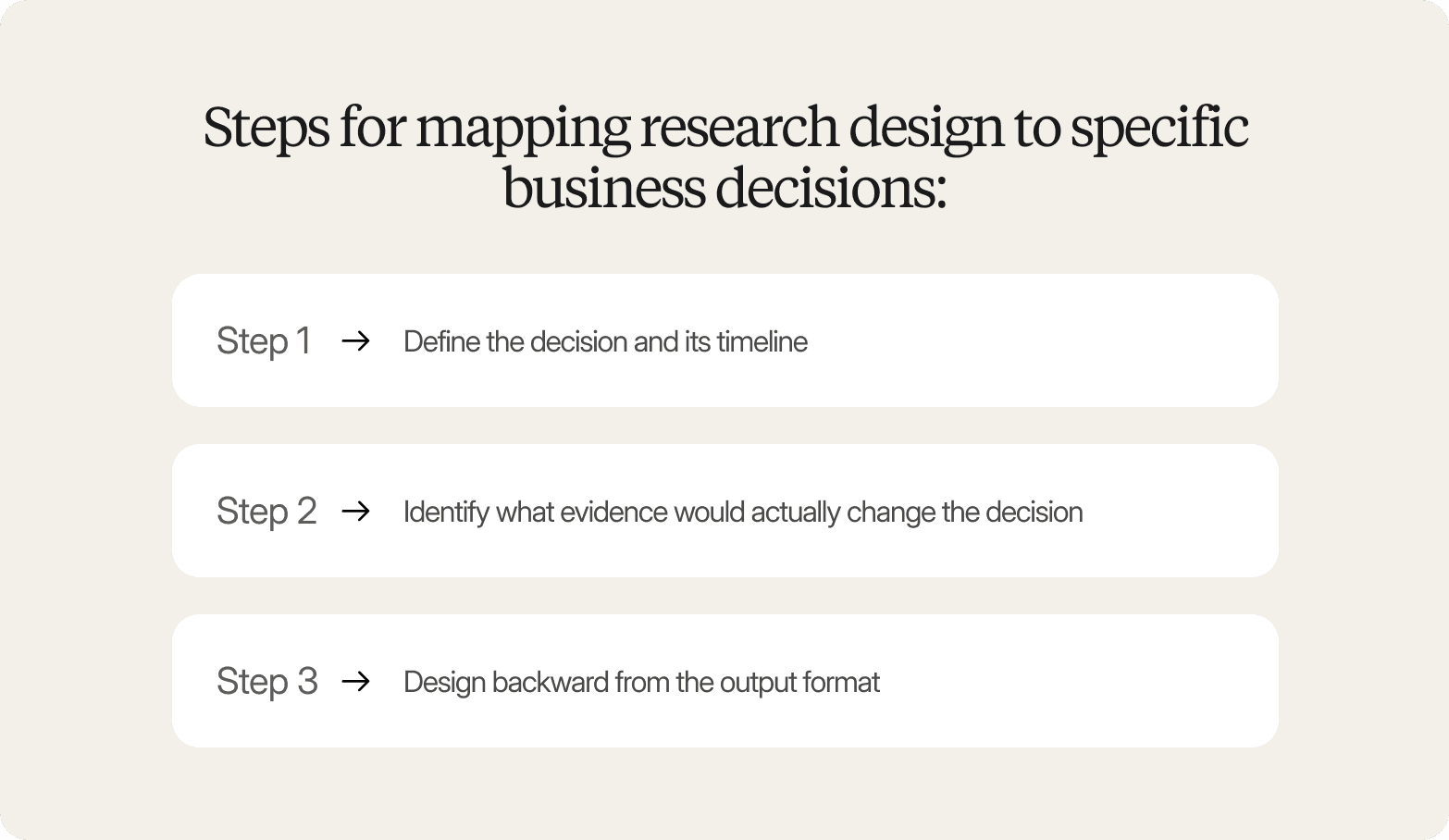
The decision-first principle is the foundation of effective qualitative research design: start with the business question, not the method. What gets decided, who decides it, and when? Every other design choice follows from those answers.
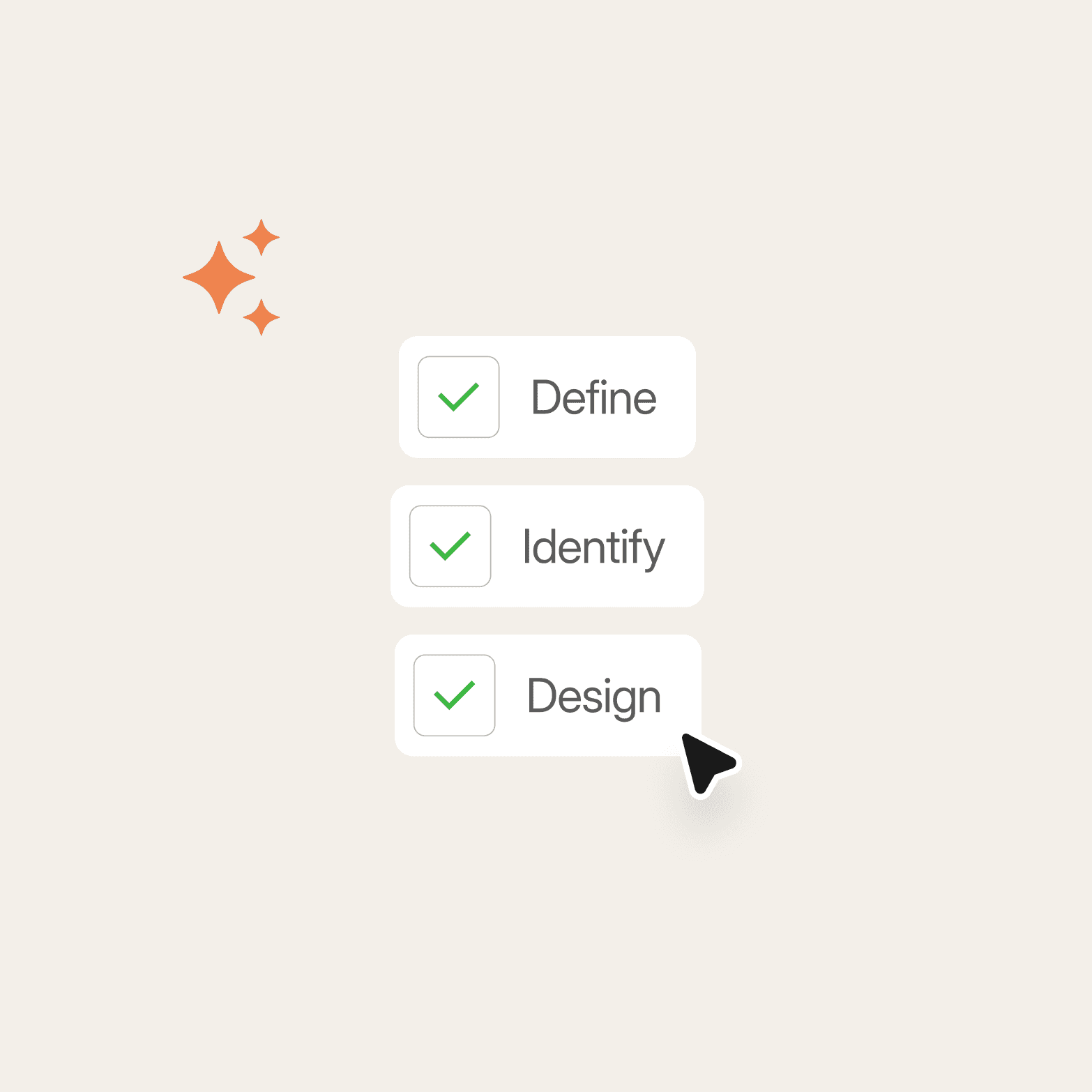
Step 1: Define the decision and its timeline
Before selecting a research method, specify the decision and the date by which it must be made. A roadmap review in three weeks cannot absorb a six-week research engagement. Research without a decision deadline tends to be thorough and late.
Step 2: Identify what evidence would actually change the decision
What would move stakeholders from option A to option B? The aim is not to generate interesting findings but to surface the specific evidence that resolves the decision. If the answer is "we need to understand emotional reactions to the packaging," that defines the required output, and therefore the method. Vague briefs produce vague findings.
Step 3: Design backward from the output format
If stakeholders need to draw conclusions from video evidence of consumer reactions, the study must include video capture. If they need verbatim quotes organized by theme, the research process must produce that structure. Modern enterprise qualitative platforms support study designs built around asynchronous video interviews with adaptive follow-up probing, meaning the output format can be specified before data collection begins rather than retrofitted afterward.
A product team diagnosing why trial-to-paid conversion dropped needs friction-point evidence from real onboarding experiences, not broad category attitudes. Regardless of method, the output format must include auditable evidence: sourced quotes, video recordings, or session-level traceability, not just thematic conclusions.
3 custom qualitative research methods by decision type
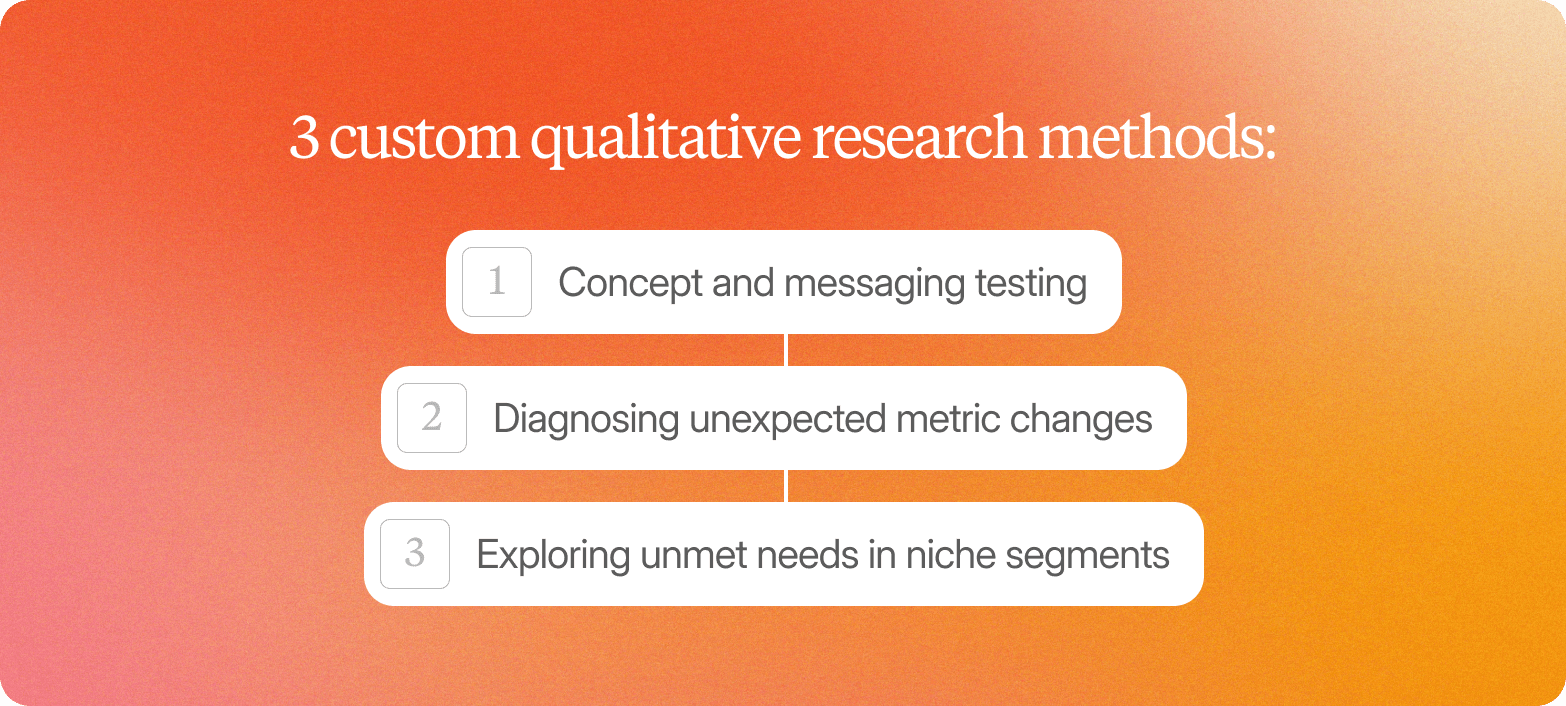
Matching the right qualitative research approaches to the decision at hand is where most teams lose time. The wrong method produces credible-looking findings that cannot answer the actual question. Unlike group settings where dynamics can suppress individual perspectives, asynchronous in-depth interviews capture each participant's perspective in isolation. Unlike quantitative research methods, which prioritize scale and statistical significance, each of these approaches is designed to reach the emotional depth and behavioral specificity that drive real decisions.
Concept and messaging testing
When the goal is to evaluate new ideas and creative stimulus before committing to production or launch, asynchronous video interviews are the most efficient fit. Study participants view the concept on their own schedule, respond in the moment, and the AI interviewer probes emotional reactions without the scheduling overhead of moderated sessions. Typical sample size: 15–30 participants per concept or segment. Stakeholders expect video recordings, verbatim reactions, and a thematic summary that distinguishes genuine resonance from polite approval. Traditional execution takes three to four weeks from recruitment to synthesis. Conveo compresses that to three to five days by running interviews in parallel and eliminating manual transcription and coding.
Diagnosing unexpected metric changes
When a satisfaction score drops or a conversion rate shifts without an obvious cause, in-depth interviews (IDIs) or short video diaries with recent users are the right approach. The goal is to reconstruct the specific moment of decision-making that preceded the behavior change, capturing observations of the attitudes and behaviors that drove the shift. Sample size: 10–15 study participants within a defined window. Outputs should include a journey map and a friction inventory that stakeholders can act on directly. Traditional IDI fieldwork runs sequentially over two to three weeks; AI-moderated interviews run concurrently, with qualitative data analysis available as sessions complete.
Exploring unmet needs in niche segments
When the target audience is too small or too specific for meaningful survey data, small-sample qualitative research with tight recruitment criteria is the appropriate design. Ten to 20 participants with precise screener criteria can surface high-value insights that a broader quantitative survey would dilute or miss entirely, including consumer behavior patterns, unspoken attitudes, and needs that no other data sources would surface. Platforms with vetted global panels and automated screening filters substantially reduce recruitment lead time.
Method selection comes down to three factors: decision timeline, evidence type, and the level of stakeholder trust required to move forward.
Compressing custom qual timelines without sacrificing depth
The timeline is where custom qualitative research most consistently fails enterprise teams. A typical qualitative research project runs six to ten weeks: two to three weeks recruiting and scheduling study participants, one to two weeks conducting in-depth interviews sequentially (the most time-consuming phase), another two weeks on transcription, coding, and qualitative data collection review, then a final week assembling the deliverable. By the time findings land, the decision has already moved on.
Most of that elapsed time is not research. It is logistics.
Asynchronous AI-moderated video interviews remove the scheduling bottleneck. Instead of booking participants one at a time, ten to one thousand conversations run in parallel. Participants complete sessions on their own schedule, with an AI interviewer that probes based on what they actually say rather than a fixed script. The interviewing phase compresses from weeks to days.
Adaptive probing preserves qualitative rigor precisely because the AI responds to unexpected answers rather than advancing a fixed guide. The result is the kind of follow-up a skilled moderator would pursue, at a scale and speed manual execution cannot match.
Automated transcription, coding, and thematic synthesis further reduce analysis time, with researcher review at every stage. The researcher's role shifts from executing manual steps to applying expertise where it matters most; the full body of collected qualitative data becomes an auditable record, not just a summary deck.
Conveo is the platform that enables this compression, running AI-moderated video interviews asynchronously and delivering analyst-ready synthesis without removing the researcher from the process.
"Within days, we had insights that would've taken a traditional agency a month."
Head of Customer Insights, JDE Peet’s
Making custom qual findings credible and traceable
Enterprise stakeholders do not distrust AI research outputs in the abstract. They distrust summaries they cannot verify. When a finding lands in a C-suite deck without a clear path back to the underlying conversations, the natural response is skepticism, and that skepticism is often justified. Generic LLM synthesis produces plausible-looking output with no audit trail and no way for a senior stakeholder to check the interpretation.
The standard that rigorous qualitative research analysis actually requires is a complete chain of evidence. A finding like "participants expressed frustration with the checkout flow" is only credible if it links to the three to five video recordings that show that frustration, the verbatim quotes that capture it in participants' own words, and the thematic tag that grouped those responses together. Break any link in that chain, and the finding becomes an assertion; stakeholders cannot draw conclusions from assertions.
Conveo is built around that chain. Every AI-generated theme ties directly to the video recordings and verbatim quotes it was built from, so stakeholders can engage with the evidence behind any claim rather than accept a summary on faith. This is the failure mode that generic AI platforms cannot address: they produce outputs without showing the work.
"The video clips make it tangible; it's not just data anymore, it's real people with real emotions."
CMI Manager, Edgard & Cooper
When a CMI director can pull up a 90-second clip of a real consumer describing their hesitation, that is a different class of evidence than a bullet point in a deck. Stakeholders who can inspect the source material trust the finding enough to act on it.
How Conveo supports custom qualitative research at enterprise scale
When scaling a custom qualitative research capability, enterprise teams typically evaluate three options. Traditional agencies deliver quality, but at timelines of six to twelve weeks and costs that make recurring research impractical. Point platforms for transcription and analysis require separate tools for recruitment, interviewing, and synthesis; teams spend as much time stitching workflows together as running the work itself. Synthetic platforms offer speed, but their outputs are not grounded in real customer conversations, lack source traceability, and are increasingly flagged by procurement teams seeking to understand what the data is actually based on.
Conveo covers the end-to-end workflow: study design, participant recruitment, AI-moderated video interviewing, and stakeholder-ready reporting, using real human participants. Every finding links back to the original video, so stakeholders can inspect the evidence rather than just read a summary.
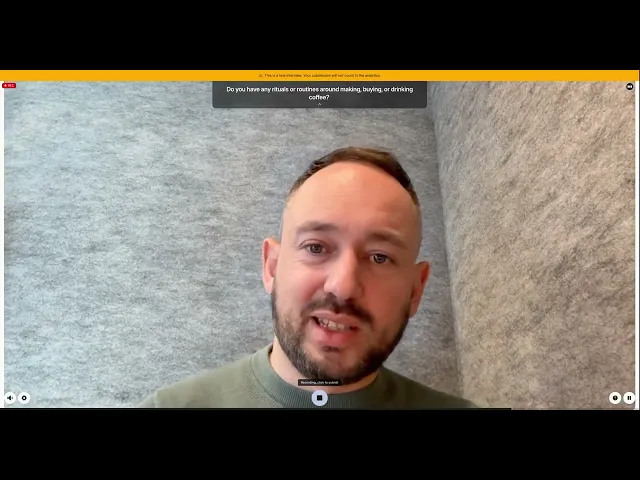
See Conveo's AI moderation in action:
For clients running recurring programs, SOC 2 certification, GDPR compliance, and EU data hosting address the procurement gatekeepers that most point platforms cannot clear. Unlike platforms that deliver study-by-study outputs, Conveo builds an insight library that compounds knowledge across qualitative research studies, so teams create an institutional knowledge base, not just a folder of individual reports.
That compounding effect matters as insights teams are expected to achieve more with the same headcount. Every design principle in this article, from decision-first framing to evidence traceability and timeline compression, is built into Conveo's platform. The result is custom qualitative research that informs in-flight decisions, not just post-mortems.
Frequently Asked Questions
What are custom qualitative research examples?
A SaaS team noticing a drop in trial-to-paid conversion runs targeted interviews with recent trial users to explore where onboarding breaks down and why users disengage. A CPG brand preparing a relaunch tests three packaging concepts to gain insight into the consumer behaviors and attitudes that drive or suppress purchase intent. A B2B company entering a niche vertical conducts a focused qualitative study because the segment is too small for statistically meaningful surveys, yet too important to enter without a real understanding of the customer. Custom qual earns its place when the decision is specific, and the "why" behind behavior matters more than scaled response data.
What is a custom qualitative research sample?
A custom qualitative research sample is a participant group recruited specifically to match the research questions the study aims to answer, rather than drawn from a generic panel. Composition, size, and screening criteria are defined by the qualitative research design: who needs to be in the study, what they need to have experienced, and how many conversations are required to achieve thematic confidence. For a packaging concept test, that might mean 25 participants screened by purchase behavior, responding to adaptive follow-up questions about emotional reactions and purchase intent, with all data collected and analyzed within 3 to 7 days.
How long does custom qualitative research take?
Custom qualitative research traditionally runs 6–10 weeks from brief to report. The research process is time-consuming under manual execution: recruiting and scheduling take 2–3 weeks, sequential interviewing adds 1–2 weeks, transcription and coding take an additional 1–2 weeks, and reporting rounds out the timeline. AI-moderated video interviews change this by removing scheduling overhead and enabling hundreds of conversations to run in parallel. Most studies on AI-moderated platforms are fielded and analyzed within 3–7 days, making research usable for in-flight decisions.
How much does custom qualitative research cost?
Traditional agency custom qual typically costs tens of thousands of dollars per research project, depending on participant volume and deliverable depth. The cost drivers compound quickly: human moderator time, manual transcription and coding, synthesis and reporting labor, and agency margin all accumulate before a single finding reaches a stakeholder. AI-moderated platforms reduce per-study costs by consolidating interviewing, transcription, and qualitative data analysis within a single workflow. Teams report spending up to 50-80% less on research than with agency-delivered qualitative programs, making recurring custom qual viable across a program, not just for one-off studies.
What is the difference between custom qualitative research and syndicated research?
Syndicated research is pre-designed and sold to multiple buyers: category trend reports and tracking studies are common examples. Because the research investment is shared, the per-buyer cost is lower. Custom qualitative research is designed for one buyer to answer a specific business question, drawing on the perspectives and behaviors of a precisely defined audience. A CPG brand can purchase a syndicated category report, but it will not explain why one packaging concept resonates more strongly with its target customers or describe the cultural attitudes and consumer behaviors driving that preference. That requires custom qualitative research built around their specific options, audience, and decision criteria.

About the author
Alex de Hemptinne
Business Impact Lead
Alex is a Business Impact Lead at Conveo, partnering with enterprise teams to embed AI-led research into their workflows. From the first study to full-scale rollout, she helps customers shift from project-based research to continuous customer intelligence.
Meet Alex on film →Qualitative insights at the speed of your business.
Conveo runs AI-moderated video interviews and structures everything they say.