In this article
TL;DR
Multimodal research combines behavioral data, audio, video, and facial expressions into a single analysis layer across multiple modalities, rather than treating each as a separate data stream. When those signals live in different platforms, integration breaks down: transcript platforms miss tone, survey data misses hesitation, and no single output tells the full story. At enterprise scale, multimodal research becomes continuous rather than episodic only when a single platform covers the full workflow from study design to insight delivery.
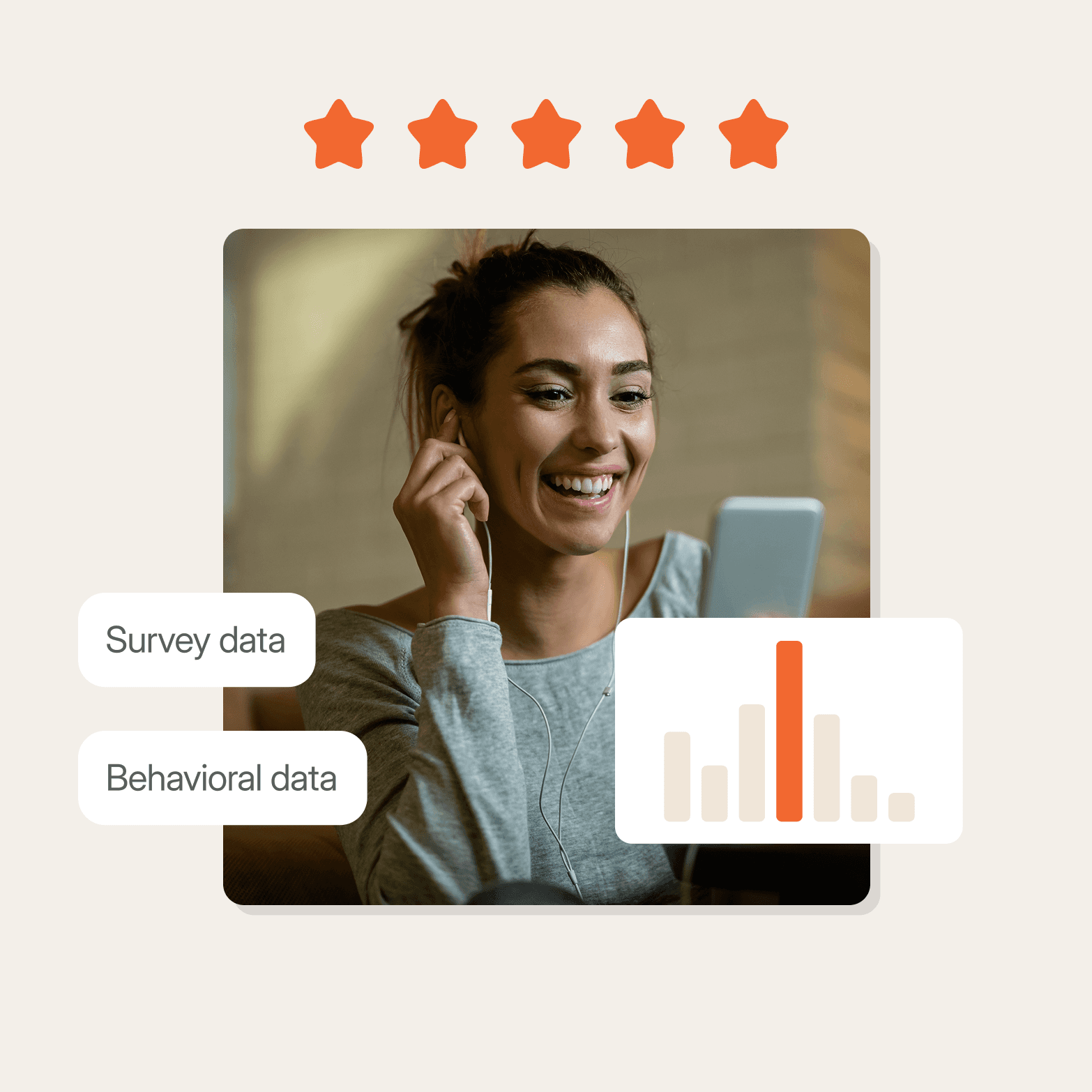
Behavioral data tells you what customers do. Surveys tell you what they say. Qualitative interviews tell you why. Most enterprise research teams collect all three, but very few integrate them.
What is multimodal research?
In recent years, the operational barriers to multimodal research have shifted. For decades, integrating behavioral signals, survey responses, and qualitative interview data required sequential workflows, dedicated analyst time, and timelines that stretched across months. Most enterprise teams settled for partial pictures because genuine data integration was too expensive to run at scale. That constraint has changed.
In the context of enterprise customer understanding, multimodal research is the integration of multiple data types across different modalities: behavioral signals, survey responses, and qualitative video interviews, analyzed together to build a complete picture of what customers do, say, and mean. Not collected in parallel and reported separately. Integrated so that one data stream illuminates another.
Three adjacent definitions are worth separating from this one:
Multimodal AI research
Refers to multimodal model architectures that process multiple input types simultaneously: text, images, audio, and video. That is a data science concept about how AI systems process information, not a market research methodology, and it is not what this article covers.
Biometric and behavioral multimodal research
Is how human behavior research institutions, such as Noldus and Ergoneers, use the term. In behavioral research, this approach combines physiological signals, including eye tracking, EEG, heart rate, and skin conductance, in controlled laboratory settings to understand human behavior. Rigorous, but not the enterprise CMI context addressed here.
Multimethod research
Uses multiple methods in different forms but may analyze and report findings separately. Multimodal research for customer understanding requires synthesis across sources rather than parallel collection.
This article addresses multimodal research as insights and CMI teams encounter it: behavioral signals, survey data, and qualitative video interviews, integrated into findings that hold up to stakeholder scrutiny.
Why organizations struggle to integrate human behavior data
Most enterprise research teams run their behavioral, survey, and interview data through separate systems that were never designed to communicate with one another. Recruitment happens on one platform, moderation on another, transcription on a third, and analysis on a fourth. Manual reconciliation of datasets from separate platforms adds hours of analyst work before synthesis can even begin. The result is that multimodal research, which depends on integrating signals from all these sources, breaks down before synthesis can begin.
Four mechanisms drive this complexity. Traditional qualitative timelines of six to twelve weeks mean multimodal findings arrive after campaign briefs are already locked or product decisions are already shipped. Manual moderation and synthesis create a bottleneck in multimodal analysis because pulling themes across behavioral, verbal, and emotional data is time-consuming when it depends entirely on analyst time. Small insights teams of one to five people cannot run enough interviews to sustain multimodal programs without building a backlog of unanswered stakeholder requests. And surveys, while fast, miss the "why" entirely: relying on a single modality forces teams to choose between speed and the qualitative depth that multimodal programs require.
The downstream consequence is a credibility problem. When stakeholders cannot trace a multimodal conclusion back to a specific participant, a specific moment in a recording, or a specific behavioral signal, they discount the finding. Workflow fragmentation does not slow research down on its own. It undermines trust in what the research produces.
Multimodal research methods: how to integrate data sources
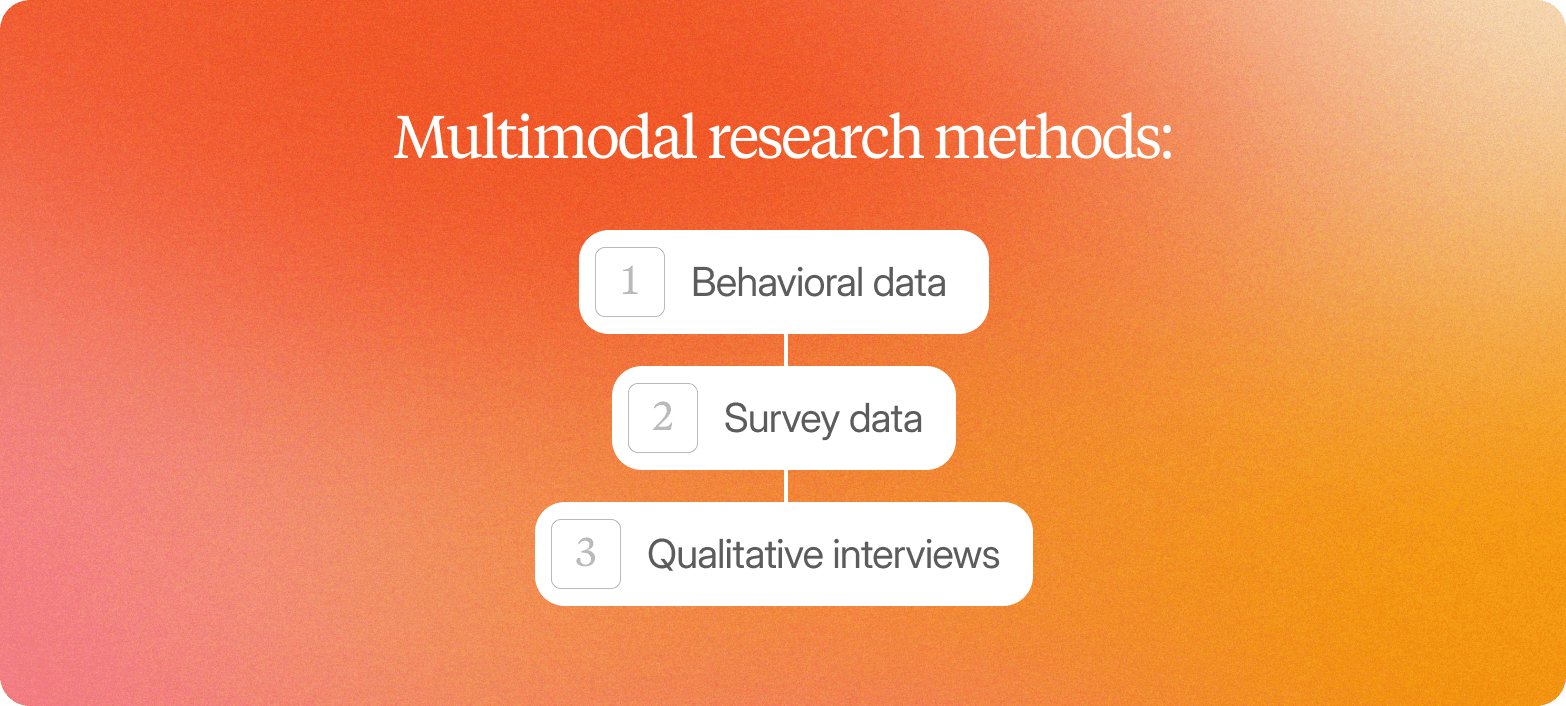
Multimodal research methods combine three distinct data collection approaches: behavioral tracking, structured surveys, and qualitative interviews. Understanding how to do multimodal research well means recognizing that integration across multiple modalities requires workflow automation, not data aggregation after the fact.
Each method contributes complementary information that the others cannot:
Behavioral data
Captures what customers actually do: purchase patterns, feature usage, navigation paths. It is precise and scalable across participant groups of any size, but it cannot explain motivation. A customer who abandons a checkout flow tells you where the problem is, not why it exists. Behavioral data arrives in multiple forms: click streams, session recordings, and transaction logs. No single form reveals intent.
Survey data
Captures stated preferences and sentiment at scale. It can surface contradictions between what customers say they want and what they actually do, but it rarely resolves them. Open-ended survey responses give you words without context.
Qualitative interviews
Supply the missing layer: the "why." Open-ended conversation enables researchers to explore motivations, frustrations, and the ways customers communicate about products in ways that no clickstream or Likert scale can capture. They also allow researchers to probe hesitation in real time, surfacing the nuanced understanding of customer behavior that behavioral data and surveys miss entirely. The tradeoff is time: qualitative interviews are the slowest method in the research cycle.
That tradeoff is the core integration challenge. When qualitative findings arrive weeks after behavioral and survey data, the decision has already been made. Async AI-moderated interviews change that calculus: conversations run in parallel, analysis surfaces within hours, and qual findings reach the team while other data sources remain actionable.
Conveo's parallel async interviewing supports 10 to 1,000 simultaneous conversations, allowing researchers to gather qualitative depth across participant groups without the scheduling overhead that has historically made qualitative research incompatible with fast-moving research programs. Adaptive AI probing in video-first interviews captures the emotional nuance and behavioral context that complement survey signals, delivering deeper insights that make multimodal analysis credible rather than decorative.
What multimodal data analysis looks like in practice
Multimodal analysis, as the term is used on Conveo's platform, means something specific: the AI synthesis of speech, tone, facial expressions, and on-screen objects from real video interviews, combined across different types of data into a single traceable finding. This is distinct from academic multimodal research, which synthesizes aural, visual, and written data modes, and from lab-based sensor fusion platforms that synchronize EEG, eye tracking, and physiological measurements. Conveo operates in a different category, grounded in real human conversations rather than biometric hardware or synthetic outputs.
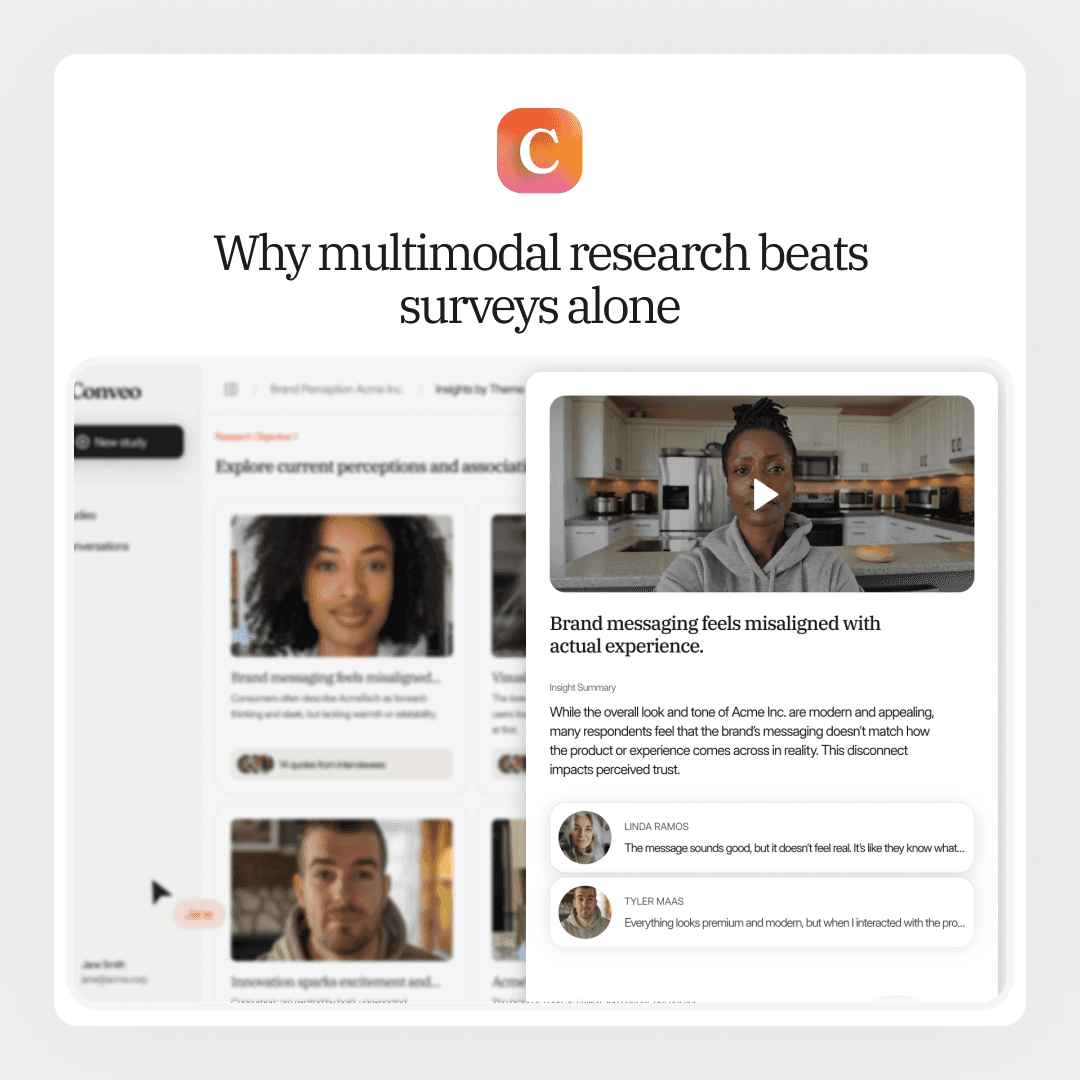
In practice, a multimodal finding in Conveo looks like this: a behavioral pattern visible in participants' responses, quantified across sessions, with video clips and verbatim quotes that surface the underlying motivation. A shift in tone when a competitor brand is mentioned. A facial expression at a price point. Visual data from the participant's environment, such as a product visible on a shelf in the background, that reframes the entire response.
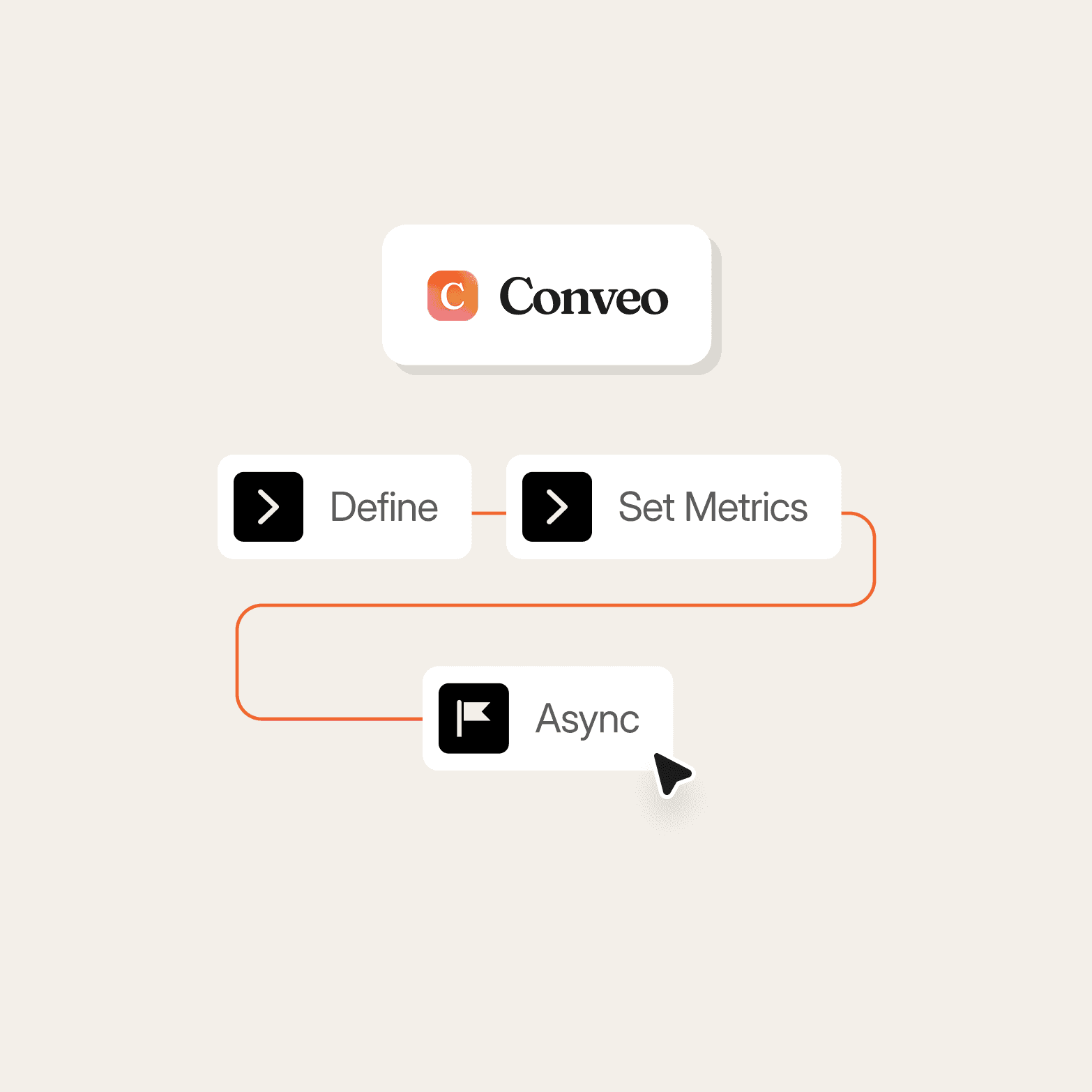
Discover how to build and launch a study in Conveo:
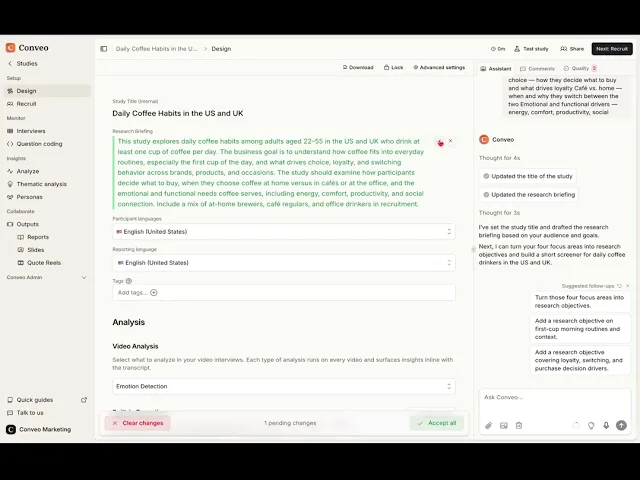
Every finding links back to its source. Stakeholders can inspect the evidence, not read a summary. And because each insight flows into Conveo's searchable library, multimodal patterns compound across studies, building a comprehensive understanding of customer behavior over time rather than disappearing into a deck no one opens six months later.
The multimodal approach in practice: 3 enterprise scenarios
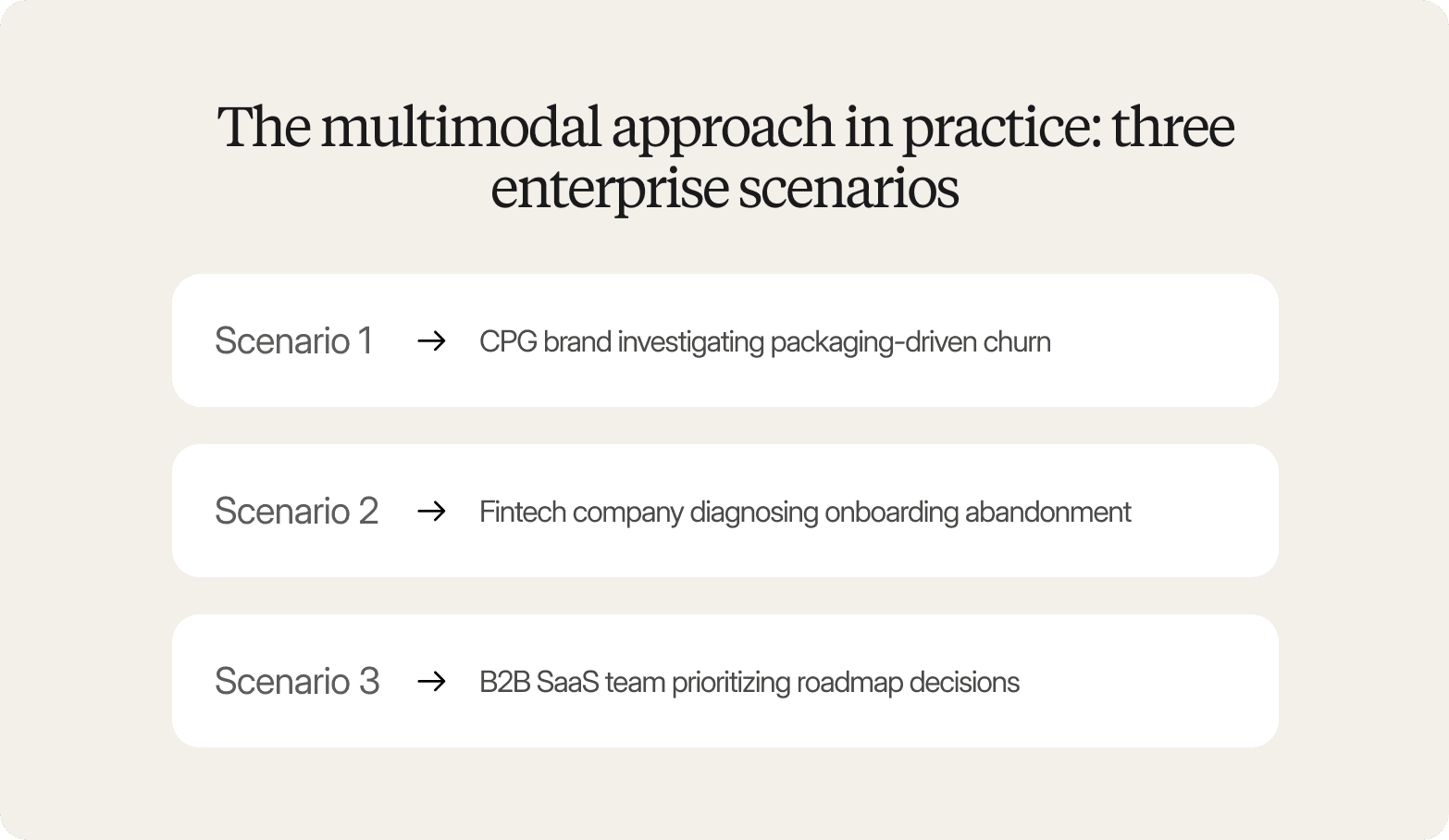
Scenario 1: CPG brand investigating packaging-driven churn
A CPG brand notices its repeat purchase rate declines three months after a packaging redesign. Sales data shows the drop-off clearly. A survey of recent buyers quantifies dissatisfaction: a strong majority rates the new packaging negatively. But neither data source explains why. Running async AI-moderated video interviews through Conveo closes the gap. Participants hold the product in front of the camera and describe their reactions unprompted. Conveo's multimodal analysis picks up consistent tone shifts and facial expressions when the new packaging appears. The interviews reveal how customers process information about brand quality through packaging cues: the redesign signals a cheaper, private-label product. That finding, traceable to timestamped video clips, gives the brand team something actionable rather than a satisfaction score to argue over.
Scenario 2: Fintech company diagnosing onboarding abandonment
Transaction data shows a significant share of new users abandoning onboarding at step three. NPS scores confirm friction. But the specific cause remains invisible until audio and video interviews surface it: the language used to describe identity verification triggers distrust rather than confusion. Participants do not understand what "enhanced verification" means or why it is needed. Conveo's AI interviewer probes on hesitation, capturing the exact phrasing that causes drop-off. That language becomes the brief for a copy rewrite, validated within the same study. The multimodal approach of combining transaction data, NPS scores, and interview insights produces a higher accuracy diagnosis than any single data source could deliver.
Scenario 3: B2B SaaS team prioritizing roadmap decisions
Feature usage logs show low adoption of a newly shipped collaboration module. CSAT scores are neutral, which the product team initially reads as acceptable. Video interviews run in parallel across three user groups tell a different story: the feature solves a workflow problem users had already worked around. They do not need the feature; they need the workaround fixed. The insight library connects this finding to a similar signal from a study run six months earlier, functioning as institutional memory and surfacing patterns across research experiments that teams would otherwise miss. The roadmap decision shifts from optimizing the module to addressing the underlying friction.
How Conveo supports end-to-end multimodal research
The ceiling most teams hit with multimodal research is not a data problem. It is a workflow problem. When interviews live on one platform, transcription on another, and synthesis happens manually in a spreadsheet, the integration overhead consumes time that should go toward analysis. Enterprise teams at Google, FOX, and Bosch use Conveo to close that gap.
"Within days, we had insights that would've taken a traditional agency a month."
Head of Customer Insights, JDE Peet’s
Conveo is a video-first AI research platform that covers the full multimodal research workflow in a single platform: study design, participant recruitment, fraud filtering, incentive management, AI-moderated video interviewing, automated transcription and coding, thematic synthesis, and stakeholder-ready reporting. Each stage feeds directly into the next, so multimodal data from speech, tone, facial expressions, and on-screen behavior is captured and analyzed without manual handoffs between platforms. The technology handles the complexity of integration, bringing signals from various modalities into a single, coherent view.
For teams running research across markets, 50+ language support, vetted global panels, and automated translation make multi-market multimodal programs feasible without extended localization cycles. SOC 2 certification, GDPR compliance, and optional EU data hosting address the procurement blockers that frequently stall multimodal data consolidation at the security review stage.
The cost impact is material: teams using Conveo report up to 50-80% lower research spend compared to agency-delivered qualitative programs. That reduction does not mean cutting scope. It means running multimodal research continuously rather than episodically, because the per-study cost is no longer prohibitive. The insight library serves as a living knowledge base, enabling researchers to evaluate performance across studies rather than recreating the same analysis from scratch each quarter.
The analysis is grounded in real video conversations with real participants. No synthetic participants, no avatar-generated responses, no black-box outputs that stakeholders cannot trace back to source.
Frequently Asked Questions
What is multimodal research?
What is multimodal research? It is the integration of multiple data types, including behavioral signals, survey responses, and qualitative interviews, across various modalities to build a more comprehensive understanding of customer behavior and motivation. It is distinct from multimodal AI (a model-architecture term) and from multimethod research, in which parallel methods run independently without synthesis. The distinction matters in practice: behavioral data shows what customers do, surveys capture what they say, and interviews surface why. When those streams sit in separate systems, each answers a different question in isolation. Multimodal research connects them, so the full story becomes visible.
What are multimodal research methods?
Multimodal research methods combine behavioral tracking, structured surveys, and qualitative interviews into a single integrated program, capturing what people do, what they report, and what they actually mean across all three layers. Integration requires workflow automation, not data aggregation. Stitching together multiple types of data outputs manually after the fact defeats the purpose. The timeline problem is real: traditional qualitative fieldwork runs six to twelve weeks, meaning multimodal findings often arrive after decisions have already been made. AI-moderated voice and video interviews run asynchronously, with insights landing in hours or days. Running 10 to 1,000 conversations in parallel eliminates the scheduling overhead that made multimodal sample sizes across different modalities impractical.
What is multimodal analysis in research?
Multimodal analysis is the synthesis of insights across multiple data types, including behavioral signals, interview transcripts, video recordings, and survey responses, into a unified set of findings rather than parallel reports that teams must reconcile manually. The critical requirement is traceability: every conclusion must link back to source evidence. Stakeholders routinely discount multimodal findings when they cannot verify the origin of a claim. In practice, automated transcription, translation, and thematic coding reduce the time cost of integrating qualitative signals from different sources. When findings are anchored to video clips and verbatim quotes, the analysis becomes auditable: not faster to produce alone, but credible enough to act on.
What is the difference between multimodal research and multimethod research?
Multimodal research and multimethod research are related but not the same. Multimethod research combines more than one data collection method, such as interviews and surveys. But each source is often analyzed and reported separately. The findings sit side by side rather than being synthesized into a single, integrated picture. Multimodal research goes further. It requires that behavioral signals, qualitative depth, and quantitative data be woven together so that each finding is supported by multiple types of evidence simultaneously. One modality is not enough: the human experience of a product or service rarely maps neatly to a single data stream. Insights from other modalities are needed to complete the picture. Multimodal research only delivers its value when synthesis actually happens, which is why workflow automation is the determining factor, not data collection alone.
How do you do multimodal research?
Effective multimodal research requires three workflow capabilities working in concert: parallel data collection, automated synthesis, and traceable outputs. Parallel data collection means running behavioral tracking, surveys, and qualitative video interviews simultaneously rather than sequentially. Compressing these into a single study window eliminates the weeks lost when each method runs as a separate project. Automated synthesis uses AI-assisted transcription, coding, and thematic analysis to integrate signals across various modalities without manual bottlenecks. Instead of a researcher reconciling three separate datasets, themes surface across modalities in a unified view. Traceable outputs link every finding to its source: a video clip, a verbatim quote, a behavioral log. Stakeholders can evaluate conclusions rather than accept summaries on faith. In practice, the enabling mechanism is an end-to-end platform that covers study design, fraud filtering, incentive handling, adaptive video interviewing, automated coding, and stakeholder-ready reporting. When those steps live in one place, the toolchain gaps that break most multimodal programs disappear.

About the author
Niels Schillewaert
Head of Research and Methodologies
Twenty-nine years in consumer research. Niels co-founded Human8 (formerly InSites Consulting), served as president of ESOMAR and teaches marketing at Vlerick Business School. At Conveo he sets the methodology and pressure-tests every feature against real-world research practice.
Meet Niels on film →Qualitative insights at the speed of your business.
Conveo runs AI-moderated video interviews and structures everything they say.