In this article
TL;DR
Patient and HCP research usually runs on separate vendor timelines, so launch decisions are made on whichever dataset arrives first, without reading the two together.
The resulting gap surfaces post-launch, when messaging doesn't match how physicians and patients actually talk about a condition, denting patient satisfaction and slowing progress toward the patient outcomes a launch was built to support.
Running both audiences inside one continuous research program lets teams read patient and prescriber understanding together, at the decision point, so pharmaceutical companies can act on findings while a decision is still open.
Every finding traces to a timestamped participant clip a medical affairs reviewer can replay, so medical affairs and market access teams can verify evidence before launch materials lock.
A searchable insight library means findings from one indication or market carry forward to the next, instead of every launch starting from zero.
Pharmaceutical market research has long run on two separate tracks: patient studies commissioned through one vendor, HCP studies through another, each with its own timeline and research methodologies, delivered into the same launch meeting weeks apart. Pharma teams rarely get patient and prescriber data back at the same time, so they build positioning calls and messaging hierarchies around whichever dataset lands first.
If patient unmet needs arrive before prescriber attitudes, the program gets shaped around patient language. If HCP barriers surface later and contradict that framing, the team is already committed.
The consequence often stays hidden at first. It surfaces months post-launch, when field teams report that approved messaging doesn't match how physicians discuss the condition with patients, eroding patient satisfaction and commercial success alike. By then, the research that could have caught the gap sits in two separate decks, too old to act on, a familiar failure mode across the pharmaceutical industry.
A more useful approach keeps both audiences in one continuous pharmaceutical market research program, so patient and professional insights can be read together at the point of decision. That integrated approach is what lets life sciences organizations turn research into a genuine competitive advantage.
Why patient and prescriber research runs on separate timelines
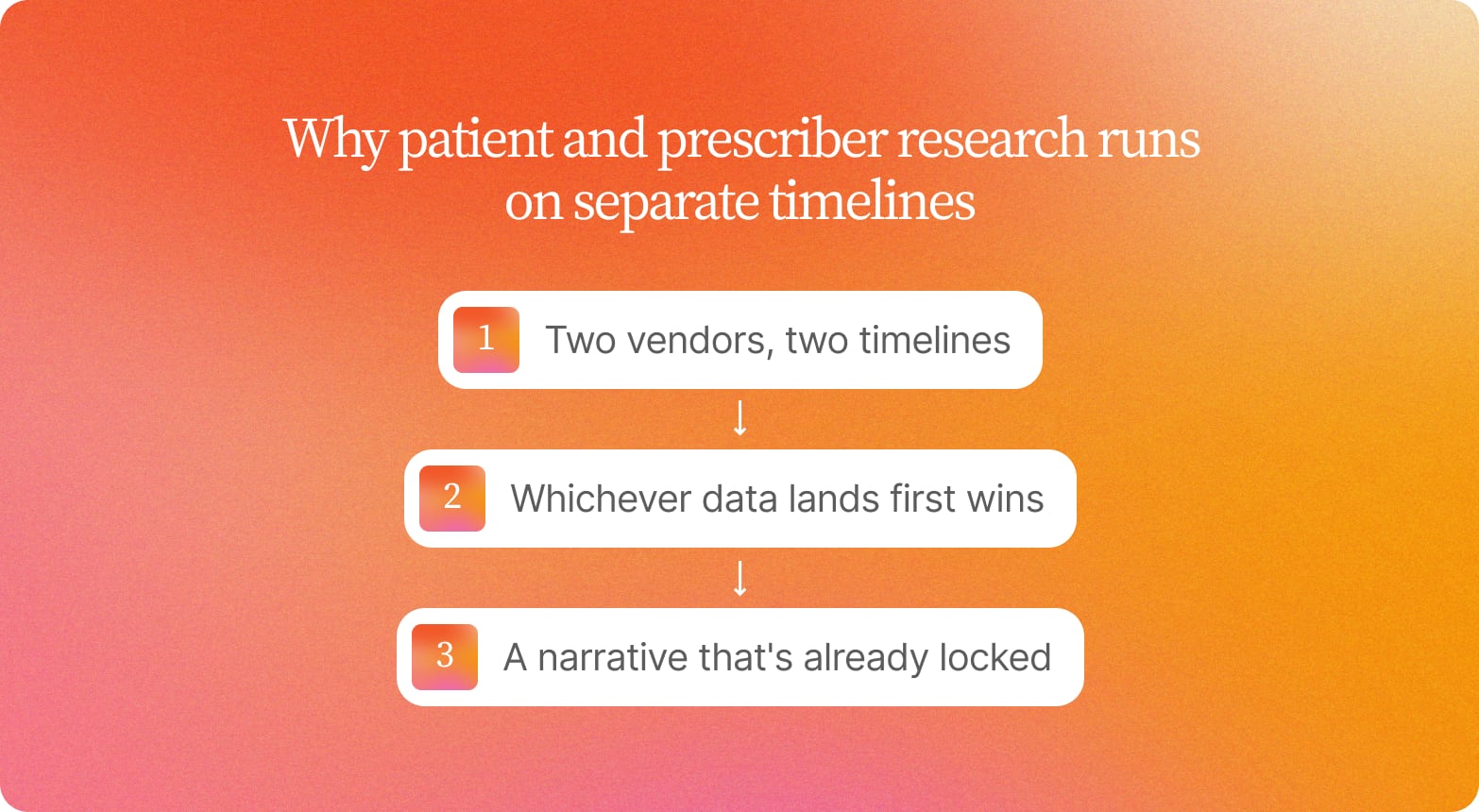
1. Two vendors, two timelines
Traditional agency-led qualitative research runs one audience at a time: an HCP study gets scoped, fielded, and analyzed, then the patient study begins. Each commonly takes 6 to 12 weeks through a standard healthcare market research company, and the two are rarely commissioned in parallel because budgets and timelines often differ. Conducting research this way turns a single research process into two independent projects with separate research objectives.
2. Whichever data lands first wins
Whichever findings arrive first shape the strategy for the target market. A positioning team locks messaging based on HCP interviews confirming clinical differentiation resonates, treating that as final. Patient interviews, still in the field, eventually surface a different picture: adherence barriers the messaging doesn't address, or a treatment experience that doesn't match the journey the brand assumed.
3. A narrative that's already locked
By the time both data sets exist in the same room, the launch narrative is already drafted. Patient needs and prescriber beliefs are never held against each other while the decision is open, so the wider competitive landscape gets read through a partial lens. That structural gap is where positioning misfires begin.
What gets lost when patient and HCP insights arrive separately
When patient and HCP research run as separate workstreams, months apart, four things tend to break down:
Persona credibility. Personas built in internal workshops look credible until a medical affairs director asks which patient said that. With separate workstreams, the team can't answer with confidence, because nobody ever read both sets of findings together.
Missed contradictions. Sequential pharmaceutical market research can't surface the contradictions that matter most. Prescribers may point to cost as the main adherence barrier, while patients interviewed separately describe pill burden instead. Both findings say something a single-audience view would miss, but in separate reports, the tension goes unexamined.
No evidence trail. When studies are fielded months apart, teams can't trace a claim back to a timestamped participant clip or to real-world evidence a medical reviewer or market access stakeholder can verify. "Patients report low motivation to continue" becomes an assertion nobody can check.
An invisible patient-access gap. Launch readiness gets assessed on a partial picture: prescriber beliefs on one side, patient experience and patient care realities on the other. The gap between them, and its implications for patient access, stays invisible until health outcomes data arrives later.
How continuous programs keep both audiences in one system
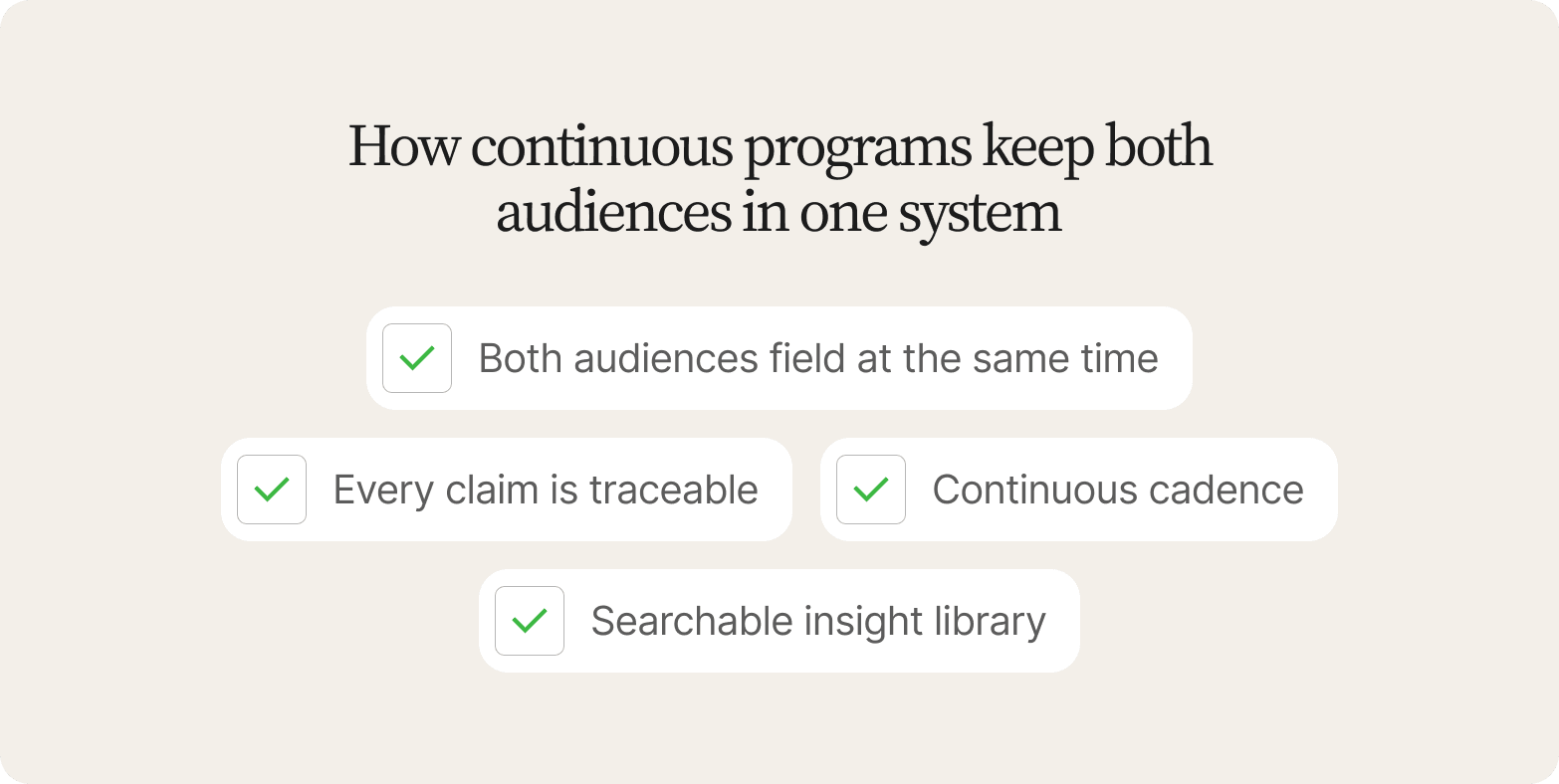
1. Both audiences field at the same time
Traditional pharmaceutical market research runs HCP and patient workstreams as separate vendor engagements sequenced across months, a pattern most healthcare firms have come to accept, even as market dynamics shift underneath the plan.
For pharma teams, Conveo is the layer where patient and HCP understanding accumulates across launches. Conveo runs asynchronous video depth interviews with both audiences simultaneously, replacing the scheduling logistics of in-person panels or focus groups with a single, continuous data-collection process. Both workstreams field in parallel, and findings arrive together before decisions lock, so teams have nothing to reconcile after the fact.
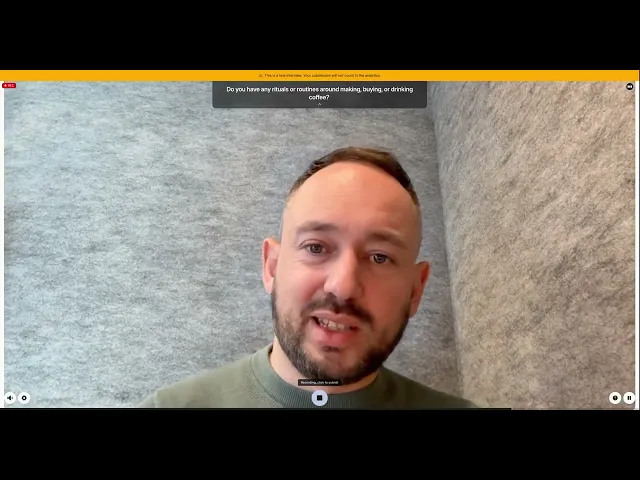
2. Every claim is traceable
Every claim links to timestamped participant video, so medical affairs and regulatory teams can verify the source of any insight before it shapes a decision. That traceability meets the evidence standards pharma teams require for positioning, labeling, or commercial strategy.
3. A continuous cadence with Conveo StoryLines
For teams that need this cadence to repeat across a launch lifecycle, Conveo StoryLines runs continuous, wave-based research, for example every two weeks or monthly, so patient and HCP understanding stays current as treatment guidelines, reimbursement, market trends, and prescribing behavior shift, instead of aging out between studies.
4. A searchable insight library that compounds
The searchable insight library compounds that value across launch cycles: clips, themes, and verbatims stay organized and retrievable by therapy area, indication, and audience, so teams don't rebuild understanding from scratch each time a new market opens. What's learned in one launch informs the next.
| Traditional sequential research | Conveo's continuous, parallel model | |
|---|---|---|
| Timing | HCP and patient studies fielded months apart | Both audiences fielded at the same time |
| Evidence trail | Findings summarized in separate decks | Every claim links to timestamped participant video |
| Multi-market fielding | Regions closed one at a time before synthesis | Markets field in parallel across 50+ languages |
| Reusability | Each study starts from zero | Findings carry forward via a searchable insight library |
The result is a decision advantage sequential research can't match: patient and professional understanding read together, at the point a decision is taken.
Research governance in pharma primary research
What pharma research requires
Pharma primary research carries requirements other categories treat as optional: informed consent documentation, adverse event reporting, and language fidelity across markets. In a healthcare sector this tightly regulated, these are operational prerequisites.
How Conveo's architecture supports it
Conveo is SOC 2 Type II certified, GDPR compliant, EU hosting (Belgium). Every session produces timestamped video and a verbatim transcript, grounded in real participants instead of synthetic proxies. Every finding traces back to a real person who said it.
That auditability matters beyond the research team: legal, compliance, and medical affairs can review the full evidence base before launch materials lock.
Pharmaceutical competitive intelligence as a research input
What secondary sources miss
Secondary sources tell you a competitor gained three points of prescribing share last quarter. Pharmaceutical competitive intelligence built on desk research alone can't tell you why an HCP switched, and it rarely captures what key opinion leaders tell colleagues in private. Prescribing databases and analyst reports show the movement; they can't surface the hesitation a physician voiced before changing their default, or the workaround a patient invented because an adherence program was too cumbersome to enroll in, a patient access problem hiding in plain sight.
What primary research reveals
Primary research closes that gap. When HCPs and patients speak in their own words, the language, pauses, and frustrations they show reveal what secondary sources can only approximate.
In a representative scenario, interviews reveal that a competitor's adherence program is widely recognized among HCPs but rarely recommended, since enrollment requires three separate patient calls to complete. That finding is invisible in market share data. It's the kind of pharma competitive intelligence that reshapes how a commercial team positions its own patient support offering and prices around that program.
Why this compounds across launches
The compounding benefit matters as much as the individual study. When competitive findings are stored in a searchable insight library instead of a one-off deck, they stay reusable across indications and launch cycles. A team preparing a new indication launch can query what HCPs said about a competitor's patient support model two years ago and carry that understanding forward without commissioning research from scratch.
Why this matters for launch decisions
Always-on, paired patient-and-HCP understanding is the foundation. Everything else here is what makes that foundation trustworthy enough to build launch decisions on:
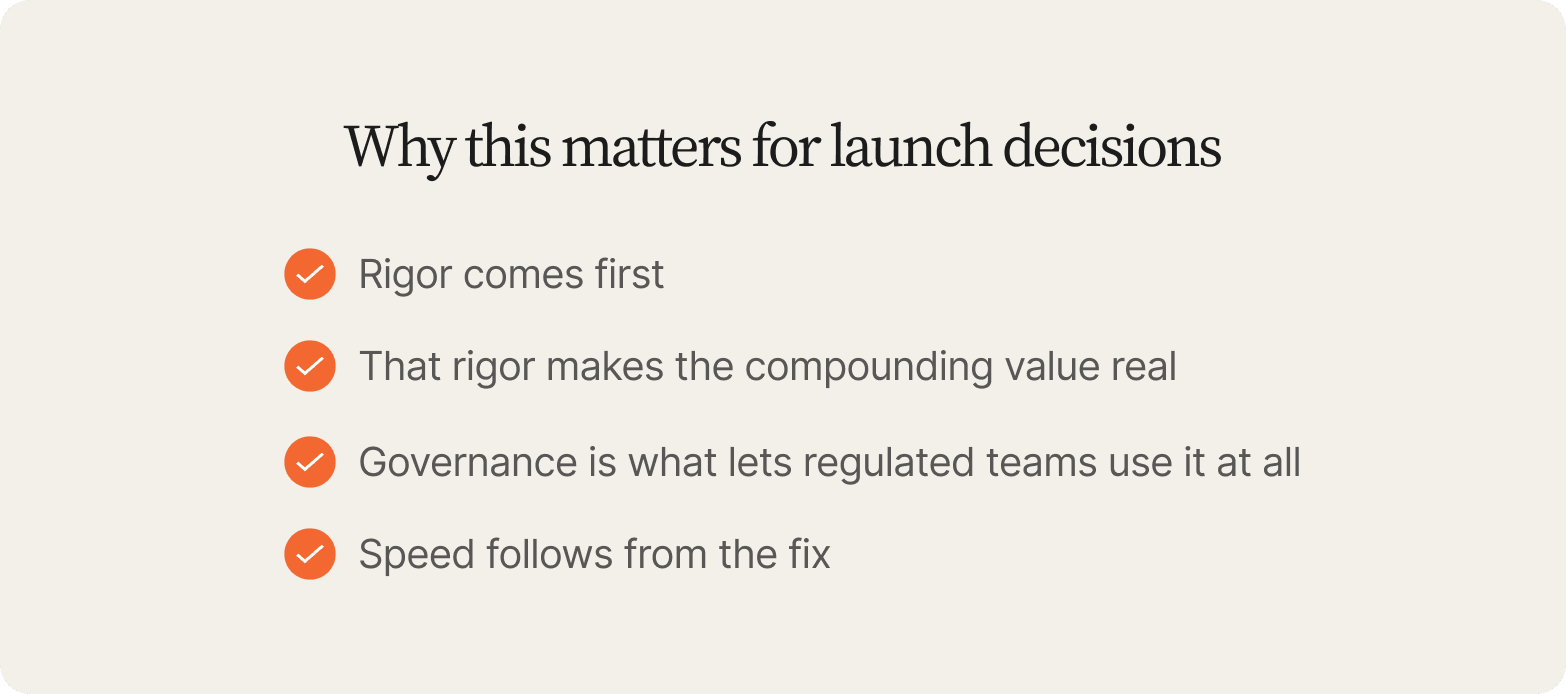
Rigor comes first. Every finding traces to a timestamped participant clip a medical affairs reviewer can replay, which is why legal, medical affairs, and market access can sign off.
That rigor makes the compounding value real. A searchable insight library only matters if what's in it can be trusted each time it's queried.
Governance is what lets regulated teams use it at all. SOC 2 Type II certified, GDPR compliant, EU hosting (Belgium).
Speed follows from the fix. Running both audiences in parallel is real, and it follows from solving the sequencing problem.
"The analysis is instantaneous. I can synthesize all the data, and also go back and watch every interview. You can ask it to challenge your own thinking. It's so easy to talk to your data."
Dafydd Jones, Associate Director, Ninth Seat
Frequently asked questions
What are examples of pharmaceutical market research?
Common examples include HCP adherence barrier studies, patient journey mapping for rare disease, cross-market launch readiness research, and medical market research alongside active clinical trials or later stages of drug development. Each is defined less by method than by the decision it informs. In a representative adherence study, interviews at the 90-day mark reveal that non-adherence stems from pill burden and a lack of felt progress, with cost and forgetfulness playing little part, a finding that changes the intervention entirely. A patient journey study might inform patient support program design and related healthcare products before a launch budget is committed. A cross-market readiness study surfaces regional label claim concerns that would otherwise surface post-launch. One set of well-designed interviews can populate personas, jobs-to-be-done frameworks, and mental models simultaneously, work that otherwise requires commissioning each as a separate study.
How long does pharmaceutical market research take?
Agency-led qualitative research in pharma typically runs 6 to 12 weeks per audience, so findings arrive after brand positioning or launch sequencing decisions are already locked. Multi-market work compounds the problem: sequential waves across regions before synthesis can add months to a program that was already too slow. Asynchronous AI-moderated video depth interviews change the cadence because data analysis begins while fieldwork is still running. Cross-market studies that once required sequential fielding can run as a single parallel wave, with synthesis happening continuously instead of after every market closes. Findings arrive while the launch decision is still open.
What is the difference between primary and secondary pharmaceutical market research?
Primary research collects original data directly from HCPs, patients, or caregivers through interviews, surveys, or observational studies, spanning both quantitative research and qualitative data collection. Secondary research analyzes existing sources, such as claims databases, prescribing trends, or published literature. Secondary research shows what happened; primary research explains why. Secondary data might reveal a drop in patient adherence at 90 days; only primary research, through quantitative data or qualitative interviews, surfaces whether the cause is pill burden, lack of felt progress, or cost pressure. Teams lose ground when they treat primary findings as single-use. A searchable insight library keeps primary research reusable across therapy areas, so a team investigating adherence barriers in one indication can draw on prior findings instead of restarting from zero.
How do you ensure research rigor in AI-moderated pharma studies?
Behavioral segmentation, grounded in triggers, objections, and decision criteria, produces defensible personas that insights teams can act on. Demographic archetypes built around age or job title stay generic. Probing logic matters as much as structure. Advanced analytics can help surface patterns across transcripts, but they do not replace good probing. Depth interviews should surface concrete sticking points: what made an HCP pause before prescribing, what workaround a patient uses when a regimen feels unmanageable, what risk they fear but rarely voice in a clinical setting. Traceability is the governance standard: every persona attribute links to a timestamped quote from a real participant, verifiable by anyone who replays it.
Can pharmaceutical market research run across multiple markets simultaneously?
Multi-market pharma research has traditionally run in sequential waves: one region closes before the next opens, commonly adding 8 to 12 weeks before cross-market synthesis can begin. By the time a global picture emerges, launch timelines have often moved. Teams can field studies in parallel across 50+ languages, with transcription and multilingual analysis running as each conversation closes, so a program extends its reach without adding fieldwork time. Themes surface continuously across markets, so a US finding can be compared against a German or Japanese equivalent within the same study cycle. Global launch readiness can then be assessed on integrated understanding instead of a patchwork of staggered regional reports.
What resources are available on pharmaceutical market research?
Conveo's resource library covers pharmaceutical market research: multi-market study coordination, evidence standards for regulatory-adjacent decisions, and persona refresh cycles that keep a target audience's needs current. Personas older than roughly six months tend to drift from clinical and patient reality, particularly where treatment guidelines and reimbursement landscapes shift quickly. A current understanding of patients and prescribers produces more timely insights and, for life sciences teams, stronger strategic decisions in launch windows measured in months.
About the author
Florian Hendrickx
Head of Growth
Florian is Conveo’s Chief Growth Officer, leading growth strategy and go-to-market execution as the company scales. He’s held growth leadership roles at companies like Deliverect, Robovision, and Aikido Security, and brings hands-on experience across marketing, sales, and product.
More by Florian →Qualitative insights at the speed of your business.
Conveo runs AI-moderated video interviews and structures everything they say.