
TL;DR
Personas built from internal workshops collapse the moment a stakeholder asks, "Where did this come from?" They can't point to a real participant.
Credible personas are behavioral segments traced to real conversations, not demographic archetypes or psychographic guesses.
Traditional research methods take 6 to 12 weeks through an agency, so teams rarely refresh personas before they drift from reality.
Synthetic AI personas repeat the workshop failure: confident language, no traceable evidence.
Video-first qualitative research compresses persona development from months to days while keeping every claim linked to timestamped participant evidence.
Market research personas are behavioral customer profiles built from real qualitative interviews, not demographic guesses, used to guide product, marketing, and research decisions. Built on internal assumptions rather than real conversations, they rarely survive stakeholder scrutiny. The moment someone asks "where did this come from," a workshop-derived persona has no answer. It can't point to a participant, a recording, or a verbatim quote. It points to a sticky note from six months ago.
The operational problem is real. Teams need market research personas to guide product decisions, marketing strategies, and campaign development. But traditional research runs 6 to 12 weeks through an agency, costs more than most teams can justify on a recurring basis, and produces findings that arrive after the decisions they were meant to inform have already been made.
So teams default. They run internal workshops, synthesize survey data, and produce persona documents that feel like marketing fiction: named fictional characters with stock photography and bullet points no one can trace back to a real conversation. Stakeholders use them until someone challenges the evidence base, and then the personas quietly fall out of use, replaced by outdated ones that no longer describe the target audience they were built for.
The shift happening now directly changes that trade-off. Video-first qualitative research compresses persona development from months to days, while keeping every claim traceable to timestamped participant evidence that stakeholders can inspect themselves.
What Are Market Research Personas?
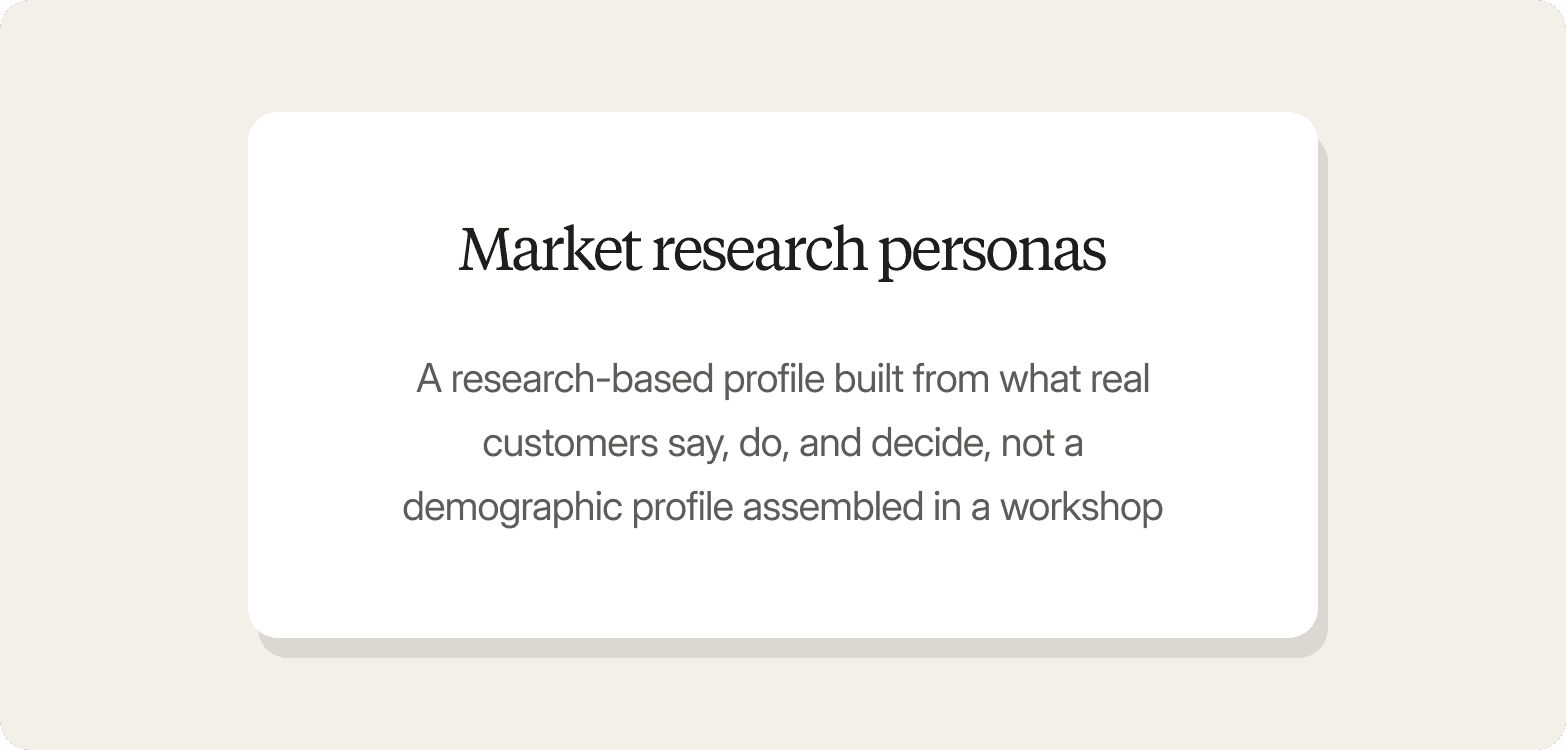
A market research persona is a research-based profile built from what real customers say, do, and decide, not a demographic profile assembled in a workshop. The distinction matters because demographic splits (age, income, region) describe who customers are, while behavioral data describes how they decide: what triggers a purchase, what creates hesitation, what language they use when something isn't working. Persona market research starts with those behavioral patterns and recruits participants specifically to pressure-test them, rather than projecting assumptions onto a slide and calling it done.
Three persona types serve different marketing efforts:
Buyer personas focus on the purchase decision: who holds budget authority, what criteria they weigh, and what objections slow the process.
User personas focus on product interaction and user needs: how real users actually use something day-to-day, where friction accumulates, and what workarounds they invent.
Marketing personas focus on messaging and positioning: which messages resonate with the intended audience, which claims fall flat, and which emotional drivers shape category perception.
Most products need two to five distinct personas in total, defined by genuine behavioral differences rather than arbitrary demographic cuts.
What personas are not is equally important to establish. They are not psychographic guesses dressed up as research, and they are not static personas built once and referenced never. Unlike traditional personas assembled from assumptions, credible personas are grounded in real conversations. When stakeholders can watch a participant say something in their own words, the persona holds up in meetings. When it cannot be sourced, it gets treated as opinion and usually discarded.
3 Reasons Most Personas Fail Stakeholder Scrutiny
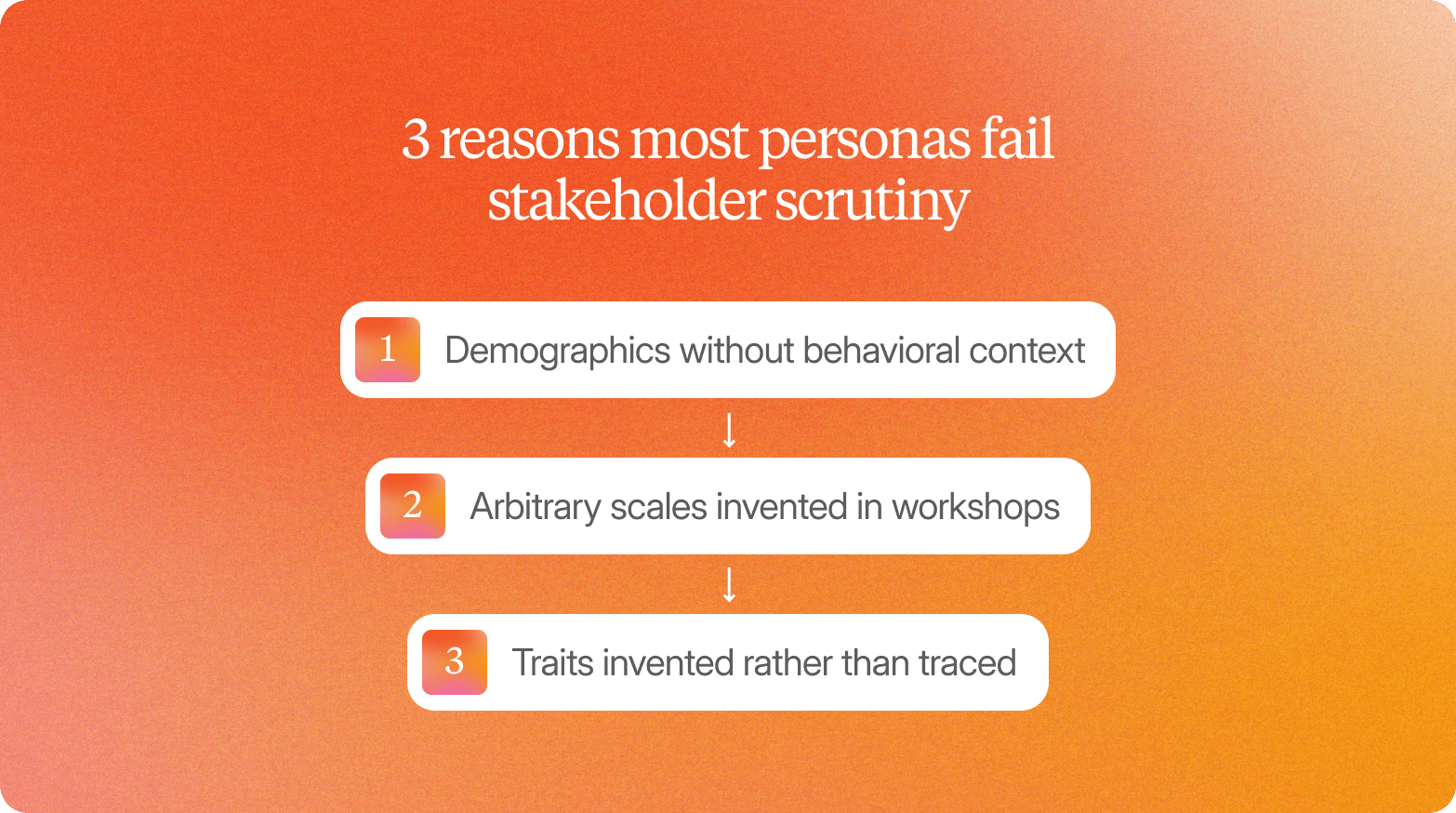
Most personas don't survive their first serious stakeholder meeting. A brand director asks where the "tech-savvy millennial" insight came from, and the researcher has to admit it came from a workshop rather than a customer conversation. At that point, the persona stops being evidence and becomes opinion. Opinion doesn't drive budget decisions or protect market share.
Three failure patterns appear repeatedly:
Demographics without behavioral context
Knowing that your primary buyer is 34 to 45 with a household income above $80K tells you almost nothing about why they chose your product over a competitor's. Age and income describe who someone is, not how they decide, and they say nothing about customer needs.
Arbitrary scales invented in workshops
A "7/10 tech-savviness" rating sounds precise until a stakeholder asks what participant evidence produced that number. In most cases, none did. The team agreed on a number in a room, working from incomplete data rather than real data.
Traits invented rather than traced
Psychographic attributes like "values authenticity" or "seeks self-improvement" often reflect how a brand wants to see its customers, rather than language that appeared in real interviews. When these traits can't be linked to a source, they read as marketing copy rather than customer intelligence.
Workshop-based personas are fast to produce but fragile under scrutiny. They collapse when stakeholders ask the one question they can't answer: who actually said this?
The problem compounds over time. Most persona market research has a 6- to 12-week lag with traditional methods, which means teams rarely refresh them. In practice, static snapshots of the customer become stale within about six months as market dynamics and customer expectations shift, but the research cycle makes updating them impractical. Teams keep using outdated personas they no longer fully trust.
The Traditional Persona Research Bottleneck
Persona market research sits at the center of a structural timing problem. Traditional research methods that produce the depth of personas typically require one-on-one interviews, moderated discussions, and ethnographic observation, and are typically run through agencies on 6- to 12-week cycles. By the time findings arrive, the campaign brief has already been written, the roadmap has already been prioritized, and the segment assumptions baked into both have gone untested.
The alternative most teams reach for is surveys. They're fast and scalable, but they flatten the signals that make personas useful. A survey can tell you that 62% of respondents prefer convenience over price. It cannot tell you that three participants visibly hesitated before answering, or that they described "convenience" in ways unrelated to the product team's definition.
Hesitation, workarounds, contradictions, and the unscripted language customers use to describe their own behavior: that's the material from which personas are built. Surveys don't capture real-world behavior, only fresh data points stripped of context. The cost structure compounds the problem: for a single qualitative study through an agency, making continuous persona maintenance financially impractical. Most teams run one or two foundational persona projects per year, then rely on those outputs far longer than the underlying customer behavior warrants.
This isn't a failure of effort. Insights teams are often running more research than their headcount can realistically support, serving product, brand, marketing, and sales teams simultaneously. The bottleneck is structural: the methods with the most depth are the slowest and most expensive to run, and the methods fast enough to keep up with decision cycles are too shallow to build reliable personas from. Collapsing that tradeoff, delivering depth at the speed of the decision cycle, is exactly what video-first research is built to do.
"Within days we had insights that would've taken a traditional agency a month"
— Head of Customer Insights, JDE Peet’s
How to Build Evidence-Based Market Research Personas
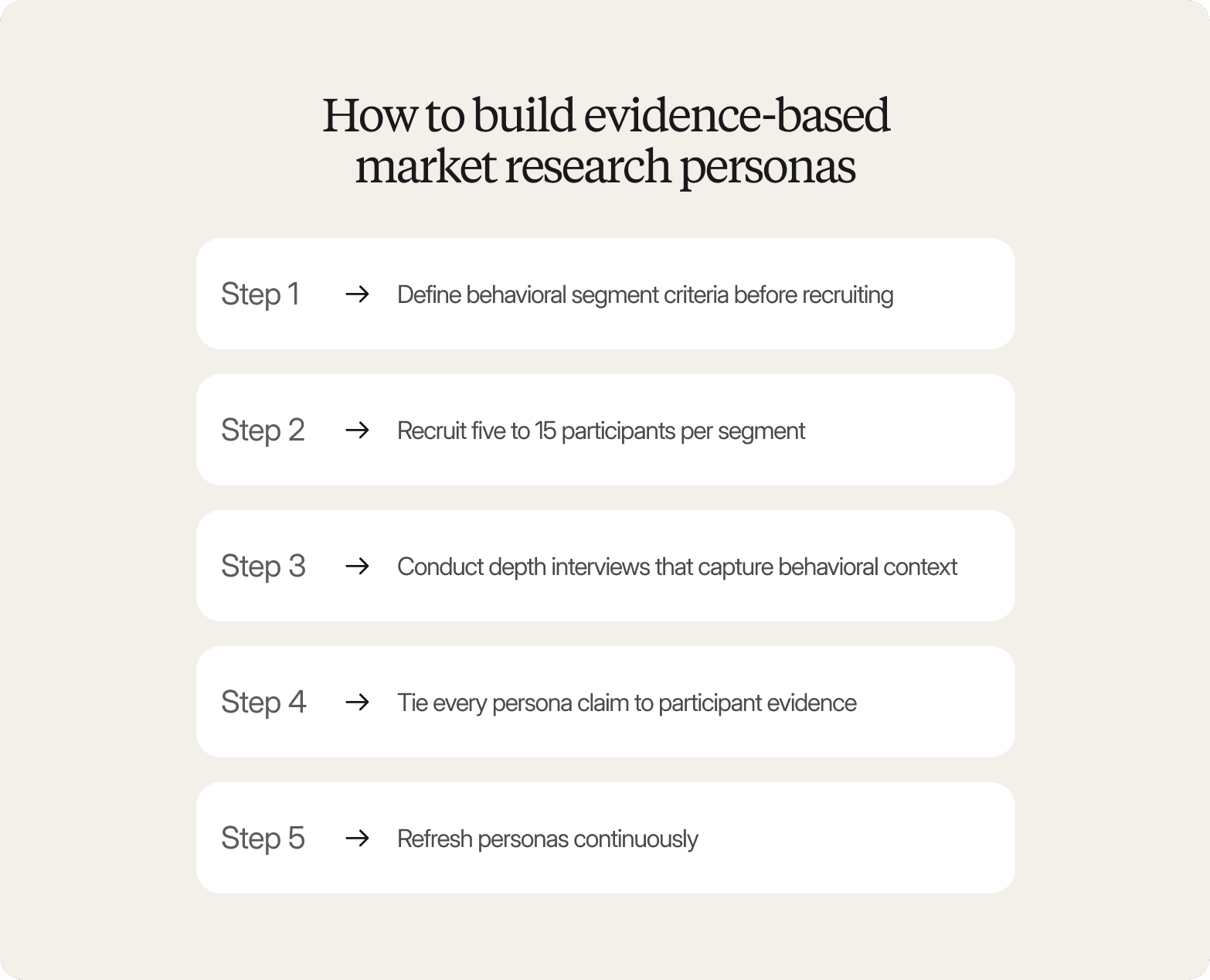
Building market research personas that hold up to stakeholder scrutiny starts with a decision most teams get wrong: defining your customer segments before you recruit, not after. Most products need two to five personas grounded in how customers actually make decisions: which channels they use, which risks they weigh, and which workarounds they've built. Demographic splits like age, income, or job title are a starting point at best. Behavioral criteria are what separate data-driven personas that guide decisions from personas that decorate slide decks.
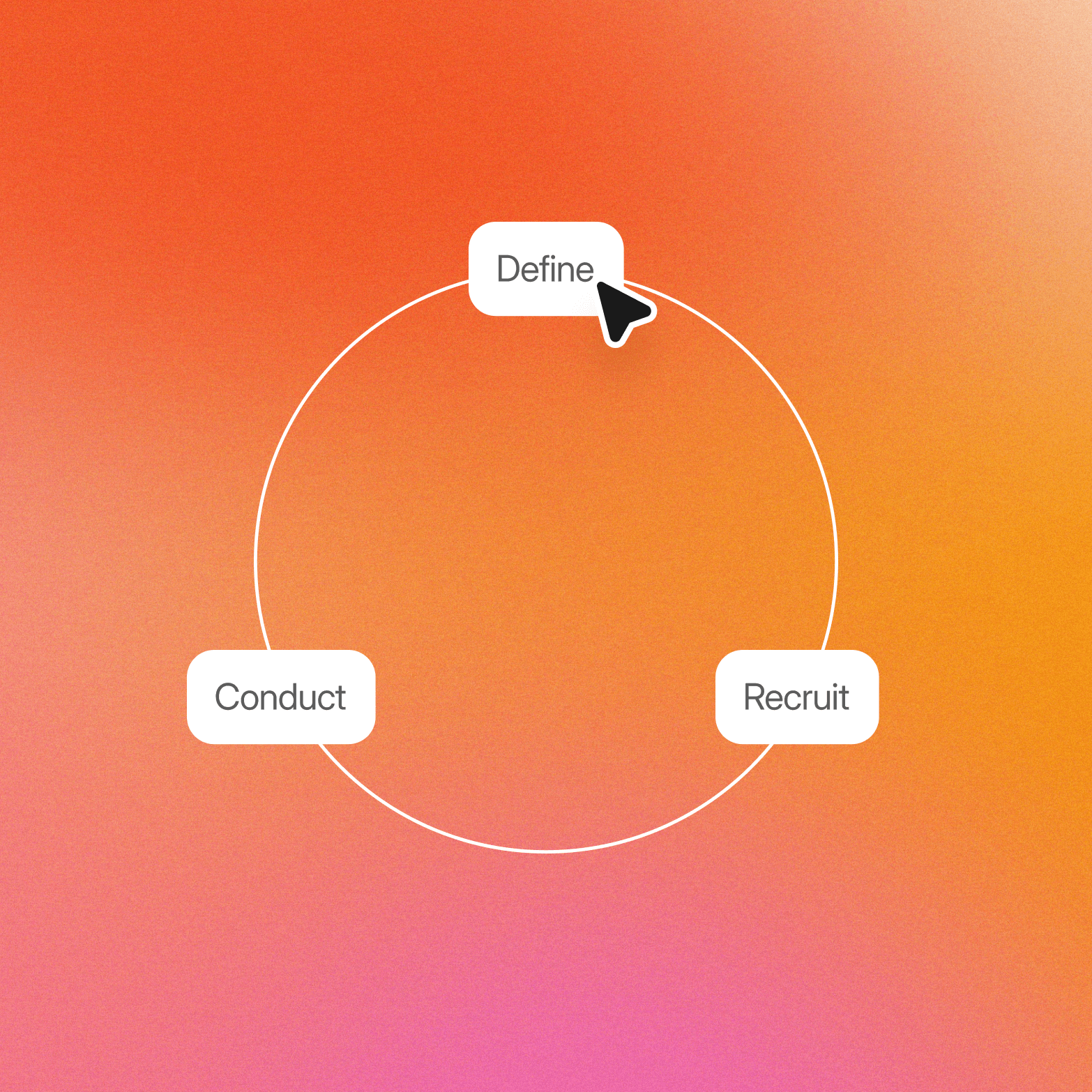
Step 1: Define behavioral segment criteria before recruiting
Identify the decision-relevant differences between your specific audience segments first. Are some buyers price-anchored while others prioritize speed? Do some evaluate alone while others build consensus? These distinctions shape whom you recruit and help brands understand which part of the target market each conversation represents.
Step 2: Recruit five to 15 participants per segment
That range is sufficient to identify behavioral patterns when segments are defined upfront. Saturation happens faster than most teams expect when the criteria are specific.
Step 3: Conduct depth interviews that capture behavioral context
Surface preferences are not enough. Interviews need to probe hesitation points, workarounds, decision criteria, and the reasoning behind choices. "What made you pause before committing?" produces more useful data than "What do you value in a product?"
Step 4: Tie every persona claim to participant evidence
Each behavioral attribute, pain point, and decision criterion should link to a timestamped quote or video clip. If a claim cannot be traced to a specific participant, it is an assumption, not a finding, and it will not produce actionable insights.
Step 5: Refresh personas continuously
Behavior-driven personas built from interviews conducted more than six months ago start to drift from reality. Markets shift. Customer language changes. Treating persona creation as a one-off deliverable rather than a living asset is where most persona programs quietly fail.
One practical advantage of structured depth interviews is that a single set of conversations can simultaneously populate personas, jobs-to-be-done frameworks, mental models, and empathy maps. Teams that run separate studies for each framework spend two to three times as much as they would if they ran a single study, only to find that the findings often contradict one another because they were collected at different times by different participants.
Video-first qualitative research compresses this entire process from months to days. When interviews are conducted asynchronously on video, analysis can begin while the final sessions are still running. Behavioral themes surface across transcripts, tone, and facial response together, so the synthesis that once took weeks of manual review becomes available within days of fieldwork closing, with every claim traceable back to the original recording.
AI Personas in Market Research: What Works and What Doesn't
The use of artificial intelligence in persona creation has grown sharply over the past two years. AI persona market research platforms now span everything from LLM-generated respondent profiles to fully synthetic focus group simulations. AI personas market research tools promise speed, cost savings, and the ability to pressure-test ideas before committing to a full study. But the category contains a fault line that experienced researchers need to understand before it becomes a procurement problem.
There are two distinct types of AI involvement in persona work, and conflating them is where teams get into trouble:
1. AI that assists human researchers, with human oversight built in
Automated transcription, thematic clustering, sentiment analysis, and searchable insight libraries that surface relevant findings from prior studies. Machine learning algorithms and predictive modeling accelerate the workflow without replacing the evidence base. When a researcher asks, "How did our target audience describe their morning routine across the last six studies?" an AI research assistant that retrieves answers from real customer data is doing genuinely useful work. The output is traceable, auditable, and grounded in real customer conversations.
2. AI that replaces real participants entirely
Synthetic respondents, hallucinated behavioral profiles, and persona generators, sometimes marketed as digital twins, that produce consumer archetypes from AI models trained on internet text rather than real human input. Synthetic respondents can overstate purchase intent or replicate training biases, and polished interfaces may conceal underlying uncertainty, encouraging overconfidence among stakeholders.
When a CMI director presents findings to a C-suite audience, and someone asks, "Can I see the actual interview where this came from?", a synthetic persona has no answer. There is no video, no voice, no traceable moment. The finding collapses under basic scrutiny. This is the same credibility failure that workshop-based personas have always produced: a plausible-sounding profile built from assumptions, not evidence, now with more confident language attached.
Video-first qualitative research addresses this directly. Every finding links back to a real participant, a real recording, and a real moment in a real conversation. That traceability is not a feature. It is the foundation of stakeholder trust. Conveo, a video-first AI research platform, is built for exactly this requirement: real voice and video conversations rather than synthetic outputs, and machine learning applied to real behaviors rather than guessed ones.
AI belongs in the research workflow. It does not belong in the participant chair.
How Video-First Research Changes Persona Validation Timelines
The speed-versus-credibility tension in persona research is a structural problem, not a planning one. Traditional agency timelines run six to twelve weeks because every step depends on the one before it: recruitment closes before moderation begins, moderation finishes before analysis starts, analysis wraps before reporting can be drafted. That sequencing is where time disappears.
Conveo resolves this by removing the dependencies that create the bottleneck. Participants receive a link and complete their session on their own schedule, so interviews span time zones without calendar coordination. Hundreds of conversations can run in parallel, so a team refreshing market research personas across three customer segments doesn't have to choose which audience segment gets attention first. The work happens simultaneously.
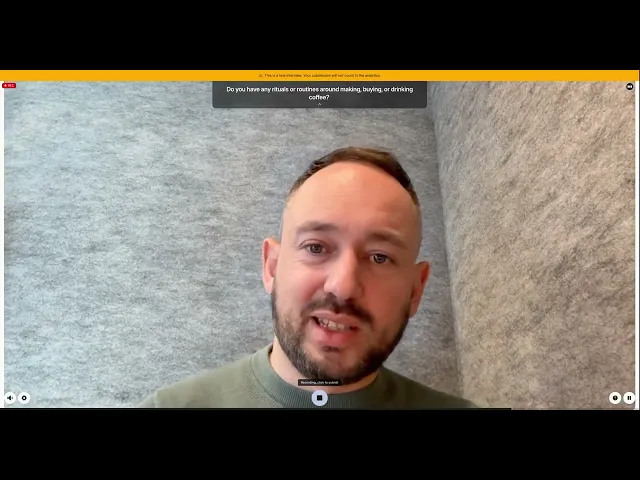
What participants produce isn't just a transcript. Conveo's AI moderation captures voice, video, and tone, then ties every theme and finding back to timestamped video clips and verbatim quotes. When a stakeholder questions whether a persona claim reflects real-world behavior, the evidence is one click away, not buried in a moderator's notes.
For multi-country programs, Conveo supports AI moderation in 50+ languages, which removes the localization delays that typically extend international audience research by weeks. Findings accumulate in a searchable insight library, so interview clips, themes, and participant quotes remain reusable across future studies rather than expiring when the deck is filed.
Enterprise procurement requirements are also addressed: Conveo is SOC 2-certified and GDPR-compliant, with EU regional data hosting. Enterprise-grade compliance remains rare among the AI-research entrants flooding the category, which is why these credentials matter: they prevent persona research programs from stalling during legal review before they even start.
3 Market Research Personas Examples
The three market research persona examples below show what behavioral segmentation looks like when it's built from real interview data rather than workshop assumptions. Each is a representative scenario, not an actual Conveo client result.
Persona | Industry | Behavioral Segment Criteria | Key Decision Driver |
The Habitual Repurchaser | CPG / Personal Care | Buys on autopilot, rarely reads packaging, reacts negatively to reformulation | Category trust built over years of consistent experience |
The Compliance-Constrained Buyer | Financial Services | Evaluates products through a risk lens first, features second; delays decisions pending internal sign-off | Perceived regulatory exposure, not product capability |
The Solo Power User | B2B SaaS | Runs advanced workflows independently, avoids team onboarding, evaluates platforms by depth of configurability | Whether the platform respects existing expertise without forcing a simplified experience |
The Habitual Repurchaser exists as a distinct individual persona because repurchasers and trial-driven buyers look identical in demographic data: same age, same income bracket. But they respond to new marketing in opposite ways. Reformulation or packaging changes trigger disproportionate churn in this specific audience segment, a pattern that only surfaces when you probe the emotional logic behind purchase routines in real conversations.
The Compliance-Constrained Buyer is distinct from a standard "cautious buyer" because the hesitation is institutional rather than personal. Interviews consistently surface language around auditability and internal approval chains that surveys never capture. Treating this customer segment as simply "slow to decide" results in messaging that addresses the wrong friction and fails to refine it for the actual buying committee.
The Solo Power User diverges from the "team adopter" segment not by job title or company size, but by the moment they decide a product is worth their time. That trigger, finding a capability that matches their mental model rather than simplifying it, only becomes visible through moderated interviews.
The common failures across all three would be personas built on demographics without behavioral context, satisfaction scales that produce arbitrary segments with no recruiting logic, and psychographic labels invented in workshops rather than traced back to verbatim interview evidence. Not all personas are created equal: a persona that cannot be used to write a screener will not improve a study.
Where Conveo Fits
Persona credibility comes down to one question: when a stakeholder challenges a claim, can you show them where it came from? That is the requirement Conveo is built around, and it's the strategic advantage that separates dynamic, evidence-based profiles from static snapshots assembled in a workshop.
Because Conveo is a video-first AI research platform, several things follow directly:
Every persona attribute traces to a timestamped video clip and verbatim quote, so a challenged claim is answered with a real participant's own words, not a moderator's paraphrase.
AI moderation runs hundreds of conversations in parallel across 50+ languages, which makes it feasible to refresh personas continuously rather than once a year.
Findings compound in a searchable insight library, so each study makes the next one faster rather than starting from zero.
Every finding grounds in real participants rather than synthetic respondents, so the personas hold up in the C-suite meeting where synthetic profiles fall apart.
SOC 2-certified and GDPR-compliant, with EU data hosting, clearing the procurement bar that stalls most enterprise research programs.
See it in action: How AI-Moderated Video Interviews Actually Work →
Conveo is not the right fit for teams that only need a quick directional pulse and don't require traceable evidence, or for programs with no stakeholders who will ever ask to see the source. Where persona claims must withstand scrutiny, traceability is the difference.
Frequently Asked Questions
What are AI-generated market research personas?
How reliable are AI-generated personas compared to traditionally built ones?
Can AI personas replace real customer interviews?
How do you make AI-generated personas credible to stakeholders?
How often should personas be refreshed?
How many participants do I need to build credible personas?