In this article
TL;DR
Healthcare market research findings often arrive after the decision they were meant to inform has already been made, usually because clinical-claims review timelines are applied by default to routine consumer behavior questions.
Four core research methodologies (depth interviews, focus groups, surveys, and ethnographic research) answer different questions; most healthcare industry insights programs need more than one.
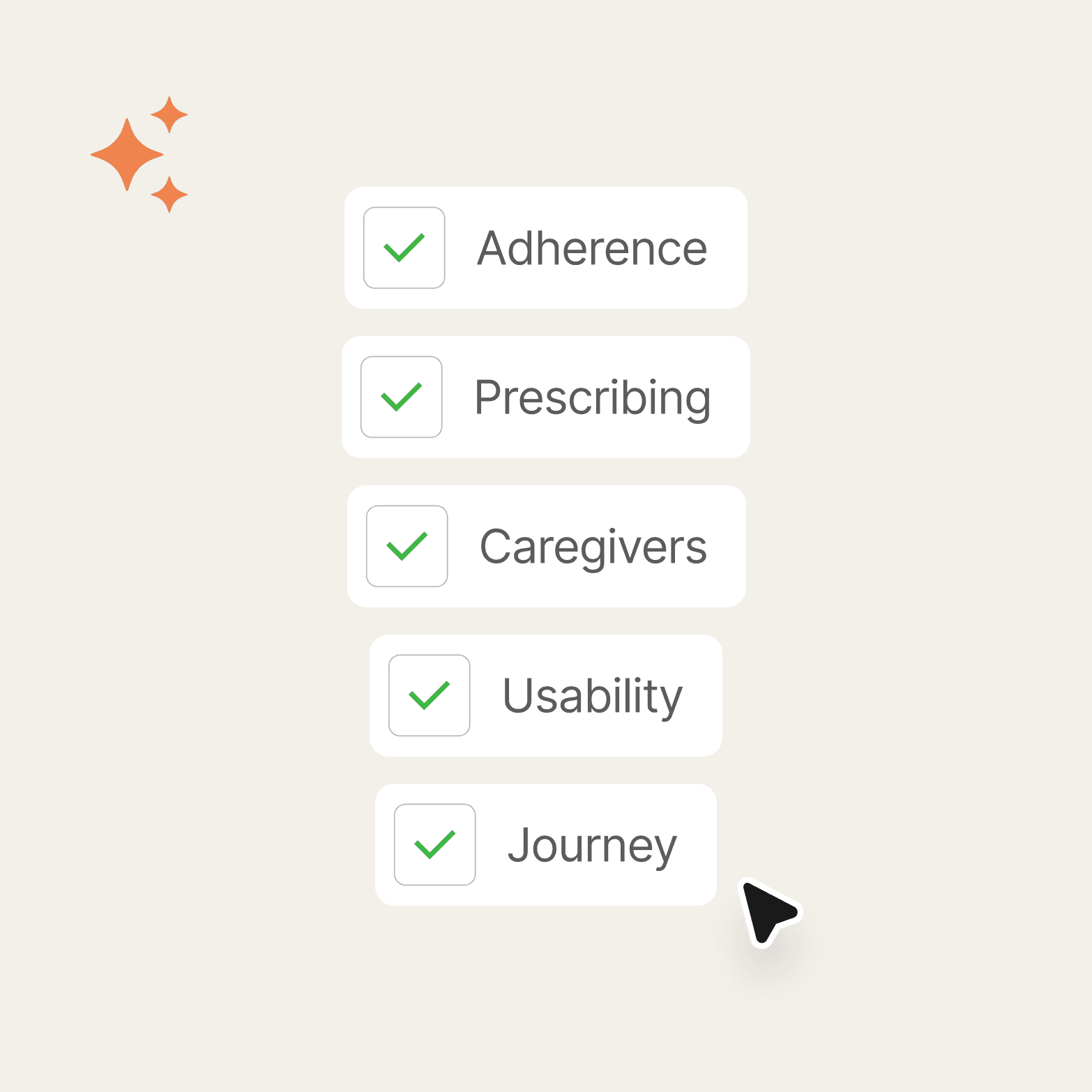
Pharma and insurance insights teams use the same primary-research toolkit for different commercial questions: personas, message testing, adherence barriers, and journey mapping for pharma; member drop-off, care navigation friction, and switching drivers for insurance.
A documented scope, reusable consent and discussion-guide templates, and evidence-backed traceability let teams separate routine consumer-understanding work from studies that genuinely require clinical review, without adding compliance risk.
Continuous, wave-based programs (Conveo StoryLines) keep that consumer understanding current instead of letting it go stale between projects.
By the time healthcare market research findings arrive, the decision they were meant to inform has often already been made. Clinical review timelines designed to govern regulated claims work get applied to consumer behavior research by default, and routine questions about patient experience or adherence drivers commonly wait 8 to 12 weeks for clearance that was never required. The packaging call gets made, the messaging gets locked, and the patient experience initiative moves to implementation without the consumer input it needed. The research was accurate. It was just late.
Most healthcare insights teams across the healthcare sector have no established pathway to separate consumer understanding work from medical-claims research, so every study routes through the same governance queue, built for one kind of work and now handling all of it. The resolution is a cleaner separation in practice: running consumer health conversations continuously within an existing governance framework, so routine understanding keeps moving while studies that genuinely require clinical review get the attention that process was designed for.
What healthcare market research is and why it matters
Healthcare market research systematically collects and analyzes perspectives from patients, clinicians, caregivers, and payers to inform product, clinical, and commercial decisions. It answers questions that claims data and market sizing reports cannot: why patients abandon a therapy after six weeks, how healthcare providers weigh clinical evidence against formulary constraints, what a caregiver actually needs when navigating a complex treatment protocol. Those answers determine whether a healthcare product launch lands, whether a disease awareness campaign changes behavior, and whether a brand team is building for the right person.
Insights teams use healthcare market research to surface unmet patient needs before a brief is written, identify adherence barriers before a campaign is built, validate messaging before it reaches a sales force, and map the patient journey before a product enters a new market. Research that arrives after those decisions are made rarely changes them. Research that arrives while decisions are still open shapes them.
Secondary research covers what is already known: market sizing, competitive intelligence, clinical trial data, claims analysis. Primary research generates what is not yet known by going directly to patients and consumers living with a condition, healthcare providers who diagnose and prescribe, and caregivers who manage treatment day to day. Each group holds a different piece of the understanding, and missing any one leaves gaps that secondary data alone cannot fill.
This article focuses on primary research methods and the execution models available to enterprise insights teams: how to design studies around clear research objectives for each participant type, where traditional approaches create timeline and scale constraints, and what changes when research moves toward a continuous read of the market.
Core healthcare market research methods
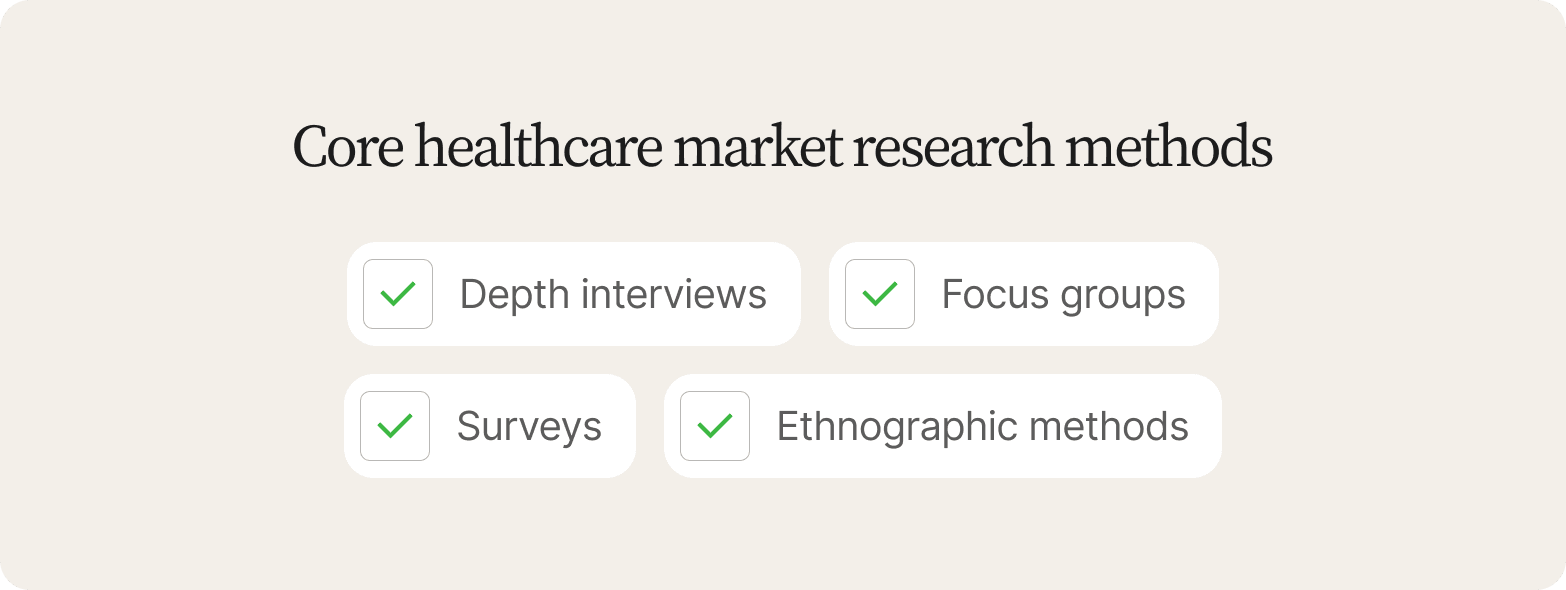
The research question determines which research methodologies to use. Exploratory work calls for depth interviews or focus groups. Validation work calls for quantitative research such as surveys or concept tests. Behavioral observation calls for ethnographies or in-home visits, where the key factors behind a behavior often surface first. Most programs use more than one method, and synchronous scheduling is usually the first constraint teams run into.
| Method | Best for | Main constraint |
|---|---|---|
| Depth interviews | Understanding the reasoning behind a behavior | Synchronous scheduling with clinicians and patients |
| Focus groups | Concept testing and shared-experience topics | Self-censoring and dominant voices in group settings |
| Surveys | Quantifying prevalence and confirming patterns | Reveals what's happening, not why |
| Ethnographic methods | Observing context-dependent behavior directly | High operational cost to coordinate |
Depth interviews
One-on-one conversations with patients, healthcare providers, or caregivers remain the workhorse of healthcare qualitative research. Sensitive topics, medication side effects, financial strain, and care burden surface in individual conversations that participants would not raise in a group setting. In pharmaceutical research, depth interviews with HCPs are particularly valuable for understanding prescribing decisions and the logic behind treatment switching. The challenge is operational: synchronous scheduling with clinicians and patients drags timelines, and traditional agency research services typically run four to six weeks from recruitment through synthesis, longer when conducting research that requires specialist clinicians. Asynchronous, AI-moderated video interviews remove that scheduling constraint: participants respond on their own time, which is why teams increasingly use this format for the same depth-interview questions.
"Even if you're doing dozens of in-depth interviews, multiple focus groups, you get those interesting nuggets and insights. But then you take them to the client and there's always a sense of: is this really a trend? It's very hard to validate, and very hard to demonstrate the difference between an important trend and a one-off anomaly."
Fergus Navaratnam-Blair, VP Trends and Futures, NRG
Focus groups
Group discussions work well for concept testing, message validation, and exploring shared experiences, such as caregiver support networks or patient community norms. The social dynamic surfaces reactions one-on-one settings sometimes suppress. The tradeoff is well documented: participants self-censor on sensitive topics in group settings, and dominant voices can skew findings toward the most confident speaker. Recruitment, facility booking, moderation, and reporting run faster than depth interviews but are still too slow for decisions that cannot wait.
Surveys
Surveys quantify prevalence and confirm patterns: what share of patients stop taking medication within 90 days, how adherence varies by age group. In insurance research, member surveys and claims validation are common tools for monitoring patient satisfaction and plan satisfaction. This is where quantitative data earns its keep, but analyzing survey results alone doesn't reveal the reasons behind the behavior. A survey can tell you that a large share of patients discontinue a medication within 90 days; it cannot tell you whether that's driven by side effects, cost, dosing confusion, or a conversation with a family member. Qualitative data has to come first.
Ethnographic methods
In-home visits, shop-alongs, and in-home usage tests reveal context-dependent behaviors that interviews and surveys miss entirely, giving teams a deeper understanding of real-world behavior rather than reported behavior. Discharge instructions that make sense in a clinical setting can become confusing at home, where patients manage multiple medications and have no one to ask follow-up questions. Operational costs, recruitment, field visits, video review, and synthesis reflect the real complexity of coordinating in-context observation.
Pharmaceutical market research: 4 commercial questions and study designs
Pharmaceutical market research connects commercial questions to study designs across four core use cases, each answering a different question for a different stakeholder.
1. Segment and refine personas
Teams that define behavioral segment criteria before recruiting avoid the most common persona failure: post-hoc segmentation that groups participants by demographics rather than how they actually make decisions. When teams define screening criteria upfront, 5 to 15 participants per segment often proves sufficient to surface stable behavioral patterns. Evidence-backed personas link to timestamped clips and verbatim quotes, so stakeholders can check the claims themselves and act on insights with confidence.
2. Concept and message testing
Teams test product positioning, pricing strategies, DTC messaging, and HCP detail aids against real consumer preferences ahead of launch: show the stimulus, probe for comprehension, then draw out objections before they surface in market. Traditional concept testing through an agency commonly takes four to six weeks; Conveo can field 100 interviews in 3 days, letting a team test more iterations in the time it previously took to test one.
3. Access and adherence barriers
Surveys confirm drop-offs are happening; studies across chronic conditions show a substantial share of patients stop taking medications within the first 90 days, but not why. Depth interviews surface the specific reasons, which commonly include:
Pill burden
No visible progress
Cost
Dosing confusion
Patient access barriers
Side effects never mentioned to a prescriber
A patient support program built to address cost won't move the needle if the actual barrier is that patients don't feel the medication is working, and a program built to increase access won't help if the real barrier was never access in the first place.
4. Patient journey mapping
Journey maps trace the patient experience from symptom onset through diagnosis, treatment initiation, and ongoing patient care, combining depth interviews with patients and caregivers with clinician interviews to understand handoffs neither side sees clearly alone. The output is a visual map showing decision points and the specific moments when patients disengage, and where intervention programs have the highest leverage on patient outcomes.
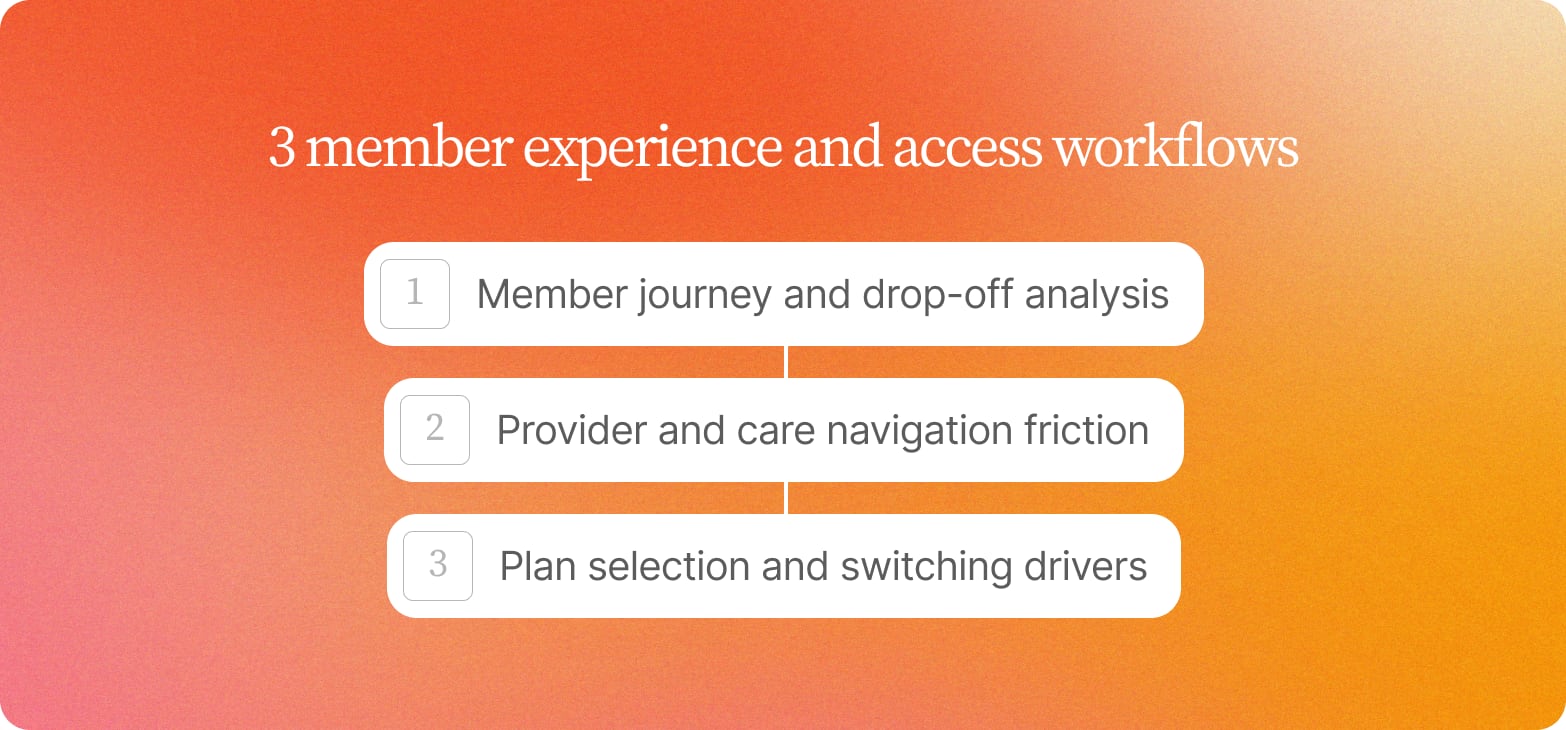
Insurance market research: 3 member experience and access workflows
Insurance market research covers how members experience their health plan, from the first attempt to use coverage through the friction points that erode trust to the decision to stay or switch.
1. Member journey and drop-off analysis
Portal analytics and claims data can show where workflow abandonment happens: a payer can see that a significant share of members start a prior authorization request and never complete it, but not why. Depth interviews fill that gap, surfacing friction such as:
Forms that demand re-entry of already-documented information
Phone trees that disconnect after 20 minutes on hold
Portal sessions that time out before a member locates the right form
The output is a journey map naming each drop-off point and the specific barrier behind it.
2. Provider and care navigation friction
Finding an in-network provider, understanding what a referral requires, and knowing whether a procedure is covered are tasks members find harder than they should be. Depth interviews with members and focus groups with care navigators surface the mental models people bring to these tasks and the workarounds they develop when official channels fail, informing portal redesigns, navigation scripts, and directory improvements.
3. Plan selection and switching drivers
Surveys quantify switching rates; depth interviews explain the triggers behind them, which often include:
A premium increase that arrived without explanation
A coverage gap discovered only at the point of care
A claim denial that broke trust in a way no retention email could repair
How healthcare research inherits clinical review timelines
Most healthcare research teams operate with a single review queue for every study. Whether the work involves clinical efficacy claims or a straightforward patient experience interview, it routes through the same legal, medical, and regulatory (LMR) process because no established pathway separates the two.
That queue governs promotional materials subject to FDA oversight and studies making clinical efficacy claims. Research into consumer behavior, why patients abandon a regimen, and how caregivers evaluate options doesn't carry the same regulatory risk, but without a separate clearance pathway, teams can't act on that distinction. The result: routine questions commonly wait 8 to 12 weeks for clearance that was never required, and by the time findings return, the decision has already closed.
Recruitment compounds the problem. Traditional depth interviews depend on synchronous scheduling across time zones, clinic hours, and limited patient availability; a single wave of 20 one-on-one interviews often takes four to six weeks before a transcript is read. The effect goes beyond delay: when a study's cost is measured in months of clearance and scheduling overhead, teams learn to stop asking, and decisions get made without consumer input simply because the process makes it easier to proceed without it.
How to separate consumer understanding from regulated claims work
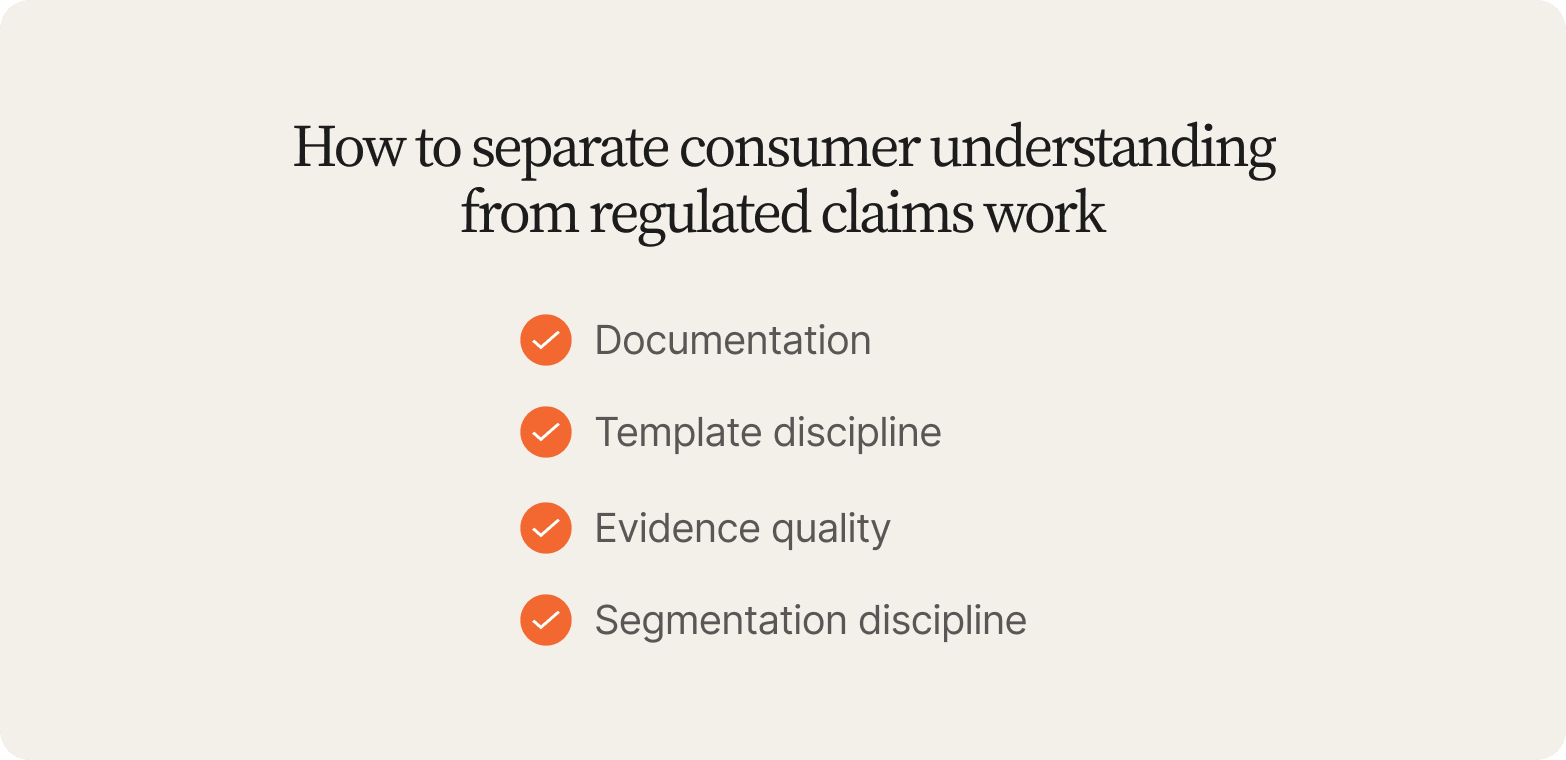
The guardrail comes from how you scope a study. Studies framed as consumer behavior research, exploring experience, adherence, and perception, sit in a different lane from studies testing promotional materials or clinical efficacy. Teams that set clear research objectives and define study scope at the outset keep routine work out of the queue that needs clinical scrutiny and get more precise insights in return.
Documentation
Before a study launches, record in writing that it doesn't make or test promotional claims or involve regulated materials. A brief, consistent scope document compliance teams review once covers recurring studies.
Template discipline
Legal- and compliance-approved consent forms and discussion guides can be reused across waves without triggering a full LMR review each time. The investment happens once.
Evidence quality
Timestamped video recordings and verbatim transcripts create audit trails that satisfy compliance without requiring clinical-grade review for every wave. When a stakeholder questions a finding, they can watch the clip and read the exact words.
Segmentation discipline
Define behavioral segment criteria before recruitment starts. Post-hoc segmentation produces personas that look compelling but can't be acted on, and undefined populations create scope ambiguity that compliance teams resolve conservatively, often by escalating a basic consumer question into a full review.
With Conveo, teams run consumer health conversations at the cadence the business needs, inside whatever framework they've already established, so routine understanding doesn't queue behind studies that genuinely need regulatory review. Studies run as asynchronous video depth interviews with AI-moderated probing and AI synthesis, with full traceability to timestamped clips and verbatim quotes for stakeholder verification.
Credibility standards for healthcare qualitative research
Healthcare insights teams lose credibility the moment a persona or finding can't be traced back to a real patient, clinician, or caregiver recording. Clinical teams, commercial leaders, and regulatory reviewers challenge findings they can't verify themselves, often with the same question: "How do we know this is representative?" When that can't be answered with a direct reference to source material, the finding either gets dismissed or triggers a follow-up survey to validate what the qualitative work already established. Both outcomes waste time and erode confidence in the insights function.
The standard is traceability: every theme, persona claim, and behavioral pattern should be linkable to timestamped video evidence, verbatim quotes, and observable signals, the kind of real-world evidence that a claims database can't produce on its own. With Conveo, teams keep every theme and persona claim traceable to timestamped video clips, verbatim quotes, and advanced analytics covering speech, tone, and facial cues, so stakeholders can gain insights and verify evidence themselves without re-watching hours of recordings.
Evidence-backed personas also need continuous refresh to stay useful. In practice, interviews older than roughly six months drift from current patient and clinician language and behavioral norms; a persona built on last year's oncology interviews may no longer reflect how that population describes side effects today. A searchable insight library retains clips, themes, and quotes across studies, turning them into actionable insights, so future research builds on prior evidence instead of restarting from zero.
Procurement and security requirements for enterprise healthcare research
Procurement gates in enterprise healthcare don't move in sequence, and being prepared ahead of time is a genuine competitive advantage. Before a methodology conversation can begin, security reviewers need three things confirmed. Without all three, the evaluation stops.
| Requirement | Why it matters |
|---|---|
| SOC 2 Type II certification | Demonstrates security, availability, and confidentiality controls maintained continuously across a sustained audit period |
| GDPR compliance and EU hosting | Non-negotiable for any program including European patients, clinicians, or caregivers; without it, teams can't run the European leg of a multi-market program in parallel |
| Granular data governance | Role-based access control, full audit trails, and configurable data retention with automated deletion |
Conveo is SOC 2 Type II certified, GDPR compliant, and EU-hosted (Belgium). Teams can walk through the full security posture during a demo, so procurement review runs alongside methodology evaluation rather than blocking it. Studies run across 50+ languages simultaneously, supporting global reach while keeping EU participant data within EU infrastructure from collection through analysis.
Continuous consumer understanding in healthcare
Most healthcare research still runs as a sequence of discrete projects: a question surfaces, a study gets commissioned, and findings arrive months later in a report, by which point the campaign has launched, or the competitor's messaging has already landed. A single study captures a snapshot. It can't surface how patient language shifts after a new treatment enters the market, or how access barriers evolve as payer policies tighten. Teams relying on periodic studies miss early signals: a campaign quietly losing relevance, or a competitor gaining ground with a message that resonates better.
Conveo StoryLines is Conveo's continuous, wave-based AI-moderated research program, run on a set cadence, for example every two weeks or monthly, rather than as one-off projects. StoryLines surfaces how patient behavior, clinician sentiment, and caregiver burden move across the wave time series, catching shifts before they show up in sales trends or prescription data, so medical affairs, market access, and brand teams have time to respond while the window is still open. As more data accumulates across waves, a searchable insight library keeps that evidence accessible, so each new wave builds on the last instead of starting over.
In practice, healthcare and pharma insights teams use continuous programs to refresh patient and HCP personas quarterly, surface how adherence barriers shift across a product launch arc, and monitor how patient language evolves in response to DTC campaigns, label updates, or new clinical data entering the conversation.
How Conveo removes the scheduling and clearance bottleneck
For healthcare and pharma insights teams, the scheduling and clearance overhead wrapped around a method is usually the real bottleneck, more than the method itself. Depth interviews are still the right tool for understanding why patients disengage; the problem is that the process is synchronous and takes weeks to convene. Personas and journey maps are still the right output; the problem is that they get built once and go stale.
Healthcare and pharma insights teams use Conveo to remove that scheduling constraint with asynchronous, AI-moderated video interviews, and to keep every claim traceable to timestamped clips and verbatim quotes so clinical and commercial reviewers can verify findings themselves. Teams evaluating Conveo also get a compliance foundation: SOC 2 Type II certified, GDPR compliant, EU hosting (Belgium), built for exactly the kind of procurement review healthcare programs face. Teams that want that understanding to stay current instead of expiring between projects run the same rigor on a continuous, wave-based cadence through Conveo StoryLines.
See how AI-moderated video interviews actually work:
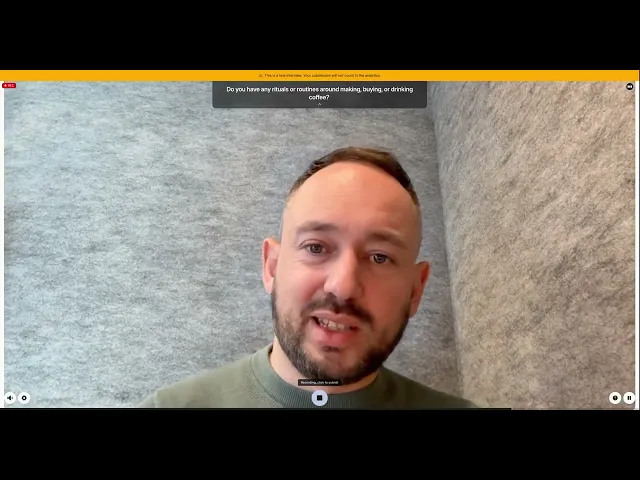
For teams whose research keeps arriving after the decision has been made, Conveo's approach to continuous, AI-moderated research is built to close that gap without sacrificing rigor.
Frequently asked questions
What is the difference between healthcare market research and pharmaceutical market research?
Healthcare market research is the broader discipline, covering patients, clinicians, caregivers, and payers across any healthcare context. Pharmaceutical market research is a subset focused on commercial questions for drug and treatment brands, such as message testing, adherence barriers, and prescribing behavior.
Why do healthcare consumer research studies get delayed by clinical review?
Most organizations route every study through the same legal, medical, and regulatory (LMR) review queue, regardless of whether the study makes a clinical claim. Routine consumer behavior research gets caught behind studies that genuinely require that scrutiny, because there's no separate, pre-defined pathway for the two types of work.
How long does a typical healthcare depth interview program take?
Traditional, synchronous depth interview programs typically take four to six weeks from recruitment through synthesis. Asynchronous, AI-moderated video interviews remove the scheduling dependency, which is the primary driver of that timeline, and can compress it substantially.
What compliance certifications should a healthcare research vendor have?
Enterprise healthcare procurement teams generally require SOC 2 Type II certification, GDPR compliance, and EU-based hosting for any program involving European participants, along with role-based access control, audit trails, and configurable data retention.
How is continuous healthcare market research different from a one-time study?
A one-time study captures a snapshot of patient or clinician sentiment at a single point in time. Continuous, wave-based programs, such as Conveo StoryLines, run on a set cadence, for example, bi-weekly or monthly, and monitor how that sentiment shifts over time, so teams can catch early signals rather than discovering a shift after it has already affected the business.

About the author
Alex de Hemptinne
Head of Customer Success
Alex is a Business Impact Lead at Conveo, partnering with enterprise teams to embed AI-led research into their workflows. From the first study to full-scale rollout, she helps customers shift from project-based research to continuous customer intelligence.
Meet Alex on film →Qualitative insights at the speed of your business.
Conveo runs AI-moderated video interviews and structures everything they say.