In this article
TL;DR
Most market research intelligence arrives after the decision it was meant to inform has already closed. The problem is structural: the operating model, rather than the method.
Consumer Understanding Infrastructure replaces the project-by-project model with a continuous, compounding collection of consumer insights, where findings remain searchable and connected across studies.
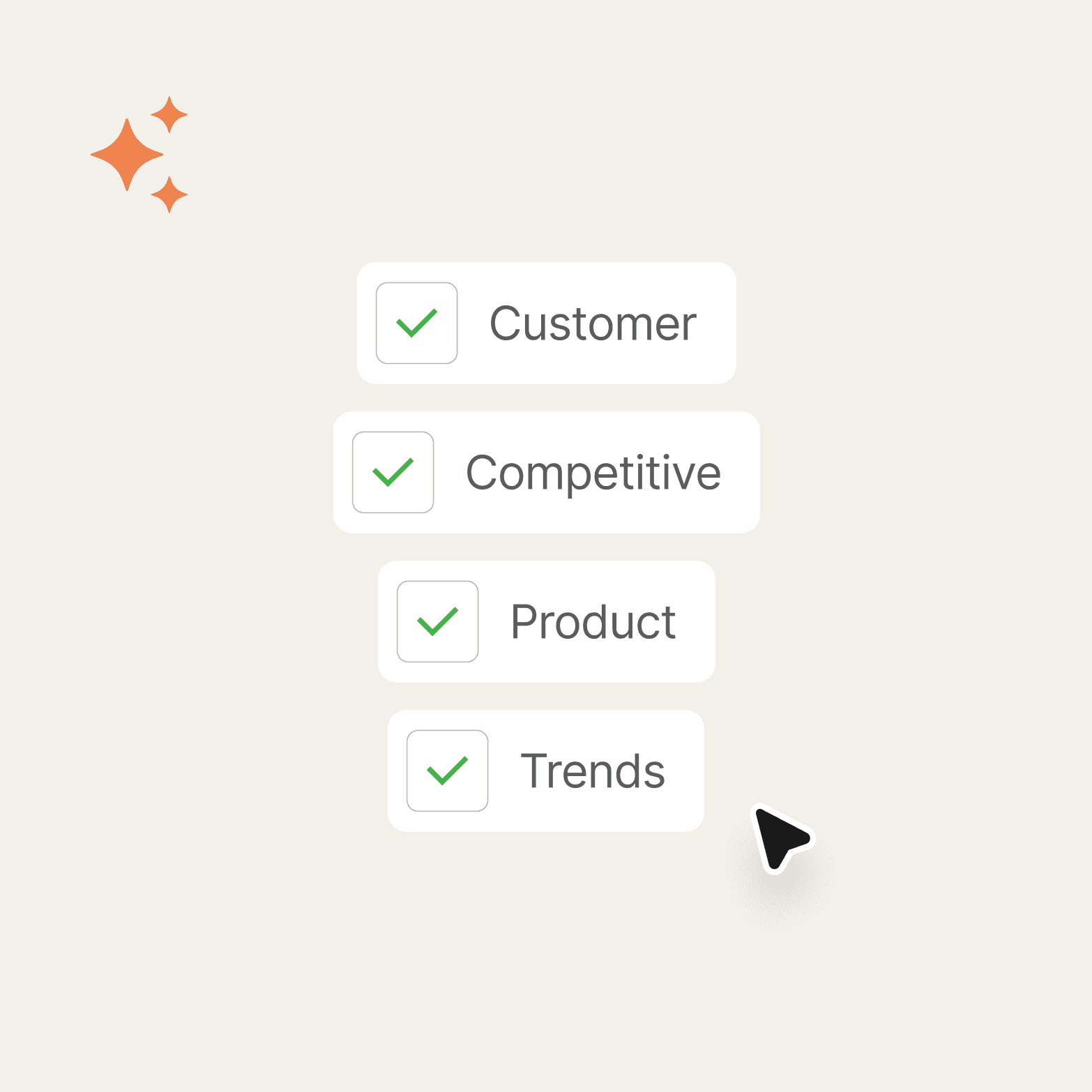
The four pillars of market research intelligence are consumer understanding, competitive intelligence, product intelligence, and market trends. Consumer understanding is the hardest to operationalize at speed because it requires qualitative depth.
Teams evaluating platforms should prioritize traceability (evidence linked to source), compounding value (a searchable insight library), and governance before considering speed claims.
Teams running always-on programs on Conveo access a searchable insight library for cross-study search and Conveo StoryLines for continuous wave-based research programs. Both capabilities exist and ship today.
Most market research intelligence arrives too late to matter. The report lands in an inbox, thorough and well-structured, six weeks after the product decision it was meant to inform has already been made. At that point, the findings document the direction rather than shape it.
The research itself is often rigorous: carefully recruited participants, skilled market researchers, thoughtful synthesis. What breaks is the operating model. Traditional qualitative research through an agency runs on a timeline of six to twelve weeks from brief to findings. Product launches, campaign pivots, and concept decisions close faster than that runway allows. [Internal link: Why qualitative research timelines break down]
The mismatch is getting worse. Decision cycles compress while research cycles do not. A brand team can test a campaign concept, get stakeholder sign-off, and brief production in under two weeks. None of those timelines accommodate a research cycle with a multi-week recruitment phase at the front end, and strategic decision-making increasingly depends on evidence that simply is not ready in time.
What changes this is a different operating model: consumer understanding built as continuous infrastructure rather than commissioned as periodic projects. When findings accumulate in real time and reach stakeholders while the decision window is still open, research stops being something teams wait for and starts being something they reach for. That shift is what this article maps out.
What is market research intelligence?
Market research intelligence is the systematic collection, synthesis, and activation of consumer understanding to inform strategic and tactical decisions. In practice, it means treating market intelligence data as a standing asset rather than a one-time deliverable.
That definition matters because it separates market research intelligence from the project-based research most teams still run. A commissioned study produces a deliverable. Intelligence produces a capability: the ability to answer new questions using existing knowledge without starting from scratch every time a stakeholder asks a question.
Traditional market research operates on a snapshot model: identify a question, design a study, recruit participants, run interviews or surveys, synthesize, and publish. By the time the report lands, the decision window has often closed, and the snapshot does not update when the market changes.
Market research intelligence works differently. Findings accumulate into a shared knowledge base that connects across studies, surfaces contradictions, and remains searchable as new questions emerge. Each study makes the next one smarter, and market analysis becomes a continuous discipline rather than a quarterly event.
This is where Conveo's category framing originates. Consumer Understanding Infrastructure is the operational layer that makes market research intelligence continuous rather than episodic: always-on interview programs, a compounding insight library, and traceable evidence that persists long after the study closes.
There are four types of market research intelligence that mature research functions typically manage, covered in more depth in the next section:
Consumer understanding: what consumers need, believe, feel, and decide, and why
Competitive intelligence: how the competitive landscape and market positioning are shifting
Product intelligence: how customers experience and evaluate specific products or features
Market and industry trends: broader forces shaping demand, behavior, and category dynamics
This piece focuses on the consumer understanding pillar, because that is where qualitative research velocity creates the sharpest operational gap. Most teams can approximate competitive intelligence and monitor industry trends with publicly available signals, competitor websites, and secondary research. Understanding why consumers behave the way they do is where the infrastructure question becomes urgent.
Market intelligence vs market research
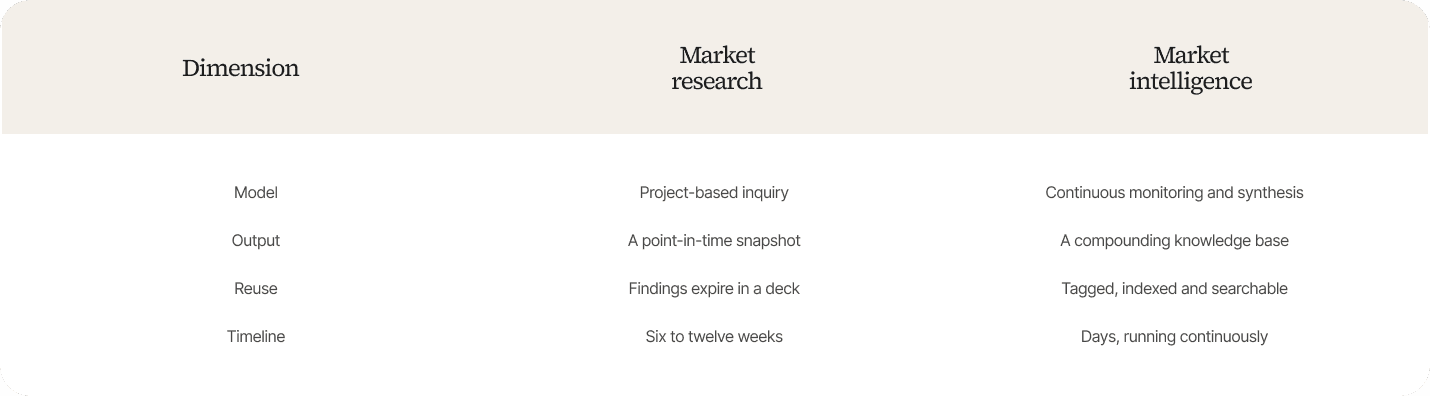
Market research is project-based inquiry. A team identifies a question, commissions a study using established market research methods such as interviews, focus groups, or online surveys, collects findings, and delivers them as a slide deck. The project closes.
Market intelligence is different. It is the continuous monitoring and synthesis of consumer behavior, competitive moves, and market conditions, organized so that each new input connects to what came before. Where market research answers a question and ends, market intelligence builds a searchable, reusable knowledge base that grows more useful with every study added, turning individual findings into valuable insights over time.
The two overlap in practice. Market intelligence often relies on market research inputs, whether that's primary research gathered directly from target customers or secondary research drawn from existing data, such as industry reports and sales data. The distinction is in what happens to the output: research becomes intelligence only once it is tagged, indexed, and made queryable across studies, rather than left as a static deck.
That structural difference is where most enterprise teams encounter friction. Each project starts fresh, and teams end up researching the same customer segments twice because the previous study was stored on someone's personal drive rather than in a properly managed market research process.
Conveo's searchable insight library exists to close that gap: every interview, theme, and verbatim quote is tagged, stored, and retrievable across studies so that prior work informs future work rather than expiring in a folder.
Why market research intelligence fails to inform decisions
Market research intelligence fails because the operational model is structurally unable to reach decisions in time, even when the research itself is credible.
Three failure modes drive this pattern, and they compound each other.
Research velocity does not match decision velocity
Traditional qualitative research commissioned through agencies takes six to twelve weeks from brief to findings. Product and campaign decisions rarely wait that long. A product team locks a roadmap in a two-week sprint cycle, and the persona research that would have challenged their assumptions lands months later. The findings are credible but irrelevant.
Findings are delivered as summaries without source evidence
A synthesis slide that says "customers are frustrated by the onboarding process" gives stakeholders no way to verify the claim. Without video evidence, verbatim quotes, and traceable source material, findings read as interpretation rather than reality. Teams report that insights get dismissed in executive reviews precisely because they cannot be interrogated.
Research dies in slide decks
Most findings are never reused. They live in PowerPoint files, organized by project name and quarter, inaccessible to anyone who was not in the original debrief. Without a searchable insight library, teams repeatedly re-commission research on the same customer segments, gathering the same market intelligence data twice.
The problem is structural. The research itself is often rigorous. The operational model surrounding it is what makes it unusable.
Types of market research intelligence (and where qualitative fits)
Market research intelligence falls into four categories, each answering a different business question and drawing on different market research techniques.
The four types:
Consumer understanding. What consumers need, feel, and experience at every stage of their relationship with a product or brand. Decisions here include repositioning a product line after NPS drops or diagnosing why a new feature is not being adopted.
Competitive intelligence. How rivals are positioned, priced, and perceived, and how that shapes the wider competitive landscape. A typical decision: whether to match a competitor's new pricing tier, defend market share, or differentiate. Teams often build this view from competitor websites and public competitor research.
Product intelligence. How customers actually use a product versus how it was designed to be used, including friction in an onboarding flow or a secondary feature becoming the primary reason customers renew.
Market and industry trends. Shifts in category behavior, the broader business environment, regulatory changes, and emerging demand trends. Decisions here include market entry timing, portfolio prioritization, and investment risk management.
Of the four, consumer understanding is the hardest to operationalize at velocity. Competitor intelligence, product intelligence, and trend intelligence can be approximated with secondary data or structured quantitative research. Consumer understanding that explains behavior, rather than simply recording it, requires qualitative research, and that takes six to twelve weeks through traditional agency models.
Online surveys narrow the gap on timeline but introduce a different problem. A well-designed survey produces useful numerical data on what customers chose. Explaining why they hesitated requires a different kind of evidence: it captures stated preferences, but misses the exact language a customer uses when describing a problem, making it a poor substitute for the kind of qualitative data that reveals customer trends before they show up in a dashboard.
The result is a structural tradeoff most teams have accepted as unavoidable: depth or speed, but not both. What has changed is the emergence of a third option: an operational model that delivers qualitative depth in days rather than months.
Market research intelligence examples: What good looks like
These examples share one property that sets them apart from the research decks that collect dust on shared drives: every claim traces back to a real person who said it, on video, at a specific moment in the conversation, producing actionable insights rather than a static report.
Note: The following examples are representative scenarios illustrating how always-on market research intelligence works in practice. They are not attributed to specific Conveo customers.
Bi-weekly customer intelligence brief
In a representative scenario, a product and marketing team receives a summary every other Monday that covers emerging objections, feature requests, and usage workarounds surfaced in the prior wave of interviews. Each finding links to a timestamped video clip, so a stakeholder who doubts whether customers actually describe onboarding as "confusing" can click through and hear it directly.
That traceability changes how findings land. When the product team sees multiple participants describing the same workaround, they can deprioritize a planned feature mid-sprint, and the key insights reach the roadmap before the quarter closes.
Evidence-backed persona refresh
In a representative scenario, a team running 50 AI-moderated video interviews across three behavioral segments completes a persona update in days rather than weeks. Each persona trait, from purchase triggers to risk perceptions to the objections that stall a decision, connects directly to verbatim customer language and the video session it came from, giving the team a far more comprehensive understanding of the target audience than a workshop could produce.
When a campaign brief is built on that foundation, the messaging reflects how customers actually describe their problem. Real customer language produces different creative output than synthesized personas built from internal intuition, sharpening marketing strategies aimed at the right target audience.
Cross-market synthesis for global launch
In a representative scenario, parallel fieldwork across 12 markets, run simultaneously, produces a stakeholder-ready report showing which messaging angles travel universally and which need localization, completing in days to weeks rather than months.
The output is a single synthesis with market-level breakdowns, each claim traceable to the participant and session, allowing a launch team to catch a messaging angle that tests poorly in priority markets before launch and reducing the investment risk of a multi-market rollout.
How to build always-on market research intelligence
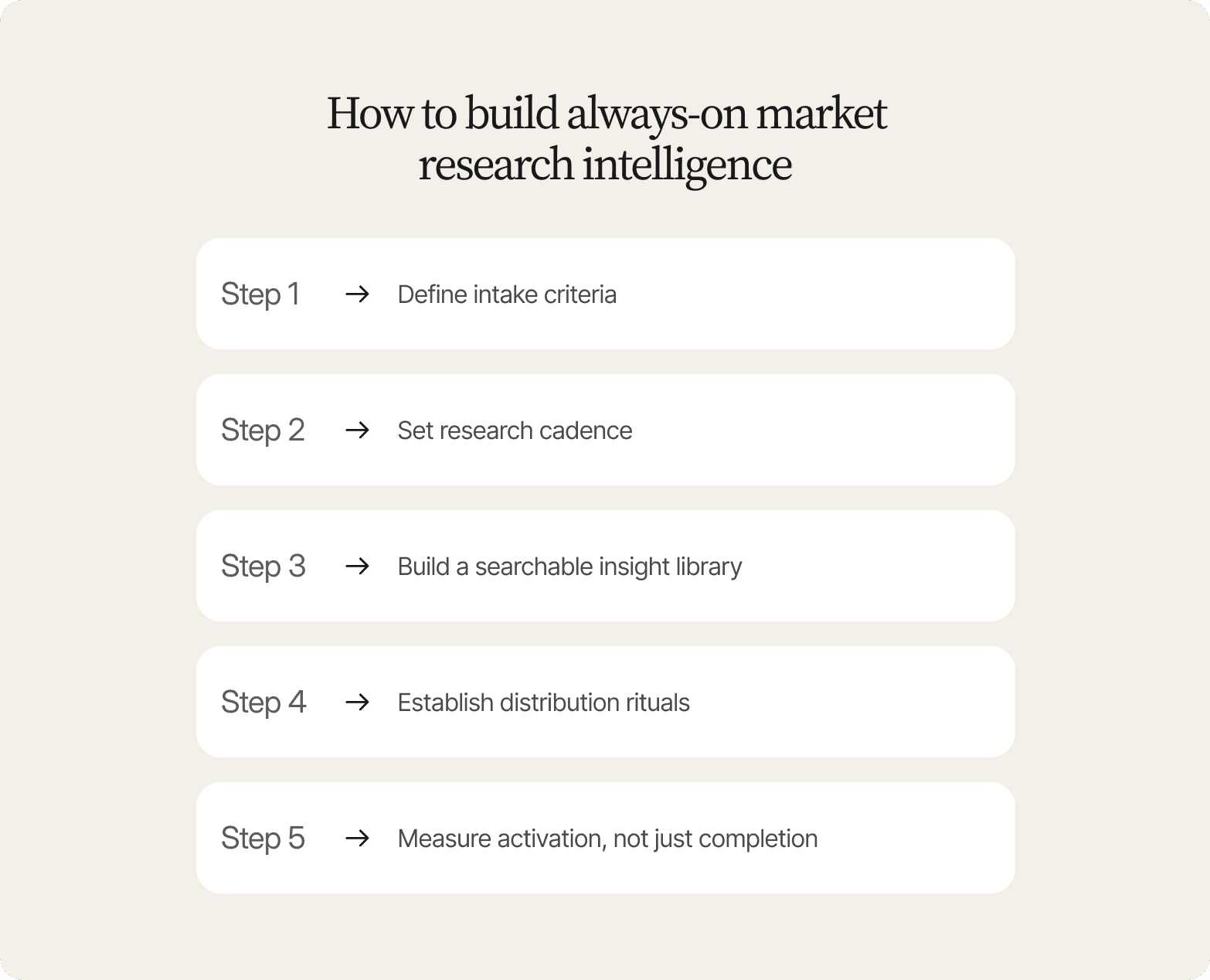
Most research teams already know what questions matter. The problem is the operating model. Commissioning a study every time a question surfaces means decisions move faster than the evidence does. Building always-on market research intelligence means shifting to continuous Consumer Understanding Infrastructure.
Here is a five-step operational blueprint for making that shift.
Step 1: Define intake criteria
Not every question belongs in an always-on program. Standing questions with recurring relevance, such as "Why are enterprise buyers churning?", belong in the continuous track. One-time decisions with a defined endpoint, such as validating a new pricing model, belong in custom research.
Step 2: Set research cadence
Bi-weekly or monthly fieldwork cycles work for most enterprise teams, each addressing two to three stakeholder questions. The scheduling bottleneck that makes gathering market intelligence data feel impossible in traditional research disappears when participants complete sessions on their own time.
Teams running always-on programs on Conveo use Conveo StoryLines, which runs continuous wave-based research in chapters, with themes tracked across waves and findings connecting across studies.
Step 3: Build a searchable insight library
Every interview, theme, and verbatim quote should be tagged and stored in a central repository organized by topic, segment, and market. When a product manager needs evidence mid-sprint, the answer should come from a search of existing findings, rather than a fresh request to collect market intelligence data from scratch.
Teams using Conveo access this searchable insight library, where every study connects to the last and nothing gets researched twice.
Step 4: Establish distribution rituals
Market research intelligence creates value only when it reaches decisions in time. Bi-weekly briefs to product and marketing, monthly deep dives for business leaders, and on-demand library access between cycles. Teams on a fixed schedule report stakeholders pulling insights proactively rather than waiting for a formal market assessment.
Step 5: Prioritize activation over completion
Study completion rates measure research output. Activation measures research impact. Track how often findings get cited in briefs, how many decisions reference specific customer quotes, and how frequently the insight library is searched.
4 criteria for evaluating market research intelligence platforms
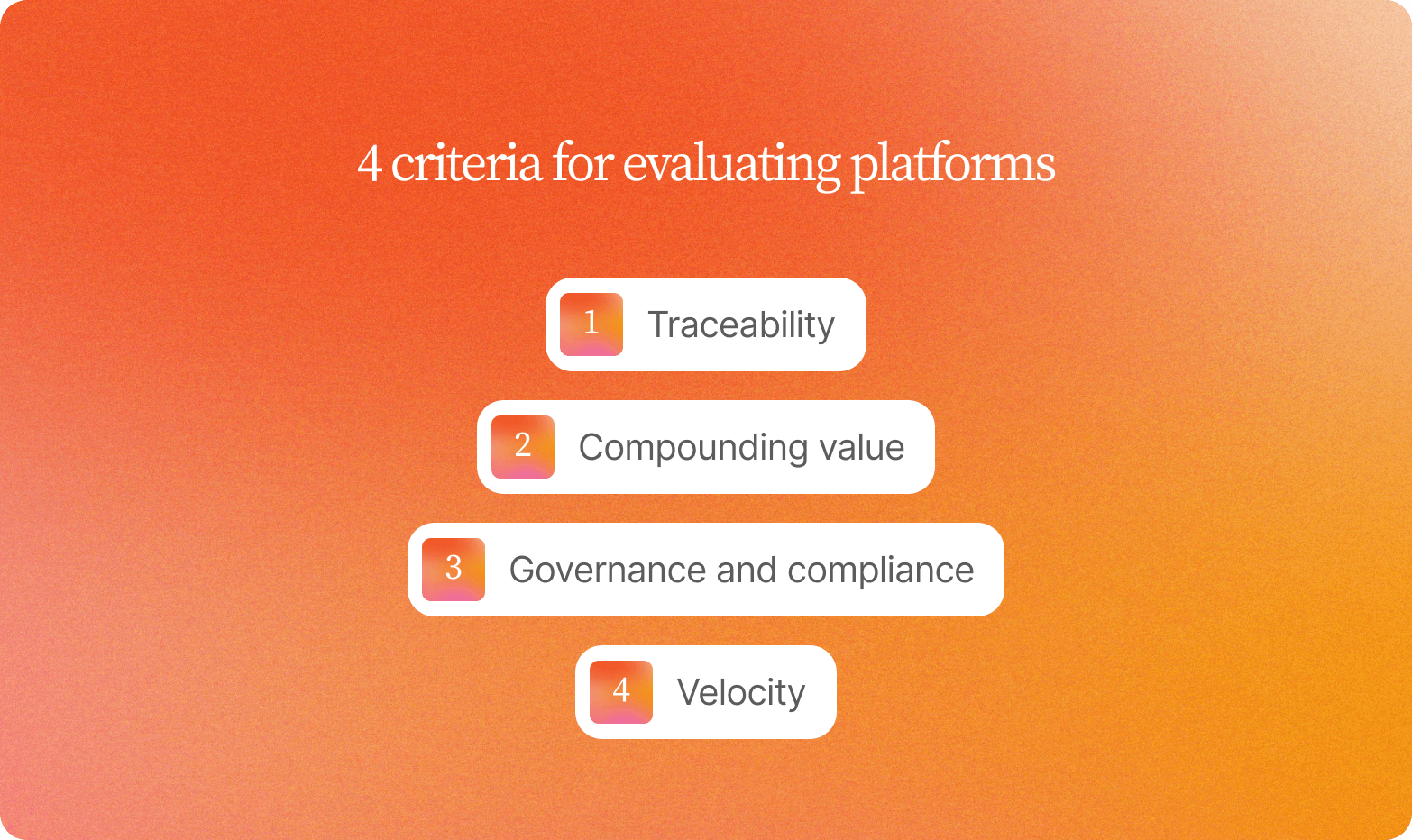
Most teams evaluating market research intelligence platforms lead with pricing or interface and skip the criteria that determine whether the platform changes how business decisions get made. Four criteria should be non-negotiable when comparing intelligence tools.
Traceability
The first question is whether findings are accompanied by evidence that stakeholders can verify. Does every theme, quote, and sentiment arc link directly to a timestamped video clip? Can a brand director verify a claim without asking the research team to re-pull the data? Platforms that summarize without sourcing shift the burden of proof back onto the researcher.
Compounding value
Research that lives in a slide deck has a shelf life of roughly 90 days. Does the platform build a searchable insight library connecting findings across studies over time? This is where the gap between a research platform and Consumer Understanding Infrastructure becomes visible: one delivers a study, the other builds institutional knowledge and supports genuinely informed business decisions.
Governance and compliance
For enterprise buyers, this criterion is often the procurement gatekeeper. SOC 2 Type II certification, GDPR compliance, EU hosting (Belgium), and SSO support determine whether a platform can clear legal and security review. Platforms lacking documented compliance credentials cause delays unrelated to research quality.
Velocity
Can the platform deliver stakeholder-ready findings in days rather than weeks, without sacrificing qualitative depth? Does it support parallel fieldwork across markets? Does asynchronous interviewing remove scheduling bottlenecks? A platform that still requires calendar coordination and sequential fielding will not change the fundamental timing problem.
See it in action: How AI-Moderated Interviews Actually Work
Competitive differentiation: Always-on intelligence vs traditional approaches
Most market research intelligence strategies still rely on one of three approaches, each with a structural ceiling.
Agency-led qualitative research, including traditional focus groups, delivers high-credibility findings, but the timing is the problem. A typical study runs six to twelve weeks from briefing to report, so findings land after the decision has already closed.
Survey platforms solve the timing problem but create a different one. Quantitative research moves fast, but it cannot capture hesitation, contradictions, or the precise language customers use when describing a problem. An online survey tells you that 62% prefer option A. Understanding why option B made them pause requires a different kind of evidence.
Synthetic AI personas produce confident, well-structured claims with no traceable source behind them. When a stakeholder asks where the insight came from, there is no answer.
The structural difference across all three is continuity. Traditional approaches run project by project, so findings expire before they can compound, and any competitive advantage they might have delivered fades with them.
Consumer Understanding Infrastructure works differently. Teams running always-on programs on Conveo access AI-moderated interviews in 50+ languages across parallel markets, with findings flowing into a searchable insight library the moment each conversation closes. Every theme and quote links to a timestamped video clip, verified directly. Nothing gets researched twice, compounding into a real competitive advantage.
"Super valuable... ahead of where most of your competitors are... quite a special way to analyze this data"
Matt Harris, Research & Insights Lead, EMEA, Canva
Why teams choose Conveo for always-on understanding
Consumer Understanding Infrastructure is the category. Conveo is how teams operationalize it.
Always-on consumer understanding
Teams running continuous programs on Conveo use Conveo StoryLines to maintain a standing read on their market, with themes tracked across waves and findings connecting across studies. The understanding never goes stale because the next wave is always running.
Research rigor
Conveo is built by researchers, with research rigor as the product's foundation rather than an added layer. Every insight traces back to a real person who said it, supported by verbatim quotes and timestamped video. There are no synthetic respondents.
Compounding knowledge
Conveo's searchable insight library means every study connects to the last. Teams reuse clips, themes, and participant segments rather than starting from scratch.
Compliance
SOC 2 Type II certified, GDPR compliant, EU hosting (Belgium), SSO, and client-configurable retention with automated PII deletion.
Speed as supporting proof
Teams report moving from weeks to days on timeline, in some cases. Speed is the result: what becomes possible when the infrastructure is continuous.
Who Conveo is not for
Conveo is not the right fit for teams that need only large-sample quantitative tracking, with no qualitative component, or for one-off custom studies with no recurring cadence.
Frequently Asked Questions
Why is market research intelligence important for business decisions?
Market research intelligence closes the gap between when a business decision needs to be made and when supporting evidence is available. Without it, teams either delay decisions until stale research arrives or decide on assumption alone. Treating customer insights as a compounding asset leads to more informed decisions and less redundant spend on repeat studies.
What are examples of market research intelligence?
Market research intelligence examples fall into three categories defined by the decisions they enable. First, tracking why customers switch to competitors between purchase cycles so retention teams can address real objections. Second, monitoring how product usage patterns shift across segments so teams can reprioritize the roadmap before support tickets pile up. Third, identifying emerging objections before they appear in churn data so marketing can update messaging while a campaign is still live.
What is the difference between market intelligence and market research?
Market research is project-based inquiry that produces a point-in-time snapshot. Market intelligence is continuous monitoring that builds a compounding knowledge base connecting findings across sources over time. The difference is what happens to the output: research becomes intelligence only once it is tagged, indexed, and made reusable across studies.
What is the difference between market intelligence and competitor intelligence?
Competitor intelligence is a subset of market intelligence focused on monitoring competitor activity: pricing, product launches, positioning, and market share shifts, often built from competitor websites and public filings. Market intelligence is the broader category that encompasses competitor intelligence, consumer understanding, product intelligence, and industry trends.
How long does it take to build market research intelligence?
Traditional agency qualitative research takes six to twelve weeks. AI-moderated video interviews compress that timeline because sessions run asynchronously and in parallel. Teams report moving from weeks to days in some cases, depending on study scope, participant volume, and recruitment speed.
How do you build a market intelligence framework?
The five-step blueprint above covers the full approach: define intake criteria, set research cadence, build a searchable insight library, establish distribution rituals, and measure activation rather than completion. The framework holds together when research velocity matches decision velocity.

About the author
Niels Schillewaert
Head of Research and Methodologies
Twenty-nine years in consumer research. Niels co-founded Human8 (formerly InSites Consulting), served as president of ESOMAR and teaches marketing at Vlerick Business School. At Conveo he sets the methodology and pressure-tests every feature against real-world research practice.
Meet Niels on film →Qualitative insights at the speed of your business.
Conveo runs AI-moderated video interviews and structures everything they say.