In this article
TL;DR
Voxpopme's core product is the video survey, with an AI Moderator as a newer add-on. Teams that want AI-moderated interviews as their main method, or need SOC 2 and EU data hosting documented, have good reason to compare alternatives.
Voxpopme's competitors include platforms focused on qualitative research, UX research, and broader experience management. The ten compared here range from AI interview tools like Conveo to enterprise survey suites like Qualtrics.
Tools in the AI-moderated interview category ask follow-up questions when an answer is unclear, so teams learn the reasons behind a response.
Conveo is the best Voxpopme alternative for enterprise insights teams that want AI-moderated video interviews with every theme linked to the clip and quote behind it.
Voxpopme is built around fast, asynchronous video research. Participants respond to prompts, AI extracts themes and sentiment, and teams get results quickly. Its core video survey model works well for collecting large volumes of feedback, but often stops at what consumers think, not why they think it. AI features have been introduced to bridge that gap, but they're an add-on to a system built around one-way feedback.
This guide compares 10 Voxpopme alternatives for insights teams looking for deeper qualitative insights from their video feedback. By the end, you’ll have a clearer view of how each Voxpopme alternative fits different research programs and confidence in choosing the right fit for your business.
Quick comparison: Top Voxpopme competitors
The table below compares each platform at a glance. Use it to shortlist before reading the full profiles below.
| Platform | Best For | AI-moderated interviews | Automated Analysis | Participant Sourcing | Output Traceability | SOC 2 | GDPR / EU Hosting |
|---|---|---|---|---|---|---|---|
| Conveo | End-to-end qual at enterprise scale | ✓ Adaptive follow-up questions | ✓ Multimodal (speech, tone, facial cues) | ✓ Third-party panels (8 providers) + own contact lists | ✓ Themes linked to clips + quotes | ✓ Type II | ✓ / ✓ |
| Voxpopme | Video feedback at scale | ✓ | ✓ | ✓ Native panel | ✓ | Not publicly listed | ✓ / Not publicly verified |
| Outset | International recruitment and digital twins | ✓ | ✓ | ✓ Third-party panels (25+) | ✓ | ✓ Type II | ✓ / Not publicly verified |
| GetWhy | Concept and creative testing, CPG/FMCG | ✓ | ✓ | ✓ Third-party panels | ✓ | ✓ | ✓ / ✓ |
| Discuss | Enterprise multilingual qualitative research | ✓ | ✓ | ✓ Third-party panels | ✓ | Not publicly listed | ✓ / ✗ (US) |
| Glaut | AI-moderated interviews for agency survey workflows | ✓ Voice | ✓ | ✗ | ✓ | Not publicly listed | ✓ / ✓ |
| Qualtrics | Video feedback inside enterprise surveys | ✗ | ✓ | ✓ Third-party panels | ✓ | ✓ Type II | ✓ / ✓ |
| Voiceform | Mixed-method surveys with AI probing | ✓ AI probing + moderation | ✓ | ✓ Native + third-party panels | ✓ | ✓ Type II | ✓ / ✗ (US + Canada) |
| Tellet | Agencies running multilingual AI-moderated interviews | ✓ Voice-first | ✓ | ✓ Third-party panels | ✓ | Not publicly listed | ✓ / ✓ |
| User Intuition | AI-moderated depth interviews at scale | ✓ Adaptive, laddering 5–7 levels deep | ✓ | ✓ Native panel | ✓ | Type II examination underway | ✓ / ✗ (US) |
| Dscout | Diary studies and in-the-moment mobile research | ✓ | ✓ | ✓ Native + third-party panels | ✓ | ✓ Type II | ✓ / ✗ (US) |
Each platform is covered in more detail in the sections that follow to help you match the right tool to the right research job.
1. Conveo: Best for end-to-end qualitative research with traceable AI analysis
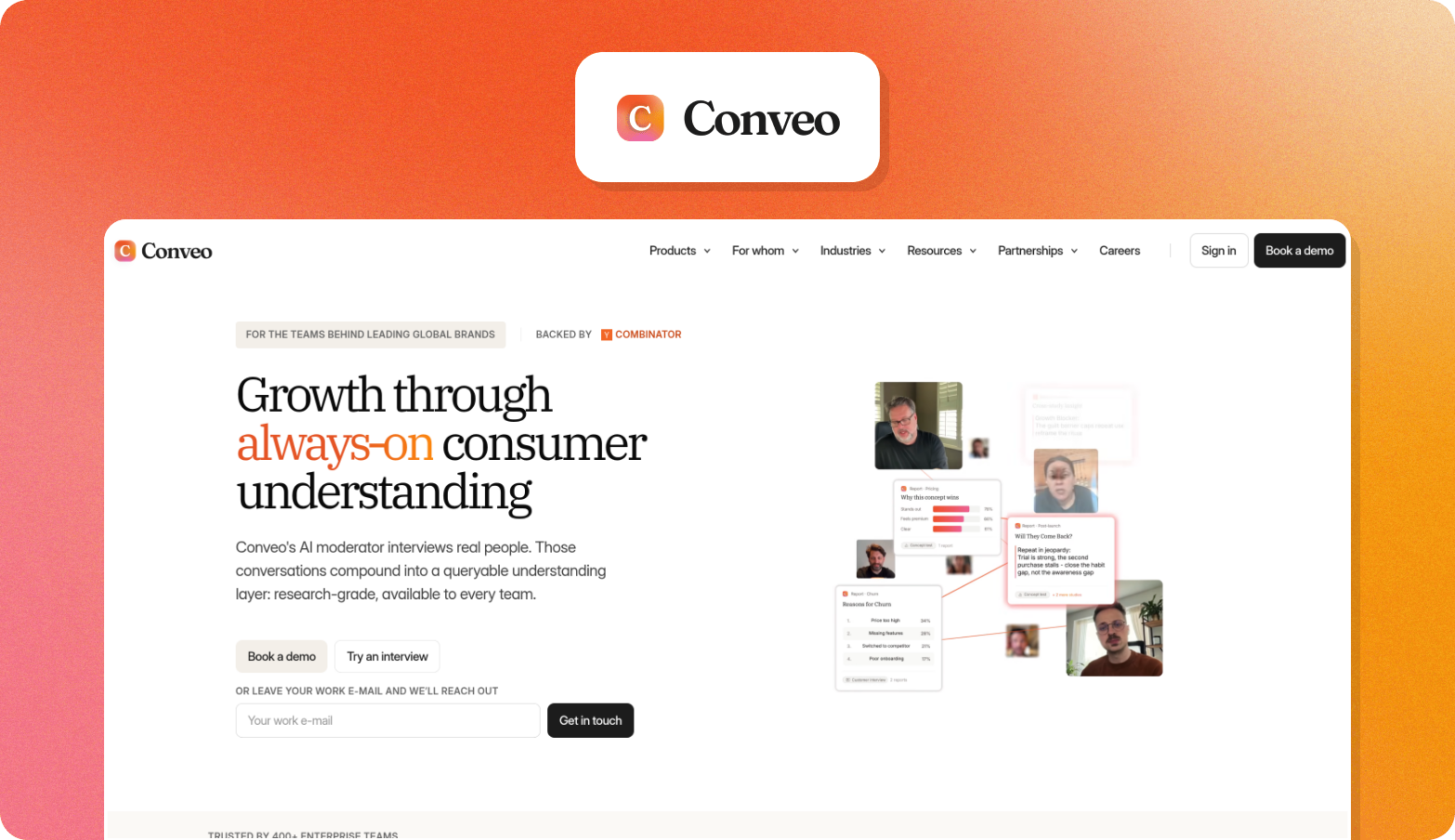
Conveo is Consumer Understanding Infrastructure for enterprise insights teams. It runs AI-moderated video interviews end-to-end, from participant recruitment through to stakeholder-ready analysis, and keeps every study in a searchable insight library.
Enterprise research teams produce qualitative findings that stakeholders routinely push back on. Manual video review misses key moments, and evidence-free summaries are hard to defend in a leadership meeting. Conveo is built around a different principle: every insight should link directly to the participant moment that produced it.
Enterprise insights teams at Google, Canva, Unilever, AB InBev, Kellanova, General Mills, and JDE Peet's rely on Conveo to understand their consumers.
"The pace, responsiveness, and research expertise of the Conveo team, on top of the top AI-moderated qual platform, have been invaluable to us in scaling brand advertising internationally."
Matt Harris, Research & Insights Lead, EMEA, Canva
How AI-moderated interviews work in practice
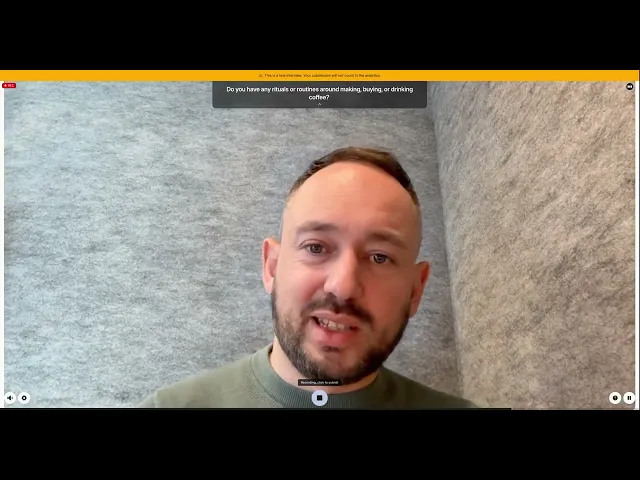
Conveo's AI research assistant asks follow-up questions when an answer is vague or leaves a gap, building on what the participant said earlier. This approach captures feedback that a fixed script would miss, leading to fewer missed opportunities and more actionable insights.
See it in action: how the AI research assistant probes a concept reaction:
What multimodal analysis captures
Transcript-based analysis misses how participants deliver their responses. Multimodal analysis processes tone and facial expression alongside the transcript.
For example, a participant might describe a feature as “fine” while frowning slightly or reacting with visible frustration during the demo. The transcript records neutral feedback. The video captures a negative reaction that the participant never states directly.
Output traceability as a stakeholder advantage
Every theme links directly to the video clip and the quote that generated it, which are displayed alongside the finding, so stakeholders can inspect the source. Findings that people can inspect directly carry more weight than summaries that rely on trust alone.
Enterprise infrastructure
Conveo holds SOC 2 Type II certification, is GDPR compliant, and offers EU data hosting in Belgium. In enterprise deals, these can shorten the security review process and reduce the time between platform evaluation and contract.
Research that builds over time
Every study lands in Conveo's searchable insight library, so when the next study starts, the team can pull up what earlier ones found.
Conveo runs both single studies and continuous programs. With Conveo StoryLines, research runs in waves on a set cadence. After each wave closes, Conveo compares the new results against earlier waves and surfaces shifts in existing views and emerging themes.
Best For
Conveo suits insights and CMI teams at consumer brands that regularly conduct qualitative research and need outputs that withstand stakeholder scrutiny. It's designed for environments where data compliance is a procurement requirement and where findings need to link back to source evidence.
Teams that only need NPS or CSAT monitoring will be better served by a survey tool.
Pricing
Conveo pricing depends on research volume.
2. Outset
Outset is an AI-moderated research platform that covers interviews, concept testing, usability testing, and diary studies with real participants or digital twins.
Strength: Outset integrates natively with recruitment panels, giving teams access to over 1.1 billion participants across 85+ countries.
Limitation: Outset doesn’t publicly list an EU data residency option, which may be a procurement barrier for some Europe-based teams.
Best for: Product and UX teams who need a broad international recruitment reach and want to use digital twins alongside real users.
3. GetWhy
GetWhy is an AI-moderated research platform that teams can run themselves or hand to GetWhy's research team for full-service delivery.
Strength: GetWhy's senior researchers can design and run studies on a team's behalf, and teams can move between self-serve and full-service work on the same platform.
Limitation: The platform is primarily built for consumer research: concept testing, creative testing, and packaging evaluation. Teams running research outside that range may find it less suited to their needs.
Best for: CPG, FMCG, and retail enterprise teams who want expert assistance in shaping their studies.
4. Discuss
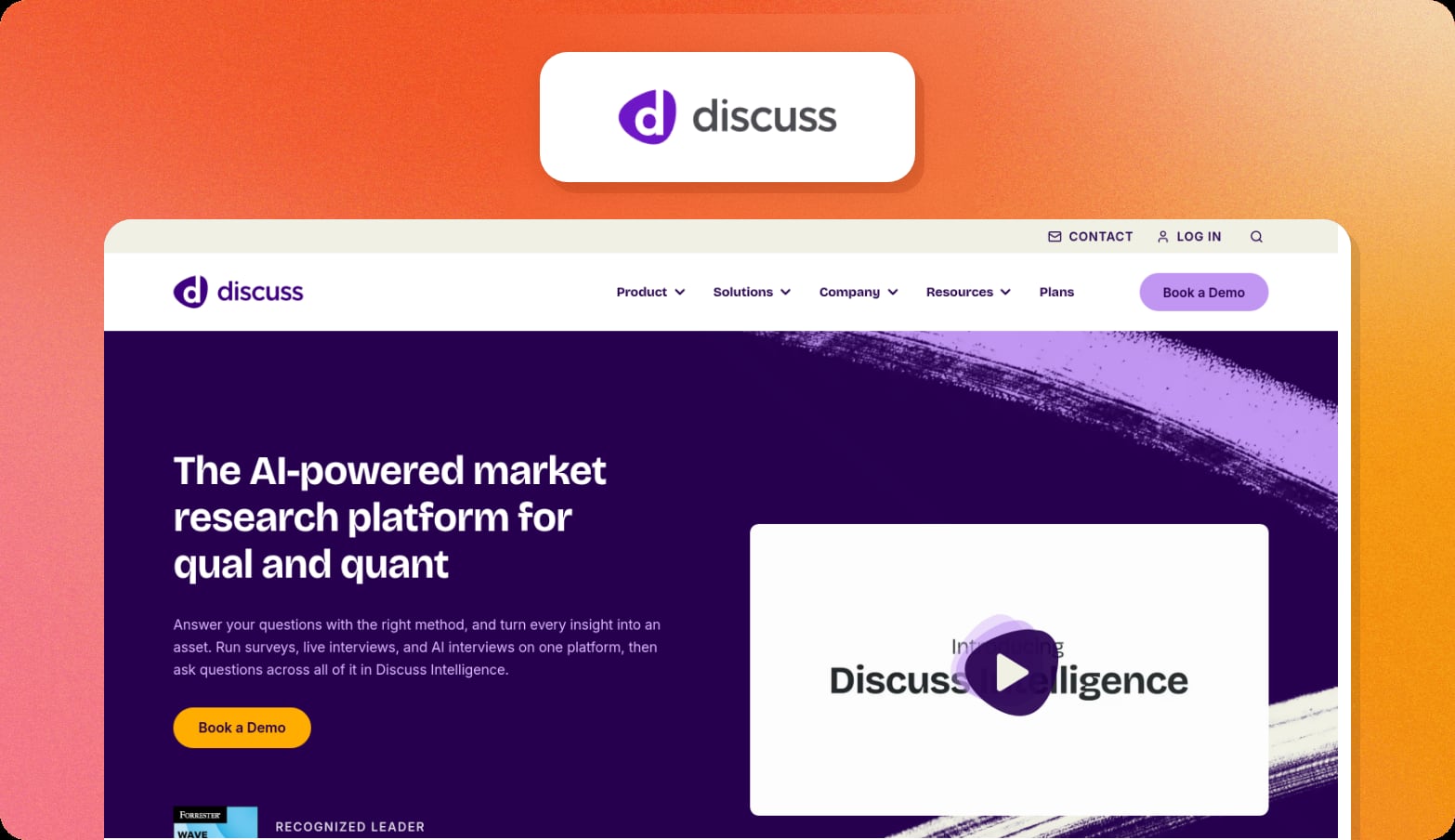
Discuss blends AI-moderated and live, human-moderated video interviews and focus groups.
Strength: Language reach. Discuss supports 80+ languages for automatic transcription, with 92%+ accuracy for major languages including English, Spanish, French, German, and Portuguese.
Limitation: Discuss doesn’t list SOC 2 among its certifications, and data is hosted in Virginia, USA. For enterprise teams with EU data residency requirements, this may be a procurement blocker.
Best for: Enterprise market insights and CX teams running multilingual qualitative research without EU data residency requirements.
5. Glaut
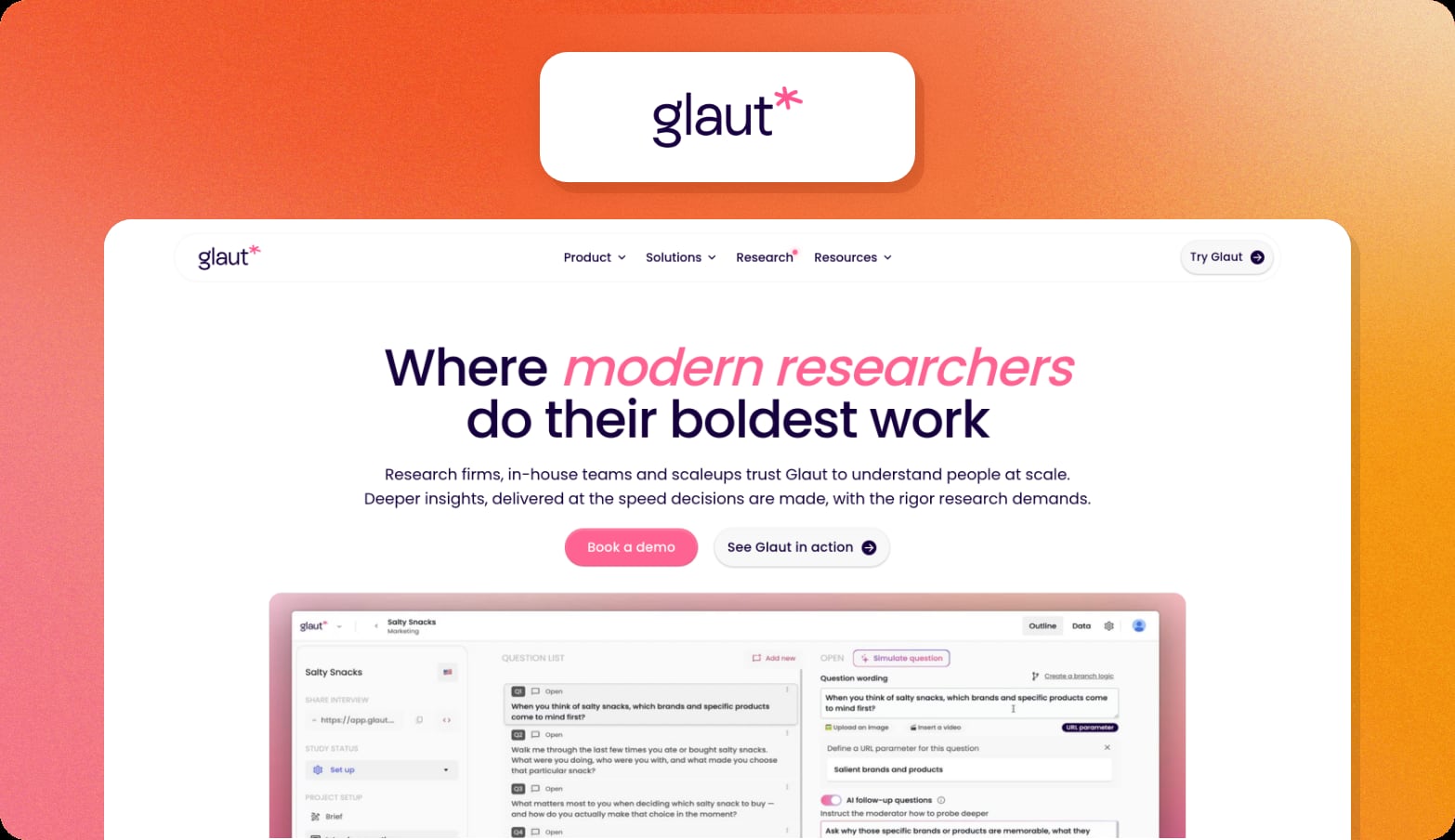
Glaut is a white-labeled AI-moderated voice interview and survey platform built for market research agencies.
Strength: Agencies can embed AI-moderated voice interviews into quantitative studies for their clients without replacing their existing stack or participant sourcing process.
Limitation: There's no native panel or identity verification. Participant quality depends on the upstream panel provider the agency uses.
Best for: Market research agencies that want to enhance their existing quantitative surveys rather than start a new research process from scratch.
6. Qualtrics
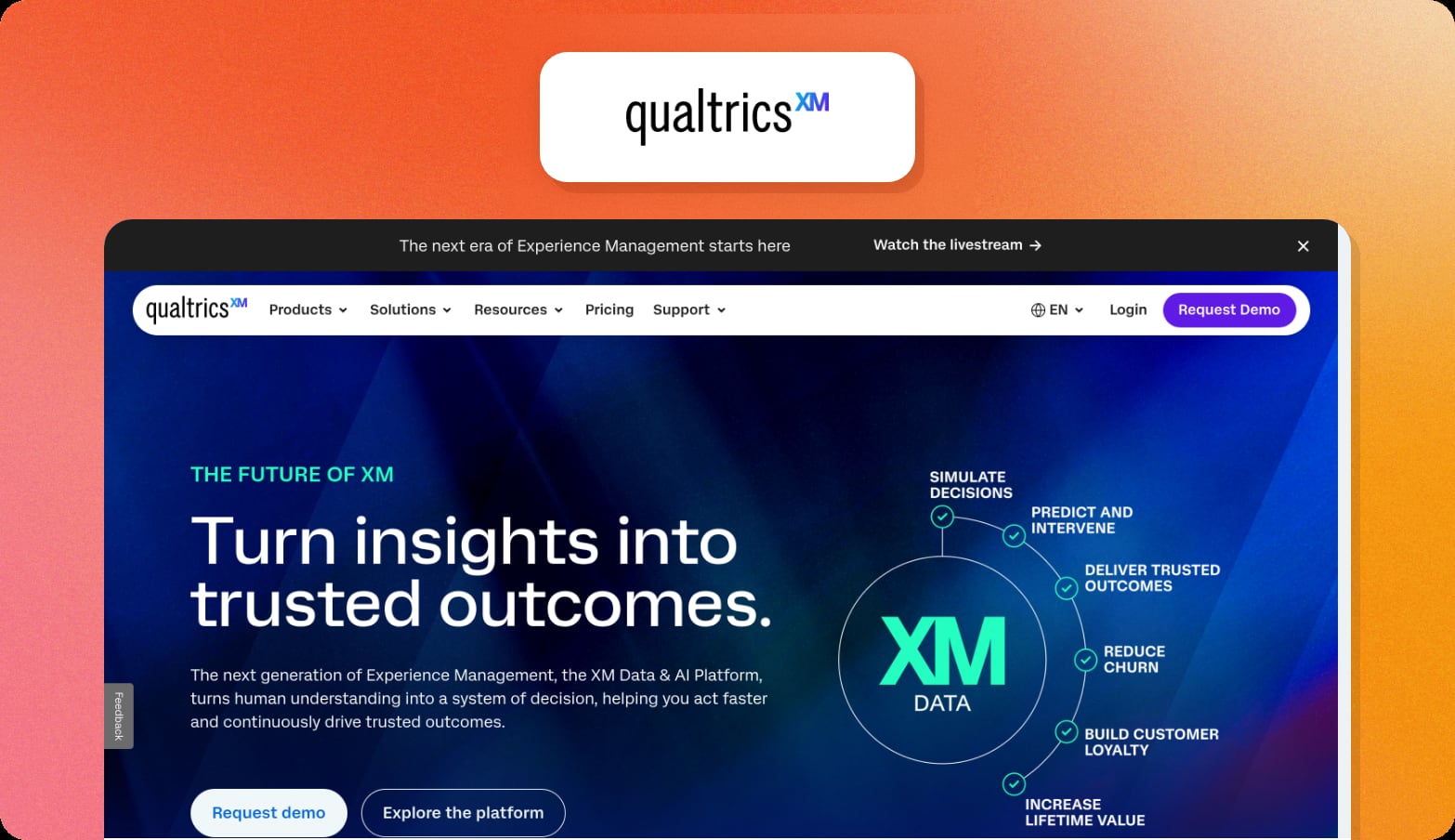
Qualtrics is a comprehensive enterprise experience management platform. Its research suite collects video feedback inside surveys alongside quantitative questions.
Strength: Video responses sit in the same platform as a company's surveys and customer experience data. AI summaries pull out themes, and each quote links back to the moment in the video.
Limitation: Qualtrics has no AI-moderated interviews at the time of writing. Video responses answer a fixed survey question and are capped at ten minutes, and live interviews need a human moderator.
Best for: Large enterprises already using Qualtrics that want to add video feedback to their existing survey programs.
7. Voiceform
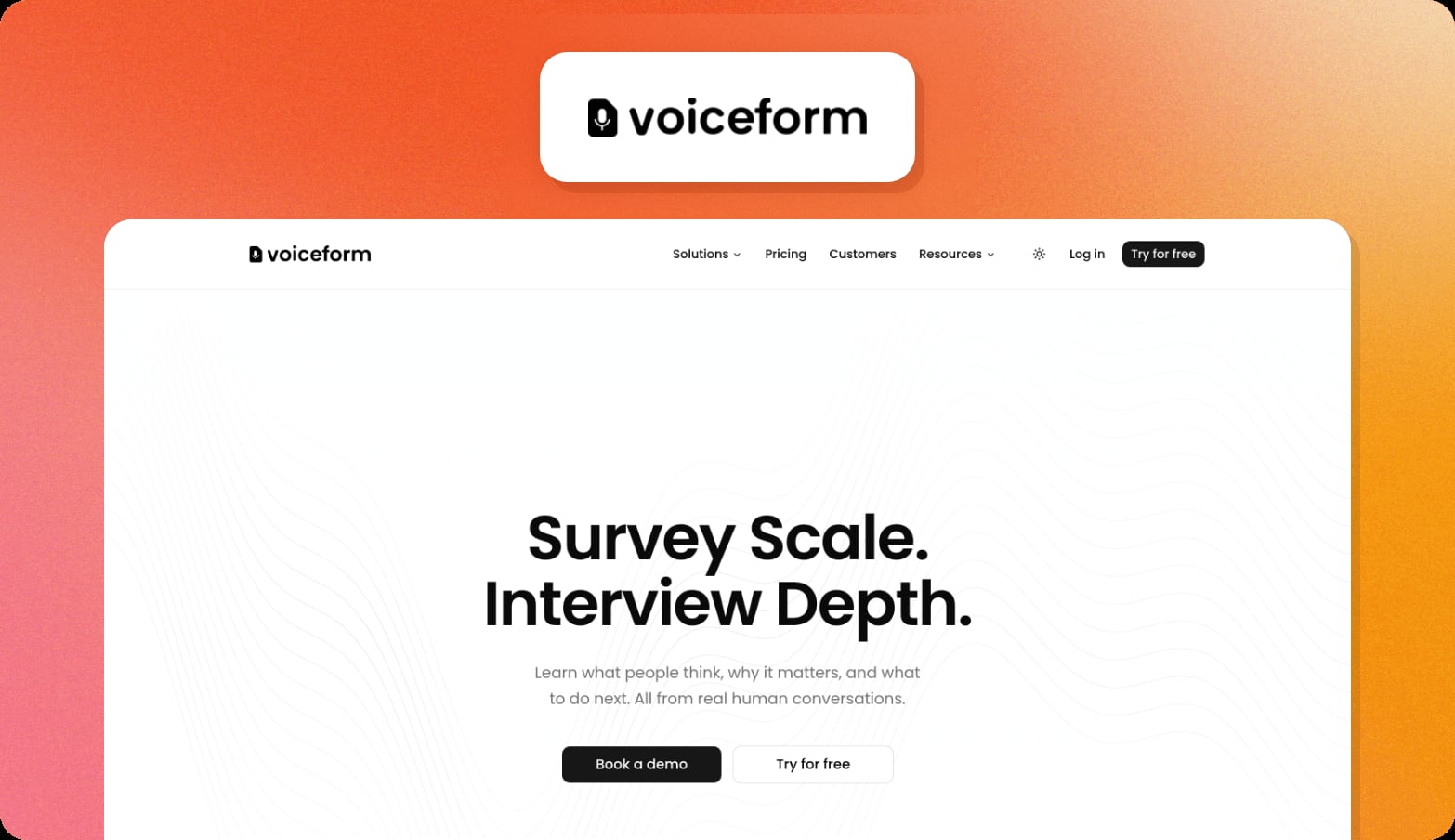
Voiceform combines structured survey question types, such as NPS, Likert, and multiple-choice, with voice and video responses.
Strength: Participants answer in whichever format they're most comfortable with, which makes studies easier to complete.
Limitation: Voiceform hosts data in the US and Canada, which may be a procurement barrier for teams with EU data residency requirements.
Best for: CX and marketing teams that want to add qualitative depth to specific survey questions without moving away from a survey format entirely.
8. Tellet
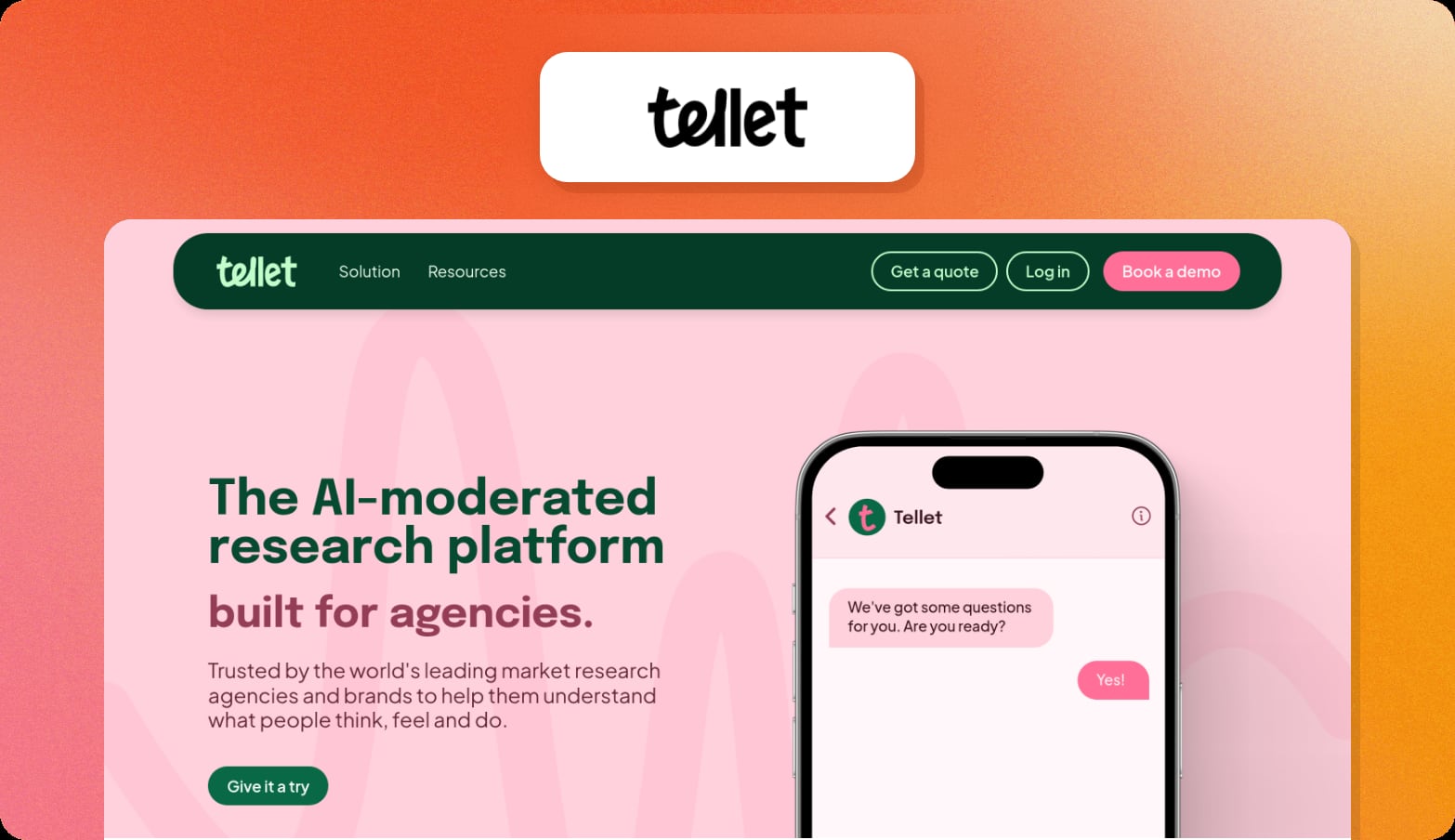
Tellet is an AI-moderated research platform built for agencies, where participants can respond by voice, video, or photo.
Strength: AI Search lets teams query existing transcripts with new questions after a study closes, re-mining completed interviews for new insights.
Limitation: Tellet doesn't list SOC 2 among its certifications, which may slow enterprise procurement reviews. No native fraud detection is described on their platform.
Best for: Market research agencies that want a straightforward AI-moderated interview tool with built-in post-study transcript querying.
9. User Intuition
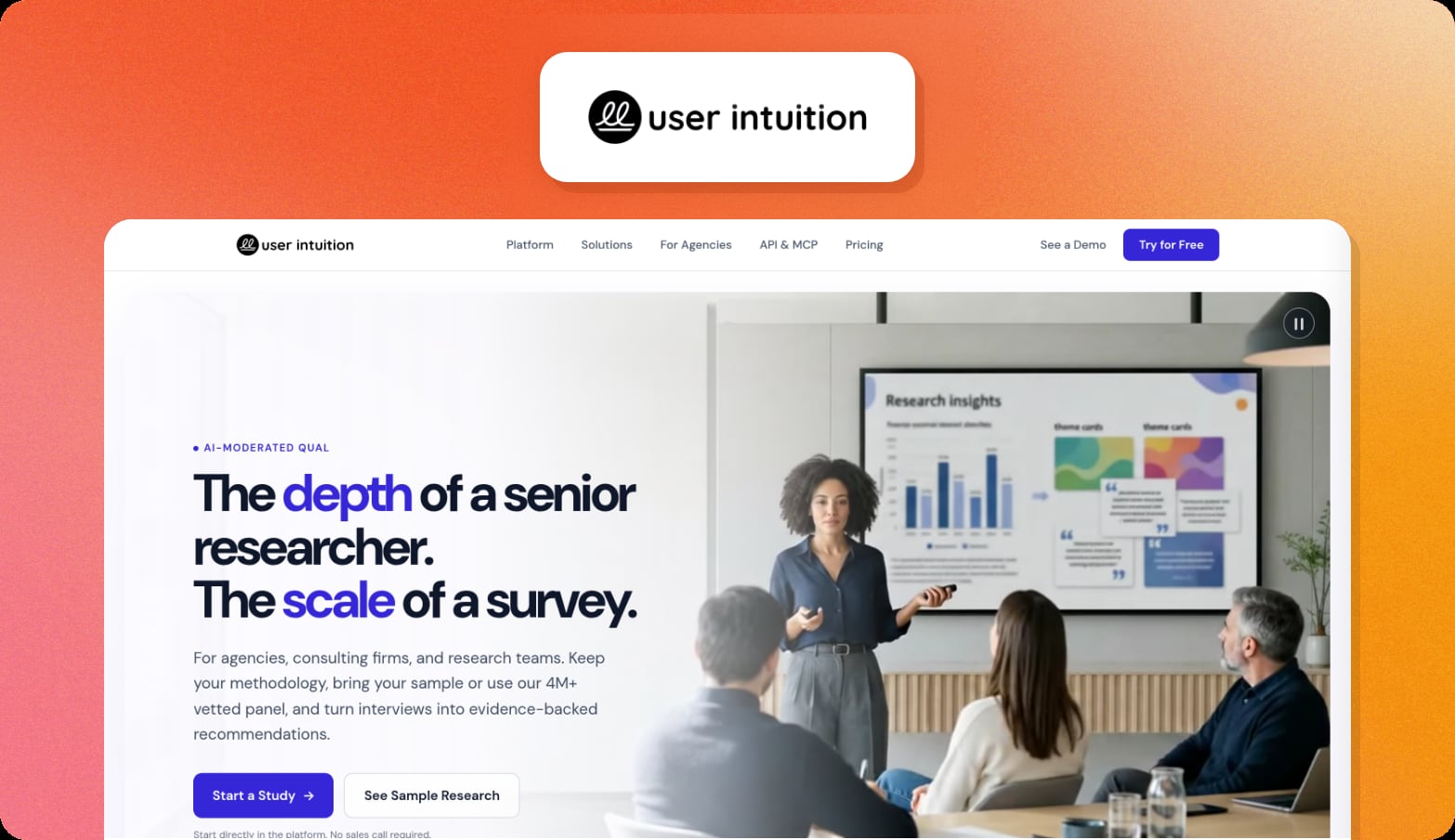
User Intuition is an AI-moderated interview platform for agencies, consulting firms, and research teams, where every conversation feeds a searchable intelligence hub.
Strength: Interviews use a laddering methodology. The AI probes five to seven levels deep to reach the root motivation behind a response.
Limitation: Interviews run in 80+ languages, but results are delivered in English only, which may not suit teams that report in other languages.
Best for: Agencies and research teams running win-loss analysis, churn research, or always-on brand tracking who want findings to build into a long-term searchable asset.
10. Dscout
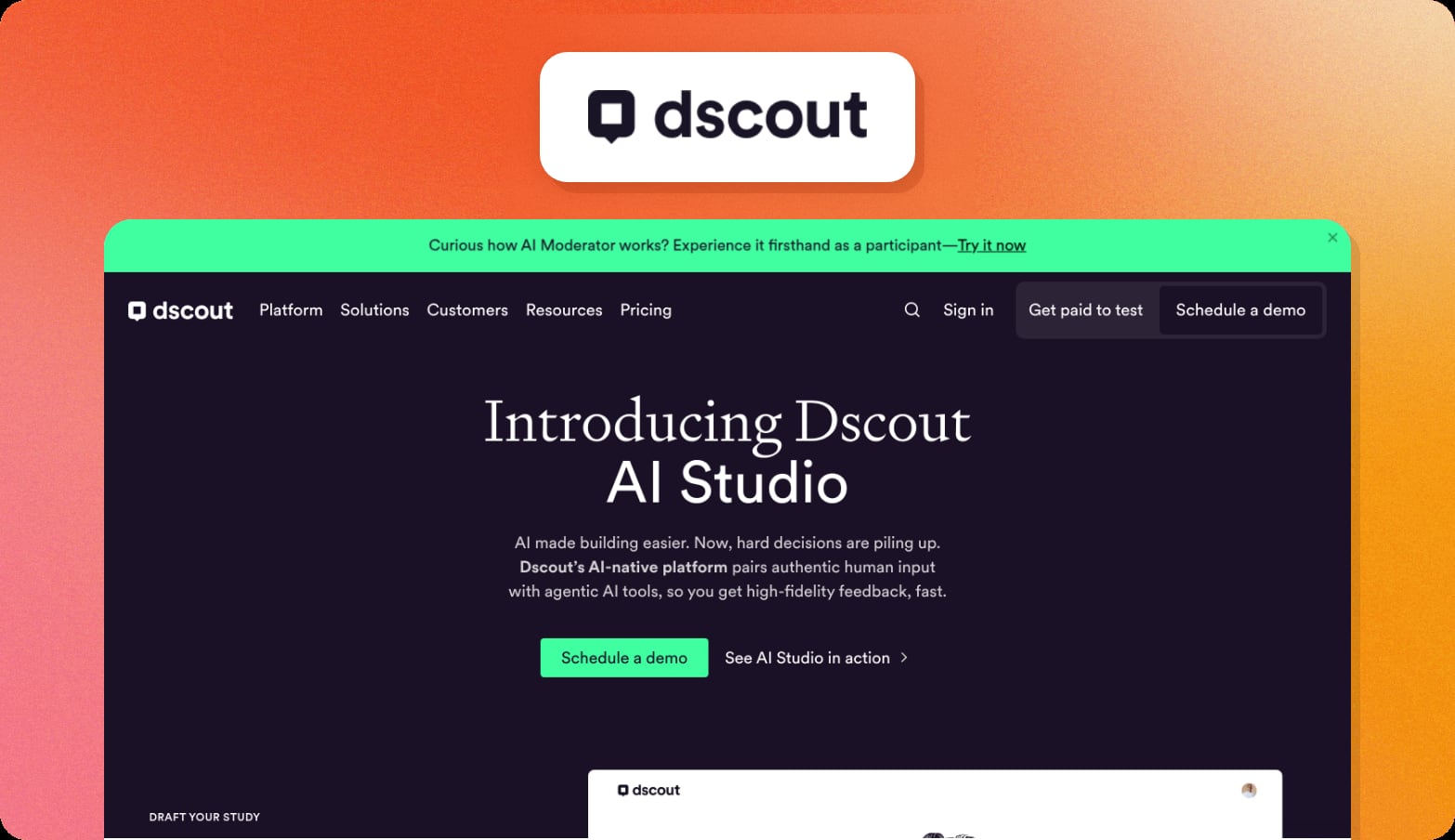
Dscout is an AI-first research platform for diary studies, interviews, and usability tests, where participants record their experiences in their own environment as they happen.
Strength: Dscout is strong for diary studies and in-the-moment qualitative research. Participants complete activities on their phone over days or weeks, so teams see how a product is used at home or in store.
Limitation: The Dscout app is available in nine languages and has no automated translation outside of AI-moderated studies, so studies in other languages rely on separate translation.
Best for: Product, UX, and design research teams running diary studies and field research where seeing behavior in context is the priority.
Decision Framework: When to Use Video Surveys vs. AI Interviews vs. Live In-Depth Interviews (IDIs)
The choice between platforms also depends on the research method you plan to use. Three variables determine the right approach: what your question is asking, what is at stake if you get it wrong, and how quickly you need the answer. The table below shows how video surveys, AI interviews, and live IDIs differ across these factors.
| Method | Question type | Decision stakes | Timeline | Best for |
|---|---|---|---|---|
| Video surveys | What people do or feel | Low to medium | Flexible or ongoing | Brand tracking, pulse checks, longitudinal studies |
| AI-moderated interviews | Why people do or feel that | Medium to high | Short | Concept testing, communication testing, consumer behavior research |
| IDIs | Complex, ambiguous, or still forming | High | Variable; often slow to start | Early-stage innovation, sensitive topics, exploratory research |
Here’s a deeper look at each method and when they work best to help you make a decision.
Video surveys
Video surveys work best when you already know the question and want to measure reactions at scale. They help teams understand what consumers think or feel, but not always why they feel that way.
For example, a CPG brand running quarterly brand tracking across five markets might want to measure how campaign exposure affects purchase intent. The questions and methodology are already defined, so a video survey is enough.
Video surveys scale well across large studies and multiple markets. However, because the questions are fixed, researchers can’t follow up when a participant says something unexpected, potentially missing out on deeper insights.
AI-moderated interviews
AI-moderated interviews are more useful when the goal is to understand why people think or behave a certain way. Instead of following a fixed script, the AI adapts its questions based on participant responses.
For example, a beauty brand testing three packaging concepts before a product review meeting might discover that one concept performs well with Gen Z consumers but poorly with older groups. AI-moderated interviews can uncover the reasons behind that split before the decision deadline.
Speed is a big advantage. Interviews run in parallel across markets and time zones, which helps teams working on short decision cycles.
Live IDIs
Live IDIs are most useful when the research question is still evolving or when the topic is sensitive and requires human judgment. A skilled moderator can notice a shift in direction during the conversation and explore unexpected reactions in ways that automated systems can’t.
For example, a financial services company exploring attitudes toward long-term saving may need a moderator who can handle anxiety, hesitation, and socially sensitive answers carefully.
The tradeoff is that live IDIs take more time and are harder to scale. Recruitment is narrow, and you can’t run them in parallel like you can with AI-moderated interviews. They’re best used when you prioritize depth and flexibility ahead of speed or study volume.
Migration playbook: Moving from Voxpopme video surveys to AI-moderated interviews
When evaluating a move to a Voxpopme alternative, there’s often concern about how to adopt a new methodology without disrupting ongoing programs. In practice, the transition usually happens through a series of smaller decisions. Here’s how to work through each of them.
1. Keep Voxpopme for programs that depend on continuity
If a program relies on longitudinal tracking data collected through Voxpopme, changing the methodology can make future waves difficult to compare with earlier results.
For example, a brand-tracking study that measures awareness and purchase intent every quarter across the same markets depends on the study remaining consistent. If the method changes mid-series, shifts in the data may reflect the new approach rather than real changes in consumer sentiment.
For these programs, keep the format, the questions, and the platform the same. If you're unsure whether a program qualifies, ask this: would the results be useful as a standalone study, or only when compared with previous waves? If it's the latter, leave it alone.
2. Run a parallel study on high-stakes projects
For concept testing or other studies tied to decisions that might impact annual revenue, run the same project on both platforms before committing to a wider change.
Use the same audience, research question, and stimulus across studies, then distribute the findings to stakeholders and share the outputs side by side. The goal is to see where fixed video prompts work well and where adaptive interviewing surfaces deeper reasoning or unexpected reactions.
Running both approaches in parallel gives stakeholders a direct comparison without forcing an immediate decision.
3. Transition new programs to AI-moderated interviews from the start
New research initiatives don’t need to inherit the methodology used in older tracking programs.
In brand perception and consumer behavior research, the main goal is often to understand why consumers think or behave a certain way. In these cases, AI-moderated interviews can uncover details that video surveys often miss, as the conversation adapts in real time.
Starting new programs with the right methodology from the beginning is usually easier than retrofitting deeper interviewing later.
Teams may find that Voxpopme continues to support longitudinal tracking and large-scale feedback collection, while Conveo handles new qualitative work. That includes new continuous programs: with Conveo StoryLines, research runs in waves on a set cadence, and each wave is compared against the ones before it.
Why research teams choose Conveo as a Voxpopme alternative
Teams comparing Voxpopme alternatives usually want two things from video feedback: the reasons behind what participants say, and evidence that stakeholders can check. Conveo provides both. Its AI research assistant asks follow-up questions in every interview, and every theme links back to the video clip and quote behind it.
Here's what CMI, CX, and brand teams get with Conveo:
Every theme linked to the video clip and quote behind it
100 interviews completed in 3 days
AI-moderated video interviews in 50+ languages
8 integrated panel providers, plus your own contact lists
SOC 2 Type II certified, GDPR compliant, with EU hosting in Belgium
Every study kept in a searchable insight library, so the next one builds on what earlier studies found
Frequently asked questions
What is Voxpopme used for?
Voxpopme is a video research company founded in 2013 by Dave Carruthers. It raised $9 million in a 2019 venture round and has its headquarters in Birmingham, UK. Research teams use it for brand tracking, market agility studies, concept testing, and customer intelligence programs. Its asynchronous format lets participants record video responses in their own time, which suits large-scale studies across multiple markets.
How much does Voxpopme cost?
Voxpopme doesn't publish pricing publicly. Contact their sales team directly for a quote.
What is the best alternative to Voxpopme for enterprise research?
For enterprise research teams that need more than video surveys, Conveo is the strongest alternative. It combines AI-moderated interviews with automated analysis and meets the compliance requirements large organizations need before onboarding a new platform. Direct competitors to Voxpopme include UserTesting, Discuss.io, Qualtrics, GetWhy, and Outset, depending on methodology and compliance requirements.
How does Conveo vs Voxpopme compare?
Voxpopme's core product is the video survey with fixed questions, and its AI Moderator is a newer add-on with adaptive follow-up. Conveo runs AI-moderated interviews on video, and every theme links back to the clip and quote behind it. With Conveo StoryLines, research can also run in waves, with each wave compared against earlier ones. On compliance, Conveo is SOC 2 Type II certified, GDPR compliant, with EU hosting in Belgium, while Voxpopme's trust center lists neither SOC 2 nor a hosting region at the time of writing.
Can AI-moderated interviews produce findings as credible as human-led research?
Yes, when the platform is built for traceability. Conveo's findings link directly to the source video and transcript for every participant response. Stakeholders can watch the interview clip that produced a specific insight rather than relying on a summary page, which makes the findings harder to challenge in a business review.
Which platforms on this list are GDPR-compliant with EU data hosting?
Conveo, GetWhy, Glaut, Qualtrics, and Tellet all have confirmed EU data hosting alongside GDPR compliance. For the other platforms, EU hosting is either unavailable or not publicly confirmed on their websites. Verify directly with each vendor when you make your shortlist.

About the author
Dieter De Mesmaeker
Co-Founder & CEO
Dieter is CEO and co-founder of Conveo. Before starting the company, he founded DataCamp and scaled it into one of the leading edtech platforms in the world.
More by Dieter →Qualitative insights at the speed of your business.
Conveo runs AI-moderated video interviews and structures everything they say.