In this article
TL;DR
Best for teams that need the "why" behind tracker movement: Brand health tracking shows that awareness dropped by 4 points. That number alone cannot tell you whether the cause was media weight, a competitor's launch, or a missed message. Stakeholders need more than a way to measure brand health; they need an explanation before campaign budgets are reallocated.
The timing problem: Agency-led qualitative brand health work typically runs 6 to 12 weeks. By the time findings arrive, the reallocation decision has already been made without them.
The resolution: Conveo pairs continuous brand health measurement with AI-moderated video interviews that deliver actionable insights in days, turning movement in brand health tracking into stakeholder-ready explanations and deeper insights while the decision window is still open.
Every insights team eventually hits the same wall: the tracker says something moved, but not why. This piece walks through what survey-only brand health tracking misses, how AI-moderated interviews close that diagnostic gap in days instead of weeks, and what it takes to keep the whole program defensible across waves and markets.
What brand health tracking misses without qualitative diagnostics
Brand health tracking is the longitudinal measurement of awareness, consideration, preference, loyalty, and advocacy, the classic brand funnel, across a defined participant base over time. These are the brand health tracking measures most programs report against, and treated well, they function as key performance indicators for brand strategy. Treated as the whole picture, they become a problem: brand health metrics are genuinely useful for spotting movement in a brand's success. They are designed to detect change rather than account for it.
That gap has a real cost. When consideration drops mid-quarter, diagnostic qualitative research through an agency takes 6 to 12 weeks, so the decision window usually closes before the explanation arrives. Teams end up adjusting messaging, media spend, or marketing strategy based on assumptions rather than evidence.
Survey-only brand health measurement compounds this because a numeric response strips out signals like:
Hesitation before answering a consideration question
A skeptical tone that signals how consumers perceive a brand attribute
A flat affect on a loyalty scale, the same scale used to infer customer satisfaction and customer loyalty
A participant who rates loyalty at four out of five looks like a retained customer, one of the existing customers a brand assumes it can count on. The same participant adding "I mean, I haven't really looked at alternatives yet" is telling you something the scale cannot record, which is why "what would make you switch?" is more predictive of vulnerability and customer expectations than any five-point rating in low-switching categories.
Brand health tracking tells you something changed. It leaves open whether that change will show up in customer perception at the point of brand purchase. Qualitative follow-up tells you what to do about it.
Why annual brand health studies arrive too late
Most brand health studies run once or twice a year: an agency recruits participants, fieldwork runs, and a stakeholder-ready deck arrives six to twelve weeks after kickoff. By then, market trends have moved on.
A competitor's pricing campaign, distribution issues, a category product recall: the study commissioned in January captures none of it in real time. Teams learn what happened to consumer perception, brand equity, and market share months after the decisions that could have protected brand reputation were already made. Multi-market programs compound the delay further, since sequential recruitment and localization add weeks per market.
The trade-off most insights leaders recognize: act on instinct when perception shifts, or wait for reliable data that arrives after the window has closed. Brand health study methodology itself is sound. The issue is cadence, built for a slower competitive environment than the one most teams operate in now.
How AI-moderated interviews turn brand health tracking movement into explanation
Brand health tracking surfaces the number, rarely the key driver behind it. Closing that gap has traditionally meant commissioning a separate qualitative study and waiting 6 to 12 weeks for agency delivery.
Instead, a researcher who notices movement in the tracker can commission a wave of AI-moderated video interviews straight away, focused on the target audience the tracker just flagged. Sessions run asynchronously, so 10 to 1,000 conversations can run in parallel across segments or geographies, without the scheduling constraints of sequential agency-led work.
For teams that want that read running continuously, Conveo StoryLines is the wave-based, AI-moderated research program that keeps consumer understanding up to date between tracker waves, giving the program a continuous understanding layer alongside its measurement.
Conveo's AI moderator captures voice, tone, and facial cues alongside verbatim responses. Every finding links back to a timestamped clip, producing consistent data stakeholders can verify rather than take on trust. That traceability is what makes AI brand monitoring credible at the executive level.
See it in action: How AI-Moderated Video Interviews Actually Work
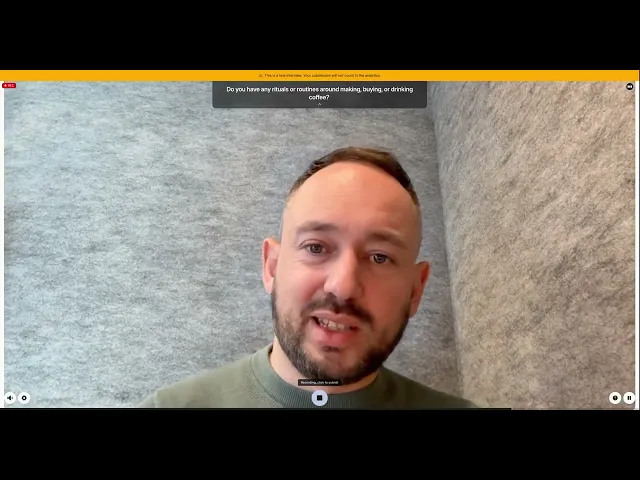
When a researcher sees a decline, they can commission 200 AI-moderated interviews across three segments and, teams report, have findings on purchase intent and perception back in days, while the campaign window is still open. Clips and quotes also feed into a searchable insight library, where findings and historical data connect across projects so nothing gets researched twice, and every wave makes the next investigation smarter.
That combination turns tracker movement into a stakeholder-ready explanation and a complete picture of what happened.
"Fast exec summary was perfect, job done"
Matt Harris, Research & Insights Lead, EMEA, Canva
Comparison table: Agency-led diagnostics vs. survey-only tracking vs. Conveo
Three dominant approaches to brand health tracking force different trade-offs, and choosing the wrong one can quietly erode competitive advantage.
| Approach | Findings vs. the decision window | Depth of insight | Multi-market scalability |
|---|---|---|---|
| Agency-led qualitative | Usually lands after the window closes (6 to 12 weeks) | Deep but slow | Sequential rollout adds weeks per region |
| Survey-only tracking | Lands inside the window, without the reason | Shows movement without causation | Scales easily, lacks diagnostic depth |
| Conveo AI-moderated interviews | Lands while the window is still open (days, teams report) | Video and voice capture tone and hesitation | 50+ markets in parallel, via integrated panel partners or your own list |
One trade-off worth noting: Conveo is priced as a premium platform and doesn't offer the multi-year syndicated benchmark history that a legacy panel provider brings.
Multi-market brand health tracking without localization delays
Sequential agency-led work requires that localization, recruitment, and moderation be handled separately in each region, which means a three-market brand perception tracking program can take three to four months before a single insight reaches the global team.
Conveo's AI moderator runs simultaneously across 50+ languages, removing the sequential dependency. Research teams can run 200 conversations in Germany, 200 in Brazil, and 200 in Japan in parallel, with all three markets delivering findings inside the same window. Conveo is SOC 2 Type II certified, GDPR compliant, EU hosting (Belgium), which addresses the legal and procurement requirements that routinely stall multi-market research, producing more reliable data from the start.
Making brand health tracking defensible: Sampling, questionnaire governance, and comparability
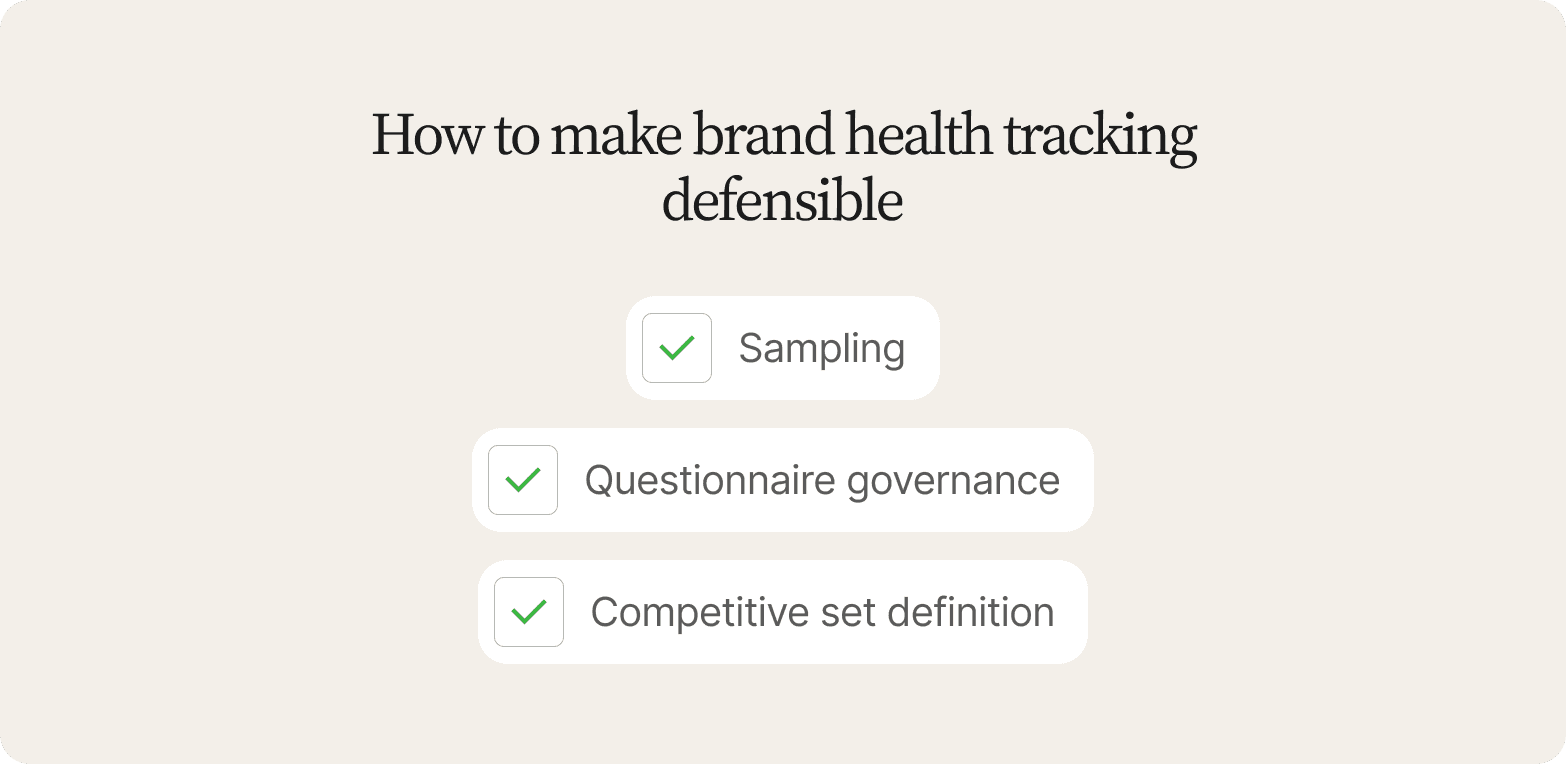
A tracker that can't withstand methodological scrutiny is actively misleading: it turns what should be reliable perception metrics into vanity metrics that look good in a deck but don't hold up under scrutiny. Three disciplines determine whether brand awareness tracking and brand health survey data stay consistent across waves:
Sampling
Questionnaire governance
Competitive set definition
Sampling
Representative samples matter more than large ones. Quota-based panel recruitment, controlling for age, gender, and category usage, is the minimum standard for comparability. Switching panel providers mid-program is one of the most common sources of structural bias, and it contaminates the customer feedback a program is meant to capture.
Questionnaire governance
Asking aided awareness before unaided recall inflates unaided scores. Using internal positioning language in association questions pulls responses toward brand promise language rather than genuine consumer mental models, and a survey that borrows its own brand positioning contaminates the data it's trying to measure.
Competitive set definition
Adding or removing competitors mid-program changes the consideration context for every question that follows. The frame moves, along with the pool of other brands in view, while brand strength stays exactly where it was. Many brands make this mistake without realizing it. The set should be defined at launch and held constant.
Conveo's AI moderator follows the same discussion-guide structure across every interview, reducing moderator variability that can introduce bias in agency-led work. The result is brand health tracking data and the market insights built on it that hold up in a boardroom.
Diagnosing why brand health moved
Brand sentiment tracking tells you something moved along the customer journey. The reason behind it stays out of view. Without understanding what drove the shift in how customers perceive the brand, the next campaign brief is built on a guess.
The qualitative methods that surface genuine diagnostic insight are specific:
Behavioral questions, anchored in real decisions ("What made you choose this brand over others?"), reduce post-rationalized answers.
Laddering questions ("What would it take for you to switch?") reveal the specific triggers that drive defection.
Projective prompts ("If this brand were a person, how would you describe them?") surface emotional associations people rarely state directly.
Their value depends entirely on how quickly they can be fielded after the tracker signals a problem, before the shift shows up in sales figures instead of just tracker data. Conveo's AI moderator runs these prompts at scale, capturing voice, video, and tone across every session- the texture that's absent from survey responses and precisely what distinguishes a diagnosis from a data point. Instead of waiting 6 to 12 weeks, diagnostic findings arrive while the campaign brief is still being written.
Evaluation framework: Comparing 3 brand tracking approaches
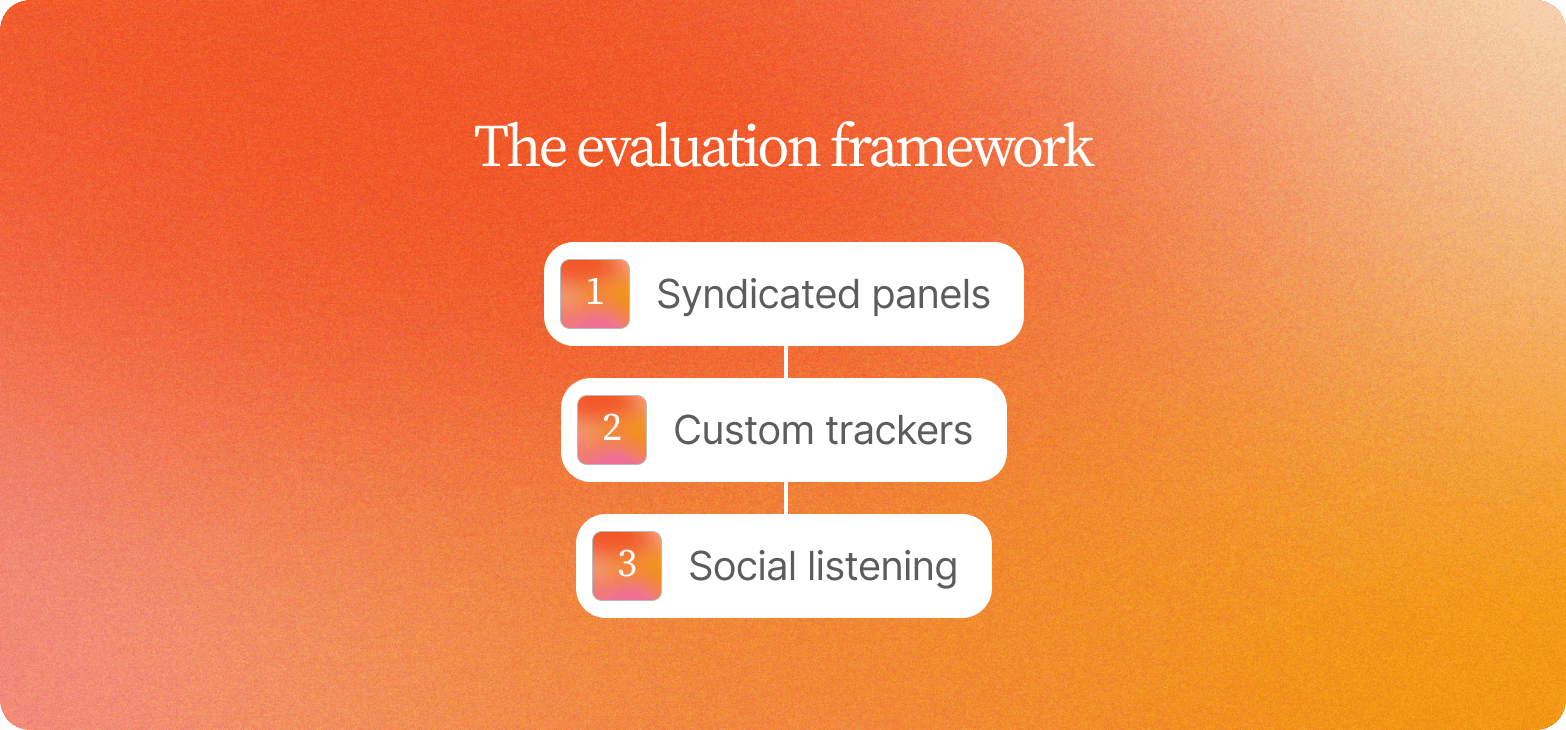
Three approaches dominate how most insights teams choose a brand tracker:
Syndicated panels
Custom trackers commissioned through agencies
Social media monitoring platforms
Syndicated panels (such as YouGov BrandIndex)
Offer daily data with years of historical trends and competitive benchmarking built in, but the competitive set and question battery are fixed. You can see that consideration dropped by three points, while whether the brand is still perceived as a strong brand, with solid brand recognition and real brand presence in the category, stays out of reach.
Custom trackers
Are fully tailored to your brand and can measure brand lift from a specific campaign, but they don't fit an agile marketing calendar: the qualitative follow-up to a metric shift typically adds 6 to 12 weeks.
Social media monitoring
Offers real-time data pulled from digital channels, useful for tracking brand mentions and letting teams proactively manage an emerging issue, but the population generating social content skews toward vocal minorities and misses the majority of category buyers who never post.
| Approach | Fits the decision window | Diagnostic depth | Real-time brand health |
|---|---|---|---|
| Syndicated panels | Yes, for metrics alone | Low (no probing) | Partial (metrics only, no reasons) |
| Custom agency trackers | Rarely (qual adds 6–12 weeks) | Medium | Low |
| Social media monitoring | Yes, for sentiment alone | Low (vocal minority, no probing) | High (volume and sentiment) |
| Conveo | Yes, with the reason attached (days, teams report) | High (AI-moderated video interviews) | Wave-based refresh between tracker waves |
Conveo combines the response speed of syndicated panels with the diagnostic depth custom qualitative work has traditionally required agency timelines to deliver, probing the actual reason a brand performs the way it does rather than just flagging that it moved. As noted above, Conveo is priced as a premium platform and carries no multi-year syndicated benchmark history. Choose based on decision speed, diagnostic depth, stakeholder trust, and how directly the approach ties back to brand performance you can act on.
How Conveo closes the brand health tracking gap
Every brand health tracker surfaces the number. A healthy brand needs more: understanding what drove it while the decision is still open.
Rather than commissioning a separate qualitative study each time the tracker moves, a researcher who spots a shift in customer experience or brand perception can commission a wave of AI-moderated interviews without opening a new agency scope. Findings arrive in days, and Conveo StoryLines keeps that read running between tracker waves.
Conveo is built by researchers. Every finding traces back to a timestamped clip and verbatim quote, so stakeholders can verify interpretation rather than take a summary deck on faith. Participants are 68% more open than when using a human moderator, and 94% rate the experience positively, indicating the data reflects genuine perceptions rather than socially managed responses that can quietly inflate brand loyalty numbers or mask early defection among brand advocates.
Clips and themes feed into a searchable insight library rather than expiring in a deck, building a store of brand health insights that gets smarter with every study.
Frequently Asked Questions
What is brand health tracking?
Brand health tracking is the longitudinal measurement of awareness, consideration, preference, loyalty, and advocacy to detect how consumer perceptions of a brand shift over time, tracking both whether a brand exists in a category and how strongly it's chosen within it. Trackers surface movement but cannot explain what drove it, so teams pair tracking data with qualitative diagnostics to understand the underlying cause.
What is a brand health tracking report?
A brand health tracking report shows how key metrics move across research waves over time. Traditional reports typically arrive 6 to 12 weeks after fieldwork closes, well after the pricing or campaign decisions that caused the shift are already locked in. Pairing trackers with fast qualitative follow-up turns metric movement into explanation while the decision window is still open.
How does Ipsos brand health tracking compare to AI-moderated approaches?
Ipsos brand health tracking is a credible, well-established approach with strong global panel reach. The constraint is diagnostic: qualitative follow-up through agency-led research typically takes 6 to 12 weeks, by which point the decision it was meant to inform has usually been made. Teams can pair Ipsos measurement data with Conveo's AI-moderated interviews, commissioning a diagnostic wave as soon as a metric moves, without disrupting the longitudinal program.
What is a brand health tracking example?
A CPG brand sees its consideration drop by 4 points among 25- to 34-year-olds in Q2. Qualitative follow-up through an agency takes 8 weeks, and by the time findings arrive, the Q3 brief is already locked. The alternative: 150 AI-moderated interviews in the segment, completed in days, surface that competitor messaging around sustainability is resonating. The team adjusts the brief while it is still open.
How often should you run brand health tracking?
Quarterly is the minimum for detecting meaningful shifts. Monthly is common in high-velocity categories like CPG and tech. Continuous tracking is emerging as the enterprise standard for brands that need to act inside the campaign window. The practical resolution: run your tracker at a cadence your budget can sustain, then use AI-moderated interviews to investigate movement quickly without increasing tracker frequency.
What are the most important brand health metrics to track?
Awareness (unaided and aided, sometimes called brand recall) Consideration (likelihood to consider your brand) Preference (likelihood to choose you over competitors) Loyalty (likelihood to repurchase) Advocacy (likelihood to recommend) Each shows movement over time, but none alone explains causation. One common mistake: treating a loyalty rating scale as predictive in low-switching categories, when "what would make you switch?" is far more diagnostic.
About the author
Jake Brown
Brand and Consumer Insight
Jake came to Conveo from three and a half years in social listening, which is where his interest in brand and consumer insights started. A people person who is energised by not knowing something yet, he works with US clients on brand and consumer studies.
Meet Jake on film →Qualitative insights at the speed of your business.
Conveo runs AI-moderated video interviews and structures everything they say.