In this article
TL;DR
Choosing the wrong type of survey method in research can invalidate your findings, leading to wasted budget and knocking stakeholder trust.
Three decisions give you a clear way to choose the right types of survey methodology for any study.
Every survey type has limitations. This article shows where those limits are and when qualitative interviews fill the gap.
Without an understanding of the different types of survey methods, it's easy to end up with a method that can’t answer your research question or produce findings you can't defend to stakeholders.
This article covers the types of survey research methods available and the decisions that determine the right approach for your project. By the end, you'll have a clear framework for choosing the right method and explaining that choice with confidence.
The Three Decisions That Determine Your Survey Method
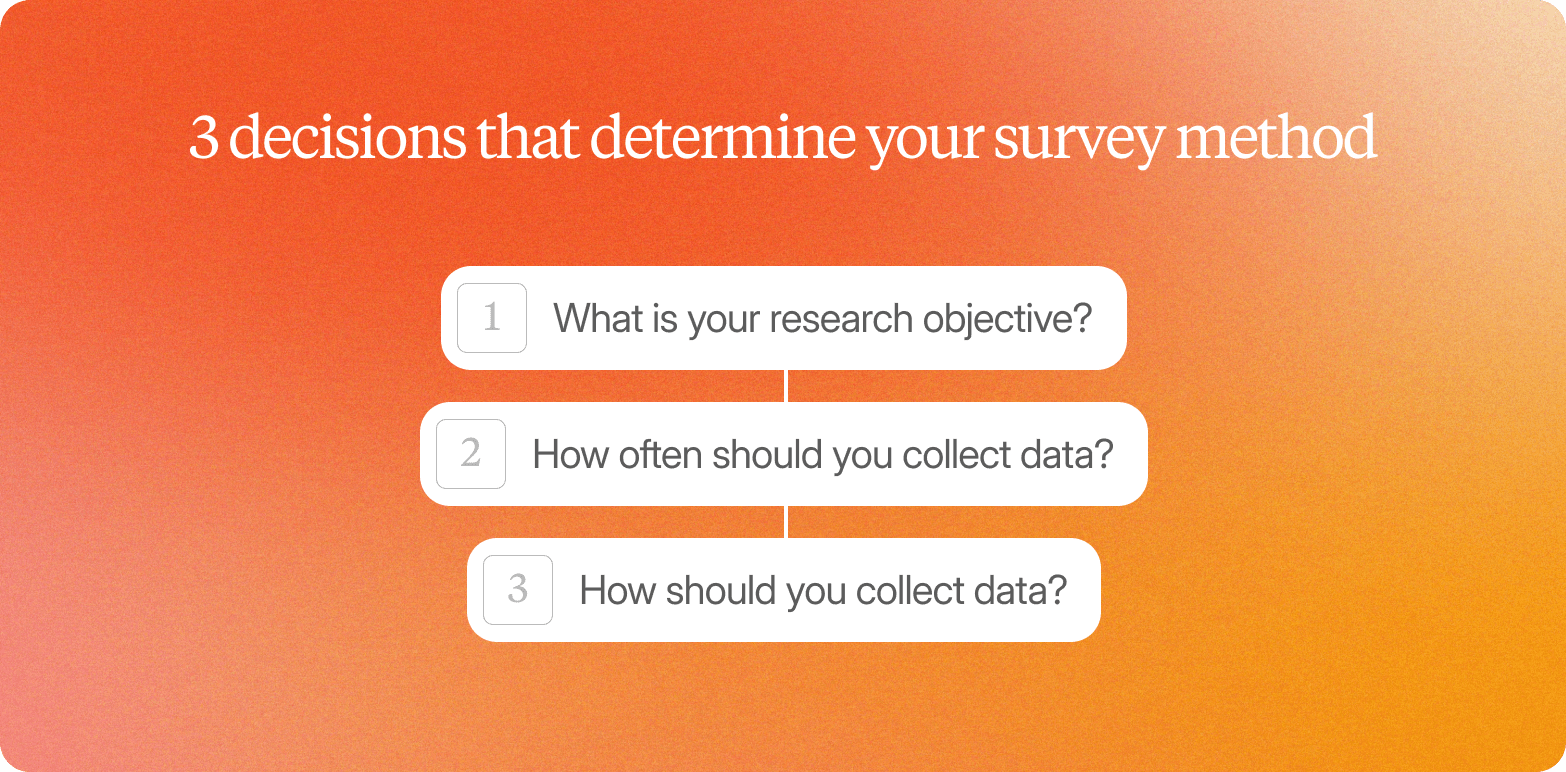
Choosing the best methods of research survey comes down to three questions: what you're trying to find out, how often you need to measure, and how you reach participants.
1. What Is Your Research Objective?
Exploratory, descriptive, and causal surveys are three methodologies designed to answer different types of questions. Here’s how to pair your research objective with the correct survey type and what it entails:
| Research objective | Survey type | How it works | Limitations | What to pair it with |
|---|---|---|---|---|
| You're trying to understand a problem, uncover opportunities, or generate new ideas. Common uses include early-stage discovery and new product development. | Exploratory | Uses open-ended questions and avoids fixed answer paths. Samples are typically smaller. The survey should leave room for participants to raise issues and ideas you may not have anticipated. | Fixed question flows can limit discovery. Once a participant reveals something interesting, the survey can't ask follow-up questions or explore the topic further. | Conveo AI-moderated video interviews, which can follow up on unexpected responses in real time. |
| You're trying to measure what is happening across a group. Common uses include brand tracking, customer satisfaction, and usage frequency studies. | Descriptive | Uses rating scales, Likert scales, NPS, and frequency questions with a large, representative sample. The goal is to quantify attitudes, behaviors, and perceptions. | Shows what is happening, but not why. For example, a low satisfaction score tells you there is a problem, but not what's causing it. | Conveo video interviews to uncover the reasons behind trends, score changes, and customer behaviors. |
| You're trying to determine whether a specific change affects an outcome. Common uses include concept testing and A/B testing. | Causal | Uses an experimental design with a control group and randomized assignment. Only the factor being tested should differ between groups so you can isolate its impact. | Other factors may influence results without your knowledge. Participants may also give answers they think are expected rather than what they truly believe. | Conveo video interviews to validate findings and understand how participants made decisions. |
Once you've chosen the right survey type for your research question, the next decision is how to structure the data collection over time.
2. How Often Should You Collect Data?
Every survey uses one of two designs: cross-sectional or longitudinal. A cross-sectional survey collects responses once from a group of people at a single point in time. A longitudinal survey collects responses from the same people more than once, over weeks, months, or even years.
Here’s when to use each:
Use a cross-sectional survey when you need a snapshot. For example, to understand current brand awareness or run a one-off health check. These surveys are quick to run and usually enough when you only need a picture of what is happening now. The limitation is that they can’t show how things change over time.
Use a longitudinal survey when you need to track change. For example, to see how attitudes shift after a product launch or how customer behavior evolves over time. Because the same people are surveyed repeatedly, you can compare results across different time periods.
Note that longitudinal surveys are harder to run in practice than cross-sectional surveys. You need to track participants over time and ensure enough of them stay involved. Analyzing data collected over a long period is also difficult because of its size and complexity.
This customer research approach requires more planning and coordination than a one-off survey, and many survey tools aren’t well-suited to managing that process. Now you know how often you’ll collect data, the final decision is the method you’ll use to get it.
3. How Should You Collect Data?
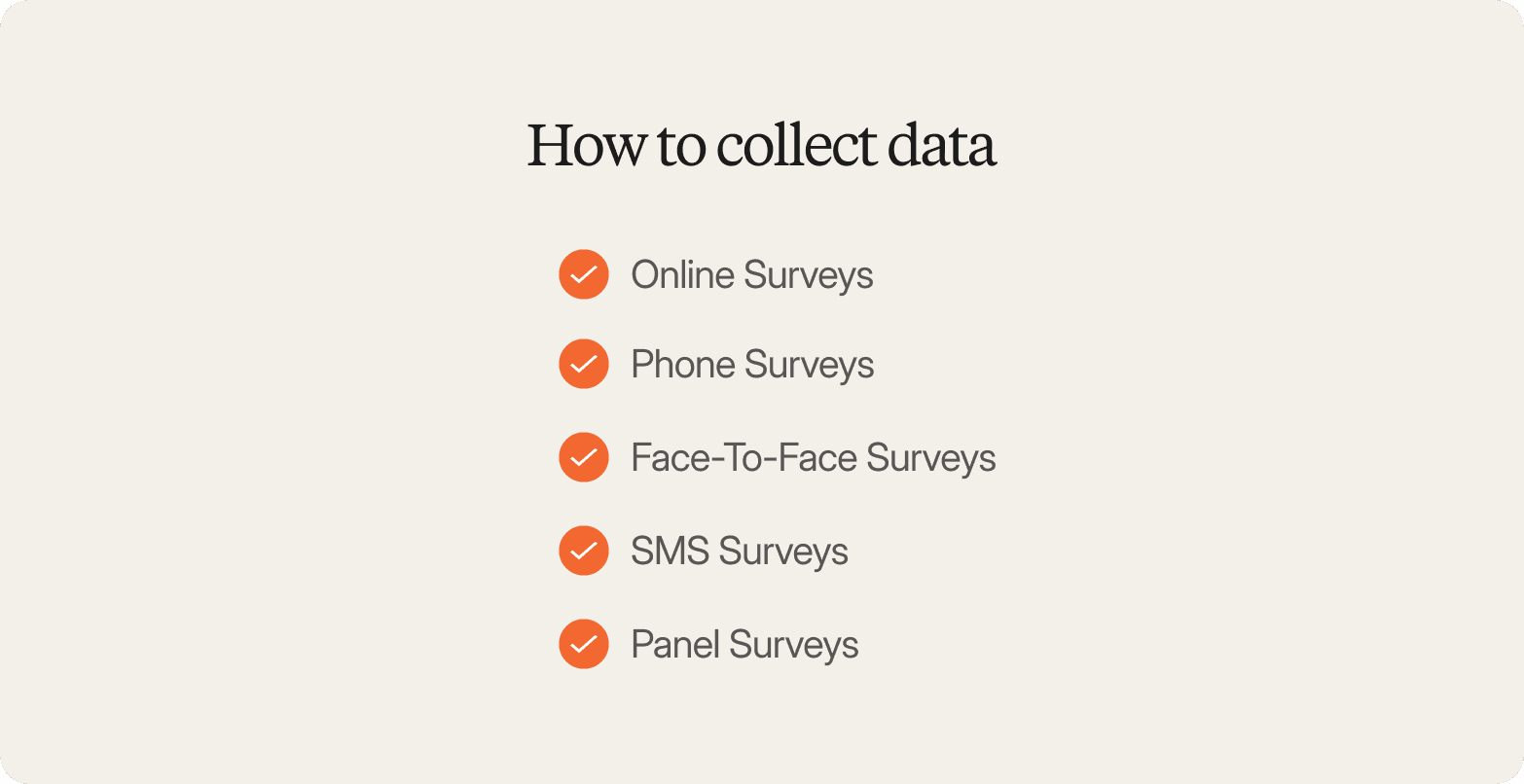
Different types of research survey collection methods have different trade-offs in cost, speed, reach, and data quality. Here’s a look at the six most common and when to choose them.
Online Surveys
Online surveys are sent via web links or email. They're quick to set up, inexpensive, and easy to scale, which is why they're widely used in enterprise research. The main issue is data quality. Bots and fake responses can contaminate the dataset, and frequent survey participants may rush answers without thinking.
Strong fraud checks and response screening are also needed. GDPR rules apply to EU participants, and SOC 2 compliance is often required in enterprise procurement. Use online surveys when you need to reach many people quickly at low cost, and the topic isn't sensitive.
Phone Surveys
Phone surveys involve calling participants directly, either with an interviewer or an automated system. They can improve data quality in some cases, but response rates have dropped as caller ID recognition has improved and people screen calls more effectively. They're also more expensive per response than online surveys.
Some teams use automated voice systems to reduce cost, but these usually reduce answer quality. Use telephone surveys for sensitive topics or hard-to-reach groups when the budget allows.
Face-To-Face Surveys
Face-to-face surveys are conducted in person, often in public places such as shops or events. They usually produce higher-quality responses and better engagement, especially for complex topics. Kiosk-based surveys at checkout points are a lighter version of this.
The main limitation is cost and logistics, especially across multiple locations. Use face-to-face surveys when depth matters more than scale.
Mail Surveys
Mail surveys are sent as paper questionnaires through the post. They're slow and costly to process, and data entry can introduce errors. Response rates are also low.
They're still used in limited cases, such as populations without reliable internet access or in formal government, healthcare, or financial research where paper communication is expected. For most enterprise teams, mail surveys aren't practical.
SMS Surveys
SMS surveys are sent directly to mobile phones. They often get quick responses because they reach people in the moment. The downside is limited space, which restricts the types of questions and their depth.
They work well for simple ratings but not detailed feedback. Use SMS surveys for quick feedback right after an interaction, such as a purchase or service experience.
Panel Surveys
Panel surveys use pre-recruited groups who agree to take part in research. Some panels are tightly managed and screened, while others are open access with incentives. Panels make it faster to reach specific audiences, but quality varies widely depending on the provider.
It's important to check fraud prevention measures, how often participants are refreshed, where data is stored, and compliance standards such as SOC 2 and GDPR. Use panel surveys when you need a specific audience that's hard to reach through open recruitment.
Applying The Framework: How To Choose The Right Survey Method
Now that these three decisions are clear, the final step is putting them together. Here's an example of how the three choices above map to common research tasks:
| If you need to... | Research purpose | Design | Collection method | Consider adding |
|---|---|---|---|---|
| Track customer satisfaction | Descriptive | Longitudinal | Online | Interviews to understand score changes |
| Measure brand awareness | Descriptive | Cross-sectional | Online or panel | Interviews to explain perception gaps |
| Explore a new market | Exploratory | Cross-sectional | Online | AI-moderated video interviews |
| Test a new concept | Causal | Cross-sectional | Online or panel | Interviews to understand reactions |
| Monitor product adoption | Descriptive | Longitudinal | Online | Interviews with key segments |
| Validate marketing claims | Causal | Cross-sectional | Panel | Interviews to understand decision-making |
Most projects fit neatly into one of these combinations, but there’s a point where the framework reaches its limit. Even when the setup is correct, the data can still leave key questions unanswered. That’s where survey methods alone are no longer enough.
"Real conversations, real emotions. That's what makes Conveo different from every survey tool."
CMI Lead, Edgard & Cooper
When Surveys Are The Wrong Method
Surveys measure what's happening but can't explain why. That’s fine for collecting scores and metrics, but there are four situations where surveys aren’t the best choice.
| Situation | Why surveys fall short | What to use instead |
|---|---|---|
| The research question needs follow-up | A fixed question path can't adapt to what a participant reveals. When someone says something unexpected, the survey moves on. | In-depth interviews or AI-moderated video interviews that can follow the conversation wherever it leads. |
| You need to understand feelings or motivations | Surveys collect the surface answer. A participant who rates brand trust at 4 out of 10 and one who rates it 7 look different in your data, but without follow-up, you don't know why. | Video interviews that can ask why, explore hesitation, and capture the reasoning behind a response. |
| Participants don't have formed opinions yet | When a topic is unfamiliar, survey responses tend to reflect guesses or social norms rather than genuine views. | In-depth interviews or focus groups, which give participants space to form and express views through conversation. |
| The topic is sensitive | Participants underreport behaviors they're embarrassed by and overreport ones that reflect well on them. Topics involving money or health are especially vulnerable. | Qualitative interviews with skilled facilitation, where moderators are trained to create conditions for more honest responses. |
Conveo runs hundreds of asynchronous AI-moderated video interviews in parallel with real participants, so research teams get the explanation behind the numbers without the six-week agency timeline. Studies that would normally take weeks to coordinate are completed in days. See how Conveo adds qualitative depth to your survey program.
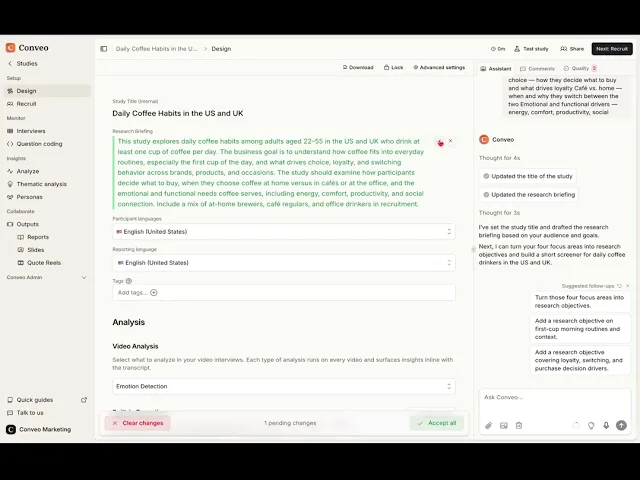
Discover how to build and launch a study from scratch in Conveo
How to Check Survey Data Quality Before You Present Your Findings
Even when you’re confident in your chosen methods for survey research, the results still depend on whether the data itself is reliable. Low-quality survey data can yield findings that appear precise but don’t reflect real behavior, leading to conclusions that fail when tested or repeated.
The table below provides a practical checklist for identifying common quality issues before you present your results.
| Quality risk | How to spot it | How to fix it |
|---|---|---|
| Bot and fraud submissions | Completion times that are unrealistically fast, duplicate IP addresses, or meaningless open-ended responses | Use platforms with fraud detection. Check completion times and remove clear outliers before analysis. |
| Panel conditioning | Response patterns that look too similar across participants or unusually high straight-line answering | Use multiple panel sources. Track participant history and include attention checks where appropriate. |
| Survey fatigue | Lower quality responses toward the end of the survey or higher dropout rates before completion | Keep surveys short. Test completion time before launch and show a clear progress indicator. |
| Speeders | Participants who complete the survey too quickly to have read the questions properly | Set a minimum completion time threshold and exclude responses that fall below it. |
| Straightliners | Participants who select the same answer option across all matrix questions | Identify and remove responses with identical patterns across multiple question rows. |
| Researcher bias | Questions that lead participants toward a particular answer | Use neutral wording and test questions with a small pilot group before full rollout. |
| Social desirability bias | Responses that lean toward what people think is acceptable rather than what they genuinely believe | Use indirect question formats. For sensitive topics, consider follow-up interviews to validate responses. |
Once data quality issues are addressed, the focus moves from cleaning results to communicating them clearly.
How to Present Findings Stakeholders Trust
Survey findings are easier to trust when it's clear what the data show and how certain the findings are. Here are some guidelines to follow:
Show effect sizes alongside statistical significance. Statistical significance tells you whether a result is likely to be real rather than random. Effect size shows how large the difference actually is. A result can be statistically significant but too small to be meaningful. Presenting both gives stakeholders the full picture.
Include confidence intervals alongside percentages. Reporting "42% of customers prefer option A" on its own risks making results look more precise than they are. Adding a confidence interval, which shows the likely range around that number, gives stakeholders a more honest view of what the data supports.
Be explicit about correlation vs. causation. If two variables move together, that doesn't mean one is causing the other. Make that distinction clear so stakeholders don't draw conclusions beyond what the data can support.
Use participant quotes to ground key findings. A short quote can illustrate what a pattern looks like in practice, making abstract results more tangible and easier for stakeholders to act on.
Add qualitative input when findings need explanation. If the survey results raise questions the data alone can't answer, running a few interviews before sharing results gives you the context to explain what's going on.
"Our leadership remembers the stories. Conveo beats another slide deck every time."
Head of Customer Insights, JDE Peet’s
How Conveo Complements Your Survey Program
Conveo is a video-first AI research platform that runs AI-moderated video interviews at scale, giving research teams the qualitative depth that surveys alone can't provide. Here's how it works in practice:
Its AI moderator adapts questions based on each participant's responses. A hesitation gets a follow-up. An unexpected answer opens a new line of inquiry instead of closing it.
There are no built-in limitations on study size. Teams can ask 100 questions or interview thousands of participants without hitting a ceiling.
Studies that would take a traditional agency six or more weeks to complete in as little as three days, with participants giving responses three to four times longer than static survey answers.
Conveo works with real participants, not AI participants. It captures tone, hesitation, and body language alongside text, so research teams can review evidence at the source rather than relying on a summary.
Teams can recruit participants through 12+ panel partners in-product or invite participants directly from their own contact lists, so they aren't locked to a single provider.
Every finding links back to the original participant and the exact video clip, so stakeholders can check the source rather than taking a summary on trust.
Each study feeds a searchable knowledge library. For large research teams, shared topic guides and locked templates keep new studies consistent with historical research, so results stay comparable across waves.
Conveo is SOC 2-certified and GDPR-compliant. Teams choose where their data is hosted, in any region.
Frequently Asked Questions
What are the main types of survey methods?
Survey methods are classified by three dimensions: purpose (exploratory, descriptive, or causal), design (cross-sectional or longitudinal), and collection method (online, phone, face-to-face, mail, SMS, or panel). Method mismatches happen when researchers focus on one dimension and default on the others.
What type of research method is a survey?
A survey is a quantitative data collection method used to gather responses from a target population at scale. It's one of the most common research methods because it produces structured, comparable data quickly and cost-effectively. Surveys work best for descriptive research, measuring what's happening across a group, and causal research, where you're testing whether one thing influences another. They're less suited to exploratory research where the goal is to uncover unknowns rather than measure known variables.
What are the types of survey methods in marketing research?
The most common forms of survey research used in marketing are online surveys for broad audience reach, panel surveys for specific target audiences, and SMS surveys for immediate post-experience customer feedback. Different types of research survey methods suit different research objectives: online surveys work well for brand tracking and customer satisfaction studies, panels are better for niche or hard-to-reach segments, and SMS is best for capturing quick ratings at the point of interaction. For marketing research that needs to explain why perceptions or behaviors are shifting, qualitative methods, such as in-depth interviews, complement survey data by adding the reasoning behind the numbers.
What is the difference between cross-sectional and longitudinal surveys?
A cross-sectional survey gathers data from a representative sample at a single point in time. A longitudinal survey gathers data from the same participants repeatedly to identify trends and track how attitudes or behaviors change over time. Cross-sectional designs are faster and less expensive, but can't support causal inference across time. Longitudinal surveys produce more reliable insights into change but require a consistent survey design across waves and careful management of survey participants to maintain sample quality.
When should you use qualitative research instead of surveys?
Qualitative research is the better choice when the research question needs follow-up questions that a fixed survey path can't provide, when research participants haven't formed opinions on a topic yet, when social desirability bias makes self-report unreliable, or when stakeholders need to understand why a pattern exists rather than just that it does. Surveys and qualitative interviews aren't alternatives. They answer different questions. Surveys collect quantitative data at scale, and interviews produce qualitative data that explains it.
What is the best survey method for market research?
There isn't a single right survey method for market research. The best choice depends on your research objective, your target audience, and your constraints. Descriptive research with large samples works well online. Sensitive topics often require telephone or face-to-face surveys to obtain more accurate responses. Niche audiences require managed panel surveys. Any market research program that needs to explain the reasoning behind customer feedback or satisfaction scores should include a qualitative component alongside the survey data.

About the author
Meg Gerli
Research Impact Lead
Meg studied at Stanford and spent six and a half years on the insights and research team at Nike before joining Conveo. She scopes studies with US enterprise teams: sample sizes, panel feasibility, and the trade-off between depth and speed, with the reasoning behind every recommendation.
Meet Meg on film →Qualitative insights at the speed of your business.
Conveo runs AI-moderated video interviews and structures everything they say.