In this article
TL;DR
Commercial intelligence is the systematic gathering and synthesis of customer evidence that explains why buyers make decisions, not just what they do. It supports pricing, positioning, retention, and segmentation decisions.
Most teams have survey scores, dashboards, and churn data but no traceable explanation for why customers switched or stopped renewing. Left unexamined, that gap creates hidden risk that no one has pressure-tested.
The core failure is timing. By the time agency-led qualitative research findings arrive, the decision they were meant to inform has already closed.
AI-moderated video interviews close that gap: thematic synthesis completes in days, so commercial intelligence reaches pricing, positioning, and retention teams while those calls are still open, supporting better decisions instead of assumptions dressed up as strategy.
Building commercial intelligence as an operating model requires four components: intake triage, a regular cadence of evidence, synthesis and distribution, and governance rules that define what counts as verified evidence.
Commercial intelligence efforts stall at the same point, every time: teams have survey scores, analytics dashboards, and churn rates, but no credible explanation for why customers switched, hesitated, or stopped renewing. Without that explanation, pricing decisions are made on assumptions, positioning briefs are written to internal consensus, and retention strategies are built around guesses dressed up as hypotheses.
Timing is the failure point here, and it rarely comes down to effort. By the time qualitative findings typically arrive, the pricing brief is locked, the positioning has gone to design, and the retention campaign is already in market. That's the decision-lag problem: insight that arrives after the decision has closed might as well never have arrived at all.
Commercial intelligence is the systematic gathering and synthesis of customer evidence that explains why buyers make decisions, not just what they do. It answers the questions no dashboard can: why a segment that looked loyal quietly moved on, why a concept that tested well in quant failed to convert, why one price point holds, and another collapses trust. Conveo's AI-moderated interviews close that decision-lag by returning thematic synthesis in days rather than weeks, so the evidence reaches pricing, positioning, and retention teams while those calls are still open, giving leadership the basis for better decisions rather than assumptions dressed up as strategy.
What Is Commercial Intelligence?
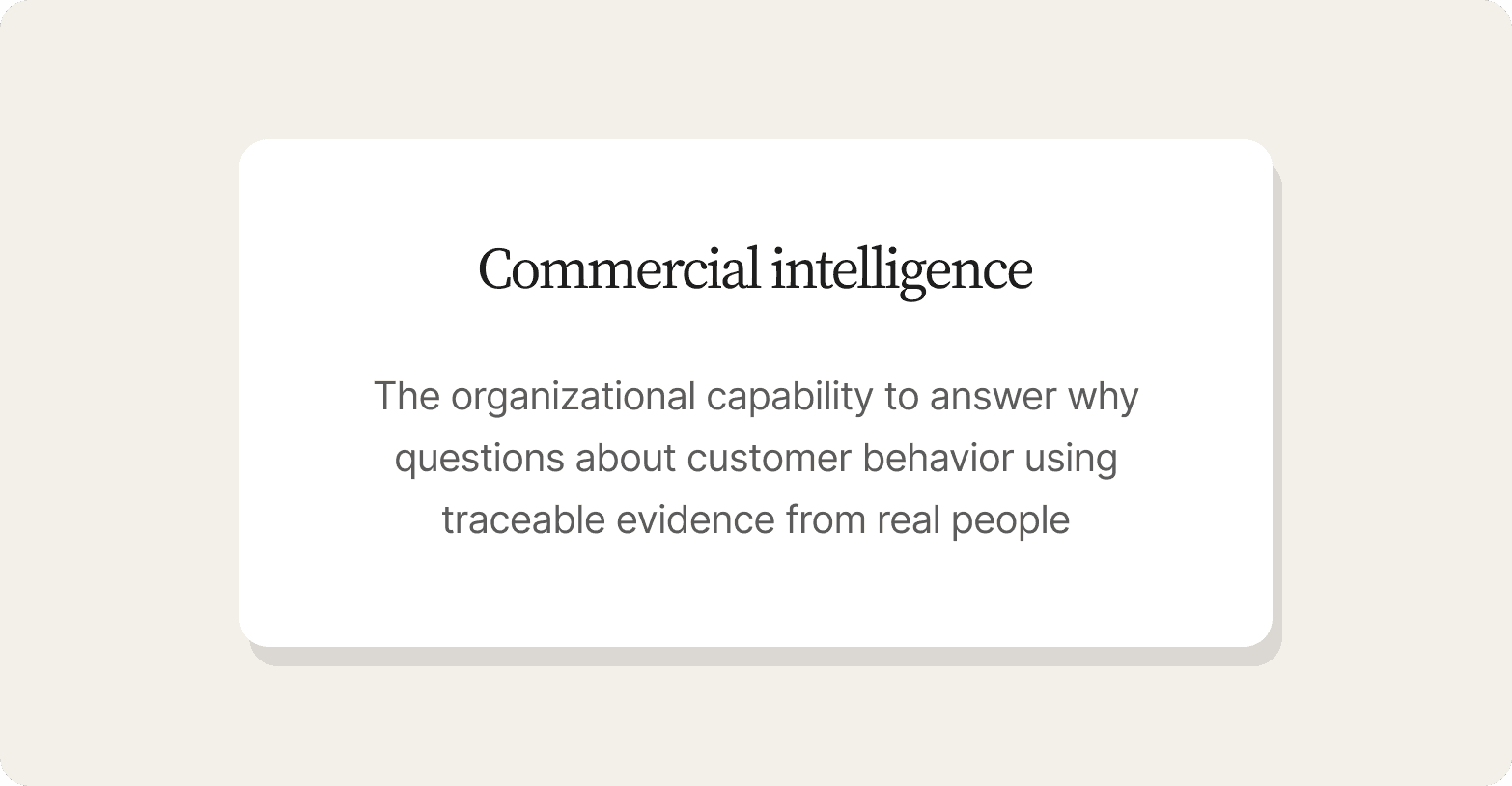
Commercial intelligence is the organizational capability to answer "why" questions about customer behavior using traceable evidence from real people, rather than relying on demographic assumptions or survey scores alone. Where other data disciplines tell you what happened, commercial intelligence tells you what drove it.
Four adjacent categories often get conflated with it, and the confusion costs teams real clarity:
Business intelligence covers internal metrics and dashboards: revenue, conversion rates, churn percentages.
Competitive intelligence tracks what rivals are doing across the competitive landscape.
Market research delivers one-off studies commissioned to answer specific questions.
Market data and broader market intelligence report movement at the aggregate level, tracking demand shifts across a category.
All four are useful. Each of them stops short of explaining why a customer hesitated, why a message landed flat, or why a segment that looked right on paper converted poorly in practice.
The decisions it supports are consequential, and often central to strategic planning: which segments to prioritize, what messaging will resonate, why customers churn, what objections block conversion, how to price without guessing, and where to direct new investments with confidence. Consider a SaaS company that knows its trial-to-paid conversion dropped by 12% on its dashboards. That is business intelligence. Without qualitative evidence that traces the friction to the specific onboarding step where users hesitate, the product team is left guessing about the fix. Commercial intelligence closes that gap, turning disconnected systems and dashboards into a coherent explanation.
Why Commercial Intelligence Fails in Most Organizations
Commercial intelligence breaks down because the data lives in the wrong places. Teams usually have plenty of it. The sales team captures objections mid-deal as part of the sales process, research runs quarterly studies, and product reviews support tickets, but no shared synthesis cadence connects those signals into a unified view of the customer. The result is three organizations each holding a piece of the picture, none of them seeing the whole thing.
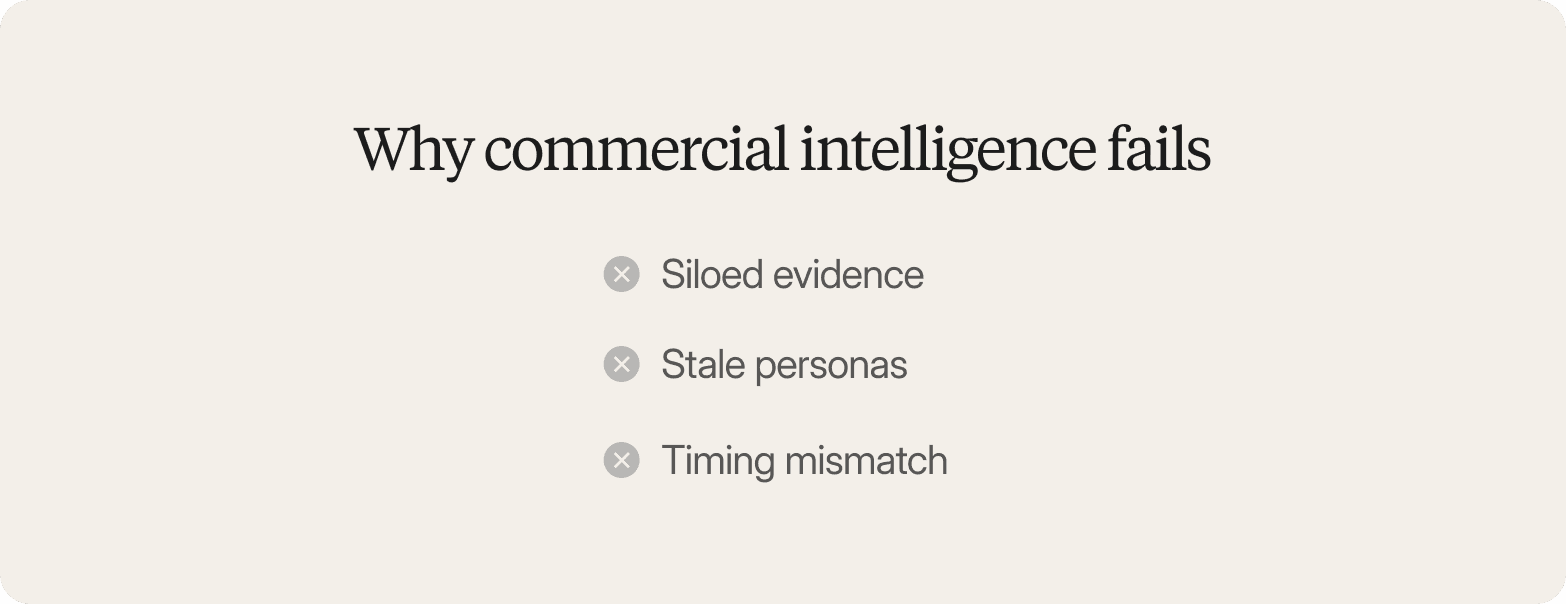
Three failure modes recur:
Siloed evidence. When signals don't cross team boundaries, contradictions go undetected, and assumptions calcify into strategy without anyone noticing they were never tested.
Stale personas. Personas built from demographics alone collapse under pressure because age and income don't reveal purchase triggers, objection patterns, or decision criteria. A repurchaser and a trial-driven buyer can look identical in a demographic cut yet react in opposite directions to a packaging change, because the underlying driver of their behavior was never captured.
Timing mismatch. Traditional research sequencing, from recruitment through moderation, analysis, and reporting, creates bottlenecks that make recurring persona refreshes impractical and add unnecessary complexity to what should be a simple lookup. Teams default to running at most one study per quarter, so the understanding they're working from is already months old by the time it reaches decision-makers.
Timing mismatch compounds every other challenge on this list.
The consequence is predictable. A product team launches a feature because survey data showed high interest, only to discover in post-launch interviews that the feature solves the wrong problem entirely. The survey measured intent but never probed why the interest existed, so the signal looked like validation when it was actually noise. By the time that's clear, the budget is spent, and the roadmap is set.
How to Build Commercial Intelligence as an Operating Model
Commercial intelligence stops being useful the moment it lives only in a research deck. Teams that get consistent value from it treat it as an operating model built on four components that run continuously.
Intake Triage
Not every question warrants a qualitative study. Some are answered by existing evidence in the insight library. Some need a quantitative scale using existing analytics tools. Triage disciplines the team to commission AI-moderated interviews only when the question genuinely requires depth, which keeps the cadence sustainable and the output credible.
Evidence Cadence
This replaces the reactive commission with a regular rhythm. Teams running 20 AI-moderated interviews a month across key segments stop waiting for a crisis to justify research, so findings arrive before the decision window closes rather than weeks after it has.
Synthesis and Distribution
This determines whether findings actually reach the people who need them. Thematic briefs, searchable video clips, and one-page summaries travel further than 40-slide decks. When a product team asks why enterprise buyers hesitate during contract review, the CMI team surfaces tagged clips from prior interviews rather than commissioning a new study from scratch. That's commercial intelligence working as infrastructure.
Governance
This sets the rules: what counts as evidence, how conflicting signals get resolved, and who owns the repository. Governance protects the integrity of the library; without it, the repository fragments and the competitive advantage of having a shared source of truth disappears along with whoever built it.
The compounding benefit is what sets this model apart from a one-off implementation: every interview added to the library makes the next study smarter, and the repository's value grows with each wave.
3 Commercial Intelligence Examples: What the Deliverable Actually Looks Like
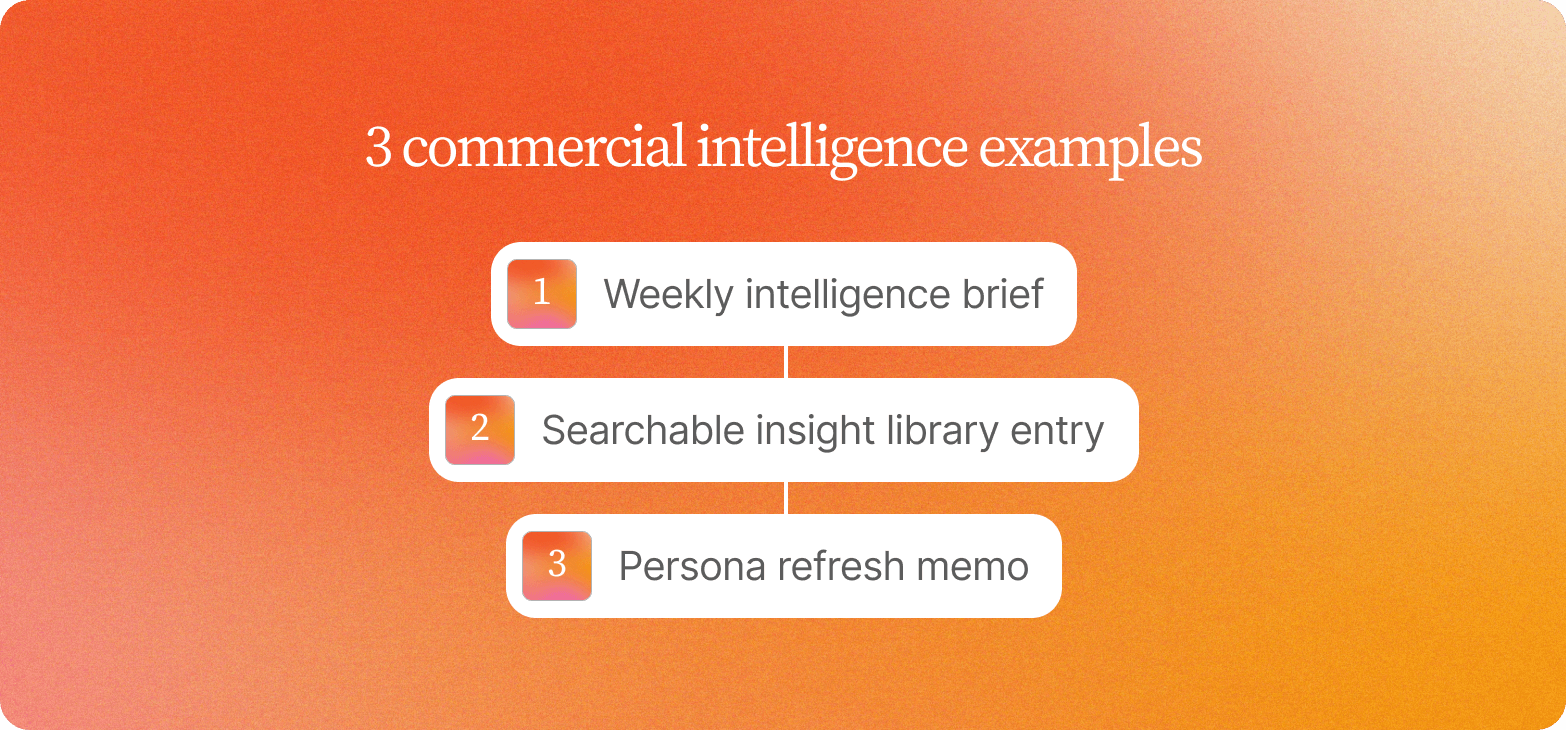
Most commercial intelligence frameworks describe the concept in the abstract. What actually lands with stakeholders is the deliverable: something short, sourced, and built around a specific question. Here are three formats teams report using successfully.
Weekly Intelligence Brief
A one-page summary sent to product and marketing every Monday. It covers the top three themes from the previous week's interviews, one direct quote per theme, links to timestamped video clips, and one recommended action per stakeholder group, so leadership sees what to do next alongside what happened. Nothing in it requires a research background to act on, and everything in it carries a source.
Searchable Insight Library Entry
A tagged finding in a repository: "Price objection, enterprise buyers." Attached to it: 12 video clips showing CFOs walking through budget approval friction on major deals, a two-paragraph synthesis of what's driving the pattern, and a list of which studies contributed evidence. When a sales leader asks where the finding came from, the answer is a click away.
Persona Refresh Memo
A two-page update to an existing persona, showing three new decision triggers discovered in recent interviews, two objections and concerns that didn't appear in research six months ago, and verbatim quotes illustrating each shift. It replaces the assumption that personas age gracefully with evidence that they don't.
What makes these formats work is the same insight creation process in each case: they're short, linked to evidence, and answer a specific question rather than presenting a data dump, removing the "where did this come from?" friction that derails stakeholder reviews when findings arrive as generic, untraceable summaries.
Evidence Rigor: What Counts as Commercial Intelligence
Not all customer input qualifies as commercial intelligence. Anecdotes, survey scores, and sales hunches are signals worth tracking. Evidence you can build a pricing or positioning decision on has to clear a higher bar.
Importantly, the rigor standard has three requirements, and together they define a defensible methodology:
Traceable. Evidence must be traceable to a real person who said it.
Probed. It must be collected through a method that allows probing, so the first answer is never the final answer.
Synthesized thematically. It must show how many participants raised a theme, so the frequency across the full set carries more weight than a single memorable participant.
That blend of AI-moderated data collection and human intelligence in the review stage is what keeps synthesis from becoming a black box.
Conveo's AI moderator probes based on what participants actually say, following the conversation rather than a rigid script, so the discussion tracks genuine reasoning. Thematic synthesis then means analyzing patterns and frequency across every transcript, with themes earning their place through recurrence rather than curation.
"You can see genuine research fluency in the product decisions. It's not the only reason we'd choose Conveo, but it's a strong proof point especially compared to competitors who are building without that research foundation"
Research & Insight Lead, Canva
The contrast with weaker types of evidence is practical. A 7/10 satisfaction score quantifies sentiment but does not explain what would move it to 9/10 or what the gap is costing in lost profit if left unaddressed. A sales leader's claim that "everyone says we're too expensive" is a signal that still needs testing. In a representative scenario, a pricing team pressure-tested that claim through interviews with 30 recent churners and found price ranked third as an objection, behind onboarding friction and feature gaps. The sales anecdote was pointing in the right direction but at the wrong target.
The governance implication: teams need explicit rules for what counts as evidence, how to handle conflicting signals, and when to commission new research versus querying the existing library. Getting this wrong carries real risk.
How AI-Moderated Interviews Change Commercial Intelligence Cadence
The traditional research sequence- recruitment, moderation, analysis, reporting- creates the same structural bottleneck described above, one week at a time.
By the time findings reach stakeholders, the decision they were meant to inform has already closed. Teams respond rationally: they commission one large annual study and guess in between.
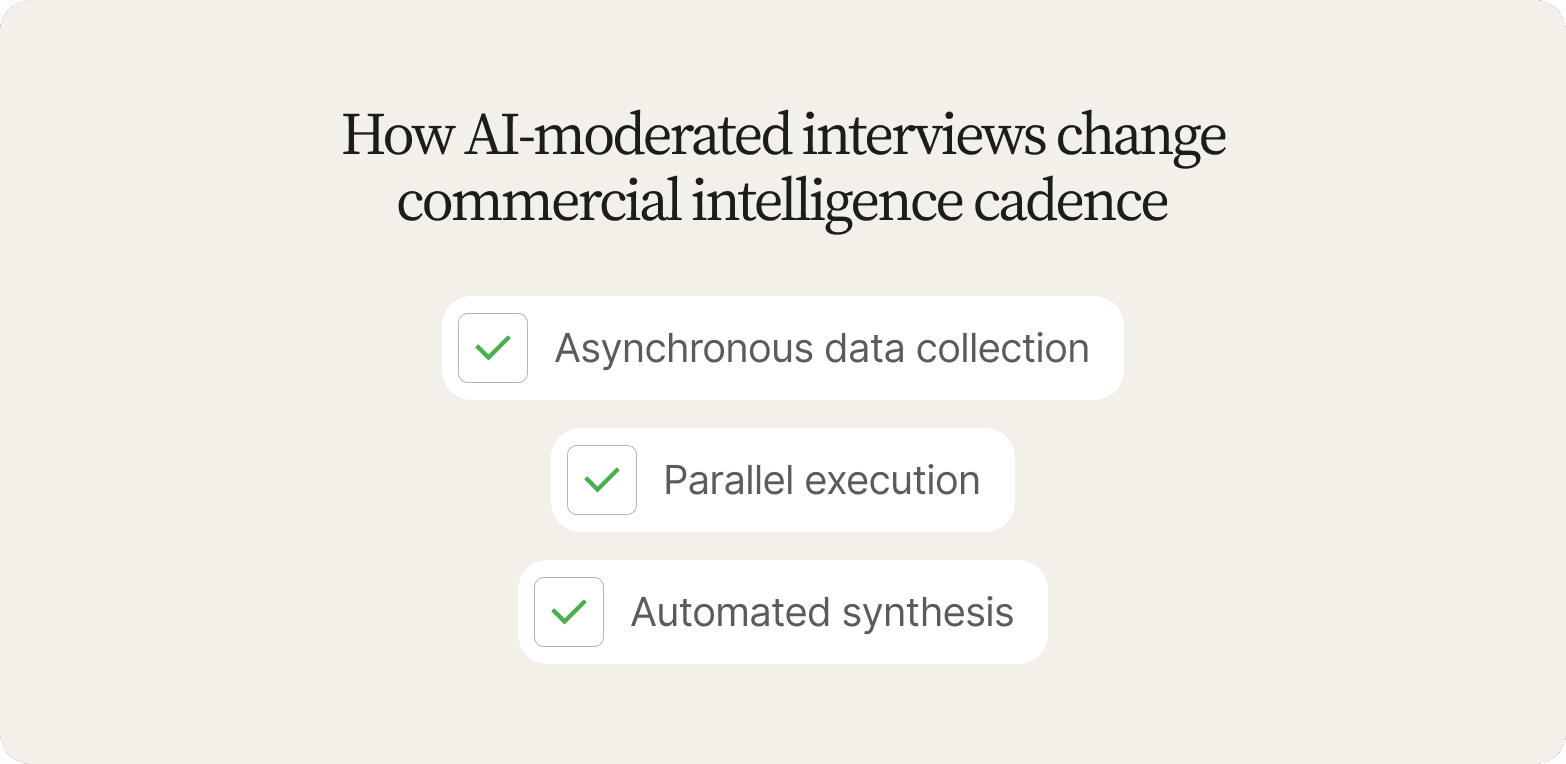
AI-moderated video interviews change that sequencing at three points:
Asynchronous data collection. Participants receive a link and complete a voice-and-video interview on their own schedule, without a moderator present, eliminating the need for calendar coordination entirely.
Parallel execution. Teams can run interviews across multiple audiences simultaneously, fielding 10 to 1,000 conversations at once, rather than choosing which segment to study first.
Automated synthesis. Thematic synthesis and timestamped video clips are ready within days of fieldwork closing.
See it in action: How AI-Moderated Video Interviews Actually Work
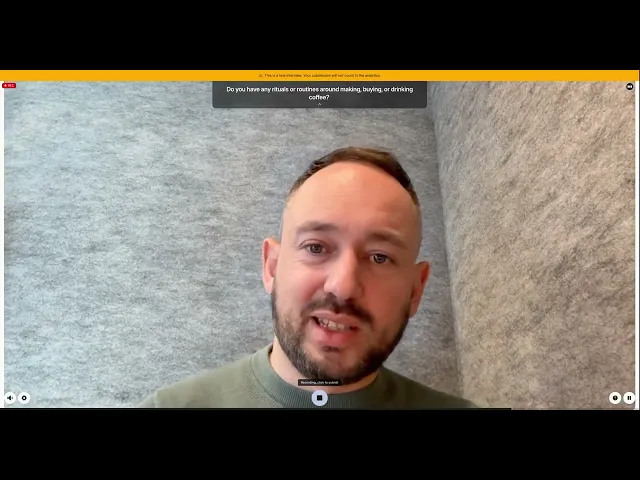
The operational shift this enables is significant. Teams move from commissioning a study when a big question surfaces to running 20 interviews per month as a standing cadence, then querying the insight library when stakeholders ask something new.
For multi-market programs, AI moderation technologies that operate across 50+ languages eliminate localization delays that can add weeks to a program. A global brand running monthly interviews across six markets can tag findings by region and theme, then surface relevant clips the moment a regional marketing team asks why messaging that performs in the US consistently underperforms in Germany. The answer is already in the library. The question only needed asking.
2 Common Commercial Intelligence Mistakes and How to Avoid Them
The failure modes above (siloed evidence, stale personas, timing mismatch) show up in practice as two specific habits. Each is solvable through changes in methods or governance rather than by increasing the volume of research.
Treating All Customer Input as Equal
An anecdote from a sales call, a Net Promoter Score, and a finding from a moderated interview carry different evidentiary weight. Conflating them produces false confidence and real risk: a single vocal complaint is treated as a signal, while a pattern across 40 moderated sessions is buried in a slide. Governance rules that state which inputs inform hypotheses and which confirm them prevent the loudest voice in the room from steering strategic planning.
Letting Insights Die in Decks
A 40-slide research report is a document no one will reference six months after the readout. A searchable insight library changes that by making past clips, themes, and verbatim quotes reusable across future studies, so teams can query what they already know before commissioning what they think they need.
Considerations
Commercial intelligence works best alongside quantitative measurement. Survey scores and dashboards remain useful for tracking movement at scale; qualitative evidence explains what's driving that movement. Teams that lean on one discipline without the other make decisions that are numerically grounded but behaviorally blind, or richly explained but statistically unmoored. Treat commercial intelligence as the "why" layer this article argues for, one that sits alongside existing measurement and explains what the numbers are reporting.
Conveo as Commercial Intelligence Infrastructure
Pricing, positioning, and retention decisions don't wait for research cycles to close, and teams that want to stay ahead of shifting buyer behavior can't wait either. The ones that get consistent value from commercial intelligence have stopped treating it as a project and started treating it as infrastructure: a continuous read on their market that's always current, always searchable, and always traceable to a real person who said it.
Enterprise clients, including Google, Bosch, Reddit, and FOX, rely on Conveo to continuously understand their customer relationships. That continuous reading is what Conveo StoryLines is built for: a wave-based, AI-moderated research program that keeps evidence current without commissioning a new study every time.
Conveo is built by researchers, and that shows up in three ways:
Traceability. Every finding traces back to a real participant, grounded in real people and supported by verbatim quotes and video, with no black-box outputs, exactly what stakeholders need when the decisions at stake involve budget allocation, new investments, market entry, or competitive repositioning.
Compounding evidence. Every study added to Conveo's searchable insight library makes the next one smarter, so teams query prior evidence instead of restarting research from zero, compounding into a durable competitive advantage.
Compliance. Conveo is SOC 2 Type II certified, GDPR compliant, and EU-hosted (Belgium), a consideration that matters as commercial intelligence findings start to protect margins and profits in pricing decisions.
AI-moderated video interviews run across 10 to 1,000 conversations simultaneously, in 50+ languages, with thematic synthesis ready in days rather than weeks, whether the use case is product feedback, service quality, or brand perception. In documented cases, teams report moving from weeks to days between fieldwork and decision-ready findings, a shift that changes what success looks like for research-driven teams.
Frequently Asked Questions
What is commercial intelligence?
Commercial intelligence is the systematic gathering and synthesis of customer evidence that explains why buyers make decisions, not just what they do. It supports pricing, positioning, retention, and segmentation decisions by providing traceable qualitative and quantitative evidence, rather than relying on demographic assumptions or survey scores alone. Where a survey tells you that satisfaction dropped three points, commercial intelligence tells you which specific friction in the purchase experience caused it, and which customer segment felt it most acutely, supporting better decisions about where to act next.
What is the difference between commercial intelligence and business intelligence?
Business intelligence tracks internal metrics: sales data, usage analytics, conversion rates. It answers "what happened" questions with precision. Commercial intelligence explains the human behavior behind those numbers: BI tells you conversion dropped 12% at checkout; commercial intelligence tells you participants hesitated because the pricing structure felt unclear. That's the difference between measuring performance and explaining it.
What is the difference between commercial intelligence and competitive intelligence?
Commercial intelligence explains why customers choose, switch, or churn based on their own stated decision criteria, gathered directly from real conversations. Competitive intelligence tracks what competitors are doing within the broader competitive landscape: pricing changes, feature launches, messaging shifts. Both inform strategy, but commercial intelligence is grounded in customer evidence rather than competitor monitoring, which makes it harder to gather and considerably harder to dismiss in a boardroom.
How do you build a commercial intelligence function?
Building a commercial intelligence function follows the four-part operating model above: an intake process for triaging incoming questions, a regular interview cadence, a searchable repository, and governance rules under a consistent methodology for what counts as verified evidence. Speed is a supporting benefit: it separates commercial intelligence from periodic research because findings reach stakeholders before decisions close, rather than after.
Is there a commercial intelligence certification?
No formal commercial intelligence certification exists for this discipline. What actually qualifies a team or individual is more practical: the ability to extract decision-relevant insight from real customer evidence, synthesize conflicting signals across markets or segments, and deliver findings in formats non-research stakeholders can act on. For teams without dedicated research headcount, that capability increasingly depends on infrastructure: when AI-moderated interviews return thematic synthesis in days rather than weeks, a lean team can gather evidence continuously rather than only when a study is formally commissioned.
How is commercial intelligence different from market research?
Market research is episodic: a question surfaces, a study is commissioned, and the findings arrive weeks later, often after the decision they were meant to inform has already been made. Commercial intelligence is continuous. Teams run regular interview cycles and query a searchable library whenever a question arises, rather than waiting until a new project starts. Market research produces reports that age in shared drives; commercial intelligence maintains a repository where past clips, themes, trends, and verbatim quotes remain findable and reusable, so knowledge compounds rather than expires.

About the author
Alex de Hemptinne
Business Impact Lead
Alex is a Business Impact Lead at Conveo, partnering with enterprise teams to embed AI-led research into their workflows. From the first study to full-scale rollout, she helps customers shift from project-based research to continuous customer intelligence.
Meet Alex on film →Qualitative insights at the speed of your business.
Conveo runs AI-moderated video interviews and structures everything they say.