
TL;DR
AI thematic analysis uses machine learning and natural language processing to surface candidate codes and key themes from large qualitative datasets in minutes rather than weeks.
It compresses the mechanical extraction phase- reading, tagging, and clustering- so a human researcher spends their time on interpretation and stakeholder communication instead.
It does not replace human judgment: deciding which themes matter and why remains the researcher's work, which is exactly where human error in manual coding tends to creep in.
Stakeholder trust depends on traceability. Every theme should link back to the original data, the verbatim quote and video moment that produced it.
It fits large-scale studies, multi-market research, and continuous discovery; it is a poor fit for tiny exploratory studies, legally restricted data, and questions that hinge on deep cultural subtext.
Twenty interviews. Forty to sixty hours of audio. Three hundred pages of transcript. That is what lands in an analyst's lap before a single finding reaches a stakeholder, and coding it by hand can take the better part of two weeks. That time cost is not a sign of poor process; it is the nature of the method. The problem is that most research teams cannot absorb it without either delaying delivery or cutting study scope.
The business consequence is predictable. Product launches proceed without validated positioning. Campaign briefs are finalized before consumer reaction data arrives. When the pace of analysis and the pace of decisions diverge by weeks, research stops influencing decisions and starts documenting them after the fact.
AI thematic analysis addresses this at the point where time is lost. Instead of requiring an analyst to read every line before patterns emerge, it surfaces candidate codes and recurring themes across large transcript datasets within minutes, working across multiple files and other textual data sources simultaneously. The analyst's role does not disappear; it shifts from extraction to interpretation. The condition that makes those faster findings credible is traceability: every theme has to point back to the participant who said it. This article explains how the thematic analysis process changes when AI is involved, where it accelerates the qual cycle, and what it does not replace.
What Is AI Thematic Analysis?
AI thematic analysis is the process of using machine learning and natural language processing to identify, extract, and organize recurring themes across qualitative datasets: interview transcripts, open-ended survey responses, focus group notes, and, increasingly, other data sources such as web pages and open-text reviews.
The core mechanism is semantic, not statistical. The AI reads the full dataset, surfaces candidate codes based on conceptual proximity, and groups related concepts into preliminary themes. It is not keyword matching or word-frequency counting, and it is a different discipline from discourse analysis, which examines how language itself constructs meaning rather than which topics recur across a dataset. It recognizes that a participant who says "I never know if my order will arrive on time" and another who says "the delivery estimate is always wrong" are expressing the same underlying concern, even though the surface language differs. Those passages get coded together, and the resulting theme is surfaced for the analyst to review, name, and contextualize.
That is a meaningful departure from manual thematic analysis, where a human researcher opens every transcript, tags passages against a codebook, and refines that codebook as new patterns emerge. AI does not eliminate the codebook; it generates a first draft, populated with initial codes and the participant language behind them. Generating initial codes by hand is where most analyst hours disappear, and it's the step AI absorbs first. The analyst receives a structured starting point rather than a blank page.
What it does not change is the interpretive work that gives qualitative analysis its value. An AI can surface the theme "price sensitivity increases when delivery reliability is low." It cannot tell you whether that finding should redirect the product roadmap or inform the next campaign brief. That judgment belongs to the researcher, and it's the reason qualitative analysis software still needs a person in the loop.
Why Manual Thematic Analysis Creates Research Bottlenecks
Manual thematic coding typically runs at two to four hours per hour of interview audio, depending on data density and coding granularity (Happyscribe). Across a standard 20-interview study, that adds up to dozens of hours of analyst time before any finding reaches a stakeholder, often the better part of a working week spent organizing text data rather than interpreting it. For a team of two or three researchers serving an organization of hundreds, that week competes with study design, recruitment oversight, and the next project already queued behind this one.
The bottleneck is linear: double the interviews, and the coding time doubles. A team that handles four studies per quarter, with 20 interviews each, cannot handle eight without adding headcount or cutting corners. Most teams do neither. They run fewer studies and cover less ground, so more decisions get made without consumer input than anyone would choose if the constraint were removed.
Multi-analyst environments add a problem headcount cannot solve. When two researchers code the same dataset, their codebooks drift. One labels a passage "price concern," another codes the same quote as "value perception." Both are defensible, and both are a form of human error baked into the process rather than a sign either analyst did sloppy work. But when those codes are aggregated and presented to a CMO or brand director, the divergence surfaces as inconsistency, and the analysis itself becomes the subject of debate rather than the findings it was meant to produce.
The result is consistent across organizations: decisions get made before the research lands. A concept gets greenlit or killed on a hunch because the thematic analysis process is still in the coding phase. The research eventually arrives, confirms or contradicts the call, and by then the question has already been answered by someone else. This is not a failure of qualitative methods as a discipline. It is structural: a methodology built for depth constrained by a process that cannot move at the speed decisions require.
How AI Thematic Analysis Works: 4 Steps
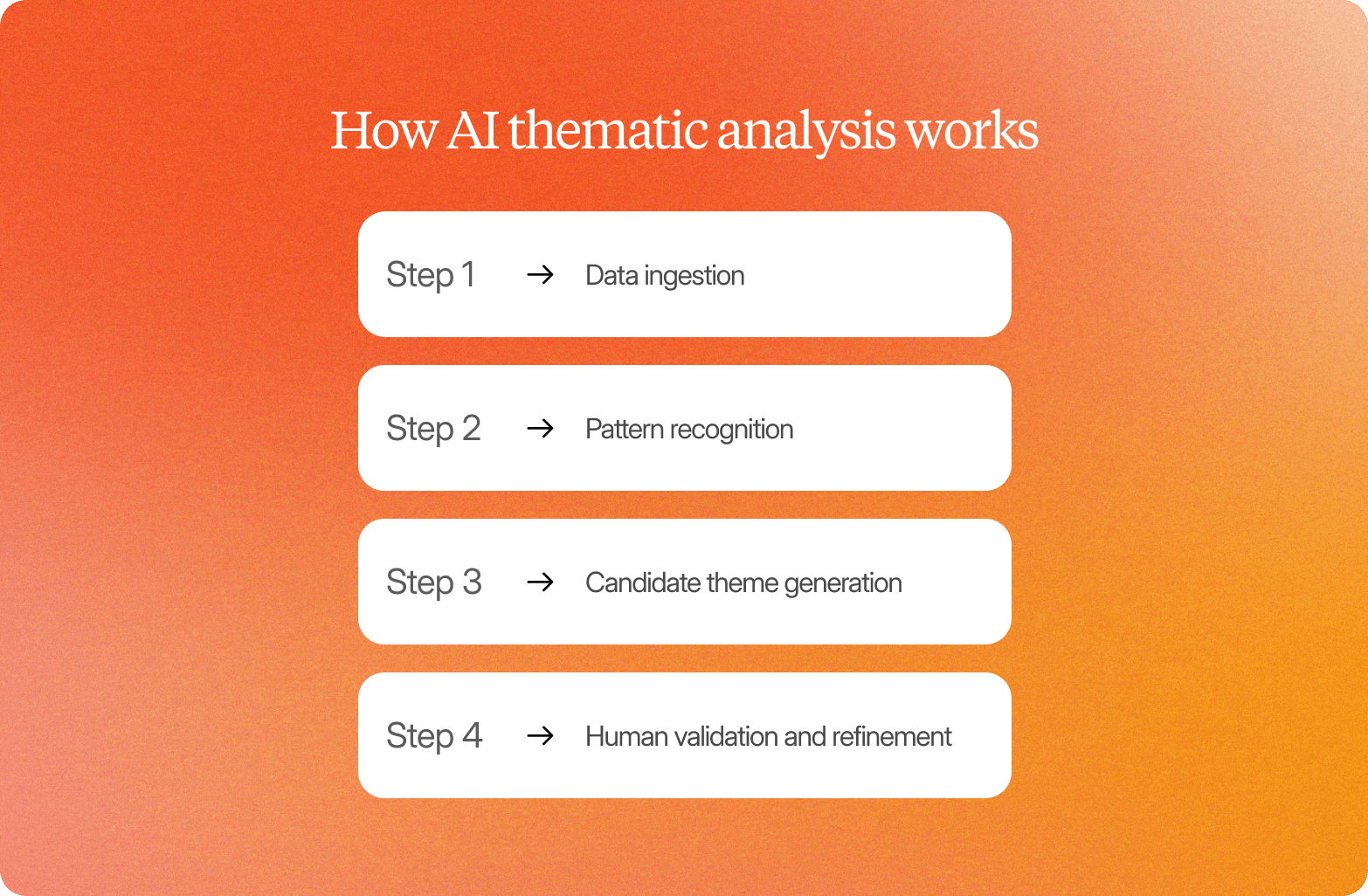
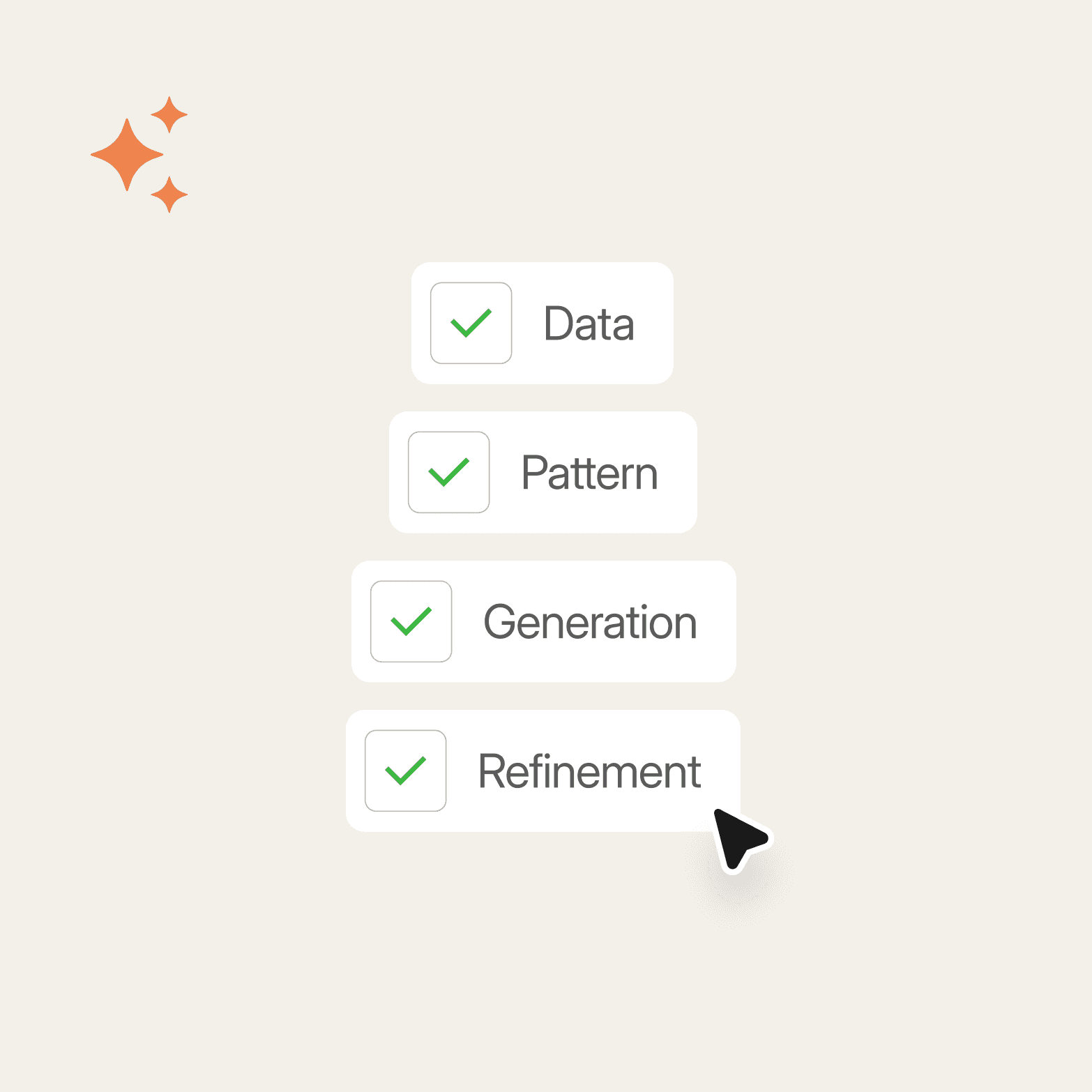
The most important thing AI thematic analysis changes is not the output. It is who does what work, and when. The mechanical reading and pattern-matching move to the platform; interpretation stays with the analyst. The analysis process runs in four stages.
Step 1: Data ingestion
The platform ingests interview transcripts, open-ended survey responses, focus group notes, audio files, or video recordings, and segments the content into semantic units, individual sentences, speaker turns, or paragraph-length responses. Because it can analyze multiple files simultaneously rather than one document at a time, it can structure transcripts for an entire study in parallel. This segmentation is what makes pattern recognition possible at scale, regardless of data type.
Step 2: Pattern recognition
Natural language processing, a branch of artificial intelligence built for working with textual data, scans all segmented units simultaneously, detecting recurring concepts, shared phrases, and sentiment analysis signals. Instead of one analyst working sequentially through documents, the platform reads the entire dataset in batch: concepts from interview 3 are compared against those from interview 47 and interview 180 simultaneously, enabling cross-dataset patterns that a single analyst working linearly would likely miss. This is a form of text mining applied specifically to qualitative research data rather than open web content.
Step 3: Candidate theme generation
Related concepts are clustered into preliminary themes through automated theme generation, each with its supporting quotes and working code definitions. These are candidates, not conclusions. The AI is not making interpretive claims about what the data means; it is organizing what it found and presenting the evidence behind each grouping so the analyst can move straight to reviewing themes rather than generating them from scratch.
Step 4: Human validation and refinement
Analysts review candidate themes, merge overlapping clusters, split overly broad clusters, and rename codes to align with the research framework and the language the business uses. Naming themes in terms stakeholders already use is what makes a finding land in a readout rather than get relitigated. They select the most representative quotes and decide which themes carry enough weight to inform a decision. This is where research expertise becomes the differentiator, and where deeper insights get separated from surface-level pattern noise.
"The AI doesn't just summarize, it surfaces patterns I wouldn't have spotted reading transcripts"
— CMI Lead Edgard & Cooper
The speed advantage is bounded and specific: it comes from eliminating the reading, tagging, and clustering phase, work that requires attention and consistency but not interpretive expertise. Analysts who previously spent most of their time on extraction arrive at the interpretation stage faster, identifying patterns more quickly and generating insights with more complete coverage of the dataset.
Stakeholder trust in qualitative findings has always depended on showing the evidence behind the conclusion, with a clear audit trail back to the source. Platforms like Conveo close that gap by linking every theme to the verbatim quote and, where video is the source, to the specific clip and timestamp that produced it. In a stakeholder review, that traceability is the difference between a finding that gets acted on and one that gets questioned until the meeting ends.
Watch the walkthrough: Conveo's AI Moderation in Action →
AI Thematic Analysis vs. Manual Coding: What Changes
Manual Coding | AI Thematic Analysis | |
Time to first themes | Days to weeks; a study with 30 to 40 interviews typically requires multiple rounds of reading before patterns emerge | Thematic clusters surface within hours of data collection completing; analysts can review structured outputs the same day interviews close |
Analyst workload | Reading, tagging, and clustering every transcript manually; one analyst can process a limited number of sessions before fatigue and inconsistency affect quality | Mechanical tagging and clustering handled by the platform; analyst time shifts to theme evaluation, framing, and stakeholder communication |
Theme traceability | Depends on how rigorously the analyst documents coding decisions; inconsistent across team members and studies | Every theme links to source quotes, video timestamps, and session context; audit trails are built into the output structure |
Scalability | Scales linearly with headcount; running 100 interviews instead of 20 means proportionally more analyst hours | Hundreds of sessions across multiple sources can be coded in parallel without additional analyst time; scale increases coverage without increasing the synthesis burden |
Note: Manual estimates reflect commonly seen enterprise qual workflows across studies of roughly 20 to 50 participants. AI-assisted timelines assume a platform with integrated transcription, coding, and thematic clustering, rather than a point solution that requires manual data transfer between steps.
Using AI for thematic analysis does not transfer the analyst's judgment to a machine. It transfers the mechanical work. Analysts still decide which themes carry strategic weight and how to connect what participants said to what the business should do next, decisions that require the history of prior studies and the internal context around a product call. Teams consistently report a further gain: because the platform applies the same semantic logic to every transcript, themes stay consistent across analysts, waves, and markets, removing the manual reconciliation step that usually precedes a stakeholder presentation.
4 Common Pitfalls of AI Thematic Analysis
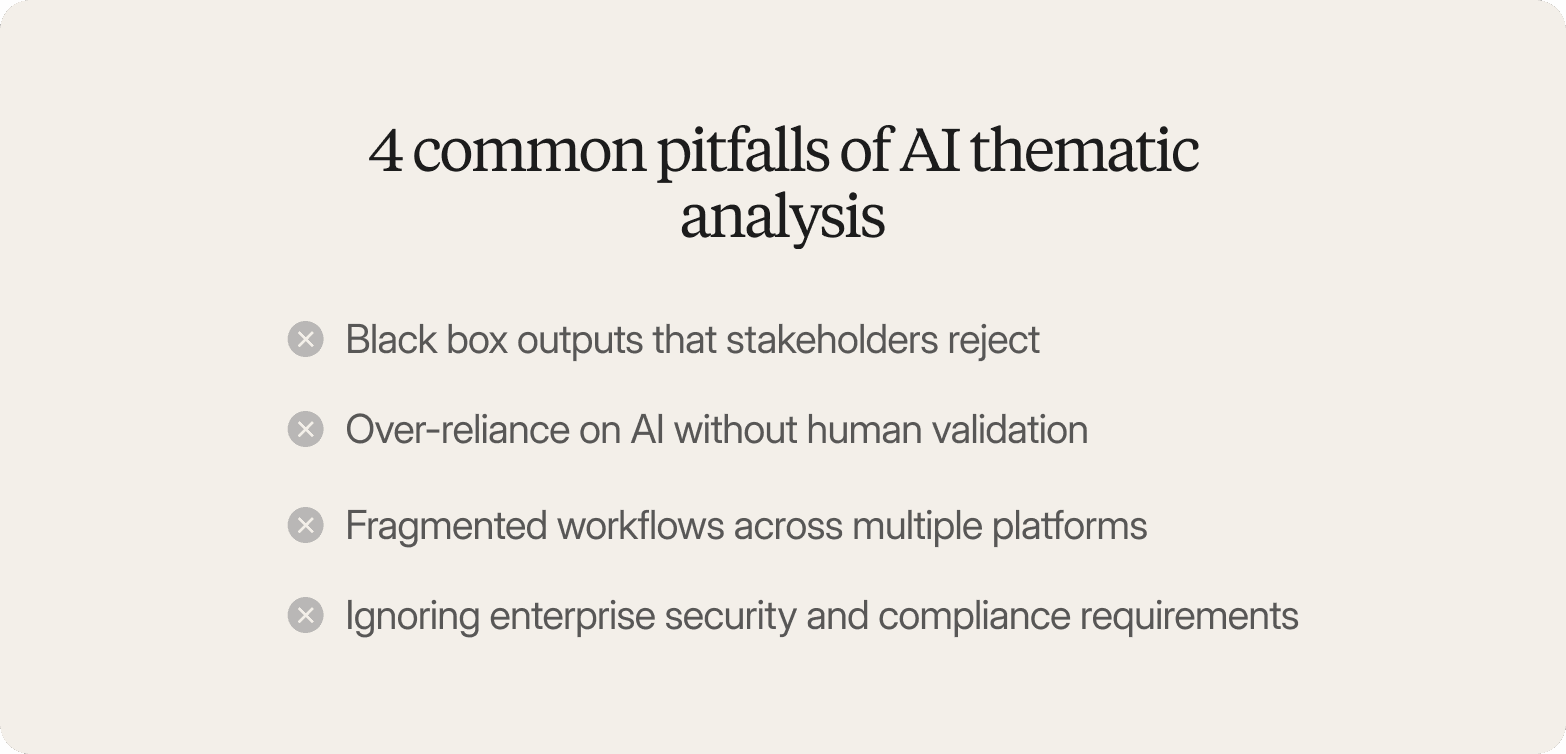
Black Box Outputs That Stakeholders Reject
Stakeholders who weren't in the room don't take findings on faith. When an output lands as a summary paragraph with no visible evidence, the first question in the review is: "Where does this actually come from?" If the answer is "the platform identified it," credibility collapses. This happens when thematic analysis tools generate themes without preserving the connection back to specific moments in specific interviews. The mitigation is structural: every theme should link to verbatim quotes and, where video is available, to the exact clip that produced it. Stakeholders can then watch a participant's tone shift when a price point is mentioned, or hear the hesitation before a competitor is named.
Over-Reliance on AI Without Human Validation
AI-generated themes are pattern candidates, not research conclusions. A theme can be statistically prominent yet analytically irrelevant, and that gap is exactly where analytical depth is lost if a team skips validation. Sarcasm, cultural idiom, and irony compound the problem: when a participant says a product "does the job," that phrase carries different weight depending on regional context and tone. The mitigation is not to distrust AI-generated themes but to treat them as a draft layer. Analysts should review every candidate against the original objectives, check quotes in context, and look for what the AI collapsed or missed. The most valuable analytical work happens in the gap between what generic AI tools surface and what researchers decide to keep, reframe, or discard.
Fragmented Workflows Across Multiple Platforms
Standalone transcription platforms, analysis repositories, and interview platforms each solve one step, but they were never designed to work together. A transcript that leaves an interview platform loses its video timestamp; a theme copied into a separate analysis tool loses its source quote. By the time findings reach a stakeholder deck, the chain of evidence is broken. Point solutions optimize vertically, so the workflow fragments by design. The mitigation is architectural: choose thematic analysis software that covers participant recruitment, AI-moderated interviewing, theme extraction, and reporting in a single environment, so no context is lost between stages and no one has to stitch together data from multiple sources by hand.
Ignoring Enterprise Security and Compliance Requirements
Consumer-grade AI platforms often fail procurement before the research team gets to evaluate them. The pattern is consistent: a researcher runs a pilot on their own data, brings it to procurement, and the security questionnaire arrives asking for:
SOC 2 certification
Documented GDPR controls
An EU data residency option
SSO support
When those boxes are unchecked, the evaluation ends there. The mitigation is straightforward: evaluate compliance credentials before features. Conveo provides this infrastructure as a baseline, so research teams can bring it to procurement with documented evidence rather than a promise, and every insight, clip, and transcript is stored in a secure, regionally hosted library with a full audit trail traceable to its source.
When to Use AI Thematic Analysis (and When Not To)
Best Fit Scenarios
Large-scale qualitative studies
When a study crosses 20 or more interviews, or open-ended responses number in the hundreds, manual coding stops being a bottleneck and becomes a project in itself. AI thematic analysis tools process the full dataset in hours, surfacing key themes while analysts focus on interpretation.
Multi-market research requiring cross-language comparison
Parallel studies across Germany, the US, and Brazil otherwise mean separate translation cycles, separate coding passes, and inconsistent labels across markets. AI-moderated thematic coding aligns outputs across languages before synthesis begins, so the comparison is built into the analysis rather than retrofitted.
Continuous discovery workflows
When customer conversations happen weekly rather than quarterly, waiting for a periodic synthesis cycle means that findings are stale by the time they land. AI-assisted theme identification surfaces patterns from ongoing interviews in near real time, keeping product, CX, and brand decisions connected to current customer reality, and surfacing new ideas the team wouldn't have gone looking for on their own.
Poor Fit Scenarios
Small-scale exploratory studies with five to ten interviews
When a study is genuinely small, manual coding takes a few hours, and the analyst needs to be deeply immersed in every conversation. Routing that work through an AI layer adds overhead without meaningful time savings, and exploratory work often depends on sitting with ambiguity and following hunches that emerge only through close reading.
Research involving sensitive or legally restricted data
Studies touching medical history, financial behavior, or personally identifiable information may carry constraints that prevent data from being processed by third-party platforms. Verify data handling agreements and regulatory obligations before routing sensitive transcripts through any external system, especially if the vendor cannot document how training data is handled.
Research questions requiring deep cultural or contextual interpretation
Sarcasm, irony, implicit power dynamics, and culturally specific idioms are difficult for AI to read reliably. When the question hinges on what participants did not say directly, human researchers remain the more dependable option, and no qualitative analysis software changes that.
How Conveo Supports AI Thematic Analysis
Conveo is the video-first AI research platform that supports the full thematic analysis workflow, from participant recruitment and AI-moderated interviewing through theme extraction and stakeholder-ready reporting. That scope matters because thematic analysis rarely fails during analysis. It fails at the handoffs:
Getting recordings into a usable format
Moving transcripts into an analysis environment
Getting findings into a form stakeholders will trust
Most teams today stitch together separate analysis tools for recruitment, moderation, transcription, and synthesis, and each handoff introduces delays and version confusion. Conveo removes those handoffs by integrating all steps. When an interview is complete, the recording is automatically transcribed, translated if needed, and coded without anyone having to move a file. Themes begin surfacing as sessions land. Recruitment runs through Conveo's integrated panel partners or your own data, with real participants throughout, never synthetic respondents.
The more consequential design decision is what happens to the evidence. Enterprise stakeholders do not accept summaries they cannot interrogate; the first question is always "Who said that, and where?" Conveo links every identified theme to the verbatim quotes and video clips that produced it, so a CMI director can click from a finding to the exact interview moment, in the participant's own words, with tone and expression intact. Its multimodal layer extends coding across tone, facial cues, and behavioral signals captured on video, surfacing patterns that text data alone would miss.
The compliance posture is a baseline, not an add-on. SOC 2 certification, GDPR compliance, and EU regional data hosting are the difference between a platform that clears security approval and one that stalls for months in a vendor questionnaire queue, a bar most consumer-grade AI tools cannot meet.
Prior thematic work often disappears into slide decks; when the same question resurfaces six months later, a new study is commissioned rather than retrieving the earlier findings. Conveo's searchable insight library prevents that loss. Every theme, quote, and clip flows into a governed repository, so teams can search prior work in plain language and get sourced answers and deeper insights in seconds. Each study compounds into organizational knowledge rather than aging in a shared drive. Hundreds of enterprise teams, including Google, use Conveo to compress thematic analysis timelines from 6 to 12 weeks to 3 to 5 days, running research in 50+ markets they couldn't reach at agency pace, without sacrificing the depth or traceability their stakeholders require.
Frequently Asked Questions
What is AI thematic analysis in qualitative data?
How does AI thematic analysis work in qualitative research?
Can I use AI for thematic analysis for free?
How accurate is AI thematic analysis compared to manual coding?
Is AI thematic analysis suitable for small studies?