In this article
TL;DR
Participant recruitment in qualitative research is the most common reason qualitative research studies stall: a time-consuming process of manual sourcing and screening that adds 3 to 6 weeks before a single interview takes place.
Most platforms handle only one step. Teams end up stitching together a panel vendor, a transcription service, and an analysis platform, each with its own contract and security review.
End-to-end platforms consolidate the entire recruitment process (sourcing, screening, fraud filtering, and scheduling) into a single workflow, removing the handoffs where delays accumulate.
Asynchronous AI-moderated interviews eliminate the need for calendar coordination entirely, enabling hundreds of parallel conversations.
Qualitative researchers can now run hundreds of in-depth conversations in parallel, capture multimodal signals across video, voice, and text, and deliver stakeholder-ready evidence in days rather than months. Whether the goal is market research, consumer insights, brand testing, or UX research, the depth and scale that once required months of agency cycles can now be achieved in weeks.
But most teams never get there. Participant recruitment in qualitative research is the point at which studies lose momentum before a single interview is recorded. Identifying the right participants, screening them against profile criteria, coordinating schedules across time zones, and filtering out fraudulent or disqualified applicants can consume three to six weeks. By the time recruiting wraps, the window for deep analysis has already narrowed.
Most platforms address only one step in the chain: panel access, screener logic, or scheduling coordination. Researchers end up chasing confirmations manually and managing no-shows the day before fieldwork. Each handoff introduces delay and quality risk.
What has changed is that integrated platforms now handle sourcing, screening, fraud filtering, and incentive management in a single workflow, compressing what once took weeks into hours. This article covers the core methods of participant recruitment in qualitative research, the recruitment efforts that slow most teams down, and how end-to-end platforms are changing what the recruitment process actually looks like.
3 reasons why participant recruitment determines study credibility
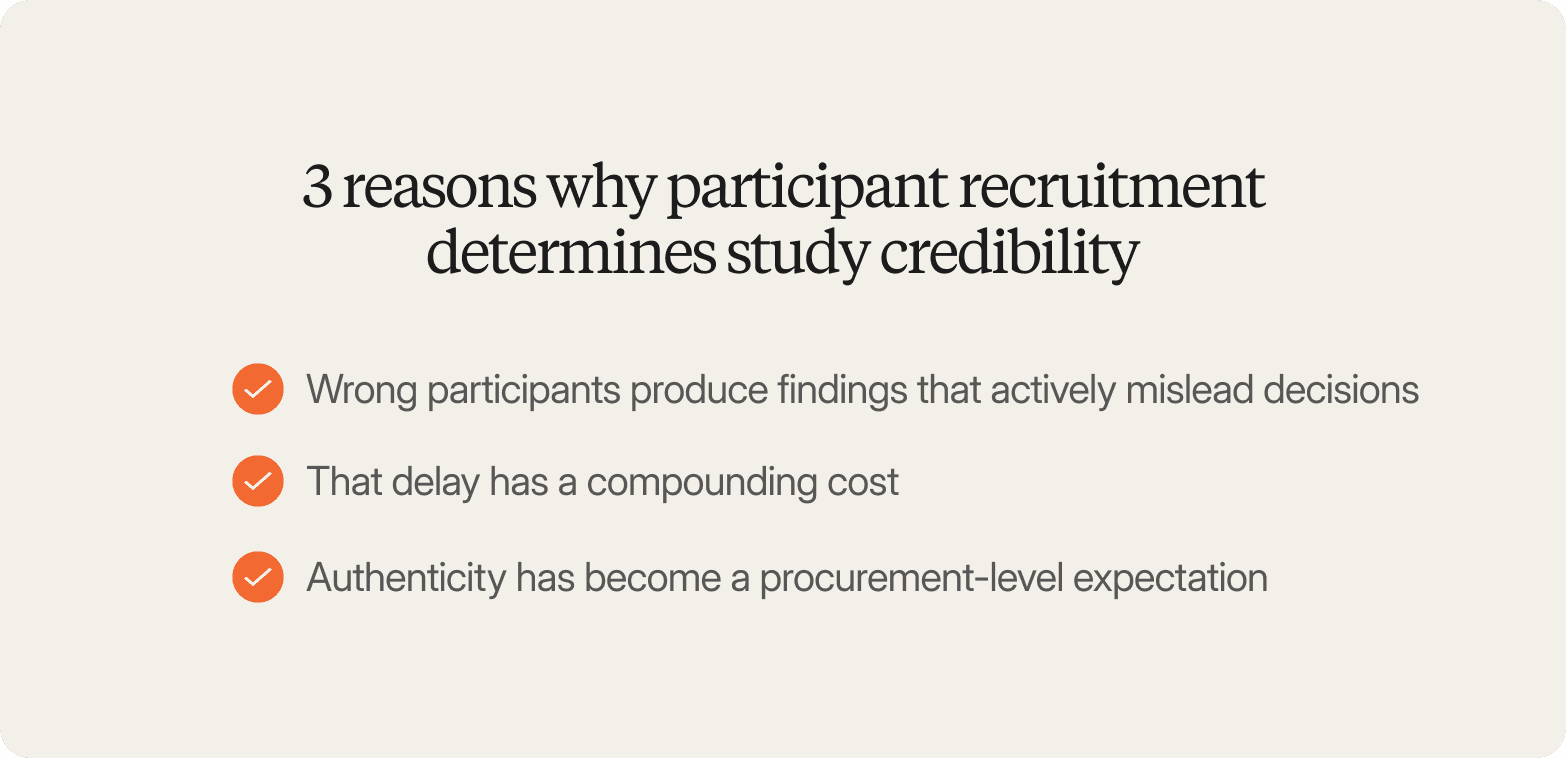
Wrong participants don't produce weaker findings. They produce findings that actively mislead decisions
When a panel includes participants who don't match the study's target population (in terms of required usage behavior, purchase history, or demographic profile), the data collected reflects the wrong audience entirely. Stakeholders who know their customer base will notice, and their trust in the research function takes a hit that outlasts the individual qualitative study.
Participant recruitment sits upstream of everything else: the interview guide, the moderation approach, the analysis framework. None of that rigor recovers a study built on the wrong sample. Unlike quantitative research, which aims to achieve statistical significance through random sampling from a broader population, qualitative and quantitative approaches serve fundamentally different purposes: qualitative research is designed to surface depth, context, and meaning, so the research question drives who gets recruited, not statistical significance thresholds. Many commodity panels lack the granular filtering needed to align specific product-usage patterns or behavioral criteria with study objectives, stretching recruitment cycles by two to three weeks as researchers wait for sufficient qualified completions.
That delay has a compounding cost
By the time a recruited panel has cleared screening and fieldwork has closed, the campaign has shipped, or the product roadmap has been locked. Research findings that arrive after the decision window closes get filed, not acted on.
Authenticity has become a procurement-level expectation
Enterprise stakeholders want to see who they are hearing from. A representative sample of real, verified participants (not a loosely screened panel) is now a trust condition for teams that have previously encountered synthetic or unverifiable respondents. Research studies built on unverifiable participants undermine confidence in every finding, regardless of how rigorous the analysis was.
Teams that build recruitment into a governed, repeatable workflow gain more than speed: the ability to run research continuously, compounding customer understanding across studies rather than starting from scratch each time.
6 common participant recruitment methods in qualitative research
The participant recruitment methods in qualitative research span a wide range of approaches. Before selecting a sampling method, teams need to consider timeline, budget, and the degree of specificity the research question demands.
Traditional recruitment methods (outreach through existing networks, in-product intercepts, and database lists) suit teams recruiting their own customers or adjacent audiences. Purposive sampling, in which qualitative researchers select specific participants based on defined criteria rather than relying on convenience or random sampling, is the standard for qualitative research studies because the goal is depth and relevance, not a statistically significant result across a broader population. For hard-to-reach populations, rare populations, or studies requiring diverse backgrounds, researchers often need to combine multiple traditional methods with panel or professional services.
| Method | Strength | Operational limitation |
|---|---|---|
| DIY recruiting (own customers, CRM, personal and professional connections) | Low cost; participants already know your brand; gain access to relevant users quickly | Manual screening against eligibility criteria and scheduling adds 2 to 4 weeks |
| Paid ads and social media platforms (including Facebook groups) | Fast reach outside existing networks | Unpredictable conversion; fraud screening is the team's responsibility |
| In-product intercepts | High contextual relevance; captures live users from the target audience | Skews toward active users; misses churned customers and competitive switchers |
| Community outreach, online communities, and online forums | Reaches hard-to-reach populations and participants from diverse backgrounds; initial participants surface further contacts through snowball referrals; community centers and professional connections open doors; panels cannot | Referrals cluster around similar demographics, limiting perspective range; particularly those studies needing a diverse sample may need to run multiple outreach streams |
| Research panels | Speed and segmentation depth across geographies; access to specific participants quickly | Higher cost at scale; panel fatigue can affect response quality |
| Professional recruitment services and agencies | High-quality, screened participants (including rare populations) that panels cannot reach; hiring professional recruitment services adds expertise when eligibility criteria are complex | Adds 1 to 3 weeks and is among the highest cost per recruit |
A key advantage of community outreach and snowball sampling is access to hard-to-reach groups and participants with diverse backgrounds that other recruitment methods miss. Budget constraints often determine whether teams rely on these lower-cost approaches or invest in professional services. Either way, the target audience and the study's focus should drive the choice of method, not convenience alone.
Most enterprise research teams run two or three of these other recruitment methods simultaneously, then manually coordinate handoffs between screeners, schedulers, and study platforms. That coordination overhead (particularly for focus groups and qualitative interviews requiring specific compositions) is often where studies lose the most time before a single session is conducted.
Operational bottlenecks that slow recruiting workflows
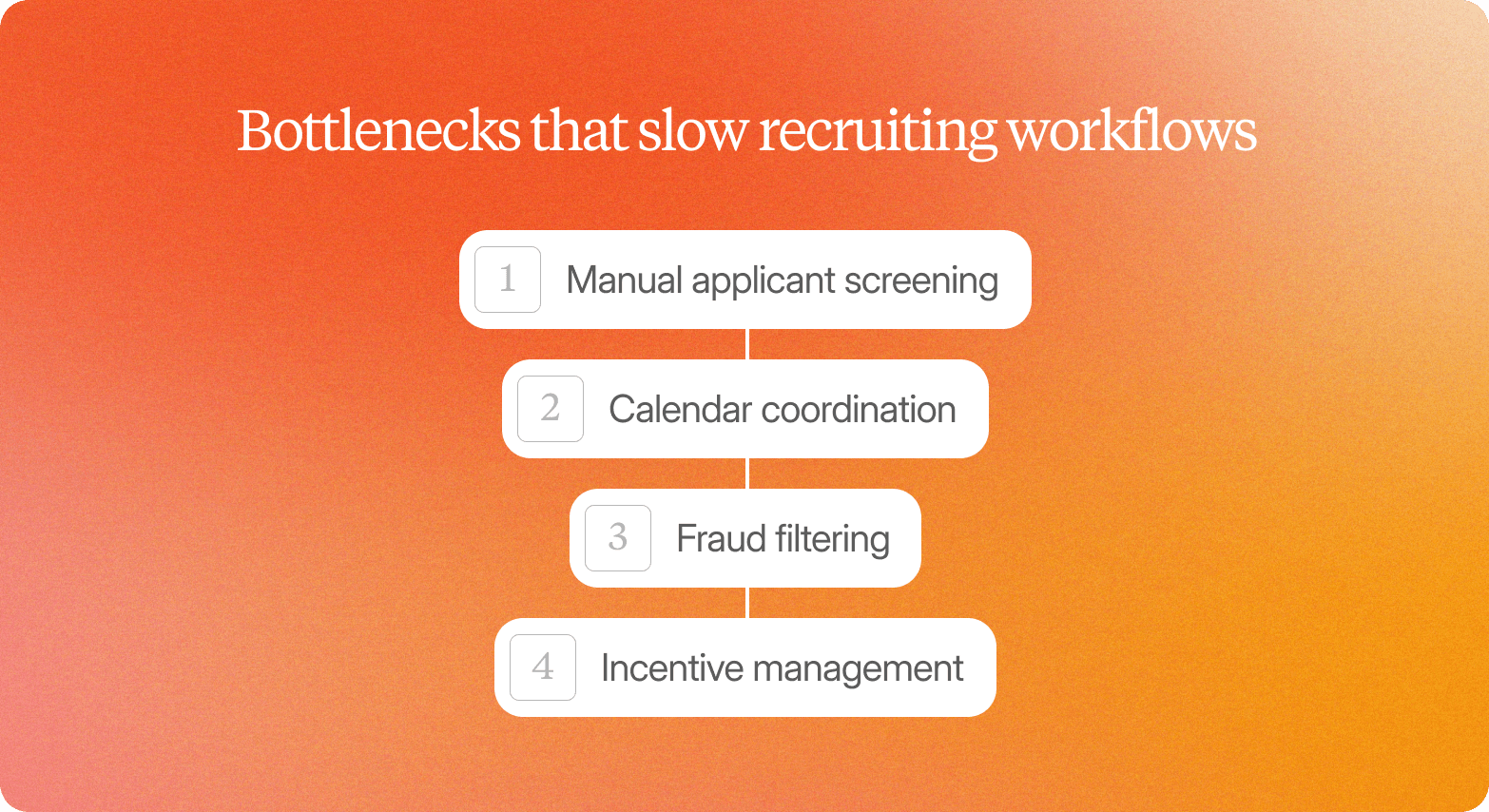
Manual workflows introduce four compounding delays, each pushing the next one back.
1. Manual applicant screening
Reviewing 40 or more screener responses to identify potential participants who meet eligibility criteria is a time-consuming process that can take up the better part of a researcher's day. The recruitment process compounds from there: each decision that requires human review becomes a queue, particularly those studies targeting specific participants with narrow criteria.
2. Calendar coordination
Scheduling across time zones adds three to five email exchanges per participant. A single no-show can collapse a carefully constructed session plan, and rescheduling restarts the loop. For focus groups and qualitative interviews that require multiple participants in the same window, this bottleneck multiplies.
3. Fraud filtering
Without built-in verification, teams spend additional hours cross-checking duplicate responses, inconsistent demographics, and speeder patterns before they can trust the sample. That work typically happens outside the platform, in spreadsheets with no audit trail, leaving the integrity of the participant pool unverifiable at the close of fieldwork.
4. Incentive management
Payment processing handled outside the research platform means follow-up emails, delayed disbursements, and occasional participant disputes that consume coordinator time long after fieldwork closes.
The result: recruitment efforts that should take days stretch into weeks. Screening delays compress scheduling windows; scheduling delays, in turn, compress analysis time. In the initial stages of fieldwork, these delays are particularly costly because they force tradeoffs between building a sufficient participant pool and staying on schedule. Teams end up choosing between the study's focus and the deadline, and the deadline usually wins.
"No more waiting weeks for an agency to summarize what consumers said."
CMI Lead Edgard & Cooper
Asynchronous interviewing removes the calendar constraint entirely. When participants receive a link and complete sessions on their own schedule, recruitment and interviewing run in parallel. Conveo, a video-first AI research platform, supports this at scale, running hundreds of conversations in parallel without adding coordinators. For global teams operating across 50+ markets, built-in transcription, translation, and access to integrated panel partners also eliminate the separate vendor contracts that typically fragment multi-market fieldwork.
How end-to-end platforms automate participant recruitment in qualitative research
Most point solutions handle one step in the research process: a panel vendor sources participants, a separate screener filters them, a transcription platform processes recordings, and an analysis platform codes themes. Each handoff is manual. Each vendor is a separate contract, a separate security review, and a separate place for something to go wrong.
Participant recruitment in qualitative research is where that fragmentation hits hardest. An end-to-end platform closes the loop by handling the full process (from selecting participants against study criteria through to delivering traceable findings) inside a single system, regardless of research topic, study scope, or target audience.
Conveo's approach covers the full recruitment workflow:
Panel sourcing: Participants sourced through Conveo's integrated panel network spanning 50+ markets, with support for BYO lists, CSV uploads, QR codes, and WhatsApp recruitment. Qualitative researchers working across different research topics can access the right participant pool without managing multiple panel vendors across separate online platforms.
Automated screening: Filters potential participants against detailed eligibility criteria, including demographics, stated behaviors, and product usage patterns.
Fraud detection: Built-in verification reduces the number of inauthentic or low-quality participants before a single session runs, protecting the integrity of the participant pool.
Asynchronous scheduling: Participants join on their own schedule, removing the calendar back-and-forth that adds days to traditional methods and fieldwork timelines.
AI-moderated video interviews: The AI moderator conducts qualitative interviews that probe participants' actual responses, surfacing depth that structured questionnaires miss. Every participant is a real person on video: no avatars, no synthetic respondents.
Watch: How Conveo handles participant recruitment from panel to interview →
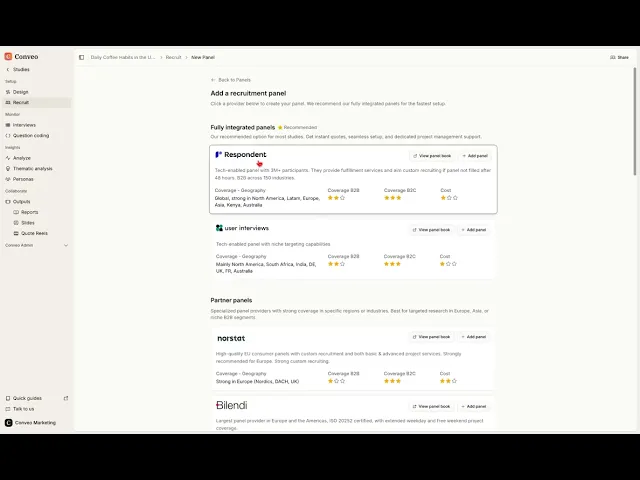
Traceability closes the loop. When research findings reach a CMI director or brand leadership team, the first question is often whether the participants "really said that." Every theme and every finding links back to a video clip and a verbatim quote from a real, verified participant.
Ethical considerations and governance in participant recruitment
Every ethical issue in participant recruitment for qualitative research carries real procurement weight at enterprise scale. It is not enough to recruit the right participants. Enterprise teams must demonstrate to legal, security, and compliance stakeholders that every participant interaction was properly governed, particularly in studies that cover sensitive topics or recruit from vulnerable groups.
Qualitative research studies involving sensitive topics (mental health, personal finance, trauma, or bereavement) require additional consent and data governance measures. Qualitative health research and other studies recruiting from hard-to-reach groups face particular scrutiny: participants who share sensitive personal information need clear assurances about how their data is stored, processed, and used before they will agree to participate.
Three requirements define ethical recruiting governance in practice:
| Requirement | What it means in practice |
|---|---|
| Informed consent | Participants must understand the time commitment, how their data will be used, and that their session is being recorded on video and audio before agreeing. A generic opt-in is not sufficient when recordings contain personally identifiable information. |
| Participant verification | Identity must be confirmed without creating new privacy exposure. Unverified samples undermine the credibility of every subsequent finding. |
| Incentive transparency | Compensation must be stated clearly and accurately so participation reflects genuine interest, not financial pressure or misrepresentation. |
The governance gap in this market is real
Many AI interview platforms lack SOC 2 certification or EU-region data hosting, which means enterprise procurement teams cannot approve them, regardless of the recruiting workflow's speed. A platform that cannot pass a security review does not get deployed. (Compliance data reflects publicly available information as of June 2026. Verify directly with vendors.)
Stakeholder trust depends on the sample as much as the methodology. Video evidence of real participants, traceable consent records, and verified identities address the skepticism that synthetic or avatar-based approaches cannot. Conveo's SOC 2 certification, GDPR compliance, and EU data hosting remove the security blockers that stall enterprise adoption at the point where it matters most: procurement approval.
Multi-market recruiting: Quotas, translation, and fraud prevention
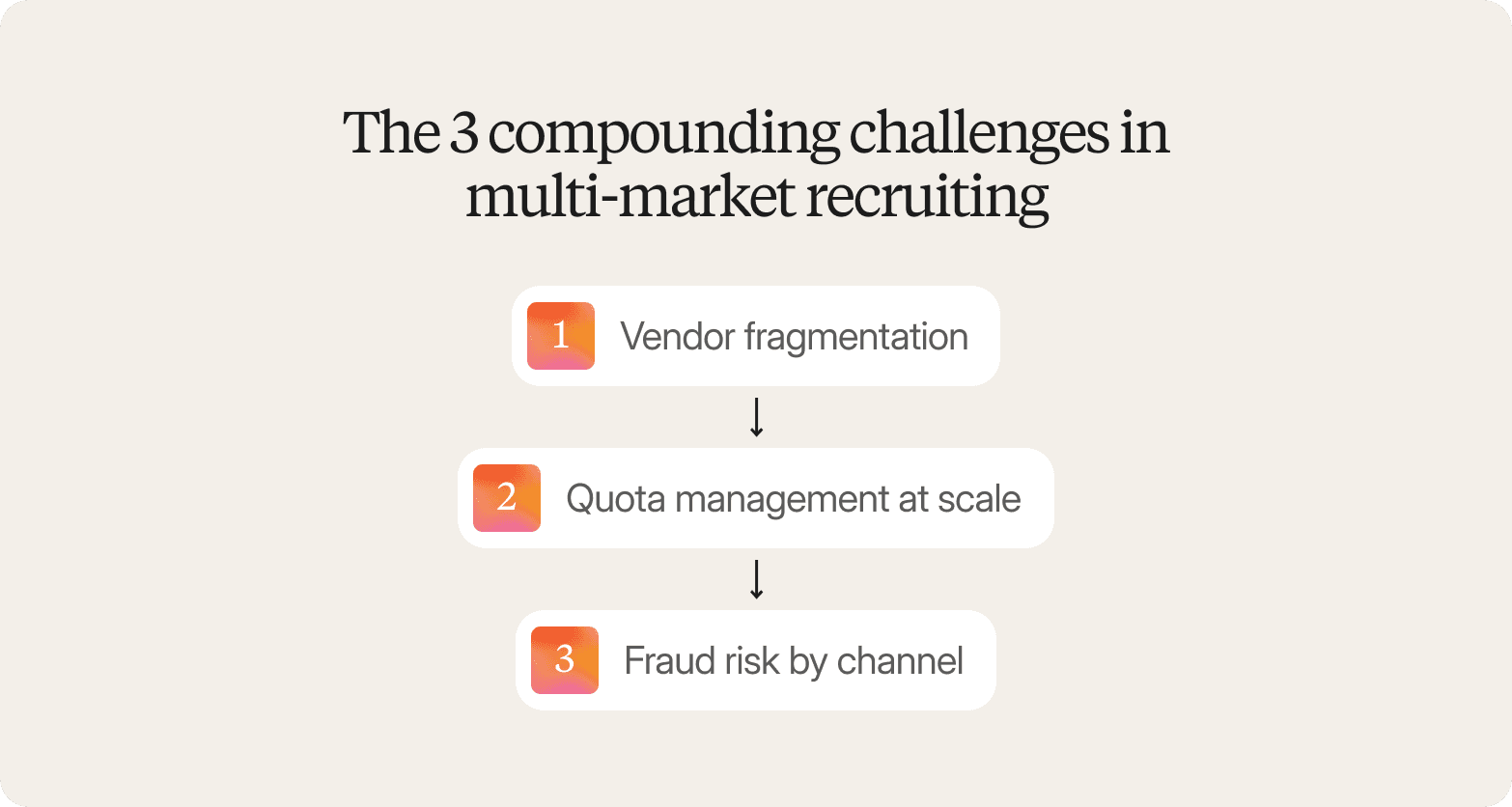
Running participant recruitment in qualitative research across multiple markets is one of the most operationally demanding parts of a research program, particularly when researchers need participants from diverse backgrounds, regions, and languages.
The 3 compounding challenges:
Vendor fragmentation
Teams planning a five-country qualitative study often coordinate with separate local vendors for panel access, translation, and transcription in each market. Each adds its own timeline, contract, and quality standards. The result: two weeks of coordination before a single interview runs. Building a diverse sample across research studies in multiple markets is nearly impossible when each country requires separate recruitment efforts through separate vendors.
Quota management at scale
Recruiting 10 participants per market across 5 countries means tracking 50 individual schedules in 5 languages across multiple time zones. Manual workflows cannot hold that together reliably. Gaps show up as missed quotas, delayed fieldwork, and compressed analysis time. For teams needing to reach hard-to-reach groups or rare populations in specific geographies, the complexity compounds further.
Fraud risk by channel
Most qualitative recruitment relies on nonprobability, opt-in sources like social media platforms and loosely vetted databases, which are fast but come with real tradeoffs: teams often cannot verify who is on the other side of the screen. Without built-in verification, low-quality participants enter the sample before anyone catches them, and incentives are paid out on unusable data.
Conveo addresses all three layers in one platform: 50+ markets with automated transcription and translation in 50+ languages, integrated panel partners with built-in fraud filtering, and asynchronous interviews that let teams recruit and run hundreds of conversations in parallel with no calendar bottlenecks.
How Conveo transforms participant recruitment
The recruitment bottleneck exists because most research stacks treat sourcing, screening, interviewing, and analysis as separate problems, each solved by a separate vendor. Conveo closes that gap by handling the entire workflow on a single platform, supporting recruitment strategies that scale from a single qualitative study to continuous enterprise research programs.
3 capabilities make the difference for enterprise research teams:
Integrated panel access with built-in quality controls. Conveo connects to a network of vetted panel partners, including Respondent.io and User Interviews, and also supports BYO lists, CSV uploads, QR codes, and WhatsApp recruitment. Automated behavioral screening against eligibility criteria and built-in fraud detection ensure sample quality before a session begins. The key advantage for qualitative researchers is that professional services contracts are no longer needed to build a reliable participant pool across markets.
Asynchronous AI-moderated qualitative interviews at scale. Participants complete video conversations on their own schedule. Conveo's AI moderator probes based on real responses, not scripted question paths, surfacing depth that static surveys miss. Successful recruitment across diverse backgrounds and geographies is possible without adding coordinators: teams run hundreds of qualitative interviews in parallel across 50+ markets with built-in transcription and translation.
Traceable, stakeholder-ready evidence. Every finding links back to a video clip and a verbatim quote from a real, verified participant. No avatars, no synthetic data, no outputs that require stakeholders to take research findings on faith.
The result is a recruitment-to-insight cycle measured in days, not weeks, with SOC 2 certification, GDPR compliance, and EU data hosting that clears enterprise procurement without delay.
Frequently Asked Questions
What is participant recruitment in qualitative research?
Participant recruitment in qualitative research is the process of identifying, screening, and scheduling individuals who meet a study's criteria before any interviews or focus groups begin. Recruitment quality determines study credibility: the wrong participants produce research findings that stakeholders reject. Without a representative sample aligned with the research question, even rigorous analysis yields misleading results. Manual recruiting typically delays qualitative research studies by three to six weeks before fieldwork starts.
What are the most common participant recruitment methods?
The most common participant recruitment methods in qualitative research each come with real tradeoffs: DIY recruiting: Low-cost, but sourcing and screening participants manually consume significant researcher time. Paid ads and social media platforms: Fast reach, but targeting precision is limited, and fraud risk is higher. In-product intercepts: Strong contextual fit, but sample sizes are typically small and skew toward active users. Research panels: Fast turnaround, but panel costs add up quickly at scale. Professional recruitment services and agencies: High-quality, screened participants, but turnaround runs days to weeks. Most teams combine two or more of these methods and coordinate handoffs manually, which compounds delays before a single interview has been conducted. Convenience sampling may be faster, but purposive sampling (selecting specific participants based on defined eligibility criteria) produces the depth qualitative research requires, particularly those studies targeting hard-to-reach groups or participants with rare profiles.
How long does participant recruitment typically take?
Recruiting participants in qualitative research manually takes 3 to 6 weeks from study brief to first interview, once screener design, applicant outreach, calendar coordination, and fraud filtering are accounted for. Platforms that automate sourcing, screening, and incentive management compress that window from weeks to hours. The async interview model removes the remaining bottleneck: because participants complete sessions on their own schedule, recruitment and interviewing run in parallel rather than in sequence.
What is an example of participant recruitment in qualitative research?
A participant recruitment example in qualitative research: a CPG brand needs 30 qualitative interviews with parents of children under 5 who recently switched nappy brands. Manual recruiting means screening 100+ applicants against eligibility criteria, coordinating schedules across time zones, and manually filtering for fraud. Conveo automatically handles criteria-based screening, panel sourcing through integrated partners, asynchronous scheduling, and parallel interviews. Every participant is a real human on video, with traceable research findings linked to each clip and verbatim quotes, so stakeholders can verify sample authenticity without having to ask for it.
What are the ethical issues in participant recruitment for qualitative research?
The core ethical issues in participant recruitment for qualitative research are informed consent, participant verification, and incentive transparency. Consent must cover time commitment, data usage, and whether sessions are recorded. Verification confirms the participant's identity without creating a privacy risk. Incentives must be fair without becoming coercive. Studies covering sensitive topics (such as mental health, bereavement, or financial hardship) require additional governance measures for hard-to-reach groups sharing vulnerable information. Enterprise teams also require SOC 2 certification, GDPR compliance, and audit-ready data governance to handle participant PII responsibly. Platforms without confirmed certifications stall procurement regardless of how efficient their recruiting workflows are.
How do you prevent fraud in participant recruitment?
Participant recruitment in qualitative research carries a real risk of fraud, particularly when panel sources rely on open opt-in channels. In practice, social media platforms and loosely vetted online communities produce higher rates of fake identities, duplicate accounts, and bot-driven completions than vetted panel sources, and teams without built-in verification often pay incentives before discovering the problem. Conveo addresses this through three layers: identity verification at the screener stage, sourcing through vetted panel partners with built-in fraud filtering, and video and voice evidence collected during every session. Video is harder to fabricate than text responses, and real human participants on camera provide stakeholders with verifiable proof of sample authenticity that synthetic or avatar-based approaches cannot match.

About the author
Alex de Hemptinne
Business Impact Lead
Alex is a Business Impact Lead at Conveo, partnering with enterprise teams to embed AI-led research into their workflows. From the first study to full-scale rollout, she helps customers shift from project-based research to continuous customer intelligence.
Meet Alex on film →Qualitative insights at the speed of your business.
Conveo runs AI-moderated video interviews and structures everything they say.