In this article
TL;DR
Most competitive intelligence arrives after the positioning decision it was meant to inform has already closed. Agency timelines of 6 to 12 weeks mean findings land in time to confirm strategic decisions that have already been made.
Traditional qual compounds the problem: recruited panels, moderation schedules, and multi-week synthesis passes mean that gathering information this way delays every downstream decision.
Surveys capture stated preference. Decision makers need the behavioral record: what buyers actually compared, in what order, and what triggered the search.
Conveo's AI-moderated video interviews compress the timeline from weeks to days, capturing real comparison behavior and decision triggers while the window is still open.
Every finding traces back to a real participant, through verbatim quotes and video timestamps.
Run as a continuous system, the cycle starts shaping decisions while they are still open.
Competitive intelligence fails on timing. Most teams generate plenty of competitor analysis; the issue is that it lands after the decision it was meant to inform has already closed. This guide walks through the four-stage competitive intelligence cycle, a full worked example, a lightweight operating model, how to measure whether it's working, and four common failure modes.
What Is the Competitive Intelligence Cycle?
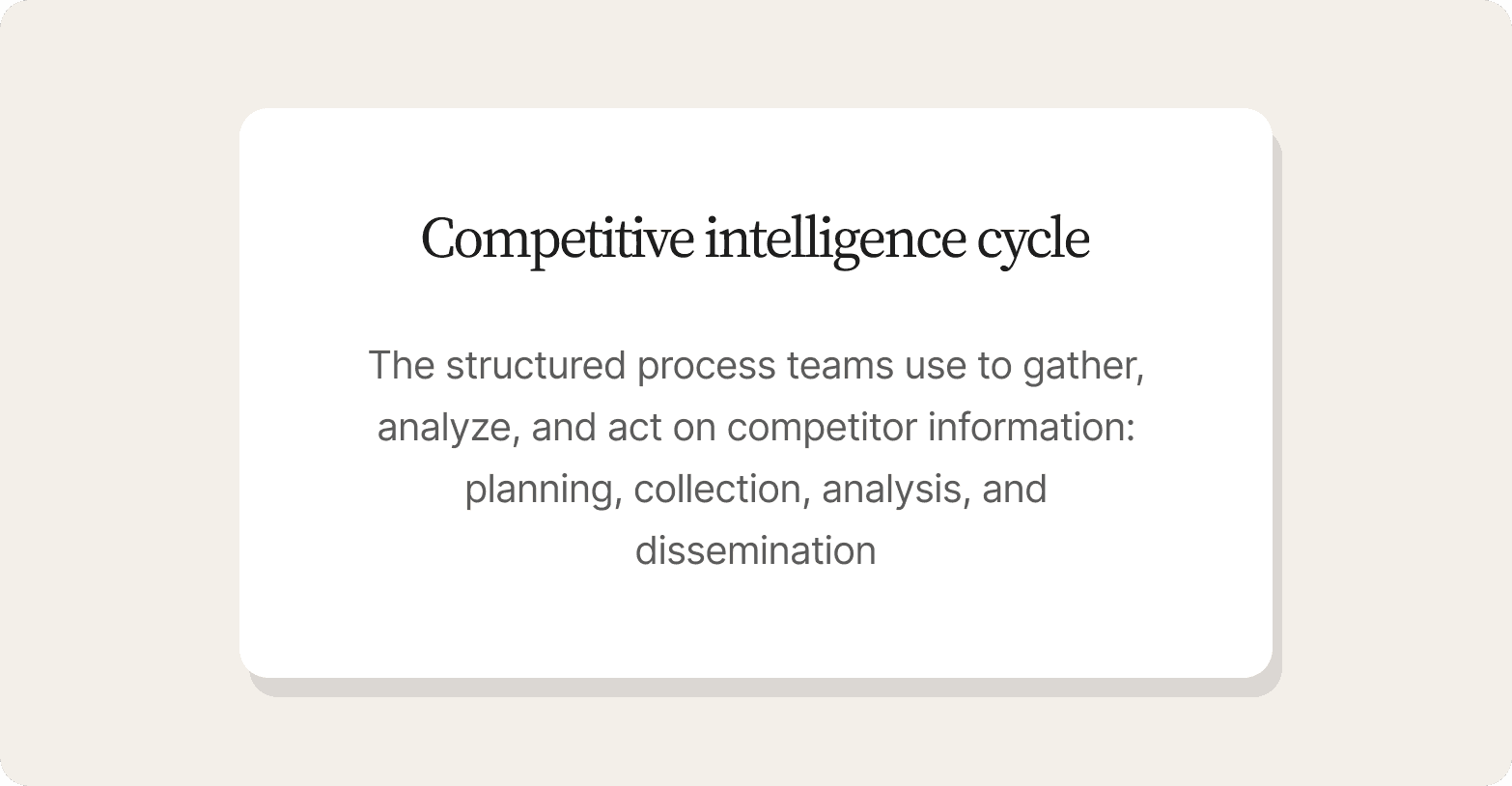
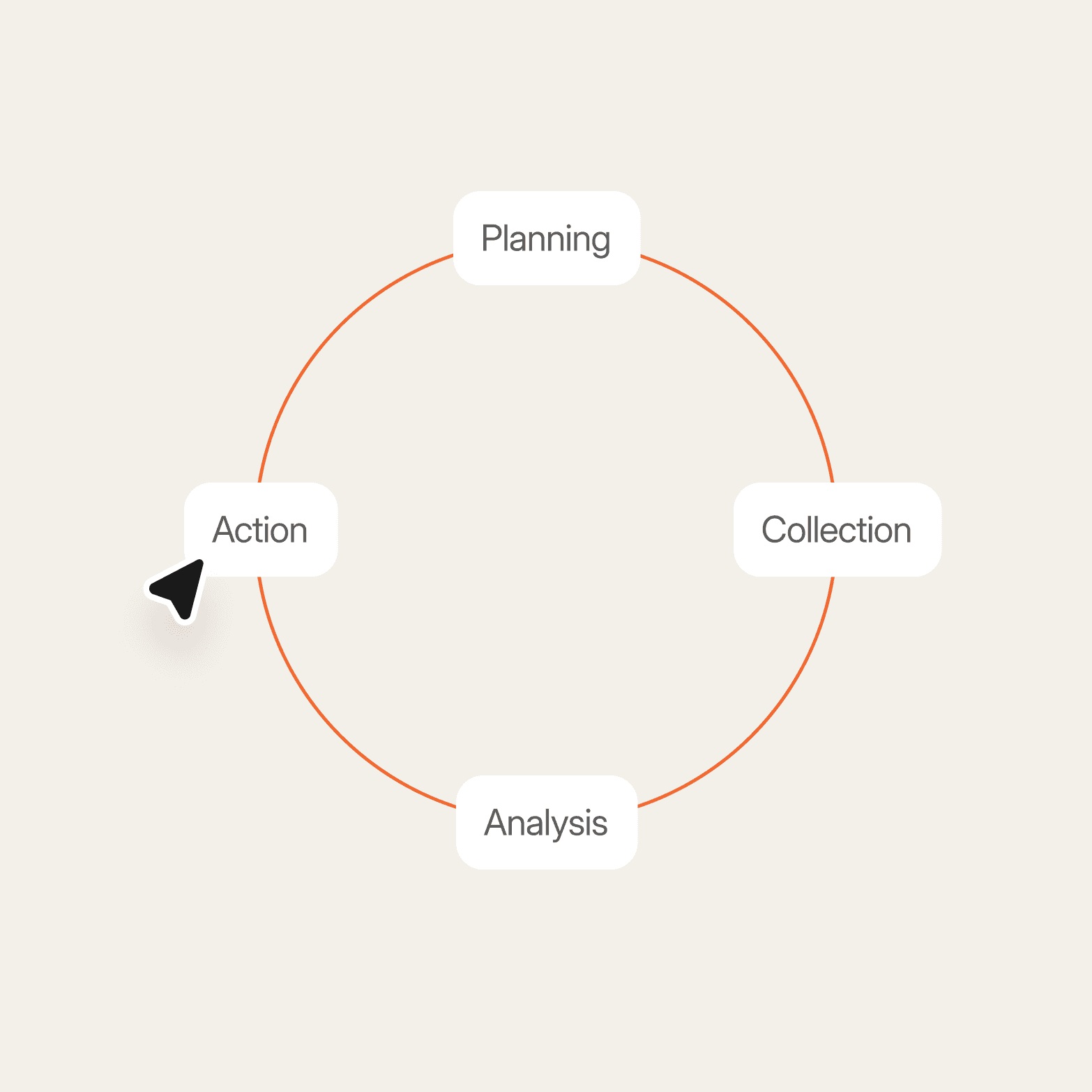
The competitive intelligence cycle is the structured process teams use to gather, analyze, and act on competitor information: planning, collection, analysis, and dissemination. Some call this the competitive intelligence process; its competitive intelligence aims are the same at every stage: turn scattered signals into defensible business decisions. Done well, it runs continuously, feeding each upcoming decision with current behavioral evidence.
Most teams never get there. In practice, the cycle runs on triggers: a competitor launches a product, a deal is lost to a name that keeps appearing in sales calls, a board member asks why the pricing narrative isn't landing. It fires reactively, produces a response, and goes quiet until the next event. That pattern means the business is perpetually catching up to a shifting competitive environment, tracking competitors' activities long after it could have stayed ahead of them.
The cycle breaks on the quality of the underlying evidence. Teams that gather competitive intelligence to feed business strategy need behavioral data: what buyers actually compared, in what order, and what triggered the search. Workshop-built competitor perceptions produce confident narratives that no one can trace back to a real conversation, leaving decision-making resting on collective assumptions.
Three failure modes reliably undermine the cycle's credibility. First, workshop-built perceptions can't be interrogated: no transcript, no verbatim, no video. Second, traditional agency qual takes 6 to 12 weeks, so insights arrive after positioning briefs or roadmap decisions have already been locked in. Third, prior studies disappear into decks, so teams re-research the same narratives every quarter.
A competitive intelligence cycle that works operates as a continuous system: each study builds on the last, and findings reach decision-makers while decisions are still open.
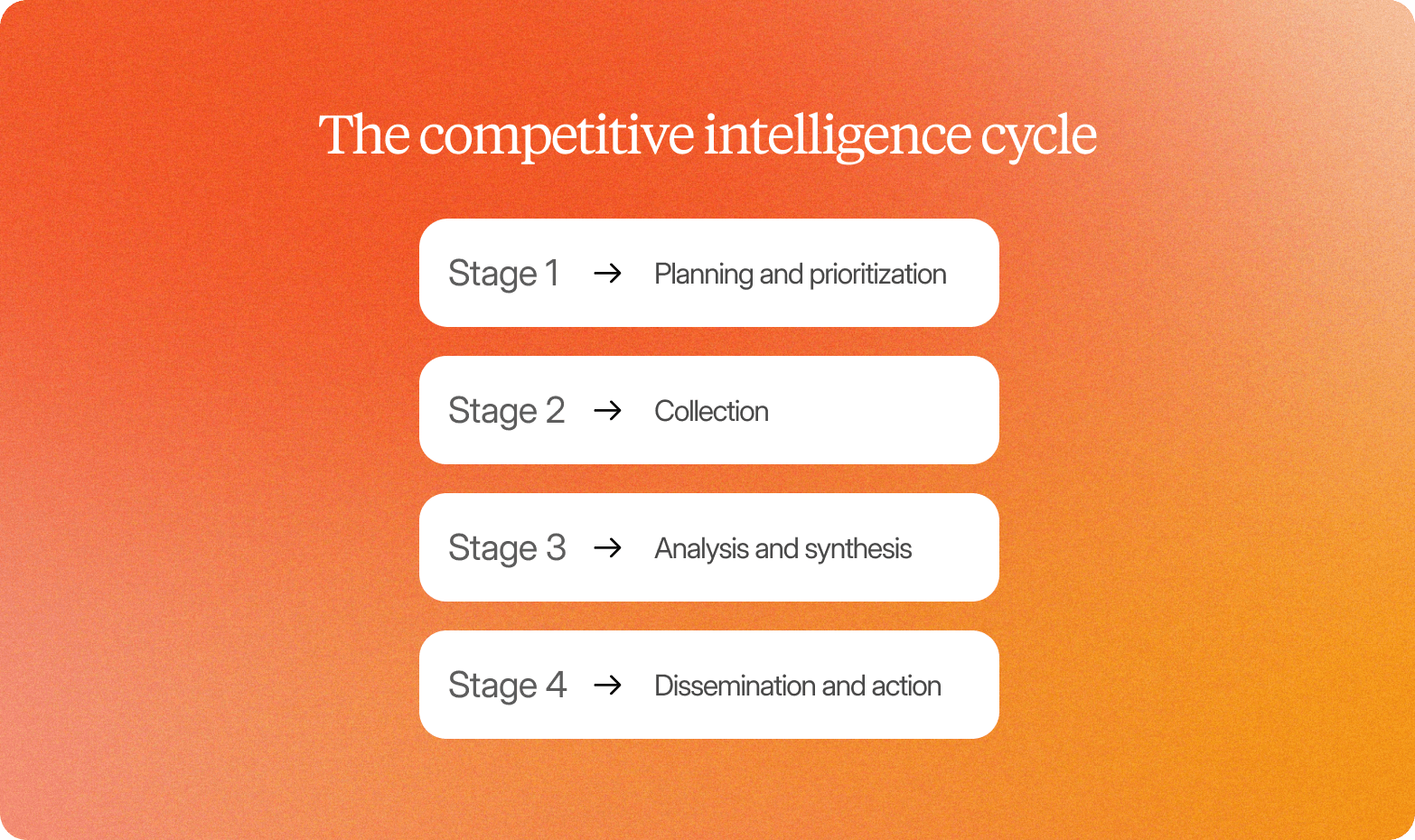
Stage 1: Planning and Prioritization
Planning converts upcoming decisions into specific intelligence questions before any research begins.
The failure mode is skipping intake entirely. Teams default to "what are competitors doing?" and generate research that's comprehensive in coverage and useless in direction. Decision-anchored questions produce intelligence, whether it's strategic intelligence for the boardroom or tactical intelligence for tomorrow's call; broad monitoring just produces information.
Good questions are specific enough to be answerable and consequential enough to matter. Instead of "what's Competitor X's positioning?", ask: "What would have had to be true for buyers to choose Competitor X over us in Q3 deals?" or "Which competitor narratives are gaining traction as a strategic shift in customer needs pulls the category toward [emerging use case]?"
A decision-window-first framework forces the right specificity: name the decision (pricing change for Enterprise tier), the owner (VP Product), the timeline (closes in four weeks), and the intelligence question that unblocks it. With that structure in place, market intelligence converts into actionable insights for the strategic plans actually on the table, and research informs the call rather than filling time.
Stage 2: Collection
Collection is where most cycles break down first, because the evidence base matters less than when it arrives. Traditional agency qual takes 6 to 12 weeks, so findings land after positioning decisions, campaign briefs, and roadmap priorities are already set.
The fix is a different collection model. Conveo's asynchronous, AI-moderated video interviews let teams run hundreds of buyer conversations in parallel, compressing timelines from weeks to days while the decision window is still open. Collecting data this way behaves closer to real-time data than the batch-and-wait rhythm of a traditional fielding window.
Collection should capture behavioral evidence. What explains a buyer's choice is the evaluation path: what they compared, in what order, and what triggered the search. Gathering information this way surfaces it while it's still fresh.
Three interview starters that consistently surface this evidence:
"What other products or approaches did you seriously consider?" Forces a real shortlist instead of guessed competitors.
"How did you actually compare them, and in what order?" Exposes the real evaluation path, whether that was peer referrals, review sites, demos, or procurement mandates.
"What would have had to be true to choose the alternative?" Identifies the specific claim or proof point that would have flipped the decision, which is exactly what positioning and sales enablement need to defend against switching. It's also the easiest question to skip in a live conversation under time pressure; asynchronous AI moderation asks it every time, consistently, across every session.
Stage 3: Analysis and Synthesis
Analysis is where the cycle either produces something stakeholders can act on, or collapses into confident narrative with nothing behind it.
The failure mode is familiar: synthetic personas generated with large language models and other generative AI tools, like workshop archetypes before them, produce polished stories that can't answer "who said this?" with a real quote. Data science can cluster patterns, but the raw data underneath still has to come from a real conversation.
What makes analysis credible is traceability. When each theme links to timestamped video clips, "show me the debrief" friction disappears, because the debrief is the clip. What matters most are moment-of-doubt events: a feature or article that made a competitor feel stronger, visible hesitation when a rival is named, contradictions between stated criteria and actual behavior. These signals live in tone and expression, beyond the reach of transcript text alone, which is why voice and video surface competitive signals that surveys structurally miss. Artificial intelligence speeds up the data analysis and tagging, but the strategic insights still come from a person deciding what the pattern means.
Stage 4: Dissemination and Action
Dissemination means delivering intelligence in a format a stakeholder can act on the moment they open it. The alternative, a 40-slide deck that needs a researcher to interpret it in a meeting, stalls at the point of use.
A stakeholder-ready output has five components: the decision it informs, the intelligence question it answers, the evidence (timestamped clips or verbatim quotes), the pattern identified, and the recommended action. A short data visualization often does more for key stakeholders than another paragraph of prose, whether the audience is refining value propositions, adjusting marketing strategy, or deciding what to build next.
Watch the walkthrough: Reading a Conveo Report
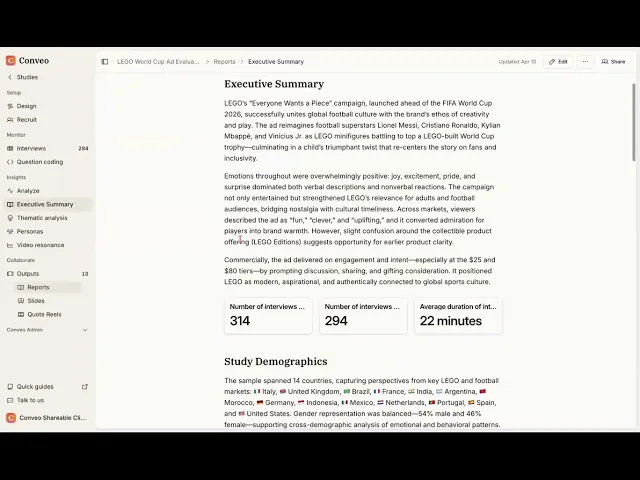
Conveo's searchable insight library keeps every finding tagged and searchable across projects, so nothing gets researched twice. Dissemination feeds the next cycle: what stakeholders do with the findings flows directly back into planning for the next decision window.
Competitive Intelligence Cycle Example in Business
The following is a representative scenario, not a specific named client engagement.
A SaaS company is preparing to launch a new Enterprise pricing tier as part of its broader strategic plans for the category.
Plan: The VP of Product needs to finalize pricing within 4 weeks. Getting this wrong locks in pricing strategies that are hard to unwind. The intelligence question: what pricing structure did buyers expect when evaluating this category, and which competitor's model felt most aligned with their procurement process? The output is an intake brief naming the owner, the deadline, and the target participant profile: buyers who evaluated two or more competitors in the past six months.
Collect: The team recruits 15 such participants for asynchronous, AI-moderated video interviews. Core questions include what else they seriously considered, how they compared pricing models, and what would have made a competitor's pricing feel more credible. The output consists of 15 recorded interviews with timestamped transcripts linked to specific competitor mentions.
Analyze: The team identifies repeatable patterns. Nine of the 15 buyers expected usage-based pricing and described per-seat models as "outdated." Six named a competitor's transparent pricing calculator as a trust signal. The output is a report centered on one finding: usage-based pricing is now table stakes for credibility, with timestamped clips and a recommended action to pilot a usage-based tier before the full launch.
Distribute: The findings go into a searchable insight library, tagged "pricing," "competitor evaluation," and "Enterprise tier." The VP pilots usage-based pricing in beta. Three months later, when the CFO asks why the team moved away from per-seat pricing, the answer is retrievable in seconds, with video evidence attached, and that question triggers the next planning phase.
How to Build a Competitive Intelligence Cycle That Runs Continuously
Most competitive intelligence efforts share the same flaw: they are triggered by events. By the time intelligence lands, the decision it was meant to inform has already been shaped by assumption.
A continuous cycle runs on a lightweight operating model. Building a strong competitive intelligence program within an existing organization takes four things: defined roles, a repeatable cadence, clear handoffs, and governance. All four are within reach of an existing team.
Roles
The decision owner (VP Product, CMO, or senior brand leader) submits questions tied to upcoming decisions, naming the decision, timeline, and what they need to know. The research lead translates those questions into collection plans, recruits participants, and oversees the quality of the data returned, serving as the methodological backbone of the cycle. Stakeholder consumers across product, marketing, sales, and customer success receive outputs and feed action outcomes back into the cycle. Most insights teams already have the people for all three roles; what they lack is the operating model that connects them, which is why a working program rarely depends on hiring dedicated competitive intelligence professionals.
Cadence
Quarterly planning sessions map decisions coming up in the next 90 days. Bi-weekly collection sprints field interviews while decisions are still forming. Monthly dissemination reviews make sure outputs reach owners before the moment passes. Conveo StoryLines formalizes this rhythm as a wave-based, AI-moderated research program that runs on a standing cadence instead of one-off studies. For CI professionals, that's a narrower job than trying to stay up to date on every rival, or trying to stay competitive on every front at once.
Governance
The intake brief moves from owner to research lead; the research lead returns a stakeholder-ready report; the owner logs the outcome and closes the loop. Competitive intelligence cannot include deceptive recruitment, requests for proprietary information, or recordings made without consent, and any signal pointing to potential risks or potential threats needs a named escalation path. Continuous monitoring keeps the cycle ready to activate the moment a decision opens, and that readiness is what prevents the scramble to commission research after urgency has already set the terms.
How to Measure Whether Your Cycle Is Working
Most teams measure the wrong thing: quarterly reports published, interviews conducted, calls completed. None of that tells you whether intelligence changed a decision or prevented a costly mistake. Activity metrics are easy to produce; impact metrics, tied to organizational performance, are harder to produce, which is why they matter more. A report full of data with no actionable insights attached leaves the decision exactly where it was.
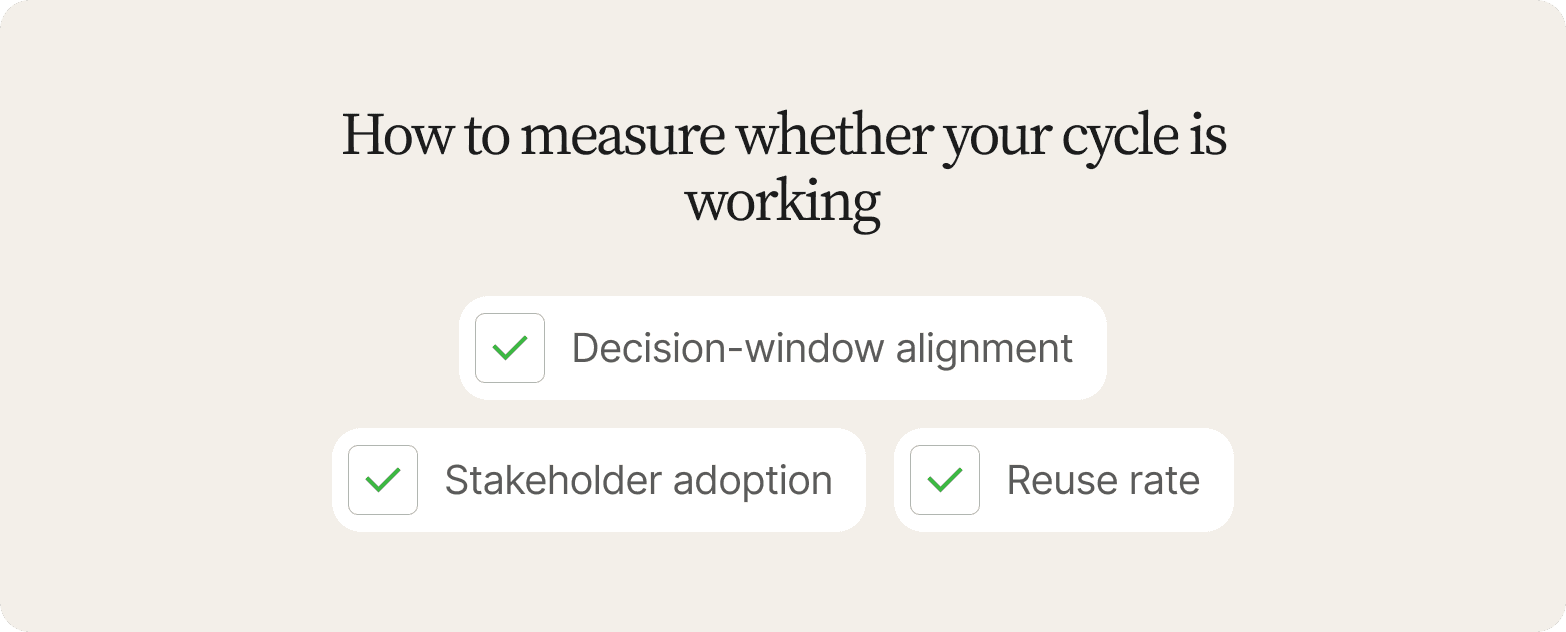
Three leading indicators reveal whether the cycle is actually working.
Decision-window alignment
What percentage of outputs arrive before the decision closes? If findings consistently land after the brief is locked, the cycle is decorative rather than directional.
Stakeholder adoption
How often do decision owners cite competitive intelligence in exec reviews or planning sessions? Adoption means the people who own decisions are pulling intelligence into the room when it matters, whether or not every stakeholder reads every report. If it isn't referenced in the artifacts where decisions get made, it isn't being used.
Reuse rate
How often do teams query the searchable insight library for prior learnings before commissioning new research? If every question triggers a fresh study, intelligence is disappearing into decks instead of compounding.
A lightweight post-decision review closes the feedback gap: did the intelligence change the decision, and what question should have been answered that wasn't? The second question feeds directly into planning for the next cycle. One produces reports; the other produces better decisions, and compounding better decisions is what eventually shows up in revenue growth and market share.
Considerations
Governance overhead is a real cost to plan for. Consent, recruitment ethics, and escalation paths need an owner from day one.
A compounding library only compounds if teams actually use it. The reuse rate needs to be tracked as deliberately as the output volume.
Method choice is a fit decision. AI-moderated interviews are the right primary source for evaluation-path and trigger evidence; secondary sources and internal sources remain necessary complements.
Emerging technologies change what "competitor" means faster than the category. New AI-moderated tools and other disruptive technologies can shift buyer attention before it shows up in a market share report, so revisit the competitor set often.
4 Common Failures (and Fixes)
Workshop-built perceptions that can't be traced
A room of smart people mapping competitors generates confident narratives fast, but no one can answer "who said this?" The fix is replacing internal alignment sessions with AI-moderated video interviews, which capture what workshops never can: visible hesitation, tone shifts, and contradictions between stated criteria and actual behavior.
Insights arrive after decisions close
Traditional agency qual takes 6 to 12 weeks, so findings typically land after the brief is written or the roadmap is locked. Running AI-moderated interviews in parallel compresses the timeline while preserving the verbatim evidence that makes findings credible and allowing intelligence to emerge as market and industry trends are still forming.
"The pace, responsiveness, and research expertise of the Conveo team, on top of the top AI-moderated qual platform, has been invaluable to us in scaling brand advertising internationally."
Matt Harris, Research & Insights Lead, EMEA, Canva
Prior studies disappear into decks
Every cycle loses ground when a study closes, and the deck gets filed, forcing teams to re-research the same territory each quarter. Most competitive intelligence tools solve for collection or reporting individually, but few connect one study to the next. A searchable insight library means researchers can query prior learnings before commissioning anything new.
Multi-market intelligence slows down in localization
Sequential fieldwork and translation can stretch a cycle that should take days into months. Running interviews in participants' native languages simultaneously, as Conveo does across 50+ languages, removes that bottleneck for launches and pricing decisions that can't wait for regional sequencing, and lets teams act on emerging market opportunities before a competitor claims the ground.
How Conveo Compresses the Competitive Intelligence Cycle
Teams building a continuous cycle need three things: evidence that arrives while the decision window is open, findings traceable to a real participant, and a library that compounds across quarters. Most competitive intelligence tools optimize for a single stage; few carry both strategic competitive intelligence and tactical competitive intelligence through the same pipeline.
Conveo's async, AI-moderated video interviews are built around that timing problem specifically: hundreds of conversations run in parallel, so a question that surfaces on Monday can have evidence behind it by Thursday. Every clip is traceable to a real person, so an exec review can audit any finding on the spot, which is what turns competitive intelligence into a genuine competitive edge.
Conveo StoryLines fields interviews on a standing cadence, and a searchable insight library keeps every finding accessible across waves, so understanding compounds with every wave. That compounding library serves as business intelligence for the competitive side of the business, surfacing market opportunities as they open. For teams already underway with digital transformation, this is usually the easiest piece to make continuous first.
Frequently Asked Questions
What are the four stages of the competitive intelligence cycle?
Planning and prioritization, collection, analysis and synthesis, and dissemination and action run continuously rather than as a one-time project.
How long should a competitive intelligence cycle take?
As long as the decision window allows. Traditional agency qual typically takes 6 to 12 weeks; async, AI-moderated interviews can compress that to days.
What's the difference between competitive intelligence (CI) and market intelligence?
Competitive intelligence focuses on how buyers evaluate you against named alternatives. Market intelligence covers category-level needs and behavior more broadly, without anchoring to a specific competitor or decision.
Who should own the competitive intelligence cycle?
A lightweight three-role model works for most teams without dedicated CI professionals: a decision owner who submits questions tied to real decisions, a research lead who runs collection and analysis, and stakeholder consumers who use the findings and feed outcomes back into the cycle. Competitive intelligence helps most when these three roles are clear.
How do you keep competitive intelligence from going stale between studies?
Run it as a continuous program and route every finding into a searchable insight library. That's the difference between a competitive intelligence program and occasionally deciding to gather competitive intelligence when asked. Conveo StoryLines fields interviews on a standing cadence, and the searchable insight library keeps prior findings connected, so the next study starts from what's already known.

About the author
Dieter De Mesmaeker
Co-Founder & CEO
Dieter is CEO and co-founder of Conveo. Before starting the company, he founded DataCamp and scaled it into one of the leading edtech platforms in the world.
More by Dieter →Qualitative insights at the speed of your business.
Conveo runs AI-moderated video interviews and structures everything they say.