In this article
TL;DR
Concept testing methods range from surveys and monadic tests to in-depth interviews and focus groups, each suited to a different stage of development and a different kind of question.
Surveys tell you what consumers prefer; they rarely explain why. Closed-ended scales miss the reasoning, hesitation, and emotional context that drive real purchase decisions.
Qualitative concept testing methods surface the "why," but traditionally require weeks of recruiting, scheduling, and manual synthesis that most teams cannot sustain at pace.
AI-moderated video interviews resolve the speed-versus-depth tradeoff by running asynchronous, adaptive conversations with your target audience at scale, compressing timelines from weeks to days.
A research-grade concept testing interview requires structured stimulus exposure, open probes, and follow-up logic that responds to what participants actually say, not a rigid script.
Most concept testing methods get chosen for the wrong reason: they fit the calendar, not the question. Innovation and brand teams default to surveys because they close quickly, and by the time traditional market research returns findings, the product decision has already moved on. The result is expensive launches built on internal assumptions, concepts that tested well on a rating scale but failed in the market, and missed opportunities that a single round of conversations with potential customers might have caught.
Surveys measure stated preferences and produce scores. They do not capture the moment a participant’s tone shifts when they hear a price point, the hesitation before they describe a use case, or the unprompted comparison to a competitor they trust more. Those signals are where concept failure lives, and they only surface in conversation.
Qualitative concept testing addresses this gap. AI-moderated video interviews have changed the historical trade-off: teams now run real qualitative concept-testing studies in days, not weeks, without sacrificing the depth that makes findings credible.
This article covers the main concept testing methods available, how to conduct concept testing at each stage of development, and how to choose between approaches based on your decision timeline, research question, and the kind of evidence your stakeholders will act on.
Why concept testing matters for innovation teams
Understanding the benefits of concept testing begins with the cost of skipping it. Teams that skip or compress product concept testing absorb the cost later: reformulated packaging, repositioned messaging, delayed launches, or products that reach shelves and miss.
The structural problem is timing. Innovation roadmaps move in two- to four-week cycles, but the innovation process requires real consumer input at every stage. A concept that needs validation this sprint cannot wait six to twelve weeks for an agency to recruit, moderate, and synthesize. By the time findings land, the decision has already been made, usually by whoever had the most confident opinion in the room.
So teams fill the gap with internal assumptions. Marketing strategies are built on what the brand team believes the target market will think, not what consumers actually said. That substitution feels pragmatic in the moment and is expensive over time.
The credibility problem runs alongside. When research is summarized in a deck without traceable quotes or sourced themes, findings become negotiable. Manual moderation and time-intensive synthesis mean that most teams run one or two studies per quarter, even though the work genuinely demands more.
4 types of concept testing methods
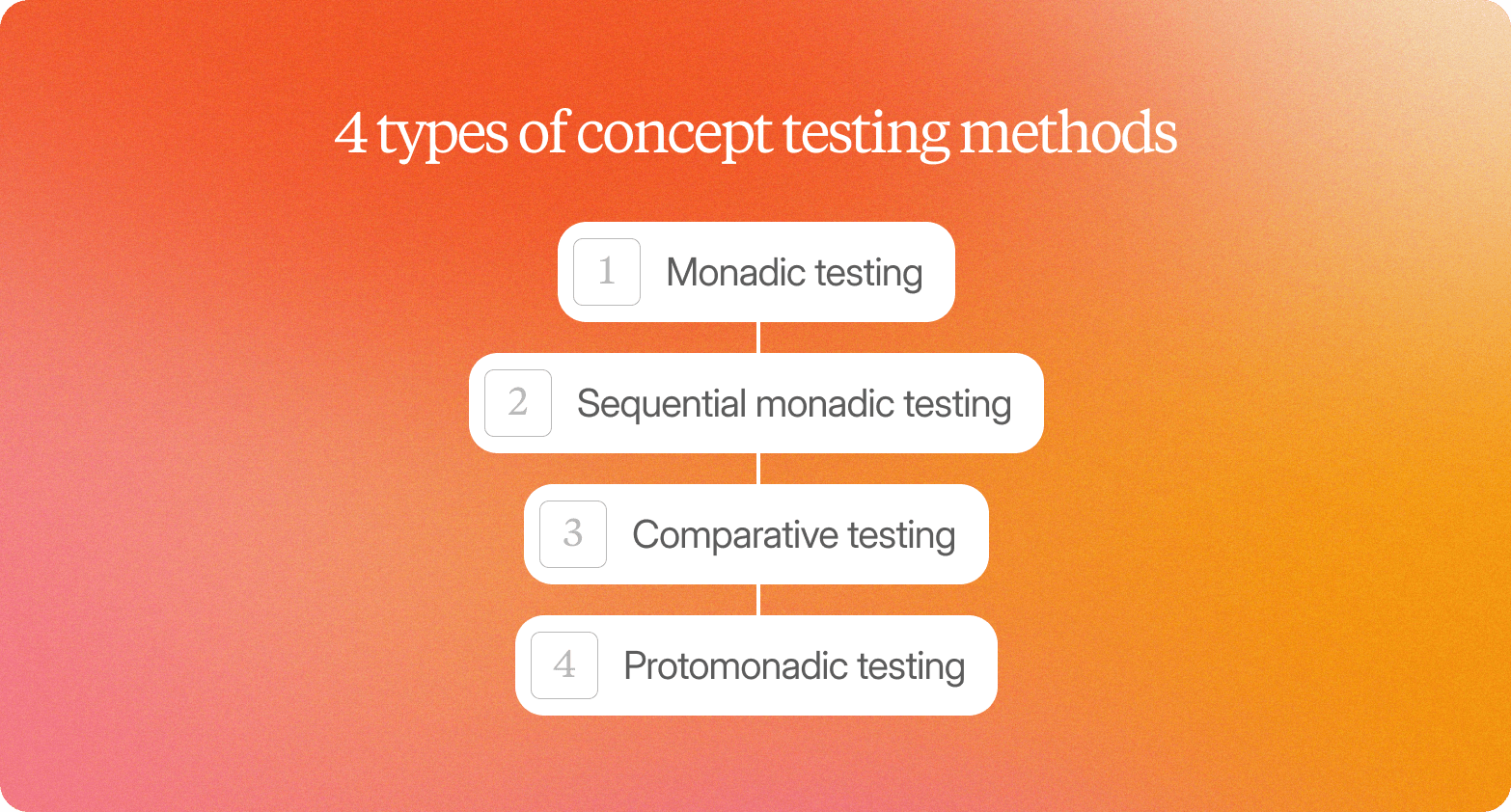
The method you choose depends on the question you are trying to answer: which concept wins, why it wins, or what to fix before it can. Each of the four standard concept testing methods answers a different version of that question.
| Method | How it works | Best for | What it misses |
|---|---|---|---|
| Monadic | Each respondent evaluates one concept individually, in isolation | Absolute appeal scores; benchmarking against norms; reducing order bias | No direct comparison data; requires larger sample sizes to test multiple concepts |
| Sequential monadic | Each respondent sees multiple concepts in randomized order, evaluating each before moving on | Comparing two to three concepts with a smaller sample, understanding relative performance | Suppression effects can deflate scores; results are not directly comparable to pure monadic benchmarks |
| Comparative | Respondents see all concepts side by side and rank or choose a preferred option | Fast winner identification; preference ranking when differences are clear | Tells you which wins, not why; context effects distort individual concept scores |
| Protomonadic | Sequential monadic evaluation followed by a direct comparison question at the end | Cross-validating sequential monadic findings; combining independent scores with preference data | Longer survey length; fatigue risk increases with more than three concepts |
For teams testing a single concept against category norms, monadic is the standard. For teams that need to compare multiple concepts or choose between two reformulations, the sequential monadic or protomonadic approach provides both individual and comparative data in a single study. Comparison testing is particularly useful when differences between creative concepts are subtle enough that a direct side-by-side could introduce order bias.
All four methods are typically conducted as surveys, which offer speed and statistical scale but cannot elicit reasoning. A respondent who rates a concept 7 out of 10 and one who rates it 4 out of 10 produce different numbers. They do not explain what drove the gap.
This is where qualitative concept testing plays a distinct role. Rather than collecting ratings at scale, it captures the emotional reaction, hesitation, and usage scenario that the respondent projects onto the concept. The tradeoff, historically, has been volume: manual moderation limits how many interviews a team can run, forcing teams to rely on surveys for anything that needs to move quickly.
Qualitative vs. quantitative concept testing: When to use each
Most teams default to surveys when they need speed and focus groups when they need depth. Both come with tradeoffs that shape what you can learn and how fast you can act on it.
The table below maps the three primary concept evaluation methods against what each reveals and when it belongs in your research program.
| Method type | What it reveals | When to use it |
|---|---|---|
| Quantitative research (surveys, A/B tests) | Preference ranking, stated intent, and statistical significance across large samples. Tells you what people chose, not why. | When you need to measure customer preferences at scale, compare multiple options, or validate a direction that has already been refined through qualitative work. |
| Traditional qualitative (focus groups, one-on-one interviews) | Emotional reactions, usage scenarios, and language consumers use to describe a concept, friction points that a survey would never surface. | When you need to understand why a concept resonates or what needs to change before committing budget. Manual moderation and synthesis limit how often you can run it. |
| AI-moderated qualitative (asynchronous video interviews) | The same depth as traditional qual: adaptive probing, real emotional reactions on video, without the scheduling bottleneck. Interviews run in parallel, day or night, across any market. | When you need qualitative depth on the timeline that quantitative research usually occupies. Suited to iterative concept work requiring multiple rounds without weeks between each. |
Use quantitative research to measure: which concept scores highest, how purchase intent compares across segments, or whether a change moved the needle. It is a valuable research method for validating a direction that has already been refined through qualitative work.
Use qualitative concept testing methods to gain an in-depth understanding of why one concept lands and another does not, what language consumers use to describe the benefit, or what is missing from a concept that looks good on paper.
AI-moderated interviews resolve the persistent tension between depth and speed. Instead of scheduling 20 participants over two weeks, teams run hundreds of video interviews simultaneously, with the AI probing adaptively based on each participant’s responses. Findings come back structured and traceable, without adding headcount or extending the research timeline.
How to choose the right concept testing method
Choosing among concept testing methods comes down to three factors: the decision being made, the stage of development, and the team’s risk tolerance. Get the match wrong and you either collect data too shallow to act on, or spend time generating depth on a question that only needed a directional signal.
Early-stage concepts
At the early stages of the development process, the goal is not to measure preference. Teams need to understand the emotional response a new concept triggers before committing significant resources to production. Qualitative concept testing methods are the right fit for testing concepts here: they surface what feels compelling, what creates confusion, and what language consumers use to describe the customer needs the concept is trying to solve. Preference rankings at this stage produce false precision.
Mid-stage refinement
The team has a shortlist of viable directions and needs to identify the most promising concept and know what to fix. Sequential monadic testing limits concept-to-concept contamination and captures genuine reactions to each option. This is where concept refinement decisions, adjusting messaging, visual elements, or perceived value, are most actionable before the design is locked. Qualitative follow-up interviews probe the preference drivers that quantitative data alone cannot surface.
Pre-launch validation
The concept is defined, and the team needs to confirm it resonates at scale before committing to launch budgets. Quantitative methods are the right primary tool. Qualitative depth still has a role, but a narrower one: final messaging adjustments benefit from a small number of video interviews that reveal how real consumers interpret the claims.
5 common concept testing mistakes to avoid
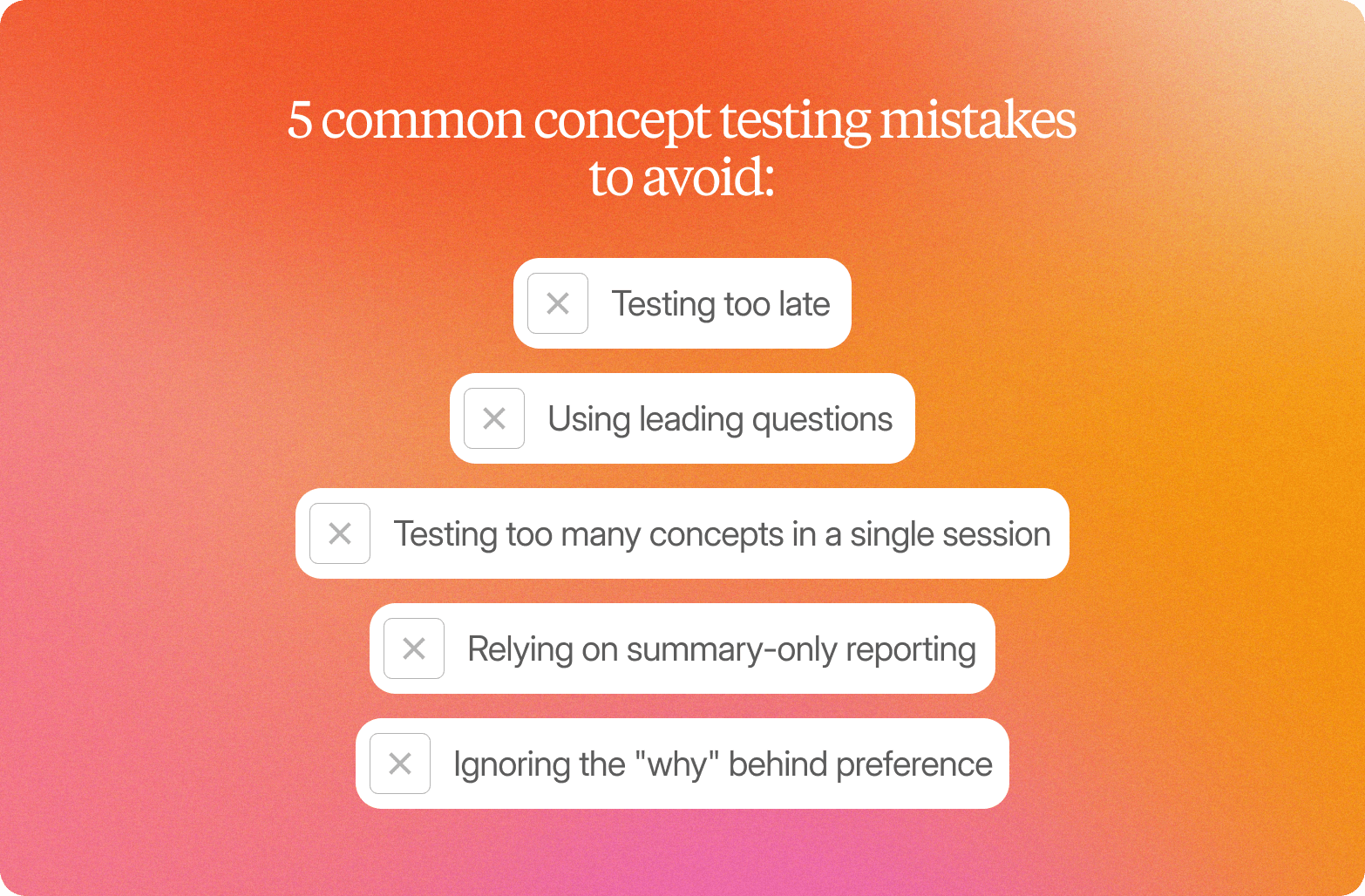
Poor concept-testing execution does not slow down findings. It produces findings that point in the wrong direction. Successful concept testing requires not just the right method, but the right discipline in executing it. These are the five most common mistakes teams make across concept testing methods.
1. Testing too late
Running concept research after the design is finalized means findings arrive when the window to act has closed. Build research into the decision process, not after it.
2. Using leading questions
“What do you love about this concept?” primes participants to respond positively, confirming assumptions rather than testing them. Use open-ended language: “What’s your reaction to this?” The goal is reliable feedback, not validation.
3. Testing too many concepts in a single session
When participants evaluate too many concepts back-to-back, order effects, fatigue, and comparison bias contaminate the data. Rotate order across participants or run separate sessions.
4. Relying on summary-only reporting
A slide that says “68% of participants responded positively” strips the context that makes the valuable data behind it actionable. Themes should link to quotes, and quotes should link back to the original conversation.
5. Ignoring the “why” behind preference
Preference data tells you which concept won. It does not tell you what to fix. Every preference signal needs a follow-up that provides deeper insights into why consumers responded as they did.
What makes a good concept testing interview?
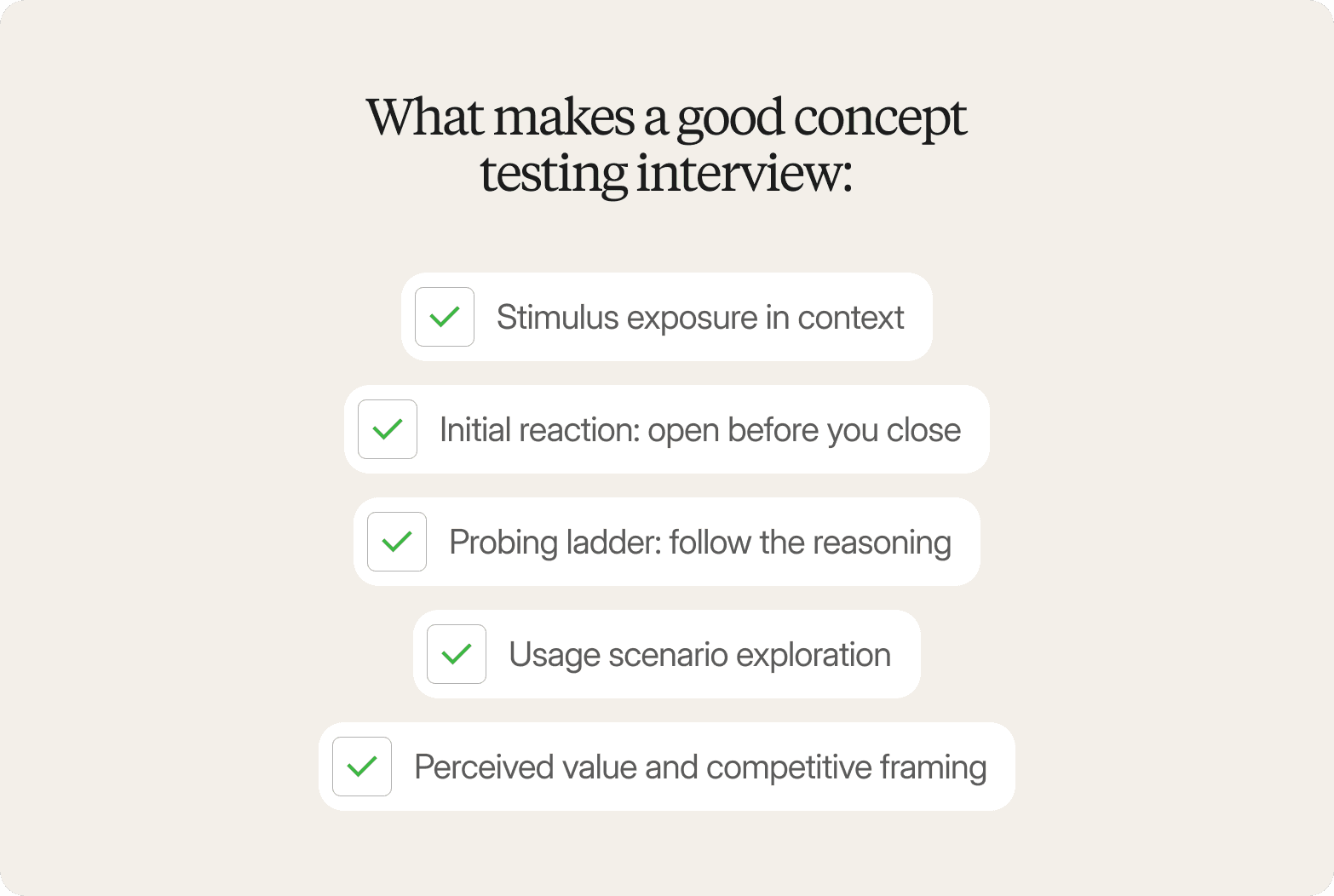
Research-grade qualitative concept testing delivers far more than a first impression. When the interview structure is built for depth, it surfaces the reasoning behind reactions, friction points that would kill adoption, and the brand perception and competitive positioning that shape willingness to pay.
Stimulus exposure in context
Participants should encounter the concept as they would in the real world: on a shelf, in an ad, during a product demo, or alongside competing options. Showing the concept’s key features in a realistic setting produces far more detailed feedback than isolated stimulus testing.
Initial reaction: open before you close
The first question should always be open-ended. “What’s your first reaction?” captures emotional responses that closed-ended questions miss. Asking someone to rate appeal on a five-point scale before articulating their reaction collapses nuance into a number.
Probing ladder: follow the reasoning
Adaptive follow-up questions (“Why do you say that?” “Can you tell me more?”) reveal what is driving appeal, what is creating doubt, and what is being misread. This is how you gather feedback that goes beyond surface impressions and becomes genuinely actionable.
Usage scenario exploration
“Walk me through a situation where you’d reach for this” surfaces the use-case assumptions participants bring to a concept, which often differ significantly from those the team designed for. This reveals whether a concept addresses real customer needs or an imagined one.
Perceived value and competitive framing
Asking participants to compare the concept to what they currently use reveals competitive positioning and realistic willingness to pay.
AI-moderated interviews apply this probing structure adaptively across every session without requiring a human moderator, delivering consistent depth at a scale that traditional moderation cannot match.
How AI-moderated video interviews change concept testing
The tradeoff that traditional concept testing forced on researchers was never about budget or sample size. It was about simultaneity. A scheduled in-depth interview program means one conversation at a time, one timezone at a time, one moderator stretched across a project that takes weeks to complete. AI-moderated video interviews dissolve that constraint at the structural level.
Because sessions run asynchronously, participants respond on their own schedule rather than booking into a calendar slot. A concept test that once required three weeks of fieldwork now runs hundreds of interviews in parallel, completing in days. The insights team does not need to grow to keep pace with the volume.
"We ran a concept test for a new product line; in one night, we had 200 interviews analyzed."
CMI Manager, Edgard & Cooper
The credibility question deserves a direct answer. Stakeholders who have seen AI-generated summaries without traceable sources have good reason to be skeptical. In Conveo’s approach to concept testing, every theme links back to the original video clip and verbatim quote. Stakeholders can watch the moment a participant hesitated at a price point, hear the tone shift when a product name landed wrong, and read the exact words behind each finding. Conveo’s video-first methodology means researchers work with real humans on camera, not synthetic responses, delivering qualitative insights backed by evidence that holds up in a stakeholder presentation.
On the analysis side, automated transcription, translation, coding, and thematic synthesis compress the time between raw recordings and structured findings. Multi-market studies benefit particularly: 50+ language support and asynchronous fieldwork mean a five-market study runs in parallel, not sequentially.
What stakeholder-ready concept testing outputs look like
Traceability is a key component of stakeholder-ready outputs and a primary reason concept testing methods that rely on text-only reporting lose credibility with senior buyers.
Stakeholder-ready outputs are built on three layers. The first is a decision narrative: a one-page executive summary that answers the central business question directly. Did the concept land? Which version performed better and why? This is a decision input, not a recap of findings.
The second layer is qualitative analysis organized by concept element. Reactions to messaging, packaging, and perceived value are distinct and should be reported separately. When a concept underperforms on perceived value but resonates on messaging, the team needs to know that distinction before the next iteration.
The third layer is supporting evidence: verbatim quotes and video clips that stakeholders can inspect themselves. This is where concept testing methods that rely on text-only reporting fall short. A written transcript captures what a participant said, not the hesitation before they said it or the shift in tone when they saw the price. Multimodal analysis, blending speech, tone, facial cues, and on-screen objects, surfaces an interpretation that transcripts miss.
A searchable insight library makes the collected data from past concept tests reusable across future studies. Prior concept reactions are retrievable in seconds, not buried in a shared drive.
Multi-market concept testing considerations
Running concept testing for products across multiple markets is one of the most operationally demanding tasks in enterprise research. Coordinating recruitment, scheduling, moderation, and synthesis across four or five markets simultaneously can stretch a study from days into months. Teams that get this right gain a meaningful competitive advantage by launching products that resonate with diverse target customers in each target market.
The translation pitfall is where global studies most commonly lose fidelity. Literal translation preserves the words but strips cultural context. Stimuli and discussion guides need to be adapted to reflect local market trends and customer preferences, not converted word-for-word. When local teams adapt stimuli too freely, cross-market comparisons become unreliable.
Conveo’s support for more than 50 languages, combined with automated transcription and translation, removes the manual coordination layer that typically extends these timelines. Teams receive coded, analyzed output across all markets as sessions are completed, with a five-market study running in parallel rather than sequentially.
For enterprise teams, governance requirements are non-negotiable. SOC 2 certification, GDPR compliance, and EU regional data hosting options determine whether a platform can be deployed across global markets at all.
How Conveo supports the full concept testing workflow
The depth-versus-speed tradeoff in concept testing is a structural problem, not an inevitable one. The research process that forces teams to choose between a small sample with real depth and a large sample with shallow responses was built around the constraints of human moderation and agency timelines. Those constraints no longer apply, and the full benefits of concept testing are now accessible without the operational drag that once made them impractical.
Conveo supports the full concept testing workflow in one place, from recruitment through to stakeholder-ready output. The AI interviewer runs asynchronously: 10 or 1,000 participants complete sessions in parallel, on their own schedule, without a moderator coordinating calendars. Because the AI probes adapt to what each participant actually says, the depth that typically requires a skilled human moderator is preserved at scale. When a respondent hesitates at a price point or qualifies their reaction to a visual, the platform follows up. Scripted surveys cannot do that.
Discover how to build and launch a study in Conveo
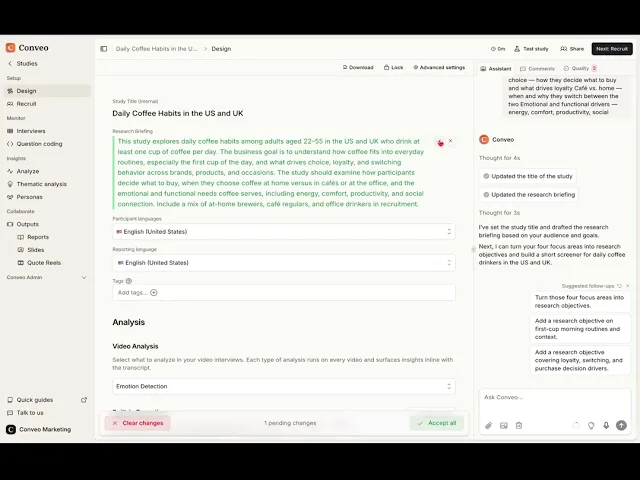
As sessions land, Conveo automatically transcribes, translates, codes, and synthesizes. Every finding remains traceable to the original video clip and verbatim quote, so stakeholders can inspect the evidence rather than accept a summary. For teams running multi-market concept tests, 50+ language support and built-in panel recruitment with screening and fraud detection remove the overhead that typically makes global research a separate project. SOC 2 certification and GDPR-compliant infrastructure give enterprise and European procurement teams a clear path to deployment.
Frequently Asked Questions
What are the most common concept testing methods?
The most common concept testing methods are monadic, sequential monadic, comparative, and protomonadic. In monadic testing, participants evaluate a single concept in isolation. Sequential monadic exposes each participant to multiple concepts in a set order. Comparative testing presents all concepts side by side. Protomonadic combines both: participants evaluate one concept monadically, then see the others for direct comparison. Most teams execute these through surveys, which deliver speed and scale but rarely explain why a concept lands or falls flat. Qualitative concept testing fills that gap, surfacing emotional reactions, usage scenarios, and perceived value.
What is qualitative concept testing?
Qualitative concept testing is the process of validating product ideas, messaging, or packaging through in-depth conversations with target consumers. Where surveys tell you what people chose, qualitative concept testing tells you why: what emotional reactions a concept triggered, how someone imagines using it, what they perceive the value to be, and where their hesitation lives. The tradeoff with traditional approaches is throughput. When moderation and synthesis are done manually, each concept test becomes a scheduling and resource management project. AI-moderated video interviews change that: sessions run asynchronously, so multiple concept tests run in parallel rather than waiting on calendar slots.
How long does concept testing take?
Traditional concept testing timelines run six to twelve weeks through a research agency: one to two weeks for recruitment, one to two weeks for moderation, two to four weeks for transcription and synthesis, and one to two weeks for reporting. By the time findings land, the launch decision has often already been made. AI-moderated concept-testing methods compress this into days. Interviews run asynchronously, transcription and synthesis happen automatically, and stakeholder-ready themes are available without a manual reporting sprint. Teams typically move from brief to structured findings in three to five days.
What is a concept testing example?
Here are a few examples of concept testing, starting with a common product validation scenario. A CPG brand needed to validate new packaging for a snack product before committing to production. The core question: Does the new design communicate health benefits without sacrificing taste appeal? The team ran AI-moderated video interviews with 50 target customers, health-conscious snackers aged 25 to 45. Participants viewed the packaging on-screen, shared initial reactions, and compared the new design to existing packaging, all within days. The key finding: participants responded positively to the health messaging but consistently described the color palette as "too clinical." That pattern was traceable to video clips and verbatim quotes, which built stakeholder confidence in the recommendation to adjust the design before launch.
What is the difference between concept testing and product testing?
Concept testing validates ideas before production commits resources: messaging, packaging, and key features. Product testing validates finished products after production, measuring usability, satisfaction, or performance. Prototype testing and usability testing sit between the two, evaluating a functional build before full production. The timing difference is critical. Concept testing methods run before the decision is made: before manufacturing begins, before a campaign ships. Product testing runs after the money is spent. Concept testing is cheaper to act on precisely because it happens while options are still open.
How do you analyze concept testing data?
Analysis depends on the method. Quantitative concept tests use statistical analysis to measure preference scores, purchase intent, and likelihood to recommend. Qualitative concept tests require thematic synthesis to gain deeper insights from the collected data: transcribing interviews, coding responses by concept element, identifying patterns, and connecting those patterns to the research question. AI-assisted synthesis automates transcription, translation, and initial coding, compressing the time from raw interview to structured themes. Every theme should trace back to specific video clips and verbatim quotes. Stakeholders who can inspect the evidence behind a recommendation are far more likely to act on it.

About the author
Kavya Pillutla
Research Impact Lead
A qual researcher by nature, Kavya spent four and a half years on the Human Insight and Innovation team at PA Consulting, on brand strategy and concept testing. She joined Conveo for the pace of a startup without leaving research, and gets her energy from seeing a study turn into a product on a shelf or an ad on a billboard.
Meet Kavya on film →Qualitative insights at the speed of your business.
Conveo runs AI-moderated video interviews and structures everything they say.