In this article
TL;DR
Concept testing research evaluates whether a product idea, message, or creative concept resonates with real consumers before a team commits significant resources to it. Use it when a decision is irreversible, expensive, or time-sensitive, and when you need to understand not just what your target audience thinks, but why. The core tradeoff between depth and speed has always defined the benefits of concept testing. AI-moderated video interviews now dissolve it, delivering real consumer conversations and actionable insights in days.
Concept testing research has a timing problem that no amount of process improvement has fully solved: by the time results arrive, the decision is usually already made. Teams either commit blindly or delay the product launch, absorbing the cost of a slower timeline. Neither outcome is acceptable when product roadmaps move at a pace of weeks.
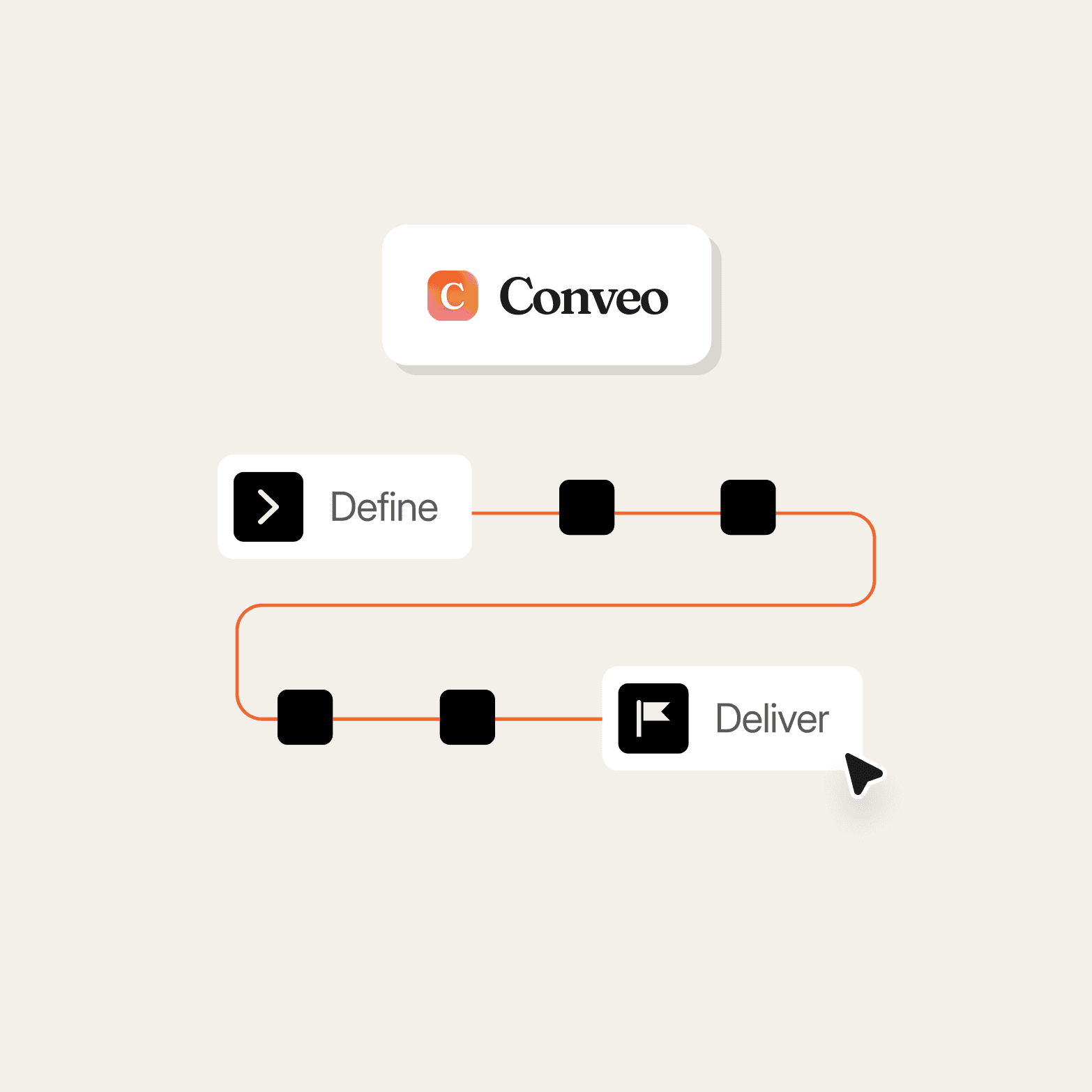
The structural reason is worth naming directly. Traditional concept testing follows a sequential dependency chain: agency briefing, participant recruitment, moderator scheduling, manual transcription, thematic coding, and stakeholder reporting. Each step waits for the previous one to finish. That architecture was designed for a research cadence that no longer aligns with how decisions are made.
What's changing now is more significant than a faster version of the same process. Qualitative research is shedding the constraints that made it slow and hard to defend. Parallel asynchronous interviews mean hundreds of conversations can run simultaneously. AI-assisted synthesis collapses the analysis phase from weeks to hours. Stakeholder-ready findings no longer require a separate reporting layer. The depth that made Qual valuable is no longer in tension with the speed organizations demand.
Surveys deliver scores quickly, but they cannot explain why a concept fails or what needs to change before launch. That gap is where concept test research does its most important work. This guide covers the concept testing methods, methodologies, and workflows that teams use to validate ideas within days without sacrificing qualitative rigor.
What is concept testing research?
Concept testing research is the process of evaluating product ideas, messaging, packaging, or features with target customers before committing resources to production or launch. The goal is to identify which product concepts resonate, understand why they resonate, and surface what needs fixing while there is still room to act. It is distinct from usability testing, which evaluates whether an existing product is easy to operate. Concept testing belongs at the front end of the product development process; usability testing belongs at the end of development. Understanding the distinction avoids scope confusion when planning a study.
Why concept testing research matters for product teams
Across product research literature, 95% of new products fail to meet their performance targets. The benefits of concept testing are most visible at exactly this point: the cost of skipping consumer validation is not hypothetical. It lands on the income statement.
Three risks compound when teams move into the development stage without validating product concepts.
Misaligned positioning
A concept that scores well on internal functional attributes can still fail in-market if it misses the mark on emotional resonance. Consumers buy perceived value, not features.
Wasted production investment
Manufacturing 10,000 units of a package design that potential customers find confusing costs orders of magnitude more than the research to catch it early.
Stakeholder misalignment
Without traceable consumer evidence, internal debates devolve into opinion contests, with cautious team members pulling in different directions instead of acting on what real target customers actually said.
The speed problem compounds all three. Marketing campaigns and product roadmaps now move faster than traditional research was designed to support. That research was built around a sequential dependency chain where each step cannot begin until the previous one finishes. This is a structural constraint, not a team execution failure. Concept testing and UX research integrated into sprint cycles demand a different architecture, one where steps run in parallel and outputs arrive within days.
Concept testing methods: Qualitative, quantitative, and hybrid
Teams choose between qualitative interviews, quantitative surveys, or hybrid approaches based on three factors: time, risk, and the level of stakeholder confidence required.
Qualitative concept testing
Qualitative concept testing, through depth interviews or focus groups, explores why target customers respond to a product concept the way they do. Strengths: adaptive follow-up questions surface emotional drivers and usage context that surveys miss; video and verbatim capture provide traceable evidence that development teams can review directly. Limitations: traditional qual requires moderator scheduling, manual transcription, and thematic coding, which can slow the delivery of actionable feedback when the product development process demands fast decisions.
Quantitative concept testing
Quantitative concept testing uses a survey fielded at scale to participants to measure concept appeal, purchase intent, and feature preference. Strengths: fast fielding, statistical significance, clear benchmarks for go/no-go decisions. Limitations: quantitative data tells you what survey respondents said, not why. Open-ended survey components can gesture toward an explanation, but without adaptive probing, they rarely surface the specific friction that tells a team how to fix what is not working.
Hybrid approaches
The hybrid concept testing strategy pairs qualitative depth with quantitative scale: depth interviews surface the themes and tensions that matter; a concept testing survey confirms which patterns hold at volume across a broader customer base. The operational challenge is that running qual first, then quant, doubles the timeline. When AI-moderated video interviews operate asynchronously, both streams can run in parallel, delivering collected data within the same window that a sequential design would need for one. That compression is what makes hybrid concept-test market research viable within a product roadmap, not just alongside it.
4 concept testing methodologies
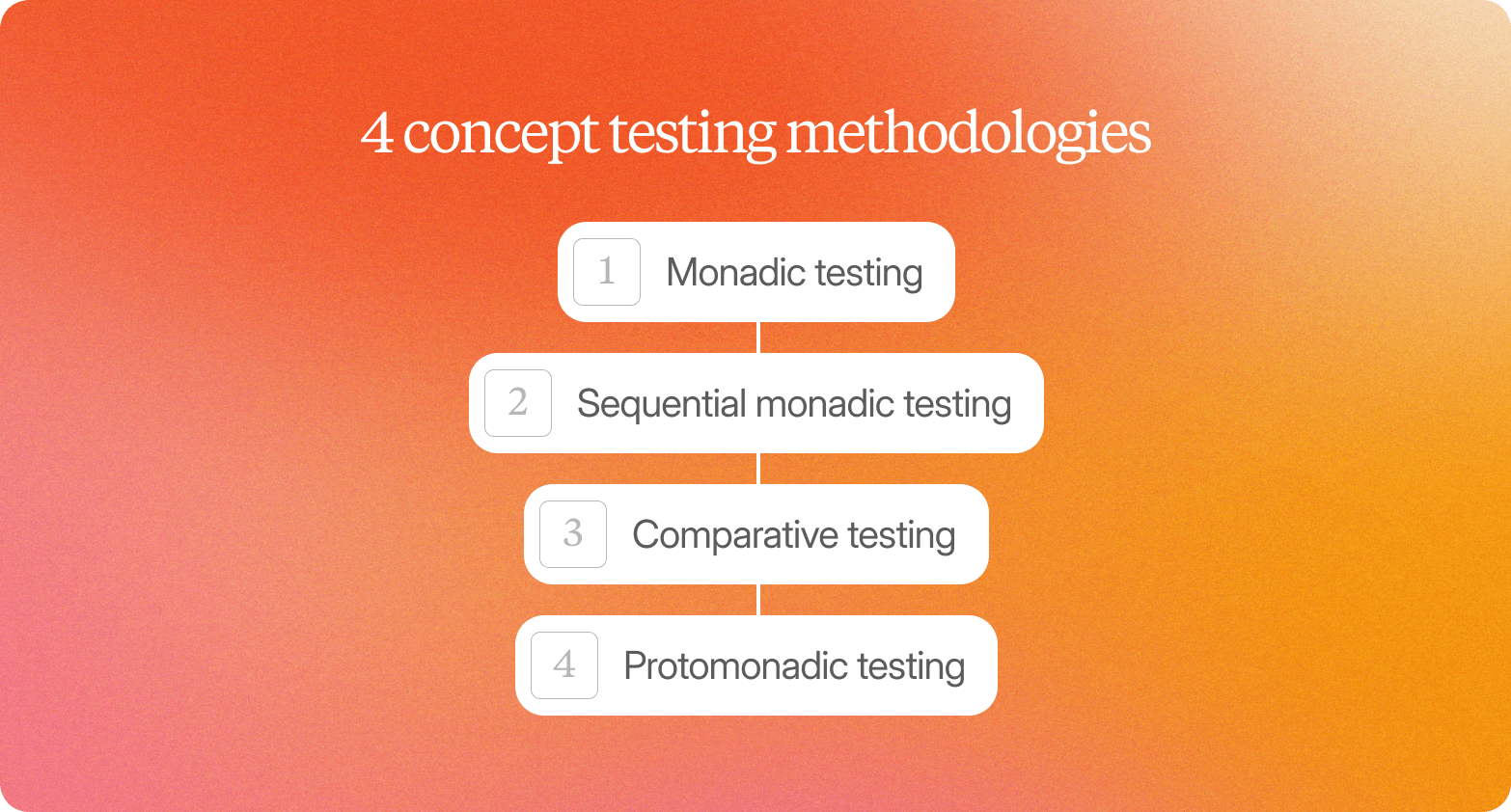
These four methodologies define how survey participants and interview respondents are exposed to stimuli across the concept testing process.
Monadic testing
Exposes each participant to only one concept in isolation. Reactions to a single concept are uncontaminated because there is nothing to compare against. Best for early-stage exploratory work.
Sequential monadic testing
Shows each participant multiple concepts one after another, in randomized order. Balances depth with efficiency. The same survey participants evaluate all concepts, reducing sample size requirements. Most practical when teams need to compare multiple concepts with a constrained participant pool.
Comparative testing
Presents multiple concepts side by side simultaneously. Efficient for identifying the most promising concept quickly. The tradeoff: participants focus on obvious differences rather than exploring any single concept in depth.
Protomonadic testing
Combines both: participants first evaluate each concept individually, then compare them directly. Most thorough, but most time-intensive.
One consideration that cuts across all four methodologies: static survey-based concept testing applies the same follow-up questions to every survey respondent, regardless of their response. Conveo's AI-moderated video interviews adapt in real time, probing based on what each participant actually expresses rather than following a rigid script. That adaptive layer adds qualitative depth that a choice of methodology alone cannot produce.
How to run concept testing research: A 6-step workflow
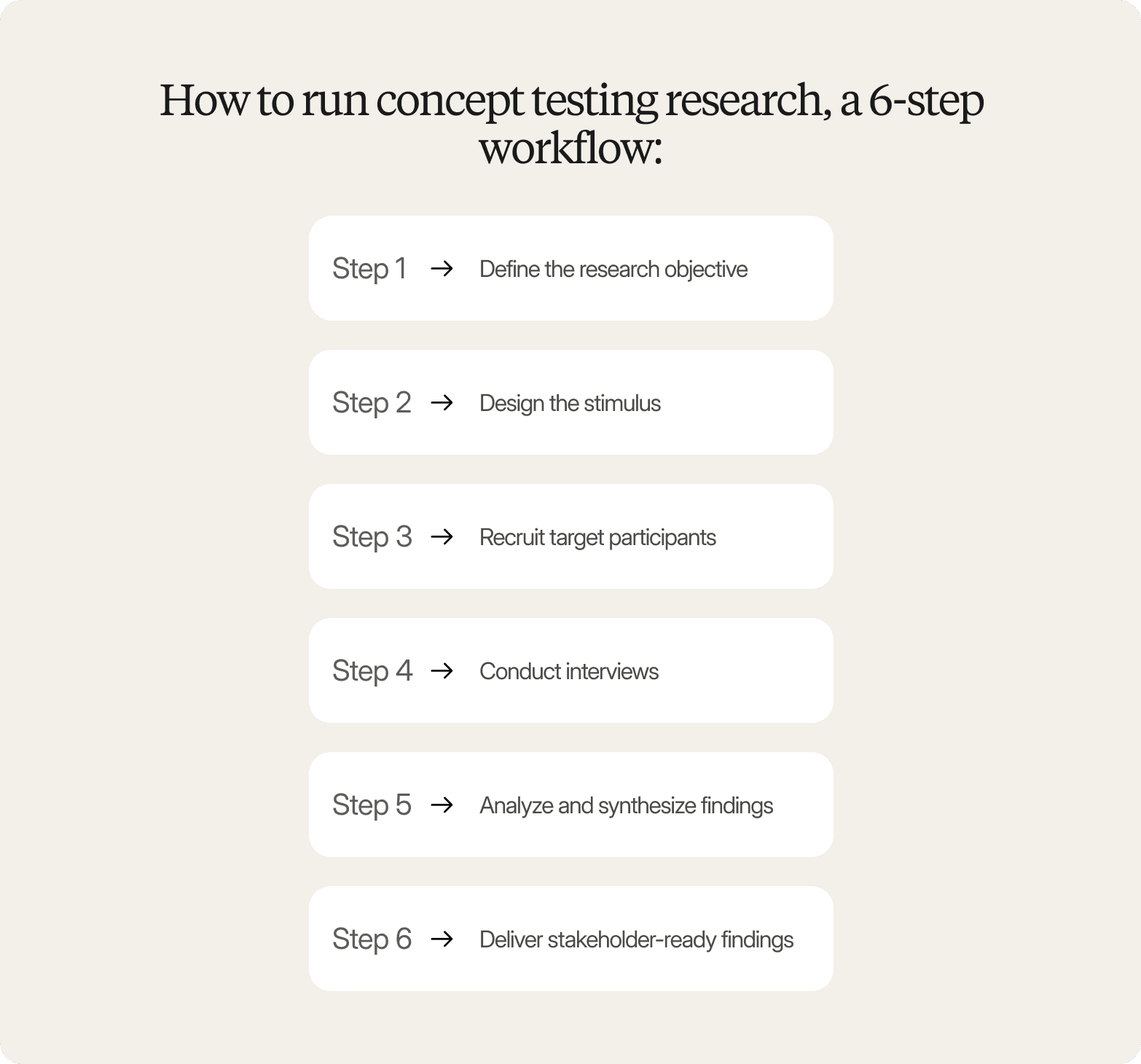
Step 1: Define the research objective
Start with a single, answerable decision: are you testing whether to proceed, which direction to iterate, or which concept to prioritize? Vague objectives produce vague findings. "Get feedback on the new packaging" leaves analysis open to interpretation. "Determine which of three packaging designs best communicates premium quality to women aged 25–40" gives the study a clear pass/fail criterion before a single interview runs. In AI-moderated research, the study objective also shapes the interview guide: the sharper the objective, the more precisely the AI interviewer can probe when a participant's response opens an unexpected line of inquiry.
Step 2: Design the stimulus
Stimulus format shapes what you learn. An effective concept testing setup handles the full range: packaging mockups, storyboards, prototypes, video ads, feature demos, and design concepts. Show concepts in realistic usage contexts (packaging on a shelf, an ad in a social feed) rather than isolated on white backgrounds.
For early-stage product ideas, the most common format is a verbal concept structured around three components: the insight (the consumer need in the customer's own words), the benefit (the product's promise), and the reason to believe (evidence the consumer will receive that benefit). A concept that leads with the benefit before establishing the insight often produces unreliable feedback. Participants are reacting to a solution before they've agreed there's a problem.
Step 3: Recruit target participants
Define participant criteria before opening a single screener: demographic fit, category involvement, and behavioral qualifiers that confirm the person has a genuine stake in the concept. "Purchased skincare in the last 30 days" filters more precisely than age and gender alone, producing more reliable feedback from the right target market.
Sample size guidance: 15–30 interviews for exploratory concept tests; 50–100 for validation with thematic saturation across your full customer base.
Conveo's built-in recruitment handles fraud filtering and incentive management inside the same workflow where the discussion guide lives, removing the operational overhead that typically delays fielding by days.
Step 4: Conduct interviews
Traditional moderation requires scheduling sessions one by one. By the time 20 sessions are complete, a week has passed before analysis can begin.
Conveo's AI interviewer runs asynchronously. Participants receive a link and complete the interview on their own schedule. The AI probes based on what each participant actually says rather than following a rigid script. When a participant describes a concept as feeling premium, the AI follows up: "You mentioned it feels premium. What specifically gives you that impression?" That depth of probing is what separates concept testing research and analysis built on real conversational depth from the surface-level user feedback a fixed question set produces. Because sessions run in parallel, 100 conversations can be completed in the same window that traditional scheduling allows for 10.
See it in action: How to build and launch a study in Conveo →
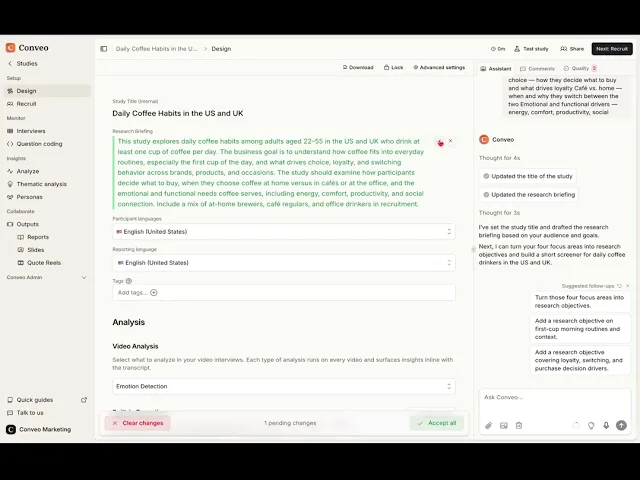
Step 5: Analyze and synthesize findings
Analysis is where concept testing projects most often stall. Transcription, thematic coding, sentiment tagging, quote extraction, and video clip curation are each necessary. When done manually, they consume days before any interpretation begins.
Conveo handles the processing layer so the research team can focus on meaning-making. As sessions complete, the platform transcribes recordings, applies thematic coding, and surfaces sentiment patterns to help teams identify patterns across the full participant set. What would take a week of manual transcript review can be compressed to hours. Every theme links back to verbatim quotes and timestamped video clips, making findings traceable for stakeholder scrutiny.
Step 6: Deliver stakeholder-ready findings
Most concept tests don't fail at the research stage. They fail at the handoff. A 40-slide deck lands in a stakeholder's inbox, and findings get reinterpreted, summarized differently across development teams, and acted on inconsistently.
Conveo's highlight reels surface the moments that matter: a participant's hesitation at a price point, the exact words a shopper uses to describe what's missing. Themed summaries organize findings by concept dimension (appeal, relevance, perceived value), so teams move from actionable insights to decision-making without rebuilding the analysis themselves. Exportable reports give stakeholders something they can search, share, and cite.
Concept testing questions: What to ask and why
Poorly designed concept-testing questions elicit superficial reactions rather than the emotional drivers, usage contexts, and customer preferences that make findings actionable.
Initial reaction questions
Capture unfiltered first impressions before rational justification sets in. Examples: "What's your first reaction to this concept?" / "What stands out most to you?" Initial reactions reveal emotional resonance that later questions may rationalize away. In Conveo's AI-moderated interviews, these questions also capture nonverbal signals (such as hesitation before answering or a shift in tone) that a text-based concept-testing survey cannot detect.
Depth and context questions
Uncover why consumers react the way they do and how the concept fits their lives. Examples: "You mentioned it feels premium. What specifically gives you that impression?" / "Walk me through how you'd use this in your daily routine." Conveo's AI interviewer generates contextual follow-up questions based on each participant's actual response rather than advancing through a fixed script, making depth questions genuinely scalable across hundreds of sessions to gather insights at volume.
Comparative and preference questions
Understand how the concept stacks up against alternatives and what would strengthen it. Examples: "How does this compare to what you currently use?" / "What would make this concept more appealing to you?" These questions surface actionable feedback and specific fixes rather than vague dissatisfaction, giving teams the ranked signal needed to prioritize the next iteration in an iterative process.
Bias avoidance
Avoid leading questions: "What makes this concept appealing?" assumes appeal before the participant has expressed any. Use neutral framing: "What is your reaction to this concept?" For survey-based concept tests, limit question sets to 8–12 items to prevent fatigue and response degradation. AI-moderated interviews handle this differently: adaptive probing follows each participant's actual responses, so depth increases without the fatigue risk of a fixed question list.
Concept testing examples across industries
CPG packaging redesign
A beverage brand needed to determine which of three label redesigns read as genuinely "natural" to health-conscious buyers aged 25–45 before committing to production tooling. Packaging mockups were shown in a realistic shelf context. Design A's earth-tone palette consistently read as natural, but the AI interviewer's follow-up questions surfaced a problem surveys would have missed: participants liked the look but doubted the brand's transparency because the ingredient font was too small to read without picking up the bottle. That finding, surfaced from the customer's perspective in their own words, would not have appeared in concept testing survey data. Decision: carry Design A's palette with Design B's larger ingredient callout before tooling.
SaaS feature validation
Thirty product managers walked through an interactive prototype of an AI-powered task prioritization feature. The concept landed well (users understood its value immediately), but a recurring concern emerged that quantitative data would be buried by an average score. Participants didn't want the AI to make decisions for them. They wanted it to surface recommendations they could accept or ignore. That distinction, "suggest, don't decide," only emerged because the AI interviewer probed what users actually meant when they said they were "a bit uncomfortable" with automatic reordering. The development team redesigned the feature as an advisory layer before the product launch, a change that would have required a full rebuild post-launch without this user feedback.
How Conveo compresses the concept testing timeline
The problem this article has traced is not a technology gap. It is a timing gap. Concept decisions have deadlines. Traditional research has timelines. When those two realities collide, teams either delay the decision, commission research and ignore the results, or skip validation entirely and absorb the downstream risk.
Conveo is a video-first AI research platform that closes that gap by running asynchronous AI-moderated video interviews in parallel. Whether conducting concept testing across hundreds of conversations, sessions run simultaneously on participants' own schedules, across markets and languages. Calendar time stops being the constraint.
"We ran a concept test for a new product line; in one night, we had 200 interviews analyzed."
CMI Manager, Edgard & Cooper
The Conveo platform handles the full concept testing process lifecycle: built-in recruitment with fraud filtering, AI-moderated adaptive interviewing, AI-assisted transcription and thematic synthesis, and stakeholder-ready findings: highlight reels, themed summaries, exportable reports. The research team focuses on interpretation and communication. The platform handles the processing.
The credibility advantage matters as much as the speed advantage. Video clips and verbatim quotes tied to each insight make findings traceable. Real participants, not avatars or synthetic responses, address stakeholder skepticism about AI-generated research. This distinction matters for enterprise procurement teams: real participant data is the foundation of launching successful products, not a proxy for it.
For global enterprise teams, compliance infrastructure is a procurement requirement. Conveo is SOC 2 certified, GDPR-compliant, with EU regional data hosting, a meaningful consideration when conducting concept testing across European markets. Hundreds of enterprise teams, including Google, FOX, and Bosch, rely on Conveo for their concept testing infrastructure.
Frequently Asked Questions
What is the difference between concept testing and usability testing?
Concept testing research evaluates whether an idea resonates with a target audience before it is built. Usability testing evaluates whether a built product is easy for users to operate. Concept testing belongs at the front end of the product development process: it validates ideas and gathers feedback before significant resources are committed. Usability testing belongs after development: it identifies friction in how people interact with what already exists. UX researchers and product managers use both, and the key is knowing which question you are trying to answer at each stage.
Can AI-moderated interviews replace traditional concept testing focus groups?
For most concept-testing use cases (understanding individual reactions, emotional drivers, and usage context), AI-moderated video interviews deliver comparable depth while offering greater operational efficiency. They run asynchronously, scale to hundreds of sessions in parallel, and produce consistent follow-up questions across every participant. They are not appropriate where group discussion itself is the research stimulus. Traditional focus groups remain the right format when the dynamic interaction between participants is what you're studying, not individual reactions to a new concept.
How many participants do you need for concept testing research?
For exploratory concept tests, 15–30 interviews are the right range. For validation studies that require thematic saturation across segments, target 50–100 completed sessions. In qualitative concept testing, the goal is thematic saturation rather than statistical significance: new themes stop emerging once a sufficient number of conversations have been conducted, regardless of the total sample size. For quantitative validation through a concept-testing survey, 200–500 respondents typically yield statistically significant results. The right number depends on how many audience segments you need to understand and how much variation you expect across them.
How long does concept testing take?
Traditional concept testing, run through a research agency, typically takes four to eight weeks from brief to debrief. The timeline is driven by the sequential dependency chain: each step (recruiting, scheduling, moderating, transcribing, coding, reporting) cannot begin until the previous one finishes. AI-moderated asynchronous interviews compress that significantly. With built-in recruitment, sessions running in parallel, and AI-assisted synthesis, a concept test with 50 or more completed interviews can move from study setup to stakeholder-ready findings in two to five days. The decision window determines which model is viable.
How do you measure success in concept testing research?
A well-executed concept test produces both qualitative and quantitative indicators. Qualitative indicators include thematic saturation, consistency of reactions across participants, and clarity of actionable direction: can the team leave the research knowing what to do next? Quantitative benchmarks include concept appeal scores, purchase intent scores, and feature preference rankings from survey respondents. The most useful concept tests combine both: scores support data-driven decisions at the go/no-go stage; interview depth provides the iteration guidance that tells development teams specifically what to fix and why.

About the author
Florian Hendrickx
Head of Growth
Florian is Conveo’s Chief Growth Officer, leading growth strategy and go-to-market execution as the company scales. He’s held growth leadership roles at companies like Deliverect, Robovision, and Aikido Security, and brings hands-on experience across marketing, sales, and product.
More by Florian →Qualitative insights at the speed of your business.
Conveo runs AI-moderated video interviews and structures everything they say.