In this article
TL;DR
A purchase-intent score tells you where a concept lands. Knowing what to change before the launch decision closes takes a different kind of evidence.
By the time a low score is explained, the launch decision has often already moved on without the evidence it needed: the lag is the real cost, and it shows up in decisions made without evidence
Async AI-moderated video interviews close the gap: voice, video, and tone capture the specific value gaps a score alone can't surface
The rigor comes first: every finding traces back to a real participant, on video, so stakeholders can check the source instead of trusting a summary
Running large volumes of conversations in parallel removes the one-moderator-one-session ceiling that made this depth impractical at scale, and creates more testing opportunities within the same budget
Apply this framework to get from raw consumer reaction to a decision-ready brief while the launch window is still open
What Consumer Product Testing Misses, and Why It Costs More Than Time
A product decision doesn't wait for the research to catch up. Packaging goes to print, creative goes into production, and a launch date holds regardless of whether the evidence behind it is any good. When product testing only returns a purchase-intent number, the decision closes without the "why" attached, and there's no way to go back and get it once the moment has passed.
Consumer product testing is the structured process of gathering real consumer feedback on a product, concept, packaging, or formulation before the decision is locked in. It sits alongside broader market research as one of the more diagnostic tools available to insights teams. When done well, it explains not just what consumers prefer but why, and what would need to change for them to choose differently.
Most programs stop at the first half. A rating of 6.2 out of 10 arrives, a concept gets ranked, and the team moves forward without the mechanism behind the number.
Online survey tools and other survey-only testing can't probe hesitation, follow a contradiction, or ask why someone's tone shifted when they read the price. AI-moderated interviews, asynchronous, video-based conversations where an AI moderator adapts its follow-up questions to what a participant actually says, close that gap without requiring a live moderator for every session. Traditional qualitative testing run by a market research company can close the same gap methodologically, but the tradeoff has historically been weeks of sequential scheduling between brief and findings, which is exactly the lag a launch decision can't always absorb.
Consumer Product Testing Methods: IHUT, CLT, Lab Testing, and AI-Moderated Interviews
| Method | Speed | Rigor | Cost | Claim support | Insight depth |
|---|---|---|---|---|---|
| IHUT | Slow (weeks, with logistics) | High for real-world usage | Medium to high | Strong for longitudinal and efficacy claims | Deep: captures repeat-use behavior across occasions |
| CLT | Moderate (weeks) | High for controlled sensory comparison, typically conducted on site at a facility | Medium | Strong for first-impression and comparative claims | Moderate: single-session, no longitudinal read |
| Lab testing | Variable (weeks to months) | Highest for safety and technical performance | High | Strongest for regulatory and safety claims | Low on the "why": no consumer voice |
| AI-moderated interviews | Fast (days rather than weeks) | High: built on real participants, traceable video, adaptive probing | Real cost savings in some cases, secondary to what it makes possible | Strong for concept, usage, and attitude claims; pairs with IHUT for the qualitative layer | Deepest on the "why": adaptive probing follows what participants actually say, producing responses 3 to 4x longer than static surveys |
Each method serves a distinct decision. CLT fits first-impression and side-by-side comparisons under controlled conditions. In-home usage testing captures how a product performs across real occasions over time, which static surveys and single-session qualitative research can't replicate. Lab testing answers safety, formulation, and product quality questions no consumer method can, which is why almost every manufacturing company still pairs it with lab data before validating a product's performance claims. AI-moderated interviews fill the gap the other three leave open: the explained "why" behind preference, gathered at a volume a one-moderator-one-session model can't reach.
The most defensible programs combine methods rather than choose between them, and most enterprise companies running ongoing market research studies use more than one in parallel. AI-moderated interviews work alongside IHUT to add the qualitative layer that self-reported surveys miss, or alongside CLT to probe the reasoning behind sensory reactions before findings are included in a stakeholder deck.
In-Home Usage Testing (IHUT): An End-to-End Execution Playbook
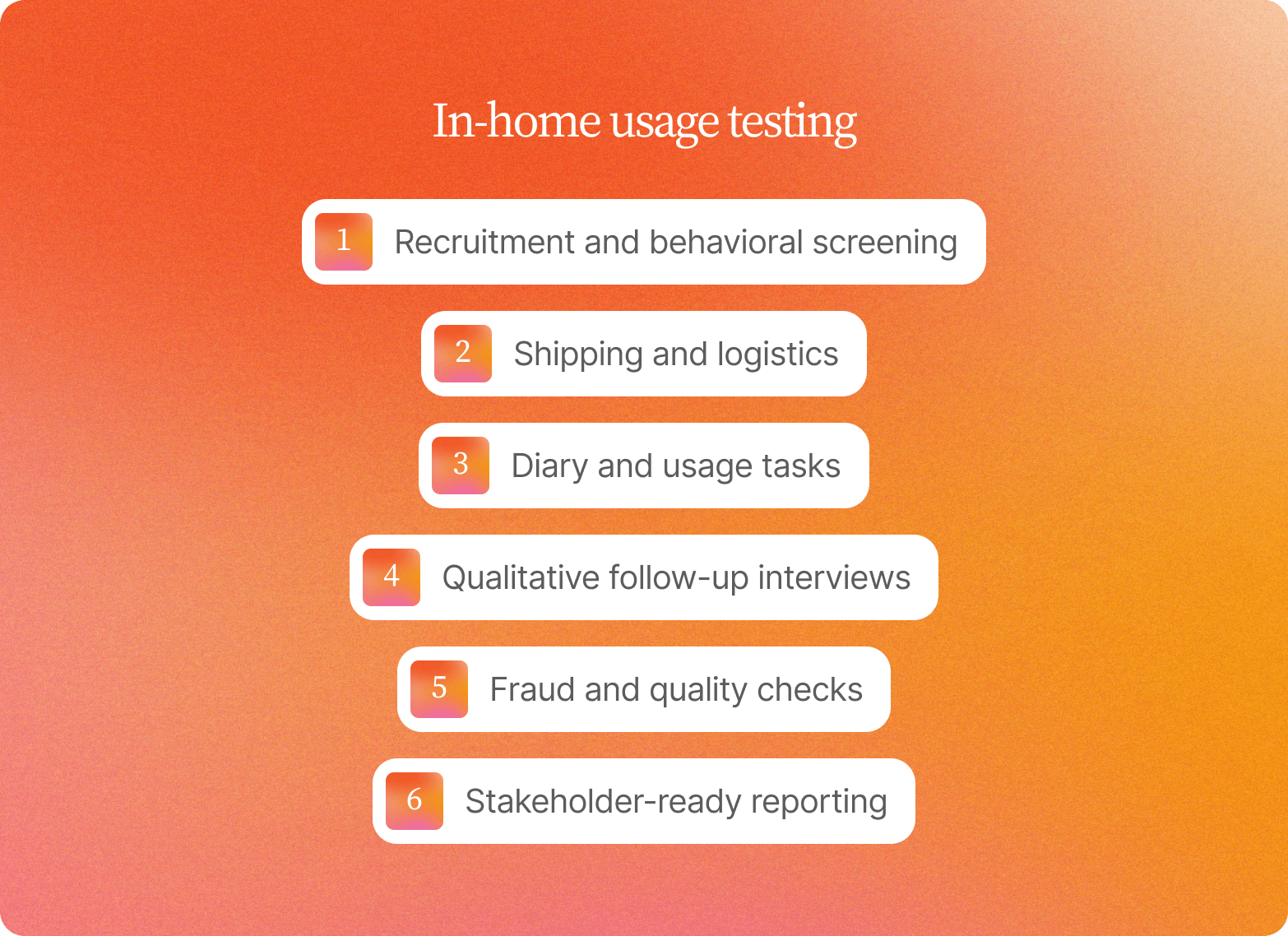
A sound IHUT methodology, or home product testing program, runs in six connected stages, and the quality of each one determines whether the findings hold up in a stakeholder meeting.
Recruitment and behavioral screening
IHUT research starts before the product ships. Recruit through integrated panel partners or your own list via CSV, QR code, or WhatsApp, then apply a recruitment screener rather than a demographic filter alone, with clear objectives and study requirements defined up front. Screeners that test actual shopping habits and usage habits, going beyond claimed ones, filter out participants who won't engage authentically with the product and help identify the right participants for a given study.
Shipping and logistics
Coordinate product dispatch with the study launch so that participants receive materials and task instructions together, along with a short thank-you note confirming what to expect next. Build in confirmation touchpoints: a delivery acknowledgment and a brief orientation task establish engagement before the diary period begins.
Diary and usage tasks
Structure diary prompts around specific moments of use rather than open-ended reflection. Timestamped video diary entries, captured through a mobile-accessible link, produce behavioral evidence static surveys can't. Participants report what they actually did, which often differs from what they think they should have done, providing researchers with detailed feedback rather than a single satisfaction score.
Qualitative follow-up interviews
Once the diary data is in, AI-moderated follow-up interviews probe the moments that matter: hesitation, unexpected use cases, and the language participants naturally reach for. Because sessions run asynchronously, follow-up can scale across a large home-use-test sample without extending the timeline of the wider IHUT project.
Fraud and quality checks
Behavioral screeners, video review, and participation monitoring flag low-effort or inconsistent entries before analysis begins, ensuring that the product testers included in the final sample provide honest feedback rather than scripted answers. Every insight links back to a real person who said it, with verbatim quotes and timestamped video clips a stakeholder can check directly.
Stakeholder-ready reporting
Thematic synthesis, sentiment arcs, and highlight reels translate raw in-home data into findings a brand, innovation, or regulatory team can act on without a research translation layer, and turn scattered consumer feedback into valuable insights the business can actually use. The output reads less like a raw product review and more like a decision brief, with the benefits of each finding tied directly to the launch call it informs.
Teams that run this kind of program well tend to treat it less as a one-off vendor engagement and more as an internal capability: an ongoing set of testing services the insights function owns, rather than something re-briefed from scratch with every new product or packaging update. The participants who choose to participate in each wave build a usage history that makes every subsequent study faster to field.
Remote Product Testing: Where Video-First, AI-Moderated Interviews Fit
Remote product testing has a structural problem: one moderator, one session, one participant at a time. That ceiling compresses fieldwork into weeks of sequential scheduling, and what comes back often reflects only what people rated, while the reasons behind their behavior remain out of view.
Rigor is what makes the alternative trustworthy; speed only matters once the evidence holds. Every session runs with real product testers on video, so an adaptive AI moderator can follow up on what someone actually says rather than a fixed script. When a participant calls a feature "too expensive" or trails off mid-sentence, Conveo's AI moderator probes that specific moment, surfacing the value gap or credibility issue driving the reaction. Multimodal analysis across voice, tone, and facial cues captures what text responses miss: confusion, flat enthusiasm, price discomfort visible before the participant has words for it. Stakeholders can audit every finding against timestamped video and verbatim quotes rather than accept a summary.
That same design is what makes the scale possible: fielding runs in parallel across a large participant base, in 50+ languages, across any target market a brand operates in, so teams reach decision-ready findings while the decision window is still open.
Multi-Market Product Testing Without the Localization Bottleneck
Running IHUT programs across multiple markets traditionally requires coordinating physical distribution, recruiting local moderators, and managing sequential translation and analysis, extending timelines by 4 to 8 weeks per additional market.
Conveo runs multi-market consumer product testing in 50+ languages with automated transcription and translation, removing weeks of localization delays. Teams, including manufacturers running product introduction plans across several countries, can run multiple packaging or product variations in parallel across markets and compare consumer product trials in one target market against another without extending timelines beyond the typical 2 to 3 weeks of agency packaging research per variant.
4 Best Practices for Consumer Product Testing That Actually Drive Product Decisions
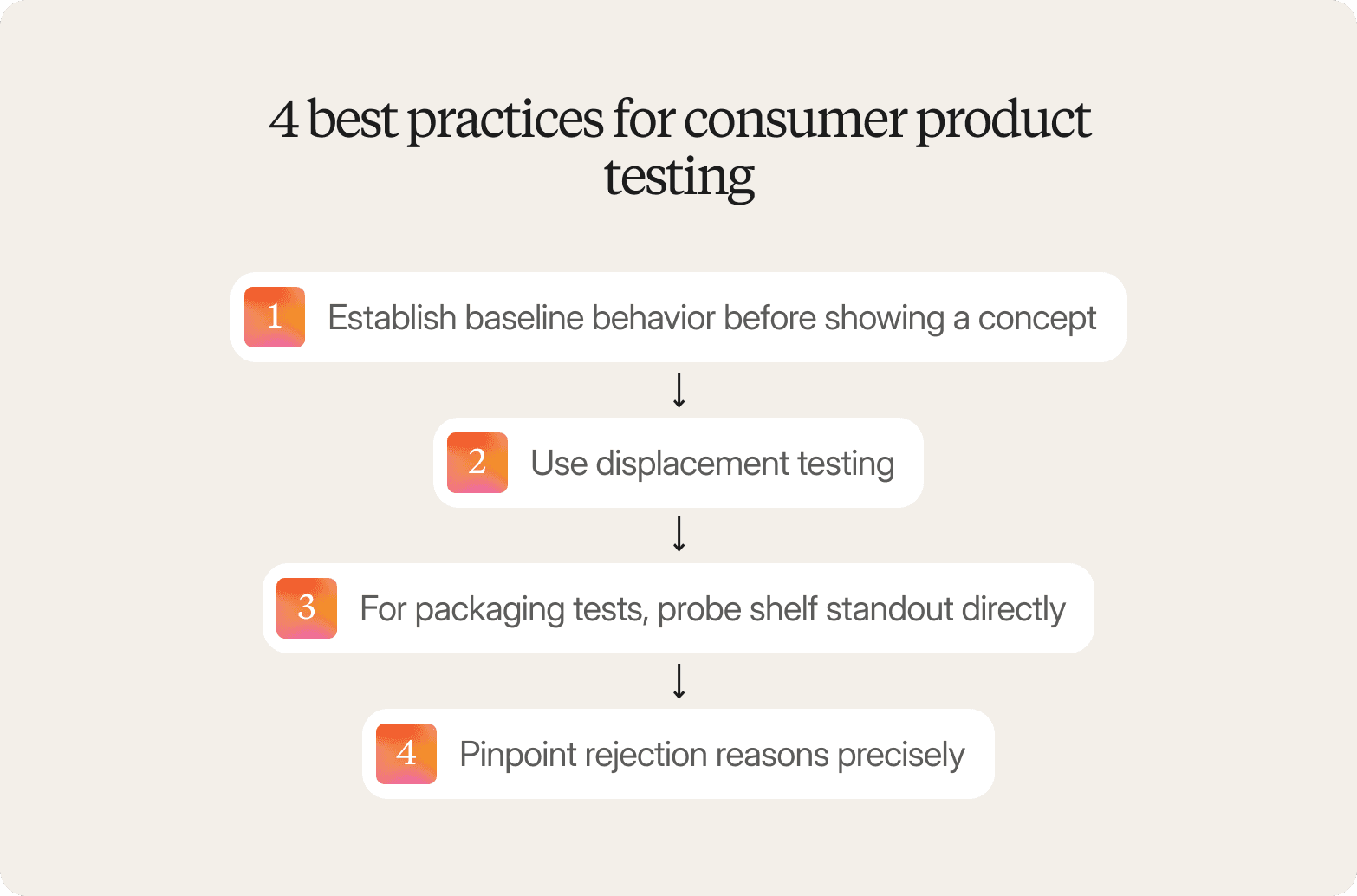
Teams that test products the right way rarely fail because of methodology. Most product tests fail because they measure the wrong thing: likeability instead of switching barriers, novelty interest instead of true adoption intent. The fix is a sharper focus on the question itself; sample size rarely solves it.
1. Establish baseline behavior before showing a concept
Ask "what do you use now, what works, what doesn't" to measure real switching barriers rather than a reaction to something new and unfamiliar.
2. Use displacement testing
Ask "what would you stop using to make room for this" to separate novelty interest from true adoption intent, and to reveal actual shopping habits rather than stated preference.
3. For packaging tests, probe shelf standout directly
Ask "which would you reach for next to [competitor] and why" to diagnose shelf standout rather than likeability alone.
4. Pinpoint rejection reasons precisely
Ask, "Is there anything that would make you put it back on the shelf?" to identify the exact design element or product quality issue causing rejection, and turn that into a specific improvement rather than a vague callout.
Adaptive probing follows what a participant just said (for example, "too expensive" or "interesting") to surface the specific value gap or credibility issue driving rejection, producing more detailed feedback than a fixed questionnaire ever could.
Watch an AI-moderated interview run start to finish
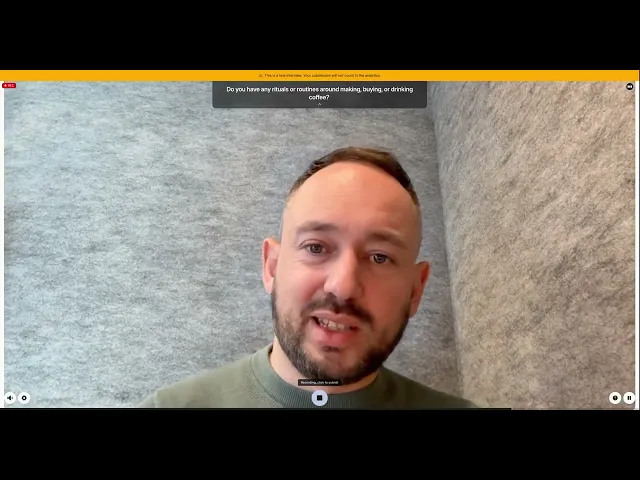
How AI-Moderated Video Interviews Close the Gap Before the Decision Window Shuts
The real cost of traditional fieldwork shows up in the decision itself. Packaging, creative, and launch calls close while the evidence is still in the field, so the findings land against a decision that has already been made.
Async AI-moderated video interviews run in parallel across hundreds of consumers, removing the one-moderator-one-session ceiling that can stretch traditional IHUT fieldwork to 6 to 12 weeks. That parallelism is what keeps findings inside the decision window rather than behind it.
Conveo captures voice, video, and tone so teams can see confusion, flat enthusiasm, and price discomfort that text responses don't reveal, making every insight traceable to timestamped video clips and verbatim quotes stakeholders can audit. Teams at JDE Peet's report reaching insights within days that a traditional agency would take about a month to produce.
One CPG team conducted 200 AI-moderated consumer interviews in a single night, using automated analysis to accelerate concept decisions, a scale that would be out of reach for most traditional market research studies run session by session.
Procurement and Compliance: What Enterprise Teams Need to Clear Legal and Security Review
Enterprise companies can clear procurement faster on evidence they can inspect. Conveo is SOC 2 Type II certified, GDPR compliant, EU hosting (Belgium). Every insight links back to timestamped video clips and verbatim quotes so stakeholders can audit the evidence behind a claim and sign off with confidence, turning review meetings from opinion contests into evidence-based decisions across industry and category.
Why Traceable Evidence Wins the Room
The rigor comes first: Conveo is built by researchers, and every finding traces back to a real participant, on video, so a stakeholder can check the source rather than trust a summary. That traceability is what makes the speed usable: a fast answer only helps a launch decision if the team can defend it in the room afterward.
The same design compounds:
Depth that holds up under questioning. Adaptive AI-moderated probing follows what a participant actually says rather than a fixed script, producing responses 3 to 4x longer than static surveys and surfacing the specific "why" a score alone can't. That depth is genuinely helpful across categories from personal care to household cleaner products, and across enterprise companies and CPG manufacturers alike.
Governance that clears procurement. Conveo is SOC 2 Type II certified, GDPR compliant, and EU hosting (Belgium), which clears the governance bar most enterprise procurement processes set before findings inform a launch call.
Scale without the wait. Because fielding runs in parallel rather than one session at a time, teams can test more concepts, more packaging variants, and more markets within the same window that an agency-led study would need for one, creating comprehensive coverage without a comprehensive budget increase.
IHUT, CLT, and lab testing each stay the right tool for the decisions they were built for. AI-moderated interviews close the specific gap those methods leave open: the explained reason behind a reaction, available while the decision is still open to change, so teams can act on it with confidence and drive product success.
Frequently Asked Questions
Can we trust AI analysis for product decisions that affect launch timelines and budgets?
Yes. Teams at Google, Unilever, AB InBev, Kellanova, and General Mills rely on Conveo for decisions at exactly that level of stakes. Every finding traces back to a real participant, with verbatim quotes and video, so stakeholders can verify the source rather than accept a summary. Conveo is SOC 2 Type II certified, GDPR compliant, EU hosting (Belgium), which satisfies the governance requirements most enterprise procurement processes require before findings inform a launch call.
Will AI provide the same depth as human moderators for product testing?
AI moderation extends adaptive probing across a large volume of simultaneous conversations in a way that a single human moderator can't match, session after session. Conveo's AI moderator follows what each participant actually says rather than advancing through a fixed script, resulting in responses 3 to 4x longer than those in static surveys. Human judgment remains essential for study design, hypothesis framing, and interpreting findings in the business context; that work stays with the researcher, and the AI frees up more time to spend on it.
How many participants can a single product testing study realistically include?
Because sessions run asynchronously and in parallel, a study can involve 10 to 1,000 conversations simultaneously, depending on the decision at stake, without adding to the fieldwork timeline. That range is what makes it practical to test multiple packaging variants or markets in the same window a single-session study would need, giving research teams the ability to scale a study up or down as objectives change.
Does AI-moderated testing replace the need for an agency-run study?
Not necessarily. Many teams run AI-moderated interviews alongside agency-led IHUT or CLT work rather than instead of it, using the faster method to get a directional read while the launch window is still open, and reserving agency-run studies, including those from a traditional market research company, for claims that need that specific rigor, like longitudinal efficacy or regulatory support. The two work as complementary options, and agencies typically brief their own clients on which method best fits each decision.
What happens if a participant gives a low-effort or inconsistent response?
Behavioral screeners, video review, and participation monitoring flag low-effort or inconsistent entries before they reach the analysis stage. Because every response is tied to a real participant on video, a researcher can check the source directly and confirm the feedback is genuine, rather than rely on a flagged-and-discarded system with no visibility into why a response looked off.

About the author
Meg Gerli
Research Impact Lead
Meg studied at Stanford and spent six and a half years on the insights and research team at Nike before joining Conveo. She scopes studies with US enterprise teams: sample sizes, panel feasibility, and the trade-off between depth and speed, with the reasoning behind every recommendation.
Meet Meg on film →Qualitative insights at the speed of your business.
Conveo runs AI-moderated video interviews and structures everything they say.