In this article
TL;DR
Finding participants for user research is time-consuming when panels filter by demographics rather than behavior
60-80% of participants typically don't match study behavioral criteria, triggering re-recruitment cycles that add weeks to the research process
The fix is screening for specific product behaviors upfront, before a single research session is scheduled
This guide covers the five core recruitment methods, behavioral screening approaches, fraud controls, and the infrastructure that compresses recruitment from weeks to days
Knowing how to recruit users for user research sounds straightforward until you're three days from kickoff and your research panel is full of people who match the demographic brief but have never actually used the product category you're researching.
That's the core failure mode. Most recruitment methods filter by age, location, income, and job title. Almost none filter by behavior. They can't tell you whether a participant switched mobile banking apps in the last 90 days, tried a new CPG format for the first time in the past quarter, uses a project management platform daily versus occasionally, or abandoned an onboarding flow more than once in the past month.
The result: teams screen participants manually after recruitment and find that 60-80% don't qualify. That triggers re-recruitment cycles that add one to three weeks to timelines already tight against sprint deadlines. For any team conducting research on a sprint schedule, that gap between research goals and reality is the bottleneck that kills continuous discovery. Proven strategies exist to close it, but most teams are still running the research process the slow way.
Why Most User Research Recruitment Fails
The gap between demographic profiles and behavioral fit shows up fast. A team recruiting "active mobile banking users" fills their list with people who only check balances. Nobody has ever initiated a transfer or navigated the feature the team is actually researching.
The root cause: panels segment by who people are, not what they've done. Product usage patterns and feature adoption sequences are rarely captured in panel databases, and even more rarely surfaced as filterable criteria. When teams try to close that gap with screener questions, they hit a secondary problem: self-reported behavior is unreliable. Participants select the answers that qualify them, not the answers that are accurate.
Screeners that collect only demographic information miss the behavioral signals that matter. A participant who matches your target audience on paper, but who hasn't experienced the pain points your product solves, can't provide the background information your research needs. Their responses don't reflect real users' experiences, which means the findings fail to meet the research objectives and lead product decisions in the wrong direction. Real users who can provide valuable insights about actual behavior are the only participants worth recruiting.
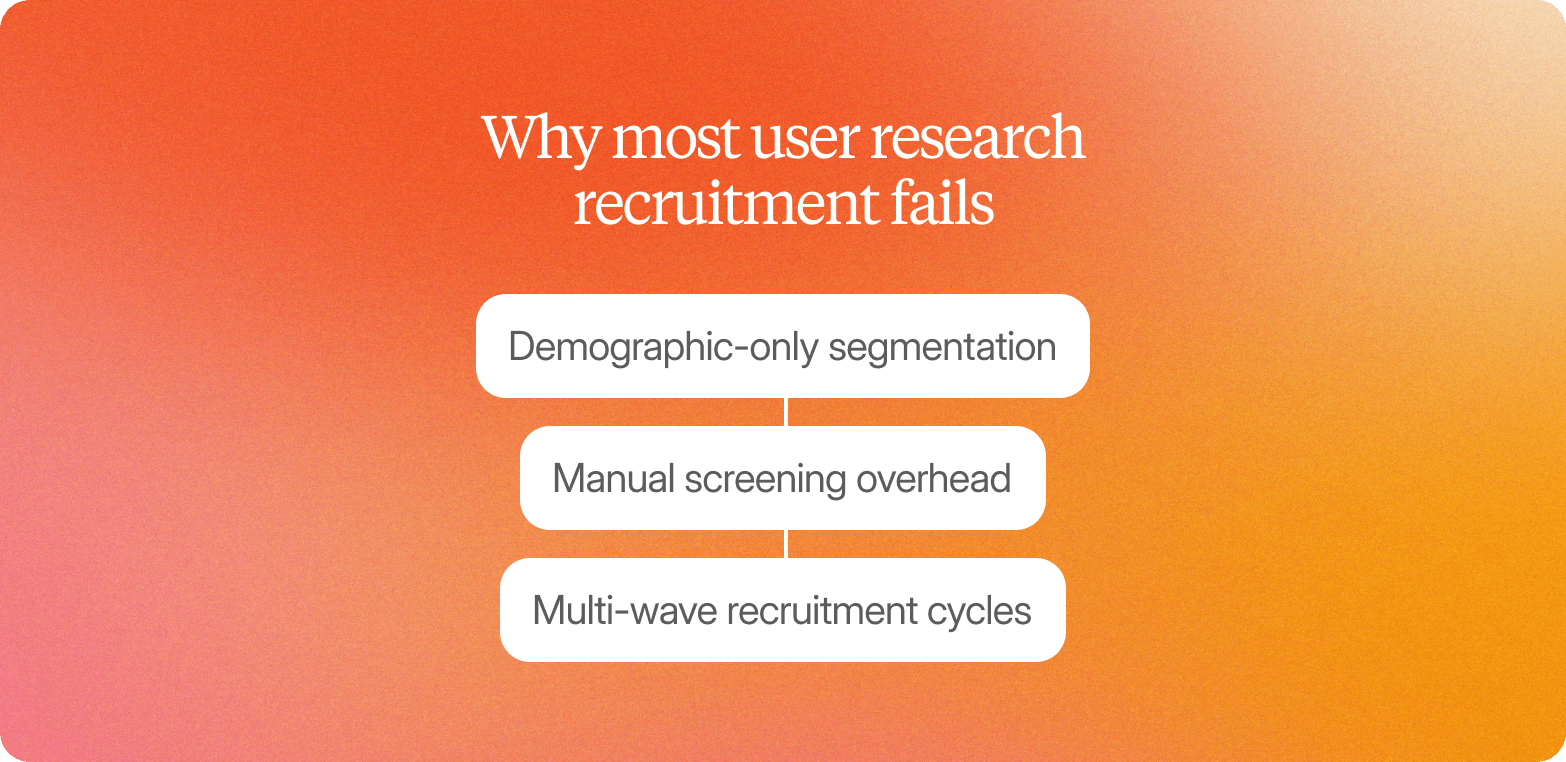
Three specific failure modes drive most of this waste:
Demographic-only segmentation: Panel filters stop short of behavioral criteria, missing the usage patterns that matter
Manual screening overhead: The effort required to verify participant fit falls entirely on the researcher
Multi-wave recruitment cycles: Failed screens force teams to restart rather than recover quickly
The 5 Core Recruitment Methods (and When Each One Breaks Down)
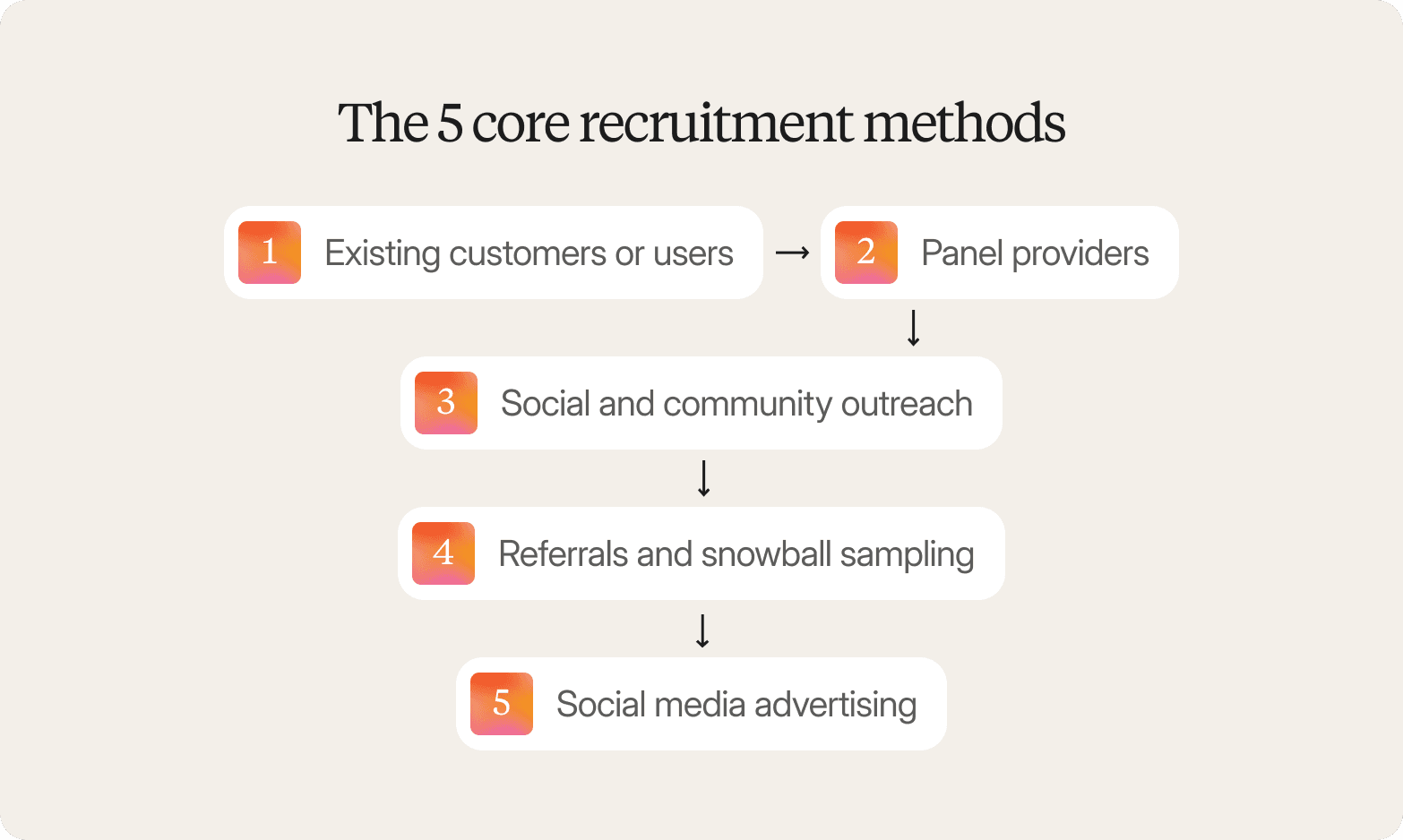
No single recruitment approach delivers speed, behavioral precision, compliance infrastructure, and scale simultaneously. Each fits certain research activities and breaks down in others.
Existing customers or users
The default starting point for most product and UX research teams. When you can segment your existing user base by behavior (feature adoption, session frequency, support history), recruitment is fast, and existing users arrive with genuine product context. Building your own research panel from that base gives you a standing pool of willing participants who already understand your product, are ready to provide feedback, and are far more likely to match behavioral criteria than a cold panel.
The breakdown comes when research needs require people outside that base: lapsed users, non-customers, competitive switchers, or users who never converted. Building an internal research panel also requires consent infrastructure and CRM integration that smaller teams often underestimate. And when the goal is to capture a diverse range of perspectives, relying solely on existing users limits the sample by design.
Panel providers
Third-party panels offer demographic reach and speed that an internal recruitment approach can't always match. The limitation is behavioral precision. Most panels filter by specific demographics (age, gender, income bracket), but not by "users who abandoned an onboarding flow in the last 90 days." For research goals that require behavioral criteria, panel data often produces participants who fit the demographic profile but not the actual use case.
Social media platforms and community outreach
Reddit, LinkedIn, online groups, and niche Slack communities work well for early-stage teams reaching engaged user segments. Posting in the right online groups and other platforms can quickly surface participants with specific interests at low cost. The problems emerge when you need compliance documentation, consistent screening quality, or incentive management at scale. Organic outreach across social media platforms produces variable quality and no audit trail.
Referrals and snowball sampling
For hard-to-reach B2B segments or sensitive topics, referrals remain one of the few proven strategies. The tradeoff is sample bias: networked referrals cluster around similar profiles and perspectives. A diverse range of participants is harder to achieve through referral networks alone, especially when research objectives require input across different demographic information groups or behavioral segments. When representativeness matters, other recruitment methods need to supplement referrals.
Social media advertising and paid channels
Social media advertising on Facebook, LinkedIn, and Google allows targeting by job title, interest, and geography, making these channels useful when you need to recruit outside your existing user base. Cost-per-recruit can become prohibitive quickly, often exceeding $50-$100 per completed research session. Paid channels also lack the behavioral signals that define most meaningful research criteria, so other recruitment methods typically need to run alongside them.
How to Recruit Without Multiple Screening Waves
The alternative to demographic-first recruitment is screening participants against behavioral criteria upfront, before a single research session is scheduled. Instead of filtering by demographics and hoping behavioral fit follows, teams define specific conditions a participant must meet: "purchased the category in the last 30 days," "adopted Feature X within the last sprint cycle," "currently using a competing platform," or "switched brands after a price change." Only pre-screened users who clear those filters enter the study.
When screening is embedded in the sourcing process rather than bolted on afterward, multi-wave recruitment cycles stop. Your recruitment efforts target the right participants from the start, and there's no first wave to disqualify and no second wave to compensate for.
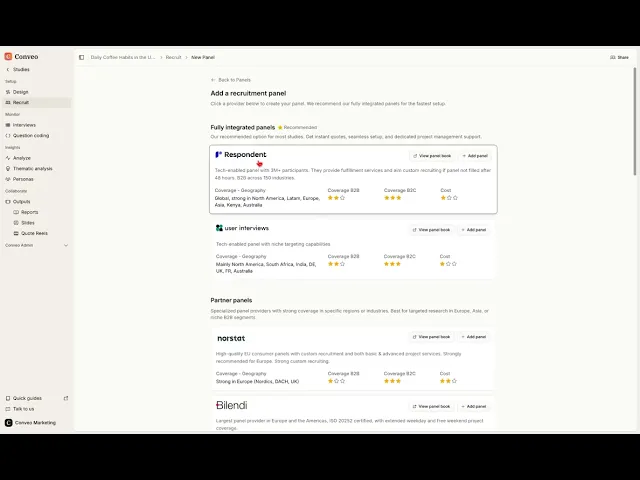
Conveo connects to an integrated network of panel partners, including Respondent.io and User Interviews, among others, and applies behavioral screeners before any session is scheduled. Teams can also source from their own list via CSV upload, QR code, or WhatsApp link. Either way, screening criteria are applied at the point of sourcing, not after the fact. Disqualification rates, which typically run at 60-80% in panel-based recruitment, drop significantly when behavioral filters are applied upfront. The result is a diverse range of willing participants who genuinely match your research needs, not just the demographic brief. Teams can invite participants who meet precise behavioral criteria rather than casting wide and filtering down, which keeps recruitment efforts focused and timelines tight.
The downstream effect is real: studies that previously required three to four weeks of recruitment efforts can move from brief to the first research session within days.
"We pull richer insight in hours, not weeks."
Head of Customer Insights, JDE Peet's
Recruiting Niche and Hard-to-Reach Users
Enterprise admins, compliance officers, and senior B2B decision-makers don't show up in consumer panels. They're behind procurement gates, inside closed enterprise systems, or too senior to respond to cold outreach. Finding research participants in these segments requires proven strategies rather than standard panel workflows.
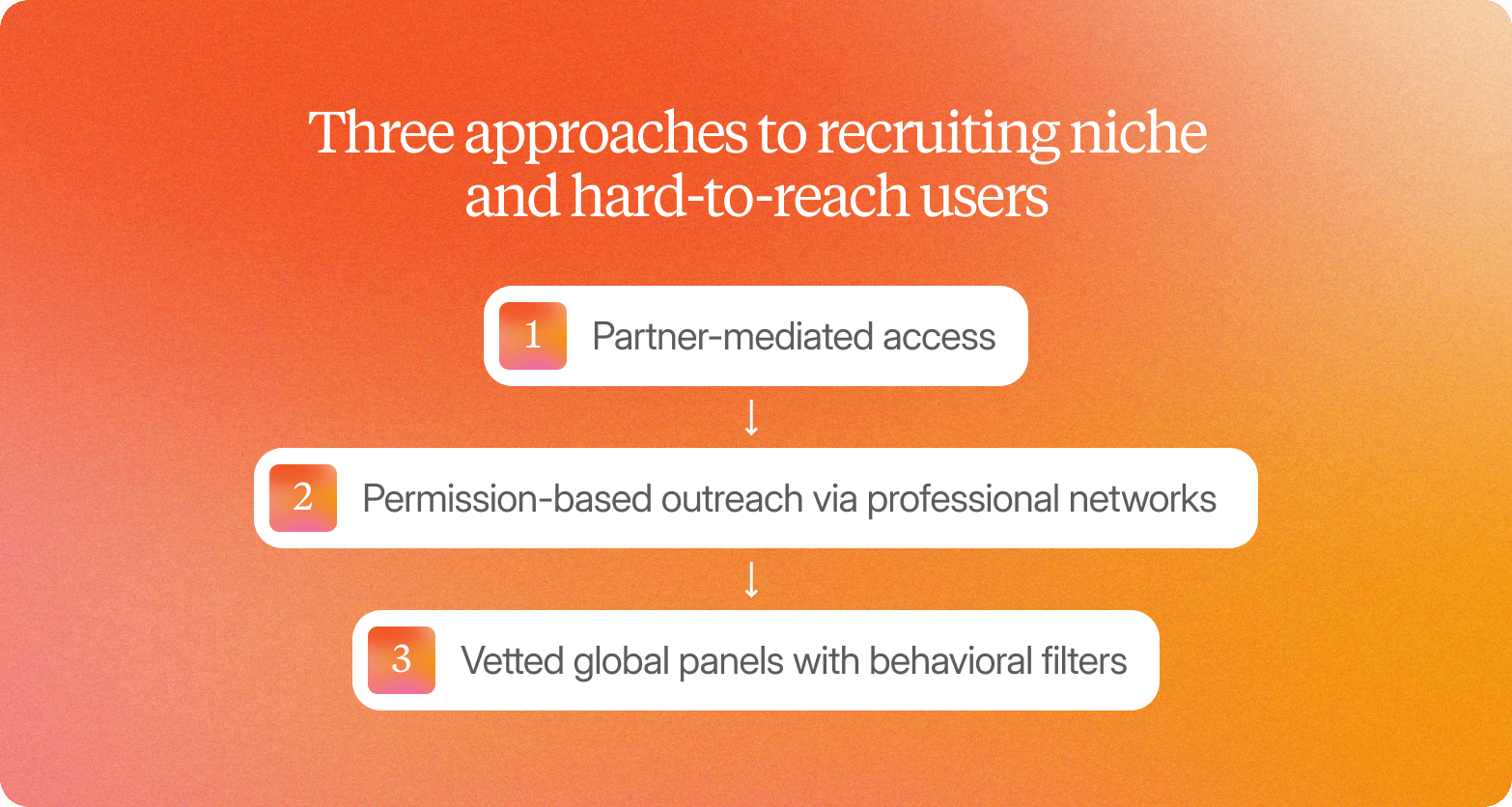
Three approaches have traction in practice:
Partner-mediated access
Customer success and account managers already have a relationship. Routing research requests through those channels (with a clear value exchange, such as aggregated findings shared back or early access to new features) gets past gatekeepers in ways cold outreach cannot. Invite participants through these warm introductions, and response rates improve substantially. This is one of the most reliable, proven strategies for reaching senior B2B decision-makers without adding weeks to timelines.
Permission-based outreach via professional networks
LinkedIn, industry associations, and other platforms that offer access to specific professional segments work well when paired with opt-in messaging tailored to the target audience's communication style. This recruitment approach typically adds one to two weeks to timelines, but participant quality is meaningfully higher because participants self-selected based on specific interests and genuine relevance to the topic.
Vetted global panels with behavioral filters
When local sourcing is thin, or a study spans multiple markets, platforms with access to global panels can find participants across geographies that other recruitment methods can't reach. Conveo's integrated panel network spans 50+ markets across its panel partners, and behavioral filters go beyond basic job title, which matters when the target profile is narrow and the study needs to run across multiple countries simultaneously.
The honest tradeoff: niche recruiting is time-consuming and costs more per participant than consumer panel work. But conducting research activities with proxy users and assuming the findings transfer produces insights that mislead rather than inform.
Fraud, Professional Participants, and Quality Control
Participant quality is one of the most underestimated risks in scaled online research. Bots cycling through screeners, VPN users masking their location, and "professional respondents" who have memorized the right answers can all clear a standard screener and provide shallow responses that look like data but carry no real signal.
Even a small group of fraudulent participants can contaminate thematic findings if they're not caught before synthesis. In large-scale research activities, a small group of bad actors generates fabricated data points that corrupt entire thematic clusters, producing findings that erode trust in the research function when they don't hold up.
Three quality control mechanisms address this directly:
Video verification is the most reliable signal of participant authenticity. Real users appearing on camera in a research session produce verbal, behavioral, and contextual cues that text-based panel responses simply can't replicate. Conveo's video-first approach means stakeholders can trace findings back to real, recorded conversations, reducing internal skepticism when research is presented.
Behavioral screening shifts qualification criteria away from self-reported demographic information toward actual product behaviors: which features participants use, how frequently, and in what context. Pre-screened users who've cleared behavioral filters are harder to impersonate and less likely to supply fabricated data points. Asking participants to provide feedback on specific product behaviors (rather than generic opinions) surfaces usability issues that generalized responses routinely miss.
Engagement and reliability tracking flags low-quality contributors before they enter a new study by logging participant completion rates, response depth, and session behavior across research activities. Previous participants who underperformed are identified before they can affect new recruitment efforts, protecting the reliability of your participant pool over time.
The payoff is reliable insights that provide stakeholders with valuable information they can act on, not findings that look credible on first read but don't hold up under scrutiny.
How Recruitment Choices Affect Interview Throughput
Recruitment decisions seem like a participant-quality problem. In practice, they're a throughput problem. Who you recruit and how you reach them determine not just sample quality but also how quickly interviews run and whether findings land in time to influence a decision.
The bottleneck most teams underestimate is calendar coordination. Sourcing high-quality participants and scheduling each for a 45-minute live research session can take one to two weeks before a single interview runs. For teams conducting research on a sprint cadence, that's the difference between insights that inform decisions and insights that arrive after them. The research process becomes time-consuming in ways that are structural rather than incidental.
Asynchronous, AI-moderated interviews change that dynamic. Instead of coordinating schedules, participants receive a link and complete the research session on their own time. Conveo's AI moderator runs sessions in parallel, meaning a team can conduct hundreds of conversations in roughly the same elapsed time it previously took to schedule 10. That scale makes it possible to recruit participants for user research on an ongoing basis, rather than treating each study as a one-off project.
When AI moderation includes adaptive probing, participants who invest time in thoughtful responses provide valuable information that would otherwise require a follow-up round. Capturing that depth on the first pass compresses the end-to-end research process and delivers more meaningful insights per study cycle.
Enterprise Recruitment Operations: Roles, SLAs, and Quality Metrics
At scale, user research recruitment stops being a one-time task and becomes a repeatable operational system. Teams that treat it as a project pay for that inefficiency in delayed timelines and inconsistent participant quality.
The role split matters
Research teams own their study design, screening criteria, and interpretation of findings. Research ops owns the recruitment process logistics: building and maintaining the organization's own pool of pre-qualified contacts, deciding whether to use internal recruitment or external panels for each study, managing incentive distribution, compliance documentation, and vendor relationships. When those responsibilities blur, both sides slow down.
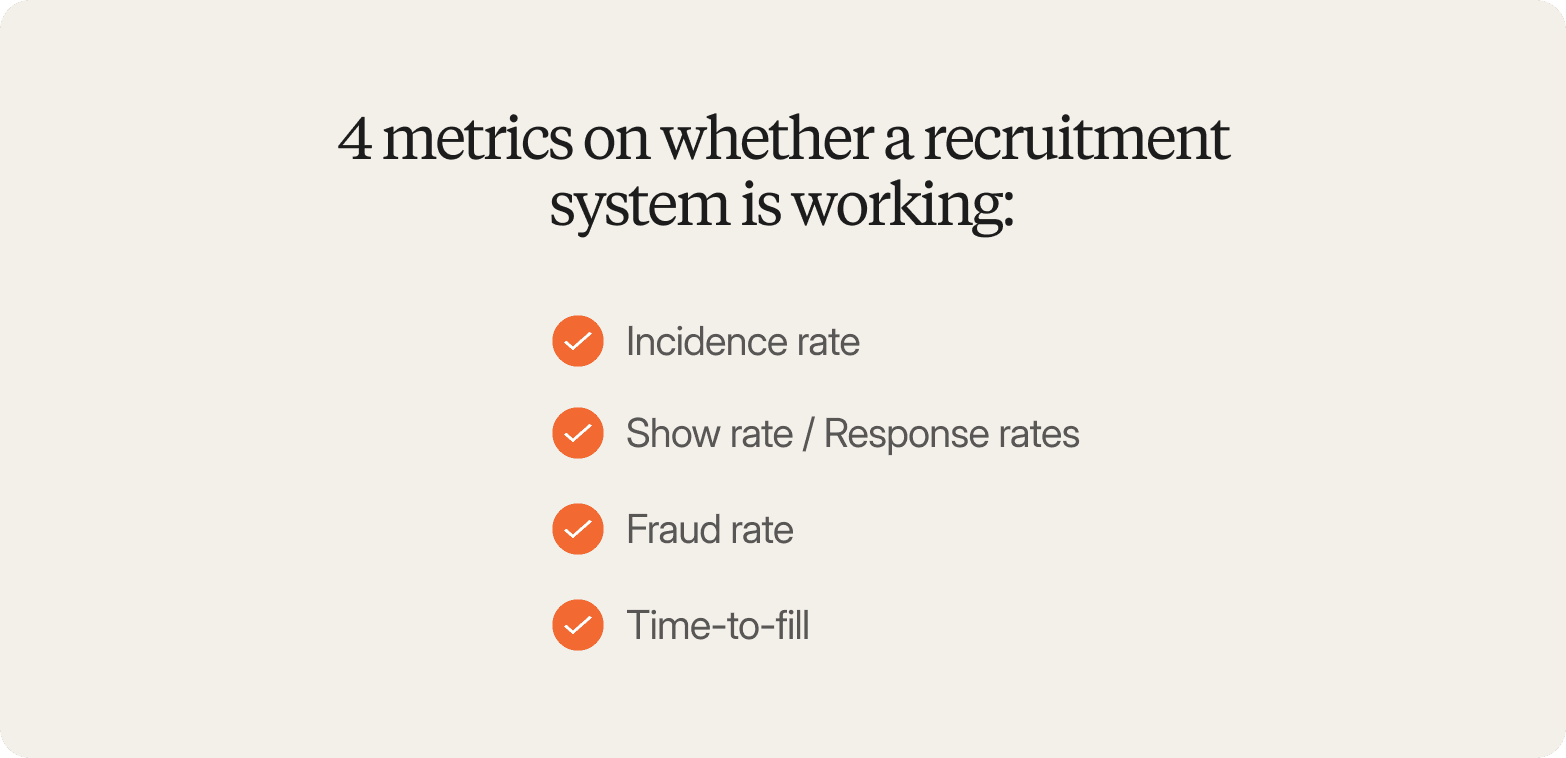
Four metrics define whether a recruitment system is working:
Incidence rate: Percentage of candidates who pass screening. A behaviorally profiled participant pool should clear 80%+. Demographic-only panels often land at 20-40%, meaning more recruitment effort to recruit participants for user research studies at the same cohort size.
Show rate / Response rates: Percentage of recruited participants who complete their research session. Target: 70-85%. Adapting communication style to match the participant segment (senior B2B decision-makers versus consumer panel respondents) has a measurable effect on show rates.
Fraud rate: Percentage flagged as bots, duplicates, or professional survey-takers. Target: under 5%.
Time-to-fill: Days from finalized study brief to a cohort of willing participants ready to interview. Standard consumer segments: three to five days. Niche B2B profiles: seven to ten days.
Compliance sits underneath all of it. For enterprise teams, SOC 2 certification, GDPR compliance, and EU regional data hosting are not procurement checkboxes: they are the conditions under which recruitment can even begin. Conveo's compliance infrastructure is designed to clear those gates before a study launches.
How Conveo Brings Recruitment, Moderation, and Synthesis Together
The recruitment challenges covered in this guide are not independent problems. They compound. A team that fixes screening but still runs live-scheduled research sessions gains precision without gaining speed. A team that accelerates interviews but stores findings in disconnected slide decks gains throughput without meaningful insights that carry forward.
Conveo connects these stages into a single research process: behavioral screening at the point of sourcing, AI-moderated asynchronous interviews, video-first sessions with full traceability, and a searchable insight library that compounds with each study. The result is quality participants matched to your research goals (not just your demographic brief) and reliable insights that stakeholders can act on with confidence.
Watch how it works: Participant Recruitment and Screening in Conveo
For enterprise teams, Conveo's compliance posture covers SOC 2 certification, GDPR compliance, and EU regional data hosting, clearing procurement and legal gates upfront so studies launch without weeks of vendor review, adding to recruitment efforts.
Frequently Asked Questions
How do you recruit users for user research?
Recruiting users for user research works best when you screen for specific product behaviors, not just demographics. The five primary recruitment methods are building your own research panel from existing users, third-party panel providers, social media platforms, community outreach, referrals, and social media advertising. Platforms that source and screen pre-screened users against behavioral criteria upfront eliminate the 60-80% disqualification rate that forces re-recruitment cycles, compressing the research process from weeks to days.
How do you recruit a strong user research sample?
Start with behavioral screening, not demographic matching. Define the target behavior first: what has the participant done, how recently, and how often? Screener questions should surface actual usage patterns and pain points, not self-reported attitudes. Collect relevant background information about participants' product experience upfront rather than during the session. Vetted panels with fraud filtering ensure participants match the identities they claimed. For UX research specifically, participants should have active experience with the onboarding flow or the usability issues you're investigating.
What is the biggest risk in online panel recruitment?
Participant fraud: bots, VPN users masking their location, and professional respondents who have memorized the right answers. Even a small group of fraudulent participants can produce data points that look credible but carry no real signal. Themes built on bad data erode trust in the research function when decisions based on them don't hold up. Video verification, behavioral screening, and engagement tracking across research activities are the three mechanisms that most reliably address this.
How long does user research recruitment take?
For standard consumer segments, a well-run recruitment process should deliver a qualified participant pool within 3 to 5 days. Niche B2B profiles (compliance officers, clinical specialists, or senior IT decision-makers) typically require seven to ten days. Multi-wave demographic-only recruitment can extend that to three to four weeks. The goal is to make finding research participants fast enough that it no longer becomes the bottleneck in continuous discovery. Teams that invest time in building their own pool of pre-qualified contacts reduce time-to-fill significantly across repeat study cycles.
What compliance requirements affect enterprise user research recruitment?
For European teams and buyers, GDPR compliance and EU regional data hosting are baseline procurement requirements. For US enterprise organizations, SOC 2 certification is increasingly a hard gate during vendor review. Beyond certifications, enterprise research requires documented consent trails confirming that each participant agreed to being recorded, to having their data stored, and to having responses shared internally. Teams building a diverse range of participants should also consider accessibility needs to ensure the research sample reflects the full scope of the user base. Verbal consent on video alone is typically insufficient for enterprise legal review.

About the author
Ivayana Abdi
Research Impact Lead
Ivayana has worked in market research since 2017, most recently as group manager of research operations and logistics at Culturati, and trained at RIVA and the Burke Institute. She joined Conveo for the hybrid researcher model: agile with new methods, fluent in the traditional ones, and able to combine the two for clients who want to try new things.
Meet Ivayana on film →Qualitative insights at the speed of your business.
Conveo runs AI-moderated video interviews and structures everything they say.