In this article
TL;DR
Consumer research panels provide teams with repeated access to relevant participants, making them useful for ongoing and multi-market research programs.
Running panel research across several markets requires careful coordination of quotas, participant management, and tracking who has already taken part.
A well-managed panel program can support research over time, helping insights teams build on previous findings instead of repeatedly starting from scratch with new participants and recruitment processes.
This guide explains how to evaluate consumer research panels in marketing research, including participant quality, fraud prevention, governance, and compliance requirements.
As a research function grows, recruitment starts to eat up more and more time, and there's no guarantee that each new batch of participants will be as reliable as the last. A consumer research panel changes that by giving research insights teams and research operations managers a pre-vetted pool to draw on whenever a new study starts.
This consumer panels market research guide covers how panels work and how to evaluate one for quality, compliance, and fit against other recruiting approaches, so you know what to look for before you commit to one.
What Is a Consumer Research Panel?
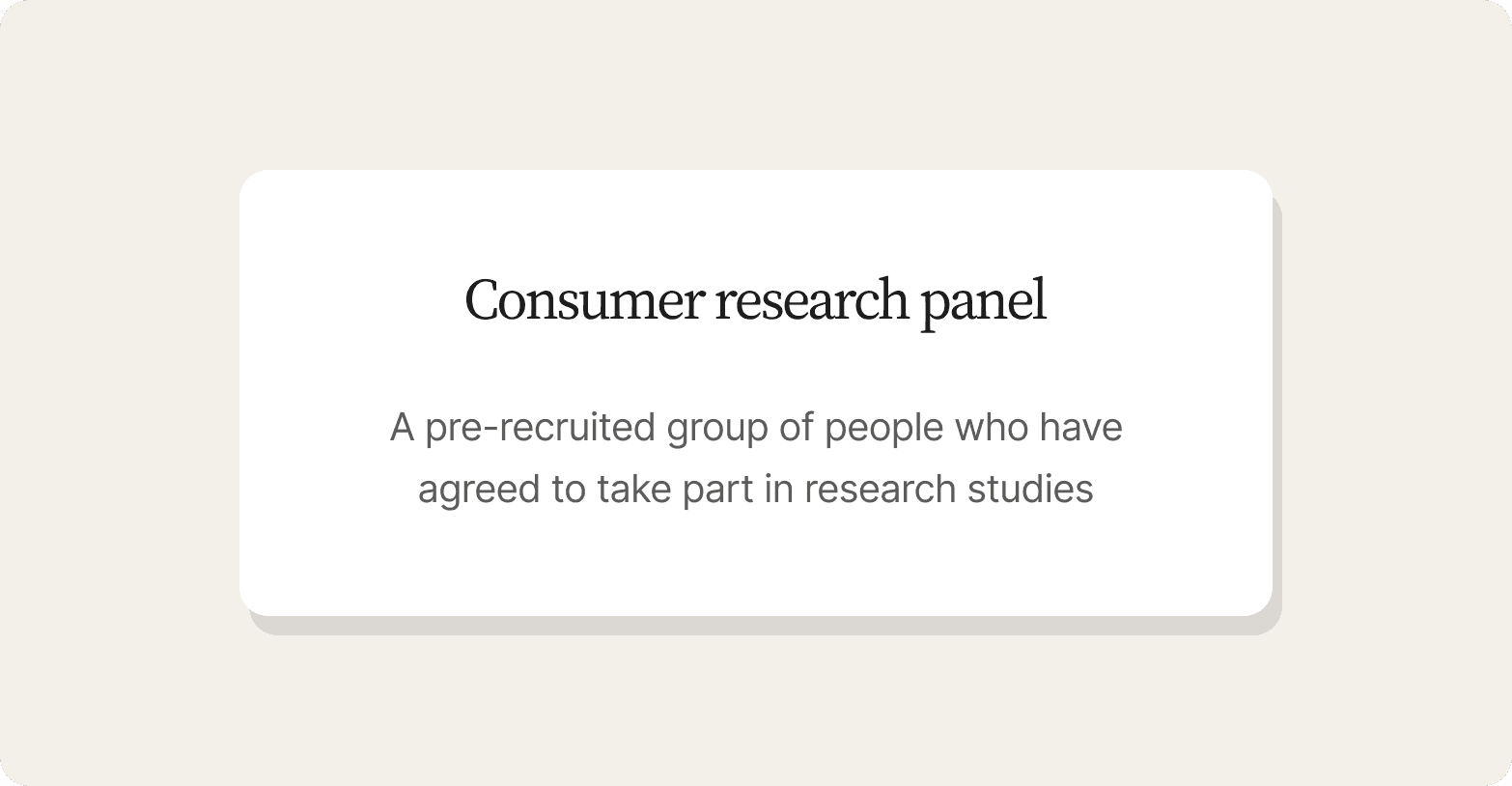
A consumer research panel is a pre-recruited group of people who have agreed to take part in research studies. Instead of finding new participants each time a study begins, researchers can draw on the online research panel to recruit participants who meet their requirements.
That makes them particularly useful when researchers or market research companies need repeated access to qualified participants. Having the same pool of ready participants is also what sets a panel apart from a few similar approaches:
One-off recruitment finds new participants for each study instead of drawing from an existing pool.
An insight community invites members to participate in ongoing discussions and activities around a brand, not just individual studies.
A longitudinal research program follows the same participants over time to track how their views or behavior change.
Market research consumer panels can support ongoing research, such as brand tracking, as well as individual studies, such as concept testing and behavioral research, that can inform marketing strategies.
How Consumer Research Panels Work
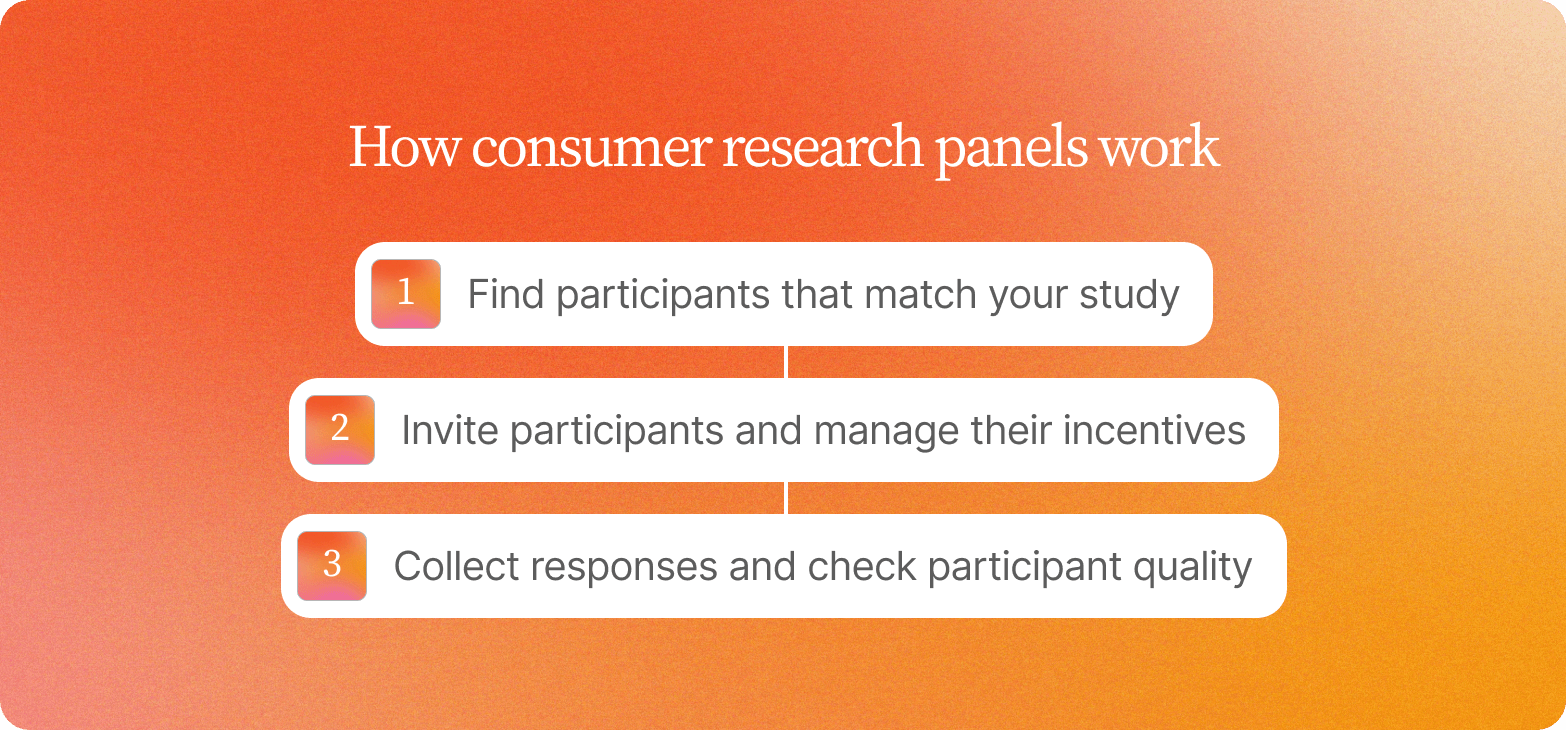
A panel moves through several stages before you collect data. Knowing that sequence helps you see where a panel fits into your own research process, and where it can support formats like video-based depth interviews alongside structured surveys.
1. Find Participants That Match Your Study
Market research firms and researchers start by defining the type of people they want to speak to. Panels can filter participants using demographic criteria, such as age group or location. They can also use behavioral criteria, such as:
What someone has bought
Whether they have recently switched brands or providers
How often they use a product or service
There are key differences between the two, but neither method is inherently better. Demographic criteria work well for studies like category awareness or market sizing, where a representative spread of ages and locations matters more than any specific behavior. Behavioral criteria are better suited to studies like churn research or feature adoption, where the value lies in reaching people who've taken a specific action.
Some panels layer the two together, using demographics to build the base and behavior to narrow it down.
2. Invite Participants and Manage Their Incentives
Once researchers have identified the right participants, the panel provider sends invitations to people who match the study criteria. These invitations typically explain what the study involves, how much time it will take, and what incentive participants will receive. Depending on the research method, participants may complete an online survey or take part in an interview at a suitable time.
Incentives are usually based on the time and effort required to participate, as well as the difficulty of recruiting participants. Panel providers track invitations, participation, and payments, helping researchers keep a record of who took part and what incentives were paid.
Many consumer panel market research providers also check whether participants have completed the required parts of a study before releasing an incentive. This helps ensure payments go to genuine participants and supports the quality of the data collected.
3. Collect Responses and Check Participant Quality
Credible panels use quality controls before, during, and after a study to identify potential fraud and poor-quality responses. These can include:
Quality scoring. Tracking signs of low-quality participation over time to help identify participants who may not provide reliable responses.
Response-pattern analysis. Looking for unusual patterns, such as answers completed unusually quickly or responses that are inconsistent with information provided during screening.
VPN detection. Identifying participants who may be masking their location.
Identity checks. Depending on the provider, this may include phone verification, ID document checks, or location checks.
Credible panels should be able to explain how they assess participant quality and identify potential fraud.
When to Use a Consumer Market Research Panel for Data Collection
Panels make recruitment convenient, but they’re not automatically the best option for every repeated research program. Use the table below to determine which approach best fits the type of research you need to run.
| Research need | Best approach | Why |
|---|---|---|
| Brand tracking or other recurring studies | Consumer research panel | Gives you repeat access to participants who match your target criteria |
| Concept testing with a specific audience | Consumer research panel | Helps you find participants based on relevant demographics or behaviors |
| Multi-wave research using different participants from the same target market | Consumer research panel | Supports repeated recruitment without starting from scratch each time |
| Tracking how the same individuals change over time | Panel with recontact capabilities | Previous responses remain available as context across research waves |
| One-off exploratory or discovery research | One-off recruitment | Finds participants specifically for a single research question |
| Ongoing discussions and repeated feedback from the same group | Insight community | Built around a longer-term relationship and dialogue with participants |
Once you’ve decided that an online market research panel is the right fit, shortlist a few options to compare.
Consumer Insights Panel Quality: What to Evaluate Before You Commit
Not every panel gives you the same level of control over who takes part in your research or how their data is handled. When comparing providers, look beyond panel size and ask how they handle these key factors:
| What to evaluate in online consumer research panels | What to look for | Why it matters |
|---|---|---|
| Fraud prevention | Response-pattern analysis, quality scoring, and duplicate detection | Without strong checks, fraudulent or low-effort responses can weaken your research findings. |
| Participant verification and screening | Phone, ID, or location checks where offered, along with behavioral screening | You could end up with participants who aren't who they claim to be or don't have the experience your study requires. |
| Recontact rules | Frequency caps and controls that prevent participants from taking part too often | Without limits, frequent participants can become over-represented or experience research fatigue. |
| Incentive management | Transparent payouts and audit trails | This makes it easier to track spending, resolve payment issues, and show that participants were paid as agreed. |
| Security and compliance | SOC 2 documentation, GDPR compliance, EU data hosting where needed, SSO, and configurable data retention and deletion rules | Weak controls can create privacy or security risks and make internal approval more difficult. |
A high-quality panel provider should be able to give clear answers to these questions and show how its controls work.
The Challenges of Using Consumer Research Panels Across Multiple Markets
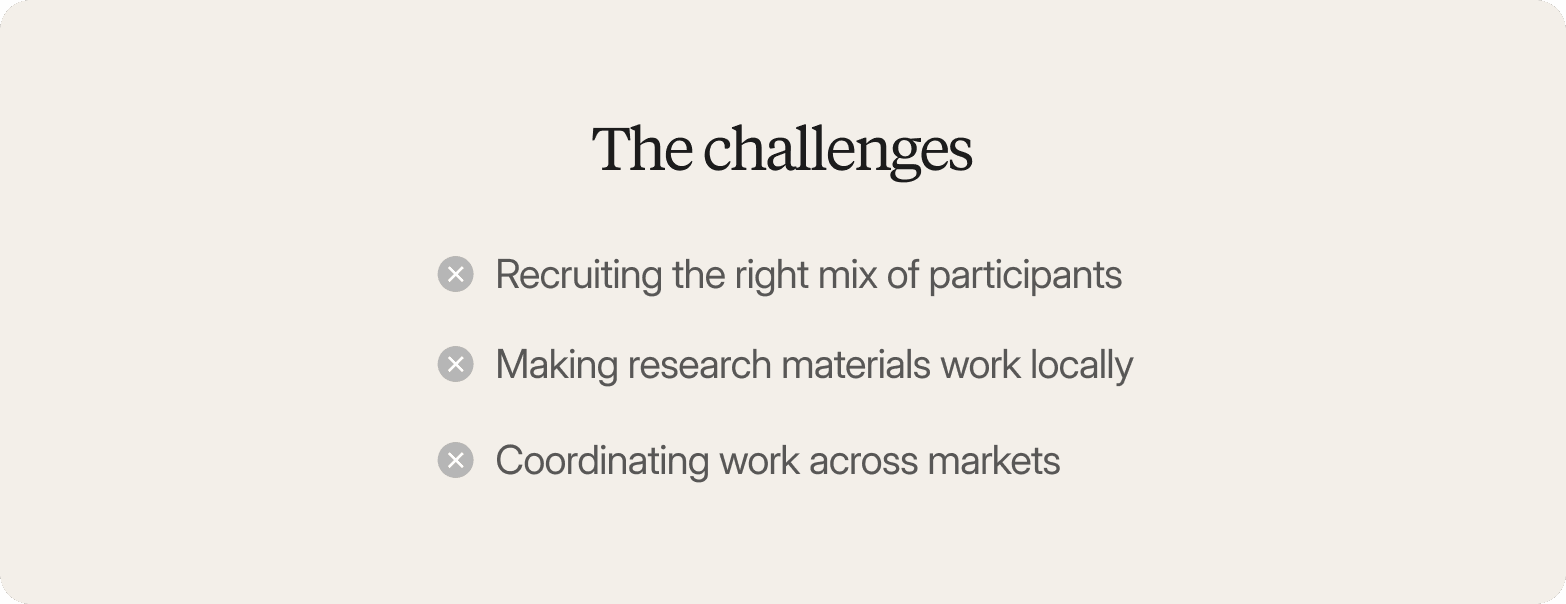
Online panels give teams access to participants in different geographic locations, but running the same study across those markets still creates practical challenges. For example:
Recruiting the right mix of participants: The audience you need may be easy to find in one country but harder to recruit in another, so quotas need to be managed separately for each market.
Making research materials work locally: Terminology may need to be adapted for each market while keeping the research sufficiently consistent to compare findings across countries.
Coordinating work across markets: Translation, local review, approvals, and fieldwork can introduce multiple handoffs into the data collection process. By the time every market has completed the study, the decision the research was meant to inform may already have been made.
AI-moderated interviews can reduce some of these coordination demands when conducting research. Participants can complete asynchronous interviews in their own language and on their own schedule, removing the need to arrange live sessions across time zones.
Platforms like Conveo handle this end-to-end: they tap vetted global panels, screen participants for quality, manage incentives, and then run AI-moderated interviews in participants' own languages across 50+ languages.
Participants respond asynchronously on their own schedules, so a seven-market study runs in parallel rather than market by market. Researchers still own localization decisions, but the recruitment, scheduling, and moderation overhead that usually stretches multi-market work across months largely disappears.
"The pace, responsiveness, and research expertise of the Conveo team, on top of the top AI-moderated qual platform, have been invaluable to us in scaling brand advertising internationally."
Matt Harris, Research & Insights Lead, EMEA, at Canva
Beyond Surveys: How to Use Consumer Research Panels for Qualitative Depth
Traditional research methods, such as surveys, can reveal patterns in what people do or think. But when a result raises a bigger question, you may need to hear directly from the people behind the numbers.
Consumer research panels can support in-depth interviews and asynchronous video research, allowing you to revisit relevant participants to explore their answers in greater detail and gather more insightful data.
For example, a retailer could use an online survey panel with 500 people who recently stopped buying from its brand and find that price was the most common reason given. It could then invite some of those same participants to take part in asynchronous video interviews to understand what “too expensive” actually meant and what led them to switch.
See it in action: How AI-Moderated Interviews Work
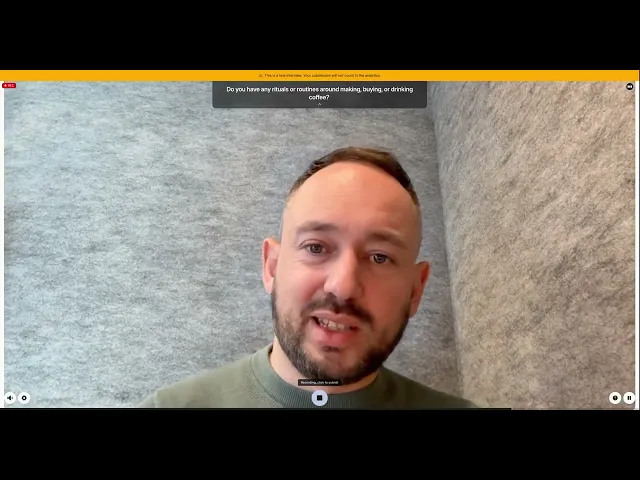
By combining behavioral screening with video-based research, panels can help you reach a large, targeted audience and then explore the experiences behind the patterns you find. This gives you the numbers you need to spot what is happening, along with qualitative feedback that helps explain why.
Governance and Compliance for Panel-Based Research
Using a consumer panel in market research involves collecting and managing participant data, so compliance should be part of the evaluation process from the start. For enterprise teams and research agencies, the underlying security and compliance infrastructure matters too. Look for:
SOC 2 certification. Evidence that the provider has established controls for managing security and protecting data.
GDPR compliance and EU regional data hosting. Important when research involves participants or teams in Europe.
Single sign-on (SSO). Allows organizations to manage access through their existing identity systems.
Client-configurable retention and deletion rules. Controls that let organizations set how long research data is retained and request deletion when needed.
These details affect whether your research process meets internal security and procurement requirements. Without them, you may not be able to use the valuable insights you get from your online panel research.
Frequently Asked Questions
How do you know if a consumer research panel provides high-quality data?
High-quality data depends on the quality of the participants and the controls used to manage them. Look for clear screening criteria, fraud prevention measures, and processes for identifying low-quality or suspicious responses. A credible provider should also be able to explain how it manages participant quality over time.
How do consumer research panels prevent fraud?
Credible consumer research panels use data quality measures to identify suspicious participants and unreliable responses. These can include quality scoring, VPN detection, and response-pattern analysis. Depending on the provider, panel members may also go through phone, ID, or location checks. The specific controls vary between providers, so it is worth asking how they ensure data quality before choosing a panel.
What's the difference between a consumer panel and an insight community?
A consumer panel is primarily a source of participants for research projects. Researchers can recruit suitable people from the panel for recurring studies, such as concept tests, brand tracking, or quantitative research. An insight community is designed for ongoing engagement with the same group of participants over a longer period. Members may take part in repeated discussions and research activities, allowing researchers to return to the same respondents over time.
How do panels support qualitative research?
Consumer research panels can recruit pre-screened participants for qualitative research, including focus groups and asynchronous video interviews. Researchers can screen participants based on demographics and relevant behaviors to find people with the right experience for the research. This helps market researchers understand consumer behavior and the reasons behind people's choices, rather than only collecting survey responses or measuring how many people hold a particular view.
What is a branded research consumer panel?
A branded research consumer panel is a group of research participants recruited and managed specifically for a particular brand or organization. Instead of drawing participants from a general third-party panel for each study, the organization builds an ongoing pool of people it can invite to take part in future research. Depending on how the panel is set up, members may include existing customers, target consumers, or a mix of both.
How much does a consumer research panel cost?
The cost of a consumer research panel depends on the incentive offered to participants, how much screening is required, and the geographic markets included in the study. More detailed behavioral screening can increase the upfront cost of recruiting each qualified participant. Costs can also vary depending on whether you need a broad target audience or a more specific group based on behaviors such as purchasing behavior.

About the author
Ivayana Abdi
Research Impact Lead
Ivayana has worked in market research since 2017, most recently as group manager of research operations and logistics at Culturati, and trained at RIVA and the Burke Institute. She joined Conveo for the hybrid researcher model: agile with new methods, fluent in the traditional ones, and able to combine the two for clients who want to try new things.
Meet Ivayana on film →Qualitative insights at the speed of your business.
Conveo runs AI-moderated video interviews and structures everything they say.