In this article
TL;DR
The core problem: research findings usually arrive after the decision has closed. Research ops is measured by studies delivered, so the case for the infrastructure needed to close that gap rarely gets made.
Where findings go to die: insights live in decks instead of a centralized research repository, so teams cannot prove whether past research already answered the question, and the second answer lands too late anyway.
The admin trap: without traceability to past research, research operations absorb the coordination load and never demonstrate compounding value to leadership.
The resolution: a research repository where findings accumulate, and value shows in what teams no longer have to re-research.
What this guide covers: the six responsibility areas of a mature research operations function; a research ops framework for consolidating a fragmented research toolkit; a procurement playbook covering data privacy regulations and data security; an AI responsibility matrix; and how to operationalize knowledge sharing.
Who this is for: insights and consumer and market intelligence (CMI) leaders running 50+ studies a year, the user researchers and UX research teams working alongside them, and the Research Operations Managers who build the infrastructure.
What is research operations?
Research operations, or ResearchOps, is the infrastructure that makes research possible at scale. At the enterprise level, most of that load falls to qualitative research, where every study carries participants, recordings, consent, and synthesis. The ResearchOps Community defines it as "the people, mechanisms, and strategies that set user research in motion," covering the roles, tools, and processes needed to support researchers in scaling the craft's impact across an organization.
The definition is precise in what it excludes. Someone who runs a discussion guide, moderates an interview, or synthesizes findings is conducting research. The function that makes those research activities repeatable, governable, and traceable across a team is doing research operations. Research ops lets researchers spend their time on study design and interpretation instead of on the operational work of getting a study into the field.
Nielsen Norman Group's research ops framework identifies six focus areas:
Participants: participant recruitment, screening, incentives, and access to research spaces.
Governance: consent, data retention, research ethics, and privacy compliance.
Knowledge: how findings get collected, synthesized, and made searchable, and how knowledge sharing happens between teams that never speak to each other.
Tools and platforms: standardizing the research tools that hold research quality steady (NN/g calls this focus area "Tools"; this guide favors "platforms" in procurement contexts to match enterprise buying language).
Competency: how research methods and research practice get built and shared across teams.
Advocacy: how valuable insights reach the people making decisions.
Three in particular (knowledge management, governance, tools) bear the heaviest load at enterprise scale and are the most likely to be under-resourced. The six are interdependent. A team that has solved recruiting but has no knowledge management system ends up re-studying questions it has already answered. A team with strong synthesis practices but no governance framework fails its first serious security audit.
Is ResearchOps only a UX discipline?
Most published frameworks have emerged from UX research, and much of the writing on user research operations still assumes a product-team context. Enterprise insights and CMI functions face the same operational problems at greater scale. A CMI team running multi-market brand tracking across a dozen countries, reporting into brand, marketing, and strategy, and managing vendors across three continents is doing research operations under a different name.
The infrastructure each side needs looks different, though. UX researchers optimizing a checkout flow and CMI leaders validating a category entry both depend on quality user research, but multi-market recruitment, moderation in 50+ languages, cross-functional stakeholder reporting, audit trails for regulatory compliance, and the ability to connect findings across waves are rarely features of a platform built around user experience research and usability testing.
Why ResearchOps exists now
Most enterprise research functions accumulated their operations instead of designing them. A recruiting platform here, a transcription service there, a reporting layer added when the team grew. Five years on, the Research Operations Manager inherits six or seven platforms that share no data, each with its own security questionnaire and renewal date.
That is the predictable outcome of research volume growing faster than the infrastructure supporting it. Organizations running 50 or more studies a year cannot coordinate that through ad hoc platform choices and manual handoffs. Someone has to own the research process end-to-end, which turns scaling research into a solvable infrastructure problem instead of a headcount problem.
Three pressures drive the role.
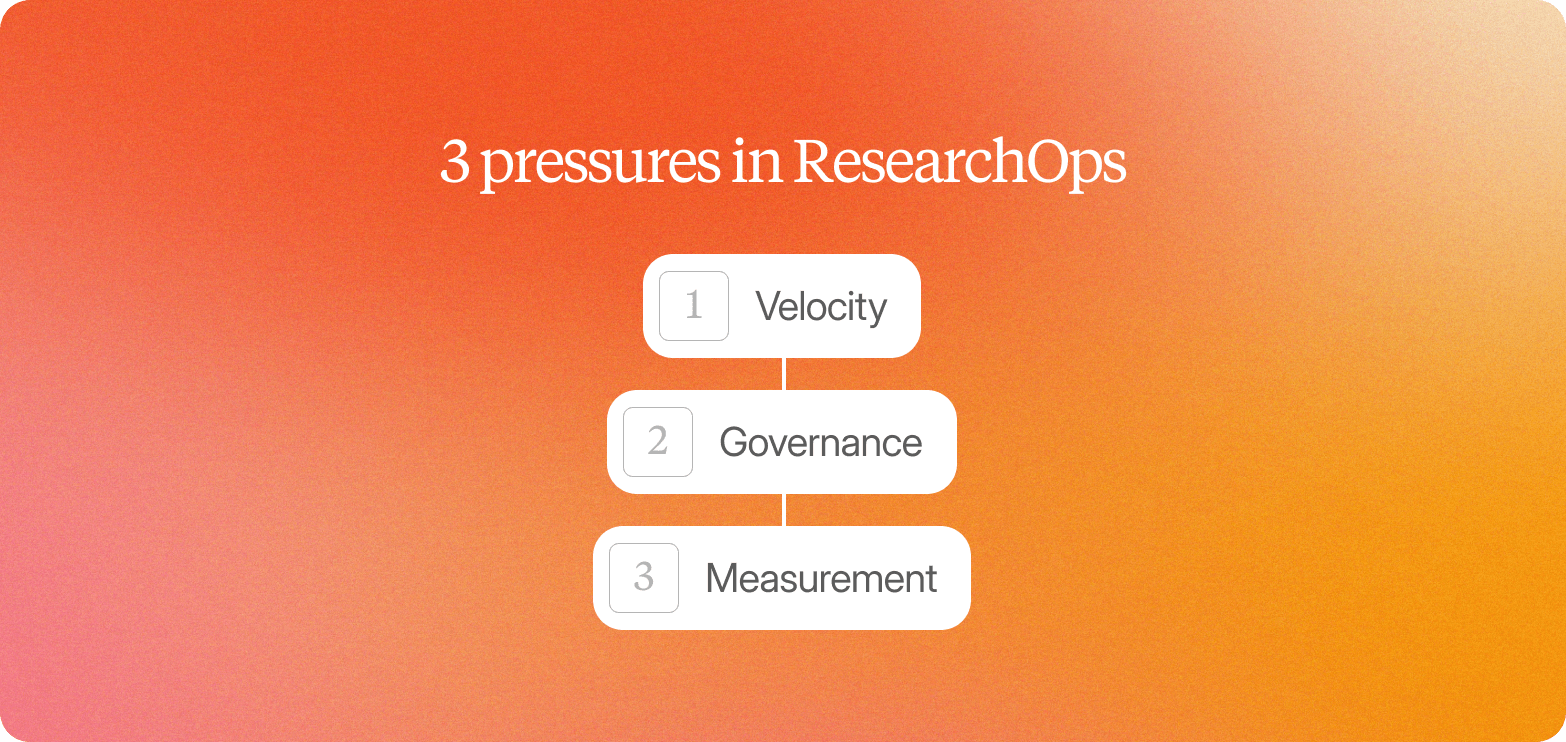
Velocity. Product and marketing cycles have compressed. Brand teams need concept validation in days, and innovation teams want consumer input before the decision window closes, ahead of the launch post-mortem.
Governance. SOC 2 Type II certification, GDPR compliance, EU data residency, SSO, and on-demand PII deletion are non-negotiable at enterprise scale, and none of them are self-certifying. As data privacy regulations have tightened across markets, Research Operations Managers have inherited the security reviews, vendor audits, and research documentation that keep research infrastructure off the legal team's risk register. Every new platform is another review cycle.
Measurement. Throughput is visible; duplication is not. When findings live in slide decks instead of searchable systems, nobody can see that the same question was answered six months ago, or that last quarter's insights are contradicted by what the team learned last week. That is decision-lag, and it separates a function that delivers studies from one that compounds them.
What a Research Operations Manager actually owns
Treating ResearchOps as recruiting and scheduling reduces the job to logistics, under-resources the function, and leaves the organization exposed to exactly the risks it hired ResearchOps to prevent. NN/g's research ops framework spans participants, governance, knowledge, platforms, competency, and advocacy (ResearchOps 101, NN/g). Four of those carry most of the enterprise weight.
Participant management: more than a recruiter's job
Participant management covers finding, recruiting, screening, scheduling, and compensating research-study participants. At 50 or more studies a year across multiple markets, that is a system. A research operations manager owns:
Which panel partners cover which markets, and whether the organization maintains its own customer research panel or buys reach study by study
How behavioral screeners filter for quality over availability
How incentives clear across currencies and jurisdictions
How fraud gets caught before it contaminates a dataset
Streamlining participant recruitment is the part of the job leadership sees first, because it is what researchers complain about most loudly. It also compounds. A single poorly screened wave can skew findings that inform a product decision, a campaign brief, or a concept going into market.
Governance: consent, privacy, and what happens to the data
Governance covers processes and guidelines for consent, privacy, and information storage. In practice, it is the difference between passing a security review and failing one: current data processing agreements with every research vendor, jurisdiction-appropriate consent language, documented retention, and a working PII deletion process.
Enterprise teams need documented answers on participant privacy, bias, ethics, and consent: who agreed to what, whether the sample was screened in a way that could skew the findings, and whether the study met the standards the organization has committed to.
This makes the research operations manager a procurement gatekeeper in everything but name. When legal or infosec asks whether a platform is GDPR compliant, whether data stays in the EU, whether SSO is supported, and whether there is an audit trail, that is the person who answers.
Knowledge management: the research that already happened
Knowledge management covers processes and platforms for collecting, synthesizing, and sharing research insights. Without a deliberate system, the same research question gets commissioned repeatedly because nobody can find the answer from the last time it was asked. That is an infrastructure problem, and it belongs to the research operations manager.
The fix is a centralized research repository where findings are tagged by topic, market, and methodology, where contradictions between studies surface instead of staying buried, and where a brand director can pull relevant consumer context before a briefing without filing a research request. A shared drive does none of that. Knowledge sharing is the outcome; the research documentation standards that make it possible are the work.
Platform consolidation: one stack, not five
NN/g calls this focus area "Tools," covering efficiencies through consistent toolsets and infrastructure. At most enterprises, the research toolkit was accumulated instead of designed: a recruitment platform, a separate transcription service, a separate analysis layer, a reporting tool, and a project management system that tied none of them together.
The research operations manager owns the rationalization of that stack, which means evaluating platforms against the full research process instead of a single capability, negotiating enterprise contracts, managing renewals, and running the security review for each new vendor. The standard they are held to is whether the research team can produce consistent, comparable outputs on a timeline that still matters to the decision waiting on them.
The ResearchOps stack: what to consolidate and why
Research stacks fragment the same way most technology stacks do: one problem at a time. A recruitment vendor when the panel felt thin, transcription when manual notes became unmanageable, an analysis layer when coding by hand got slow, a reporting template because nothing else produced a stakeholder-facing output on its own.
The hidden cost of "we already have platforms for that"
Most enterprise research teams do have something covering participant recruitment, something covering transcription, something covering analysis, and something covering research reports. What they do not have is a workflow where those things connect.
Every handoff is a point where data degrades. A transcript exported from one platform into an analysis layer arrives without the video timestamp, the tone signal, or the behavioral screening context that gave it meaning. A finding documented in a synthesis deck three months ago is invisible to the researcher starting a study today, because no searchable layer connects the two.
Compliance compounds it. Every vendor is a separate security review, a separate data processing agreement, a separate renewal cycle, and a separate point of failure if a GDPR audit arrives, and data security is only as strong as the weakest vendor holding participant video. That overhead never appears in a license cost. It accumulates in the Research Ops Manager's calendar and in the organization's risk profile.
What end-to-end coverage actually looks like
A consolidated research toolkit is one where every stage of the research process shares the same data layer, the same participant record, and the same compliance posture:
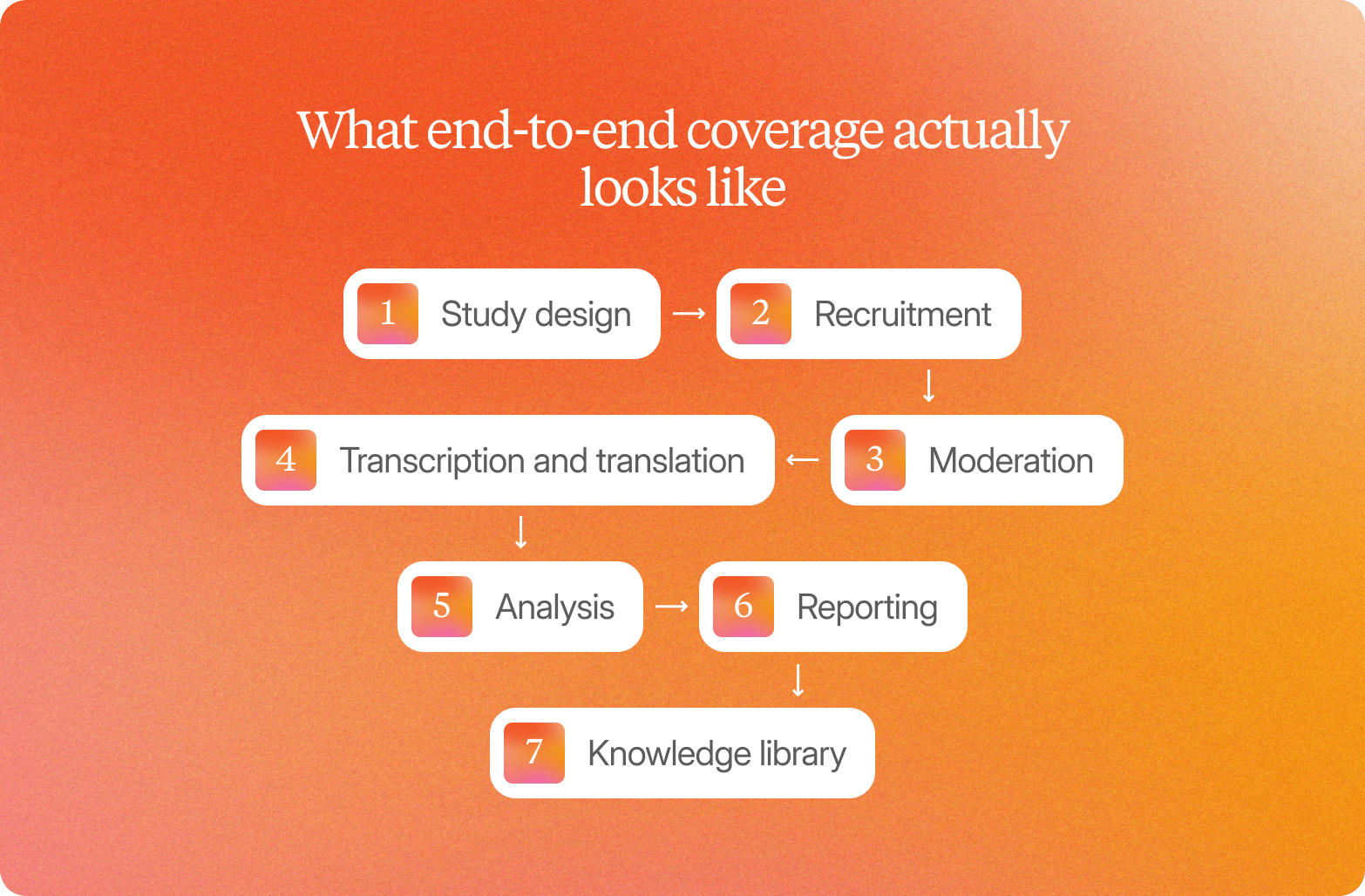
Study design. The research question is structured, the screener is built, and the research methods are selected.
Recruitment. Research participants are sourced, screened, and scheduled, with their data flowing straight into moderation instead of through an export.
Moderation. Where the work of conducting research happens, with behavioral context visible across every one of the research sessions in a wave.
Transcription and translation. Spoken language becomes searchable text without a re-import and re-tag cycle.
Analysis. Themes and patterns surfaced with past research accessible in context, so analysis never starts from zero.
Reporting. Research reports built from the underlying data instead of rebuilt by hand in presentation software.
Knowledge library. Findings accumulate across research projects and stay searchable.
Fragmentation breaks at three points: recruitment to moderation, transcription to analysis, and the missing persistent layer between reporting and the next study. Those gaps are where institutional knowledge evaporates and duplicate research gets commissioned.
Some things should stay outside the qualitative stack. Survey platforms remain the right home for quantitative data, and survey data belongs alongside qualitative research findings, in its own analysis engine. Product analytics keeps behavioral telemetry; CRM and support systems keep the account context used to triangulate what participants say; and legacy vendor relationships for in-person focus groups often sit outside the platform, too.
The consolidation argument
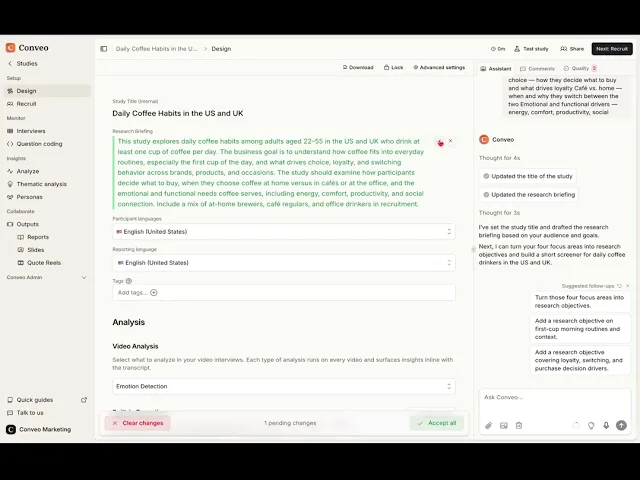
A platform that covers study design through the knowledge library in a single environment removes those handoff failures by design. Behavioral screening at recruitment stays attached to the participant record instead of being lost during the handoff to moderation. Transcripts stay linked to video timestamps and tone signals. Themes remain linked to the source material and feed into the knowledge library, where they are searchable across all prior research initiatives.
Watch the walkthrough: setting up a research study in Conveo.
Governance and compliance: the procurement playbook
For a Research Operations Manager, the compliance review is the gate. A platform with the right capabilities but missing research documentation sits in legal review for months, and a security questionnaire can take weeks to resolve if the vendor is not prepared to answer it on day one.
Use this to structure vendor evaluation and prepare your internal security team.
| Requirement | What to ask for | Conveo |
|---|---|---|
| SOC 2 Type II | Current attestation report covering the Security Trust Services Criteria, the audit period dates, and confirmation it covers the systems your team will actually use | SOC 2 Type II certified |
| GDPR | Signed Data Processing Agreement (required of processors under GDPR Article 28), current sub-processor list, documented DSAR and deletion SLAs, mapped against the data privacy regulations of every market you recruit in | GDPR compliant |
| Data residency | Where video, transcripts, and analysis outputs sit at rest, and whether regional hosting is standard configuration or a contract addendum | EU hosting (Belgium) |
| Access management | SAML 2.0 or your identity provider, automated provisioning and de-provisioning, and role-based access so teams are scoped to their own research projects | Confirm during evaluation |
| PII deletion | Whether deletion is on-demand or request-based, the SLA, whether it is permanent and verifiable, and whether recordings can be deleted independently of aggregated findings | Confirm during evaluation |
| Audit trail | A log of who accessed which studies and when data was exported, exportable for compliance reporting, with configurable retention periods | Confirm during evaluation |
Verify Conveo's current certification status through the trust portal before relying on it in a security review, since a lapsed report is not equivalent to a current one.
How AI fits into ResearchOps without breaking rigor
The objection surfaces in nearly every enterprise procurement conversation: if an AI research assistant conducts the interview, who is accountable for the methodology? It deserves a structural answer, and reassurance alone will not do.
Who owns what
Research ops teams adopting AI-moderated research define what the platform handles and what the researcher owns, and they map it before procurement, long before a compliance question arises.
| Activity | Researcher | Platform |
|---|---|---|
| Study design and discussion guide | Accountable | Informed |
| Participant screener logic | Accountable | Informed |
| Moderation of research sessions at scale | Consulted | Responsible |
| Data collection, transcription, and translation | Informed | Responsible |
| First-pass thematic coding | Consulted | Responsible |
| Multimodal signal capture (speech, tone, facial cues) | Informed | Responsible |
| Interpretation of findings | Accountable | Consulted |
| Research reports that stay current as evidence arrives | Accountable | Consulted |
| Data governance and PII handling | Accountable | Responsible |
| Compliance documentation | Accountable | Responsible |
Researchers remain accountable for every decision that requires judgment: what to ask, how to interpret what participants said, and how to turn findings into a recommendation that a business can act on. The platform takes the high-volume operations that slow programs down without adding methodological value: running conversations in parallel, handling data collection and transcription, and surfacing initial thematic clusters.
For teams that have relied on focus groups and manually moderated user interviews to cover the same ground, the constraint was the number of sessions a small team could run before the decision window closed.
"The analysis is instantaneous. I can synthesize all the data, and also go back and watch every interview. You can ask it to challenge your own thinking. It's so easy to talk to your data."
Dafydd Jones, Associate Director, Ninth Seat
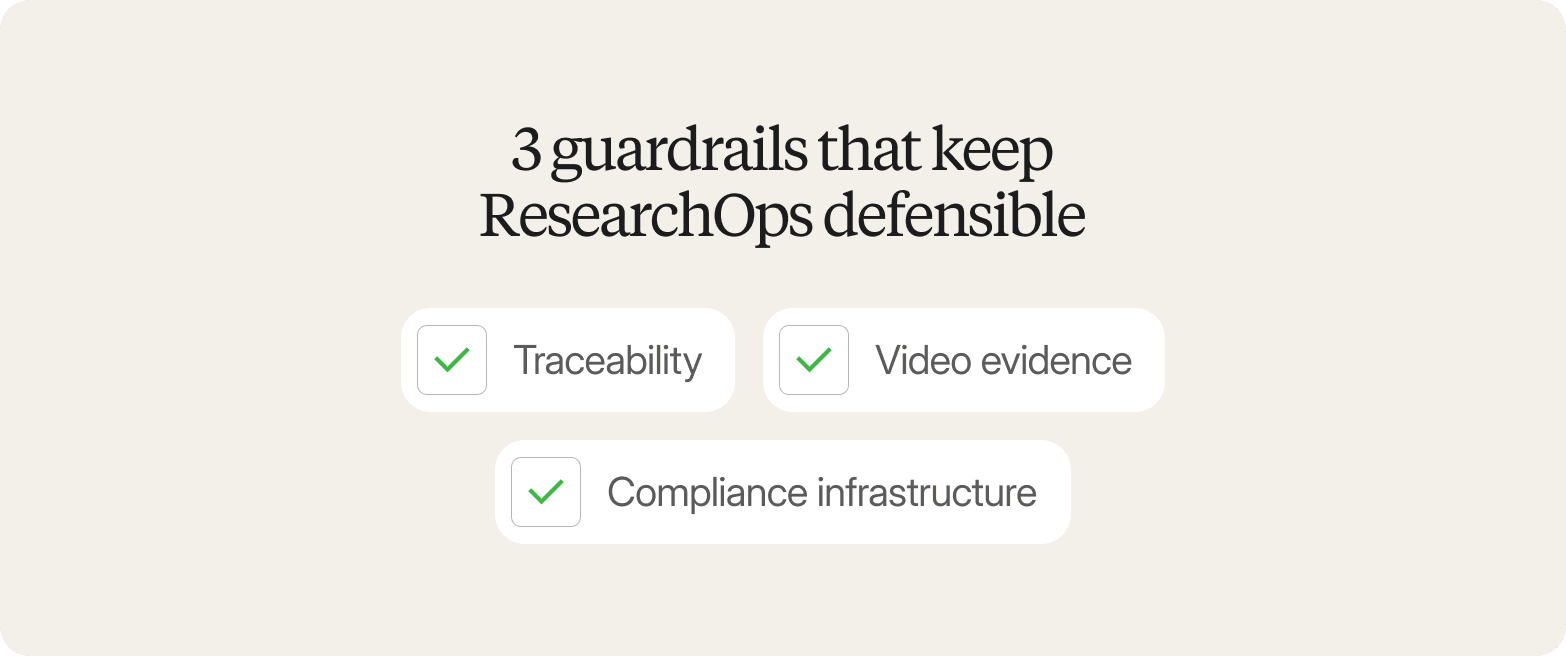
3 guardrails that keep it defensible
1. Traceability
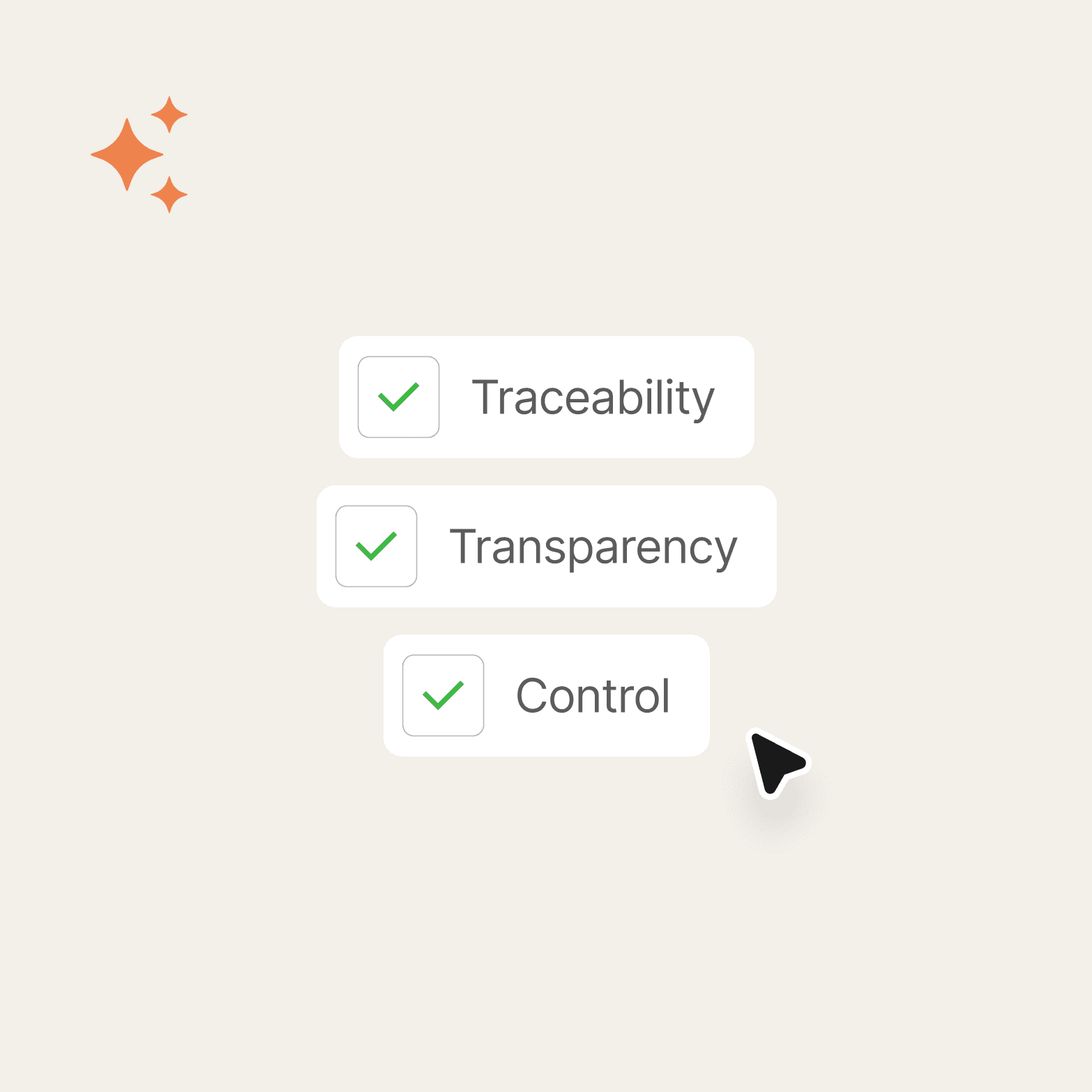
Every finding in a Conveo study traces to a specific participant, a specific moment in a recorded video session, and a verbatim quote, grounded in a real person instead of a synthesized composite. When a stakeholder challenges a finding, the researcher returns to the source material and shows who said it and in what context.
2. Video evidence
Multimodal analysis surfaces speech, tone, and facial cues across every session. This applies to interviews conducted natively in Conveo and does not extend to uploaded video. Researchers can review the video, verify the platform's read of a participant's hesitation or emotional response, and override the interpretation where judgment calls for it.
3. Compliance infrastructure
SOC 2 Type II certified, GDPR compliant, EU hosting (Belgium): the research data sitting in Conveo's searchable insight library, including recordings and verbatim transcripts, is stored under conditions the organization's legal team can audit.
Accountability and the final call on what the findings mean stay with the person whose name is on the report, and documenting that division up front creates an audit trail that traditional agency studies often lack.
Operationalizing knowledge compounding: the insight library as infrastructure
Most research libraries are graveyards. Decks from Q3 sit in a drive nobody opens, next to a folder labeled "raw data" created by someone who has since left. Asked whether the team has ever explored a segment's purchase triggers, the honest answer is usually "probably, but I'd have to dig." That digging takes days, and often the answer is to run the study again, after the decision it would have informed has already been made.
Research documentation without operationalization produces archives. An archive is something you search when you have time. Infrastructure is what the organization runs on.
What operationalized knowledge compounding actually requires
Three conditions must be met before a research repository becomes durable infrastructure.
A taxonomy organized by the questions stakeholders ask. Filing by study name or date is useless when a brand manager asks whether Gen Z's attitude toward the category has shifted since the last tracker. Organize findings by topic, audience segment, geography, and decision type so a cross-study search surfaces the relevant clips and themes instead of a folder list.
A repeat-study prevention protocol. Before anything gets commissioned, research ops runs a structured check against the centralized research repository:
Has this question been asked in the last 18 months?
Does the existing finding still hold?
Is the gap a genuine knowledge gap, or a stakeholder confidence gap?
Has it been answered in an adjacent market or segment?
If the answer to the first is yes and the rest do not warrant a new study, the finding is surfaced and the budget stays in the team's hands.
Findings linked to the decisions they informed. A finding tagged to the product decision it shaped, the campaign it validated, or the hypothesis it disproved becomes traceable evidence. Applying research insights to a live decision is where knowledge sharing starts to protect the research investments the organization has already made.
What Conveo's searchable insight library does
Conveo's searchable insight library connects findings across every study a team runs. Every study feeds it directly: verbatims, thematic clusters, and video clips are indexed as they arrive, with no manual tagging pass that depends on a researcher having spare time.
Cross-study search means the answer to "have we looked at this before?" comes in seconds. The library surfaces relevant clips and themes across all past research and makes it visible when a question has already been answered. That second function is the one that carries weight in a budget conversation, because it lets a team prove with evidence that a proposed study duplicates existing work.
Two outcomes matter beyond the research function.
Avoided duplicate research spend. An Insights or CMI leader can defend this directly to finance.
Faster stakeholder response. A brand director who asks a question at 9 a.m. gets sourced evidence before noon, without a call to scope a new study.
For teams moving toward always-on measurement, Conveo StoryLines runs continuous, wave-based AI-moderated research (for example, every two weeks or monthly) so the library keeps compounding between studies as well as within them.
Getting started: first 90 days for a new ResearchOps function
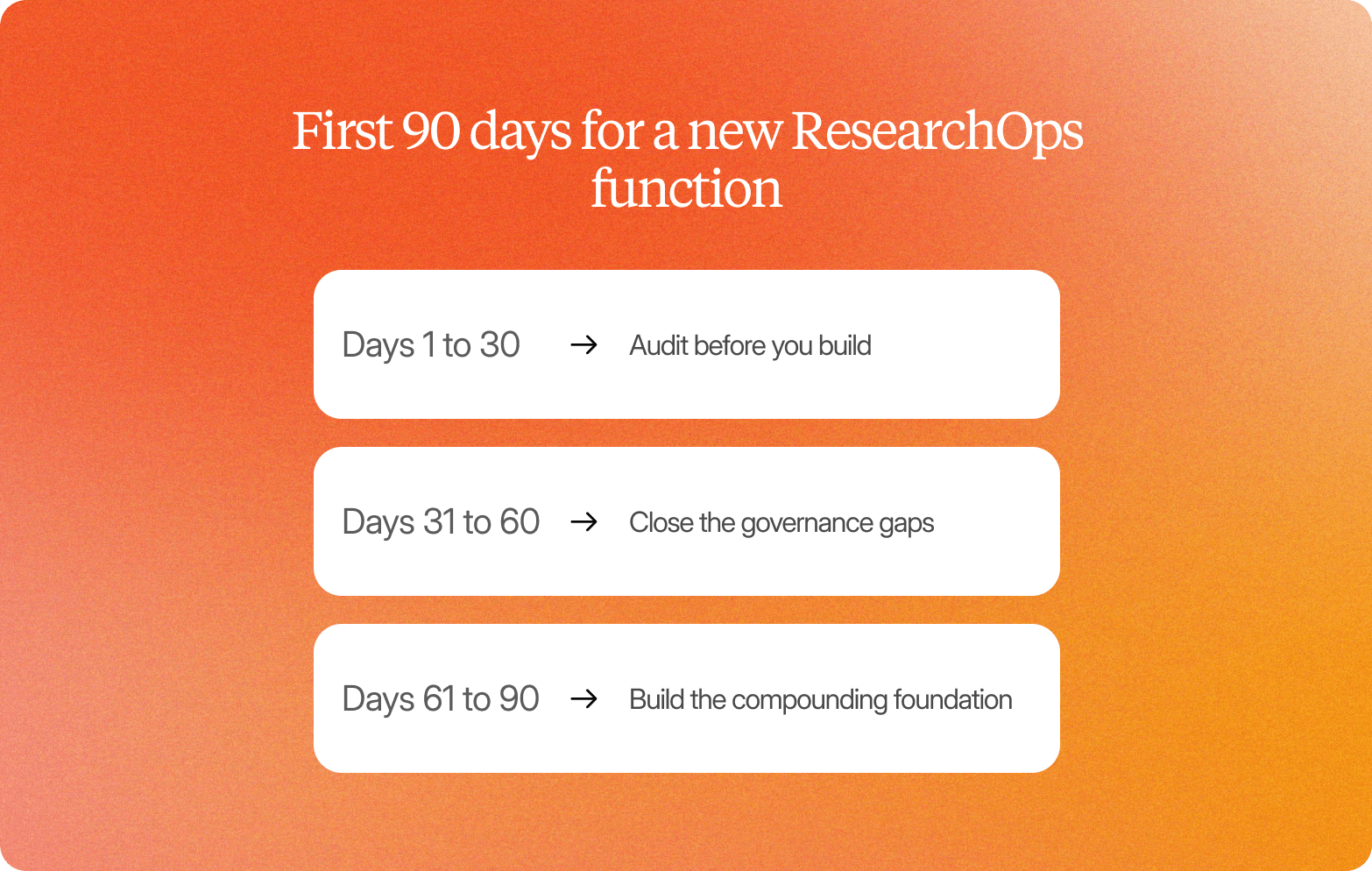
Days 1 to 30: audit before you build
Resist the instinct to fix things. Map the stack first, because you cannot make the case for infrastructure investment without knowing what the organization already spends, where, and why.
List every research tool the function touches: recruitment sources, moderation environments, transcription services, analysis layers, reporting formats, and wherever findings live after a study closes. For each vendor, record:
The contract renewal date
The compliance documentation on file
Whether one team uses it or several
Most organizations find overlapping capabilities across three or four vendors, and no single platform covers the current research process end-to-end.
Then audit process as well as platforms. Where do research outputs go after delivery? Who can access past research? How long does it take a new team member to find what was learned six months ago? Those answers make decision-lag visible.
Days 31 to 60: close the governance gaps
Work the procurement table above systematically. Any platform that cannot produce documentation against all six requirements is a governance risk, whatever the team's vendor preference, and those gaps become the strongest argument for consolidation.
On consolidation, shortlist platforms that cover the workflow end-to-end instead of individual steps, because scaling research beyond a certain volume depends more on the connections between stages than on any single stage.
Days 61 to 90: build the compounding foundation
Establish the knowledge library as a shared organizational asset. Every study that closes should produce a findable record in a single centralized repository: the research question, the research methods used, the key findings, and the verbatim evidence supporting them. Making prior findings searchable is what gives the repeat-study check something to search against.
Then build the leadership case. By day 90 you have an audit showing fragmentation, a compliance gap analysis showing risk, and early evidence of compounding value. Frame it in terms leadership already tracks: avoided research spend, faster time-to-answer, reduced compliance exposure, and valuable insights reaching decisions early enough to change them, so that research investments keep paying out after the study closes instead of expiring with the deck.
Why this belongs on Conveo
Consolidation, compliance, and a compounding knowledge library are three separate problems in most enterprise research stacks. Conveo closes all three from a single environment.
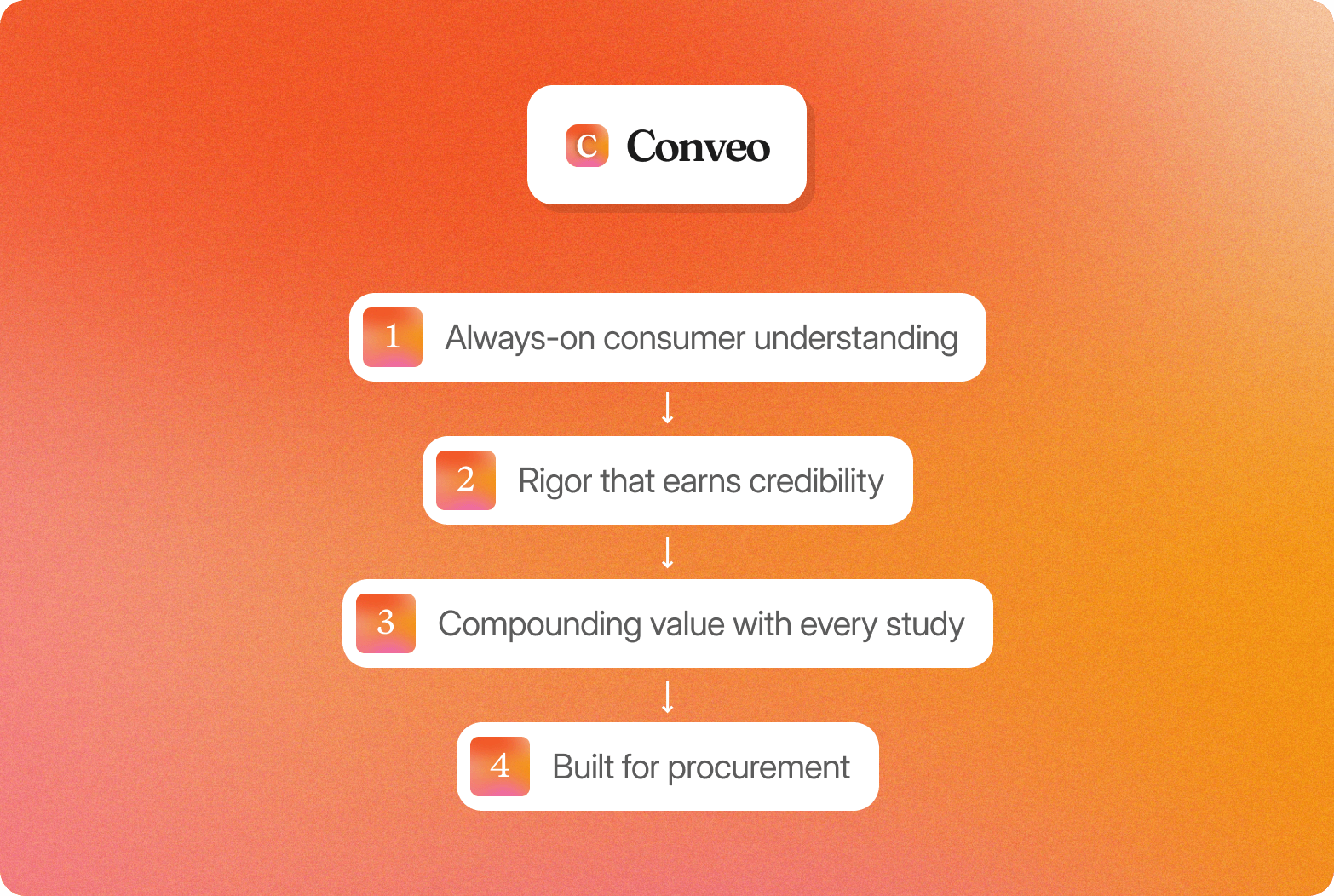
Always-on consumer understanding. Findings that arrive after the decision get fixed by never starting from zero. Conveo's searchable insight library keeps prior findings searchable and traceable, and StoryLines extends that into continuous, wave-based measurement.
Rigor that earns credibility. Conveo is built by researchers, and every finding traces to a real participant, a timestamped video moment, and a verbatim quote, grounded in what people actually said.
Compounding value with every study. Study design, recruitment, moderation, transcription, analysis, and the insight library share one data layer, so nothing gets re-tagged, re-imported, or re-researched.
Built for procurement. SOC 2 Type II certified, GDPR compliant, EU hosting (Belgium).
Frequently Asked Questions
What is ResearchOps, and how is it different from a research role?
ResearchOps, short for research operations, is the practice of managing the infrastructure, systems, and processes that enable researchers to work effectively at scale. A researcher designs studies, moderates conversations, and interprets findings. The Research Operations Manager makes that possible by managing vendor relationships, standardizing workflows, governing data, and ensuring the research tools in the stack pass compliance reviews. At enterprise scale, operational drag limits research output more than researcher skill does.
When does an organization need a dedicated Research Operations Manager?
Individual researchers can manage their own participant recruitment, consent forms, and note storage while the team is small. Most organizations reach the tipping point once volume climbs to dozens of research projects a year, or when multiple teams run studies independently without shared standards. At that point, a dedicated research ops function prevents data silos, inconsistent outputs, and compliance exposure.
What does a Research Operations Manager actually own day to day?
The role spans six areas: participant management, governance and compliance, knowledge management, platform decisions, workflow standardization, and research advocacy. Day-to-day, much of it is vendor contracts and security reviews, requests from research teams, maintaining the research repository, and keeping study outputs retrievable for audit purposes. This is the person who answers the procurement team's security questionnaire.
How does platform consolidation reduce the burden on research ops teams?
Every platform in the research toolkit is another vendor contract, another security review, and another set of credentials to manage. Teams running separate platforms for recruiting, moderation, transcription, analysis, and reporting spend significant time on vendor coordination instead of on the quality of qualitative research. A single platform that covers the research process from study design through delivery means fewer renewals, fewer onboarding cycles, and a single compliance posture to maintain.
What compliance requirements should a research ops team evaluate when selecting a research platform?
SOC 2 Type II certification, GDPR documentation, EU hosting for European teams, SSO integration, and on-demand PII deletion. Beyond the certifications, teams need a full audit trail: for any stored insight, where it came from, who accessed it, and when. Platforms that cannot demonstrate data security controls at that level create governance risk that falls on the Research Operations Manager to resolve. Verify against the vendor's current trust portal before signing, because certification status can change.
How does a research ops function support always-on research programs rather than one-off studies?
One-off research initiatives need vendor coordination and project management. Always-on programs need infrastructure that accumulates findings across waves, surfaces contradictions between studies, and makes past research retrievable without a manual search. Conveo StoryLines runs continuous, wave-based AI-moderated research, for example every two weeks or monthly, keeping a searchable insight library current between studies instead of only within them. A function consolidated onto a platform built this way can support that shift. One that has not will spend its capacity on coordination.

About the author
Dieter De Mesmaeker
Co-Founder & CEO
Dieter is CEO and co-founder of Conveo. Before starting the company, he founded DataCamp and scaled it into one of the leading edtech platforms in the world.
More by Dieter →Qualitative insights at the speed of your business.
Conveo runs AI-moderated video interviews and structures everything they say.