In this article
TL;DR
The real problem is decision-lag: when insights arrive after the decision window closes, they explain outcomes rather than shape them
Traditional qualitative research methods take weeks because each stage waits for the previous one to finish, not because anyone is working slowly
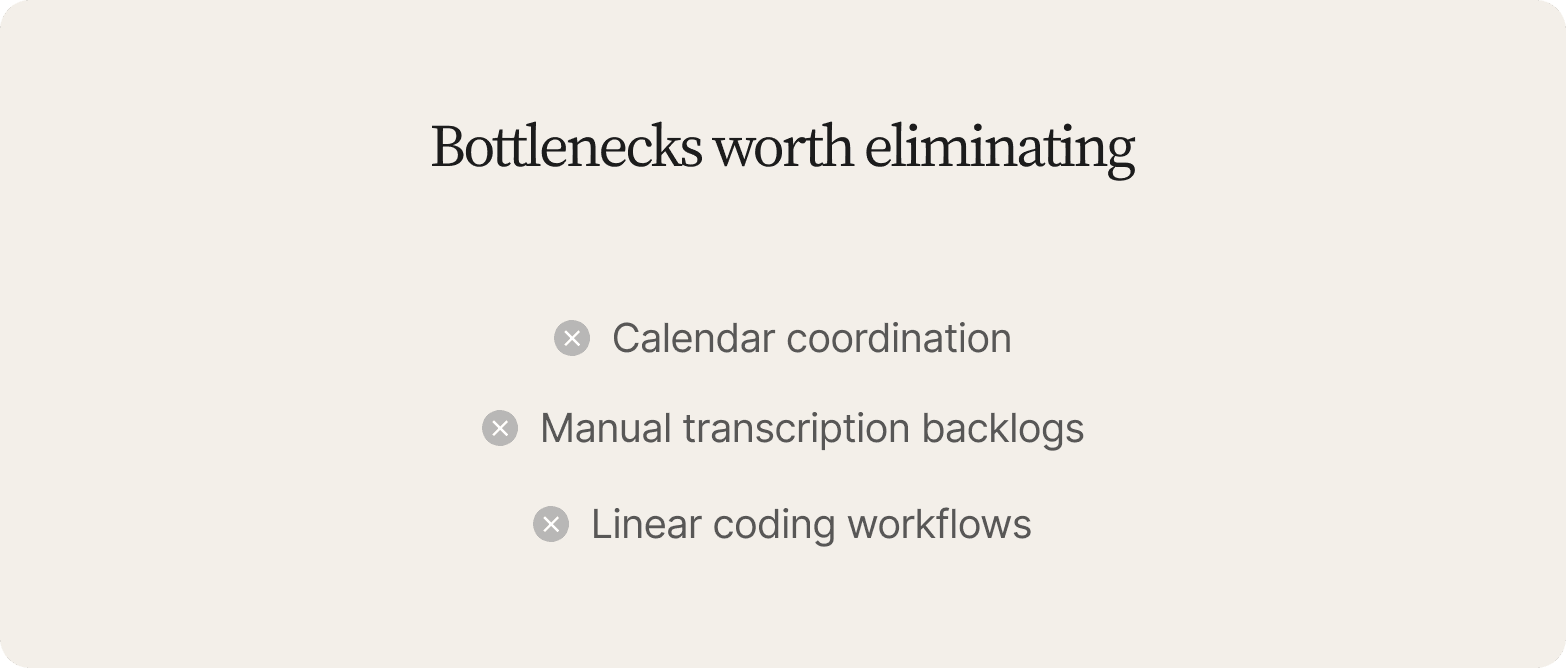
Three bottlenecks compress safely: calendar coordination, transcription backlogs, and linear coding workflows
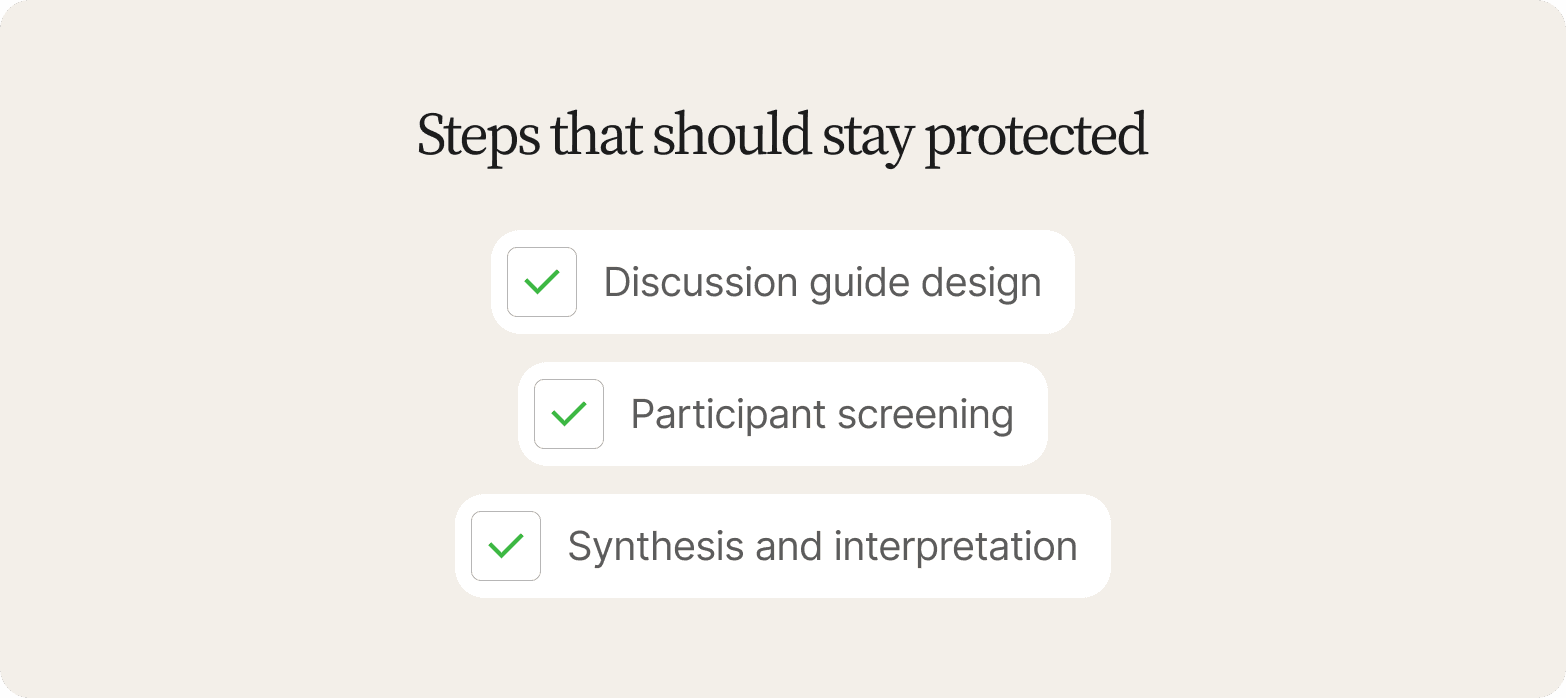
Three steps must stay protected: discussion guide design, participant screening, and synthesis/interpretation
Speed is a capability that expands what research teams can do, not a mandate that replaces deliberation
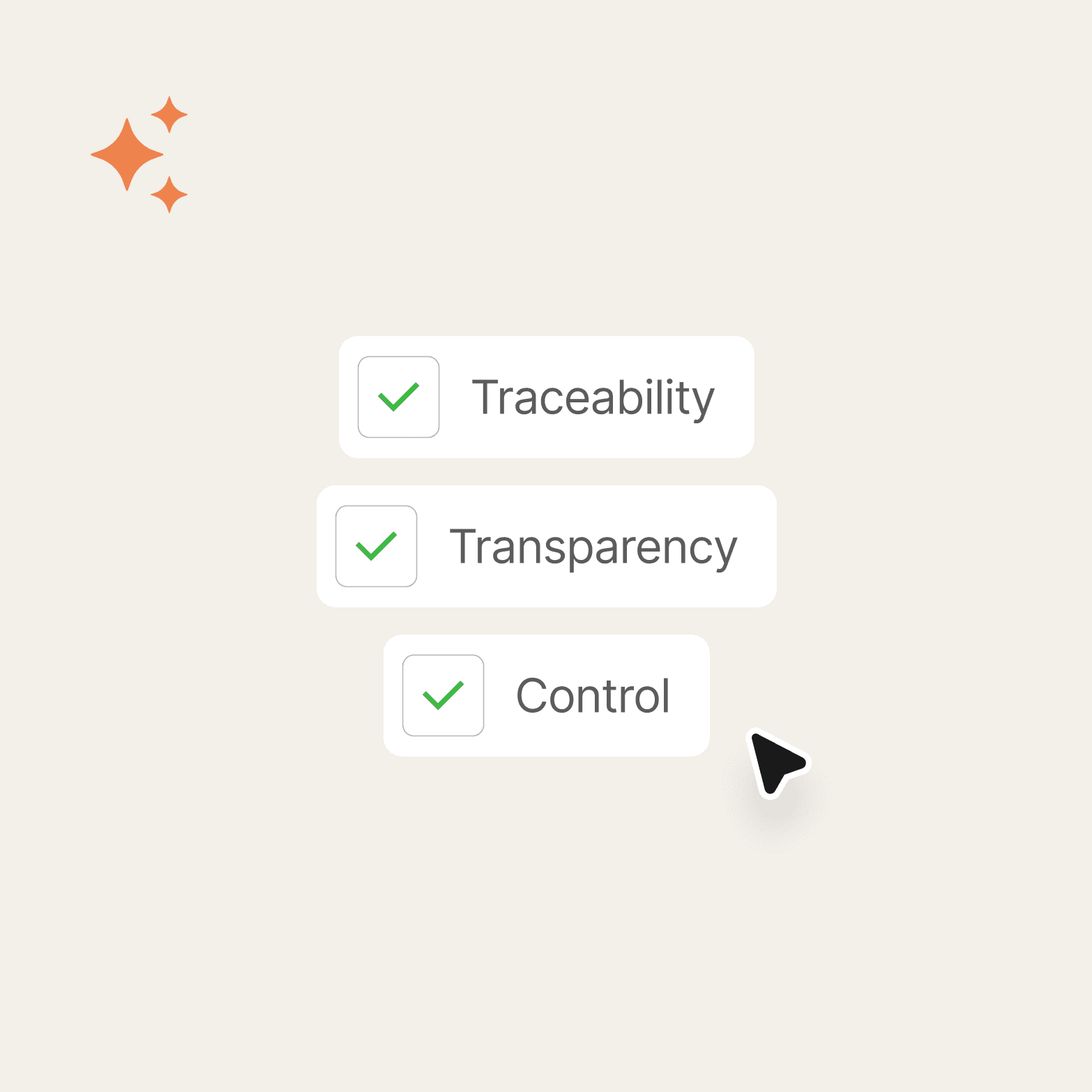
Evaluate faster approaches using three criteria: traceability to source evidence, methodological transparency, and researcher control over interpretation
Research operations managers know the pattern. A product lead needs consumer input before a sprint closes. A brand team needs messaging validation before the creative brief locks. The research plan is sound; the timeline is not. By the time findings arrive, the decision they were meant to inform has already been made, so the insight explains the outcome rather than shaping it.
This is the decision-lag problem, and it is not a sign that qualitative research methods are flawed. Traditional workflows were built for a world where weeks between question and answer were acceptable, and that world has narrowed considerably.
Qualitative and quantitative research answer different questions. Quantitative research uses numerical data and larger samples to test hypotheses. Qualitative research methods explore human behavior in depth, capturing the subjective nature of how people think and decide, through in-depth interviews and participant experiences rather than quantitative data alone. The tradeoff is depth versus scale, and most product and brand decisions genuinely need the depth.
The structural problem sits in how traditional qual workflows are sequenced: recruitment scheduling adds time before a single interview begins, manual transcription creates a backlog that scales with session count, and qualitative coding adds hours per interview on top of that. A standard study consumes weeks end to end, not because anyone is working slowly, but because each step waits for the last to finish, and a two-week product sprint cannot absorb a process built that way.
This article covers where time actually disappears in traditional qual workflows, which steps can be compressed without degrading rigor, and how teams evaluate the speed-versus-rigor trade-off among agency-led qual, DIY stacks, and AI-moderated platforms. The aim is a diagnostic framework for an internal business case: that faster research is achievable without trading away the traceability enterprise stakeholders require.
Why Traditional Qualitative Workflows Create Decision-Lag
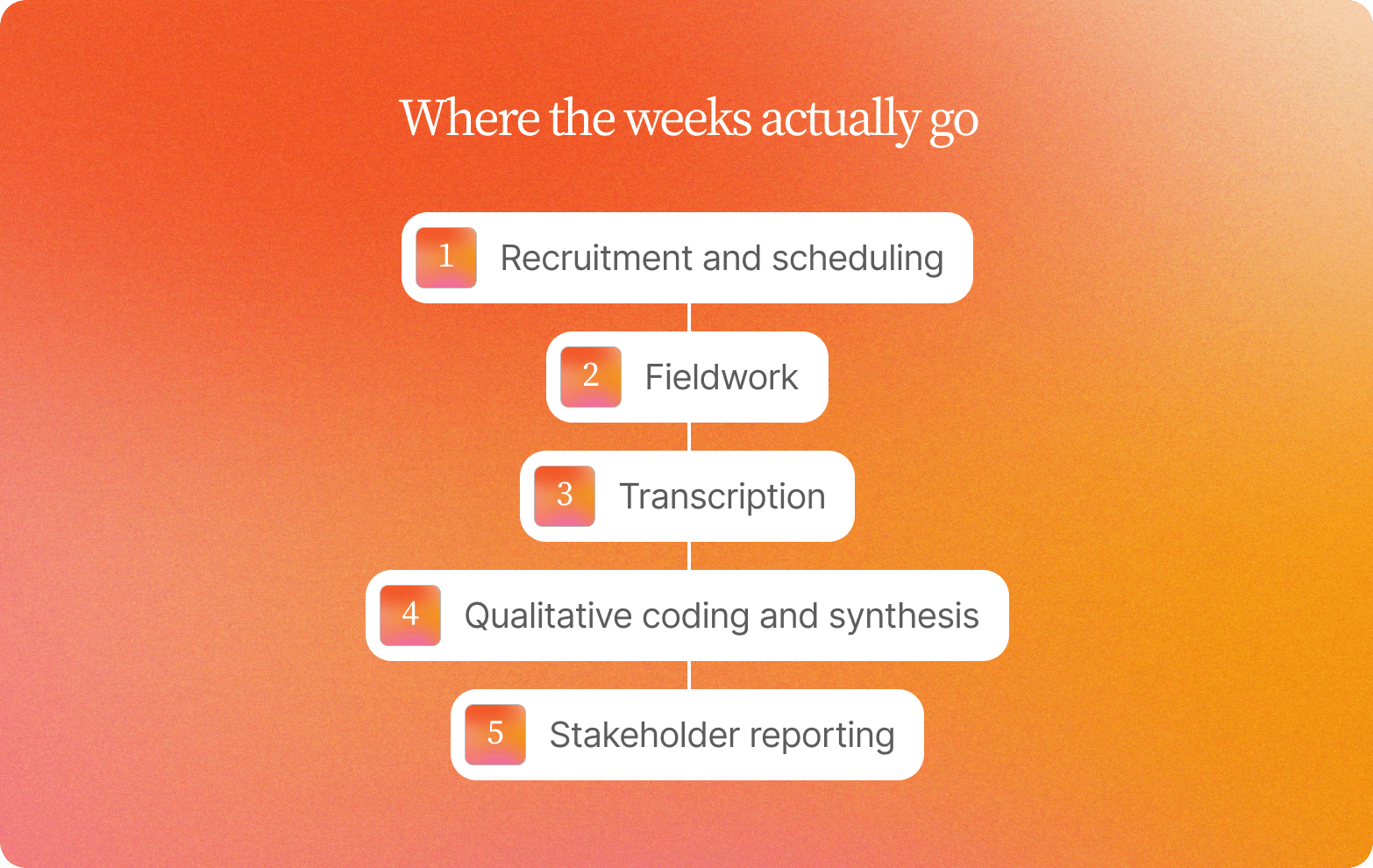
The answer is structural. The research process behind traditional qualitative research methods is a sequence of manual, human-dependent stages, each of which must be completed before the next begins.
Recruitment and Scheduling
Before collecting qualitative data, someone has to find the right participants, screen them for fit, and get them on a calendar that accounts for moderator availability and time zones. Teams report this alone consumes one to two weeks, and global programs add their own local coordination delays.
Fieldwork
Live moderated interviews, often run as in-depth interviews, face a hard ceiling: one moderator, one interview at a time. Moderators have limited daily capacity, participants cancel and reschedule, and there is no parallel track, so every session waits for the previous one to close.
Transcription
Once fieldwork closes, recordings sit in a queue. Manual transcription services take several business days to return clean transcripts, and the qualitative data trapped inside cannot be analyzed until they come back. The delay scales linearly with interview count.
Qualitative Coding and Synthesis
Manual qualitative coding typically takes two to three hours per interview. Thematic analysis requires reading transcripts multiple times, tagging quotes, identifying patterns, and building a coherent narrative. This in-depth analysis step cannot be compressed without sacrificing the rigor that makes findings credible.
Stakeholder Reporting
Findings go into a deck before decisions are reached: quote selection, thematic and descriptive summaries, framing for specific audiences, and revision cycles. Several business days is realistic for a well-run process.
Add those stages together and a standard study, run competently, takes weeks from brief to findings. Historically, this timeline reflects the real cost of sequential, human-dependent work carried out to a professional standard. The business risk is that decisions do not wait: concept reviews close, campaign briefs lock, sprint cycles move on, and teams end up either treating research as a post hoc explanation or commissioning the next study, knowing it will arrive too late again.
"No more waiting weeks for an agency to summarize what consumers said"
CMI Lead, Edgard & Cooper
What Slows Down Qualitative Research (and What Does Not)
Some steps in a qual timeline take time because they require researcher judgment or interpretive work that cannot be compressed without degrading the output. Others take time because of operational constraints unrelated to research quality. The opportunity is eliminating the second category while protecting the first.
3 Bottlenecks Worth Eliminating
Calendar coordination
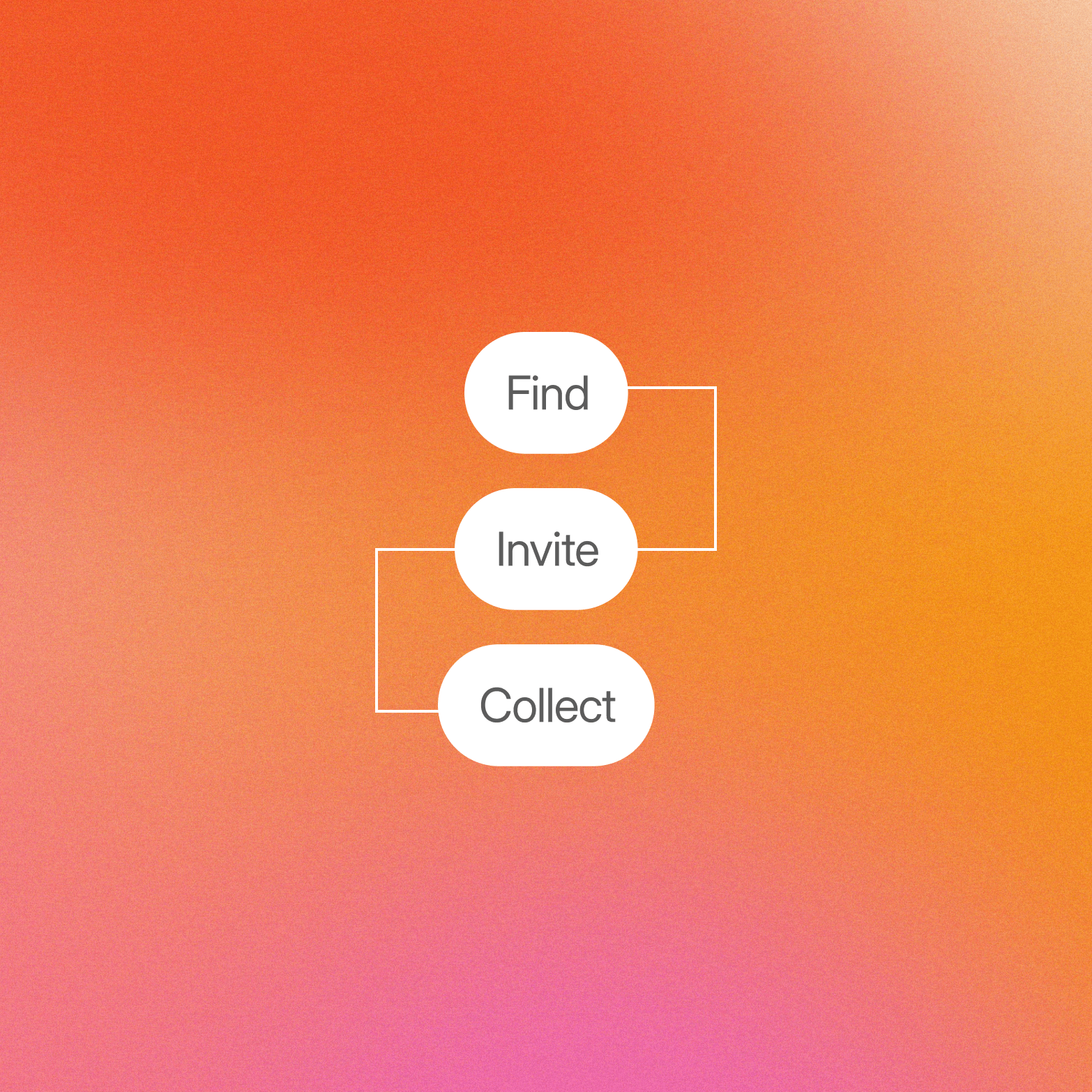
Scheduling live interviews across time zones turns fieldwork into a serial process, and every scheduling gap compounds into lost time. Asynchronous video interviews remove this constraint: participants complete sessions on their own schedule, so fieldwork runs in parallel.
Manual transcription backlogs
Waiting days for transcripts before analysis can begin adds time after the research itself is already complete. Automated transcription compresses this to hours and delivers transcripts incrementally as sessions land.
Linear coding workflows
Manual qualitative coding, sometimes formalized as content analysis, traditionally begins only after all transcripts are complete. AI-surfaced coding lets initial themes surface as sessions arrive, so researchers can refine the discussion guide mid-study or deliver preliminary findings before the last interview is done.
Three Steps That Should Stay Protected
Discussion guide design
A poorly constructed guide creates leading questions that unduly influence responses, and no amount of speed fixes that upstream problem. The guide still needs to reflect the underlying hypotheses or theory behind what you are trying to learn, and rushing its design will create rework later.
Participant screening
Faster recruitment only helps if the participants recruited actually fit the criteria. Screening must be precise, consistent, and often context-specific to the study's decision; recruiting the wrong participants invalidates findings regardless of speed.
Synthesis and interpretation
Identifying patterns, resolving contradictions, and building a narrative that reflects participant experiences requires human judgment and inductive reasoning, moving from specific observations to broader themes. The researcher must also stay alert to their own influence and researcher bias when deciding which contradictions matter. AI can surface themes and tag quotes, but the researcher decides what's meaningful, which makes the findings trustworthy rather than merely fast.
How AI-Moderated Interviews Address Decision-Lag
The decision-lag problem is structural. Traditional qualitative research methods run slowly because the workflow is linear, with each phase waiting for the last to close before the next can start. AI-moderated interviews break that sequence by running fieldwork, transcription, and initial coding in parallel rather than in sequence, compressing timelines from weeks to days without removing any analytical step.
Parallel Fieldwork
Asynchronous, in-depth video interviews remove the calendar-coordination dependency entirely; participants complete a session when it suits them, so a study can run to completion in days.
Moderation quality holds steady. An AI moderator probes based on what participants actually say, adapting follow-up questions to specific language and hesitation, which removes the need for second-round interviews to chase threads a rigid script missed.
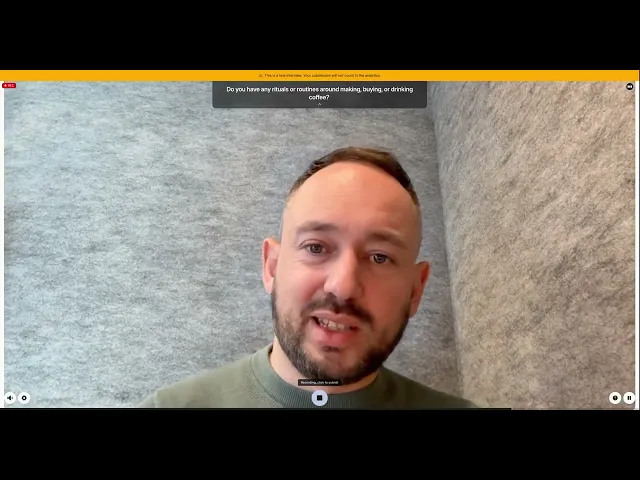
See it in action: How AI-Moderated Video Interviews Actually Work
Automated Transcription and AI-Surfaced Coding
Collecting qualitative data no longer means waiting on a transcription backlog: it happens automatically as each recording lands, so researchers can begin to analyze first interviews before the last participant finishes. Coding compresses the same way. AI surfaces trends and themes as sessions arrive; researchers validate and refine that output rather than building it from scratch, so the analytical judgment stays with the researcher while the administrative overhead does not.
Incremental Stakeholder Readouts
Findings can be shared as they emerge, giving stakeholders deep insights before a final deck is even close to ready. Every finding traces back to a timestamped video clip and verbatim quote, so stakeholders get relevant insights they can verify themselves rather than summaries they must take on faith, shifting the review conversation from "do we trust this?" to "what do we do about it?"
Comparison: Traditional Qual vs AI-Moderated Interviews
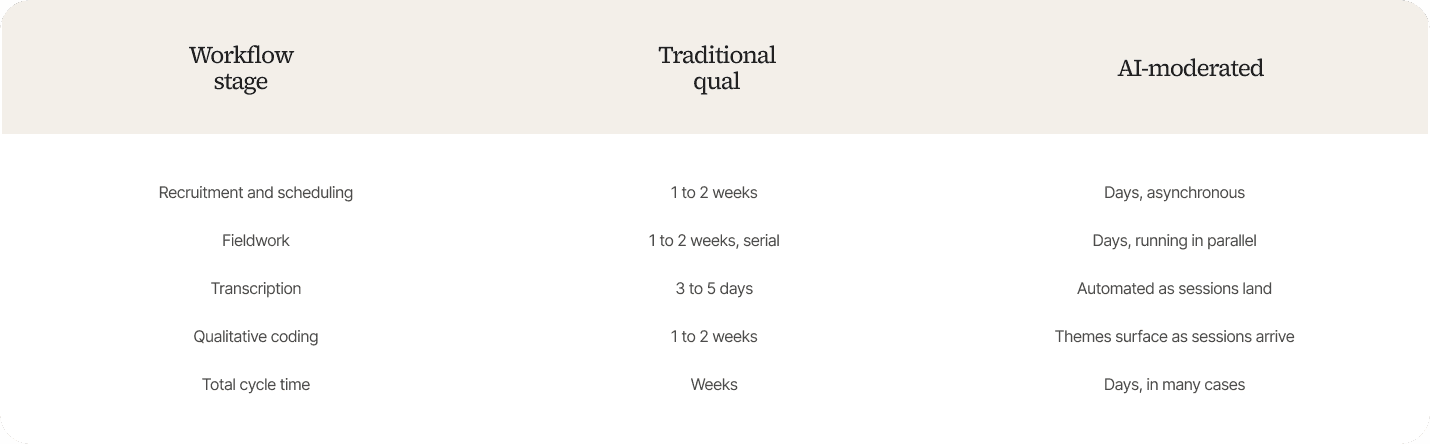
Each row below draws on the same multiple data sources, video, transcripts, and coded themes, so the speed difference is structural: it comes from removing calendar dependency and running work in parallel rather than in sequence, without trading away traceability or rigor.
| Workflow stage | Traditional agency-led qual | DIY qual stack | AI-moderated interviews | What changes |
|---|---|---|---|---|
| Recruitment and scheduling | 1 to 2 weeks (calendar coordination across time zones) | 1 to 2 weeks (same constraint) | Days (asynchronous, participants complete on their schedule) | Removes calendar coordination bottleneck |
| Fieldwork | 1 to 2 weeks (live moderation, serial interviews) | 1 to 2 weeks (same constraint) | Days (parallel asynchronous sessions) | Fieldwork runs in parallel rather than waiting for scheduling windows |
| Transcription | 3 to 5 days (manual transcription backlog) | Hours (automated transcription tools) | Automated, incremental as sessions land | Removes transcription backlog; analysis starts before fieldwork closes |
| Qualitative coding | 1 to 2 weeks (2 to 3 hours per interview, manual coding) | 1 to 2 weeks (same constraint) | Initial themes surface quickly; researcher validates and refines | AI surfaces patterns as sessions arrive; researcher maintains interpretive control |
| Stakeholder reporting | 3 to 5 days (deck creation, review cycles) | 3 to 5 days (same constraint) | Incremental readouts, traceability to timestamped video | Findings shared as sessions land; stakeholders inspect source evidence |
| Sensitive or nuanced topics | Well-suited (experienced moderators adapt in real time) | Moderate (depends on researcher skill) | May benefit from human moderation for highly sensitive topics | Very sensitive topics (healthcare decisions, personal loss, discrimination) may warrant slower, human-moderated approaches for participant trust |
| Total cycle time | Weeks | Weeks | Days, in many cases | Parallel workflows compress end-to-end timeline significantly |
Note: cycle time estimates are based on typical enterprise studies. Multi-market programs with complex screening may vary. The scenarios above are representative of common patterns, not specific client results.
For example, a DIY stack shortens transcription but leaves the scheduling and coding bottlenecks in place. With AI-moderated interviews, recruitment, fieldwork, transcription, and initial theme extraction overlap rather than wait for each other.
When Speed Matters (and When It Does Not)
Not every research question requires the same timeline, and compressing a study into days just because the capability exists carries its own risks: missed nuance, under-recruited samples, and findings that move too quickly for stakeholders to trust. The right question is whether the decision window and stakes align with a compressed cycle.
3 Scenarios That Justify Moving Fast
Product sprint cycles
For instance, a two-week sprint cannot accommodate a multi-week research timeline. When the qual cycle compresses to days, research becomes a pre-decision input instead of a post-decision validation.
Campaign launch windows
By the time a multi-week study returns, the creative brief is locked, and the media buy is placed. A compressed cycle lets teams test messaging or creative before the launch window closes.
Continuous discovery programs
One-off projects tie confidence to the most recent project alone. Continuous qual builds confidence through convergence: when the same theme recurs across multiple studies of the same phenomenon over months, researchers approach theoretical saturation, where new insights become incremental refinements rather than one-off discoveries. This is where Conveo StoryLines fits, enabling continuous wave-based research that makes ongoing discovery operationally feasible for teams that previously could only afford quarterly agency-led studies.
2 Scenarios That Call for Slower Timelines
Foundational segmentation or brand positioning
Decisions with multi-year consequences reward slower timelines; compressing the cycle risks limited generalizability if patterns are misread across segments.
Sensitive or high-stakes topics
Research on healthcare decisions, financial stress, or workplace discrimination requires time to build participants' trust, and rushing recruitment or moderation poses real risks.
Key Takeaway
Speed expands what research teams can do without replacing the need for deliberation. Teams no longer face a forced tradeoff between consumer input and a decision window for time-sensitive questions. The option to slow down when stakes require it remains, and using it is a sign of judgment.
Evaluating Speed-Versus-Rigor Tradeoffs
The question stakeholders ask when faster qual is on the table is rarely "can we afford it?" It's "can we trust it?" Does compressing a multi-week timeline down to days mean sacrificing the traceability or transparency that makes a finding defensible to a senior decision-maker?
A Three-Part Framework for Evaluation
1. Traceability to source evidence
A finding that cannot be traced to a specific person, moment, and statement is an assertion, not evidence. Surveys deliver speed and numerical precision at scale, but they cannot show hesitation or exact language; a five-point rating is descriptive, not explanatory. AI-moderated interviews produce timestamped video and verbatim transcripts that capture lived experience, so stakeholders move from "the research says" to "here is the participant explaining exactly why," after some in-depth analysis of the underlying footage rather than a glance at a summary slide.
2. Methodological transparency
Rigor requires visibility into who was recruited, what was asked, and how responses were coded within the research process. Platforms that summarize transcripts without surfacing the discussion guide or coding logic create credibility risk. Methodological transparency in AI-moderated research means the guide, probing logic, and full session are all available for review.
3. Researcher control over interpretation
Speed only threatens rigor when interpretation is handed off entirely to an algorithm that cannot account for the subjective nature of human behavior or its own influence on how a theme gets framed. AI can surface themes and tag quotes faster than any manual process, but managing researcher bias and deciding which patterns matter for the business question still belongs to a person.
Applying the Framework Across Common Approaches
| Approach | Traceability | Methodological transparency | Researcher control | Typical cycle time |
|---|---|---|---|---|
| Agency-led qual | High, if transcripts and video are provided | High, if the agency shares the guide and coding framework | High: experienced moderators and analysts | Weeks; expands research capacity for complex programs |
| DIY qual stack (Zoom + transcription + manual coding) | Medium: video and transcripts available, but no timestamped tagging | Medium: researcher controls the guide and coding | High, but time-intensive | Weeks |
| AI-moderated interviews | High: timestamped video and verbatim transcripts for every session | High: discussion guide, probing logic, and full session available for review | High: AI surfaces themes, researcher validates and interprets | Days, in some cases |
Considerations
Recruitment quality matters more, not less. Less time to recover from a poorly recruited sample means recruitment effort and precise screening become critical dependencies.
Not every topic suits asynchronous moderation. Highly sensitive topics may benefit from human rapport-building.
Findings remain subjective. Qualitative data is an interpretation of lived experience, not a neutral measurement, which is exactly why traceability and researcher judgment matter.
Stakeholder readiness varies. Incremental delivery requires stakeholders who can engage with emerging data; some teams need change management first.
Compounding value takes time. The first study may not feel dramatically different; value compounds as insights accumulate.
Compliance remains non-negotiable. Ensure any platform meets your requirements for data residency, access controls, and audit trails.
How Conveo Helps Research Operations Teams Close the Decision-Lag Gap
For research operations managers, the aim is compressing timelines without sacrificing rigor. This is what Conveo was built to solve. Conveo is Consumer Understanding Infrastructure: a category of platform that sits alongside the CRM and ERP as core enterprise infrastructure for understanding consumers at scale, designed for always-on research that compounds insight over time rather than resetting the research process with each new study.
The platform is built by researchers. Discussion guides, probing logic, and coding frameworks are designed with qualitative research discipline at the center, and every qualitative data point traces back to timestamped video and verbatim quotes, giving stakeholders source evidence and relevant insights they can inspect rather than summaries they must trust on faith. As insights accumulate, the Knowledge Layer makes prior learnings searchable and reusable, and Conveo StoryLines enables wave-based research on an ongoing cadence for continuous discovery.
Compliance is built in: Conveo is SOC 2 and GDPR compliant and operates from European hosting, with primary infrastructure in Belgium.
Teams report compressing timelines from weeks to days in many cases, presenting findings while decisions are still open rather than after decisions are made. Removing structural bottlenecks is what makes that speed possible. The pitch is that research operations teams can run rigorous qualitative research on the timeline decisions require.
Frequently Asked Questions
Why does traditional qualitative research take so long?
The workflow is sequential: recruitment finishes before fieldwork, fieldwork before transcription, transcription before coding. Each stage waits for the last to close, and the delays compound. Unlike quantitative research, which tests hypotheses across large samples using numerical data, qualitative research explains the human behavior behind the numbers, and that explanatory depth is inherently slower to produce than a survey.
Can AI-moderated interviews match the depth of human-moderated interviews?
Yes, through adaptive probing: the AI moderator follows up based on what participants actually say, pursuing threads a rigid script would miss. The full video and transcript remain available for researcher review, so nothing is lost in translation, and teams report comparable or greater depth for most commercial questions. Very sensitive topics may still benefit from human moderation.
How do I know if faster research will be credible to my stakeholders?
Credibility depends on traceability and transparency. Stakeholders interested in verifying a finding should be able to inspect it themselves, with timestamped video and verbatim quotes included, which shifts the conversation from "do we trust this?" to "what do we do about it?"
What types of research are not suited to compressed timelines?
Foundational work with multi-year consequences, like segmentation or brand positioning, benefits from slower, deliberative timelines. Sensitive topics like healthcare decisions or workplace discrimination require time to build participant trust. Slowing down when the stakes require it is itself a sign of good judgment.
How do I build an internal business case for AI-moderated research?
Quantify how often findings arrive after the decision window has closed. For instance, identify specific decisions last quarter that were made without consumer input because the timeline didn't fit. Frame faster research as expanding what the team can do, and emphasize that traceability and rigor are preserved, not traded away.

About the author
Florian Hendrickx
Head of Growth
Florian is Conveo’s Chief Growth Officer, leading growth strategy and go-to-market execution as the company scales. He’s held growth leadership roles at companies like Deliverect, Robovision, and Aikido Security, and brings hands-on experience across marketing, sales, and product.
More by Florian →Qualitative insights at the speed of your business.
Conveo runs AI-moderated video interviews and structures everything they say.