In this article
TL;DR
Customer intelligence (CI) is the discipline of turning real customer conversations and behavioral signals into decision-ready understanding, not just collecting data
Surveys capture what customers say; customer intelligence explains why customer behaviors diverge from expectations, closing the gap that causes teams to act on assumptions
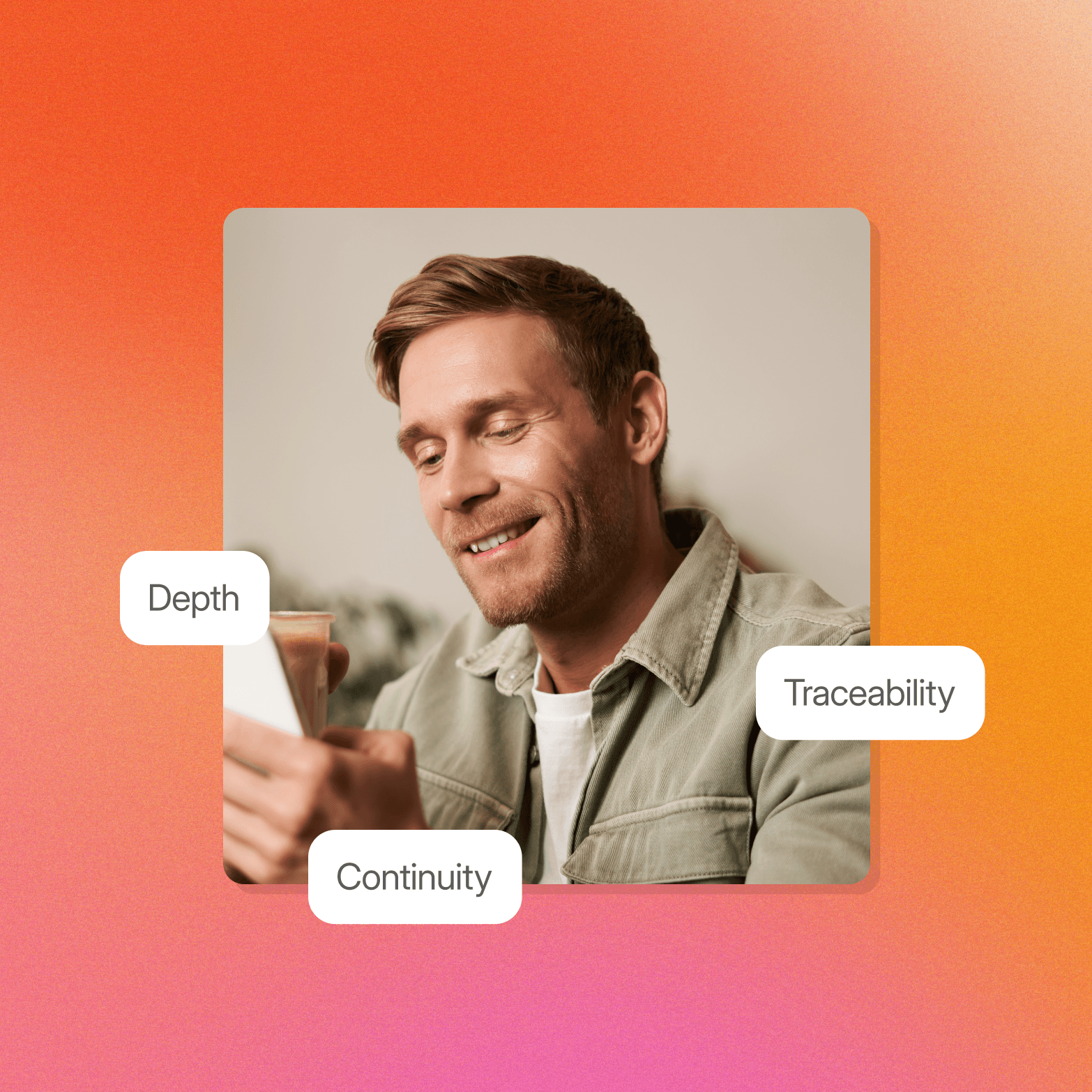
Three components separate actionable intelligence from passive data: depth (conversational understanding), traceability (evidence stakeholders can inspect), and continuity (knowledge that compounds across studies)
AI-moderated video interviews now deliver qualitative depth at quantitative speed, compressing timelines from weeks to days without sacrificing the nuance that makes findings credible
Building an effective customer intelligence strategy starts with aligning research to decision moments, running real conversations with individual customers, making findings traceable, and converting data collected into actionable insights that compound over time
Customer intelligence is the discipline of turning real customer conversations and behavioral signals into decision-ready understanding, not just collecting data. For decades, qualitative research faced a fixed trade-off: surveys offered speed and scale but no depth, while in-depth interviews offered depth but took weeks. That constraint meant enterprise teams often made decisions without truly understanding why customer behaviors diverged from expectations.
That tradeoff is dissolving. AI-moderated video interviews now gather customer intelligence data from hundreds of real conversations in parallel, with adaptive probing, traceable evidence, and analysis timelines measured in days, a deeper understanding of customers that's continuous, grounded, and credible enough to change decisions rather than just document them.
This article covers what customer intelligence is, why it matters, how to leverage it in practice, and what makes it credible enough to influence decisions.
What Is Customer Intelligence?
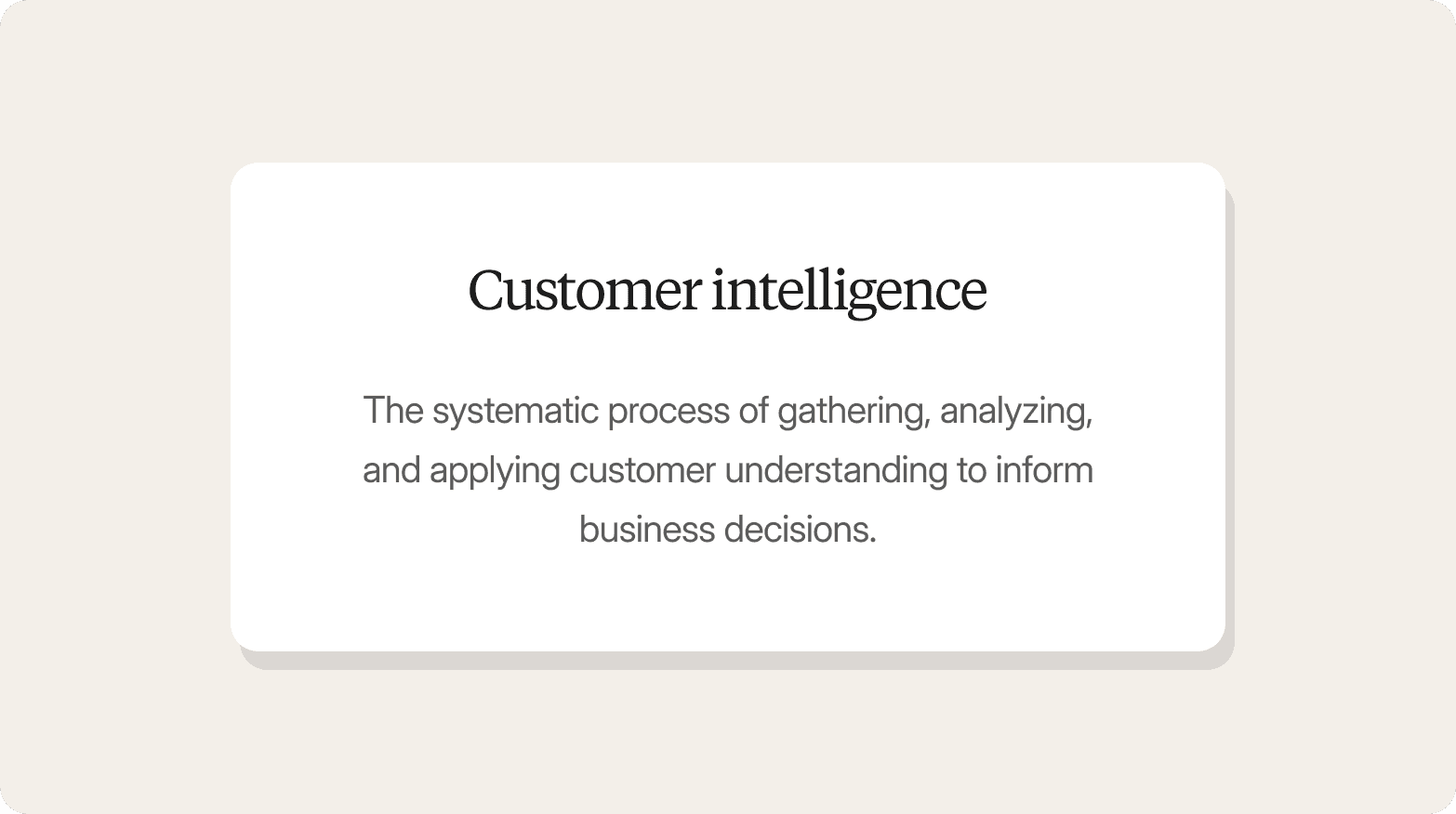
Customer intelligence (CI) is the systematic process of gathering, analyzing, and applying customer understanding to inform business decisions. It is not a data warehouse, a dashboard, or a survey score. It is the organizational capability to understand why customers behave as they do, before a decision window closes.
Customer data tells you what happened: a feature adoption rate dropped 30% last quarter. Customer analytics tells you where patterns exist: the drop is concentrated among users who onboarded in under five minutes. Customer intelligence tells you why: those users never understood the core workflow because the setup experience created false confidence before they'd learned anything.
Unlike business intelligence, which draws mainly on operational and financial data, customer intelligence analytics synthesizes multiple data types:
Demographic data: age, location, firmographic attributes
Psychographic data: values, attitudes, lifestyle
Transactional data: purchase history, average order value, returns
Interaction data: support tickets, product usage, survey responses
First-party data: gathered directly from customer conversations
Third-party data: from market research panels and consumer research firms, useful as a supplement, though the richest intelligence comes from direct customer interactions
Customer intelligence meaning extends beyond demographic profiles and behavioral logs. It covers motivations, unmet needs, and the context behind choices, including customer opinions, customer preferences, and customer information that behavioral tracking alone can't surface.
Three components separate actionable customer intelligence from data that sits in a report:
Depth means understanding why customers behave as they do, not just cataloging what they did.
Traceability means linking every claim about customer insights back to real evidence, so stakeholders can inspect the source rather than accept a summary.
Continuity means building knowledge that compounds across studies over time, rather than starting from scratch each quarter.
The product team in the example above had customer intelligence data in the form of metrics. What they lacked was the explanatory layer that only real conversations provide. The gap closed only when customers described the friction in their own words, naming the exact moment the workflow stopped making sense. That shift, from pattern recognition to contextual understanding, is what effective customer intelligence delivers.
Why Does Customer Intelligence Matter If You Already Have Data?
Customer intelligence matters even when you have data because data alone tells you what customers did, not why. Most enterprise teams are already surrounded by data yet still make decisions based on assumptions. Behavioral analytics, customer relationship management (CRM) records, and engagement dashboards tell you what customers did. Customer intelligence closes the gap between action and motivation, and that gap is where strategies go wrong, campaigns miss, and products get built without a real understanding of customer needs.
Three decision moments show why that gap matters:
Product roadmap prioritization. Usage data shows which features get clicked, not which problems customers are actually trying to solve or which gaps they'd switch vendors over. Without that context, roadmap decisions default to the loudest internal voice.
Brand and messaging validation. Marketing efforts miss when the language or framing doesn't match how customers actually think about the category. Teams that validate with real consumer conversations before production catch mismatches while changes are still cheap.
Customer experience improvements. Drop-off rates and satisfaction scores flag a symptom, not a cause. Understanding the full context of customer journeys, from the first touchpoint through renewal, is what enables teams to improve customer satisfaction at the moments that matter.
Predictive and explanatory intelligence solve different problems. Predictive customer intelligence uses behavioral patterns, predictive analytics, and machine learning to forecast what customers are likely to do next, valuable for demand planning, identifying at-risk customers, and modeling customer lifetime value. Explanatory intelligence, built on real conversations, is what most teams actually lack: prediction tells you a customer is about to leave; explanation tells you why.
Teams that build continuous customer intelligence into their decision-making compound their advantage over time. Customer loyalty, customer retention, and long-term revenue growth all improve when decisions are grounded in a continuously refreshed understanding of customer needs. Business leaders who treat customer intelligence as infrastructure, not a periodic project, stay ahead of broader market trends rather than reacting to them.
How Do You Build Customer Intelligence? 3 Components, 3 Methods
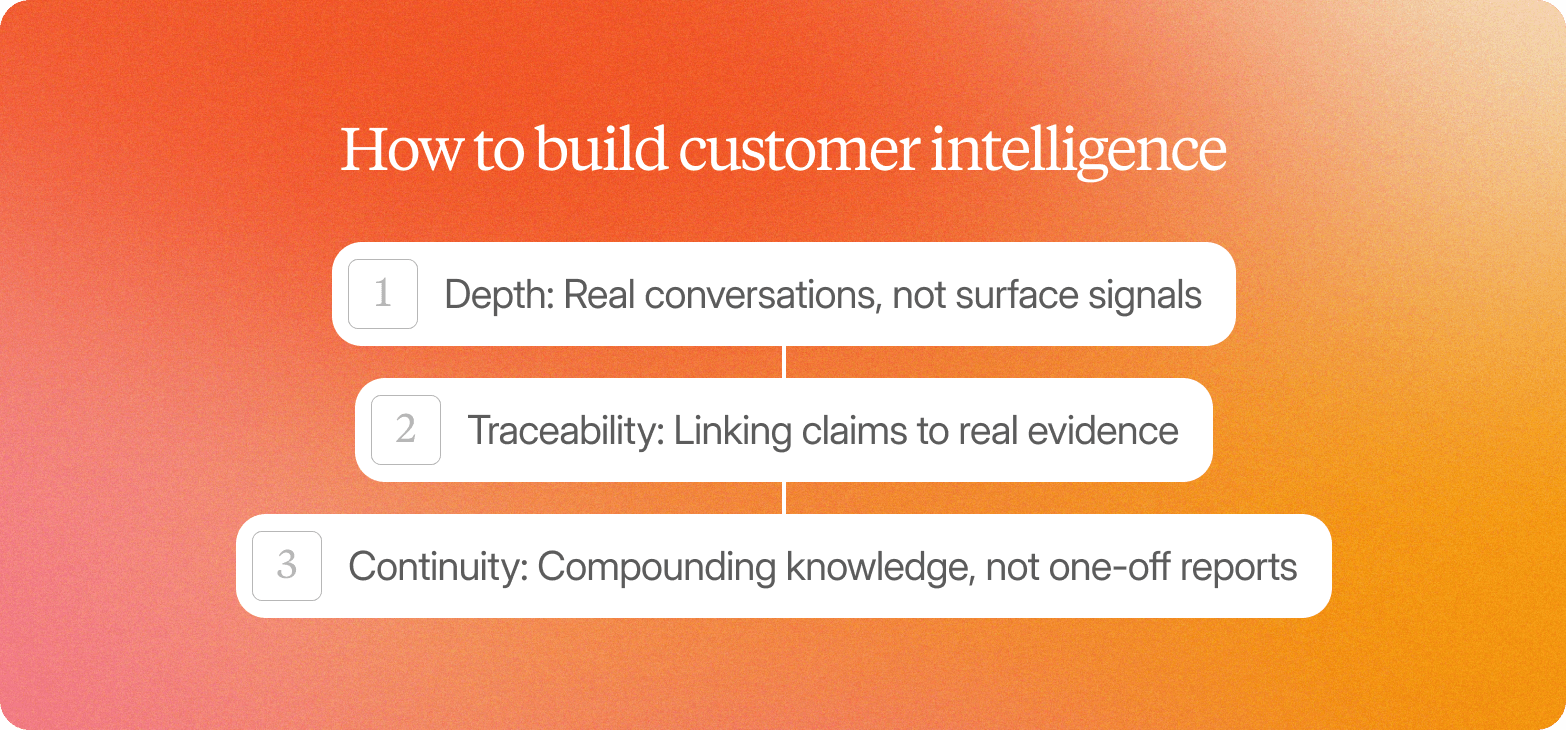
Customer intelligence rests on three components, and gets built using one of three research methods. Here's each.
1. Depth: Real Conversations, Not Surface Signals
Depth means capturing why customers behave as they do, not just what they did. Surveys answer the question you asked; they rarely answer the question that matters. When 60% of customers rate a feature "somewhat useful," that looks like validation. Video interviews with the same individual customers can reveal they use it only because the alternative is worse, not because it works. That distinction changes the roadmap entirely.
The gap between what customers say and what they mean lives in signals surveys can't capture: a pause before answering, a drop in tone, a hesitation that signals uncertainty rather than satisfaction. Analyzing customer data at the behavioral level tells you what happened. Qualitative data from real conversations tells you why, and how to address the customer preferences driving it.
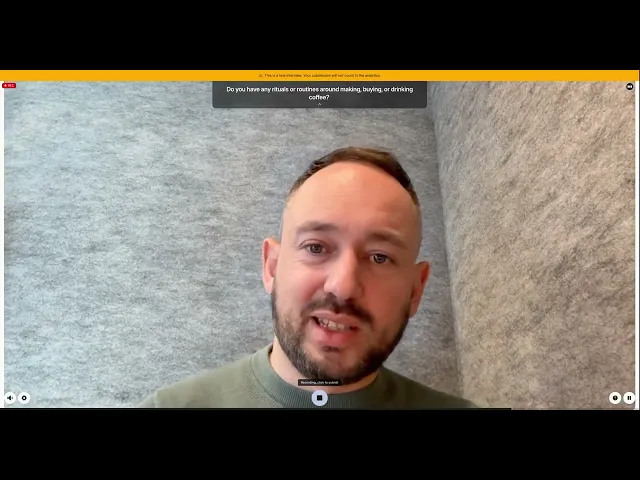
Conveo's video-first interviews use adaptive probing, following what participants actually say rather than a fixed guide. When a participant's language shifts or trails off, the AI moderator follows up, and that follow-up is where customer feedback yields customer insights no structured survey could surface.
See it in action: How AI-Moderated Video Interviews Actually Work
2. Traceability: Linking Claims to Real Evidence
Traceability means every insight links back to the real evidence behind it, so stakeholders can inspect the source rather than take a summary on faith. Stakeholders who weren't in the room have no reason to trust a summary slide, and this is where customer intelligence efforts succeed or fail: not in the quality of the interviews, but in the ability to defend the conclusions.
When every theme, claim, and recommendation links directly to timestamped video clips and verbatim quotes, findings become auditable. "Customers want faster checkout" is a claim anyone can dispute. A two-minute clip of a customer explaining she abandoned her cart because the form asked for her date of birth, billing address, and phone number before showing the total is customer information no one disputes.
That shift changes how research teams defend their work internally. Instead of vouching for a finding personally, they point to the source, building stronger customer relationships between the insights function and the stakeholders it serves.
3. Continuity: Compounding Knowledge, Not One-Off Reports
Continuity means every study contributes to a growing, searchable body of knowledge rather than sitting in a folder no one reopens. Most research findings have a short shelf life: a study lands in a deck, gets presented, and sits unsearched while the next team with a related question starts from scratch. Disparate data sits in disconnected reports, and institutional knowledge stays locked in the heads of the researchers who worked on each project.
A compounding insight library changes that. Every interview, theme, and clip is indexed and searchable in plain language, so data collected from past studies remain active inputs rather than archived artifacts. Good data management at the library level- the ability to tag, connect, and surface previous findings- is what separates episodic research from continuous customer intelligence.
"We are heavy users... so much knowledge there. The differentiation from Conveo is the qualitative results"
Cassia, Unilever
In practice, a brand team searching for "packaging concerns" can surface findings from three previous studies in seconds and build on what's already known, rather than commissioning redundant work.
Comparing the 3 Research Methods
Three methods produce customer intelligence, each with a different tradeoff between depth, speed, and cost.
| Method | Depth of insight | Time to insight | Scale | Best for |
|---|---|---|---|---|
| Surveys | Low: captures what, not why | Days | High (thousands of respondents) | Directional sentiment reads, tracking metrics over time |
| Traditional qualitative research (agency depth interviews, focus groups) | High: rich context and rapport | 6+ weeks | Low (dozens of participants) | One-off, high-stakes decisions with long lead time |
| AI-moderated video interviews | High: adaptive probing captures nuance | Days | High (hundreds of participants in parallel) | Continuous, decision-timed customer intelligence at scale |
Surveys are fast and cheap to scale but structurally shallow: feedback data measures what customers select, not why. Consumer data collected through rating scales capture customer expectations against predefined options but rarely reveal the motivations behind them.
Traditional qualitative research earns its depth. Types of customer intelligence built from in-person observation and facilitated discussion often surface needs customers haven't yet articulated. The trade-off is time: gathering customer intelligence through agency-run qual typically takes six weeks or more from brief to debrief, and by the time the findings land, the decision has often already been made.
AI-moderated video interviews remove the tradeoff. Asynchronous sessions let teams collect data from hundreds of conversations in parallel, compressing timelines from weeks to days without losing conversational richness. Machine learning models handle transcription, translation, and thematic synthesis, and data integration between the platform and downstream systems, CRM tools, product analytics, and reporting dashboards, so consumer data flows where it's needed.
Conveo supports this full workflow in one place: study design, participant recruitment, AI-moderated interviewing, multimodal analysis, and stakeholder-ready reporting. Every finding traces back to real video responses from real participants, not avatars or synthetic outputs, which addresses the credibility concern that quietly blocks AI research adoption within enterprise organizations.
How to Build a Customer Intelligence Strategy in 4 Steps
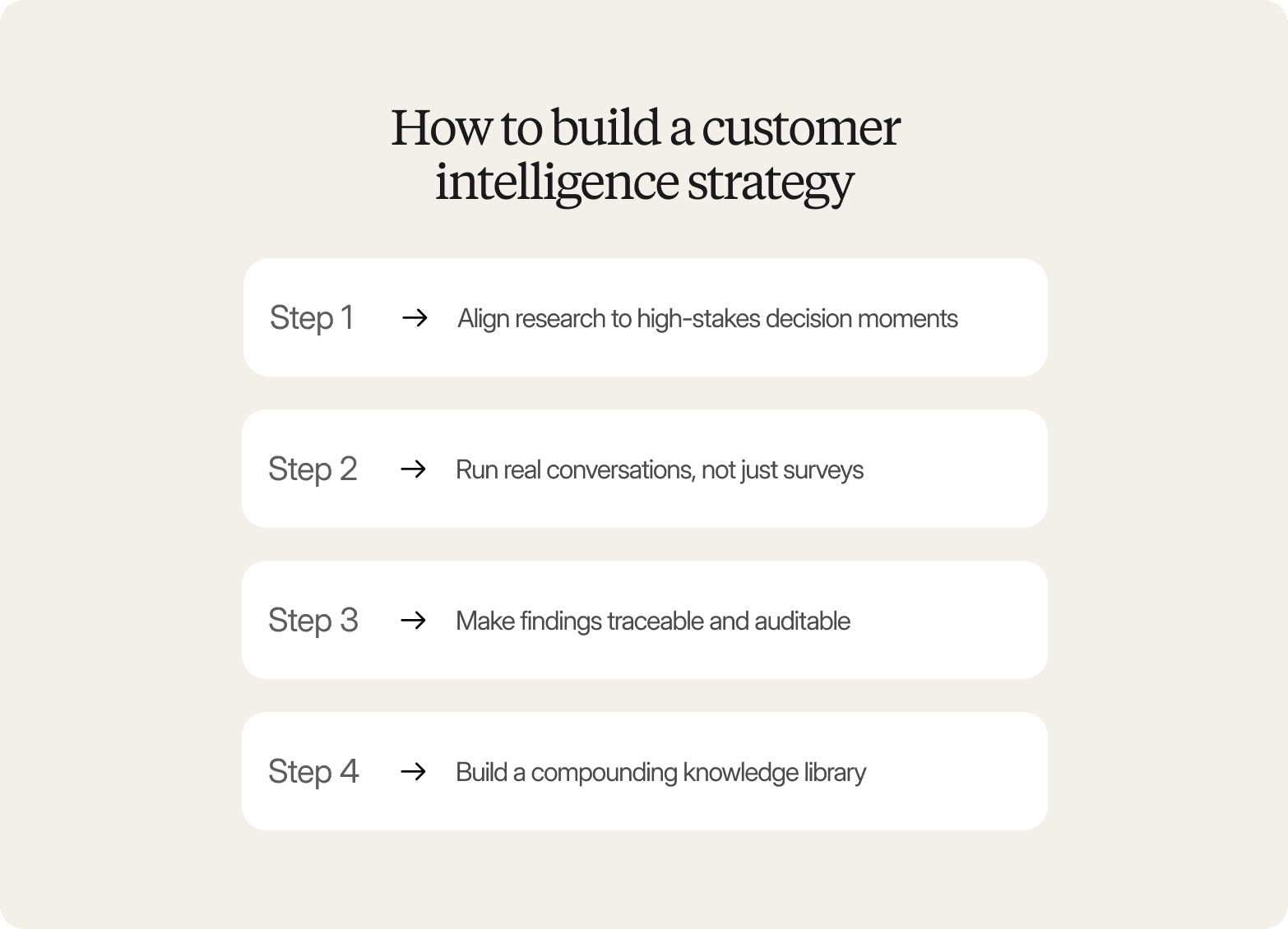
Building a customer intelligence strategy means aligning research to decision moments, running real conversations, making findings traceable, and compounding what you learn over time. Here's how, in four steps.
Step 1: Align Research to High-Stakes Decision Moments
Intelligence only influences decisions when it arrives before commitments are made. Delivered after the fact, even the most rigorous findings become documentation rather than direction. A robust customer intelligence program is built around decision calendars, not research convenience.
Three decision moments where timing determines impact:
Concept validation before campaign launch. Creative and messaging decisions get locked weeks before production begins. Research that lands after the brief is approved confirms what the team already chose.
Feature prioritization before roadmap planning. Engineering capacity gets allocated in planning cycles. Customer input that arrives mid-sprint rarely changes what has already been scoped and resourced.
Messaging testing before a brand refresh. Brand architecture decisions involve legal, agency, and executive alignment. Once those stakeholders have signed off, the window for meaningful consumer input has closed.
The practical rule: start with the decision date and work backward. Teams that build their customer intelligence strategy around decision calendars rather than research convenience are the ones whose findings actually get used.
Step 2: Run Real Conversations, Not Just Surveys
The most useful customer intelligence lives in moments surveys can't reach: the pause before an answer, the shift in tone when a price point lands the wrong way, the way someone trails off while describing a feature they wanted to like but didn't.
A survey asks "Do you like this feature?" and records a rating. An AI-moderated interview asks "Walk me through the last time you tried to use this feature" and follows the thread, probing hesitation and surfacing customer feedback the customer couldn't have named if asked directly. The goal: gather behavioral data alongside attitudinal responses to understand customer preferences at a level of nuance quantitative methods can't reach.
AI-moderated interviews run asynchronously, across dozens or hundreds of participants in parallel, expanding research capacity without adding headcount.
Step 3: Make Findings Traceable and Auditable
Findings that can't be traced back to source rarely survive their first stakeholder challenge. A summary in a deck is easy to question. A timestamped video clip of a participant explaining exactly why they rejected a concept is not.
Building traceable customer intelligence means linking every theme, claim, and recommendation to the verbatim quote or video moment that supports it. That shift, from "the research showed" to "here is the participant saying it," is what makes qualitative research influential rather than merely informative.
Step 4: Build a Compounding Knowledge Library
Most research programs share a structural problem: every study starts from scratch. A compounding insight library changes that. Instead of treating each study as a standalone event, every finding, clip, and data point flows into a searchable repository that grows more valuable over time.
Analyzing customer data across studies, rather than in isolation, is where the value accumulates
A product team planning a pricing change can search the library and find prior studies on price sensitivity, which price points triggered hesitation, which framings reduced resistance
Teams can track how attitudes toward renewal, upgrade, or cancellation shift across cohorts without commissioning a new study each time
What Should You Look for in a Customer Intelligence Platform?
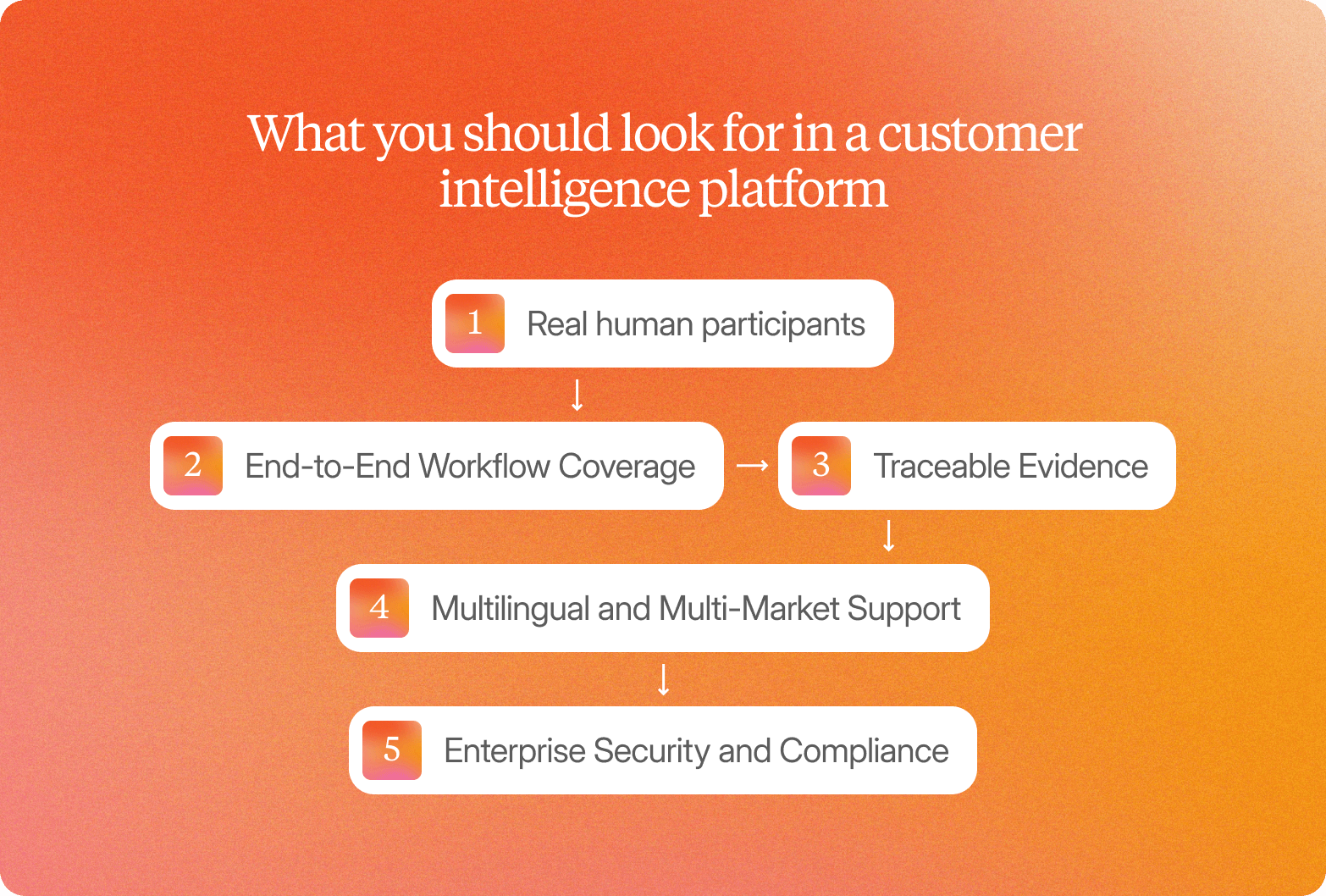
Look for real participants over synthetic ones, end-to-end workflow coverage, traceable evidence, multi-market support, and enterprise-grade security. Not all customer intelligence platforms are built for the same job, and choosing the wrong one creates credibility problems that are hard to undo once stakeholders have seen a report they can't verify.
Hold any platform against these five criteria before committing.
1. Real Human Participants, Not Synthetic Responses
The AI research market is splitting into two camps: platforms that use synthetic or avatar-based responses for speed, and platforms that ground every finding in real human conversations. Stakeholders distrust outputs they can't verify, so video-based interviews with real participants are the most direct answer to that credibility problem.
2. End-to-End Workflow Coverage
Study design, participant recruitment, AI-moderated interviewing, analysis, and reporting should reside in a single system rather than be stitched together across separate tools. That removes coordination overhead and eliminates the risk of customer information getting lost across disconnected systems.
3. Traceable Evidence for Every Claim
Generic AI synthesis produces summaries quickly, but summaries without sources create the same trust problem as synthetic respondents. Every insight should link back to a timestamped video clip and verbatim quote, since traceability is what makes customer intelligence efforts defensible.
4. Multilingual and Multi-Market Support
Relying on separate vendors per region is expensive and inconsistent. A platform supporting 50+ languages end-to-end, with automated translation and integrated panel partners for first-party data, consolidates overhead into a single workflow.
5. Enterprise Security and Compliance
SOC 2-certified, GDPR-compliant, compliant with the California Consumer Privacy Act (CCPA), with optional EU data hosting: these are the credentials enterprise buyers require before signing. Compliance should be verifiable, not just claimed. (Conveo's compliance posture is detailed in the FAQ section of the product page.)
How Does Conveo Support Customer Intelligence Programs?
Conveo supports customer intelligence programs end-to-end: real-participant AI-moderated interviews, traceable video evidence, and a compounding knowledge library, the same five criteria research leaders evaluate before committing to a platform.
Conveo, a video-first AI research platform, is trusted by enterprise teams across consumer insights, UX, marketing, and product workflows to run continuous customer intelligence research. Every study uses real participants, not synthetic respondents. Every finding links back to timestamped video evidence, and every insight flows into a compounding knowledge library that makes the next study faster and sharper than the last.
Frequently Asked Questions
What is customer intelligence?
Customer intelligence is the systematic process of gathering, analyzing, and applying customer understanding to inform business decisions. It goes beyond collecting data points: customer intelligence focuses on building a coherent picture of who your customers are, what drives their behavior, and how that understanding should shape strategy. Consumer intelligence, in this broader sense, encompasses all methods and data sources a team uses to understand customers deeply enough to act with confidence. In practice, customer intelligence combines three layers. Behavioral data captures what customers actually do: which products they buy, where they drop off, how they navigate a purchase decision. Attitudinal data captures what customers say they think, feel, and prefer. Contextual understanding explains why those behaviors and attitudes exist: the motivations, trade-offs, and circumstances that sit beneath the surface. That third layer is where qualitative research earns its place. Surveys and data analytics handle the first two reasonably well. The "why" requires real conversations.
What are some customer intelligence examples?
Customer intelligence looks different depending on which function is asking, but the pattern is consistent: real conversations surface what dashboards and surveys cannot. Product: A CPG team uses AI-moderated interviews to understand why a newly launched feature isn't being used. Analytics show where users drop off; interviews explain why, improving customer service decisions faster than any A/B test. Brand: A team testing campaign messaging runs video interviews with 40 target consumers in under a week, hearing how customers describe the problem in their own words, language that improves customer satisfaction with the resulting campaign. CX: A team traces a surge in support tickets back to a single unclear onboarding instruction. Fixing it enhances the customer experience for every user on that path, without a broader redesign. Innovation: A team tests three concept directions before committing to development. One scores well on appeal but triggers price hesitation, a finding that avoids months of development spend on a positioning the market won't support.
What is the difference between customer intelligence and customer data?
Customer intelligence is the analyzed and contextualized understanding of why customers behave as they do. Customer data is the raw input: purchase history, survey responses, support tickets, click-through rates, and customer transaction records. Customer data tells you what happened. Leverage customer intelligence, by contrast, and you understand why, and what to do next- actionable insights rather than data points that just describe outcomes. Example: customer data shows 40% of users abandoned a checkout flow. That flags a problem but doesn't solve it. Customer intelligence reveals they abandoned because the form asked for information they didn't have on hand before showing the total, a level of specificity that produces a fix rather than a metric.
What are customer intelligence tools?
Customer intelligence platforms fall into three broad categories: survey platforms, traditional qualitative research, and AI-moderated research platforms. Surveys deliver speed and scale but capture consumer data at the surface level: what customers say, not why. Feedback data is easy to collect but structurally limited in what it can explain. Traditional qualitative research- depth interviews and focus groups- closes that gap with conversational depth, but agency timelines run six weeks or more, impractical as a continuous practice. AI-moderated video interview platforms run real one-on-one conversations at scale, across hundreds of participants in parallel, compressing timelines from weeks to days while preserving the nuance that makes findings credible.
Why is customer intelligence important?
Customer intelligence closes the gap between knowing what customers did and understanding why. Without it, business leaders make decisions on internal assumptions, and the gap between what teams build and what customers need widens with every product cycle. Product decisions grounded in customer intelligence solve real customer needs Marketing efforts built on customer language resonate because they reflect how customers describe their own situations CX improvements that draw on customer intelligence address root causes rather than symptoms, improving customer satisfaction and reducing support overhead Teams that invest continuously see compounding returns: stronger customer relationships, higher customer retention, and improved customer loyalty as trust accumulates. Customer lifetime increases when customers feel genuinely understood, and customer lifetime value improves as a result Teams without customer intelligence default to guesswork, slower course corrections, and higher spend on marketing efforts that miss, an increasingly expensive gap as customer expectations rise and switching costs fall.

About the author
Florian Hendrickx
Head of Growth
Florian is Conveo’s Chief Growth Officer, leading growth strategy and go-to-market execution as the company scales. He’s held growth leadership roles at companies like Deliverect, Robovision, and Aikido Security, and brings hands-on experience across marketing, sales, and product.
More by Florian →Qualitative insights at the speed of your business.
Conveo runs AI-moderated video interviews and structures everything they say.