In this article
TL;DR
The traditional concept testing process often takes 6–12 weeks through agencies, or it relies on survey scores that show whether a concept worked without explaining why.
Qualitative video-based concept testing fills both gaps. It captures detailed feedback, shows clear evidence, and delivers results that stakeholders can use in just a few days.
This approach helps teams decide which ideas are worth taking forward, before spending budget, with evidence they can review and trust
Concept testing exists to answer one question before you commit budget: will this idea resonate with customers?
The timeline and scale constraints that once made concept testing a slow, one-off gate are breaking down. It no longer has to rely on long agency cycles or small, delayed samples. Qualitative consumer conversations can now happen quickly enough to influence decisions while they’re still open.
This guide covers how to choose the right concept testing method, where qualitative video-based testing fits into the process, and how to run concept testing that produces findings stakeholders will trust.
What Is Concept Testing?
Concept testing involves gathering feedback from your target customers through surveys, focus groups, or interviews to validate your product idea and determine whether to proceed with development.
The main benefit of concept testing is preventing the waste of budget and significant resources on launching a product that the market won’t adopt. You might also use feedback from concept testing research to identify your product’s value proposition and refine your messaging.
It's sometimes conflated with three other research methods that serve different purposes. Here’s how they compare:
| Method | What it evaluates | When it runs |
|---|---|---|
| Concept testing | Whether a product has market appeal and consumer fit | Early stage, during ideation or prototyping |
| Usability testing | Whether a working product is easy to use | Post-development, with a functional prototype |
| Market testing | How a product performs with real buyers | Post-launch |
| Prototype validation | Whether a product functions as intended | During development |
Concept testing works best with fast responses because development stalls without it, but feedback depth is equally important. A concept test that surfaces the reasons behind consumer preferences gives teams more to act on than one that only captures quantitative data.
Why Concept Testing Matters (And Why It Often Fails)
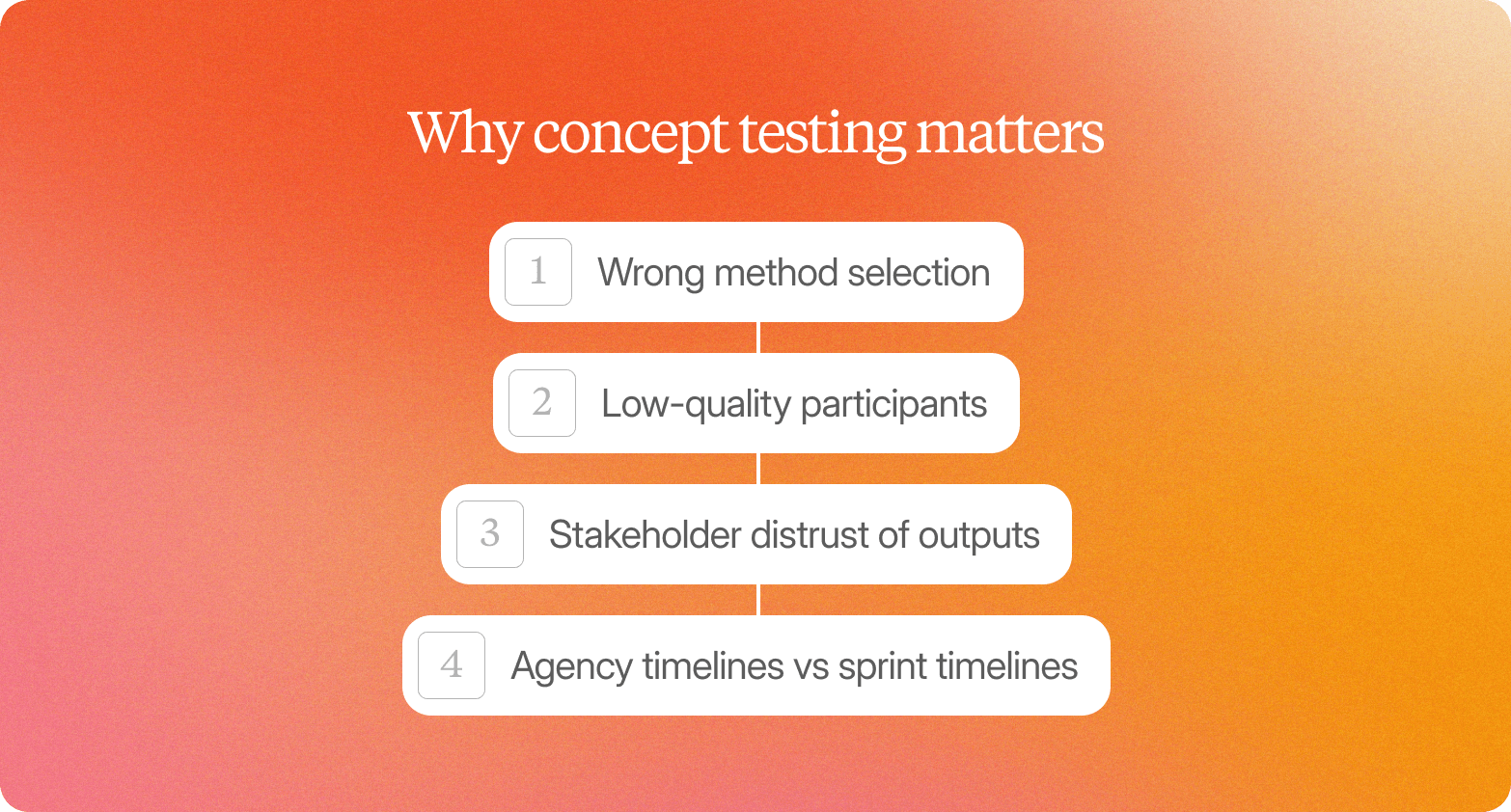
Our customer data shows that teams that do concept testing well see a +25% improvement in product launch success rates. Yet many teams don’t see that lift in practice because their concept testing doesn’t produce usable input for real decisions.
The issue is usually not effort, but breakdowns in method, data quality, timing, or trust in the output. When that happens, teams end up launching without clear direction and leave potential improvement on the table.
Wrong Method Selection
Survey-based concept testing is quick and easy to scale, but it only produces scores. A result like 6.2 out of 10 shows that something is off, but not what or why. Video-based concept testing adds context by capturing how participants explain their reactions, which gives teams clearer direction on what to change.
Low-Quality Participants
Panel fatigue, where repeat survey-takers give low-effort responses to get through quickly, and low-effort responses weaken results before analysis starts. If the sample is unreliable, the findings will look structured but won’t reflect real user reactions. Vetted panels and video responses help reduce this risk because participant identity and effort are easier to verify.
Stakeholder Distrust of Outputs
When findings arrive as a summary without supporting evidence, stakeholders often hesitate to act on them. Video-based concept testing links each theme back to real participant clips and quotes, so teams can see the source behind each insight. This makes it easier to trust and use the findings in decision-making.
Agency Timelines vs. Sprint Timelines
Traditional concept testing often takes weeks, while product decisions now move in days. When insights arrive after the decision is made, they lose practical value. Faster, video-based workflows help teams get findings during the decision window, not after it has closed.
When to Use Concept Testing
Concept testing fits at multiple stages of the product lifecycle, but it isn't always the right call. The decision hinges on what question you're trying to answer.
When the question concerns scale or reach, market research provides more useful data. When it's about whether an interface works, usability testing is the right tool. Concept testing earns its place when the question is about the idea itself. The table below maps each lifecycle stage to the decision it raises and the method that fits it.
| Lifecycle stage | Decision | Method | Why |
|---|---|---|---|
| Idea | Which concepts are worth developing? | Concept testing | Concept testing surfaces which directions have genuine pull before you commit design or engineering resources to the development process. |
| Idea | Is there a market for this problem at all? | Market research | You need to understand whether and where the problem exists before you can test solutions against it. |
| Concept | Which framing of the value proposition lands? | Concept testing | Participants explain their reaction in their own words, which tells you why one framing works and another doesn't. |
| Concept | Which feature set is most compelling? | Concept testing | Concept testing captures the reasoning behind preference while the design is still easy to change. |
| Prototype | Is the interface making the concept harder to understand? | Usability testing | Usability testing isolates where the experience breaks down so you can fix execution without confusing it with a concept problem. |
| Prototype | Does the value proposition still hold with a working product? | Concept testing | A prototype can obscure a weak value proposition behind polished execution. Concept testing checks whether the core idea still resonates. |
| Pre-launch | Will this messaging land with the target audience? | Concept testing | Concept testing tells you whether the audience understands the offer and finds it compelling before you spend on distribution. |
| Pre-launch | How large is the addressable market for this launch? | Market research | You need to understand the audience landscape and reach before you can interpret how concept test findings will scale. |
Qualitative depth matters most at the stages where the decision turns on why: why a concept doesn't land or why a feature set feels incomplete. At the idea and concept stage, that's where concept testing earns its place.
4 Key Concept Testing Methods: How to Choose the Right Approach
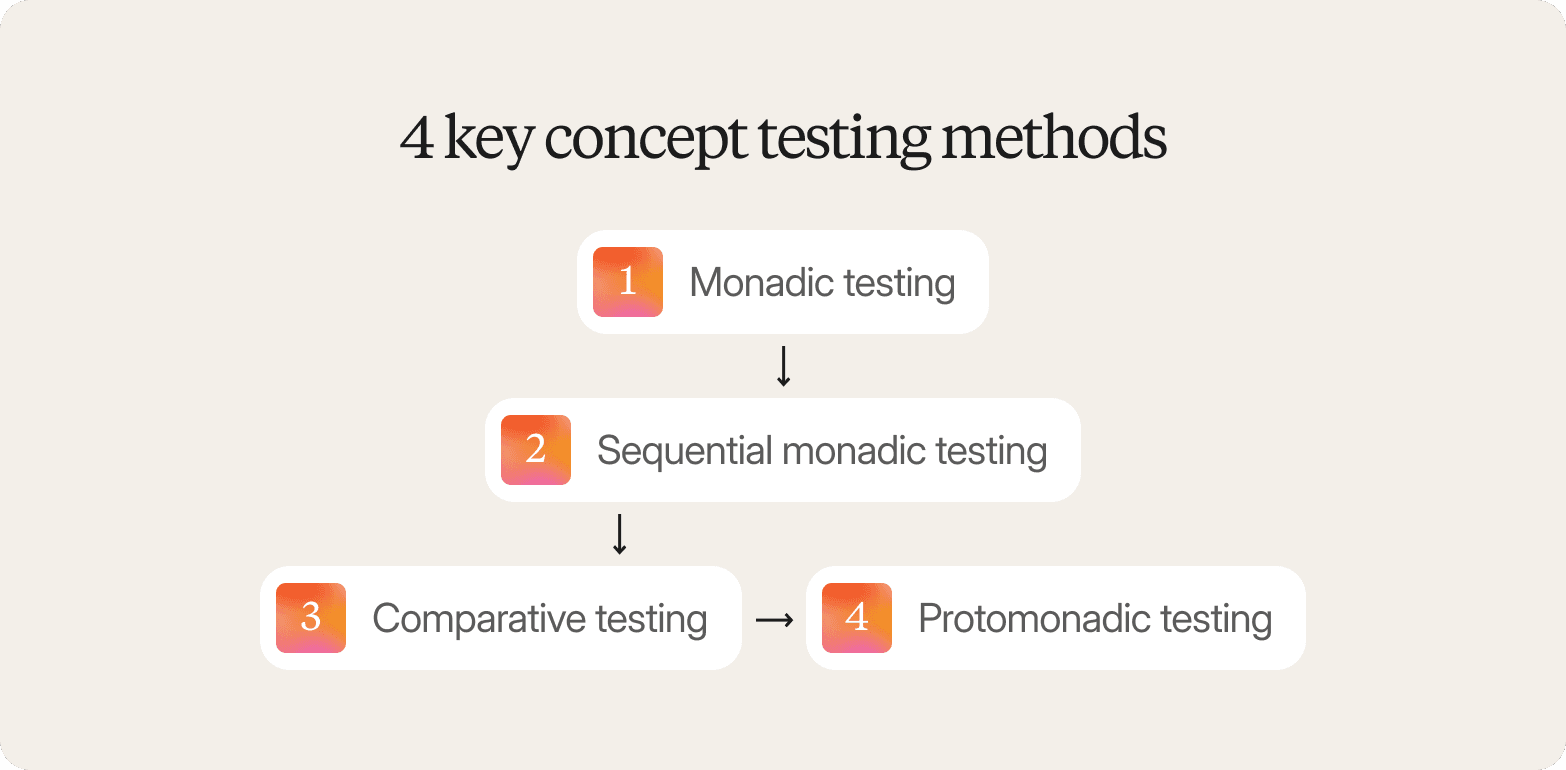
Different concept testing methods suit different research goals, budgets, and timelines. Here are the four most common approaches, with the pros and cons of each.
1. Monadic Testing
In monadic testing, each participant sees and reviews a single concept. For example, if a restaurant wants to test three different menu designs, one group would see only Menu A, another would see only Menu B, and a third would see only Menu C.
Because people only see one option, their feedback is less influenced by comparisons with other concepts. This helps the restaurant understand how people react to each design on its own.
The main drawback is that you need a separate group of participants for every concept you want to test, which increases the cost and time needed for research.
2. Sequential Monadic Testing
In sequential monadic testing, participants review several concepts one after another. For example, a software company testing three homepage designs might show Design A, then B, then C to one group, while another group sees them in a different order. This lets researchers compare multiple concepts without requiring separate participant groups for each.
The main challenge is that the order can affect people’s opinions. A very strong concept shown first may make later concepts seem weaker by comparison. To reduce this problem, researchers usually change the order for different participants.
3. Comparative Testing
Comparative testing presents participants with multiple concepts simultaneously and asks them to compare them directly. For example, a snack brand might use a concept testing tool to show participants three packaging designs together and ask which one stands out most on a shelf.
This is useful when teams want to quickly identify the strongest option from a large group of ideas. The downside is that side-by-side comparisons are less natural than how people normally make decisions. Participants may focus too much on obvious differences rather than on their overall experience or preferences.
4. Protomonadic testing
Protomonadic testing begins by presenting participants with a single concept. Later in the survey, they compare it with other concepts. For example, a streaming service might first ask participants to review one advert on its own. Later, participants see several adverts together and choose their overall favorite.
This gives researchers an independent reaction and comparison feedback in the same study. The main drawback is that the concept testing survey takes longer to complete, which can cause some participants to lose interest or drop out before finishing.
While these methods help teams measure reactions and compare concepts, they don’t fully explain why people respond the way they do. That’s where qualitative video-based concept testing helps you gain deeper insights.
Instead of focusing on metrics, qualitative testing captures the reasoning, emotions, and reactions behind participant feedback. For example, a monadic test score of 6.2/10 tells you that a new concept underperformed with your target market. A video response may reveal that participants felt the product promise seemed unclear. That tells you where to focus the next iteration: the messaging, not the concept itself.
Decision Framework for Choosing a Concept Testing Method
The table above explains when to use concept testing during the product lifecycle. This table explains which testing method is best suited to different decisions and how video-based qualitative research can enhance the results.
| Decision type | Stage in the product development process | Recommended method | Where video research helps |
|---|---|---|---|
| Screening multiple early concepts | Idea | Comparative or monadic testing | Scores show which concept performed best, but they don’t explain why. A winning concept may truly connect with people, or it may simply have fewer weaknesses than the other options. |
| Improving a value proposition or feature set | Concept | Sequential monadic testing | Sequential monadic testing shows which version scored higher, but it doesn’t explain what caused the difference. |
| Refining messaging before launch | Concept / pre-launch | Monadic testing | A low score can mean people didn’t understand the message, were not convinced by it, or didn’t think it applied to them. These are very different problems. |
| Confirming market readiness before launch | Pre-launch | Monadic testing | Pre-launch scores show whether reactions are generally positive or negative. |
Discover how to build and launch a study in Conveo:
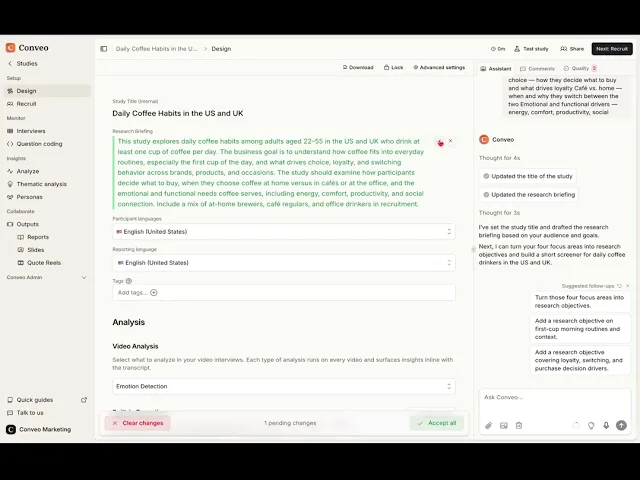
How to Run Qualitative Concept Testing at Scale
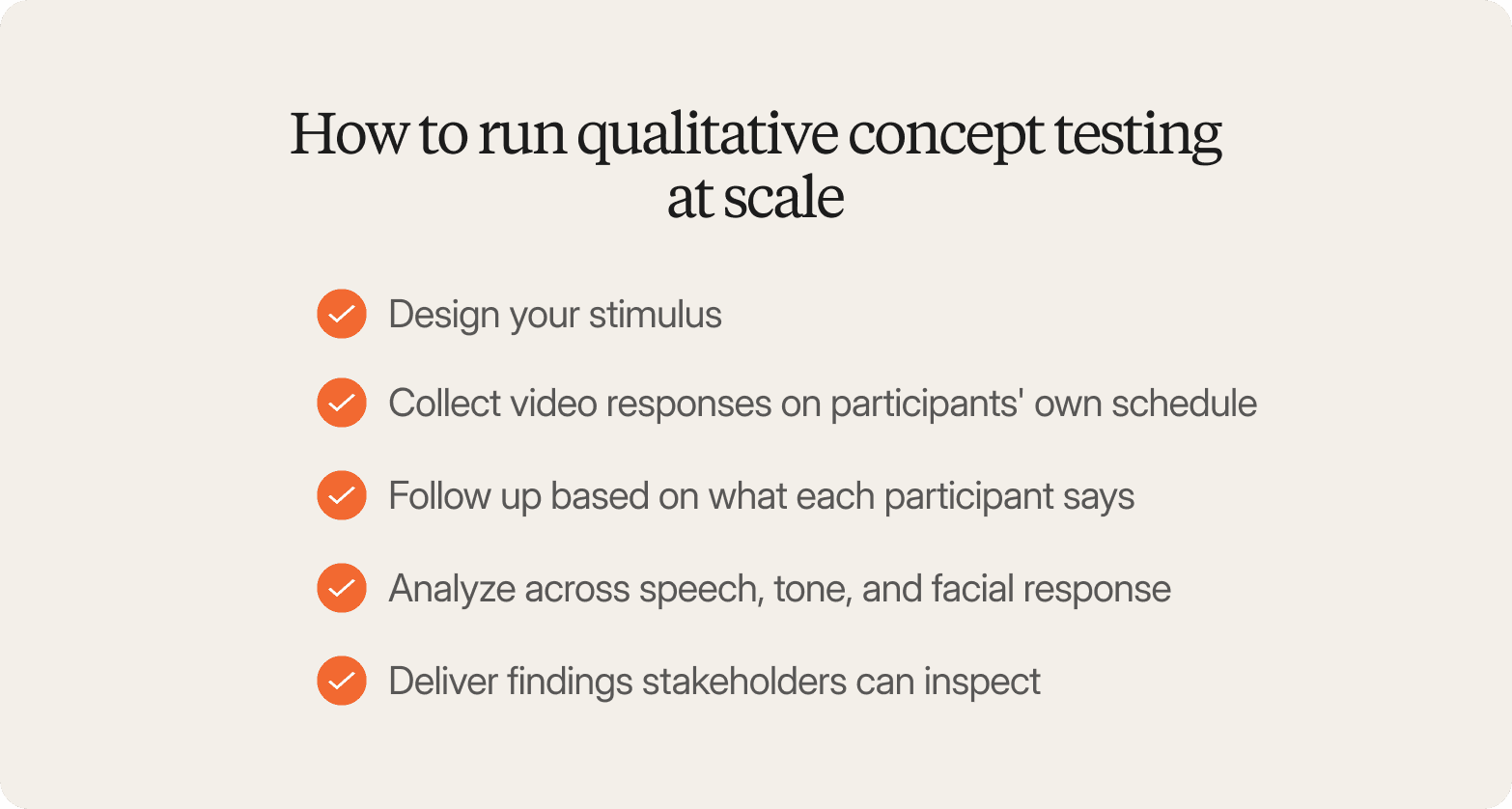
Qualitative concept testing at scale gives teams the reasoning behind participant reactions, fast enough to inform decisions before they're made.
Conveo is the qualitative research platform CMI teams and CX teams use for concept testing and creative concept optimization. It runs async video interviews, adapts follow-up questions to each participant's response, and analyzes speech, tone, and facial reaction, with findings delivered in days rather than weeks. Here’s the 5-step workflow.
1. Design Your Stimulus
The stimulus is the concept or material participants respond to. It needs to be clear and consistent. If it's vague, you won't get reliable feedback across participants. If it's too complex, people may find it hard to focus on the core idea.
At early stages, written concepts work well for testing a value proposition or a new product idea. Video can be better for brand testing or tone, while images or prototypes are useful when people need to react to something visual or functional.
2. Collect Video Responses On Participants' Own Schedule
With no moderated session to schedule, participants record video responses whenever it works for them. This makes it easier to reach a large sample in a short window, without the back-and-forth that slows traditional recruitment.
"We ran a concept test for a new product line; in one night, we had 200 interviews analyzed."
CMI Manager, Edgard & Cooper
3. Follow Up Based On What Each Participant Says
Conveo's AI moderator adapts its questions based on each participant's responses, so the interview tracks where the concept resonates and where it creates friction. That's where the reasoning behind each reaction comes from.
For example, if someone says a concept feels expensive, the next question might ask whether the price is higher than they'd be willing to pay or whether the benefits aren't clear enough to justify it.
4. Analyze Across Speech, Tone, And Facial Response
Conveo analyzes signals that transcripts miss: hesitation, tone, and facial reactions that often carry as much information as the words themselves. For example, someone might say a concept is appealing but pause before explaining why. That gap can signal uncertainty, even if the written answer looks positive.
Tracking these signals alongside verbal responses captures reactions participants didn't put into words.
5. Deliver Findings Stakeholders Can Inspect
Conveo links findings to the video clips, quotes, and evidence behind them. Stakeholders can inspect the source of a finding rather than taking the analyst's word for it. That makes findings easier to act on and easier to defend in a stakeholder review.
Across the full workflow, Conveo's customer data shows this approach running 5x faster than agency-led qualitative research.
Multi-Market Concept Testing
Testing concepts in multiple markets goes beyond translating the material. The same idea can perform differently depending on local culture, category expectations, or how the brand is perceived in that region.
Conveo supports over 50 languages with automatic transcription and translation, enabling teams to run the same study across markets without separate tools or vendors.
The harder part is comparing results across regions without losing context. Conveo groups responses by market so teams can clearly see where a concept works well and where it may need changes before moving forward.
Making Concept Test Findings Credible: Evidence and Traceability
One reason concept test findings might not be used to inform decisions is traceability. A deck of themes presents conclusions without the reasoning behind them. Stakeholders who can't follow a finding back to its source have two options: trust the analyst or challenge the output.
Some platforms address this by producing highlight reels: clips a researcher curates and packages for stakeholder viewing. Reels are useful and give non-researchers a quicker path to the data. But someone has decided what to include and what to leave out.
Conveo produces an evidence trail. Every theme connects directly to the participant responses behind it, so a stakeholder can follow the reasoning from the conclusion back to the source. In practice, a finding looks like this:
The theme states the finding: "Concept B's price point felt disconnected from perceived quality."
Every clip from participants whose responses generated that theme links directly to it, along with the verbatim quote.
Any stakeholder can inspect the source directly.
Tone, hesitation, and facial response are part of the evidence trail alongside the transcript. A participant who says a concept feels "fine" with visible hesitation is giving a different signal than one who says it with ease. Both produce the same word on a transcript, but the video tells a different story.
3 Key Concept Testing Examples
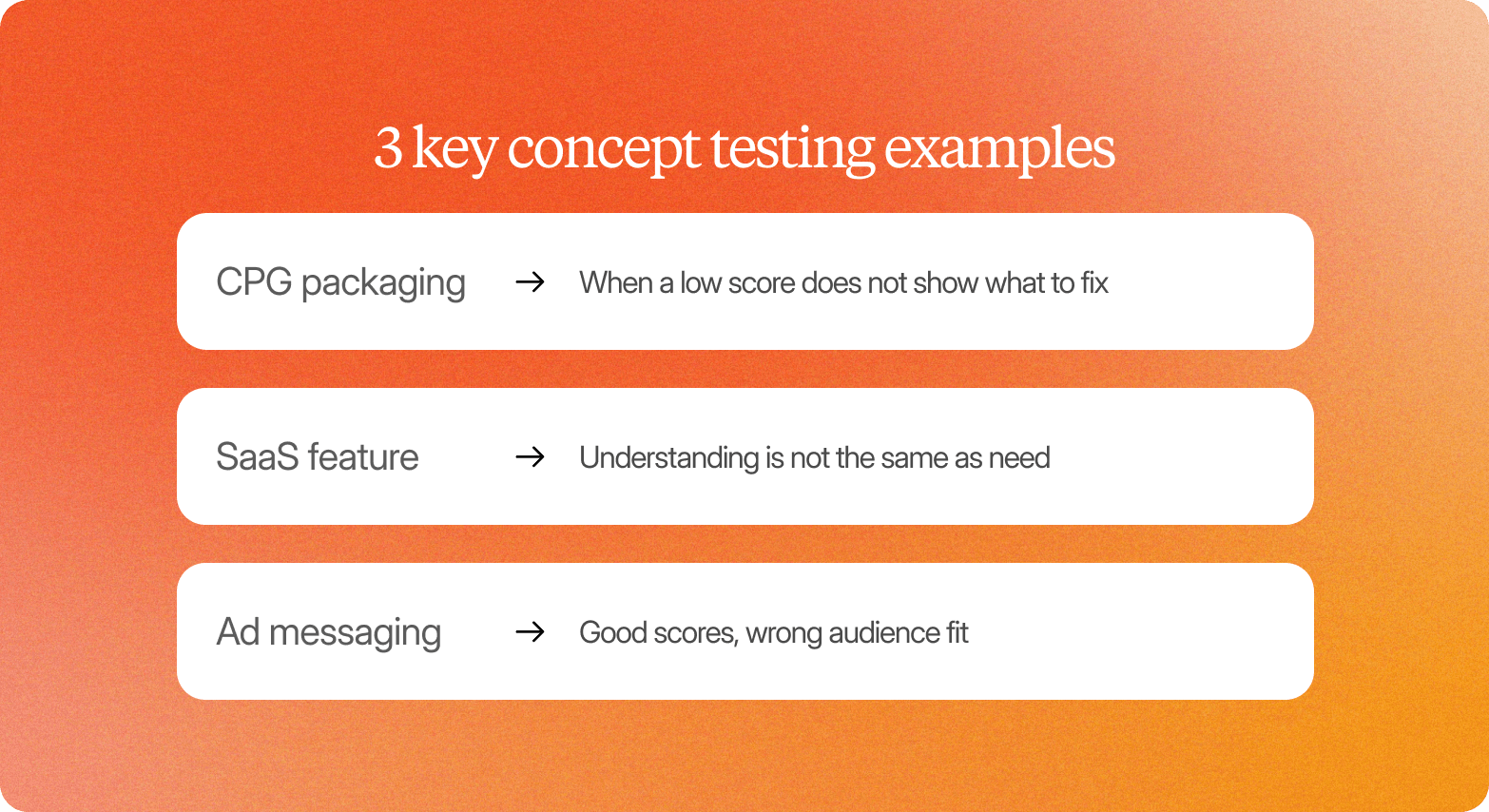
A few examples below show how video concept testing explains the reasoning behind reactions for different industries and use cases.
1. CPG Packaging: When A Low Score Does Not Show What To Fix
A consumer goods brand tested two packaging ideas before production. The goal was to find which one better reflected a premium brand position. Each participant saw one concept and recorded a video response. The scores were similar, but one came in slightly lower than the team expected.
The video feedback made the issue clearer. People described the lower-scoring design as “mass market,” signaling that its choices were pulling the brand away from its premium position. Typography and material cues were the main problem.
The team adjusted the visual design to better match the brand position and ran another test to confirm the improvement.
2. SaaS Feature: Understanding Is Not The Same As Need
A product team was preparing a new collaboration feature. The question was whether users understood the feature and could see when to use it. Participants reviewed a simple feature description and recorded video responses. Follow-up questions changed based on each answer.
Many participants understood the feature but couldn’t point to a real moment in their workflow where it would matter. The issue was positioning, not functionality. As a result, the team rewrote the messaging around a specific trigger in the user journey where the feature naturally fits.
3. Ad Messaging: Good Scores, Wrong Audience Fit
A brand tested three ad concepts before launching a campaign. One version scored highest on appeal, so it initially appeared to be the strongest option. But the in-depth interview showed a different problem. People in the target group said the ad felt like it was meant for an older audience or a different life stage.
The tone was driving interest, but it was attracting the wrong fit. The team reviewed the video responses more closely, focusing on tone and reactions, and confirmed the mismatch. They adjusted the execution before spending on media.
How Conveo Supports Concept Testing at Every Stage
Effective concept testing delivers three things: reasoning behind each reaction, evidence stakeholders can inspect, and findings that arrive within the decision window. Conveo is built around all three.
Participants record video responses on their own time, eliminating the need to schedule with a moderator and making it easier to gather feedback from large groups quickly. Follow-up questions adapt to what each person says, helping reveal the thinking behind each answer. Analysis examines what people say, how they say it, and their facial expressions, with every insight tied back to the original responses.
Discover how to build and launch a study in Conveo:
Enterprise Trust Infrastructure
Testing early product ideas, new positioning, or sensitive concepts requires a level of security that enterprise teams expect before approving tools. Conveo meets this with SOC 2 Type II certification, GDPR compliance, and EU data hosting. A public trust portal at trust.conveo.ai provides full transparency into compliance.
Concept Testing Across 50+ Languages
Global teams can run the same concept test across many markets and still compare results directly. Conveo supports more than 50 languages using vetted panels, with automatic transcription and translation included.
Research That Compounds Across Projects
Each study is stored in a searchable library, so insights are not lost after a project ends. Results can be reused, compared, and connected over time, helping teams build a more in-depth understanding of customers with each new study.
Frequently Asked Questions
What is concept testing?
Concept testing is a research method used to evaluate a product idea or new concept before it launches. As a form of concept testing market research, it helps teams understand customer preferences, reduce risk, and improve the chances of successful concept testing outcomes. Concept testing is different from proof of concept testing, which focuses on whether a product idea is technically achievable rather than whether it has market appeal.
What is an example of concept testing?
A common product concept testing example is showing different product ideas to a target market and asking which one they prefer. For example, a food brand might use comparative testing to show three snack packaging designs and collect feedback. This helps teams test multiple concepts, evaluate concepts individually, and gain valuable data on which direction performs best.
What is concept testing in new product development?
In concept testing in new product development, teams evaluate early-stage ideas before building the final product. This part of concept development and testing helps reduce risk by validating demand early. Methods like monadic testing or sequential monadic testing are often used to get valuable insights into consumer attitudes and a deeper understanding of how each concept performs.
What is concept testing in UX research?
In UX research, concept testing usually refers to testing early design ideas before they are built. It helps teams understand how users react to a new concept and whether it meets expectations. UX teams often use rapid concept testing to gather feedback quickly and make changes based on qualitative insights and user behavior.
What is the difference between concept testing and usability testing?
Concept testing evaluates whether a product idea has market appeal and customer fit, while usability testing evaluates finished or near-finished designs. Concept testing focuses on whether a product concept is appealing and useful, often using comparative testing or monadic approaches. Usability testing focuses on whether people can successfully use the product. Both are part of effective concept testing and product development, but they answer different questions.
What is concept testing in marketing?
Concept testing in marketing refers to evaluating messaging, positioning, or product ideas before launch. Marketers use it to understand how a target market responds to different concepts and to refine messaging. It is a key part of concept testing in marketing because it provides valuable insights into what resonates and what doesn’t, helping improve campaign and product performance.

About the author
Kavya Pillutla
Research Impact Lead
A qual researcher by nature, Kavya spent four and a half years on the Human Insight and Innovation team at PA Consulting, on brand strategy and concept testing. She joined Conveo for the pace of a startup without leaving research, and gets her energy from seeing a study turn into a product on a shelf or an ad on a billboard.
Meet Kavya on film →Qualitative insights at the speed of your business.
Conveo runs AI-moderated video interviews and structures everything they say.