In this article
TL;DR
Customer research tools fall into five categories: AI-moderated interview platforms, qualitative repositories, UX testing tools, consumer intelligence platforms, and survey tools
The right choice depends on whether your team needs continuous qualitative discovery, usability validation, or lightweight feedback collection
Teams running voice and video interviews at scale benefit most from AI-powered research platforms
Conveo is the only platform here that combines AI-led interviews, automated thematic analysis, and a compounding insight library in one workflow
Tools like Dovetail and Notably support analysis, but don’t run interviews or recruitment
UX research tools such as Maze and UserZoom support usability testing, not open-ended discovery
Consumer intelligence platforms like GWI surface market trends, but don’t generate primary customer conversations
If you’re evaluating AI-moderated workflows specifically, start with an AI-powered video interview platform before comparing point tools
The number of customer research tools has exploded in the last few years. Some focus on interviews, others on usability testing, repositories, surveys, or consumer intelligence. Choosing the wrong one doesn’t just slow a study; it can lock your team into the wrong workflow for months.
This guide compares the top-rated customer research tools for product teams in 2026 using five practical evaluation criteria, so you can quickly see which tools match how your team actually runs research.
Here’s how the categories break down and where each tool fits.
The 5 categories of customer research tools
Most teams don’t need every type of customer research tool. They need the category that matches how their research teams collect customer data, run customer conversations, and turn research findings into actionable insights.
| Category | Best for | Examples in this list |
|---|---|---|
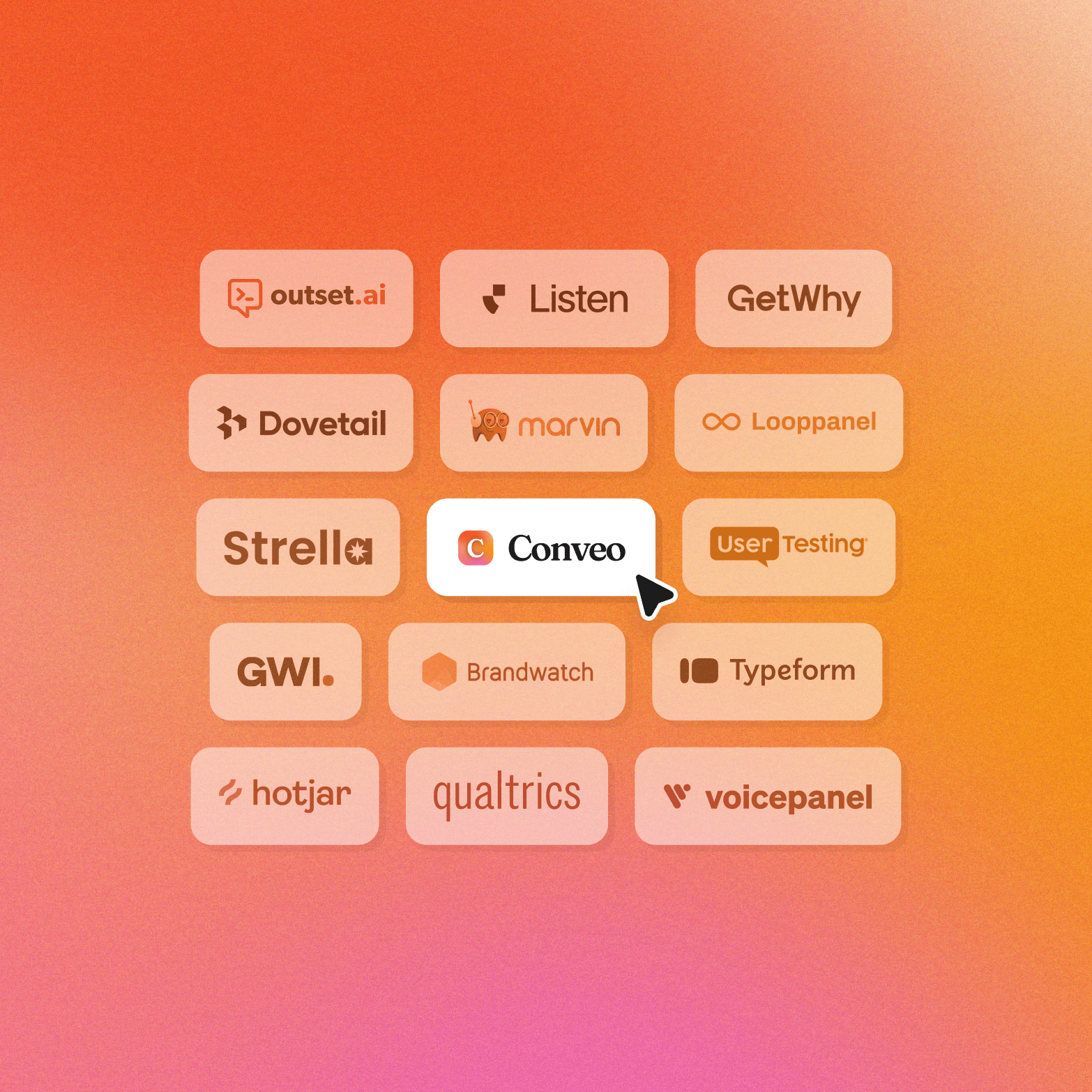
| AI-moderated interview platforms | End-to-end qualitative research at scale to collect customer insights across the customer journey | Conveo, Outset, Listen Labs, GetWhy |
| Qualitative analysis & repositories | Organizing qualitative data, tagging customer feedback, and synthesizing customer insights | Dovetail, Marvin, Notably |
| UX & usability testing tools | Task-based validation, session recordings, and observing user behavior during user interactions | Maze, UserZoom / UserTesting |
| Consumer intelligence & data platforms | Tracking market trends, brand perception, consumer behavior, and competitive intelligence | GWI, Brandwatch |
| Survey & lightweight feedback tools | Survey creation, structured data collection, and scalable customer surveys | Typeform, Hotjar |
This structure reflects how modern market research teams compare customer insights tools based on workflow fit rather than surface-level feature lists.
It also clarifies where AI-powered interview platforms like Conveo fit for teams running continuous customer research rather than one-off studies.
AI-moderated interview platforms
1. Conveo
What it is
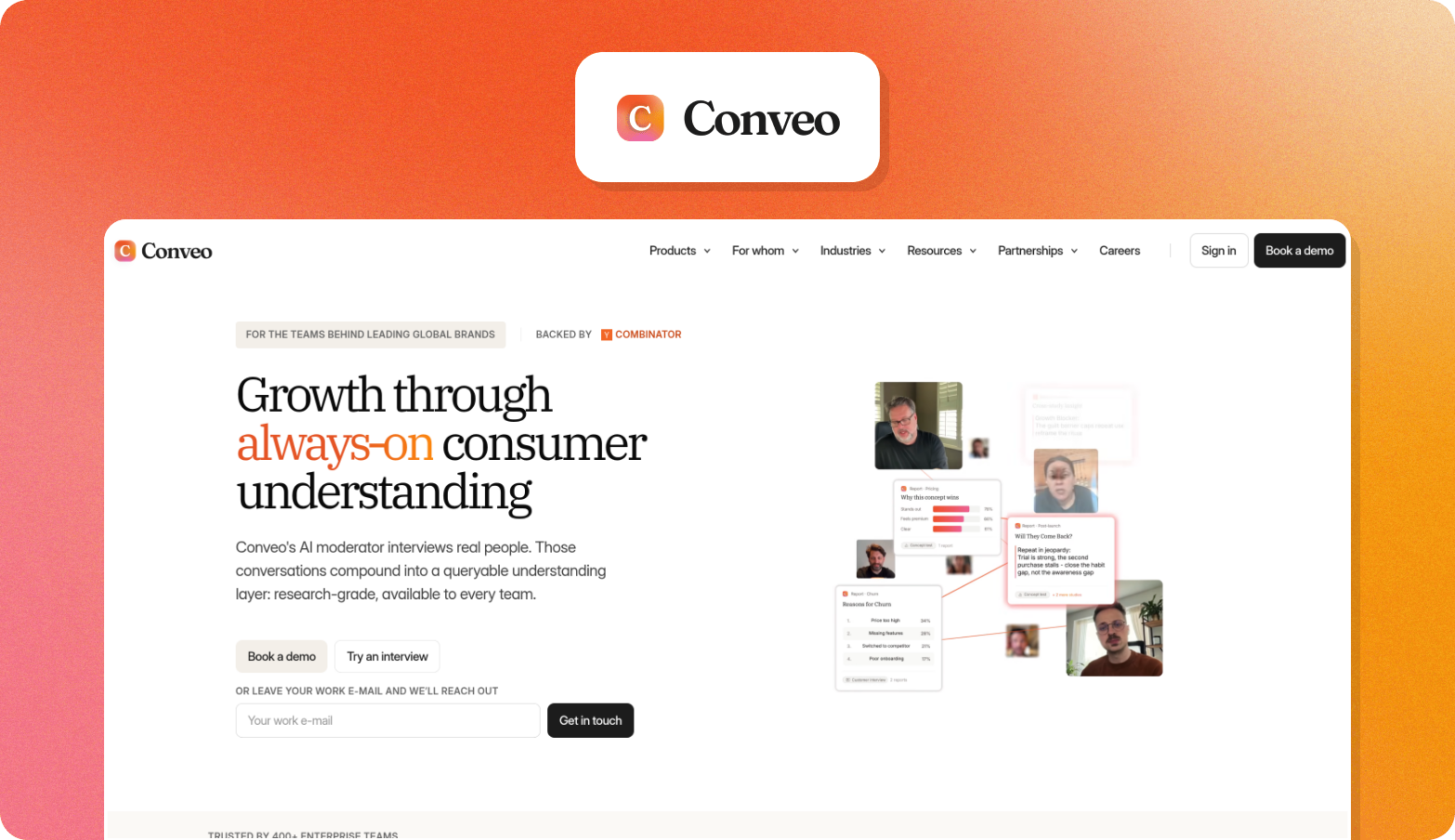
Conveo is an AI-powered video interview platform that runs the full qualitative customer research workflow, from study design and recruitment to AI-led interviewing, analysis, and stakeholder-ready reporting.
Best for
Insights, product, and UX research teams that need to collect customer insights at scale while keeping qualitative depth and traceability across the customer journey.
How it works
Study design and recruitment
Launch studies faster without coordinating multiple tools or vendors. Teams define research goals, target audience criteria, and screening logic in one workflow, while Conveo supports global recruitment and handles incentives automatically to reduce manual data collection steps.AI-led interviewing
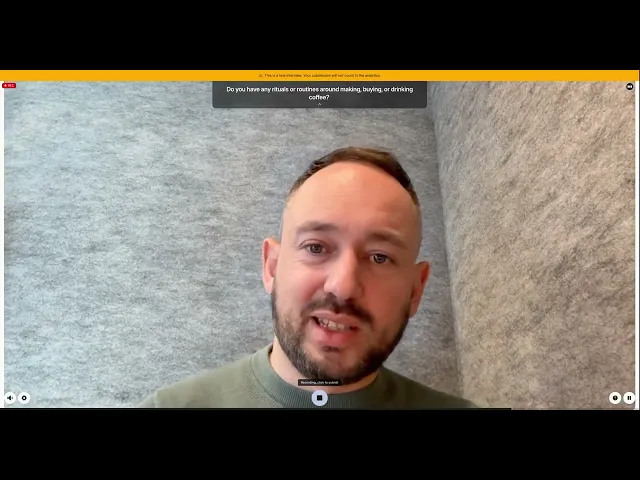
Run more interviews without scheduling constraints and still capture deeper signals. Participants join through a simple link and take part in natural customer conversations with an adaptive AI interviewer that asks follow-up questions dynamically across 50+ languages.
Discover Conveo’s AI moderation in action:
Automated analysis
Move from interviews to decisions faster without manual coding. As sessions finish, Conveo applies machine learning and natural language processing to generate structured qualitative insights, sentiment analysis layers, and clip-ready outputs for stakeholders.Compounding insight library
Reuse past research instead of starting from scratch each time. All collected customer data flows into a searchable environment where research teams and sales and marketing teams can revisit research findings and track patterns in customer needs and customer engagement over time.
Standout capabilities
Runs AI-led video interviews with automated synthesis in one workflow
Generates AI-powered insights from real customer conversations
Creates a persistent customer insights platform across studies
Supports enterprise security, including SSO, encryption, and regional hosting
Connects qualitative insights with behavioral analytics signals for competitive intelligence and brand perception tracking
One honest tradeoff
Conveo is built for continuous customer research, not quick customer surveys or lightweight feedback collection. Teams running simple pulse checks may prefer other research tools.
Criteria scorecard
| Criteria | Conveo |
|---|---|
| Research workflow coverage | High. Complete workflow from study design to stakeholder reporting, no external tools needed. |
| Qualitative depth | High. Adaptive moderation, multimodal analysis, and sentiment analysis |
| Scalability | High. Supports parallel interviews across large participant groups |
| Output credibility | High. Traceable clips, structured qualitative data, stakeholder-ready outputs |
| Team fit | Medium-High. Best for research teams running continuous customer insights programs |
If your team needs usage and experience insights grounded in real customer conversations, you can see how this works in practice in a usage and experience insights workflow or book a demo to explore the full research setup.
2. Outset
What it is
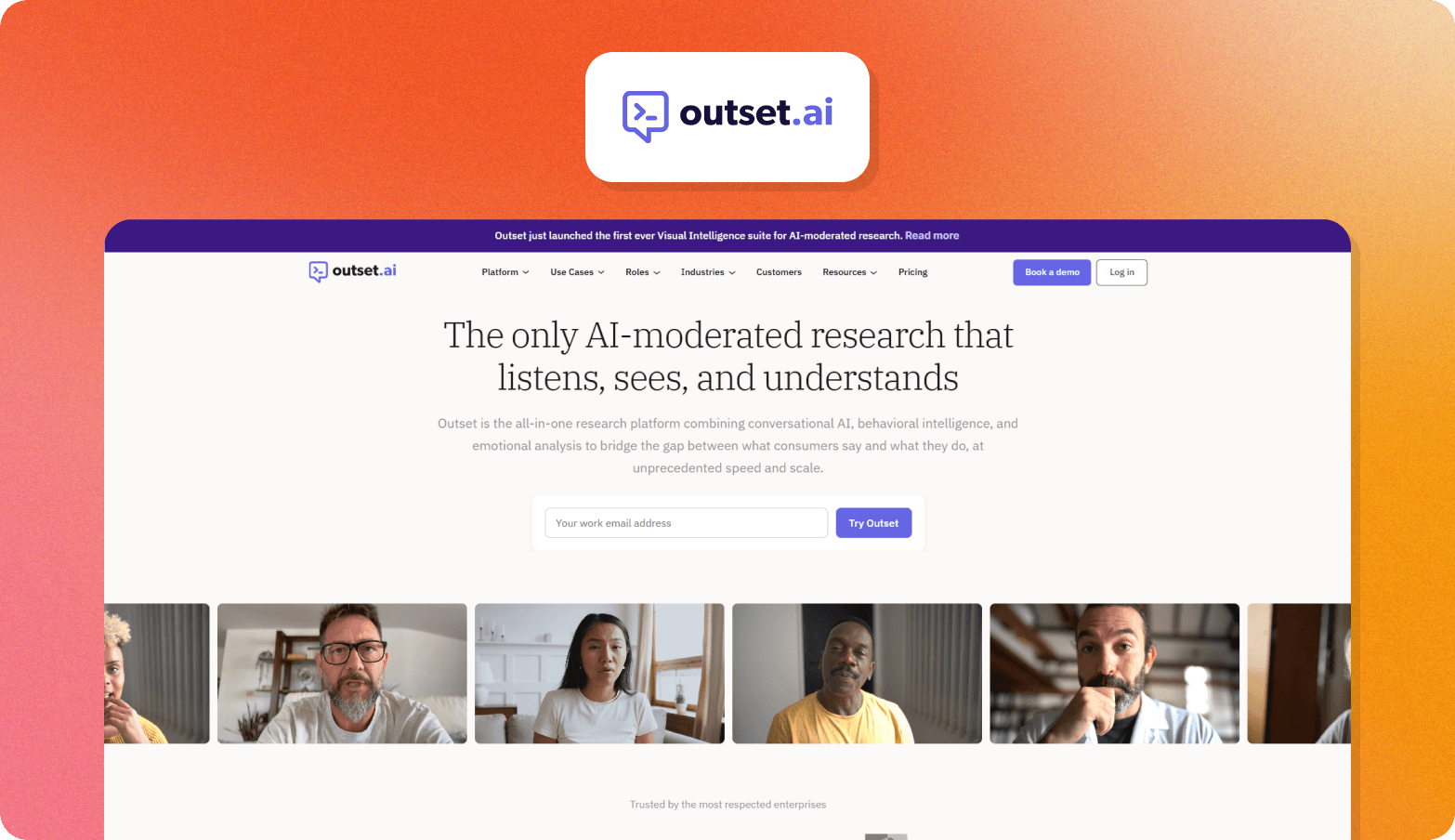
Outset is an AI-powered qualitative research platform designed to run moderated interviews and synthesize customer conversations at scale for product and UX research teams.
Best for
Product and UX research teams that want to run recurring interview-based customer research using AI moderation instead of manual scheduling and facilitation.
How it works
Outset supports asynchronous AI-moderated interviews and automated synthesis workflows that help research teams collect customer insights and generate structured research findings from ongoing discovery programs.
Standout capabilities
AI-moderated interview workflows for continuous customer research
Supports scalable qualitative data collection across distributed participants
Designed for fast synthesis of customer conversations into usable outputs
One honest tradeoff
Outset primarily focuses on interviewing and synthesis workflows rather than providing a full recruitment-to-library research infrastructure in one platform.
3. Listen Labs
What it is
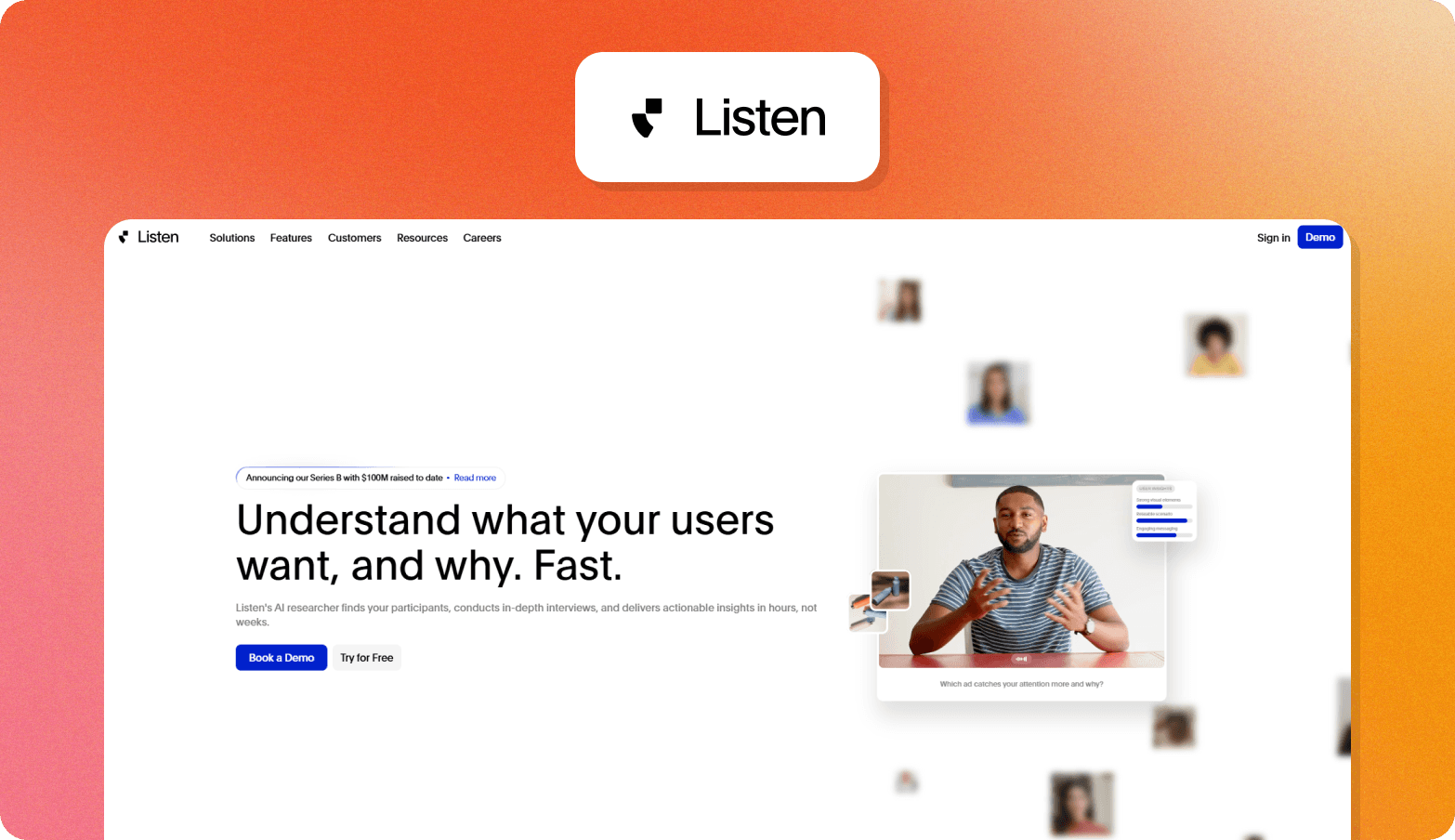
Listen Labs is an AI-powered customer research platform focused on running large-scale interview studies and turning customer feedback into structured qualitative insights.
Best for
Research teams that want to scale interview-driven customer research and generate stakeholder-ready outputs from customer interactions quickly.
How it works
Listen Labs runs AI-moderated interview sessions and applies automated analysis to help teams identify themes in customer behavior, customer needs, and customer experience signals across studies.
Standout capabilities
AI-moderated interview workflows for large study volumes
Automated synthesis of qualitative data into research findings
Supports structured delivery of insights for cross-team use
One honest tradeoff
Teams evaluating end-to-end customer research tools should confirm how recruitment, study orchestration, and cross-study insight management are handled within their workflow.
4. GetWhy
What it is
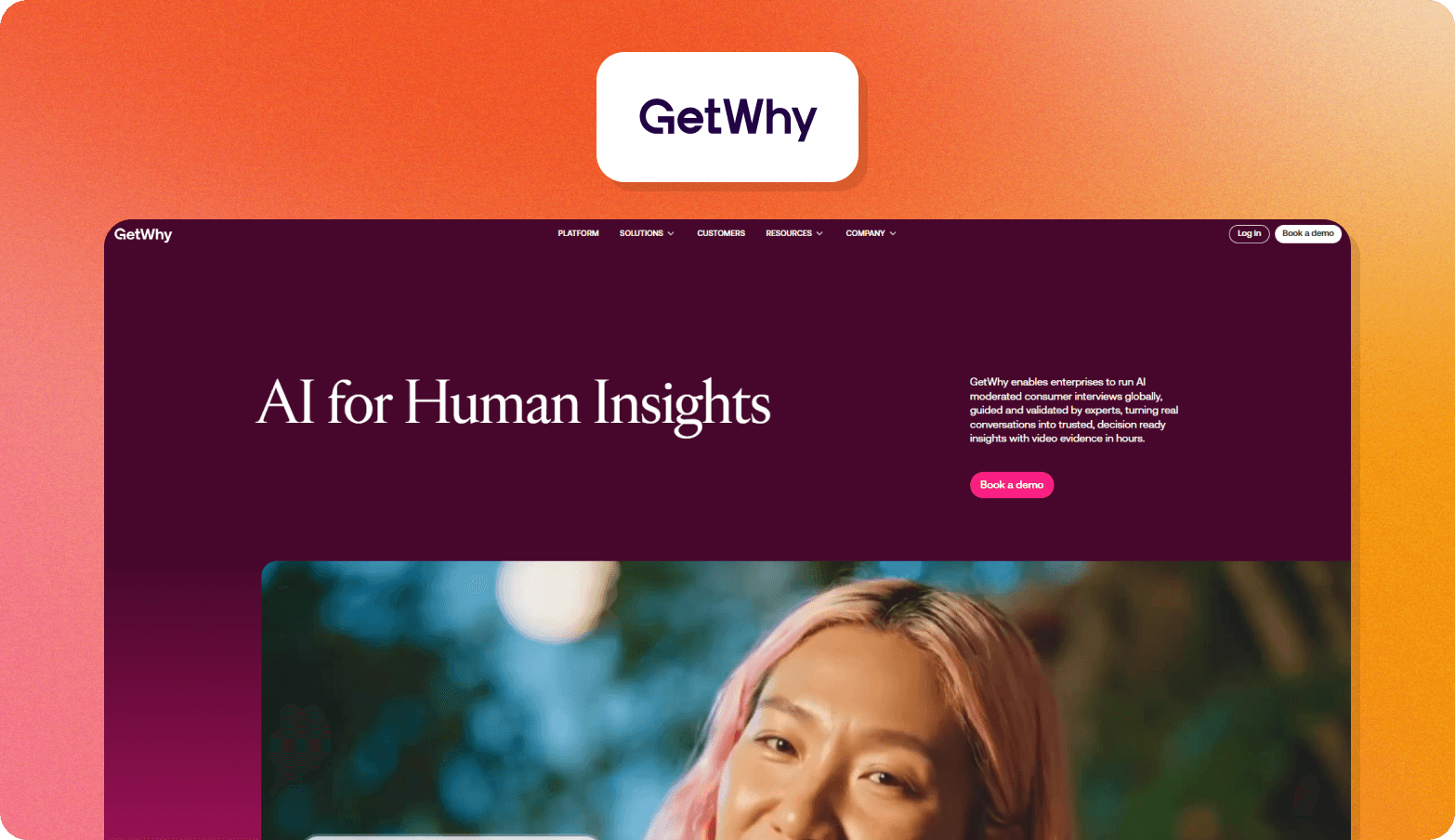
GetWhy is an AI-powered video research platform that helps teams capture customer feedback through recorded interviews and generate qualitative insights from customer conversations.
Best for
Teams that prioritize video-based customer research and want faster turnaround from interview capture to stakeholder-ready outputs.
How it works
GetWhy enables AI-supported interview capture and automated analysis that helps research teams surface patterns in customer behavior, brand perception, and consumer behavior from qualitative sessions.
Standout capabilities
Video-first approach to AI-supported customer research
Automated synthesis of interview-based qualitative data
Designed to help teams translate customer conversations into presentation-ready outputs
One honest tradeoff
Teams running continuous customer research programs should confirm how cross-study insight reuse and long-term customer data organization are supported within the platform.
Qualitative analysis and research repository tools
Repository and analysis-layer platforms help teams organize transcripts, connect survey data, and surface reusable market insights across projects, often alongside interview platforms or social listening tools.
5. Dovetail
What it is
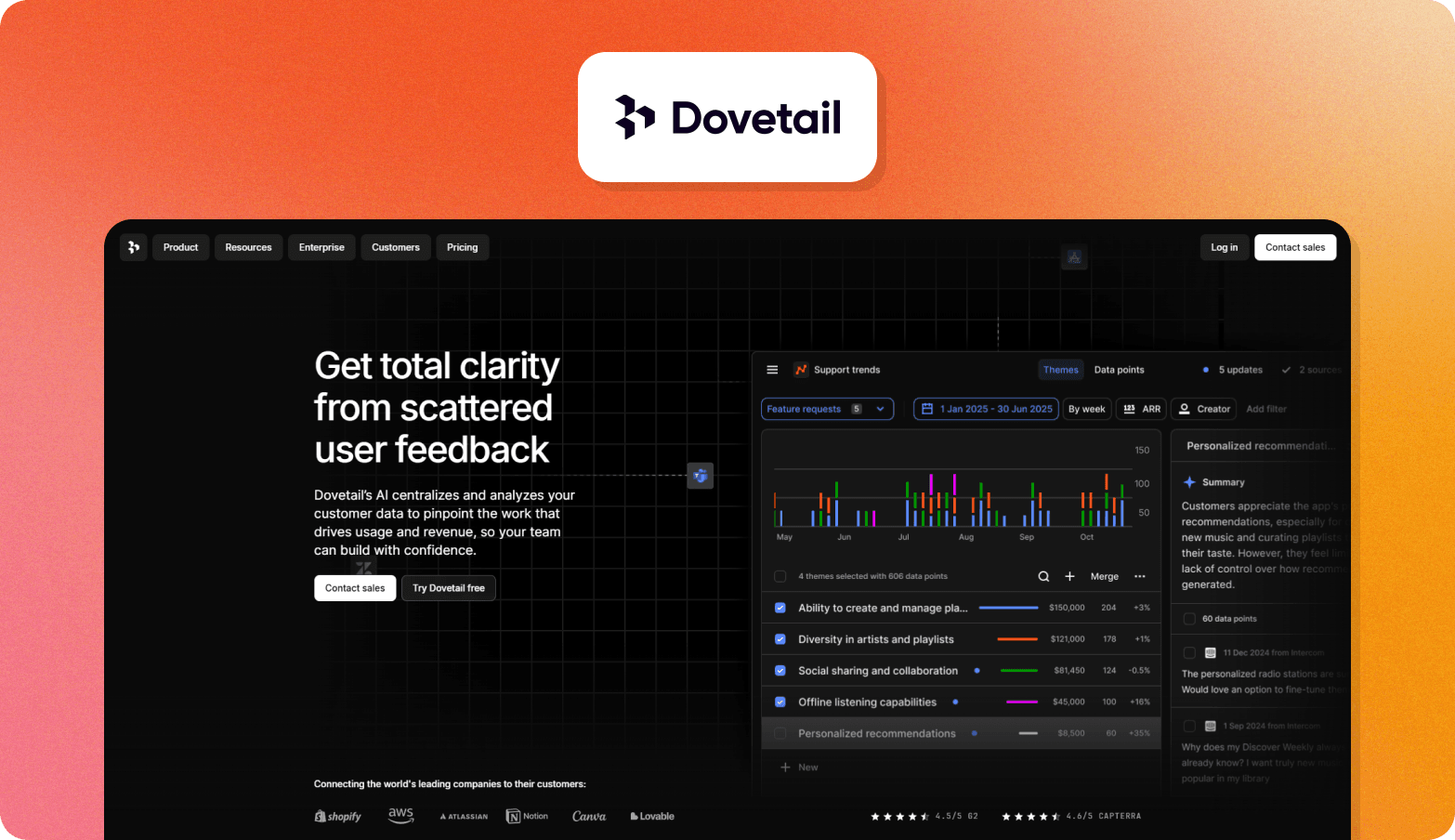
Dovetail is a qualitative insights repository that helps research teams centralize transcripts, notes, and recordings so findings remain searchable and reusable across studies.
Best for
Insights and research operations teams that already run interviews elsewhere and need structured workflows to organize customer satisfaction signals and user feedback.
How it works
Dovetail supports tagging, clustering, and synthesis across interviews, survey data, and workshops so teams can gather customer feedback and connect findings to broader consumer trends.
Standout capabilities
Flexible tagging and synthesis workflows
Collaboration across research teams
Supports integration with analytics platforms
One honest tradeoff
Dovetail does not run interviews and requires a separate research collection layer.
6. Marvin
What it is
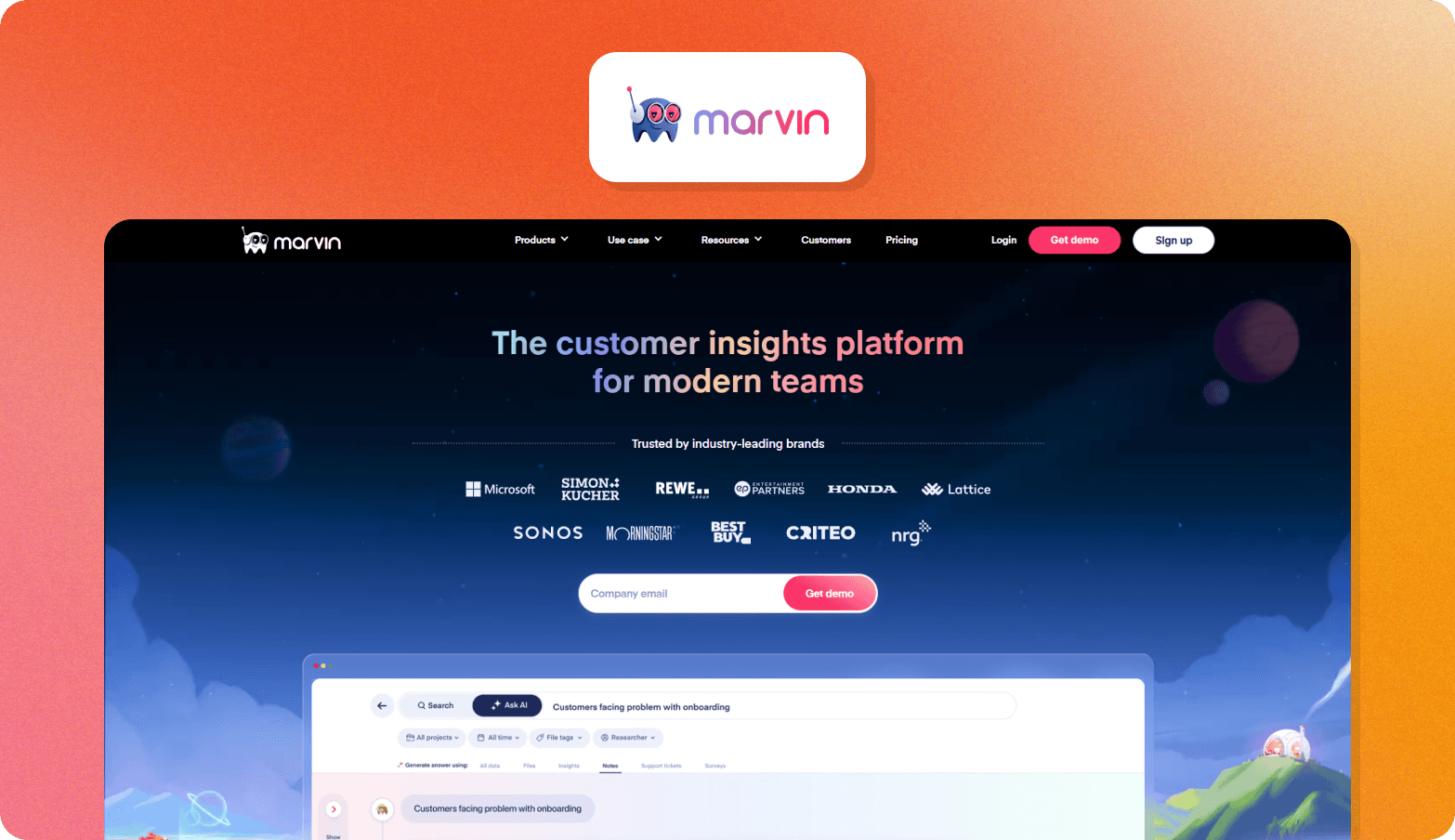
Marvin is an AI-assisted qualitative analysis platform designed to support tagging and synthesis during live or recorded research sessions.
Best for
Product and UX research teams that want faster thematic analysis and structured market insights from interview workflows.
How it works
Marvin enables real-time transcript tagging and automated theme clustering, helping teams connect interview findings with signals from analytics tools or a product analytics platform.
Standout capabilities
Real-time tagging during interviews
AI-assisted clustering of themes
Supports synthesis across multiple studies
One honest tradeoff
Marvin focuses on analysis rather than recruitment, orchestration, or repository-scale research infrastructure.
7. Looppanel
What it is
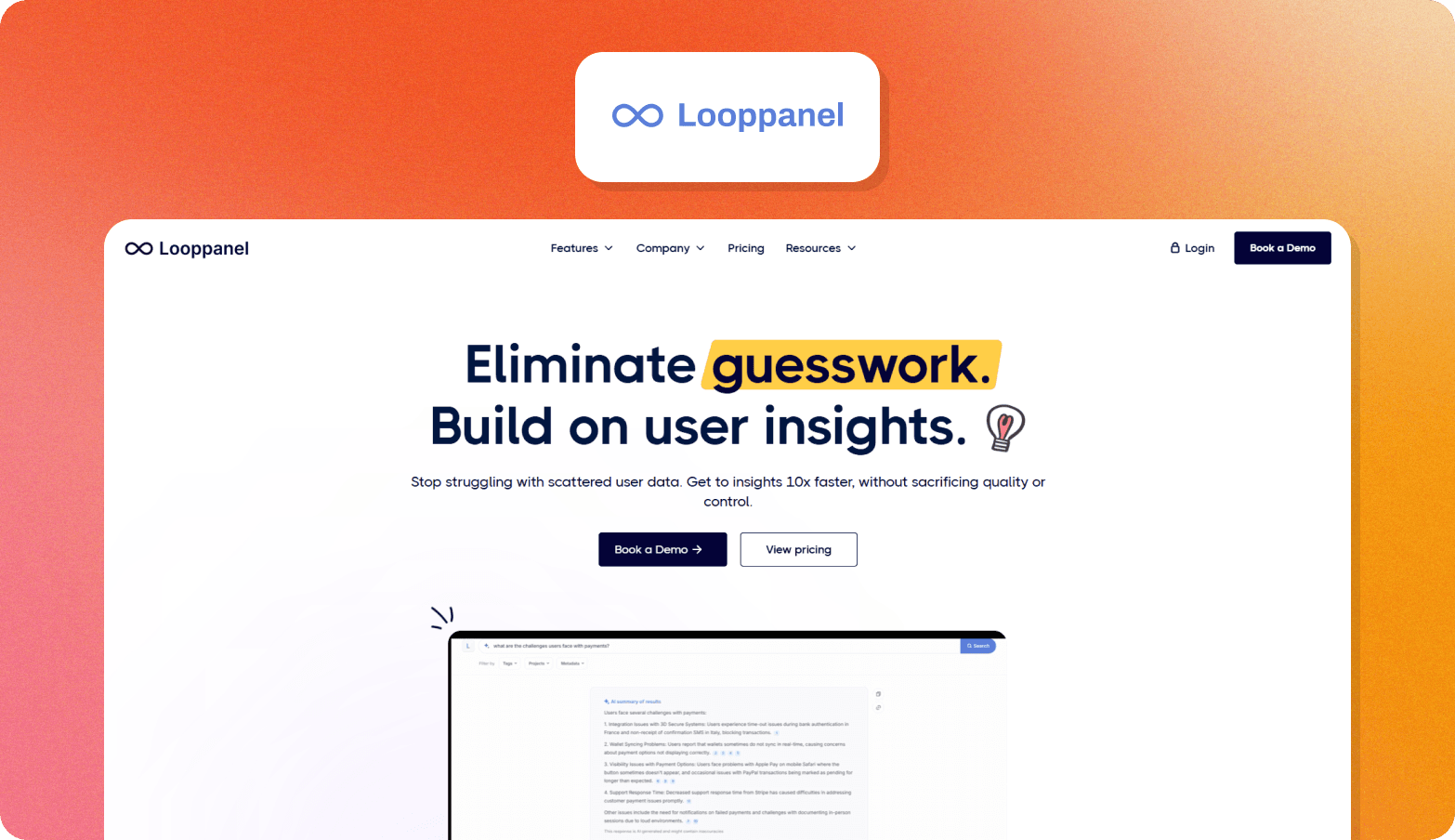
Looppanel is an AI-assisted qualitative analysis platform that helps teams organize interview transcripts, tag themes, and generate structured research findings from customer conversations.
Best for
Research and product teams that run interviews regularly and need faster synthesis without building a full research repository workflow from scratch.
How it works
Looppanel records interviews, automatically generates transcripts, and applies AI-assisted tagging and clustering, enabling teams to analyze qualitative data and identify patterns in customer needs and user behavior across studies.
Standout capabilities
Automatic transcription and AI-assisted tagging
Fast synthesis across interview datasets
Supports collaborative review of research findings
One honest tradeoff
Looppanel focuses on analysis and synthesis rather than on recruitment, interview moderation, or long-term insight-library infrastructure.
UX and usability testing tools
8. Maze
What it is
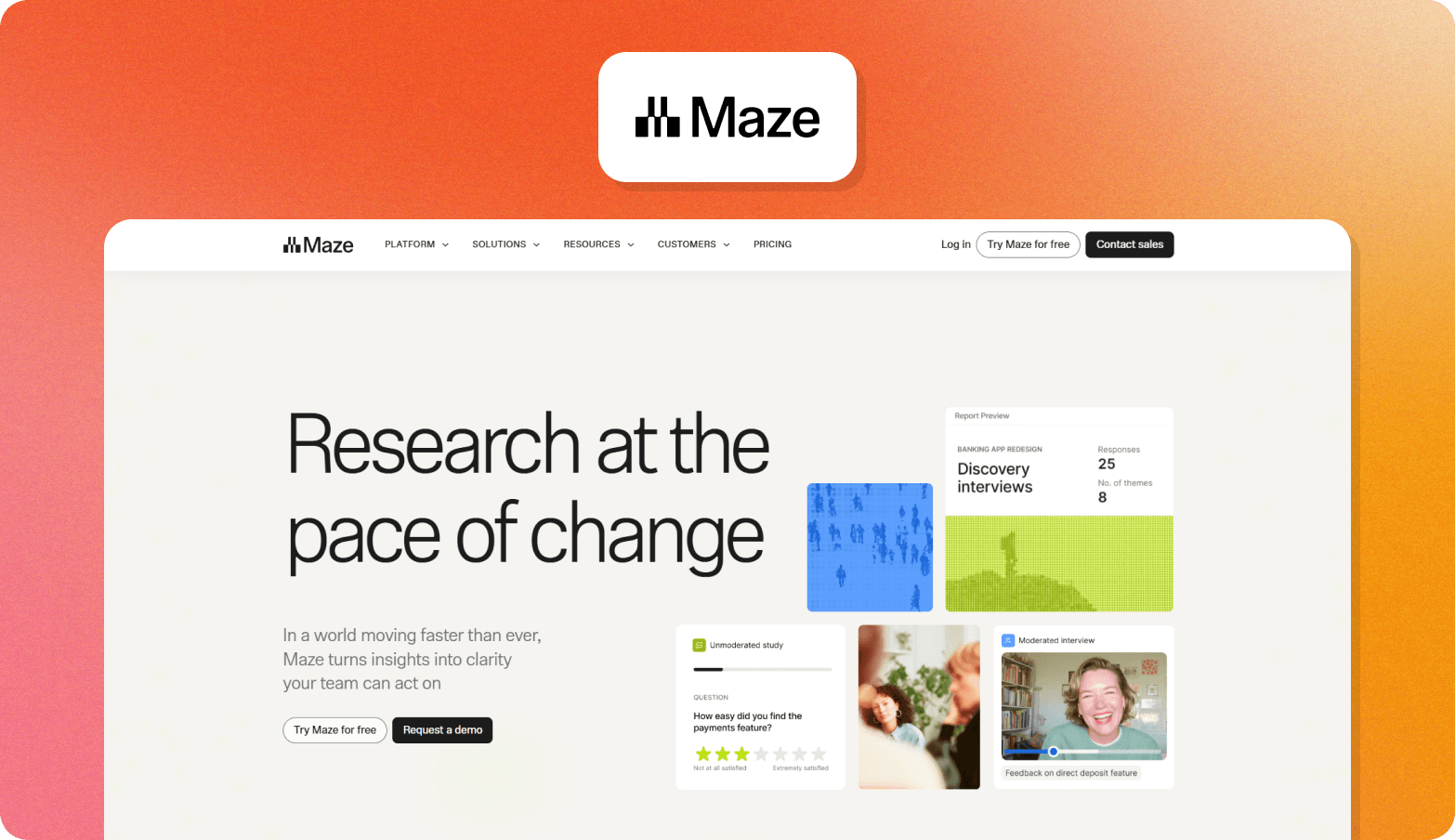
Maze is one of the most widely used ux research tools for unmoderated usability testing, prototype validation, and structured task-flow evaluation across digital products.
Best for
Product and UX research teams that want fast data collection on user interactions, user behavior, and friction points across the customer journey.
How it works
Maze runs structured usability tests on prototypes and live experiences to collect customer insights and user feedback that support early-stage design validation and strategic decisions.
Standout capabilities
Unmoderated usability testing at scale
Prototype and task-flow validation workflows
Supports behavioral analytics across user interactions
One honest tradeoff
Maze is strongest for structured usability testing and generates less exploratory qualitative depth than interview-based customer research tools.
9. UserTesting (UserZoom)
What it is
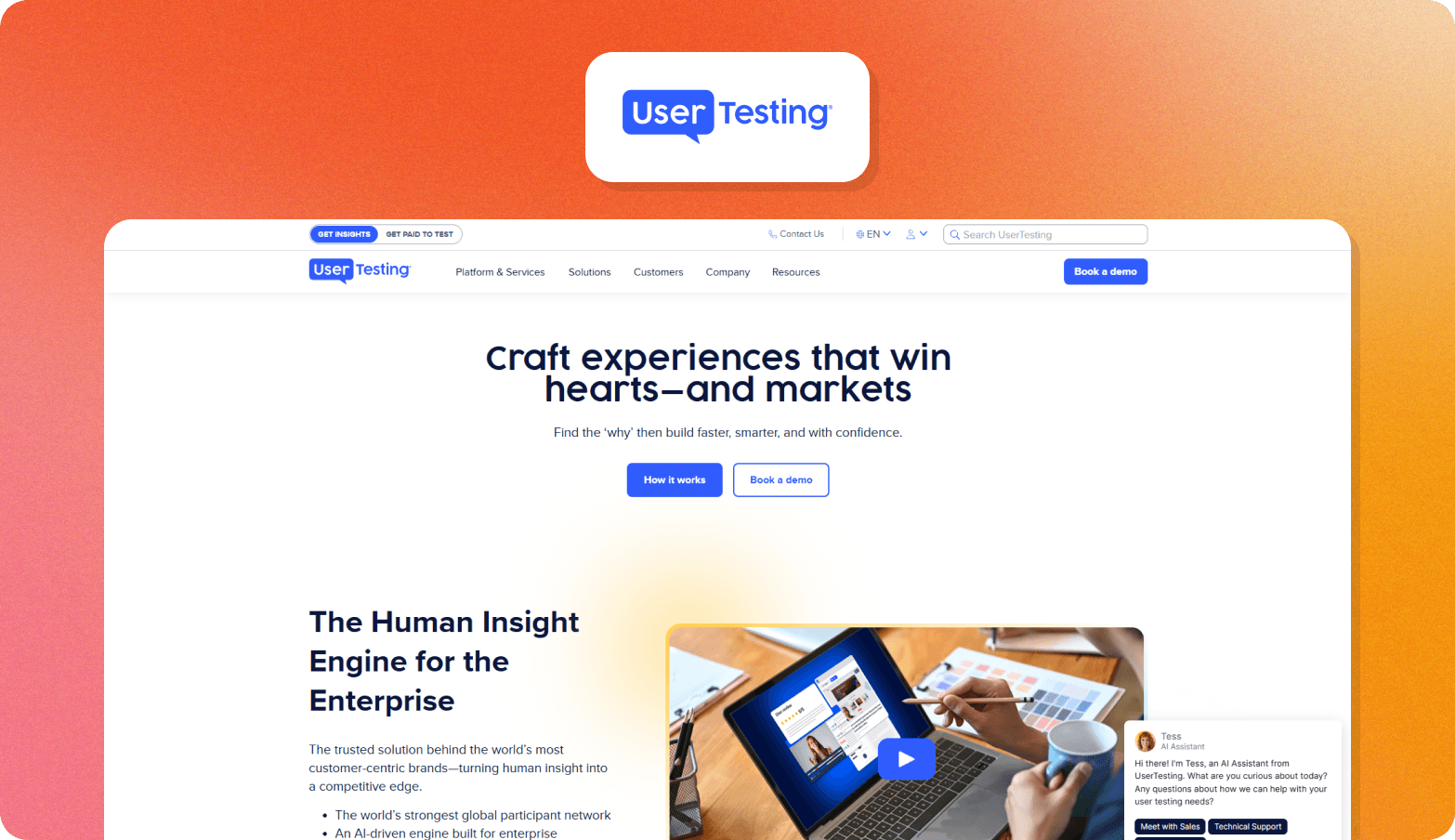
UserTesting (which includes UserZoom capabilities) is an established customer insights platform combining moderated and unmoderated studies with access to a large participant panel.
Best for
Research teams running usability studies across the customer journey who need session recordings and structured customer feedback from defined target audience segments.
How it works
UserTesting supports moderated sessions, unmoderated testing, and survey creation workflows that help teams gather customer feedback and understand customer behavior across products and digital experiences.
Standout capabilities
Large global participant panel
Moderated and unmoderated testing options
Session recordings support a deeper understanding of user behavior
One honest tradeoff
Qualitative analysis outputs are less automated than newer AI-powered insights platforms focused on synthesis at scale.
Consumer intelligence and data platforms
10. GWI
What it is
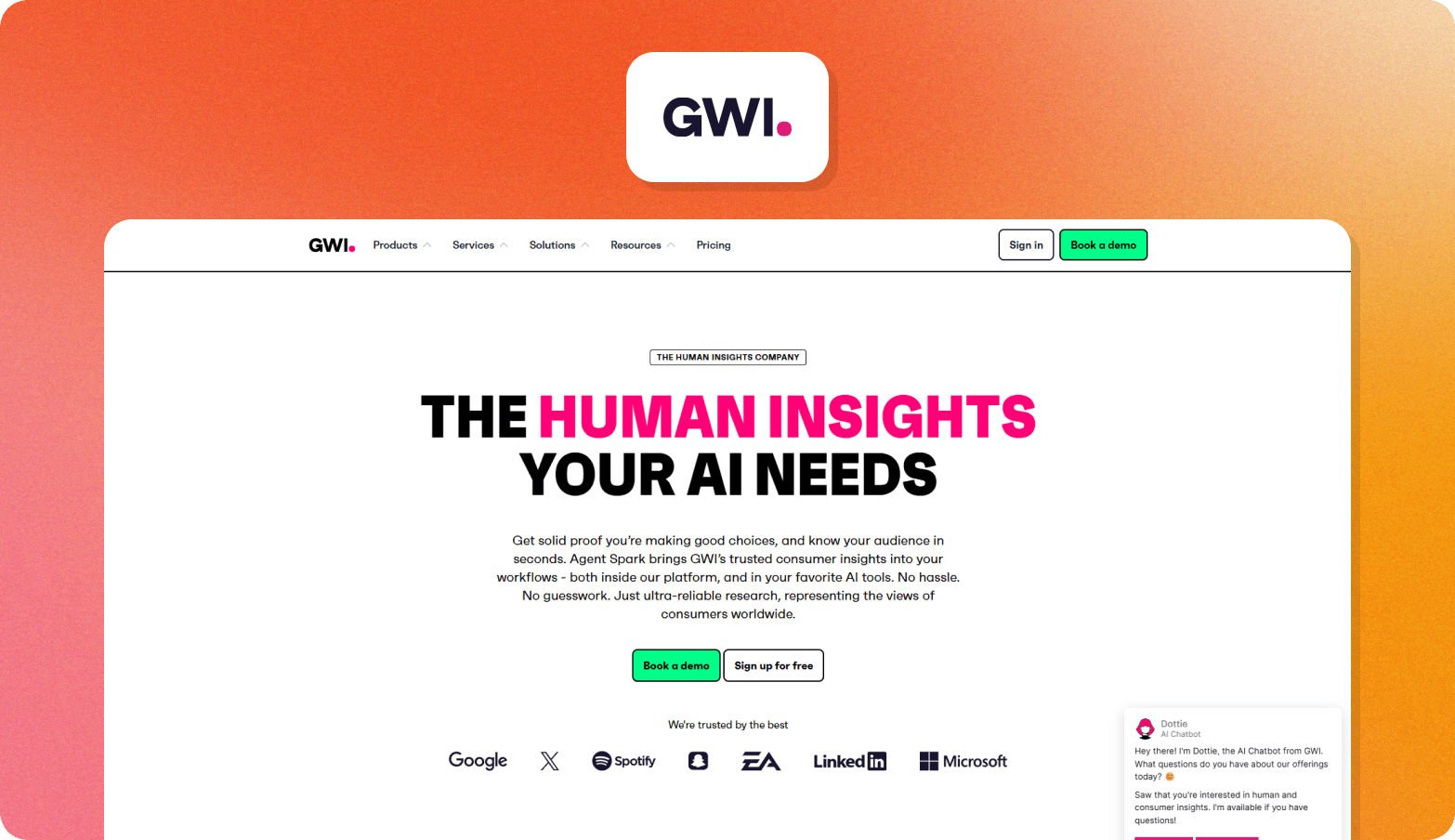
GWI is a consumer intelligence platform providing global survey data for audience segmentation, customer insights, and emerging trends analysis.
Best for
Sales and marketing teams and research teams that need large-scale market research data to understand customer needs, consumer behavior, and market trends.
How it works
GWI aggregates self-reported customer surveys and audience datasets to help teams analyze customer behavior, profile target audience segments, and generate market insights for marketing campaigns and positioning decisions.
Standout capabilities
Large international consumer datasets
Audience segmentation and profiling tools
Supports competitive intelligence and market research workflows
One honest tradeoff
GWI focuses on quantitative research findings and does not support qualitative interviews or customer conversations.
11. Brandwatch
What it is
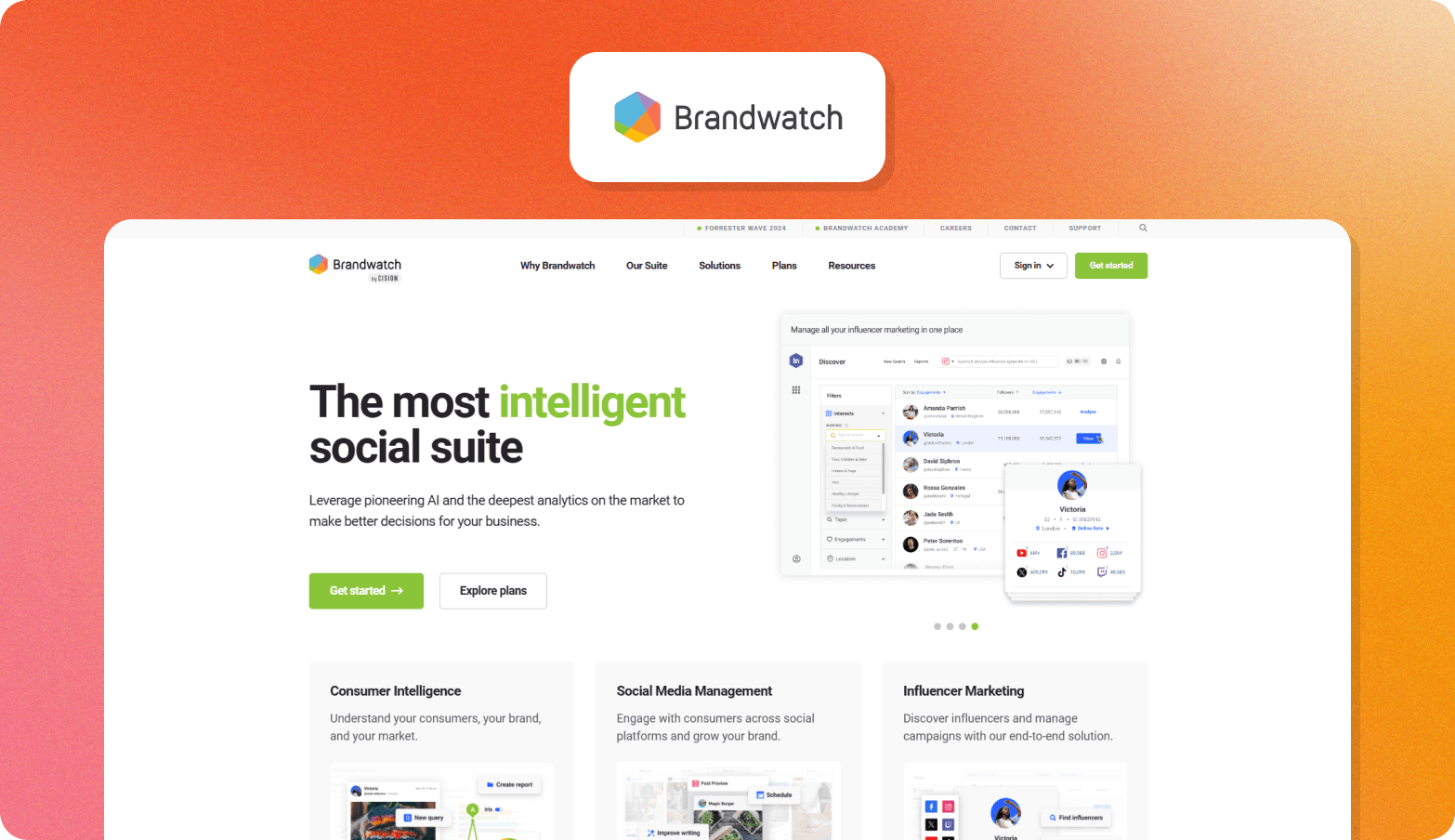
Brandwatch is a social listening platform that analyzes online conversations across social media platforms to track brand perception and sentiment analysis at scale.
Best for
Teams monitoring customer interactions across social media who want continuous visibility into customer engagement, consumer trends, and brand performance signals.
How it works
Brandwatch collects customer data from social media and other public sources using machine learning and natural language processing to support social listening, analyze social media performance, and generate actionable insights.
Standout capabilities
Large-scale sentiment analysis across social media
Tracks brand perception and customer engagement signals
Supports ongoing competitive intelligence monitoring
One honest tradeoff
Brandwatch relies on passive listening data and cannot probe motivations or run primary customer research directly.
Survey and lightweight feedback tools
12. Typeform
What it is
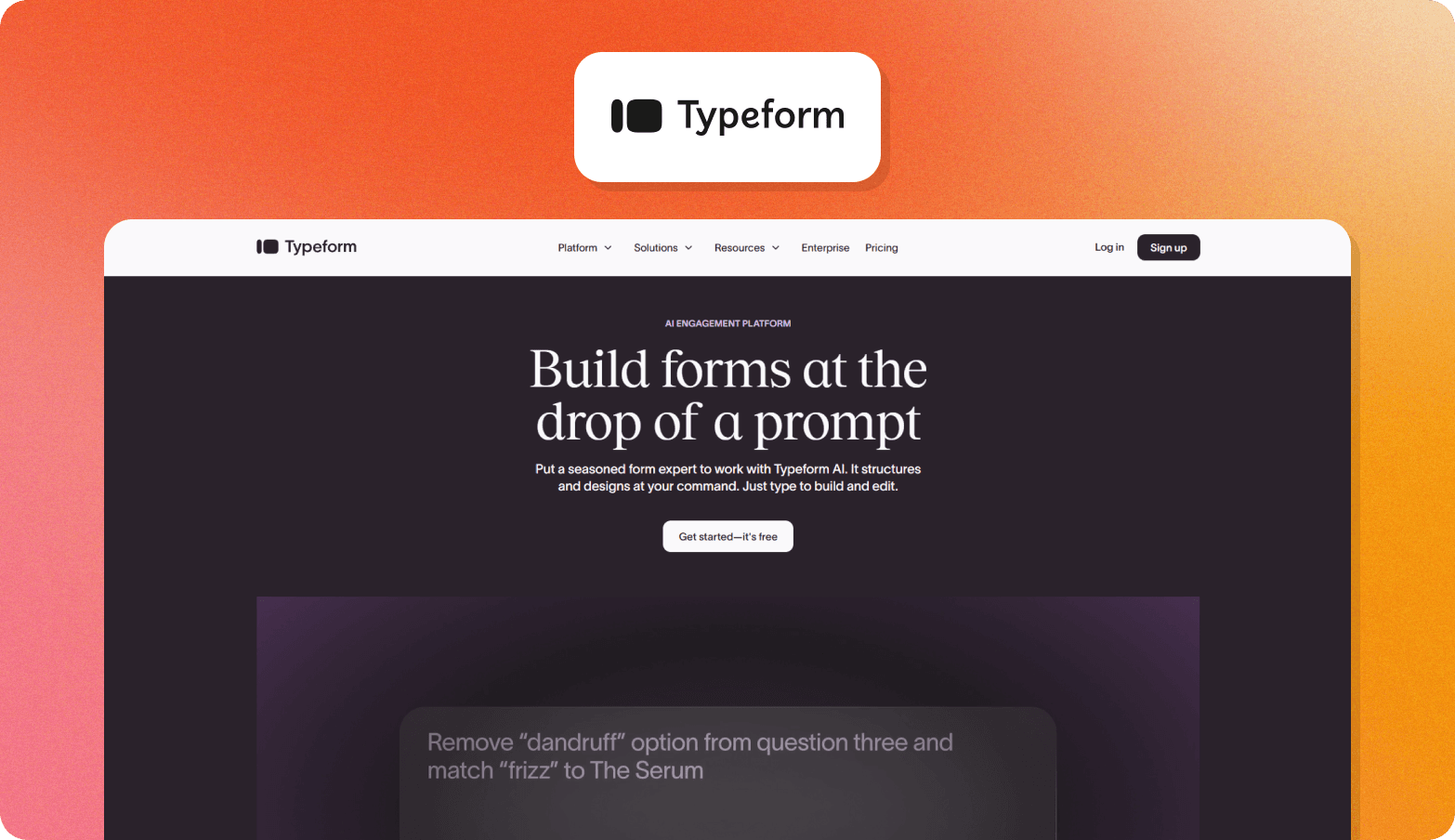
Typeform is a conversational survey-creation platform designed to collect customer insights through structured surveys and lightweight feedback workflows.
Best for
Research teams and sales and marketing teams that want flexible survey creation for market research, customer feedback collection, and early customer journey validation.
How it works
Typeform supports survey logic, branching flows, and structured data collection so teams can gather customer feedback and analyze customer behavior across defined target audience segments.
Standout capabilities
Conversational survey format for higher response rates
Flexible survey logic and survey data workflows
Useful for collecting structured customer insights quickly
One honest tradeoff
Typeform is a survey instrument rather than a full customer research tool and does not support interview moderation, qualitative data synthesis, or repository workflows.
13. Hotjar
What it is
Hotjar is a behavior analytics tool that combines heatmaps, session recordings, and on-site prompts to help teams understand how users interact with digital experiences.
Best for
Product and UX teams that want behavioral analytics visibility into user behavior, customer interactions, and friction points across the customer journey.
How it works
Hotjar captures session recordings, click patterns, and lightweight customer feedback prompts to support ongoing data collection and generate actionable insights about user interactions.
Standout capabilities
Heatmaps and session recordings for behavioral analysis
On-site feedback widgets to gather customer feedback
Supports continuous monitoring of customer behavior
One honest tradeoff
Hotjar focuses on behavioral analytics rather than qualitative interview research or deeper customer conversations.
14. Qualtrics
What it is
Qualtrics is an enterprise customer insights platform with advanced survey capabilities for large-scale customer research and experience measurement programs.
Best for
Organizations running structured market research programs that require customer surveys, sentiment analysis, and customer satisfaction tracking across the customer journey.
How it works
Qualtrics supports large-scale survey creation, collects customer data management, and advanced analytics workflows that help research teams generate research findings and customer experience insights.
Standout capabilities
Enterprise-grade survey creation and distribution
Strong sentiment analysis and experience tracking
Supports integration capabilities across analytics platforms
One honest tradeoff
Qualtrics is primarily quant-first, and deeper qualitative insights typically require separate interview-based tooling.
15. Voicepanel
What it is
Voicepanel is an AI-powered voice and video interview platform designed to collect customer insights through structured customer conversations and concept testing workflows.
Best for
Product teams exploring AI-powered customer research tools solutions for rapid feedback on product ideas, messaging, and early customer needs validation.
How it works
Voicepanel runs AI-moderated interviews that help teams gather customer feedback, analyze qualitative data, and generate AI-powered insights from customer conversations across distributed participants.
Standout capabilities
AI-powered voice and video interviews
Supports concept testing and persona exploration
Designed for fast-turnaround customer research workflows
One honest tradeoff
Voicepanel is an earlier-stage platform, and its insight library and enterprise workflow depth are still evolving compared with more established customer insights tools.
These tools solve different parts of the same problem. Some help you run interviews. Others focus on usability testing, survey workflows, repositories, or social listening.
The right customer research tool depends on where your team is trying to move faster, collecting feedback, organizing research, or turning conversations into usable insight.
Here are the five criteria we used to evaluate them.
How we evaluated these tools: 5 key criteria
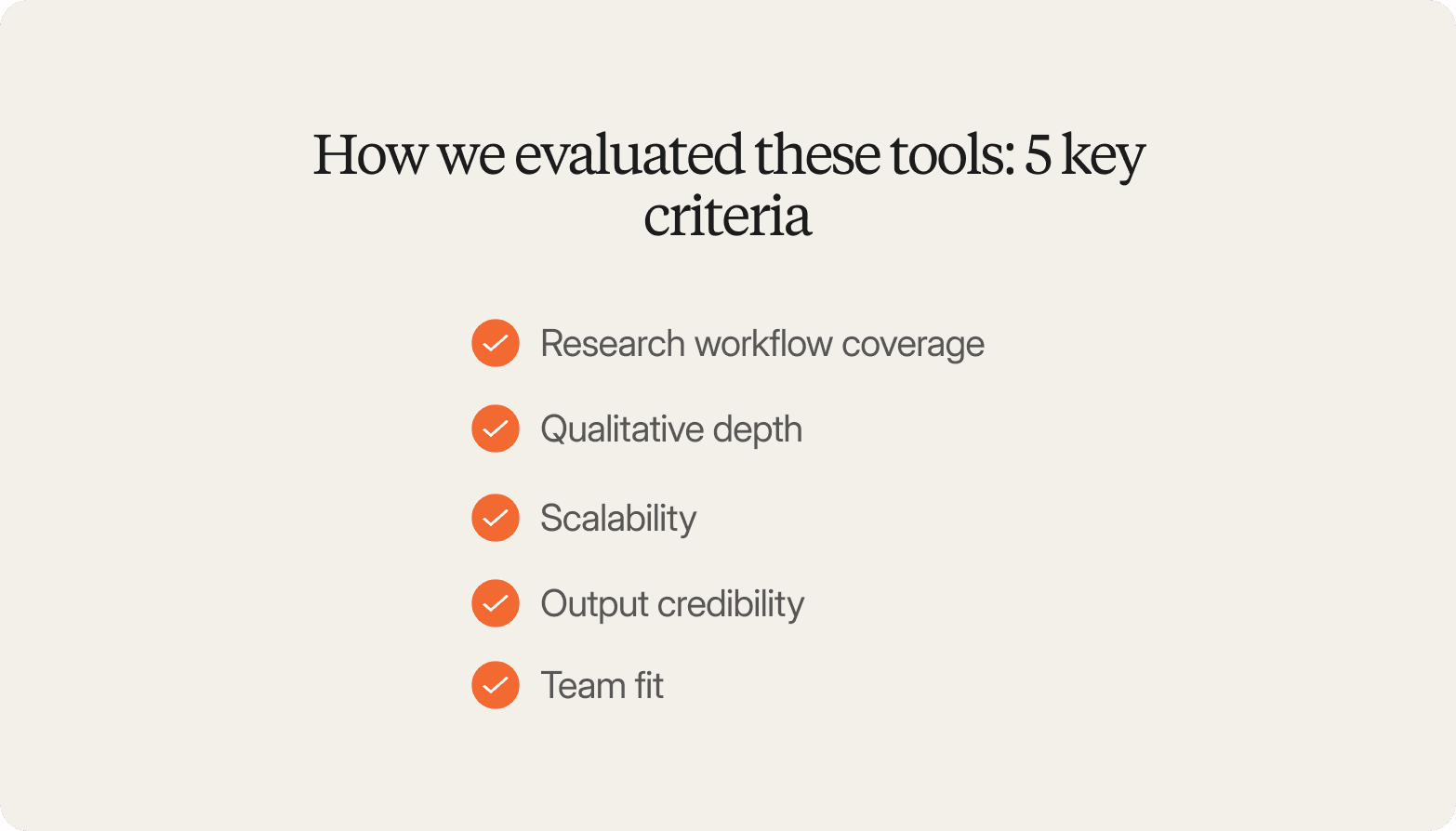
Customer research tools often look similar on the surface, but support very different parts of the research workflow. Teams choosing between them usually need to know whether a platform can produce credible insights, scale across studies, and fit the way their research actually runs day-to-day. We used the five criteria below because they reflect the practical tradeoffs that determine whether a tool works in a real research program, not just in a feature comparison.
1: Research workflow coverage
Some platforms support the full research cycle. Others focus on a single step, like recruitment, interviews, or analysis. We looked at how much of the workflow each tool actually covers.
Question to ask:
Does this tool support my full research process, or just one stage of it?
2: Qualitative depth
Some tools enable open-ended discovery and customer conversations. Others are designed mainly for structured survey-style input. We evaluated how well each platform supports exploratory research.
Question to ask:
Can this tool help me understand why customers behave the way they do?
3: Scalability
Some tools work well for ten interviews but struggle at one hundred. Others support continuous research across teams. We looked at whether output quality stays consistent as research volume increases.
Question to ask:
Will this tool still work when my research program grows?
4: Output credibility
Insights are only useful if teams trust them. We evaluated whether findings stay traceable to source data and are ready to share with stakeholders.
Question to ask:
Are the outputs structured enough to support real decisions?
5: Team fit
Some platforms are built for dedicated researchers. Others are designed for product and marketing teams running studies themselves. The right fit depends on who will actually use the tool day-to-day.
Question to ask:
Is this realistic for my team to run without extra support?
Because these platforms solve different problems, we grouped them into categories rather than stacking all 15 together.
That makes it easier to compare use cases and identify the best tools for organizing customer research in 2026, including newer AI-powered solutions for customer research and persona development.
The next step is figuring out what actually fits your team’s workflow and research goals.
Here’s how to choose the right customer research tool for your team.
How to choose the right customer research tool for your team
Different tools solve different research problems. The fastest way to narrow your options is to start with the type of insight your team needs most.
Choose an AI-moderated interview platform if:
Your primary need is qualitative depth, understanding why customers behave as they do
You want to run 10+ interviews per study without manual coding or synthesis bottlenecks
Your stakeholders expect traceable, video-backed findings rather than summary notes
Platforms in this category are often the best fit for dedicated insights and CX teams running continuous discovery programs.
For example, workflows like those described for consumer and market insights teams and customer experience teams show how interview programs scale when synthesis is built into the platform.
Choose a qualitative analysis or repository tool if:
You already have interviews or transcripts and need to organize and tag them
Your team runs moderated sessions live and needs a shared insight library
You are building a long-term research knowledge base across teams
Choose a UX or usability testing tool if:
Your research focuses on task completion, prototype feedback, or click behavior
You need structured results across many participants quickly
You are validating interface decisions rather than exploring motivations
Choose a consumer intelligence platform if:
You need market-level audience segmentation or trend tracking
Your research relies mostly on syndicated or survey-based datasets
You are monitoring shifts in behavior across large populations
Choose a survey or feedback tool if:
You need quick pulse checks at scale
Your questions follow structured answer paths
You are validating assumptions rather than exploring open-ended experiences
Most mature research teams use more than one category of tool. The key decision is which platform anchors your qualitative workflow, because that is where depth, credibility, and speed of insight start to matter most.
The best customer research tool for your team: Our final take
No single platform fits every research workflow. Some tools organize insights. Others test interfaces. Others track audiences and market trends.
If you need a repository, Dovetail is a strong choice. For usability testing, Maze works well. For audience segmentation and trend data, GWI remains a leading consumer intelligence platform.
But if your main challenge is running interviews at scale and turning customer conversations into structured, stakeholder-ready findings, Conveo is the strongest fit here.
That’s why many teams evaluating the best tools for customer research and persona development start with an AI-moderated interview platform.
If you’re deciding what to do next, ask yourself:
Do we need to understand why customers behave the way they do?
Are interviews becoming hard to synthesize consistently?
Do stakeholders expect traceable evidence, not summaries?
Frequently Asked Questions
What features should I prioritize when evaluating customer research tools?
Prioritize workflow coverage, qualitative depth, scalability, output credibility, and team fit. The right tool should support how your team actually runs research, not just how it collects responses.
How do I know AI-moderated interviews will produce findings my stakeholders trust?
Look for traceable outputs linked to source recordings, structured synthesis instead of summaries, and transparent methodology. Stakeholder trust comes from evidence, not automation alone.
Can AI-moderated interview tools replace human moderators?
They can replace moderation for many discovery, concept testing, and recurring interview workflows. Human moderators still add value for highly sensitive topics, complex facilitation, or strategic workshops.
What should product and UX teams specifically look for in a customer research tool?
Focus on speed of insight, usability testing support, structured synthesis, and the ability to connect research findings to roadmap decisions and user behavior patterns.
How do customer research tools fit into an existing enterprise research stack?
Most teams combine tools. Interview platforms generate qualitative insights, repositories organize findings, usability tools validate interfaces, and survey platforms support quantitative measurement.
How much do enterprise customer research tools cost?
Pricing varies widely based on interview volume, participant sourcing, storage, and analysis features. Enterprise platforms typically use subscription pricing rather than per-study fees.

About the author
Florian Hendrickx
Head of Growth
Florian is Conveo’s Chief Growth Officer, leading growth strategy and go-to-market execution as the company scales. He’s held growth leadership roles at companies like Deliverect, Robovision, and Aikido Security, and brings hands-on experience across marketing, sales, and product.
More by Florian →Qualitative insights at the speed of your business.
Conveo runs AI-moderated video interviews and structures everything they say.