In this article
TL;DR
Most teams pick methods based on launch timelines, not research goals. The decision windows that matter most, the ones where user input prevents expensive mistakes, are smaller and more frequent than a launch schedule reveals. Conducting user research continuously, rather than only at release, is what separates teams that learn from those that assume.
The right method depends on four constraints at once. Sprint timeline, recruiting friction, stakeholder risk tolerance, and evidence requirements all shape which method is best suited. User research best practices treat constraint-based method selection as a discipline, not a workaround.
Interviews and concept testing deliver depth surveys that cannot. Traditional moderation and synthesis timelines of six to ten weeks make continuous research operationally impossible for teams of one to three researchers without external support.
Continuous discovery requires removing manual overhead from every study. AI-assisted synthesis, AI-assisted transcription, and a searchable insight library that compounds learnings across studies change the equation. The right platform handles the research process, allowing the researcher to focus on the findings.
Conveo's AI-moderated video interviews compress study timelines from weeks to days, enabling product teams to run lightweight studies whenever new questions arise, without adding headcount or moderator capacity.
Qualitative research for product and UX teams has changed more in the last three years than in the previous two decades. Real human conversations can now run in parallel across hundreds of participants. Synthesis that once took a week arrives in hours. Findings link across studies rather than dying in individual decks. The constraint on user research methods today is not what the discipline can deliver. It is operational.
Most product teams choose their user research methods based on what the launch calendar allows, not what their research goals demand. When recruiting, scheduling, moderating, transcribing, and synthesizing a single round of interviews consumes dozens of hours, research becomes a project. Projects get scoped to major releases. The questions that surface between sprints go unanswered, and decisions across the product development process get made on assumption rather than evidence.
This article covers a constraint-based framework for selecting user research methods; a comparison of when each approach fits the research objective and timeline; best practices for methods that deliver the most depth; and a model for continuous discovery that treats user research as infrastructure rather than a periodic event.
Why product teams research only at launch (and what that costs)
Product teams do not skip user research because they doubt its value. They skip it because the operational cost does not fit inside a two-week sprint. Recruiting participants, coordinating schedules across time zones, moderating sessions, transcribing recordings, and synthesizing findings into actionable findings routinely consume dozens of hours per study.
The result is a research cadence that looks nothing like the product development process. Teams talk to users at the start of a project and again before a significant release. Everything in between is decided on instinct or on assumptions carried over from the last study, and the ability to gather continuous feedback is lost entirely.
What gets lost in that gap is significant. Usability issues compound until they become support tickets. Feature prioritization decisions get made without context. The "why" behind behavioral data in dashboards (Google Analytics, product analytics, session recordings) stays unanswered. Self-reported data from surveys tells you what users say they did; attitudinal data from questionnaires tells you how users say they feel. Neither surfaces the reasoning, friction, or unmet user needs that interviews uncover.
Continuous discovery requires removing the operational overhead that makes weekly research feel impossible. When recruiting, moderation, transcription, and synthesis are handled by a platform rather than a researcher's calendar, the question shifts from "can we afford to run a study this sprint?" to "what do we most need to learn right now?"
A method-selection framework for real constraints
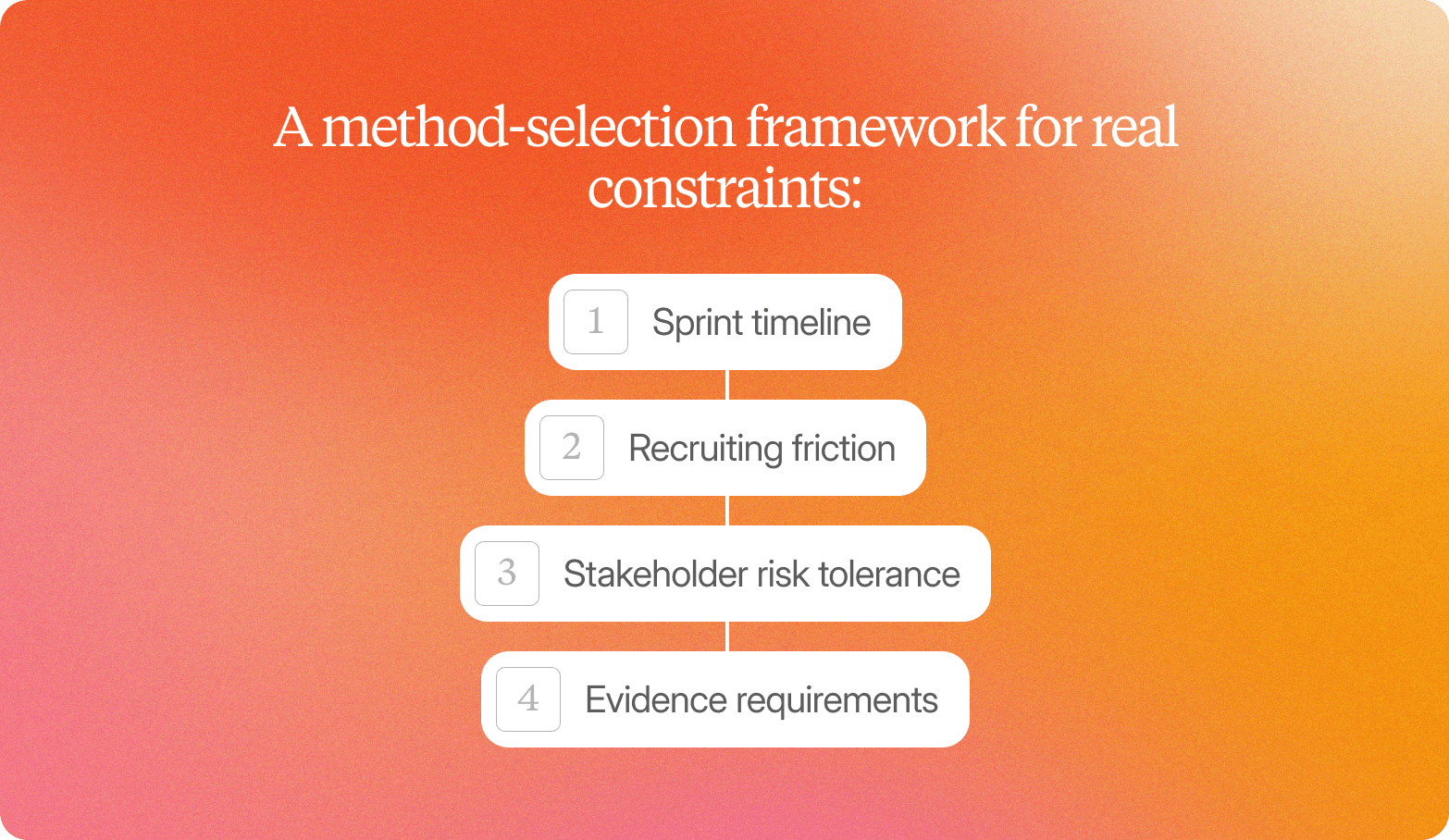
Most guides to user research methods are organized by category: attitudinal research versus behavioral research, qualitative versus quantitative, generative versus evaluative. That taxonomy is useful for a research methods course. It is less useful when you have a sprint ending in five days and three product teams waiting for an answer.
The research techniques a team can actually run are determined by four operational constraints:
Sprint timeline: How fast do you need an answer? Methods that require sequential scheduling, including traditional interviews and moderated focus groups, take weeks because each session depends on participants' availability. Async methods, including AI-moderated video interviews and diary studies, compress timelines to days by removing the scheduling bottleneck entirely.
Recruiting friction: How hard is it to reach the right target users? B2B audiences and niche user segments require longer lead times and specialist panels. Consumer audiences can often be recruited within 24 to 48 hours. Platforms that handle recruiting, screening, and incentives within the same workflow remove this as a blocking constraint.
Stakeholder risk tolerance: How much evidence do stakeholders need before they act? Teams presenting to skeptical decision-makers need traceable outputs: video clips, verbatim quotes, and transparent coding that ties conclusions back to specific source conversations, an argument for video-first methods that make data collected from real participants inspectable.
Evidence requirements: What depth does the research objective require? Surveys scale fast but consistently miss the "why." Generative research methods like user interviews and diary studies uncover motivations and behaviors that surveys cannot. Evaluative research methods, such as usability testing and concept testing, validate specific design decisions.
Applying constraint-aware logic to method selection is what user research best practices actually look like. Conveo's platform is built around all four simultaneously: async AI moderation removes the timeline bottleneck, integrated recruiting removes friction, video-first outputs address stakeholder trust, and adaptive probing maintains the depth that makes findings actionable.
Types of user research methods (and when each fits)
Most guides to the types of user research organize methods by the attitudinal-behavioral and qualitative-quantitative axes, distinguishing attitudinal research (what users say and think) from behavioral research (what users actually do). What follows is a practical map of the core user experience research methods product teams use in continuous discovery: what each is built for, where each breaks down, and what it takes to run one repeatedly.
| Method | Primary use | Timeline | Depth | Participant volume | Conveo-enabled |
|---|---|---|---|---|---|
| User interviews | Generative research, unmet needs | Days (AI-led) | High | 10–500+ | Yes |
| Concept testing | Evaluative research, validate before commitment | 2–5 days | High | 20–200 | Yes |
| Usability testing | Identify friction in task flows | 3–7 days | High | 5–30 | Partial (non-task-flow) |
| Diary studies | Longitudinal behavior in natural environments | 1–4 weeks | Very high | 10–50 | Yes |
| Surveys | Quantitative data at scale | 1–3 days | Low | 100–10,000+ | No (qual-first platform) |
| Card sorting / IA testing | Navigation and information architecture | 3–7 days | Medium | 20–100 | No |
Timeline estimates reflect AI-moderated, asynchronous delivery when Conveo is enabled; traditional moderated approaches add 2 to 6 weeks to recruitment and scheduling.
6 best practices for running user interviews (The method most teams underuse)
User interviews deliver the depth product teams need to gain insights into user behavior and motivation, but most teams conduct user research this way only during major launches because traditional moderation and synthesis timelines make continuous use operationally impossible without dedicated moderator capacity. The constraint is infrastructure, not conviction.
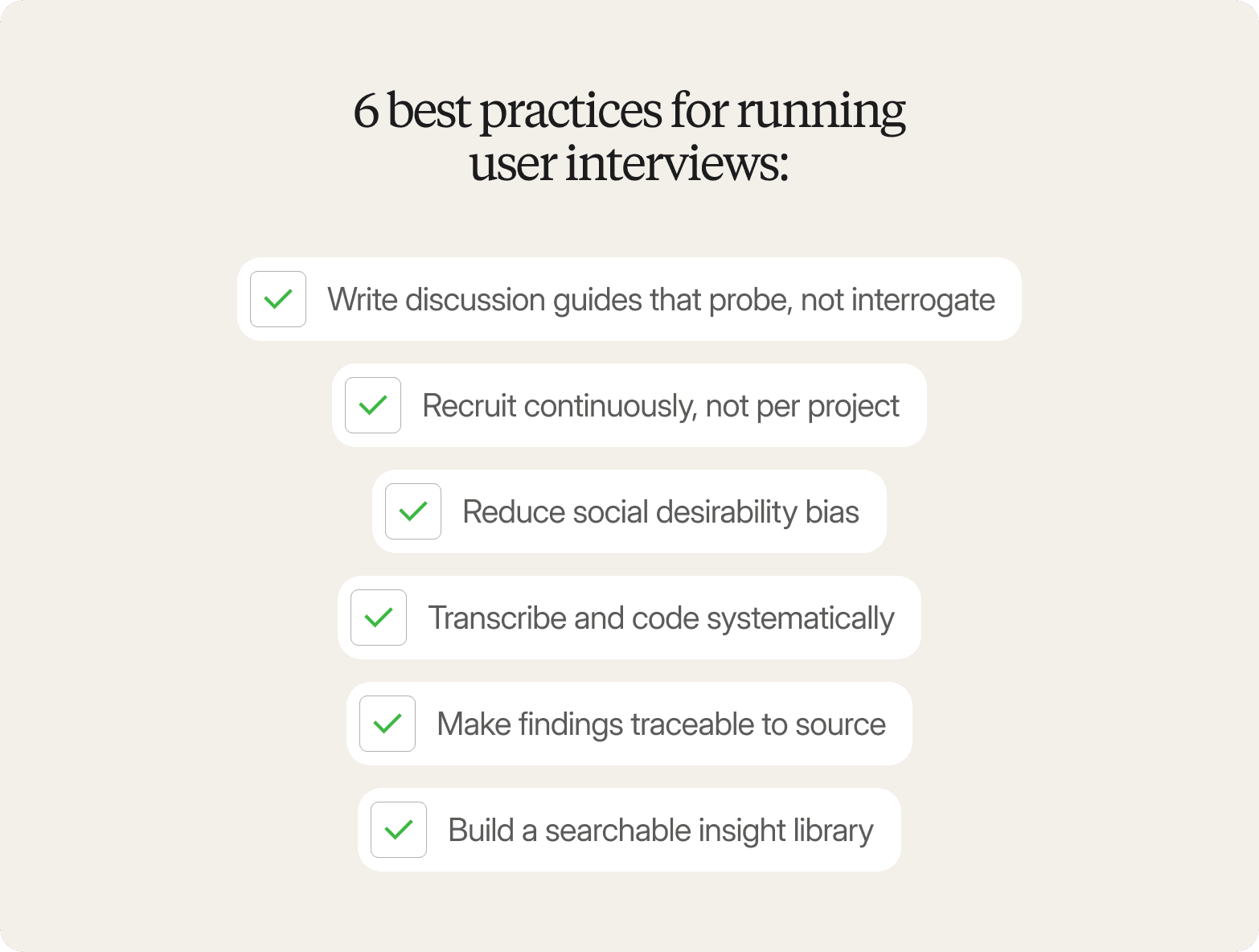
1. Write discussion guides that probe, not interrogate
The question format is the single biggest variable in interview quality. "Do you find this feature useful?" ends the conversation. "Tell me about the last time you tried to do this in your current workflow," opens it. Behavior-anchored prompts produce qualitative data grounded in real experience, the kind of deep understanding that creates user-centered solutions rather than assumption-driven ones.
Adaptive probing matters just as much as the opening question. Following what a participant actually says, rather than the next item on a list, is where the real signal lives. Conveo's AI interviewer senses hesitation and follows up based on the content of the response rather than a fixed sequence.
2. Recruit continuously, not per project
The fix is not to recruit faster for each study. It is to maintain a standing opt-in panel of target users so that when a new research goal surfaces mid-sprint, participants are available within 24 to 48 hours rather than two weeks. Conveo's integrated recruiting handles panel management within the same workflow as moderation and synthesis, removing recruitment as a blocking constraint.
3. Reduce social desirability bias
When a participant knows a researcher is watching, they perform. Removing the human dynamic changes what people say. In AI-moderated sessions, participants report significantly greater candor, particularly on topics where they might feel judged, such as admitting that a feature is confusing or describing a workaround.
4. Transcribe and code systematically
Manual transcription runs four to six hours per hour of recorded interview. AI-assisted transcription compresses that to minutes, and AI-supported thematic coding helps identify patterns across dozens of sessions (user language, recurring friction points, shared mental models) without displacing the researcher's interpretive judgment. Synthesis becomes review and validation of qualitative data, not extraction from scratch.
5. Make findings traceable to source
Every theme and recommendation should connect directly to the participant moment that produced it: a video clip, a verbatim quote, a timestamped exchange. When stakeholders can inspect the evidence behind a conclusion, findings move from "interesting summary" to actionable input. Video-first methods make this structural: the data collected from real participants is always one click from the conclusion it supports.
6. Build a searchable insight library
A persistent library tagged by theme, product area, and user segment changes the economics of every future study: before commissioning new fieldwork, teams can search what they already know. Conveo's insight library flows every session, clip, and finding into a searchable repository that compounds across studies. Teams use it to identify patterns across recurring questions, so something that surfaces in a sprint planning meeting can often be answered in minutes rather than weeks.
Running interviews continuously is not a discipline question. Knowing how to do customer research is not the constraint. Having a system that removes the operational cost of conducting research at a sprint cadence.
How to Operationalize Continuous Discovery (Not Just Launch-Only Research)
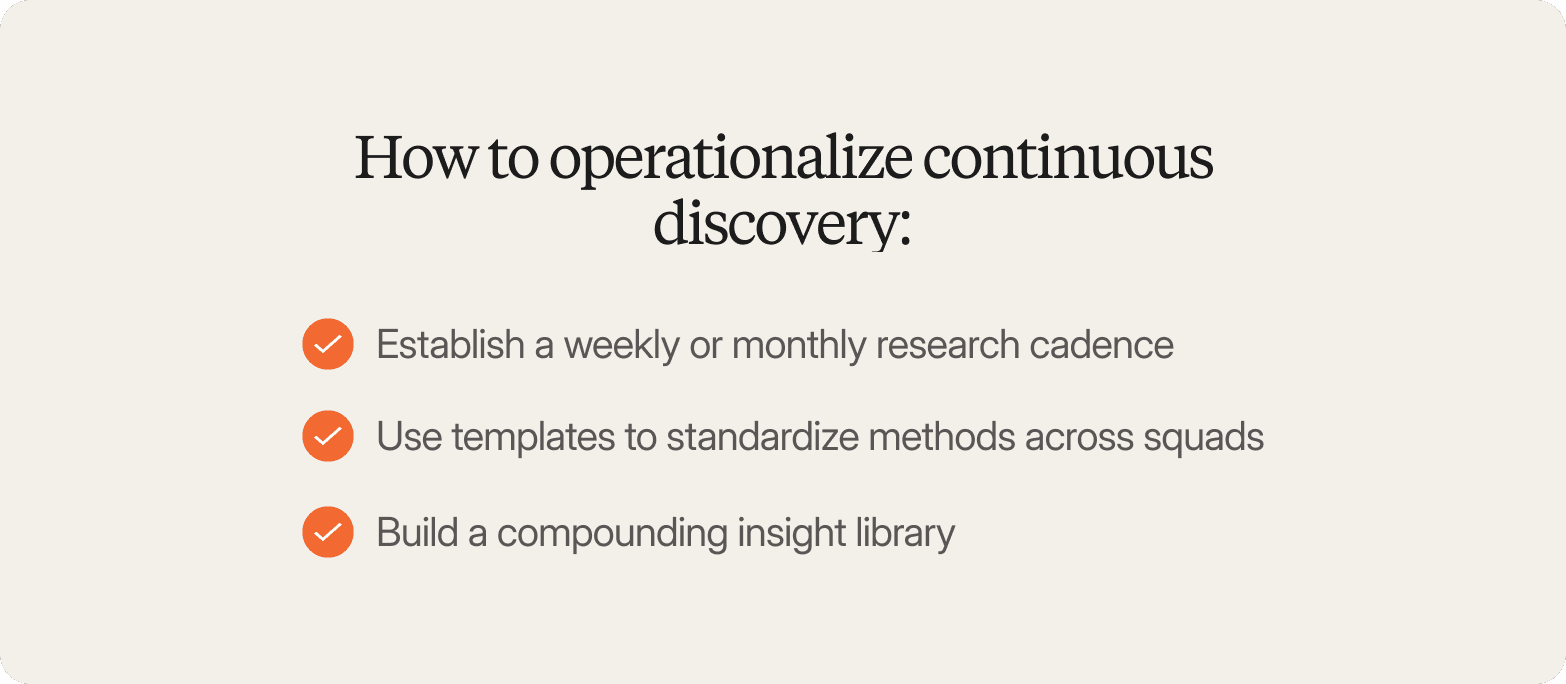
Continuous discovery requires a system for running research repeatedly, inside the development process, without turning every cycle into a full production effort. User research best practices consistently identify three operational changes: how questions are captured and triaged, how studies launch without setup friction, and how findings compound into institutional knowledge.
1. Establish a Weekly or Monthly Research Cadence
Research happens on a schedule, not when a major release forces it. For high-velocity product teams, weekly; for teams on longer planning cycles, monthly. The frequency matters less than the commitment.
What makes this work is pairing the cadence with a shared question backlog. Product managers, designers, and marketers submit research goals as they surface across the target audience and the user segments they serve. The research lead triages before each cycle: Is this urgent? Does it justify a study? Has a previous study already answered it? A well-maintained insight library means that many incoming questions can be resolved without new fieldwork, including those that Google Analytics and behavioral dashboards raise but cannot answer on their own. Conveo's insight library is built to support this loop, making past findings searchable so the research lead can route incoming questions to existing evidence before committing to a new study.
2. Use Templates to Standardize Methods Across Squads
When squads run research independently without a shared structure, findings diverge in ways unrelated to the users. Standardizing the user research methodology through templates solves this without constraining how researchers think. A shared discussion guide structure, a consistent synthesis framework, and a stakeholder report template mean that findings can be compared across studies rather than siloed in individual decks. Conveo supports this by allowing teams to build reusable study templates directly on the platform.
3. Build a Compounding Insight Library
Every interview, theme, and participant clip should flow into a single, searchable repository rather than a slide deck that gets filed and forgotten. In Conveo, each study's outputs are automatically tagged by theme, product area, and user segment as they land, covering feature usage patterns, recurring user expectations, and behavioral context across the full participant set.
The compounding effect builds gradually: early studies require full research cycles; by the sixth or eighth study, patterns are cataloged, and each new study starts from a higher baseline.
These three elements are what make user research methods and best practices sustainable at a sprint cadence. Cadence prevents reactivity. Templates remove setup friction. A library turns individual studies into institutional memory.
What Becomes Possible with Conveo
Conveo is the video-first AI research platform built for product and UX teams that need interview-quality depth at sprint-compatible speed. It handles the entire research workflow in one place: participant recruiting, AI-moderated video interviewing with adaptive probing, AI-assisted transcription and translation, thematic synthesis, and a searchable insight library. The teams that run 10 or more studies per quarter, rather than two or three, are not working harder. They are working without the manual overhead that made each study feel like a project.
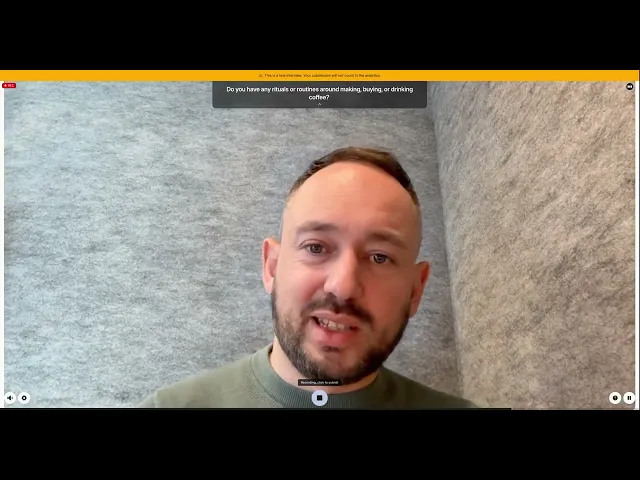
See it in action: How Conveo's AI-Moderated Interviews Work
What enterprise buyers evaluate before anything else is not speed. It is output trust. Conveo's interviews run with real human participants, not synthetic respondents or AI-generated avatars. Every finding traces back to the video clip and verbatim quote that produced it, so stakeholders can inspect conclusions rather than trust a summary. That traceability is what makes findings actionable inside organizations where research credibility is a procurement requirement. Conveo is SOC 2 certified, GDPR-compliant, and supports regional data hosting for teams with European data governance obligations.
Hundreds of enterprise teams, including teams at Google, use Conveo to move from periodic research cycles to continuous customer understanding. Teams describe cutting research timelines from months to days, not by cutting corners on methodology, but by removing the manual steps that have historically consumed researchers' weeks.
"Conveo's video-first approach is a real differentiating methodological advantage. The ability to distill insights from reactions and not just hear answers adds context you simply can't get from transcript-only tools, or any other tool in the market for that matter."
Senior Marketing Research and Insights Manager, Google
The compounding insight library is where long-term returns accumulate. Every study automatically flows into a searchable repository, tagged by theme, product area, and user segment. Stakeholders can interrogate it in plain language, surface what is already known before commissioning new fieldwork, and see patterns across studies that no single study would reveal. Unlike a generic AI summarizer that produces fast outputs without verifiable sources, Conveo's library is built on real participant data that grows more valuable with every study that runs through it.
Frequently Asked Questions
What are the main types of user research methods?
The six core types of user research are: user interviews, which surface motivations and reasoning through open-ended conversation and generative research into user needs; concept testing, which evaluates ideas before engineering resources are committed and can run A/B testing in a qualitative format to compare two or more versions of a design; usability testing, which identifies friction in specific task flows; diary studies, which capture behavioral context over time in natural environments; surveys, which quantify known patterns and collect quantitative data at scale; and card sorting or tree testing, which validates information architecture against real user mental models. Each method fits different research goals and timeline constraints. The right choice depends on what the team needs to learn and how fast the decision window closes.
What is the difference between qualitative and quantitative user research?
Qualitative research uncovers why users behave as they do through user interviews, observations, and open-ended methods that surface motivations, mental models, and friction points. Qualitative data is rich but not directly countable. Quantitative research measures how many users behave in a given way, through surveys and analytics that produce quantitative data on frequency and scale. Both are complementary: qualitative research establishes what to measure; quantitative methods validate how widely it applies. Teams that skip the qualitative step often end up collecting data about the wrong things at scale.
How do you choose the right user research method?
Method selection should be driven by four constraints: the research objective (what you need to learn and how deep the evidence must go); sprint timeline (how fast you need an answer); recruiting friction (how hard it is to reach the right participants); and stakeholder risk tolerance (how much data collected must be traceable before decision-makers will act). Teams default to surveys because they are fast, but surveys sacrifice the "why" that most product decisions actually require. Match the research method to the decision, not to the available time.
What are the best practices for interviews?
Write discussion guides with open-ended, behavior-anchored questions rather than closed prompts. Use video-first methods to capture non-verbal signals (tone, hesitation, and facial expressions) that text-based summaries strip out. Gather feedback in a way that reduces social desirability bias: AI-moderated sessions consistently produce more candid, valuable insights than moderator-observed sessions. Make findings traceable to the source so stakeholders can inspect conclusions rather than trust a summary. Build a searchable insight library rather than filing findings in a deck that no one opens six months later.
How do you operationalize continuous user research?
Establish a fixed weekly or monthly cadence so that conducting research happens on a schedule, not only when a launch forces it. Use templates to standardize the research process across squads (discussion guides, synthesis frameworks, and stakeholder reports), so researchers spend less time on setup and more on interpretation. Build a compounding insight library that tags every finding by theme, product area, and user segment. This research process, together, makes continuous discovery operationally sustainable without adding headcount.
What is the difference between user research and UX research?
UX research focuses on how users interact with a product's interface during the UX design process, including usability, task completion, comprehension, and friction in specific flows. It is primarily evaluative research, testing what exists. User research is broader, using generative research methods to generate ideas, surface motivations, and uncover unmet user needs across a target audience that extends beyond product interaction into purchase decisions and brand perception. In practice, the terms are used interchangeably at companies where UX researchers own the full research process.

About the author
Abby Euyang
Research Impact Lead
Abby studied psychology, fell for research there, and spent four years on the UX research team at PayPal. She compared the AI-moderated platforms before choosing Conveo for the researchers it had gathered, and now sits in the sessions where researcher feedback becomes product changes the same day.
Meet Abby on film →Qualitative insights at the speed of your business.
Conveo runs AI-moderated video interviews and structures everything they say.