In this article
TL;DR
Van Westendorp and Gabor-Granger now run inside Conveo's AI-moderated interviews, so every price comes back with the reasoning behind it already attached.
A Van Westendorp study on smart-glasses frame pricing found a premium that holds in the UK but not the US, and the interviews explain why.
A Gabor-Granger study on the YouTube Premium and Peacock bundle found a real lift in willingness to pay, but only among consumers who don't already have Peacock elsewhere. Neither finding needed a separate qualitative round.
The number and the reason came from the same consumers, in the same interview.
Price sensitivity testing reimagined: the fastest way to find out why
A Van Westendorp study comes back and the optimal price sits 30% below target. A Gabor-Granger curve says a bundle is worth two extra dollars a month. Both are exactly what these methods are built to produce: clean, defensible numbers, with decades of statistical pedigree behind them. And both leave a pricing team with the same problem. The curve tells you where the market lands. It never asked why.
That gap is what we built pricing questions in Conveo to close. Van Westendorp and Gabor-Granger now run inside Conveo's AI-moderated interviews, so the same consumers who give you a price also explain that price, in their own words, while the study is still in field.
To show what that actually changes about how you'd act on these numbers, we ran the two methods on two real pricing questions: what Samsung should charge for its first smart glasses, and whether bundling Peacock into YouTube Premium adds anything real at all.
Case one: Van Westendorp - the same glasses, priced two ways
We ran a Van Westendorp exercise with 404 prospective smart-glasses buyers across the US and UK. Each participant priced the same Samsung smart-glasses concept twice: once shown with a Warby Parker frame, once shown with a Gentle Monster frame. The hardware underneath was identical both times, so any difference in price comes down to how the frame itself is read.
| Market | Frame | Indifference price (IPP) | Optimal price (OPP) | Acceptable range |
|---|---|---|---|---|
| United States | Warby Parker | $299 | $259 | $177 to $432 |
| United States | Gentle Monster | $299 | $250 | $199 to $400 |
| United Kingdom | Warby Parker | £300 | £260 | £199 to £460 |
| United Kingdom | Gentle Monster | £300 | £299 | £200 to £450 |
Read as numbers alone, this is a mildly confusing table. Gentle Monster prices below Warby Parker in the US, sits at parity with it on what counts as a normal price in both markets, yet commands a real premium in the UK, where its optimal price of £299 lands almost exactly on what people consider simply fair. A quant-only readout leaves you guessing whether that UK premium is real, a fluke of sample, or something Samsung could price into confidently everywhere.
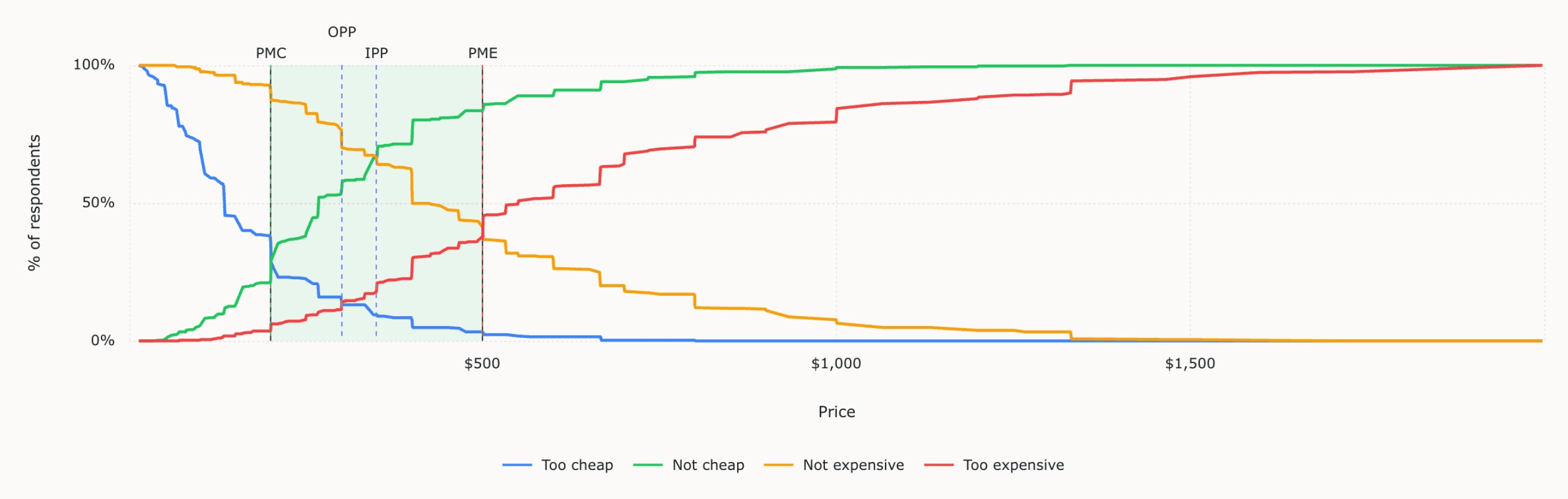
The interviews resolve it. In the UK, Gentle Monster's premium is being paid for perceived design and everyday wearability. One participant called £280 good value for what they described as a well-designed, AI-enabled pair of glasses they'd wear daily, not a novelty. In the US, the same frame mostly didn't clear that bar.
Several participants weren't familiar enough with Gentle Monster as a brand to pay more for it, and a recurring objection undercut both frames in both markets: participants pointed out it was the same hardware underneath, so the frame felt like a cosmetic choice, not a reason to pay differently. Warby Parker, in contrast, carried an existing halo. Participants who already trusted the brand, and its real-world tie to Google, treated that trust as a reason $150 to $260 felt like fair value rather than a leap of faith.
Trust set the floor too, not just the ceiling. Several participants said a very low price, $100 for the Warby Parker pairing, would make them more suspicious rather than more interested, worried about hidden costs or a catch. Others were simply unwilling to pay a premium for an unproven product category at all, wanting evidence the glasses would hold up before they'd stretch their budget.
None of that shows up in a price curve. It's the difference between knowing Samsung has room to price Gentle Monster near £299 in the UK, and knowing why. That's what lets a premium be defended with the design story actually earning it, rather than assumed to travel to every market untested.
Case two: Gabor-Granger - what a bundle is actually worth
The second study asked a narrower, sharper question, in response to YouTube’s announcement that YouTube Premium will now include Peacock.
Among people who watch YouTube at least weekly but don't subscribe to Premium, how much does adding Peacock move the price they'd pay, and is that lift real value or just a bigger number on the page?
We ran Gabor-Granger against 399 of these non-subscribers, split into two matched groups: one priced standalone YouTube Premium, the other priced YouTube Premium bundled with Peacock.
| Version | Revenue-optimal price | Would subscribe at that price | Modeled revenue per 1,000 consumers |
|---|---|---|---|
| YouTube Premium alone | $5.99 | 61% | $3,600 |
| YouTube Premium + Peacock | $7.99 | 55% | $4,400 |
Peacock moves the revenue-optimal price up 33%, and modeled revenue per 1,000 consumers up 22%. When Peacock is bundled, rejection of YouTube Premium at the lowest price we tested ($5.99) drops from 40% to 28%.
YouTube has said it won't change pricing when Peacock is introduced. So the more useful question is what this bundling does at the current price point of $15.99.
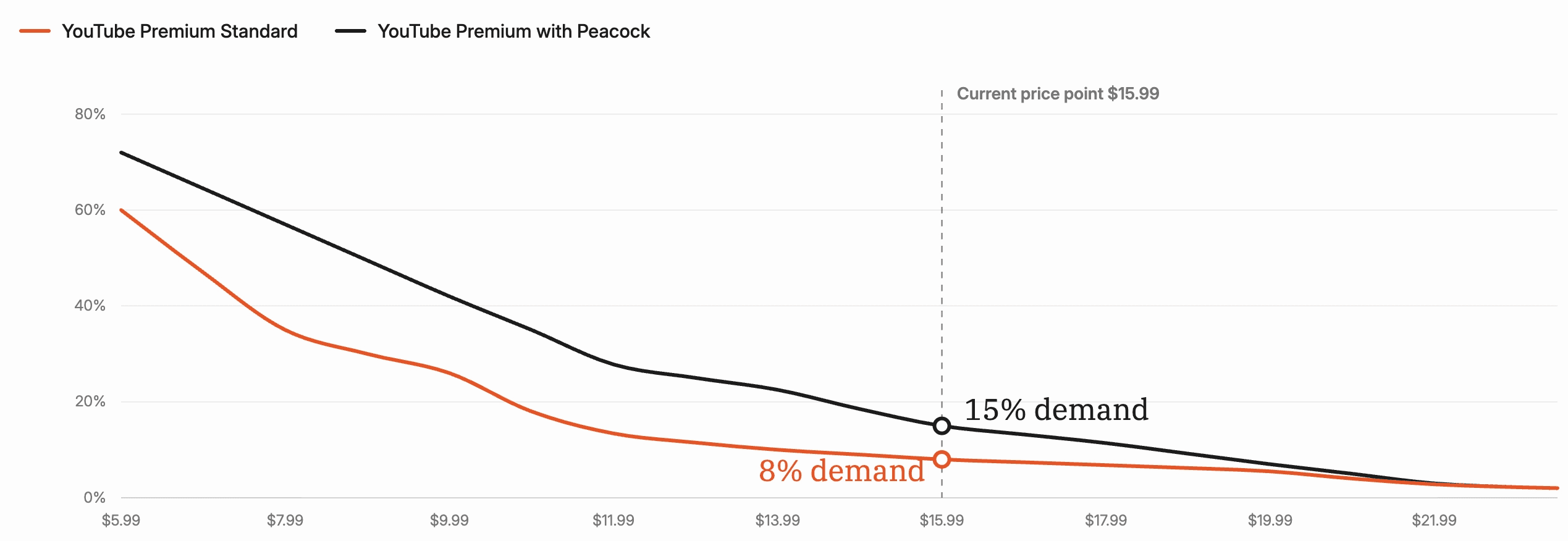
At YouTube Premium’s current price, adding Peacock nearly doubles demand, from 8% to 15% of non-subscribers saying they'd subscribe. On the face of it, this suggests Peacock is seen as valuable in its own right. But the AI-moderated probing behind those numbers tells a more specific story.
That demand isn't mainly consumers getting excited about adding Peacock to their streaming lineup. It's driven primarily by consumers who already pay for Peacock elsewhere, and see this as a way to cancel that separate subscription and fold it into one payment with YouTube. Adding Peacock turns YouTube Premium into a way to consolidate subscriptions, which lands well as subscription fatigue grows.

”I already have Peacock, so I would be able to cancel that… I could say spending, like, $19.99 and getting both Peacock and YouTube Premium, I would be okay with that”
”I don’t have different subscriptions here and there, so I like to streamline my access”
”Having YouTube Premium for videos and streaming and then YouTube Music and then Peacock, all… bundled, that makes sense for that price”
What this means for how you price
Neither study needed a second, separate qualitative round to get here. The reasoning came from the same consumers, inside the same interview, attached to the exact price point it explains. That reconstruction used to be the part that cost the most time and the most budget. A dip in a curve, a premium that only shows up in one market, a bundle lift that looks bigger than it is: each of those used to be a hypothesis you'd carry into a follow-up study. Now it's one click from the words that explain it, while the study is still fielding.
That's depth at scale in practice: hundreds of priced interviews, and every single one carrying its own reasoning. It's the real value of building Van Westendorp and Gabor-Granger into Conveo, rather than treating them as one more quant tool that stops at the number. A price on its own is a fact you have to defend in the room. A price with the reasoning attached is a recommendation. You know what's holding the number where it is, what would move it, and which objection to answer first.
Price perception moves. Now you can follow it with Price Sensitivity inside StoryLines
Pricing is not a one-time question in most categories. Costs move, competitors reposition, and what felt fair last year reads as expensive today. Pricing questions can also run inside StoryLines programs as a recurring chapter, so you can watch willingness to pay shift over time with the reasoning attached to every move, rather than rediscovering it in next year's study.
See Conveo price testing in action
Watch the the deep dive here for a full setup run-through. Book a demo or reach out to your Research Impact Lead for a walkthrough of price sensitivity testing in Conveo.
Frequently Asked Questions
What's the difference between Van Westendorp and Gabor-Granger, and when should I use each?
Van Westendorp maps what a market finds too cheap, too expensive, and everywhere in between, so it's the right tool when you need to find an acceptable price range from scratch. Gabor-Granger tests specific price points against real purchase intent, so it's the right tool once you have a shortlist of prices and need the one that maximizes revenue. Both now run inside the same Conveo pricing question type, so you choose the method that fits the question, not the tool you happen to have.
How does Conveo get the reasoning behind a price without a separate qualitative study?
Every pricing question in Conveo is followed by a tailored, automatic probe inside the AI-moderated interview. Consumers answer the structured price step first, so the quantitative data stays clean, then the interview asks why, while the reasoning is still fresh. That reasoning links directly to the price point it explains, so a dip in the curve is one click from the words behind it.
Can I run the same pricing question across multiple markets and currencies?
Yes. A single Van Westendorp or Gabor-Granger question adapts currency by market, and every answer records the currency it was given in. Combined views normalize on pinned exchange rates, so a chart you shared last week still shows the same numbers today, even if rates move.
Can I track price sensitivity over time instead of re-running a one-off study?
Yes. Pricing questions can run inside Conveo StoryLines as a recurring chapter, so you can watch willingness to pay shift as costs, competitors, and category perceptions move, with the reasoning attached to every shift rather than rediscovered in next year's study.

Qualitative insights at the speed of your business.
Conveo runs AI-moderated video interviews and structures everything they say.