In this article
TL;DR
Effective user interview questions reveal motivations and decision drivers, not surface preferences. The difference between a research study that changes a product decision and one that gets filed away usually comes down to how the questions were built.
Open-ended questions produce richer answers. Questions that start with "tell me about," "walk me through," or "describe a time when" invite narrative responses. Closed-ended questions (yes/no or single-choice prompts) shut conversations down before research participants have the chance to explain their reasoning.
Goal-aligned questions yield actionable insights. Questions tied to specific research objectives (JTBD discovery, onboarding friction, pricing perception, churn drivers) generate user insights that teams can act on. Generic "what do you think" prompts generate opinions without direction.
Adaptive probing surfaces the "why." Static question lists capture what participants say. Adaptive follow-up questions (where the next question responds to the actual answer given) uncover the motivation behind the surface response. That layer is where product decisions get made.
Video-first interviews capture what text misses. When you need depth on motivations and behavioral context, video interviews provide evidence that text-only surveys cannot: hesitation, tone shifts, and facial reactions to a concept or price point.
Poorly structured questions introduce bias before analysis begins. Leading questions, loaded framing, and hypotheticals push participants toward answers the researcher expects, corrupting the qualitative data before synthesis has even started.
The user interview questions your team writes produce answers that confirm what you already think, rather than the behavioral drivers you actually need. Participants flag users' pain points in vague terms (a feature is "confusing," a flow "feels off"), and the conversation moves on. The underlying reason never surfaces.
Static question lists are the structural problem. A scripted guide treats every research participant response as equivalent, so when someone gives a vague or incomplete answer, the interview moves to the next item rather than probing what was left unsaid. The result is a transcript full of surface-level reactions and little explanation of why users behave as they do.
The operational cost compounds quickly. When teams conduct user interviews sequentially, scheduling limits how many sessions a UX research team can run in a sprint, and manual synthesis creates a bottleneck as timelines shrink. Qualitative research can now deliver real conversations at scale, but only if the question design and interview infrastructure support that depth.
This article gives you a goal-based framework for structuring user research questions that reach behavioral depth, concrete rewrites of weak questions into stronger ones, and practical guidance on adaptive follow-up techniques that go further than any static discussion guide can.
3 reasons most user interview questions stay shallow
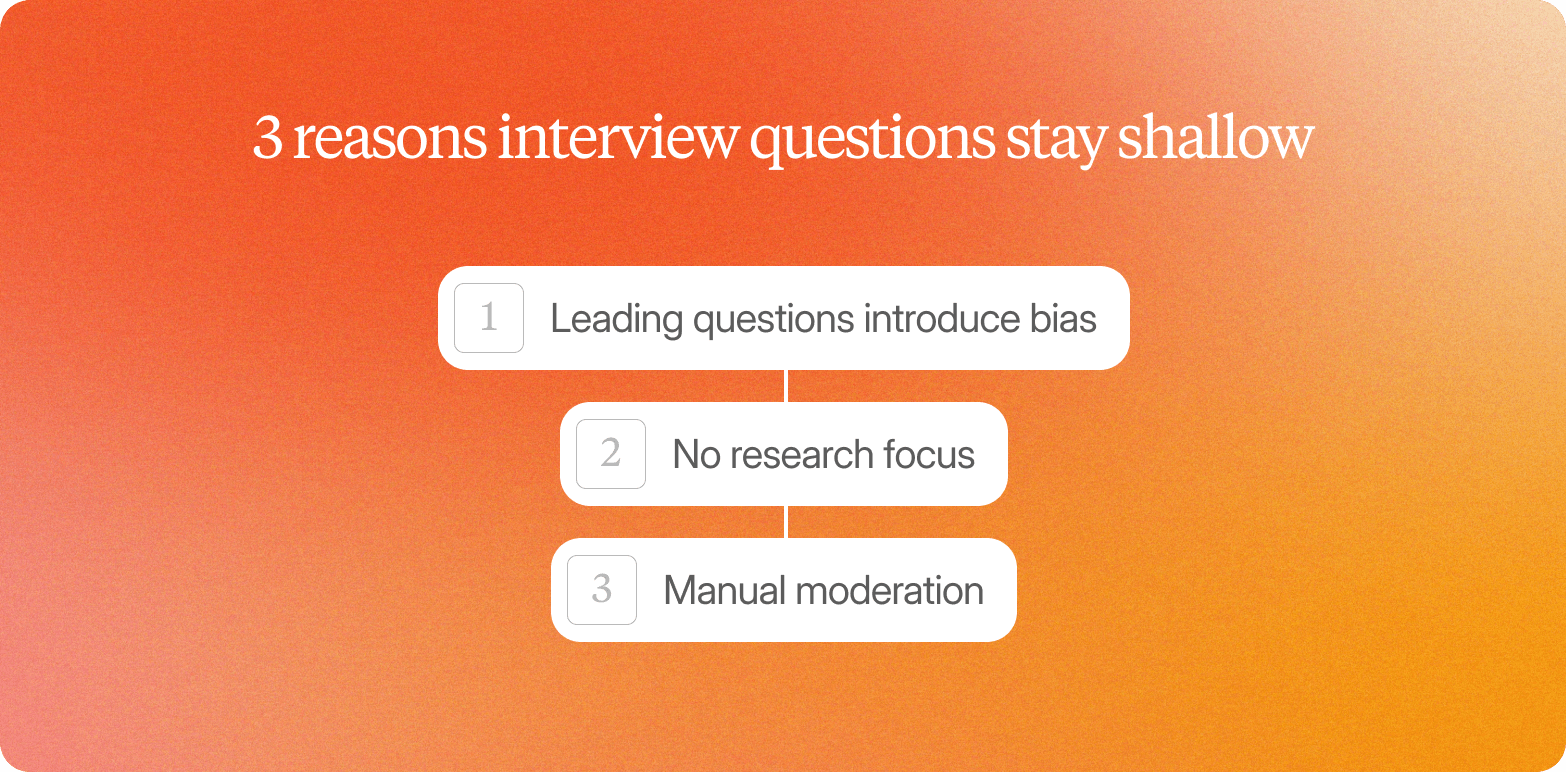
Static question lists are one of the most common reasons user research questions fail to deliver. A researcher designs a discussion guide, runs the session, and walks away with polished answers that describe behavior without explaining it. The "why" behind what research participants actually do remains buried because the questions never seek it.
Leading questions introduce bias before the interview begins
Poorly structured user research questions can steer participants toward answers the researcher is already expecting. "Would you use a feature like this?" is not a neutral prompt. It belongs to the category of opinion questions rather than behavioral probes: it frames the conversation around a solution rather than a behavior, and signals to participants what the "right" answer looks like.
The better approach: "Tell me about the last time you tried to solve this problem." That framing opens a real story instead of soliciting a reaction to a hypothesis.
Discussion guides without a clear research focus drift
Discussion guides that aren't mapped to a specific research focus produce interesting conversations but not actionable patterns. When questions for user interviews aren't anchored to a defined objective (jobs-to-be-done discovery, onboarding friction, pricing perception), interviews wander. Synthesis becomes harder, and the output is a collection of stories rather than structured evidence that the product team can act on.
Manual moderation creates a capacity ceiling
Sequential scheduling limits the number of conversations a small research team can run. By the time sessions are complete, transcripts reviewed, and themes synthesized, the sprint has moved on. The decision the research was meant to inform has already been made, and the findings arrive too late to change anything. This is the constraint that AI-moderated interview platforms like Conveo are designed to break: running hundreds of adaptive conversations in parallel so research keeps pace with product development.
The solution isn't better questions alone. It's a system that adapts to what participants actually say.
Goal-based framework: Mapping user interview questions to research objectives
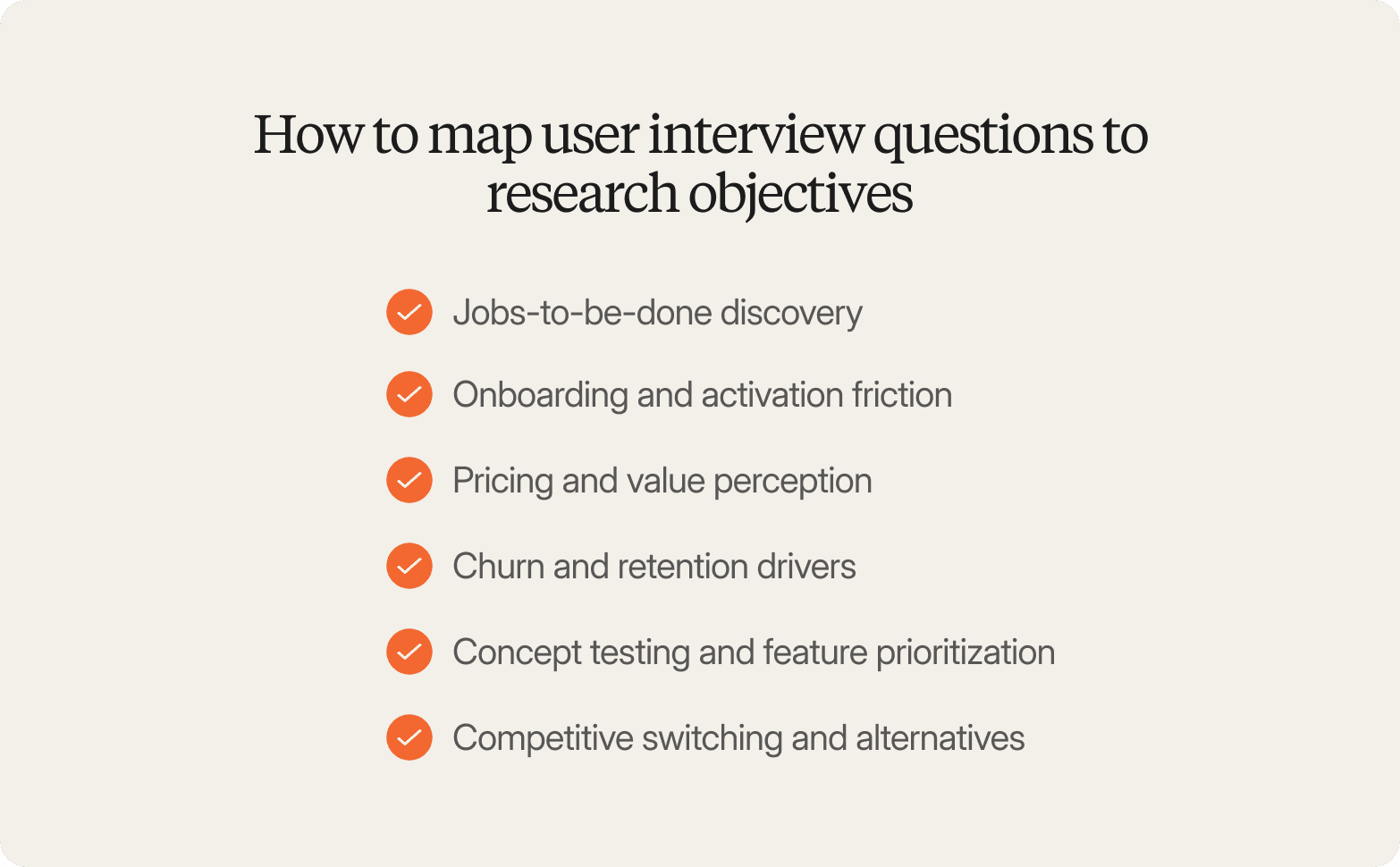
Effective user interview questions don't start with curiosity. They start with a clear research plan. Before interviewing users, define the specific objective each question is meant to address: a semi-structured interview built around vague prompts like "tell me about your experience" produces vague qualitative data. The framework below maps six common research goals to specific question types designed to surface what structured surveys cannot.
1. Jobs-to-Be-Done (JTBD) discovery
"Walk me through the last time you needed to [accomplish goal]. What were you trying to do?"
"What were you using before you found [product/solution]? What made you start looking for something different?"
These questions uncover context and trigger events that drive behavior throughout the user journey, rather than feature preferences. A survey can tell you what users selected; a JTBD question tells you what pushed them to act in the first place.
2. Onboarding and activation friction
"Describe your first experience using [product]. What stood out?"
"Was there a moment when you almost gave up? What happened?"
"Walk me through a typical day using [product] in that first week."
These reveal users' pain points and the friction they encounter in the earliest part of the user journey. The almost-gave-up question surfaces a specific moment of friction rather than a generalized satisfaction rating. Asking about a typical day also surfaces routine usage patterns that research participants rarely volunteer unprompted.
3. Pricing and value perception
"How did you decide whether [product] was worth paying for?"
"What would need to change for you to upgrade to [higher tier]?"
These questions expose the mental model research participants apply when evaluating cost versus value. Most pricing surveys ask users to rate affordability; these questions ask participants to describe their reasoning, which is where the real signal lives and where user insights about value perception are most actionable.
4. Churn and retention drivers
"Tell me about the last time you stopped using [product]. What led to that decision?"
"What would bring you back?"
Exit surveys typically capture a category of dissatisfaction. These questions identify the specific sequence of events that led to the decision to leave, providing actionable data far more useful to product and retention teams than category-level ratings.
5. Concept testing and feature prioritization
"Show me how you currently solve [problem] without this particular feature."
"If this feature existed, how would it change your workflow?"
These are the right user research questions for concept testing: they reveal whether a concept solves a real problem or merely sounds appealing in the abstract. The workaround question is especially telling: if a user has built an elaborate workaround, the need is real. If they haven't thought about it, the urgency probably isn't there. This approach also clarifies how users interact with existing solutions before a specific feature is introduced.
6. Competitive switching and alternatives
"What other platforms did you evaluate before choosing [product]?"
"What would make you switch to a competitor?"
These reveal the real competitive set and the decision criteria research participants apply across your target market, which is rarely the same as the criteria product teams assume.
Strong vs. weak user interview questions: Examples with rewrites
The difference between shallow and deep user interview questions often comes down to specificity and behavioral grounding. The sample questions below make that gap concrete: each weak example is paired with a strong rewrite from the same research scenario.
| Weak question | Why it fails | Strong rewrite | What it uncovers | |
|---|---|---|---|---|
| 1 | "Do you like this feature?" | A closed-ended question that leads participants toward a yes/no answer without revealing why or how they'd use it. | "Walk me through the last time you tried to [accomplish task]. How did you do it?" | Uncovers observed behavior and workarounds, which reveal whether a specific feature solves a real problem. |
| 2 | "What features would you want to see?" | Produces a wishlist of user preferences (hypothetical needs rather than validated behavioral evidence). | "Show me the last time you got stuck trying to [do something]. What did you do next?" | Reveals actual friction points grounded in real usage, not imagined future scenarios. |
| 3 | "How often do you use [product]?" | An opinion question that produces vague frequency estimates without explaining context or motivation. | "Describe the last three times you opened [product]. What were you trying to accomplish each time?" | Captures specific use cases and the triggers that bring users back, or don't. |
| 4 | "Would you pay for this?" | Hypothetical willingness-to-pay is unreliable without the context of a real decision. | "How did you decide whether [current solution] was worth paying for? What factors mattered most?" | Reveals the mental model research participants apply when evaluating cost vs. value. |
| 5 | "What do you think about our onboarding flow?" | Invites generic feedback without behavioral grounding, producing impressions rather than evidence. | "Walk me through your first session using [product]. Where did you feel confident? Where did you feel lost?" | Uncovers specific moments of friction and clarity that can be directly mapped to design decisions. |
| 6 | "Why did you choose us over competitors?" | Produces post hoc rationalization rather than the real decision process. | "Tell me about the moment you decided to try [product]. What were you comparing it to?" | Captures the actual competitive set and the decision criteria that were live at the time of the choice. |
Strong user interview questions ask participants to reconstruct specific past experiences in specific scenarios, not speculate about future behavior. The moment a question invites speculation ("would you," "do you think," "what would you want"), the answer becomes a projection rather than evidence.
Adaptive follow-up: How to probe past surface answers
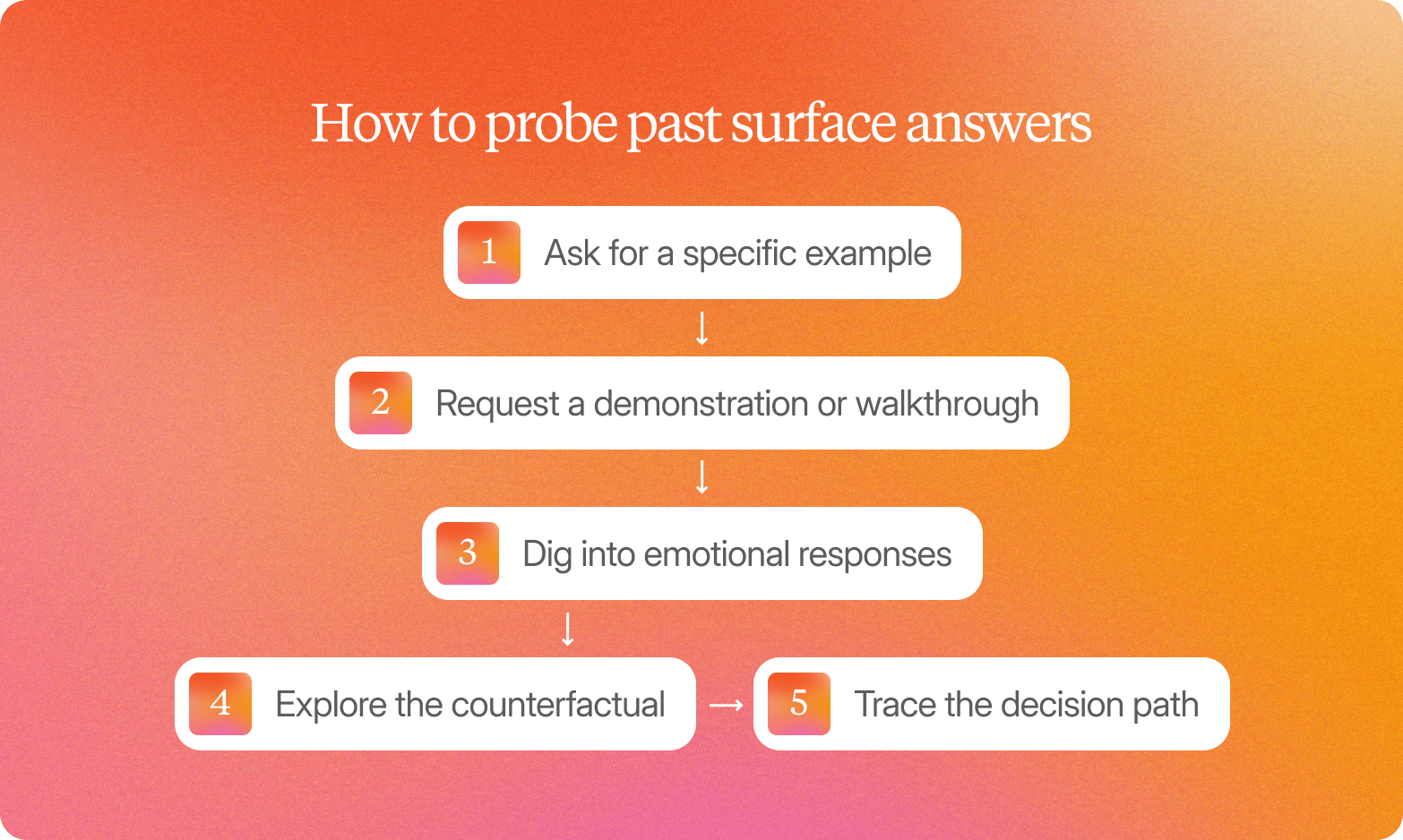
Even well-designed open-ended questions produce shallow data if you don't probe when research participants give vague or incomplete responses. A participant saying "it was frustrating" or "it didn't really work" gives you a summary, not insight. The behavioral detail (the specific moment where something broke down) lives one question deeper.
The probing principle: when participants use abstract language or emotional responses ("it felt off," "I didn't like it"), follow up with questions that force specificity. You're not challenging their answer. You're asking them to show you what they mean. This is how you collect honest answers instead of polished summaries.
1. Ask for a specific example
Participant: "The onboarding was confusing." Probe: "Can you walk me through the exact moment when you felt confused? What were you trying to do?"
2. Request a demonstration or walkthrough
Participant: "I use it all the time." Probe: "Show me the last time you used it. What were you trying to accomplish?"
3. Dig into emotional responses
Participant: "It was frustrating." Probe: "What specifically made it frustrating? What did you expect to happen?"
4. Explore the counterfactual
Participant: "I switched from [competitor]." Probe: "What would have needed to change for you to stay with [competitor]?"
5. Trace the decision path
Participant: "I decided to upgrade." Probe: "Walk me through the moment you made that decision. What happened right before?"
Each technique shares the same logic: move from the participant's conclusion back to the evidence behind it.
Where this breaks down in practice is consistency. Experienced moderators probe instinctively; less experienced ones follow the interview script. Conveo, a video-first AI research platform, addresses this directly: the platform detects vague or incomplete responses during sessions and follows up on them in real time, producing the behavioral depth you'd expect from a seasoned human moderator. Unlike a fixed set of user interview questions, Conveo's AI moderator treats each response as a signal (not an answer), adjusting its line of inquiry based on what the participant actually said. The result is consistently interesting feedback, not a transcript that reflects the quality of the moderator's day.
See it in action: How Conveo's AI moderator probes adaptively in a live session →
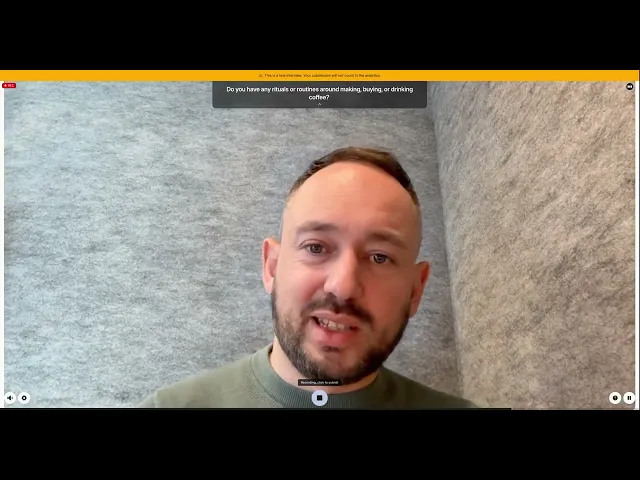
Adaptive follow-up is what separates shallow data collection from real behavioral insight.
Asynchronous and video-first interview design
Session recordings capture what text cannot: facial reactions, environmental context, real-time hesitation, and the gap between what people say they do and what they actually do.
Video-first interviews, which run asynchronously, require a different question design than live moderated sessions.
The asynchronous format also changes the economics of qualitative research as a method. Instead of sequential sessions across two weeks, AI-moderated interviews run in parallel: hundreds of conversations simultaneously, across time zones and languages, without a single calendar invite. For UX and product researchers working inside sprint cycles, this removes the single biggest constraint on how much user research a small team can actually conduct.
Four design principles make asynchronous video interviews work in practice:
1. Use "show me" prompts to capture context
Ask research participants to show the last screen, email, or object they interacted with when trying to accomplish a task. Video lets participants demonstrate how they interact with their actual environment, which no text response can replicate. This is especially useful for capturing how users interact with a particular feature in a real context, rather than describing it from memory.
2. Ask participants to narrate their environment
Questions like "Walk me through your workspace and show me the platforms you use to accomplish this goal" surface workarounds, adjacent tools, and the full user journey through the participant's own environment.
3. Design questions that work without real-time clarification
Ambiguous phrasing collapses without a live moderator. Replace "Tell me about your experience" with "Describe the last time you tried to complete this task. What happened, and where did you get stuck?" Specificity does the moderator's job. Ground every prompt in specific scenarios rather than abstract experience.
4. Tie every insight to video evidence
Stakeholders can watch the clip, read the verbatim, and trace the finding back to a real conversation. When participants perform tasks or walk through specific scenarios on camera, every insight becomes auditable. This is how video-first research closes the credibility gap left by survey summaries. When conducting research across global markets, also account for cultural differences in how participants express emotional responses and levels of directness: these variations affect how you interpret what users feel and say.
"The video clips make it tangible; it's not just data anymore, it's real people with real emotions"
CMI Lead, Edgard & Cooper
Asynchronous video interviews combine the depth of traditional qualitative research with the speed and scale modern product and UX teams actually require.
From interview to insight: Synthesis and workflow
The bottleneck is structural
Manual synthesis is where even the best-designed user interview questions lose their momentum. When a researcher is running five or six interviews, manual transcription and thematic coding are manageable. When the research study requires 20 conversations across two markets in a week, that same process becomes the constraint preventing research from influencing anything.
Traditional qual requires someone to transcribe recordings, apply codes, cluster themes, reconcile interpretations across sessions, and produce a report that stakeholders will actually read. Each step takes time, and most UX and product research teams do not have enough time to complete them. By the time findings are packaged and shared, the decision the research was meant to inform has already been made.
How Conveo compresses the workflow
Conveo covers the full workflow: from study design and participant recruitment through transcription, translation, coding, and thematic synthesis. Rather than requiring a separate transcription service, a coding platform, and a reporting layer, the platform handles the post-interview process as each session lands.
Themes surface from real conversations, tagged to the original video with timestamps
Researchers move from data collection to structured output in hours, not weeks
That compression is what makes it possible to run research alongside the product development process rather than between sprints
How Conveo elevates user interview research
The user interview questions framework in this article is designed to surface the behavioral depth that static surveys miss. But even well-crafted questions yield shallow data if the interview infrastructure cannot adapt to what participants say, or if synthesis takes so long that findings arrive after decisions have already been made.
Conveo closes both gaps.
Adaptive AI probing
Conveo's AI moderator detects vague or incomplete responses in real time and probes for the specific behavioral detail that turns a reaction into actionable insights. It doesn't advance to the next scripted question: it follows up on what was actually said. This is how teams provide valuable insights to stakeholders on every study, not just the ones where a skilled moderator happened to probe at the right moment.
Scale without scheduling bottlenecks
Hundreds of these conversations run in parallel across time zones and languages, so a small research team can conduct continuous user research rather than rationing a handful of sessions per sprint.
Traceable, stakeholder-ready evidence
Every session feeds into a compounding insight library where themes, clips, and transcripts are searchable across studies. When a new question arises during sprint planning, researchers can check existing evidence before commissioning new fieldwork. All of this runs on real participants in real conversations, with traceable session recordings that stakeholders can audit.
Frequently Asked Questions
What are the best user interview questions for UX research?
The best user research questions ask participants to reconstruct specific past behavior rather than speculate about future preferences. Questions that start with "walk me through," "describe the last time," or "show me how you currently" produce narrative responses grounded in real experience. The goal-based framework in this article maps six common research objectives to the right user research questions for each, including JTBD discovery, concept testing, and churn analysis.
How many questions should a user interview include?
Most effective user interviews use 5 to 8 core questions with room for adaptive follow-up questions (sometimes called follow-up questions) built around what participants actually say. Prepare multiple questions per objective, but don't over-script. The number matters less than the structure: each question should map to a specific research objective, and the interviewer (or AI moderator) should have the flexibility to probe vague or incomplete responses rather than advancing to the next scripted item. It's also good practice to leave space at the end for participants to raise their own questions: users' questions often signal what's on their mind more directly than anything in the guide.
How do you avoid leading questions in user interviews?
Leading questions frame the conversation around a solution rather than a behavior. Replace "Would you use a feature like this?" with "Tell me about the last time you tried to solve this problem." Remind participants at the start of the session that there are no right or wrong answers: wrong answers don't exist in user research, and that framing helps participants give honest answers rather than socially acceptable ones.
What is the difference between user interviews and other research methods?
User interviews explore motivations, decision drivers, and behavioral context through open-ended conversation. Usability testing observes participants as they complete tasks to identify interaction friction. Focus groups explore group dynamics and collective reactions, but can suppress individual opinion. Market research surveys collect data at scale but sacrifice qualitative depth. Each research method answers different questions: user interviews are best for understanding why users behave the way they do; usability testing is best for identifying where a specific interface breaks down when users perform tasks.
What types of user research questions are there?
User research questions generally fall into three categories. Descriptive research questions capture what is happening: "Walk me through how you currently handle [task]." Comparative research questions explore how experiences differ: "How does this compare to the way you solved this problem before?" Causal research questions uncover why something occurs: "What led you to stop using [product]?" Most user interview guides mix all three types, but the most effective qualitative research method for understanding behavioral drivers leans toward causal questions, because the "why" behind observed behavior is where actionable insights live.
Can AI replace human moderators in user interviews?
AI moderation does not replace the strategic role of a human researcher, but it does solve the consistency and scale limitations of manual moderation. An AI moderator can detect vague responses and probe for specificity across hundreds of simultaneous sessions, maintaining the same depth as a skilled human moderator would, without the scheduling bottleneck. The researcher's expertise shifts to study design, interpretation, and stakeholder communication. Research participants engage with the AI moderator in a semi-structured interview format, and they frequently report being as open as, or more open than, with an AI moderator, with less fear of judgment.

About the author
Abby Euyang
Research Impact Lead
Abby studied psychology, fell for research there, and spent four years on the UX research team at PayPal. She compared the AI-moderated platforms before choosing Conveo for the researchers it had gathered, and now sits in the sessions where researcher feedback becomes product changes the same day.
Meet Abby on film →Qualitative insights at the speed of your business.
Conveo runs AI-moderated video interviews and structures everything they say.