In this article
TL;DR
The five steps in the user research process each carry a distinct operational cost. Here is where teams lose time and how to resolve each bottleneck.
Study design. Guide writing and stakeholder alignment can take days; a clear research plan with a reusable template cuts setup to under an hour.
Participant recruitment. Manual sourcing and scheduling takes one to two weeks; vetted global panels with automated screeners and incentive handling remove the coordination overhead entirely.
Interviewing. Moderator availability limits parallel research sessions; AI-moderated async interviews run hundreds simultaneously, on participants' own schedules.
Analysis. Manual transcription, coding, and thematic synthesis is the single largest time drain; automated transcription, translation, and thematic clustering turn raw data into themes in hours.
Reporting. Findings buried in long decks lose stakeholder trust; structured outputs with key insights, verbatim quotes, and video clips give stakeholders the evidence behind the finding, not just the summary.
Most product teams have a user research process. Few have one that works consistently enough to trust.
The pattern is familiar: a researcher runs user interviews before a major release, synthesizes findings into a deck, shares it in a Slack channel, and moves on. Six months later, a product manager asks the same question. Nobody can find the original recordings. The team starts over.
The problem is not effort or intent. It is the operational structure underneath the research. Manual moderation, ad hoc synthesis, and one-off reporting create bottlenecks that force a choice between running research fast and running it well. When teams try to conduct user research consistently without the right structure, the cadence of research cannot keep pace with product decisions.
What is the user research process, in practice, for teams that need it to scale? It is not a sequence of steps. It is a repeatable system that produces qualitative data stakeholders can inspect, trace back to real conversations about user pain points and needs, and act on without a full debrief. When that system is in place, insights accumulate, connect across studies, and build institutional knowledge that makes every future research question faster to answer.
Why most user research processes break down
Three workflow models dominate how product and UX teams approach research today: agencies, point solutions, and manual processes. Each creates a different kind of friction, but the outcome is usually the same: the UX research cycle falls behind the pace of product decisions.
Agencies deliver rigorous primary research at the cost of the timeline. A typical engagement runs six to twelve weeks from brief to debrief, which means findings often arrive after the sprint has closed and the decision has already been made. Research that cannot reach stakeholders in time to influence a decision is not research. It is documentation.
"Within days, we had insights that would've taken a traditional agency a month."
Head of Customer Insights, JDE Peet’s
Point solutions, such as standalone transcription platforms or analysis tools, solve one piece of the problem and create another. Teams spend real time stitching together separate platforms for recruiting, scheduling, interviewing, transcribing, and reporting. Each handoff is a point where the user research process breaks down: formatting inconsistencies, research data that does not carry over, and synthesis that starts from scratch for every study.
Manual processes put the burden directly on the team. Most embedded research operations are small, often one to three user researchers serving multiple product teams simultaneously. When interview volume increases, something gives: the synthesis becomes thinner, the turnaround extends, or studies get deprioritized entirely.
The common thread is a workflow bottleneck at the same two points: human moderation and synthesis. When timelines shrink, but budgets and headcount stay flat, that bottleneck forces harder tradeoffs.
The 5 stages of a standardized user research process
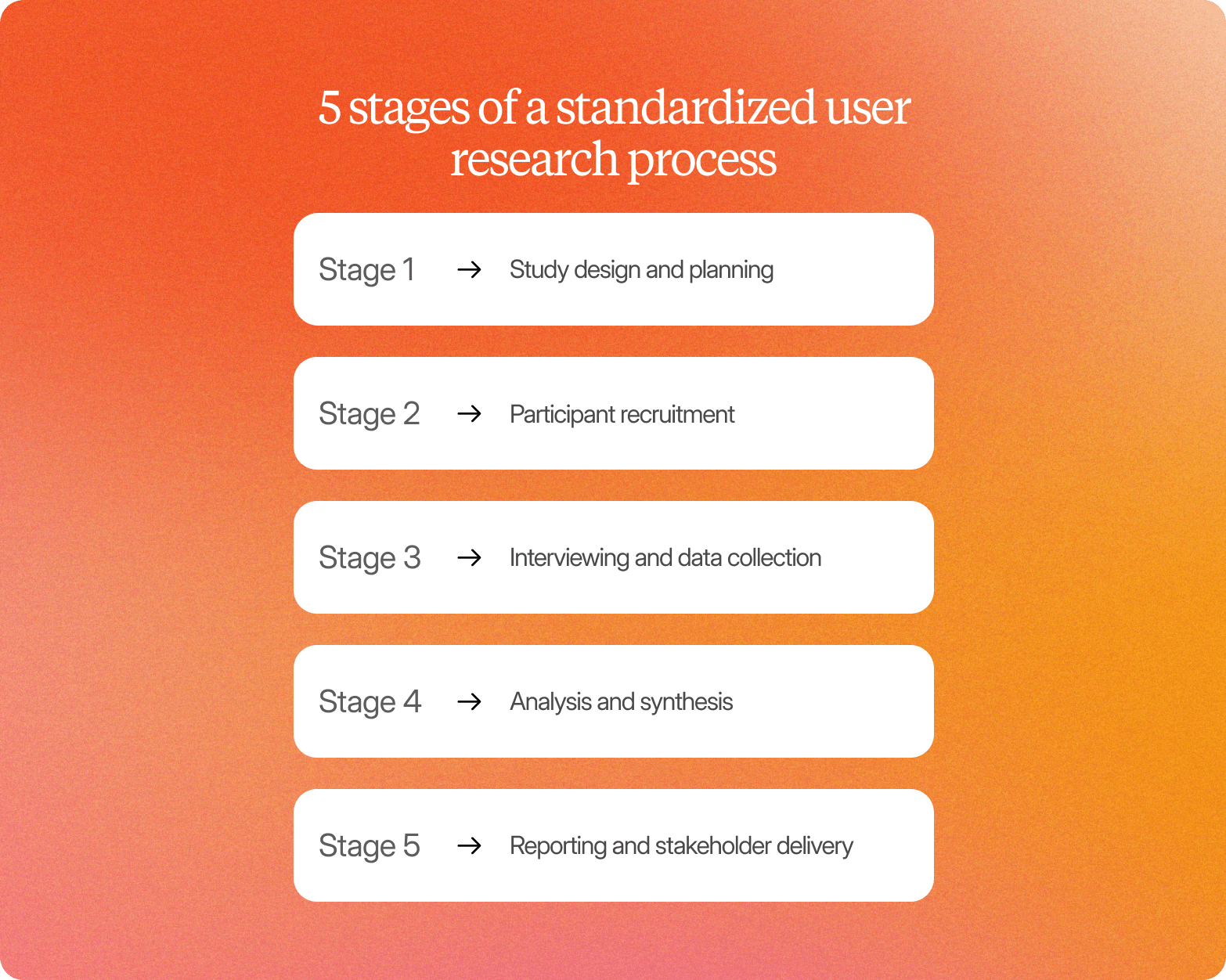
Every standardized user research process follows the same five steps: study design, recruitment, interviewing, analysis, and reporting. The problem is not the steps themselves. It is the manual overhead that accumulates at each one, turning what should be a repeatable part of the product development process into a project that consumes two to three weeks before a single set of actionable insights surfaces.
Stage 1: Study design and planning
Study design is where most research programs lose time before a single participant is recruited. Teams spend days writing guides from scratch, cycling through stakeholder feedback on question framing, and debating method selection (whether the format calls for in-depth user interviews, usability testing, or journey mapping) without a shared framework anchored to the problem space being investigated.
The stage requires defining clear research objectives, building a research plan that holds across dozens of sessions, and deciding whether the format calls for open-ended discussion or structured survey questions. Identifying the right target audience and participant criteria must happen before a single screener goes live.
Using AI in the user research process directly changes this. A concept validation study that previously required three days of guide writing and stakeholder alignment can be launched in under an hour with a pre-built template that provides explicit guidance on probing depth and question framing, with adaptive AI probing built in from the start.
Stage 2: Participant recruitment
Recruiting is where many research timelines quietly fall apart. Identifying, screening, and confirming research participants who match the target user's profile through manual outreach typically takes one to two weeks. Scheduling conflicts and no-shows extend that further, often pushing the entire user research study past the sprint it was meant to inform.
Built-in recruitment with automated screening, fraud filtering, and incentive management changes that math. Vetted research participants can be confirmed within 48 hours without a single manual email thread or calendar negotiation. Studies that previously required coordinating separate vendors across regions can now access panels spanning 50+ markets through a single workflow.
Stage 3: Interviewing and data collection
This is where the traditional user research process hits its hardest constraint. Human moderation caps daily throughput: scheduling conflicts, no-shows, and moderator availability all constrain how many user interviews can run in a given day. A user research study requiring 30 conversations can take two to three weeks to field before a single finding reaches the product team.
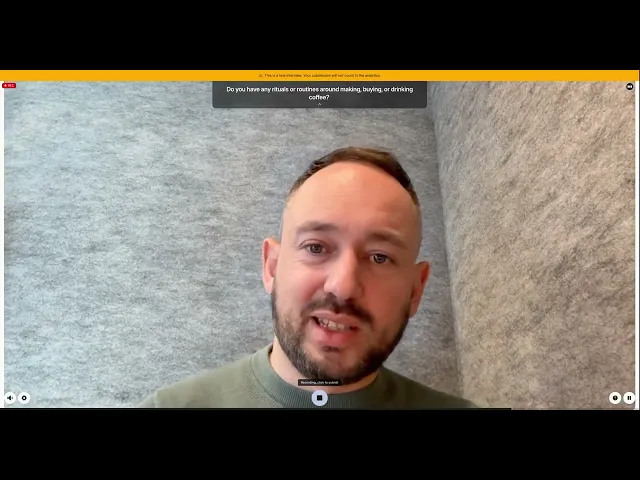
When applying artificial intelligence to the interviewing stage, the throughput constraint disappears. Async AI moderator sessions run in parallel across any number of research participants, on their own schedules. A product team that previously spent two weeks fielding 30 interviews can now complete the same study in a matter of days, with findings ready before the sprint closes. Every session is captured as a video recording, and every interview recording flows automatically into analysis, making the end-to-end handoff seamless.
The depth question matters as much as the speed question. Purpose-built AI interviewers respond to user behavior in real time, asking follow-up questions based on what participants actually say, following unexpected threads, and probing hesitation. Video-first research sessions go beyond text-based data to capture tone, facial expression, and non-verbal signals that transcripts miss entirely. This applies to user testing sessions, concept tests, and longitudinal behavioral research alike.
See it in action: How AI-Moderated Video Interviews Actually Work →
Stage 4: Analysis and synthesis
Synthesis is where momentum dies. Manually analyzing qualitative data across 20 interviews, including transcribing, coding, and building themes from raw data, can consume 10 or more hours of researcher time, often stretching delivery by one to two weeks after fieldwork closes.
AI-powered transcription fundamentally changes the data analysis phase: the platform handles transcription, translation, and initial thematic coding automatically as research sessions come in, not after all fieldwork is complete. This is meaningfully different from using a general-purpose analysis tool. A purpose-built research platform applies coding frameworks grounded in the study's own discussion guide, surfaces themes with source attribution, and runs sentiment analysis across the full participant set as part of the standard analysis process.
Automated note-taking replaces manual transcription across every session simultaneously. AI summaries provide an initial structure, grouping responses by theme, surfacing key insights, and flagging pain points that recur across participants. Researchers review and refine these outputs rather than building them from scratch. What previously took a researcher a full day of manual qualitative data analysis can now be completed in a fraction of that time, with full traceability to the source clips. This is what qualitative analysis at scale looks like in practice.
Stage 5: Reporting and stakeholder delivery
The final stage is where research either compounds or disappears. Findings packaged into a slide deck tend to answer one question once, without connecting to what was learned six months ago or surfacing when a different team asks a related question next quarter.
Each completed study produces a structured, traceable output: AI-generated themes with source attribution, video clips, and verbatim user quotes that stakeholders can verify themselves. Research summaries link directly to source clips, so findings aren't just reported, they're evidenced.
Traceable video clips, verbatim user quotes, and key moments from each session change the credibility calculus. A CMO who previously dismissed research as "anecdotal" now reviews highlight reels that surface key moments directly from customer interviews before approving campaign messaging.
How AI augments the user research process (without replacing researchers)
Many UX professionals and user researchers worry that artificial intelligence will replace human judgment or produce fabricated outputs. That concern is legitimate: research that substitutes synthetic users for real participants, or surfaces themes no one can trace to an actual conversation, is speculation, not insight. The resolution is not to avoid AI. It is to understand where AI's ability to handle operational tasks removes friction without removing judgment.
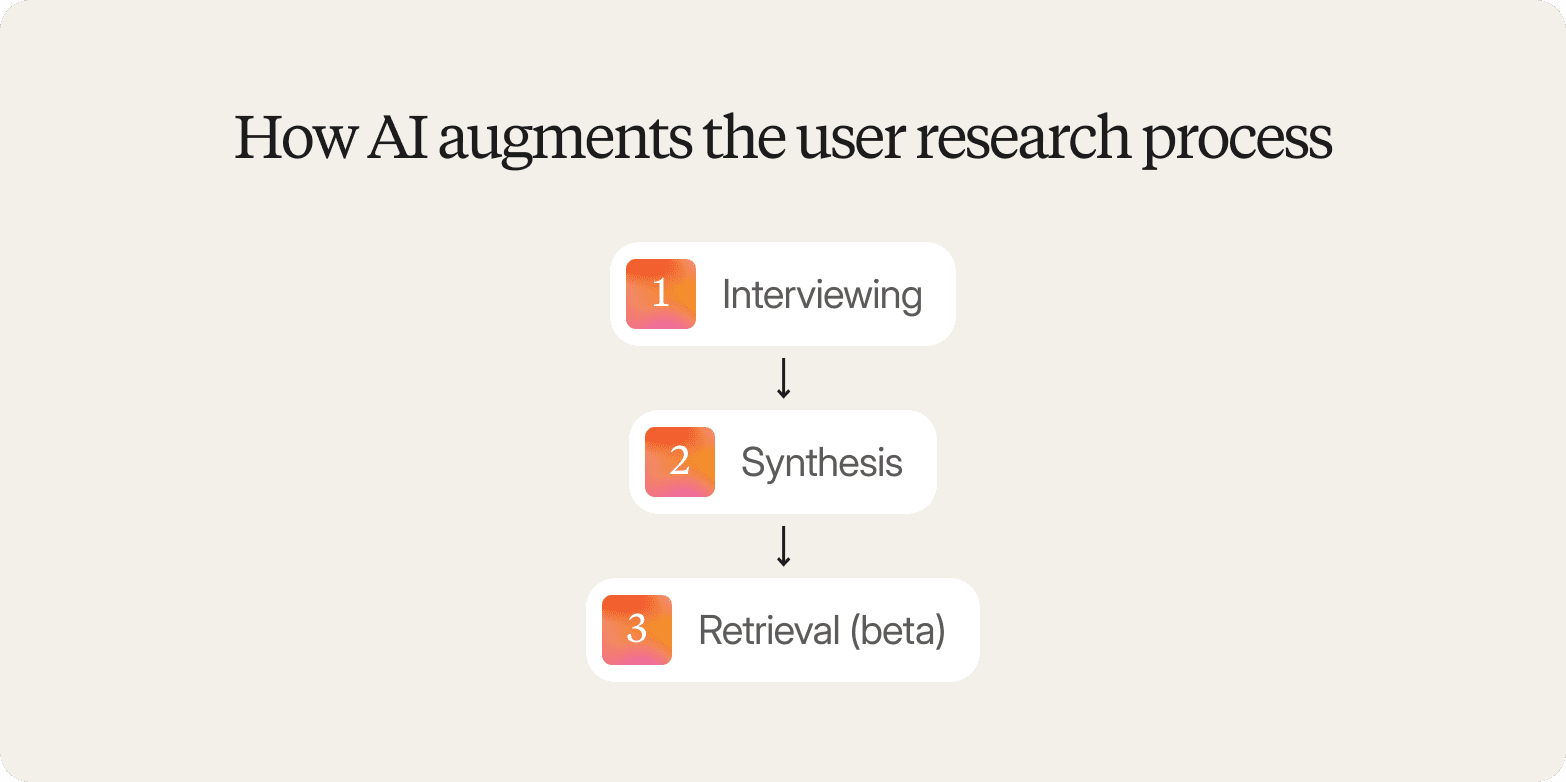
Using AI for the user research process works across three distinct layers:
Interviewing. The AI moderator eliminates the scheduling bottleneck entirely. Human users complete sessions on their own schedule, and AI models probe adaptively based on what they actually say, not a rigid script. Running hundreds of research sessions in parallel is a huge time saver for distributed teams operating across time zones. Throughput scales without adding moderators.
Synthesis. AI-powered platforms handle transcription, translation, and initial thematic coding automatically as recordings land. AI features include automated note-taking, sentiment analysis, and theme clustering. Researchers review and refine themes before anything reaches a stakeholder. The manual work shifts from data analysis to interpretation, which is where the researcher's judgment actually matters.
Retrieval (beta). Each study builds an individual, traceable record within the platform. Cross-study retrieval — the ability to surface past findings across multiple studies in plain language — is currently in beta, with broader availability on the roadmap.
When evaluating AI for the user research process, the contrast with synthetic users and fabricated personas matters. Real human users produce traceable, inspectable evidence. Stakeholders can watch the clip, read the verbatim, and judge for themselves.
A UX professional constrained by a small interview volume due to manual moderation can run significantly more research per month with AI moderation, a huge time-saver that shifts hours previously spent on scheduling and transcription toward deeper analysis and stakeholder workshops.
Conveo standardizes the user research process end-to-end, covering study design, recruiting, AI-moderated video interviews, analysis, and reporting, so teams can conduct user research consistently without fragmented handoffs.
Operational timelines: What a 3-day, 1-week, and 2-week research cycle looks like
Understanding which UX research cycle fits a given user research study depends on participant count, study complexity, and whether research sessions run async or synchronously. In each case below, the timeline bottleneck in traditional research is scheduling: lining up 30 participants for live sessions adds two to three weeks before a single interview takes place. Conveo's AI-moderated async interviews eliminate that bottleneck, compressing what previously took weeks into days.
| 3-day cycle | 1-week cycle | 2-week cycle | |
|---|---|---|---|
| Study type | Concept validation | Usability testing or messaging validation | Multi-market brand perception |
| Participant count | 10-15 | 20-30 | 50+ |
| Recruiting | Same day (vetted panel) | Day 1 | Days 1-2 |
| Interviewing | Hours 1-48 (async) | Days 1-3 (async) | Days 1-7 (async, multilingual) |
| Analysis | Automated synthesis, human review | AI-assisted thematic analysis, source-traceable outputs | Multilingual transcription, translation, and regional thematic coding |
| Reporting | Stakeholder-ready highlight reel by hour 72 | Full report with video clips, days 5-7 | Comprehensive thematic report with regional breakdowns, days 10-14 |
| Async vs. sync difference | Async removes calendar dependency entirely | Async allows parallel sessions across time zones | Async enables multilingual fieldwork without sequential scheduling |
Because AI-powered interviews run in parallel, participant volume no longer constrains the timeline. A team that previously ran one user research study per quarter can run one per sprint, with findings ready before the next planning session opens.
Building a compounding research system (not just running one-off studies)
Most research data never gets used twice. Findings land in a deck, inform one decision, and disappear into a folder no one searches. The next team with a related question starts from scratch.
A compounding research system has three components that make findings retrievable and trustworthy:
Tagging taxonomy. Consistent tags across product area, target users, and research goal mean findings can be located by someone who was not in the room. Without this, the mental models teams build about user behavior exist only in the heads of the user researchers who ran the work, and those mental models disappear when people move teams or leave the organization.
Traceable evidence. Every insight links back to video and interview recordings, as well as user quotes, so stakeholders can inspect the source rather than take research summaries on faith. This is live and applies to every completed study.
Cross-study retrieval (beta). The longer-term direction is a research archive where past findings surface in response to a plain-language query, without re-running studies. This capability is currently in beta; what's live is a consistently structured output format that makes individual study findings shareable and easier to locate across the organization.
Conveo's research repository stores each study's findings in a structured, traceable format: themes, video clips, user quotes, and source attribution in one place. The direction is institutional memory that compounds across studies; the foundation is ensuring every individual study produces outputs that do not disappear into a shared drive.
How Conveo standardizes your user research process
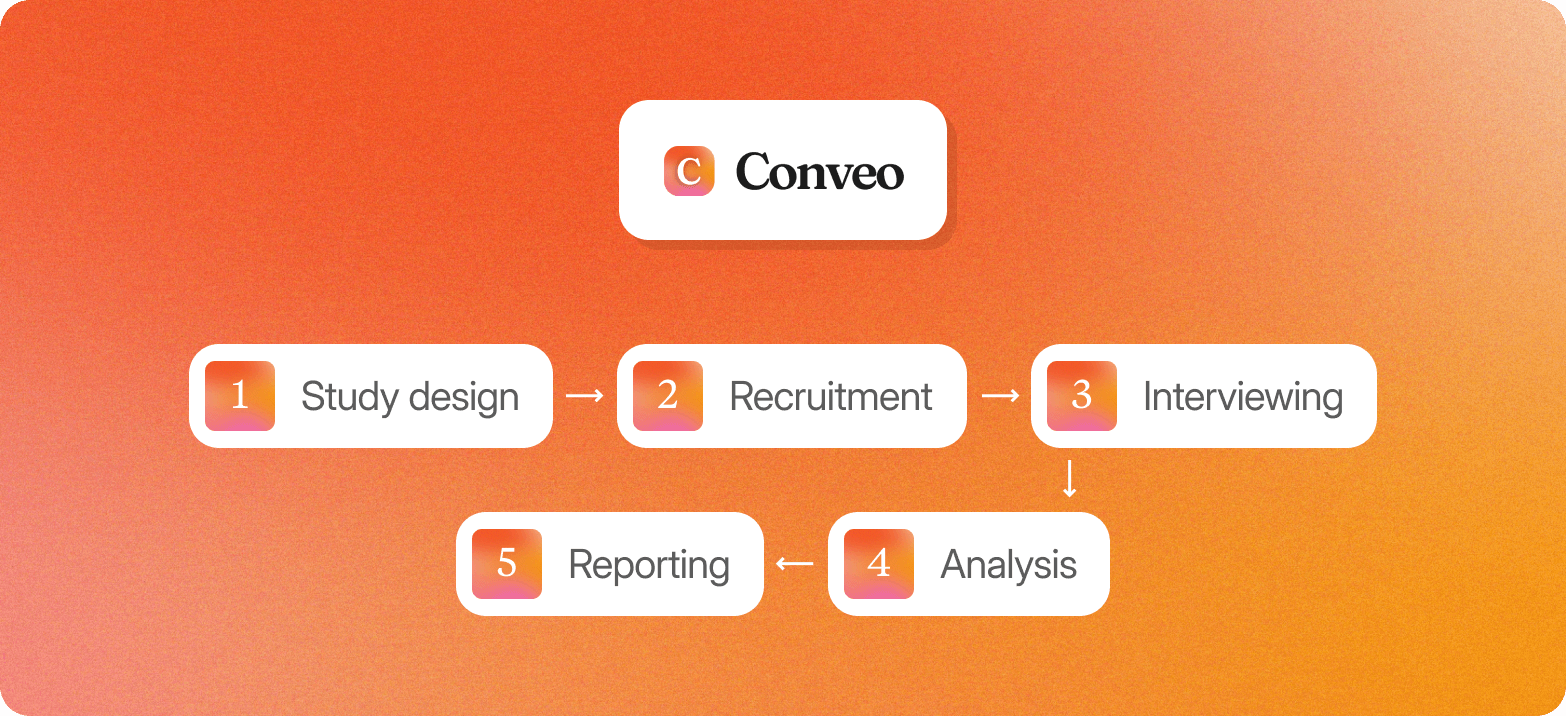
Conveo covers all five stages of the user research process in a single workflow, replacing the patchwork of research tools that breaks process consistency:
Study design: Pre-built templates and an AI assistant for guide creation reduce setup from days to under an hour, with explicit guidance on probing depth and question framing built in.
Recruitment: Integrated panel access across 50+ markets delivers vetted research participants within 48 hours.
Interviewing: AI-powered video interviews run in parallel, with the AI moderator adapting in real time to what human users actually say. Every session is captured as a video recording with automated note-taking.
Analysis: AI capabilities include AI-powered transcription, sentiment analysis, and thematic synthesis with full traceability to raw data and source clips.
Reporting: A structured research repository per study: AI-generated themes, video clips, and verbatim user quotes with full source traceability. Cross-study retrieval is currently in beta for enterprise teams.
Frequently Asked Questions
What is the user research process?
The user research process is a structured workflow for gathering qualitative data and acting on it across five stages: study design, research participant recruitment, interviewing, qualitative data analysis, and reporting. The goal is to produce traceable, stakeholder-ready outputs that inform target audience understanding and product decisions with evidence rather than assumptions.
What are the steps in the user research process?
The five steps in the user research process are: define objectives and build a research plan, recruit research participants, conduct user research sessions, analyze findings, and report to stakeholders. Each handoff between disconnected research tools adds delay. End-to-end platforms cover every stage in one workflow, so nothing stalls between steps.
How long does the user research process take?
With AI-moderated async research sessions: 10-15 interviews complete in roughly three days, 20-30 in one week, and 50+ multi-market interviews in about two weeks. Traditional agencies typically take six to twelve weeks. Human moderation is constrained by scheduling and moderator availability, which further extends timelines.
How do you use AI for the user research process?
AI capabilities augment three layers: interviewing (the AI moderator asks adaptive follow-up questions based on what participants say), synthesis (data analysis and thematic clustering happen automatically as research sessions complete), and retrieval (cross-study search is currently in beta, with full availability on the roadmap). AI's ability to handle operational tasks frees user researchers to focus on interpretation and decision-making.
How do you use ChatGPT for the user research process?
AI chat tools like ChatGPT are useful for drafting discussion guides, generating research summaries, and creating initial thematic codes. They cannot conduct user interviews, recruit participants, or produce traceable findings. The key failure mode: fabricated user quotes and hallucinated patterns with no connection to your actual research data. Always verify AI-generated outputs against source transcripts before sharing.
What is the difference between qualitative and quantitative user research?
Qualitative data analysis answers why customers behave a certain way; quantitative analysis answers how many do. Survey responses and behavioral metrics tell you what happened; user interviews and direct observation explain why. Use qualitative methods for discovery, concept validation, and understanding user behavior. Use quantitative methods when you need to measure prevalence or establish statistical significance.

About the author
Alex de Hemptinne
Business Impact Lead
Alex is a Business Impact Lead at Conveo, partnering with enterprise teams to embed AI-led research into their workflows. From the first study to full-scale rollout, she helps customers shift from project-based research to continuous customer intelligence.
Meet Alex on film →Qualitative insights at the speed of your business.
Conveo runs AI-moderated video interviews and structures everything they say.