In this article
TL;DR
A UX persona template is only as credible as the research behind it. Every field should trace to a real participant conversation, not a team brainstorm.
Static personas decay within months. Continuous qualitative data (not annual refreshes) is what keeps them useful.
Video-first user interviews capture behavioral context that surveys miss: hesitation, workarounds, and the reasoning behind decisions.
Async AI-moderated interviews remove scheduling friction, enabling persona creation and refresh across segments without adding headcount.
Detailed personas built from real users create a shared understanding that drives design decisions. Assumptions don't.
Most teams build a UX persona template during early product development, then watch it become outdated as user behavior and markets evolve. Manual recruiting, scheduling, and synthesis create enough drag that refreshes happen once a year, if at all. Designers end up making UX design decisions based on assumptions from 18 months ago rather than on real users, and survey-based inputs make it worse: they tell you what users clicked, not what they meant.
Continuous video-first user research solves this by building persona updates into the research rhythm itself rather than treating them as a separate project. The result is a design process built on evidence rather than guesswork, producing effective personas that the whole design team can actually trust.
The research-backed template is used in this guide. Includes evidence fields, behavioral pattern tables, severity ratings, verbatim quote sections, and a refresh log: everything needed to build a persona stakeholders will actually trust.
What makes a UX persona template effective
A user persona template for UX only earns its place in a roadmapping review when every claim can be traced to a source. Effective personas aren’t about completeness for its own sake. They’re about giving the design team a deeper understanding of the target user that actually changes how decisions get made. Four key attributes are non-negotiable:
| Component | What it captures | Why it matters |
|---|---|---|
| Evidence fields | Participant quote or video clip, segment definition, sample size, confidence level | Anchors each insight to reality, making findings defensible |
| Behavioral patterns with context | What users do, and the conditions under which they do it | Surfaces the “why” behind behavior, not just the action |
| Decision-making criteria | The specific factors users weigh at each choice point | Gives product teams something concrete to design against |
| Pain points with severity indicators | Friction is ranked by whether it causes abandonment or is merely tolerated | Helps teams prioritize what to fix first |
When done well, detailed personas built from real user research foster empathy across the design team and create a shared understanding of the target user, including their goals, daily-life context, and the pain points that actually block them. That shared understanding is what aligns product, design, and marketing around the same user reality.
What makes personas fail is the opposite of all this: basic demographics without behavioral context, arbitrary competency bars, and psychographic labels no one can verify. Stakeholders stop trusting personas the moment they can’t inspect the evidence behind a claim.
The problem with static persona templates
Every UX persona template starts as a reasonable snapshot. Six months later, it’s a liability. As users today move between platforms and expectations shift, the assumptions baked into the initial persona description no longer reflect reality. Most teams that create personas know this. Most do nothing about it.
Traditional persona creation relies on research methods that can’t keep pace with how quickly the user base evolves: sporadic user interviews, survey-based qualitative data, and analytics data pulled from the website. That backlog means persona updates happen once a year, if at all. Modern video-first research platforms have compressed that timeline from weeks to days, but most teams haven’t updated their process to match.
The credibility problem compounds from there. Stakeholders who can’t trace a persona back to real users start treating it as opinion. The choice becomes painful: live with stale assumptions or commission an agency study with a 6- to 12-week turnaround.
How to build a research-backed UX persona template
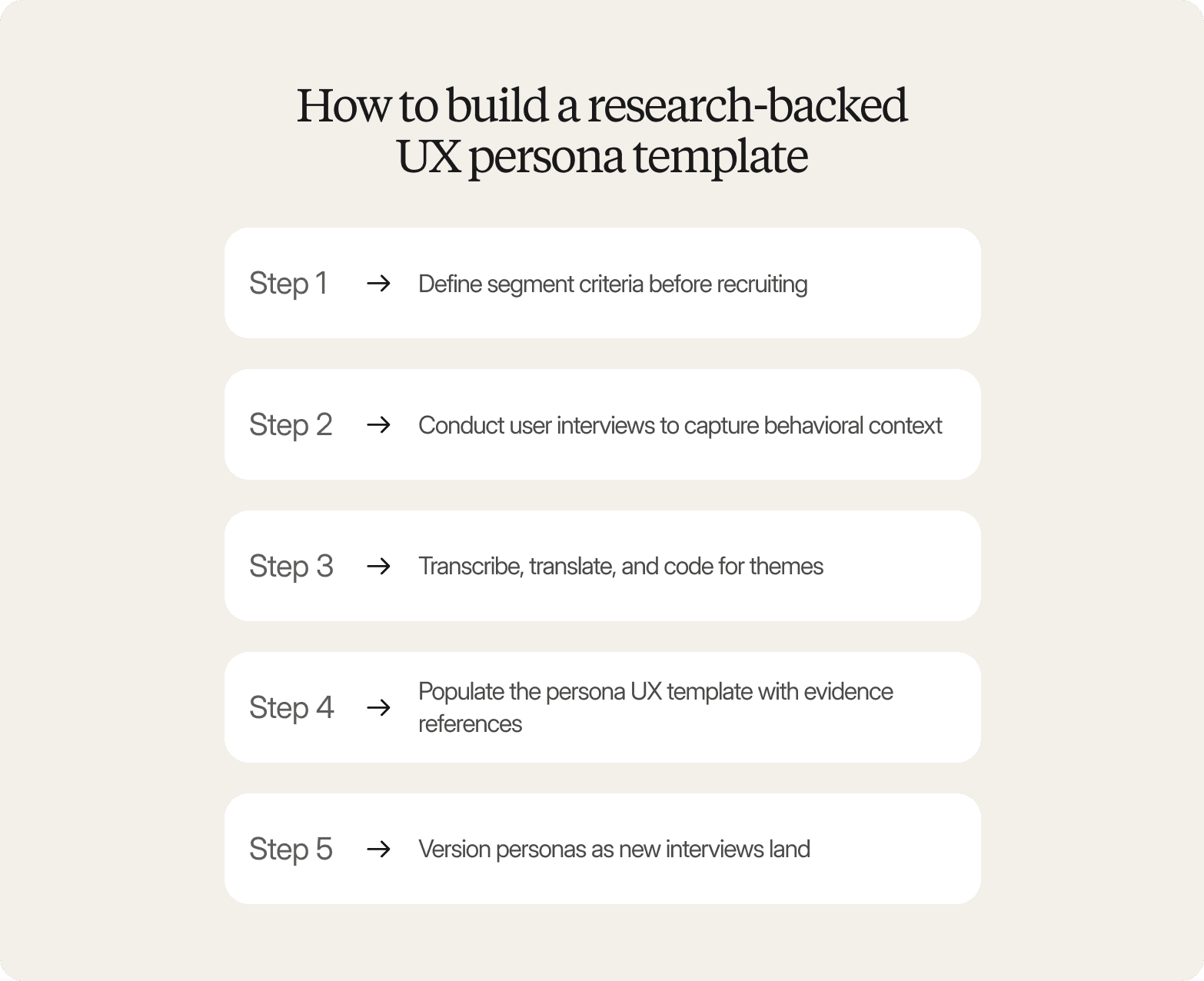
Step 1: Define segment criteria before recruiting
Decide which behavioral segments matter before contacting a single participant. How many user personas a team needs depends on how many distinct behavioral segments they serve. Most products require two to five. Draw segment criteria from analytics data and website behavior, not from internal assumptions. Criteria such as “daily active users who abandoned onboarding” yield a focused sample of potential users with similar traits. For most products, 5–15 qualitative participants per segment are enough to surface reliable patterns, provided segment definitions are set in advance rather than reverse-engineered from whoever shows up.
Step 2: Conduct user interviews to capture behavioral context
Surveys tell you what users say they do. User interviews show hesitation, workarounds, and the moment when a feature name draws a blank. Async AI-moderated user interviews remove scheduling friction entirely: participants join on their own schedule, and the AI moderator probes based on what they actually say. Hundreds of user interviews can run in parallel without adding coordination overhead, capturing qualitative data across your entire user base.
See the AI moderator in action: How AI-Moderated Video Interviews Actually Work

Step 3: Transcribe, translate, and code for themes
Every persona claim needs a source. As sessions land, thematic coding should link each behavioral pattern to verbatim quotes and timestamped video clips. This is where qualitative data turns into the evidence layer that makes personas defensible. If a claim cannot be traced to a real participant moment, it does not belong in the persona. Quantitative analytics data can confirm scale, but only user interviews surface the reasoning behind behavior.
Step 4: Populate the persona UX template with evidence references
Each template field (goals, frustrations, behavioral triggers) should reference the source interview ID and timestamp. Use the persona description to describe what this person actually does, thinks, and experiences, not a list of personality traits invented in a workshop. This is what separates a credible persona from a collaborative fiction exercise.
Step 5: Version personas as new interviews land
Personas should be living documents. When new interview data contradicts a prior assumption, the template updates, building personas that evolve as the product evolves and as users’ expectations shift. Conveo, the video-first AI research platform, supports this workflow end-to-end, from AI-moderated user interviews through automated synthesis with traceable outputs, so teams can refresh personas continuously rather than rebuilding from scratch every quarter.
Continuous persona maintenance: Moving beyond one-time creation
The operational shift that makes continuous persona maintenance realistic is asynchronous AI-moderated interviewing. Instead of coordinating live sessions across time zones, teams send potential users a link they open on their own schedule. Conveo runs those conversations in parallel, supporting hundreds of interviews simultaneously, so persona refreshes across multiple market segments happen without blocking a researcher’s week.
The scale benefit extends across markets. With AI moderation in 50+ languages, teams collecting customer feedback in Germany, Japan, and Brazil don’t face a localization bottleneck before the data is usable. Every person who completes an interview provides evidence describing different aspects of the user experience, from daily-life context to preferred channels and purchasing behavior.
What prevents refreshed evidence from dying in a new deck is the insight library. Every interview, theme, and clip is searchable across studies, so when a product manager or project manager asks whether a persona has shifted since last quarter, the answer comes from traceable evidence rather than memory.
Evidence traceability: Why stakeholders trust video-backed personas
Stakeholders who question a persona mid-roadmap meeting aren’t being difficult. They’re asking a reasonable question: where did this come from?
When a UX persona template is built from real users through genuine user research, every claim has an answer. Conveo ties each persona insight back to timestamped video clips and verbatim quotes, so findings hold up under scrutiny rather than collapsing into “the research team said so.” These are research-based personas that describe the actual person behind the data, not an ideal customer invented from business intuition.
"Real conversations, real emotions, that's what makes Conveo different from every survey tool."
CMI Lead, Edgard & Cooper
The tradeoff between synthetic persona generators and video-first user research is, at its core, a tradeoff between speed and defensibility. Real users, verified by video, produce detailed personas that procurement, legal, and product leadership can inspect and trust. This matters especially when personas inform marketing strategies or feed into buyer personas that marketing managers use to shape audience targeting. Conveo’s SOC 2 certification, GDPR compliance, and EU regional data hosting address the governance requirements that stall research adoption before a study ever launches.
When to use personas vs. JTBD vs. mental models
Each framework answers a different question about different aspects of user behavior. The practical issue isn’t which to use: it’s avoiding separate studies for each.
| Framework | Best used for | Primary question answered |
|---|---|---|
| UX Personas | Segment-specific empathy: shaping marketing strategies, communication, and onboarding for a specific target audience | Who is this user and what drives them? |
| Jobs to be Done (JTBD) | Outcome-focused feature prioritization; most useful when quantitative data shows what users do but not why | What outcome is the user trying to achieve? |
| Mental Models | Workflow logic and information architecture | How does the user expect the product to work? |
| Empathy Maps | Capturing what users say, think, feel, and do at a specific moment | What is this person experiencing right now? |
UX personas foster empathy across the design team and create a shared understanding that a marketing manager, a project manager, and a product lead can all draw on. One set of user interviews can populate all four frameworks. UX persona templates, JTBD maps, mental model diagrams, and empathy maps draw from the same participant language and behavioral signals. Conveo’s insight library makes this reuse structural: clips, themes, and quotes from a single study remain searchable across every framework your team builds next.
4 common UX persona template mistakes to avoid
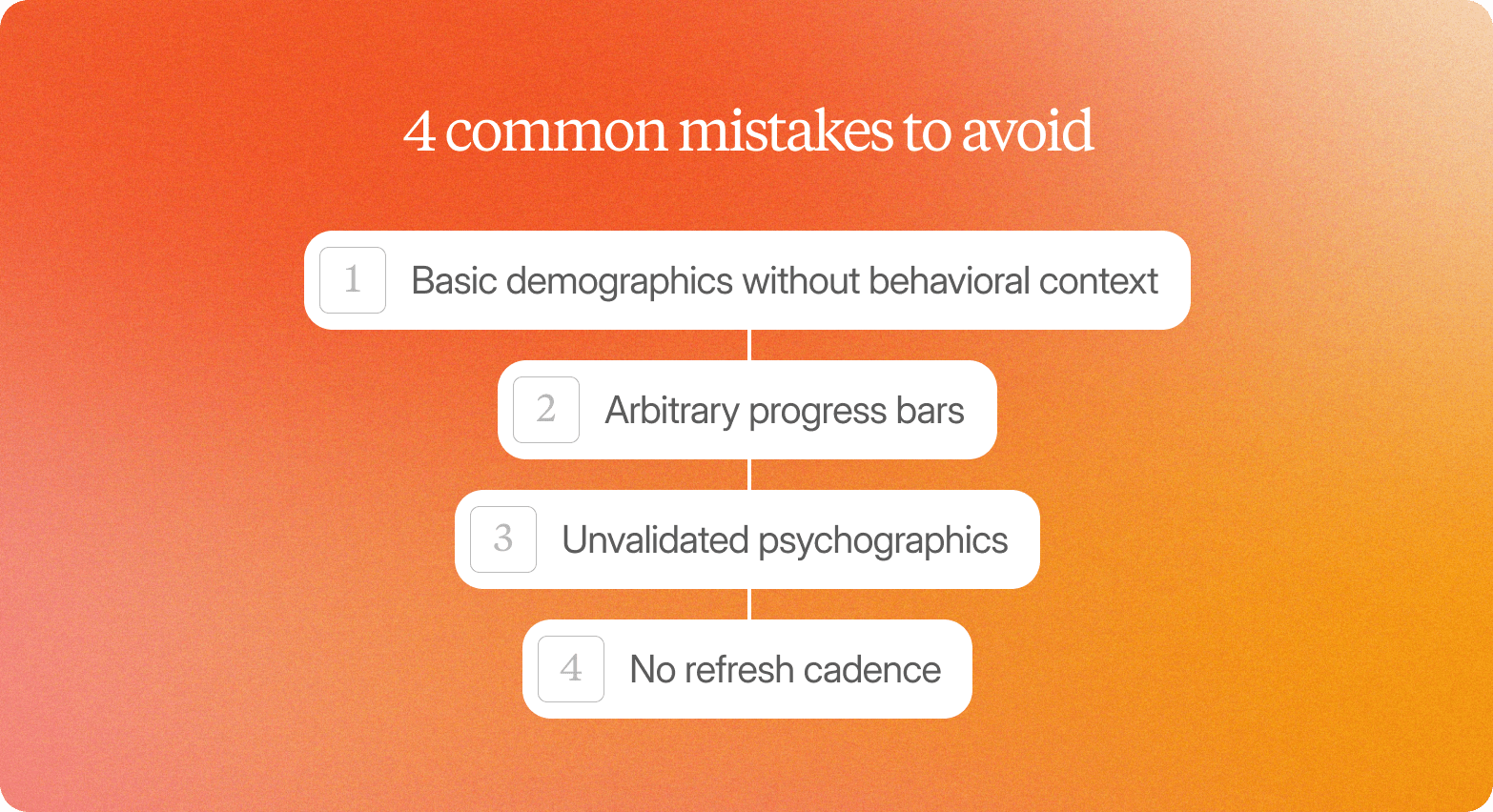
Even experienced teams building a persona template for UX fall into the same traps:
1. Basic demographics without behavioral context
Age ranges, key demographics, and job titles added to look complete, not because they inform a single design decision. A persona description that leads with basic information about where someone lives and what they earn tells the design team almost nothing about how to build for them.
2. Arbitrary progress bars
“Tech savvy: 7/10” with no source. Stakeholders ask where it came from. Nobody knows.
3. Unvalidated psychographics
Personality traits and motivations that sound research-backed but trace back to a team brainstorm rather than real user interviews. Personas describe the actual person behind the data. When teams create personas from invented details rather than customer feedback, they’re building on fiction, not evidence.
4. No refresh cadence
Personas are built once, presented once, and then ignored as the product evolves and the user base shifts.
The consequence is predictable: personas that sit in Confluence while teams make design decisions without them. Research-based personas work differently: every field ties to real users, every claim links to a video timestamp someone can actually inspect.
How Conveo keeps UX personas current
The core challenge with UX persona templates isn’t building them. It’s keeping them accurate as users, markets, and products evolve.
Async AI-moderated user interviews let teams run persona creation and refresh across multiple market segments in days, not weeks, without blocking a researcher’s calendar. Each conversation captures behavioral context through video: the hesitation before a feature name, the workaround a user has invented, the reasoning behind a preference that a survey would never surface. That customer feedback compounds into an evidence layer that the whole design team can access.
Every interview feeds into a searchable insight library where themes, clips, and verbatim quotes build across studies. When a stakeholder challenges a persona claim in a roadmap review, the evidence is traceable to a specific person, a specific moment, a specific video. That traceability converts persona documents from static artifacts into living intelligence that shapes the design process and keeps the entire team aligned on real users.
Frequently Asked Questions
What is a UX persona template?
A UX persona template is a structured document capturing the defining characteristics of a user segment (behaviors, goals, frustrations, and context) organized to guide design and product decisions. Some teams treat a persona as a fictional character representing their target user, but effective personas should be grounded in real user research and describe what actual users do and experience, not invented details. The limitation most teams discover too late is that the template is only as credible as the research feeding it. Effective personas require continuous qualitative data to stay accurate, not a one-time creation.
What should be included in a UX persona?
A well-structured user persona template for UX contains five mandatory fields: Field Purpose Segment definition Establishes who this persona represents, including key demographics and target audience criteria Behavioral patterns with context Shows how users act under real conditions, not just stated preferences Decision-making criteria Tells designers what factors users actually weigh Pain points ranked by severity Distinguishes deal-breakers from tolerated friction Evidence references Cites source interview, sample size, and confidence level for every claim Basic information like role and company size has its place, but only as context for the behavioral evidence. Detailed personas go beyond basic demographics to describe motivations, preferred channels, and the personal frustrations that shape how someone interacts with a product. Demographics without behavioral evidence and psychographics without validation are the two most common ways personas lose stakeholder trust.
How do you create a UX persona template?
Start by defining segment criteria. Then conduct user interviews to capture the depth survey responses that were missed. From recordings, transcribe and code for themes, linking every claim to a verbatim quote or video clip. Populate each field of your UX user persona template with evidence references, then version it as new interviews land. Conveo supports this workflow from AI-moderated user interviews through automated synthesis with traceable outputs, so each persona description connects directly to the source conversation and gives the design team access to the underlying evidence.
Where can I find a free UX persona template?
A free UX persona template with evidence fields, behavioral patterns, pain point severity ratings, and a refresh log is available to download at the top of this article. The structural problem with most free templates isn't the format: it's that they get populated once from survey data, then go stale. Continuous user research, not one-time persona creation, is what keeps personas accurate as users today evolve and the product changes. Conveo keeps personas current by continuously feeding them with real user language from ongoing video-first interviews.
Is there a UX persona template in Word format I can use?
Yes, the template available for download above is in Word (.docx) format, ready to share with stakeholders or upload to your existing documentation workflow. Format matters less than the research feeding it. Conveo produces traceable, video-backed persona insights that populate any template accurately, whether Word, Figma, or a slide deck, and gives the whole team access to the evidence behind every persona field.
Can I use a Figma user persona template?
Figma works well for collaborative persona documentation. The format isn't the limitation. The research inputs are. Every persona insight placed in a Figma file should trace back to real video clips and verbatim quotes, not assumptions about your target audience. The fields in the downloadable Word template above translate directly to any Figma layout.

About the author
Florian Hendrickx
Head of Growth
Florian is Conveo’s Chief Growth Officer, leading growth strategy and go-to-market execution as the company scales. He’s held growth leadership roles at companies like Deliverect, Robovision, and Aikido Security, and brings hands-on experience across marketing, sales, and product.
More by Florian →Qualitative insights at the speed of your business.
Conveo runs AI-moderated video interviews and structures everything they say.