In this article
TL;DR
Video in qualitative research captures what surveys and transcripts cannot: hesitation, tone shifts, facial reactions, and contradictions between what participants say and what they visibly feel, adding depth to data collection that text-based qualitative methods simply cannot replicate.
The bottleneck is not the interview. It is the 40 to 60 hours of manual transcription, qualitative data analysis, and synthesis that follow that push delivery to 6 to 10 weeks.
Automated transcription, AI-driven coding, and multimodal data analysis compress that timeline from weeks to hours, making continuous video research operationally viable.
Stakeholders engage differently with video evidence than with written summaries. Traceable clips organized by theme close the credibility gap that decks leave open, turning research into meaningful insights stakeholders can act on.
Video in qualitative research has always offered something surveys cannot: the moment a participant pauses before answering, the skepticism that crosses their face when they hear a price point, the shift in tone when a brand name comes up. Audio and video recordings in qualitative research capture the layer of meaning that transcripts alone erase: the spoken words matter, but so does everything around them. Unlike focus groups, where social dynamics can suppress individual dissent, video interviews surface the unfiltered reaction. That signal is exactly what product, brand, and CX teams need to make confident decisions.
The problem is not capturing it. The problem is what happens after.
Traditional video qual projects run 6 to 10 weeks from kickoff to insight delivery. By the time findings reach stakeholders, the campaign has launched, the feature has shipped, or the CX decision is already locked. The bottleneck is not the interview itself. It is the hours of manual transcription, session-by-session coding, and synthesis that follow that have forced researchers to choose between running video qualitative studies and meeting decision timelines.
This article covers what video in qualitative research captures, where the research process breaks down, and what changes when that process is no longer manual.
Why Video Matters in Qualitative Research
A written transcript tells you what someone said. It does not tell you that their voice flattened when they described your product's value, that they hesitated before answering a pricing question, or that their expression shifted the moment you showed them a competitor's packaging. Those signals are the "why" behind the answer, and they only exist on video.
Tone shifts, body language, environmental context, and hesitation patterns all sit between the spoken words. Visual cues (the furrowed brow at a price point, the slight lean-in when a concept resonates) exist in the visual data that video records but disappear the moment a conversation becomes textual data. A participant who rates a concept "7 out of 10" and says it is "pretty good" while visibly unconvinced is giving you two different answers at once. Video observation in qualitative research allows researchers to capture that contradiction without relying on what participants choose to report about their own reactions.
Surveys cannot do this. Ratings and open-ends capture stated opinion, not lived response. The moment a participant's expression contradicts their words is invisible in a text field.
Social science research has consistently shown that body language and visual cues carry as much meaning as spoken responses, and often more when the topic is sensitive or socially desirable. The benefits of using video in qualitative research include not just richer evidence but also a level of verifiability that written reports cannot match. Stakeholders who watch visual materials (a participant struggling to articulate a value proposition, or lighting up when a product concept resonates) process that evidence differently than they process a researcher's thematic summary. That verifiability is what makes video evidence more persuasive in stakeholder reviews than even the most carefully written report.
5 Common Video Research Methods
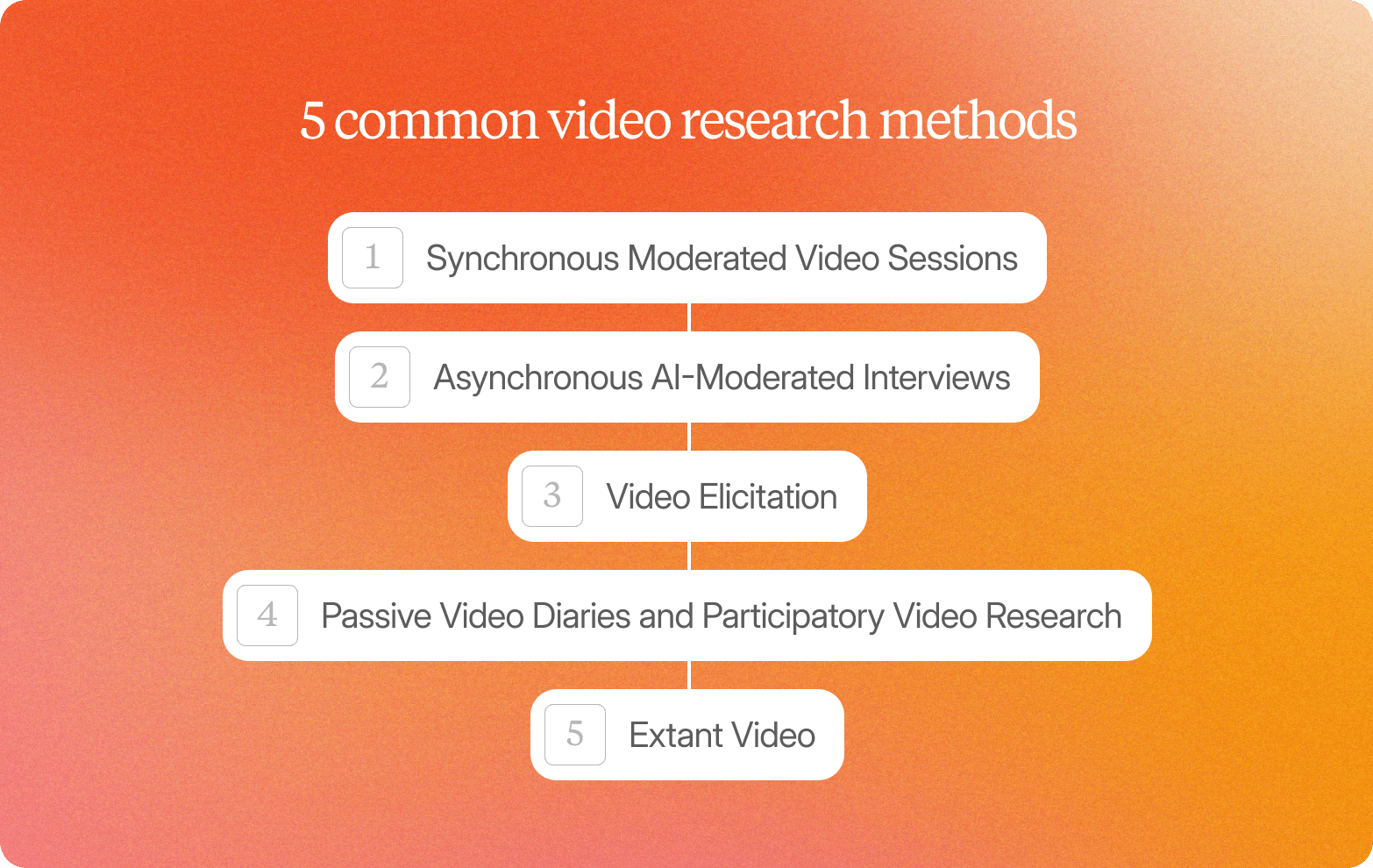
Video methods in qualitative research take different forms, each representing a distinct tradeoff between depth, scale, and timeline. Social science research has long used video technology to capture interaction, context, and human behavior that text-based records cannot preserve.
Synchronous Moderated Video Sessions
Highest conversational depth, but operationally intensive. Video-conferencing interviews in qualitative research allow a skilled moderator to read hesitation, follow unexpected threads, and build rapport that surfaces what participants might otherwise leave unsaid. Sessions use recording devices (laptop webcams, external cameras, or dedicated conferencing hardware) to capture audio data and video simultaneously. The constraint: every session requires coordinated scheduling, a trained moderator, and real-time attention. Running 50 interviews this way takes weeks, not days, and costs scale with headcount.
Asynchronous AI-Moderated Interviews
Scales to hundreds of sessions simultaneously, with no live scheduling required. Participants receive a link and complete the interview on their own time, often on mobile phones or laptops that record both audio and video. The AI moderator adapts based on what each participant actually says, probing where answers are thin. This is the format that platforms like Conveo, the video-first AI research platform, have built around: removing the scheduling constraint while preserving conversational depth through adaptive probing. The tradeoff is that real-time rapport is replaced by structured adaptivity, which works well for most research questions but differs from live human moderation.
Video Elicitation
Structured stimulus-response format, best for concept and messaging tests. Participants view a video segment (a concept, ad, or product demonstration) and then respond to moderator questions prompted by what they have just seen. The stimulus prompts discussion tied to specific moments in the footage, rather than asking participants to recall general impressions. Because the stimulus is identical across all participants, it is particularly effective for concept testing and messaging validation.
Passive Video Diaries and Participatory Video Research
Captures in-context behavior over time, with higher analysis overhead. Passive video diaries, a core method within participatory video research, ask participants to record themselves over days or weeks. This approach to participatory research entails filming people in natural settings, generating participant-generated videos that reflect real environments rather than interview rooms. The user-generated content that results can surface behaviors and routines that participants would never report in a structured interview. The analysis burden is significant (hours of unstructured footage with no interview guide to organize emerging themes), but the behavioral richness is difficult to match through any other qualitative method.
Extant Video
Repurposes existing footage for secondary research. Teams can also draw on extant video: footage already captured from customer support calls, sales discovery recordings, or prior research sessions. The use of existing videos in qualitative research is an underused source of insight, provided the original consent covers their use in research.
The Video Analysis Bottleneck
The operational math is unforgiving:
A 30-minute interview produces 30 minutes of footage that must be watched, transcribed, and coded before synthesis can begin.
A study of 20 participants generates 10 hours of raw recordings.
Manual qualitative data analysis typically runs 40 to 60 hours for an experienced qualitative researcher, and that estimate assumes a single language and a tight discussion guide.
The video analysis in qualitative research is not just time-consuming; it is cognitively expensive. Manual qualitative analysis requires a researcher to hold the full arc of 20 conversations in working memory while simultaneously coding audio and visual data and spoken words. Video recording in qualitative research produces multimodal data (speech, tone, facial expression, body language, environmental context) that no spreadsheet or text-based tool was designed to handle.
The business consequence is predictable: the product sprint closes, the campaign ships, or the pricing decision gets made while the research is still in synthesis. Teams that have experienced this once tend to reach for surveys next time. Surveys return topline results in days, but they cannot explain why customers feel the way they do. That tradeoff is exactly why video in qualitative research has historically been reserved for high-stakes, infrequent projects rather than the continuous discovery that modern product and insights teams need.
How Automated Video Analysis Changes the Workflow
Technological advancements in AI and natural language processing have changed what is operationally practical. Qualitative data analysis software now automates transcription, coding, and thematic synthesis: the manual steps that historically made video content analysis a weeks-long process. Advances in computer vision, speech recognition, and sentiment modeling mean platforms can now analyze image data from individual video frames alongside audio data from recordings, surfacing moment-level reactions that manual scrubbing would miss.
Automated workflows make video data analysis practical at sprint cadence. The significant shift is multimodal data analysis: platforms can now read speech, tone, and visual cues simultaneously, processing visual materials (facial expressions, body movements, environmental context) without researchers having to watch each recording in full. Audio, image, and textual data from transcripts are analyzed together rather than in separate manual passes.
Trustworthiness in qualitative research video depends on whether stakeholders can trace the findings back to their sources. AI summaries that produce conclusions without evidence trails create exactly the kind of "black box" problem that erodes confidence in research outputs. Every theme and every recommendation needs to link to verbatim quotes and video timestamps. That traceability is what converts an AI-generated synthesis into something a CMI director can present to the C-suite.
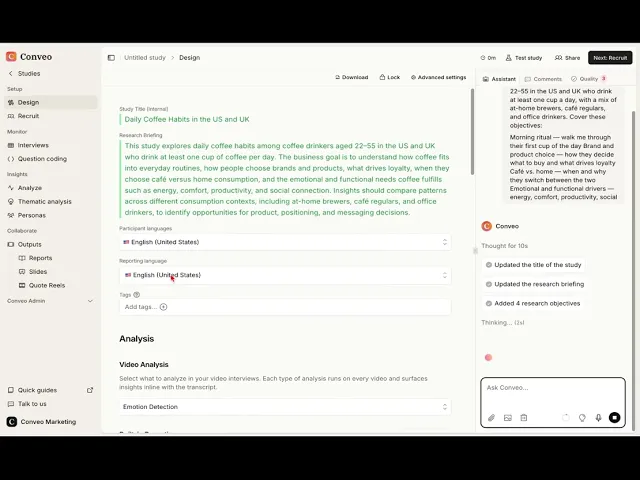
Conveo handles this end-to-end: transcription, coding, and synthesis run as recordings land, with every output linked back to the original video context. Teams can run video in qualitative research continuously rather than reserving it for annual trackers or high-budget concept tests.
Watch: How to Build a Study in Conveo from Scratch→
Video-First Platforms vs. Point Solutions
Three approaches exist for teams wanting to use video in qualitative research, and the differences in operational reality are significant.
Traditional agencies deliver genuine depth. A skilled moderator, a well-recruited panel, and rigorous qualitative analysis produce findings that hold up in front of a C-suite. Practitioner researchers at established agencies bring methodological expertise that adds interpretive rigor to complex qualitative studies. The tradeoff is time: a single study typically runs 6 to 10 weeks from brief to debrief, which limits how frequently teams can run video research alongside faster qualitative methods.
Point-solution transcription and repository platforms solve a narrower problem. They handle what happens after the interview, organizing video segments and transcripts into a searchable archive. But teams still need to manage participant recruitment, fraud filtering, consent flows, moderation, and synthesis separately, leading to tool sprawl and context loss at every handoff.
End-to-end video qual platforms eliminate the connective-tissue problem entirely. Recruitment, AI-moderated interviews, multimodal data analysis, and packaging visual materials by theme for stakeholder sharing all occur within a single workflow. Nothing falls between platforms.
Conveo has confirmed SOC 2 certification, GDPR compliance, and EU regional data hosting as of June 2026, which matters the moment a procurement team gets involved. Compliance credentials are not footnotes; for enterprise buyers, they are often the first filter.
Presenting Video Findings to Stakeholders
Raw footage creates a credibility problem no one talks about. Stakeholders distrust a two-paragraph summary when they know 10 hours of interviews sit behind it. But they will not watch 10 hours of video footage either. That gap is where research findings go to die.
The answer is not a longer deck. It is a different format entirely.
Conveo packages findings as thematic video segments: short, sourced clips organized by the insight they support, each traceable back to the full interview session. A stakeholder reviewing a concept test does not read a summary claiming "participants found the messaging confusing." They watch three people say it, in their own words, with their own hesitation visible on screen. That is a different kind of evidence: meaningful insights anchored in verifiable moments rather than researcher interpretation.
"The video clips make it tangible; it's not just data anymore, it's real people with real emotions."
CMI Lead, Edgard & Cooper
This format is particularly effective when using customer videos in qualitative market research to validate concepts or messaging with brand and marketing teams. A highlight reel that combines spoken words with visible reactions can be shared via email, embedded in a Slack message, or dropped into a presentation deck without requiring a 90-minute debrief. Non-research stakeholders align faster because they see what customers meant, not what a researcher interpreted.
Multi-Market Video Research
Running video in qualitative research across multiple geographies has always required a stack of separate relationships: local recruiters in each market, freelance moderators who speak the local language, translators to make sense of the recordings, and a project manager to keep it all on schedule.
Ethical considerations multiply in multi-market programs. Informed consent requirements, data retention rules, and privacy obligations vary by jurisdiction, and these differences are especially acute for programs involving participant-generated videos stored on non-local servers. For enterprise research programs running across the EU, APAC, and North America simultaneously, local compliance is a foundational requirement, not a footnote.
Platforms with recruitment reach across 50+ markets, automated transcription in 50+ languages, and built-in translation change that calculus. Instead of briefing a new vendor for every research project, a single study runs in parallel across geographies. The use of existing videos in qualitative research is also practical: extant video from prior multi-market studies can be re-analyzed within the same platform using the same coding framework, surfacing patterns that would have remained buried in separate archives.
For European programs, GDPR compliance and EU regional data hosting are not optional considerations. They are procurement requirements. Conveo's infrastructure clears those requirements before legal review begins, removing a barrier that quietly stalls global research programs at many enterprise organizations.
How Conveo Transforms Video Qualitative Research
Every bottleneck this article describes (the weeks of manual qualitative data analysis, the platform sprawl, the credibility gap with stakeholders, the coordination overhead of multi-market qualitative studies) traces back to the same root cause: video research has been operationally expensive relative to the speed at which decisions get made.
Conveo, the video-first AI research platform, resolves that directly:
AI-moderated interviews run asynchronously with hundreds of participants in parallel
Qualitative data analysis software handles transcription, coding, and thematic synthesis as recordings land
Multimodal data analysis captures tone, hesitation, and non-verbal cues alongside transcripts
Every theme links to verbatim quotes and timestamped video clips, so stakeholders can verify findings for themselves
A searchable knowledge library compounds insight across studies, so prior research informs every new project
SOC 2 certified, GDPR compliant, with EU regional data hosting
The result is not faster research for its own sake. It is meaningful insights that arrive while the decision is still open, backed by evidence that stakeholders can inspect.
Frequently Asked Questions
What is a video in qualitative research example?
A CPG brand tests three new packaging concepts with 50 participants in a single research project, running asynchronously over three days. Each participant views the concept on screen (a video elicitation setup where the stimulus prompts discussion tied to specific moments in the footage), then responds to an AI moderator that probes based on what they actually say, not a fixed script. Reactions are captured on video, including hesitation, surprise, and skepticism that textual data alone would miss. Conveo transcribes, codes, and clusters every session automatically, packaging video segments by reaction type within hours of the final interview. Findings will be in five days. A traditional agency running the same study would typically require six weeks.
What are the types of video in qualitative research?
The main types of video in qualitative research are synchronous moderated interviews, asynchronous AI-moderated interviews, video elicitation, and participatory video research methods, including passive video diaries. Synchronous sessions deliver real-time depth but require coordinated scheduling, which limits scalability. Participatory research through video diaries captures longitudinal behavior in natural settings, though the unstructured footage creates significant analysis overhead. Video elicitation uses a specific video segment as a stimulus, prompting discussion tied to observed moments rather than general recall. Asynchronous AI-moderated interviews remove the scheduling constraint entirely: participants join on their own schedule, the AI moderator probes adaptively, and hundreds of sessions run in parallel. For UX and product research teams running qualitative studies across multiple sprints, AI-moderated video is the format that makes continuous discovery operationally feasible without sacrificing conversational depth.
How do you analyze video qualitative data?
Video analysis in qualitative research traditionally follows a linear, labor-intensive path: watch recordings, transcribe responses, apply a coding framework, identify themes, and synthesize findings into a structured output. For a study of 20 interviews, which involves roughly 40 to 60 hours of qualitative data analysis work. Deeper analysis using frameworks such as grounded theory, thematic analysis, or discourse analysis adds further cycles of interpretation. Qualitative data analysis software significantly compresses that cycle. Transcription runs as recordings land. Coding against a predefined framework happens in parallel across all sessions. Thematic synthesis surfaces patterns across the full complex data set in hours rather than days, freeing qualitative researchers to focus on interpretation rather than extraction. Non-verbal cues (a furrowed brow, a change in tone, a hesitation) become findable signals rather than lost ones. One requirement holds regardless of method: every theme must trace back to verbatim quotes and video timestamps. Stakeholders who cannot inspect the source evidence behind a finding will not act on it.
What are the benefits of using video in qualitative research?
The benefits of using video in qualitative research fall into three categories: richer evidence, deeper analysis, and stronger stakeholder credibility. Video captures non-verbal cues that surveys miss: a hesitation before answering a price question, a shift in tone when a competitor is mentioned, a furrowed brow at a product concept. Social science research has consistently shown that body language and visual cues carry as much meaning as spoken words, and often more when the topic is sensitive or socially desirable. Stakeholders who can watch a participant's reaction in their own words are far less likely to question the interpretation than stakeholders reading a researcher's summary. That verifiability closes the credibility gap left by written reports, converting audio and visual evidence into meaningful insights that drive decisions.
How do you ensure trustworthiness in a qualitative research video?
Trustworthiness in qualitative research video depends on two things: methodological traceability and governance infrastructure. Stakeholders distrust AI-generated summaries they cannot verify, so every theme and recommendation must link directly to verbatim quotes and video timestamps. Ethical considerations around informed consent are foundational: participants must understand how their recordings will be used, stored, and analyzed before they agree to take part. Ethical issues around data retention and cross-border transfer are especially acute for international programs, where participant-generated videos may be stored in jurisdictions with different privacy frameworks. For procurement teams evaluating platforms, SOC 2 certification, GDPR compliance, and EU regional data hosting are the gatekeepers that determine whether a platform can be approved at all.
Can you use existing videos in qualitative research?
Using existing videos in qualitative research is not only possible. It is an underused source of insight. Customer support calls, user-generated content from social channels, and prior research sessions often contain rich behavioral data that teams have already paid to capture. Analyzing extant video footage for themes, recurring objections, or emotional signals is a legitimate secondary research method. Discourse analysis of existing call recordings, for example, can surface language patterns and objection clusters that inform a new study design before a single new interview is fielded. The constraint is consent: original recordings must have been captured with participant permission that covers research use. Without that, the footage cannot be ethically repurposed.
About the author
Anna Sharp
Client Growth Manager
Anna got into market research by asking the CEO of one of the largest agencies in the world out for a juice. Eight years on she is an ethnographer who backs methods she believes in. She runs studies with media and consumer clients, including the one that went from a Friday-morning brief to a finished project by Saturday.
Meet Anna on film →Qualitative insights at the speed of your business.
Conveo runs AI-moderated video interviews and structures everything they say.